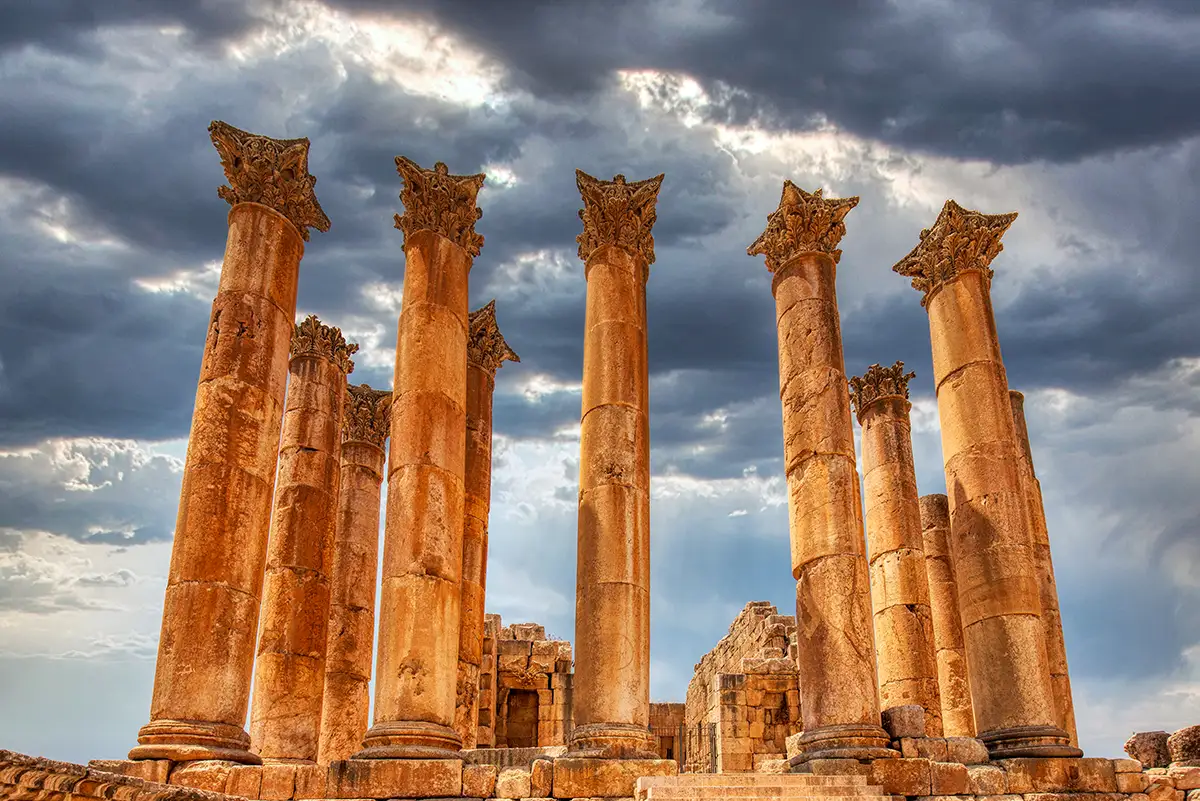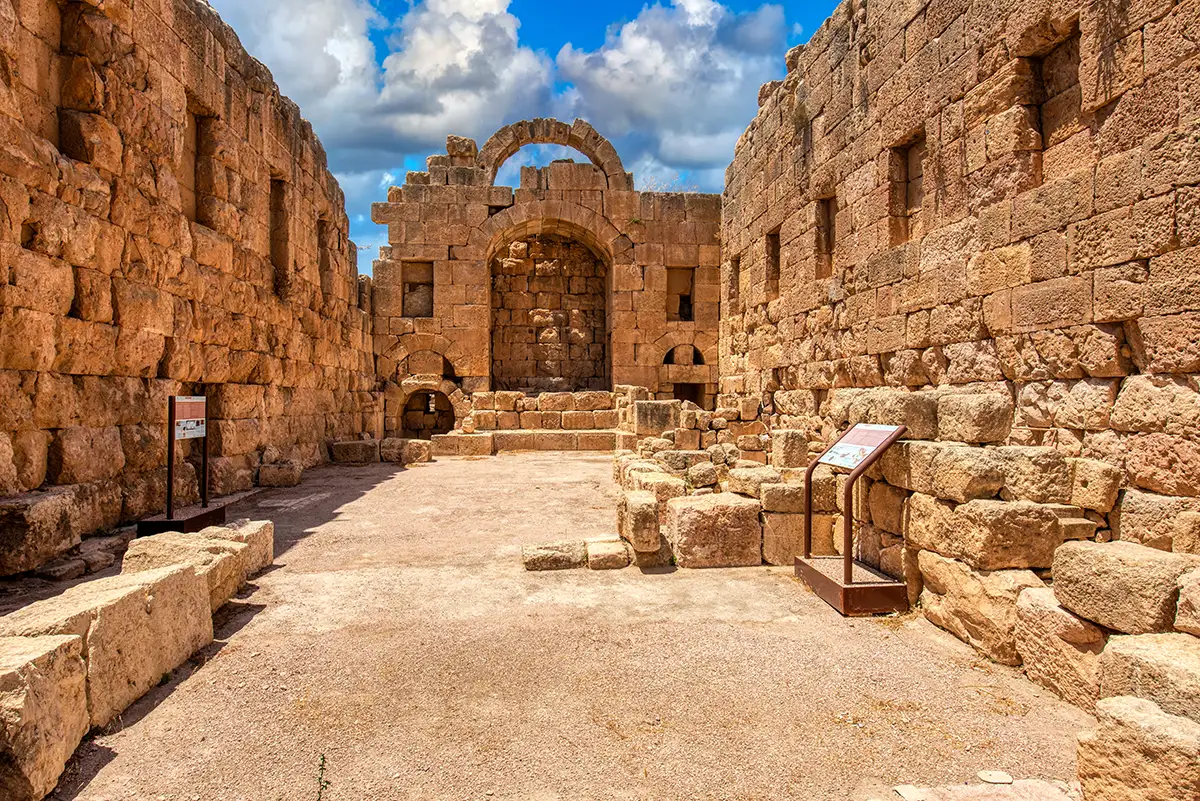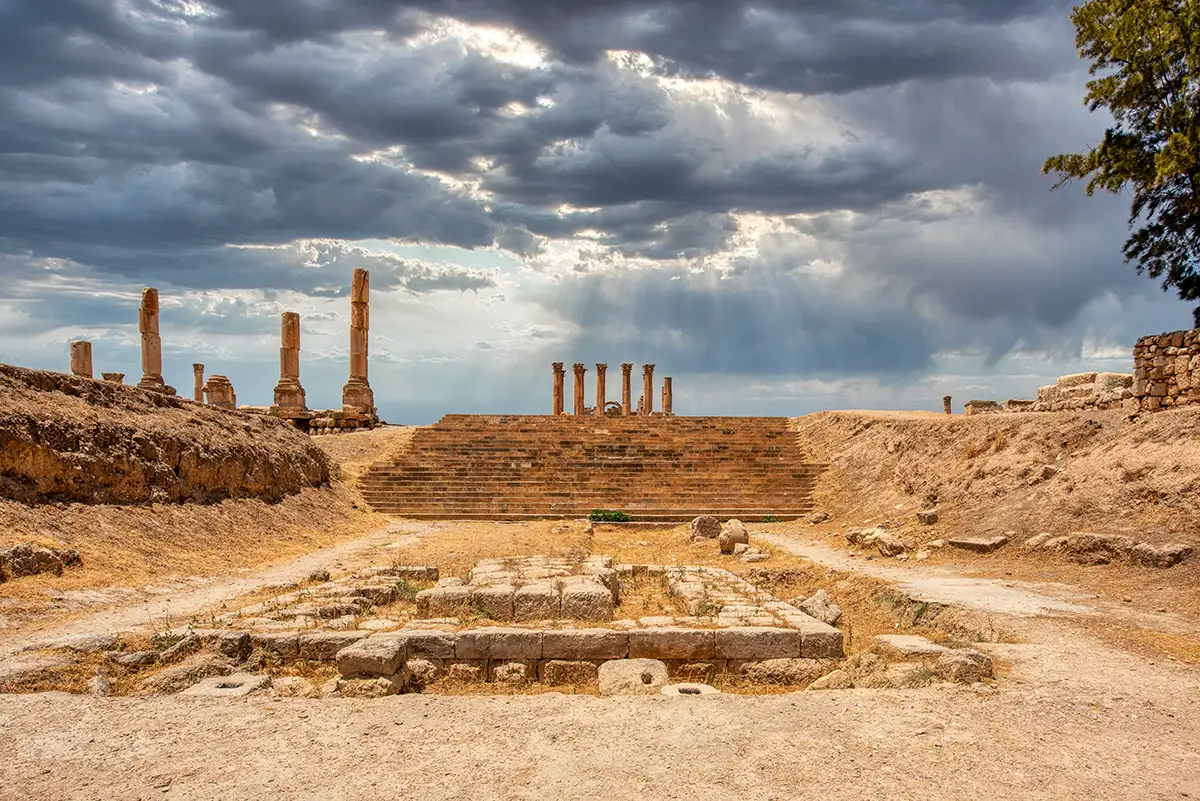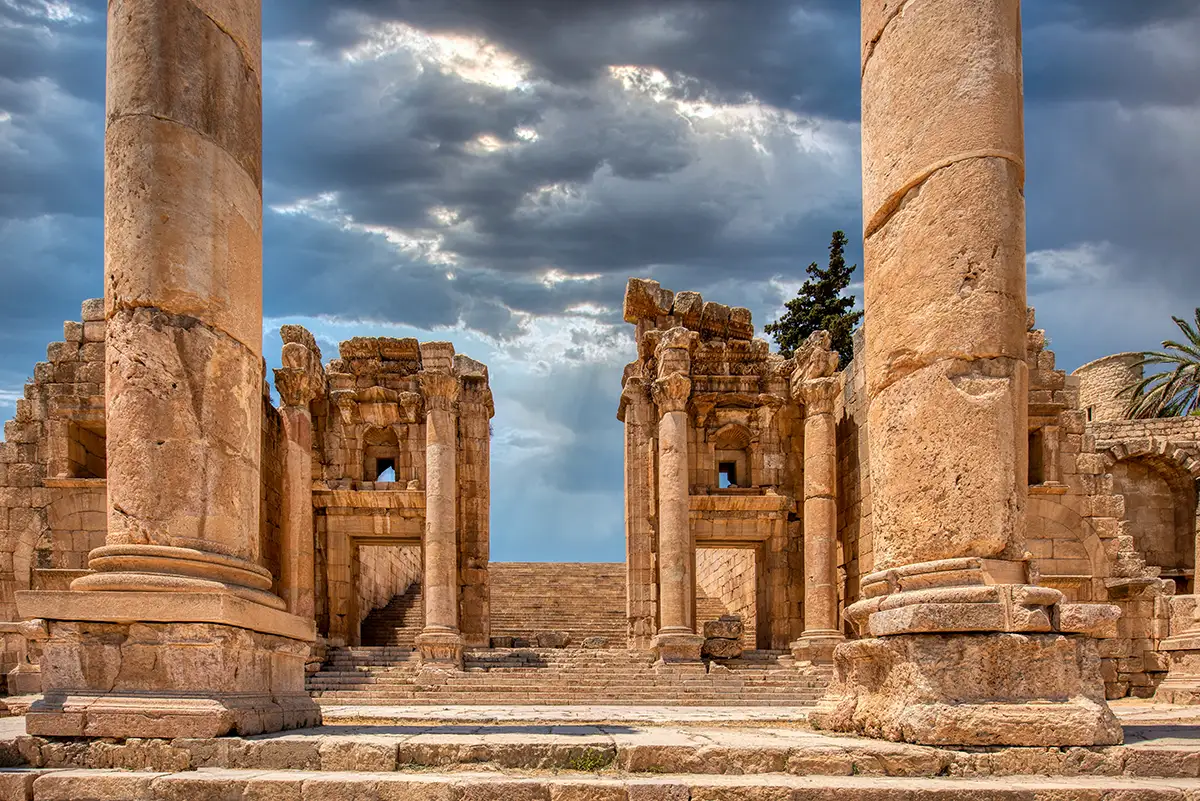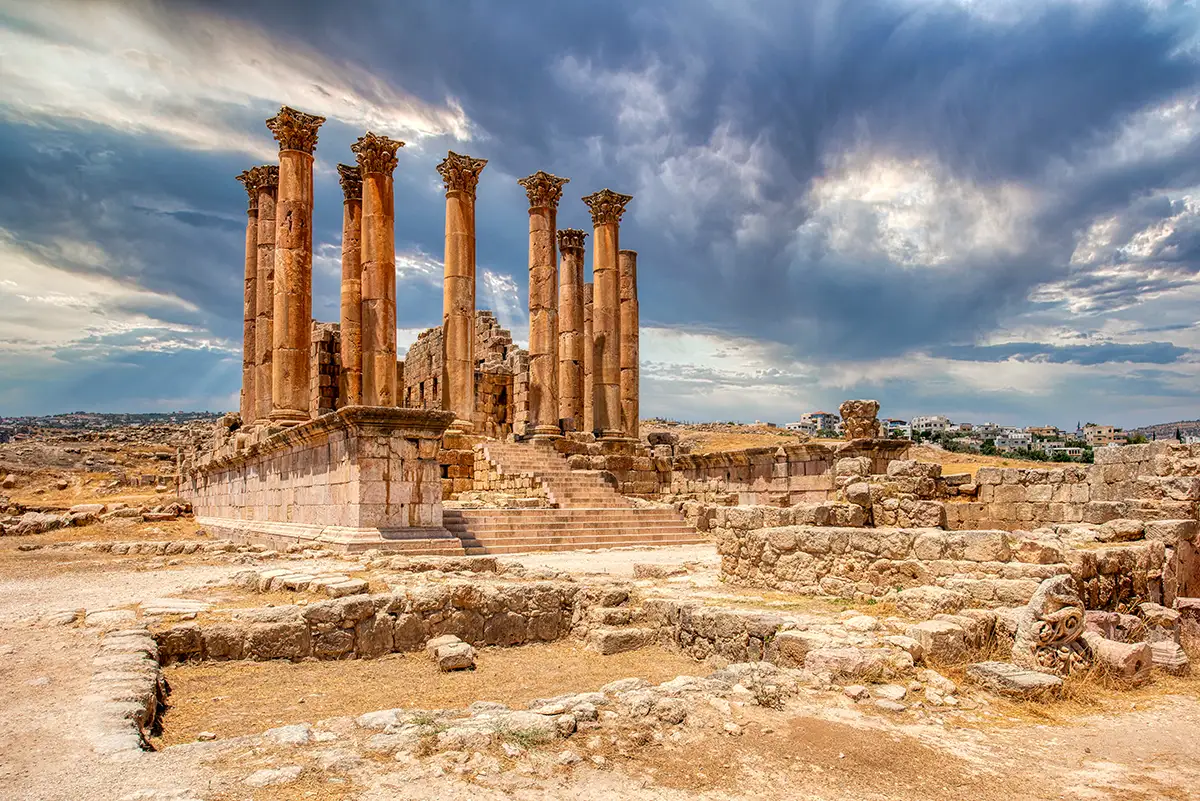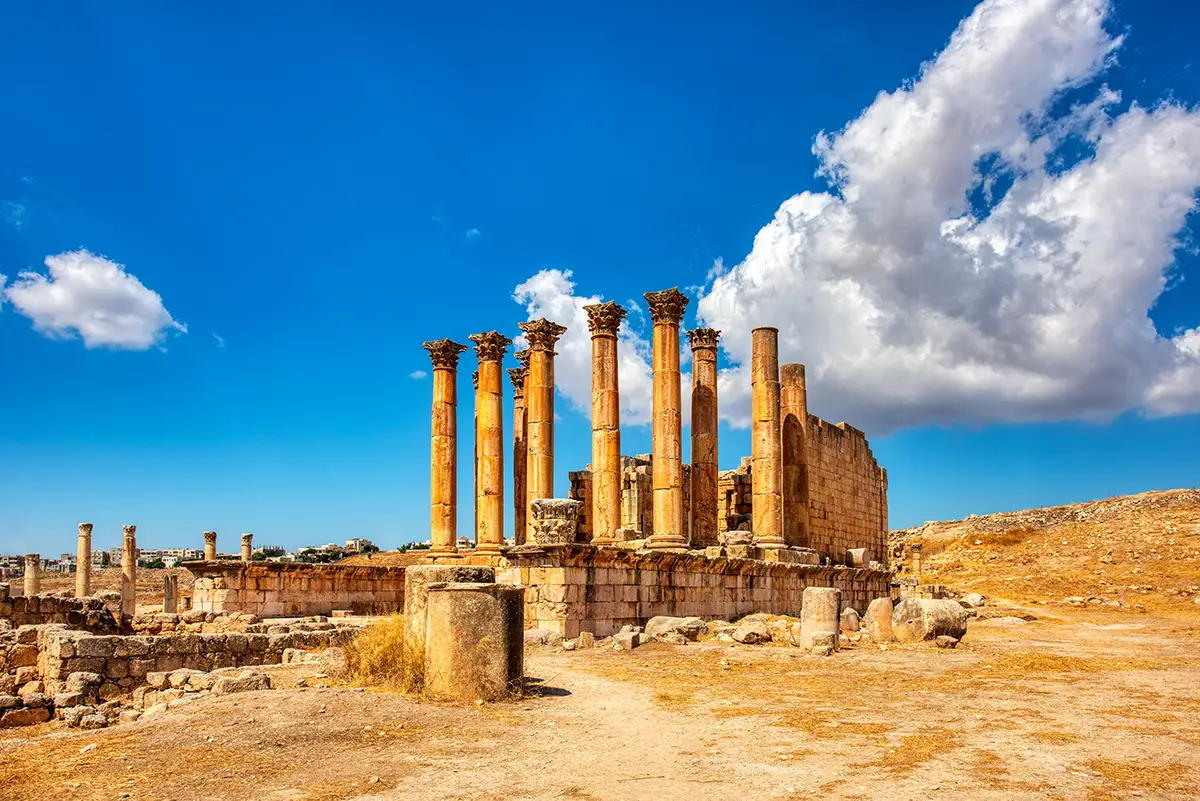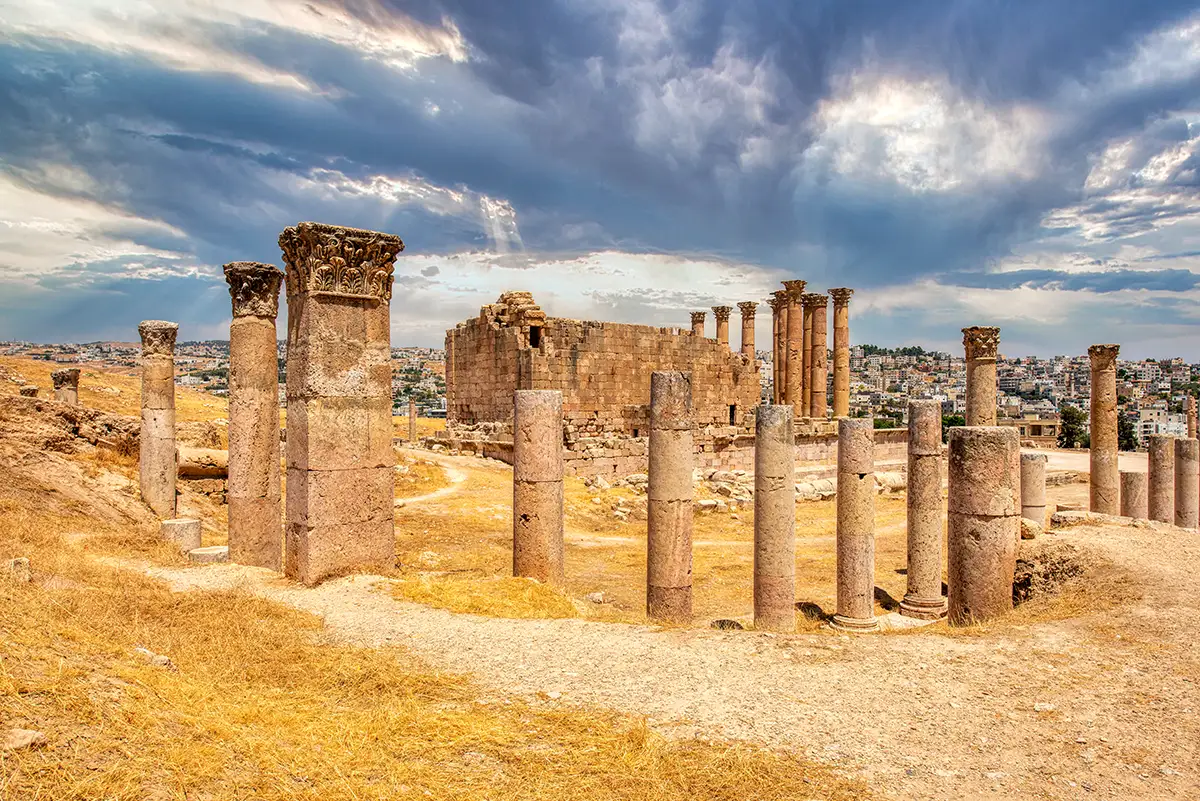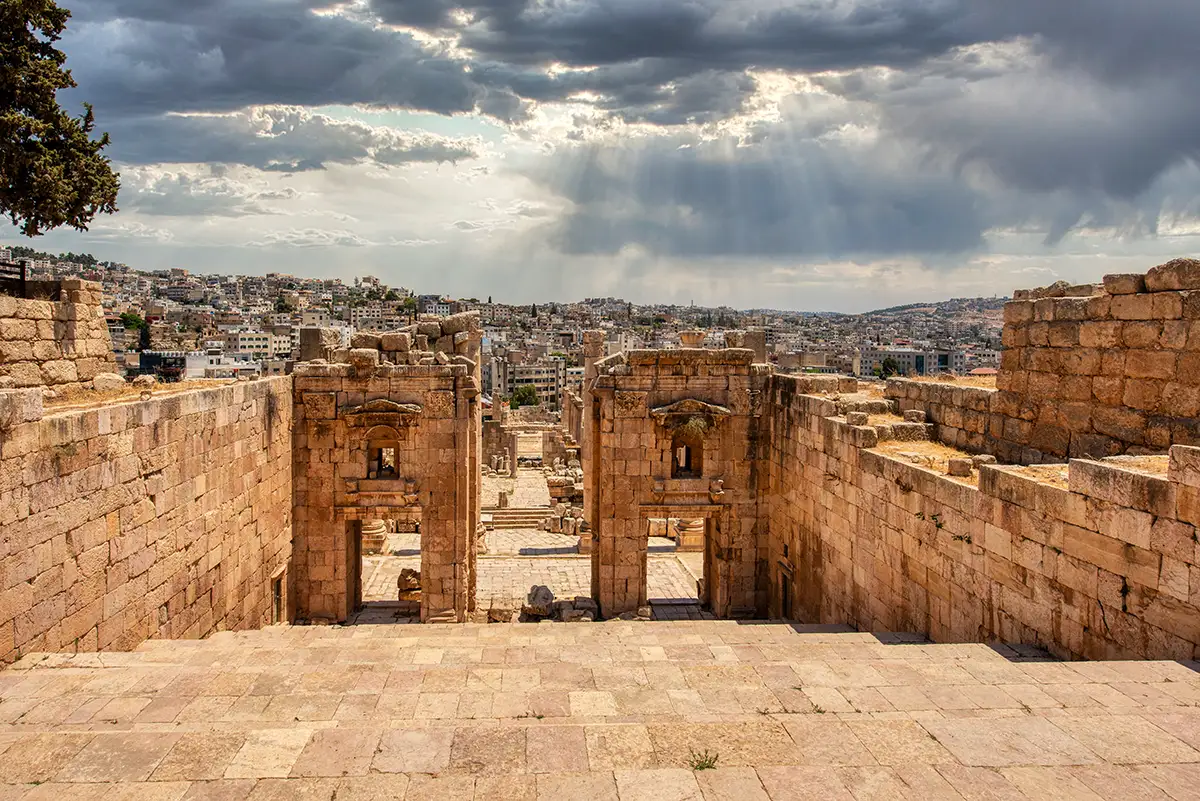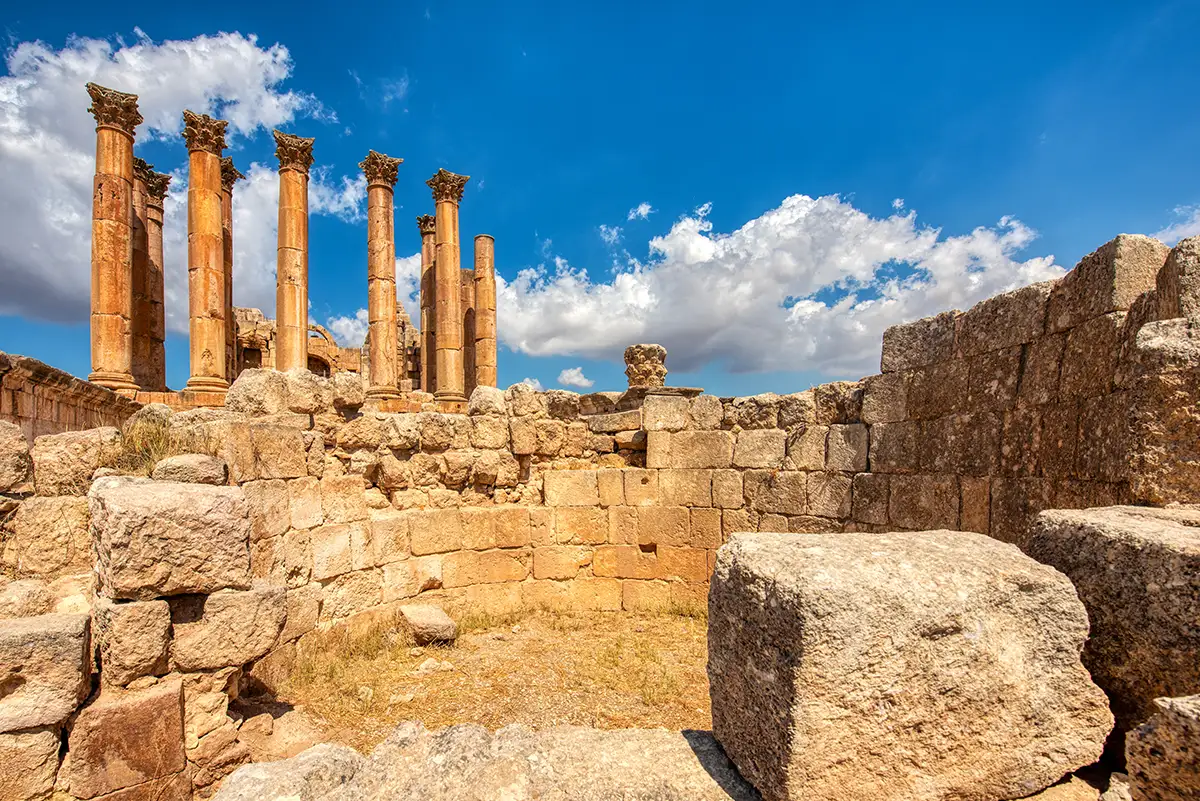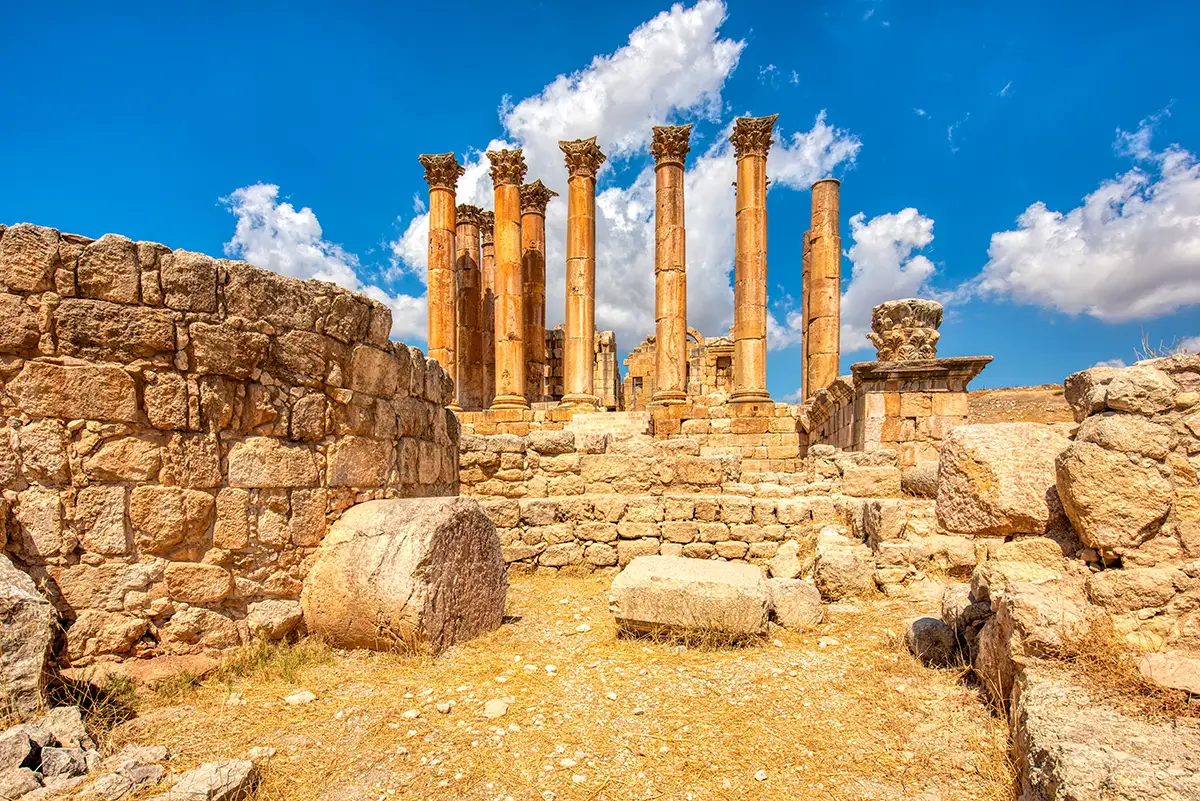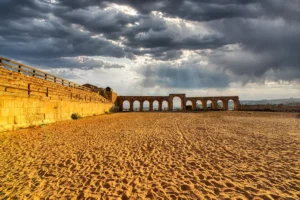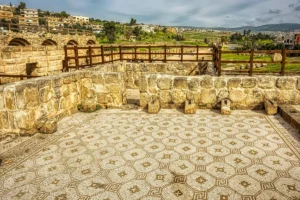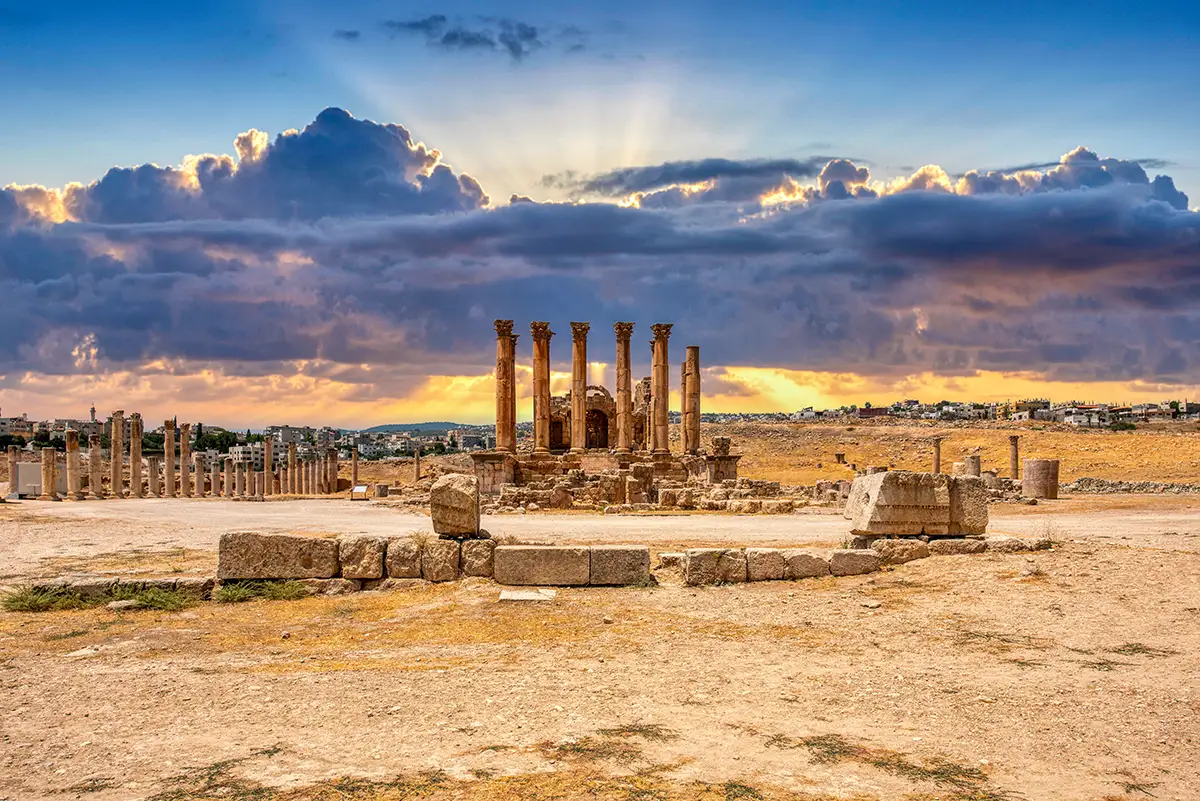
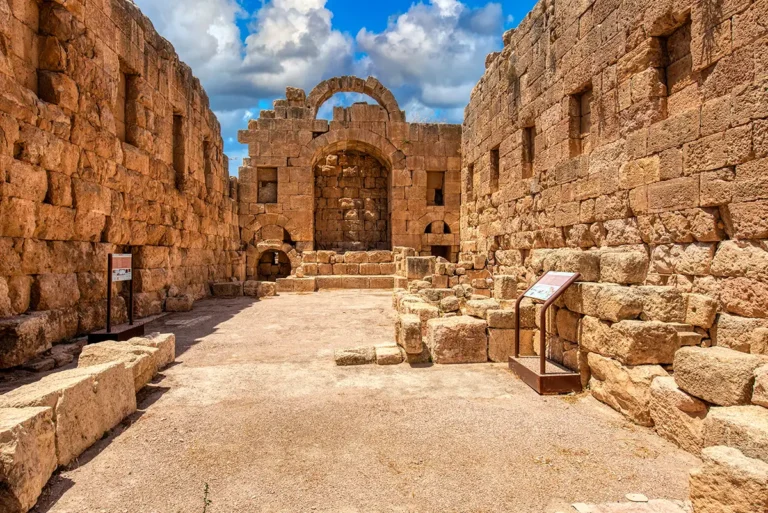
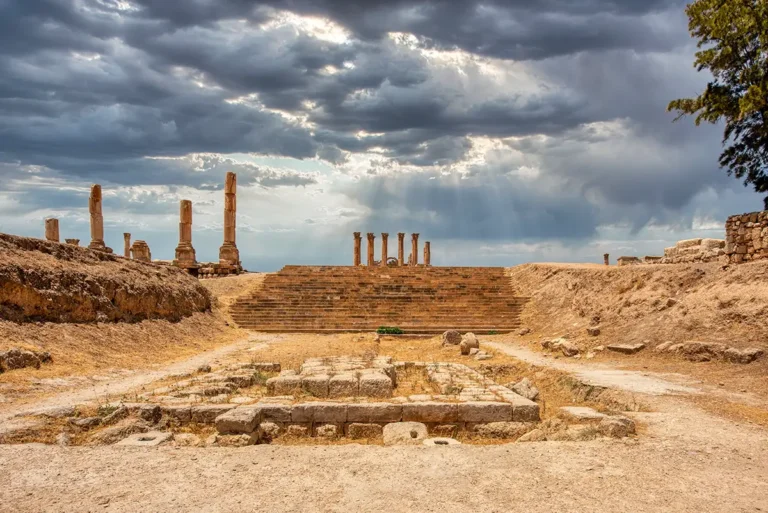

High above the Cardo Maximus, the Sanctuary of Artemis was the greatest sacred precinct of ancient Gerasa, built for the city’s patron goddess. It was designed as a journey: through a monumental gateway, up terraces and stairways, past altars and courts, to the great temple at the top — whose tall columns are still the most famous sight in Jerash.
Where Is the Sanctuary of Artemis?
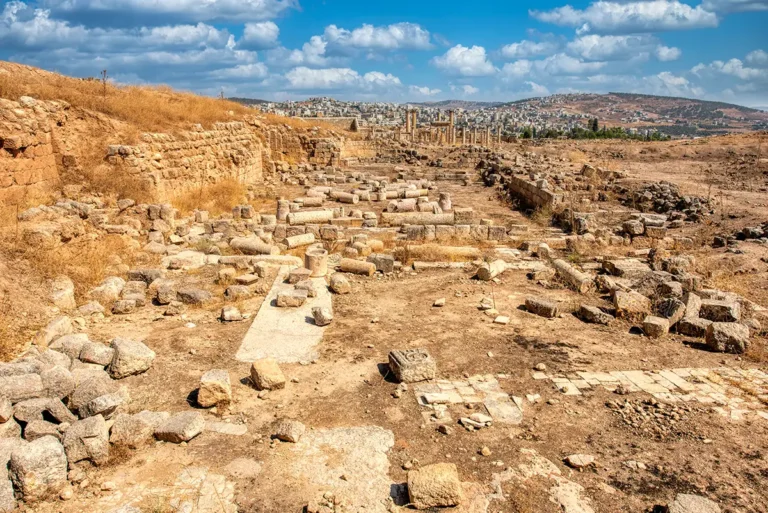
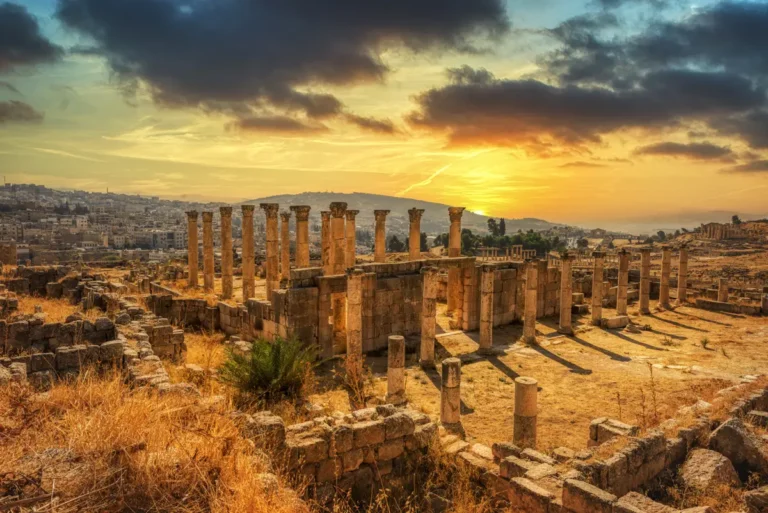
The sanctuary rises on high ground west of the Cardo Maximus, north of the Cathedral and the Church of St Theodore. Its gateway opens onto the Cardo beside the Nymphaeum, and opposite it lies the Church of the Propylaea, built in the old approach from the east.
From the upper terrace there are wide views over the colonnaded streets, the churches and the modern town.
Historical Context and Origin
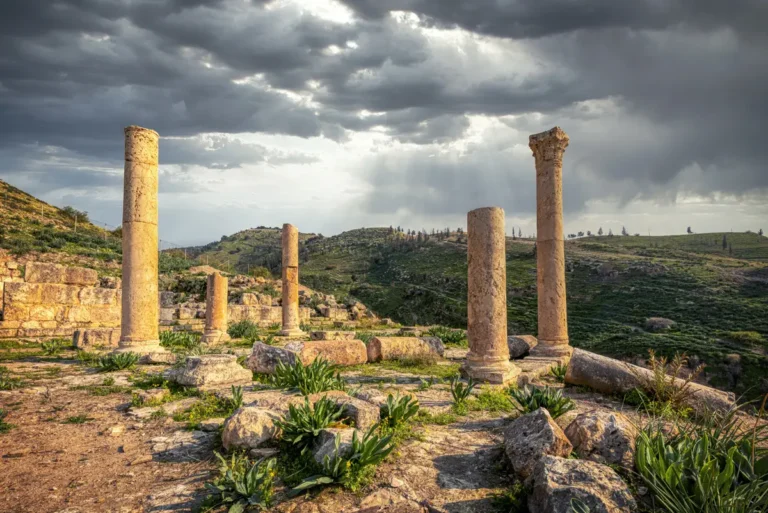
Artemis was Gerasa’s protector long before the Romans, rooted in older local cults. In AD 150 the city dedicated the monumental gateway and its colonnade, and over the following decades the gate, courts, altar, grand staircase and temple turned the hillside into a sacred route. In the late 2nd or early 3rd century work on the temple stopped: only 12 of its 32 planned columns were ever raised.
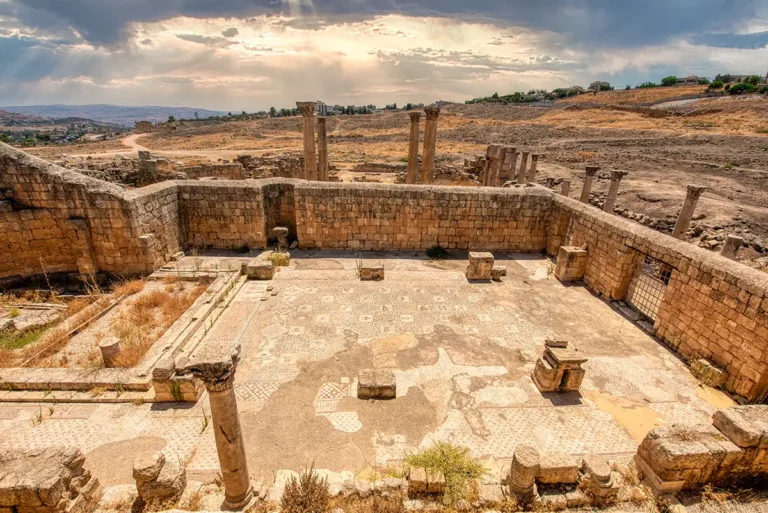
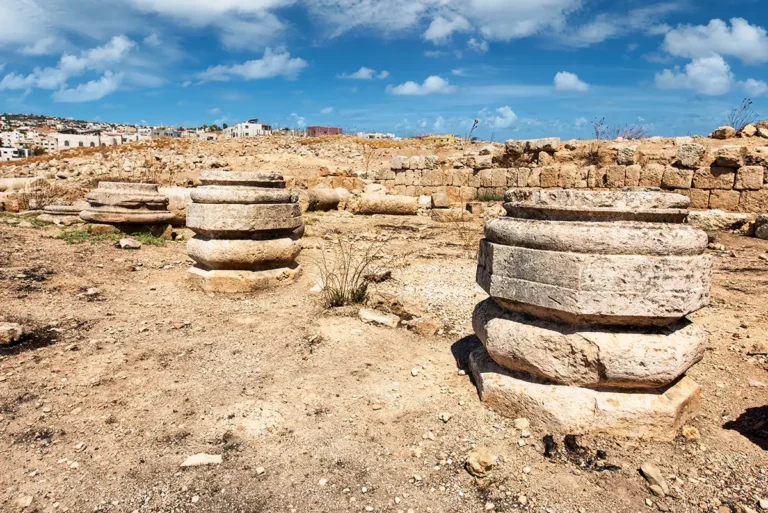
By the late 4th century, with Christianity dominant, the cult of Artemis came to an end. In the 5th and 6th centuries workshops and stone-cutters moved into the precinct — among them the Hydraulic Stone Saw — and in the Umayyad period potters worked inside the former temple.
Architectural Design
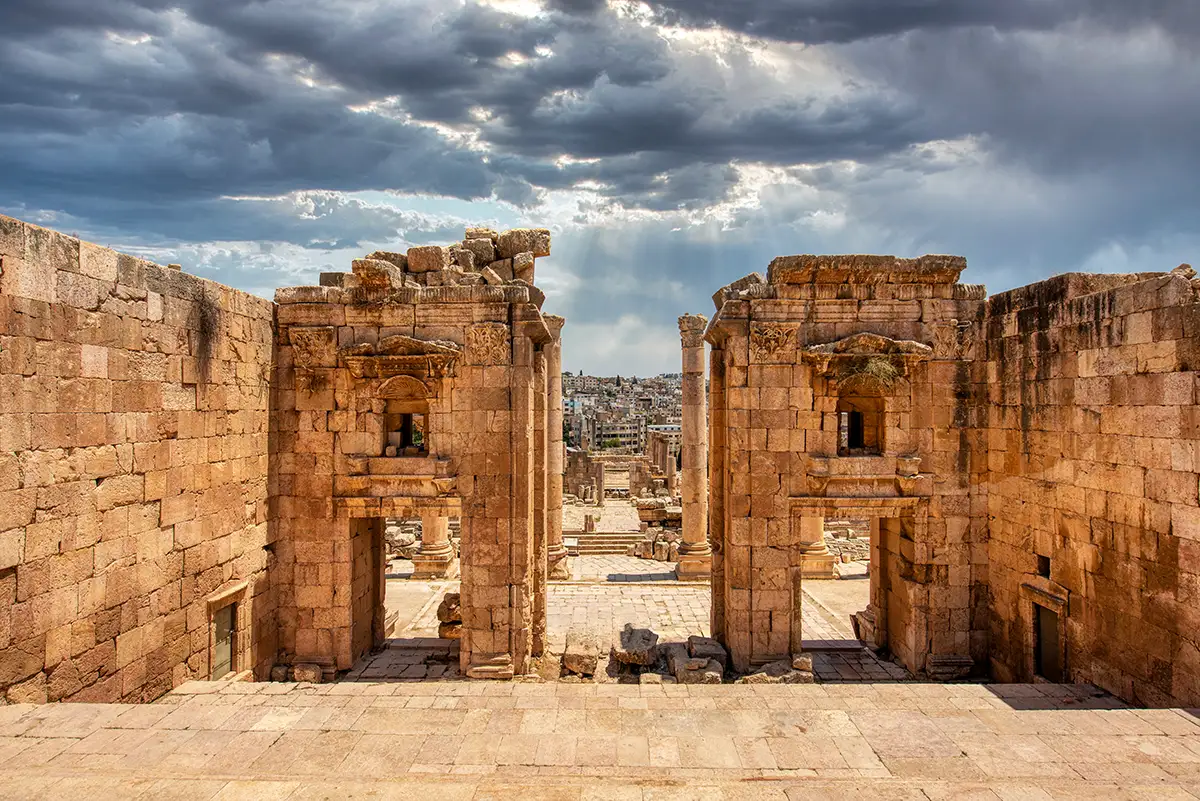
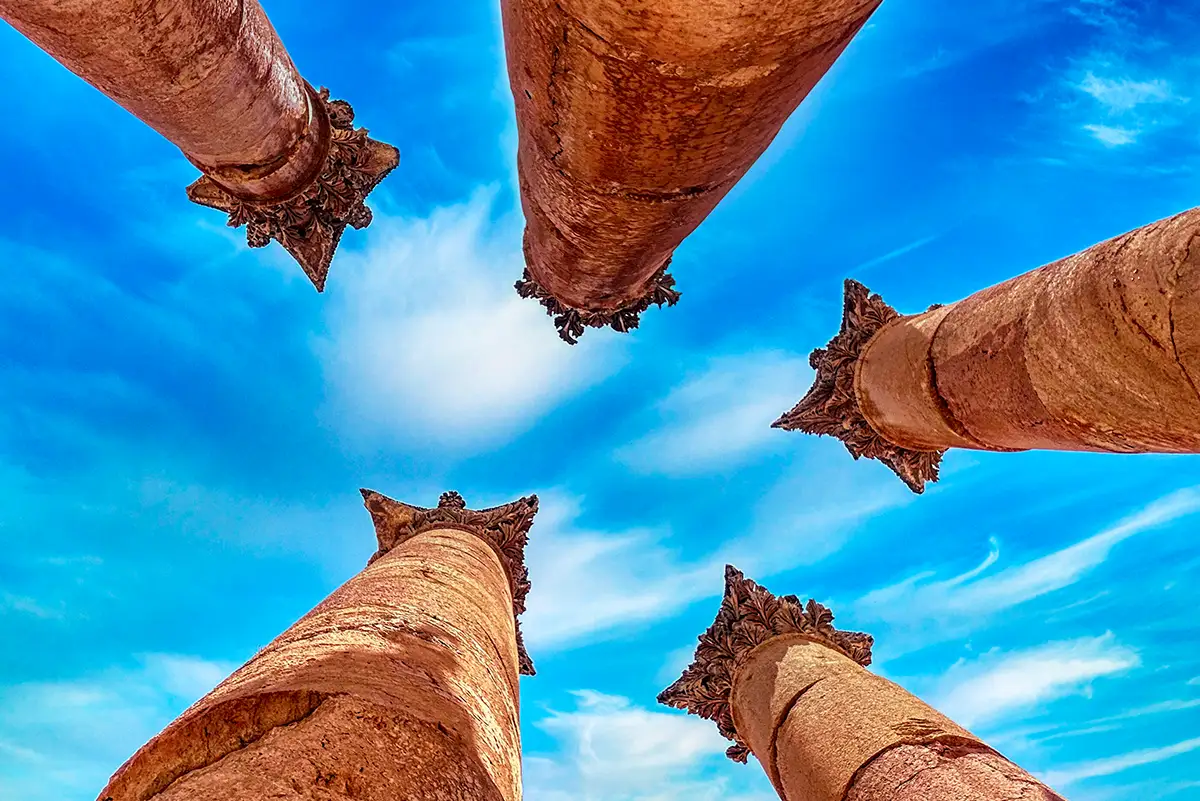
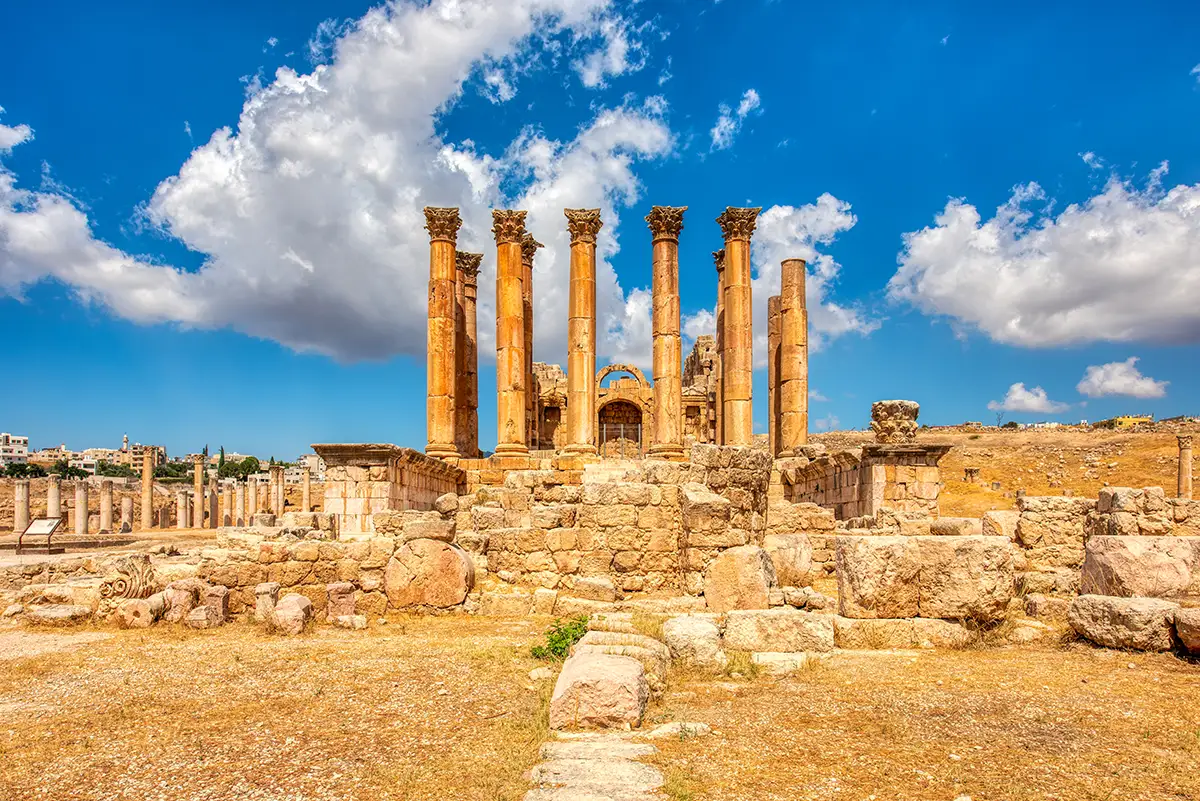
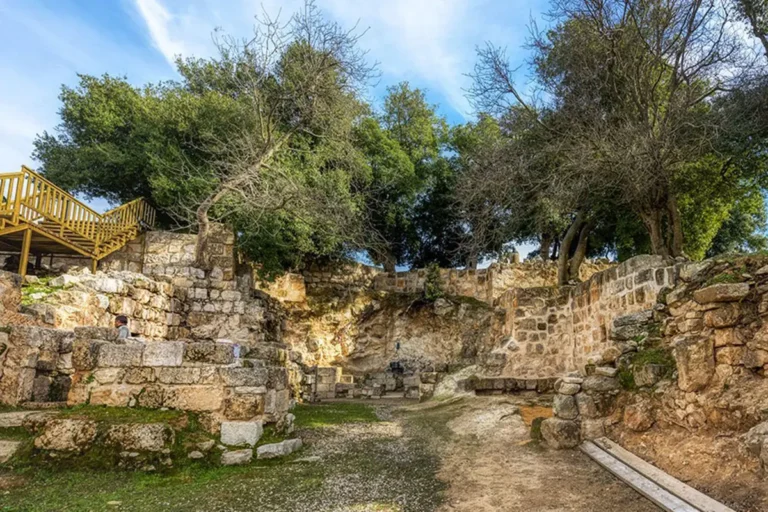
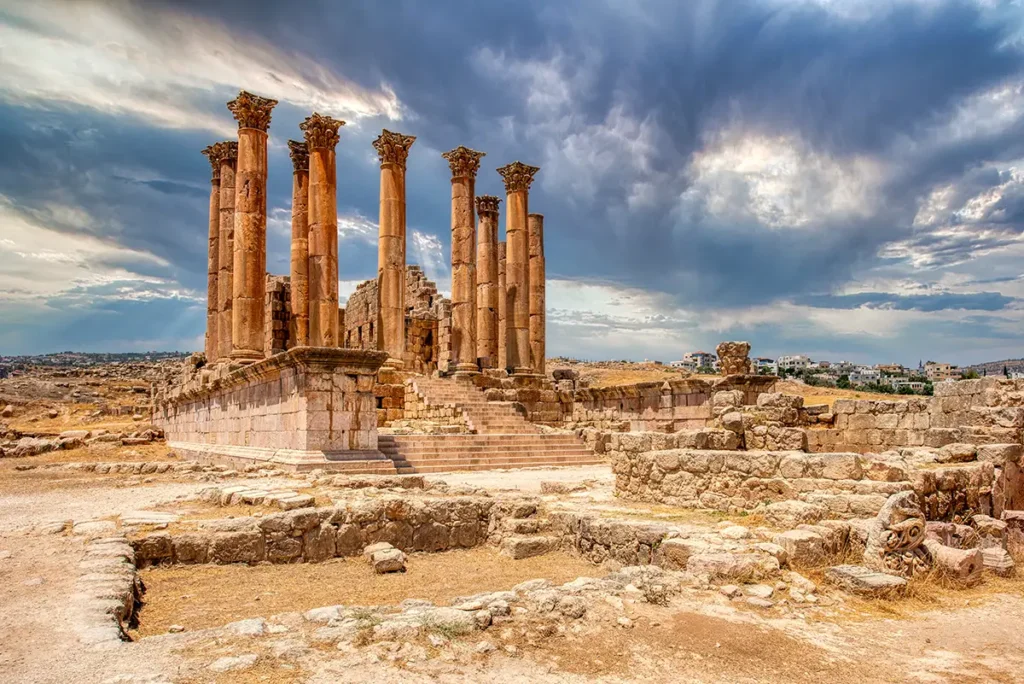
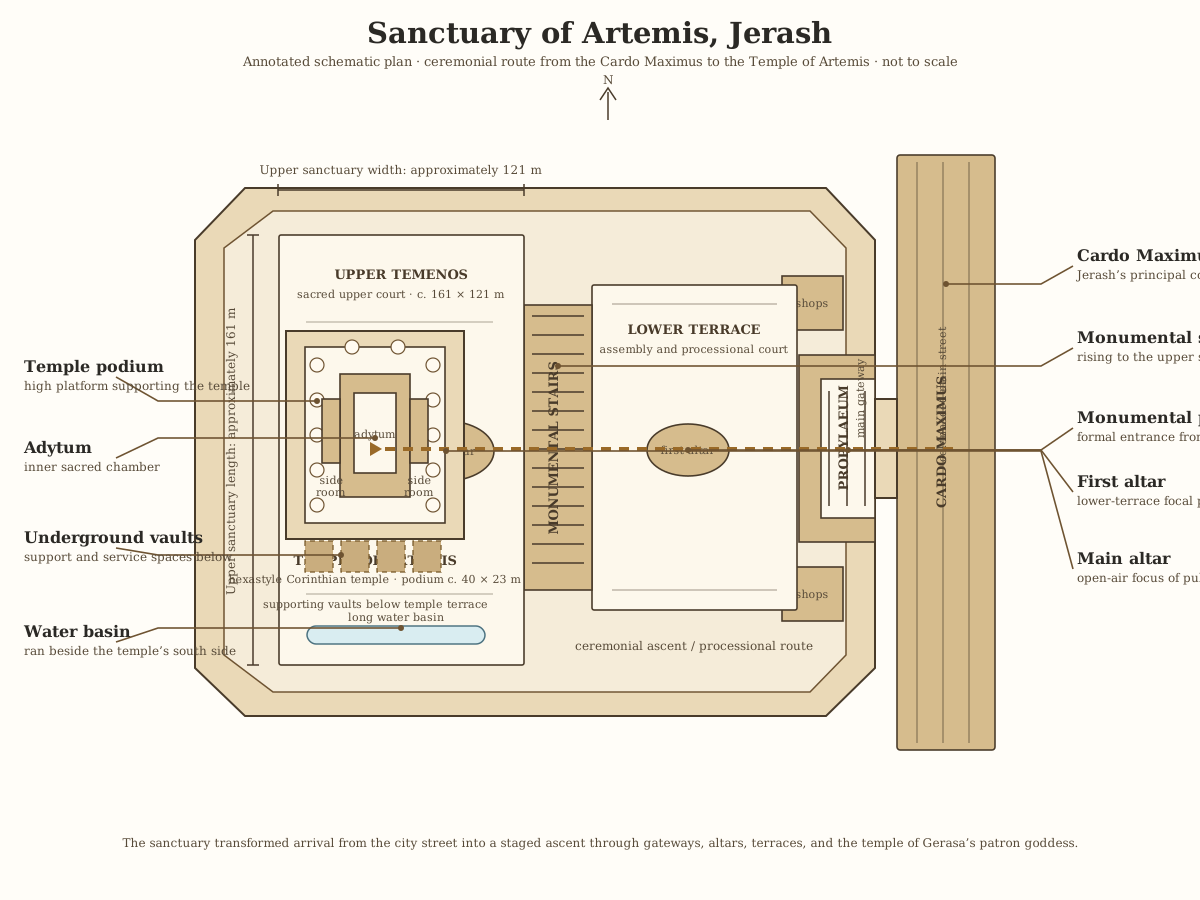
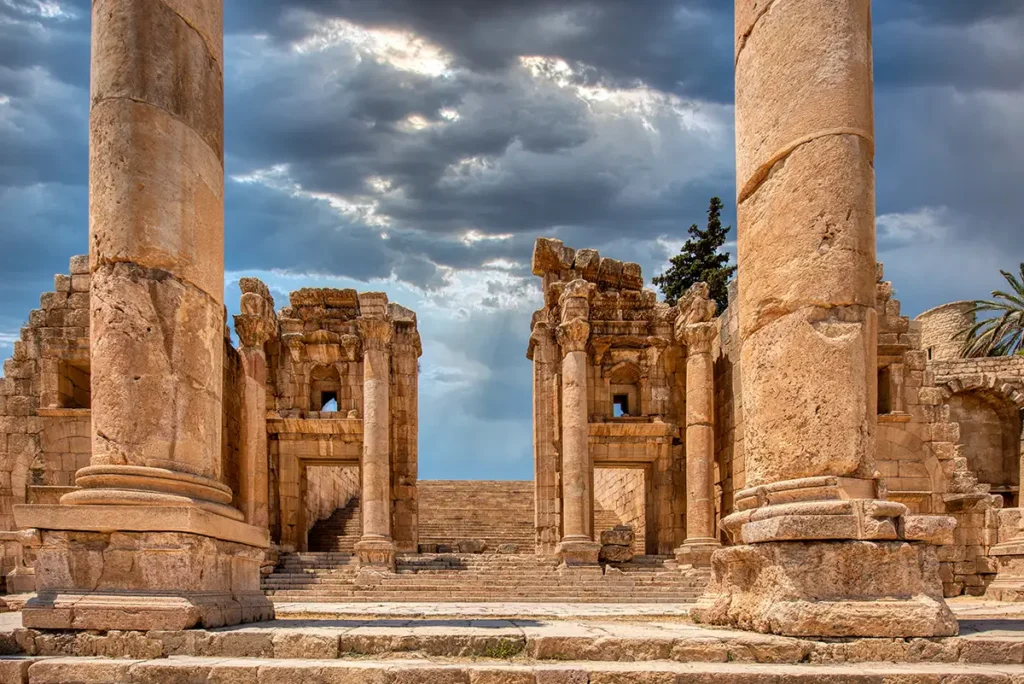
The route began at the propylaeum on the Cardo, a gateway with four great columns and a pediment, flanked by shops. Beyond it lay a lower terrace with an altar, then a grand staircase climbing to the upper court, about 161 by 121 metres, with the main altar before the temple. The temple stands on a podium about 40 metres long, 23 metres wide and 4 metres high, with six Corinthian columns across its front. Behind its deep porch, the inner sanctuary held the cult image of the goddess.
The Propylaeum
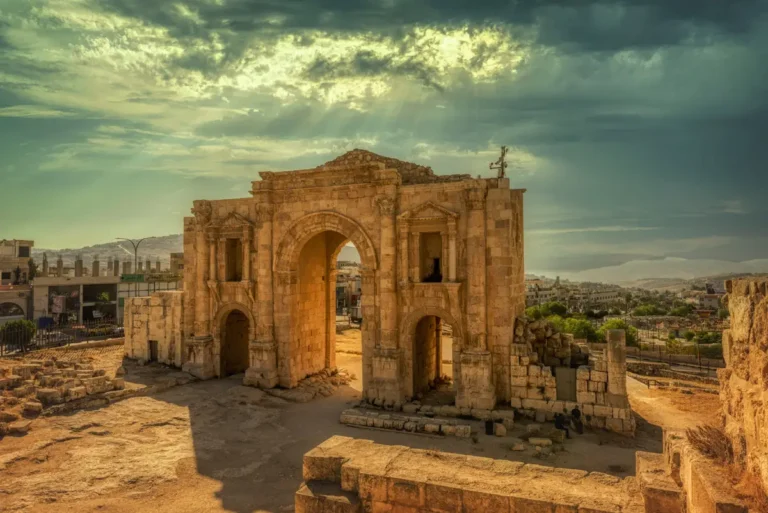
The monumental gateway on the Cardo, dedicated in AD 150, marked the threshold between street and sanctuary.
Terraces and Stairways
A lower terrace with an altar and a grand staircase turned the hillside into a sacred ascent.
The Upper Court
A vast enclosure of about 161 × 121 m, with the main altar in front of the temple.
The Temple
A Corinthian temple on a high podium, about 40 × 23 m; only 12 of its 32 planned columns were ever raised.
jerash-sanctuary-of-artemis-schematic
Tap the drawing to open it full size.
Open drawingThe Dedication Inscription of the Propylaeum
Carved on twelve blocks from the gateway’s pediment, the text records that the city dedicated the propylaeum and its colonnade for the welfare of Emperor Antoninus Pius and his family, under the governor Lucius Attidius Cornelianus. It is the key dated evidence for the sanctuary entrance.
Ὑπὲρ τῆς Αὐτοκράτο[ρος]
Καίσαρος Τ(ίτου) Αἰλίου Ἁδριανοῦ
Ἀντωνεί[ν]ου Σεβ(αστοῦ) Εὐσεβ(οῦς),
π(ατρὸς) π(ατρίδος),
καὶ Αὐρηλίου Κα[ί]σαρος
[υ]ἱοῦ αὐτοῦ καὶ τῶν [ἄ]λλων τέκνων καὶ τοῦ σύμπαντος
οἴκου σωτηρίας
καὶ κρά[τ]ους αὐτοῦ καὶ ἱερᾶς [σ]υγκλήτου καὶ δήμου Ῥωμαίων ἡ πόλις
τὸ προπύλ[α]ιον σὺν τῇ στοᾷ ἀφιέρωσεν
ἐπὶ Λ(ουκίου) Ἀττιδίου Κορνηλιανοῦ πρεσ[βευτοῦ] Σεβ(αστοῦ)
ἀντιστρ(ατήγου), ὑπάτου ἀναδε[δειγμένου].
Ἔτους γιςʹ, Δίου δκʹ.
For the welfare and continuing power of Emperor Caesar Titus Aelius Hadrianus Antoninus Augustus Pius, Father of his Country; and of Aurelius Caesar, his son, and his other children, and of the whole imperial household; and of the sacred Senate and the Roman people, the city dedicated the propylaeum together with the colonnade, during the governorship of Lucius Attidius Cornelianus, imperial legate with praetorian authority and consul-designate. In the year 213, on the 24th day of Dios.
Destruction, Rediscovery, and Restoration
The earthquake of AD 749 hastened the sanctuary’s ruin. Yet eleven of the temple’s columns still stand, about 13 metres tall — the best-known landmark of Jerash, and one of them famously sways slightly in the wind.
Visiting the Sanctuary of Artemis Today
Enter from the Cardo through the propylaeum and follow the original route: the lower terrace, the staircase, the upper court and finally the temple. Look back as you climb to see how the views over the city open up.
Allow at least 30 minutes, and longer if you visit the saw machine and the Church of the Propylaea. Late-afternoon light on the temple columns is especially beautiful.
Further reading: Study of the Artemision (Levant, 2025).