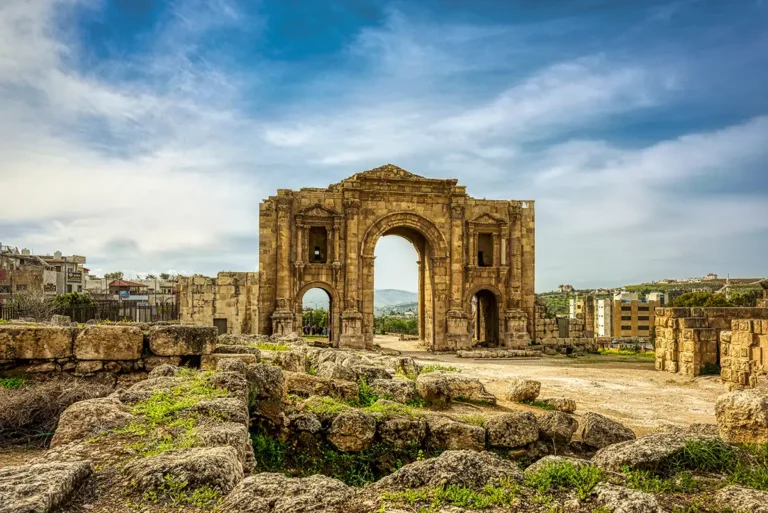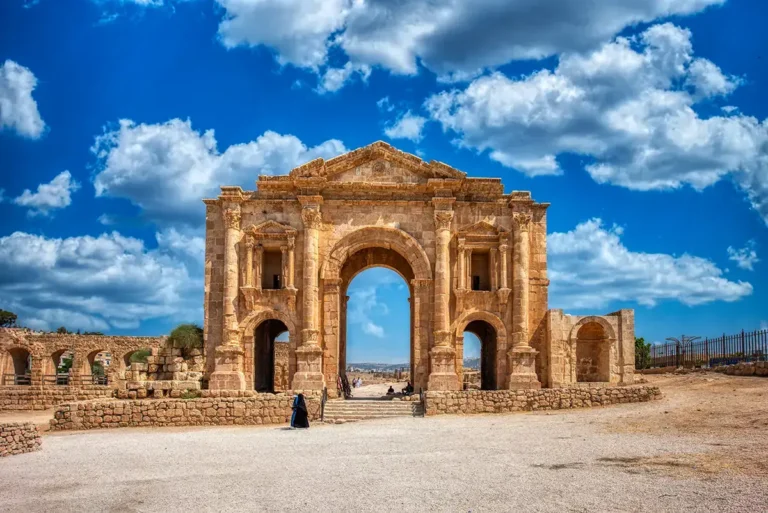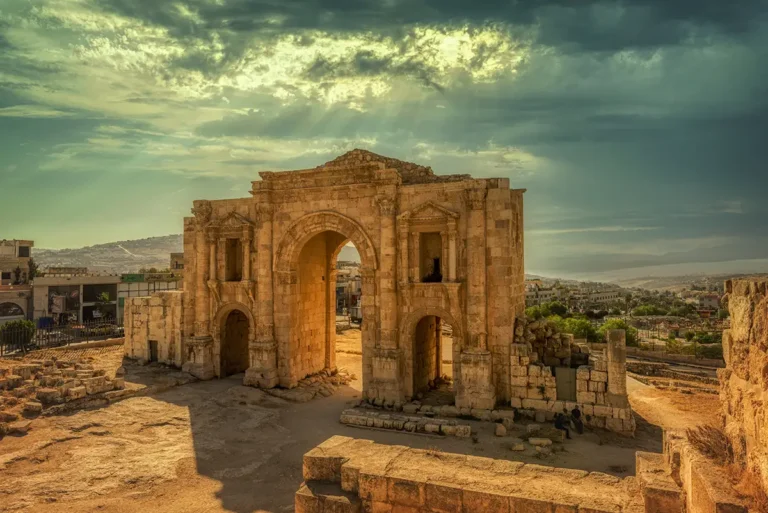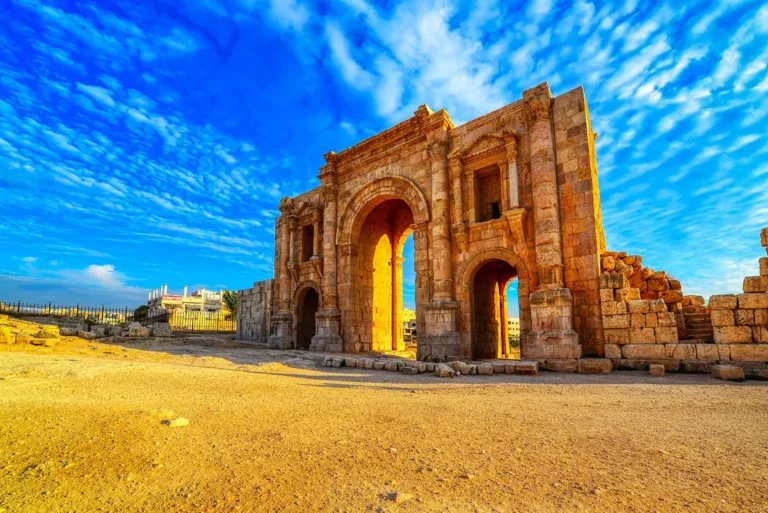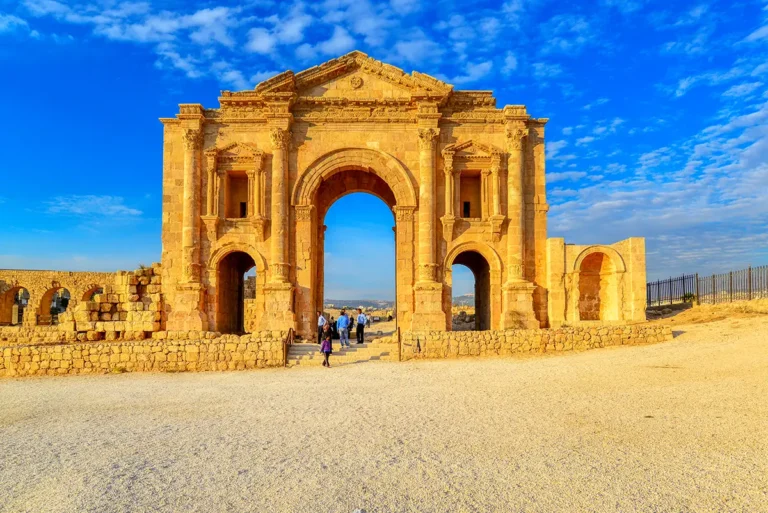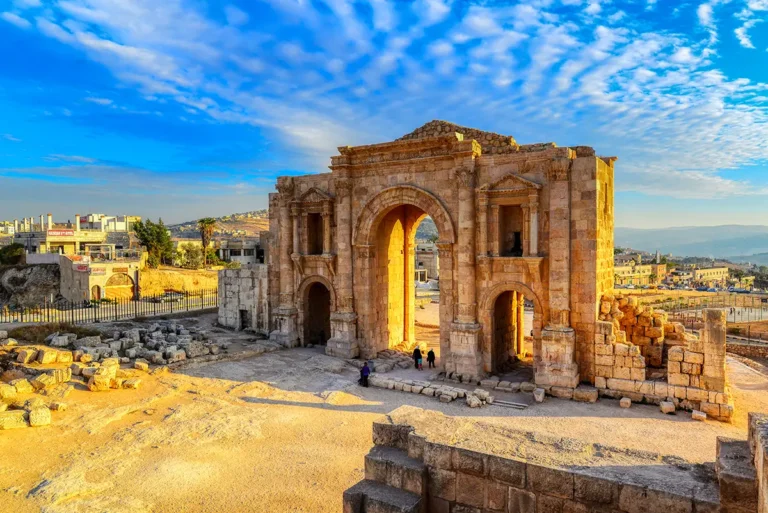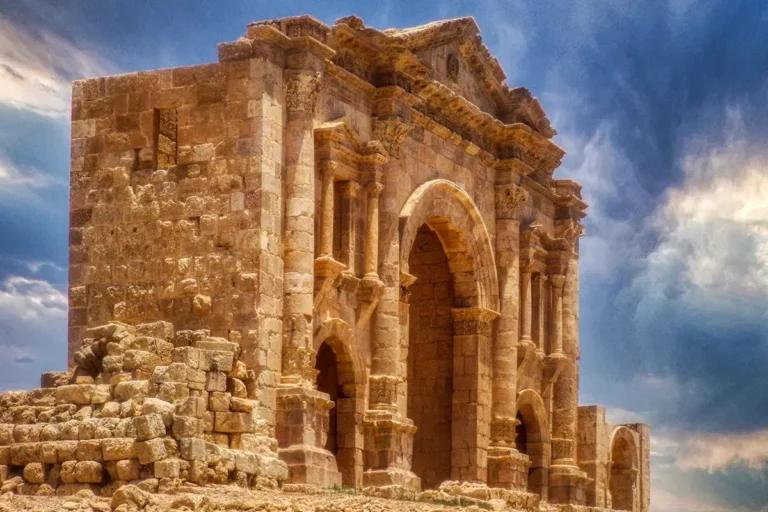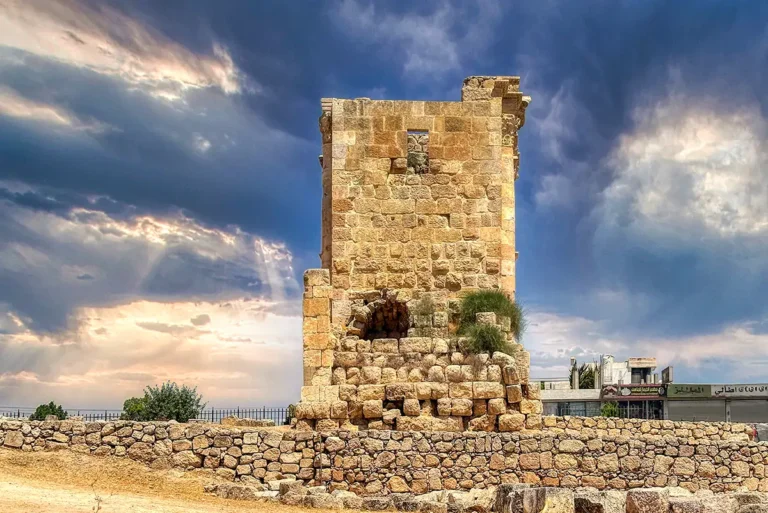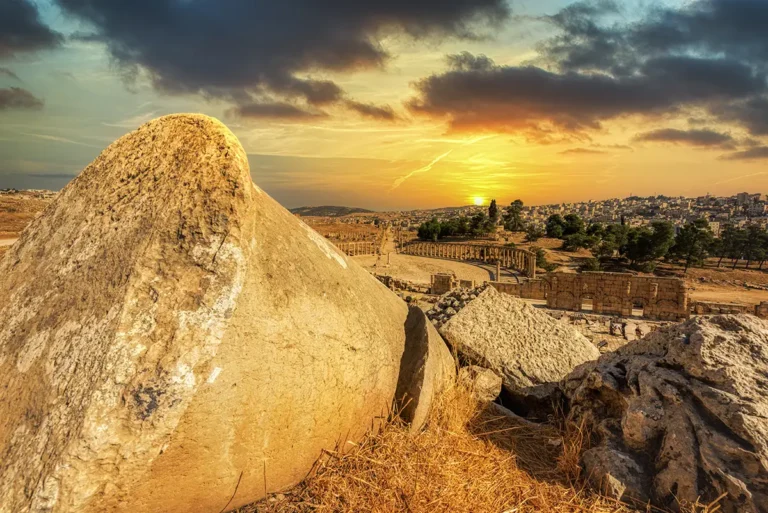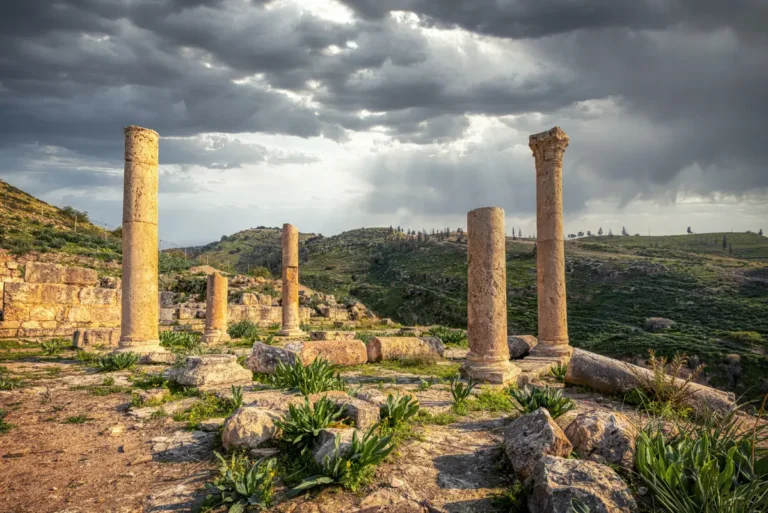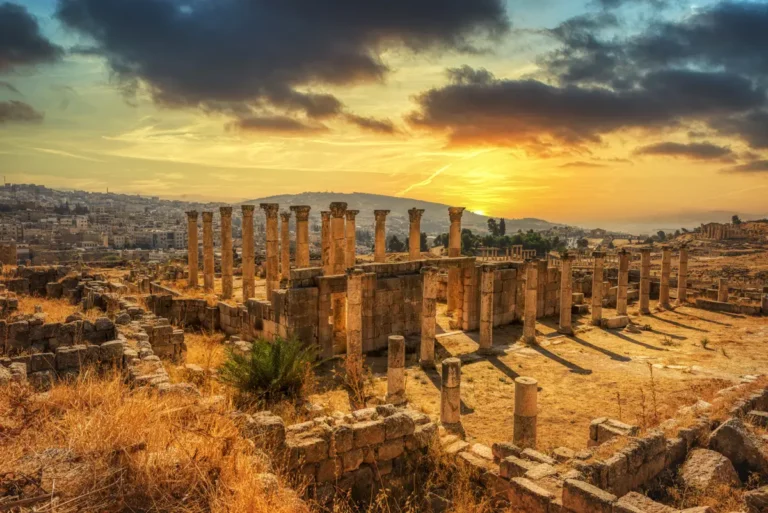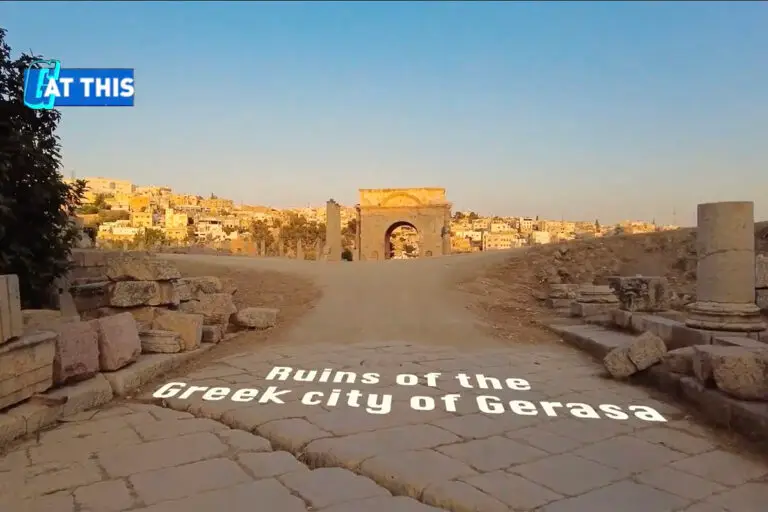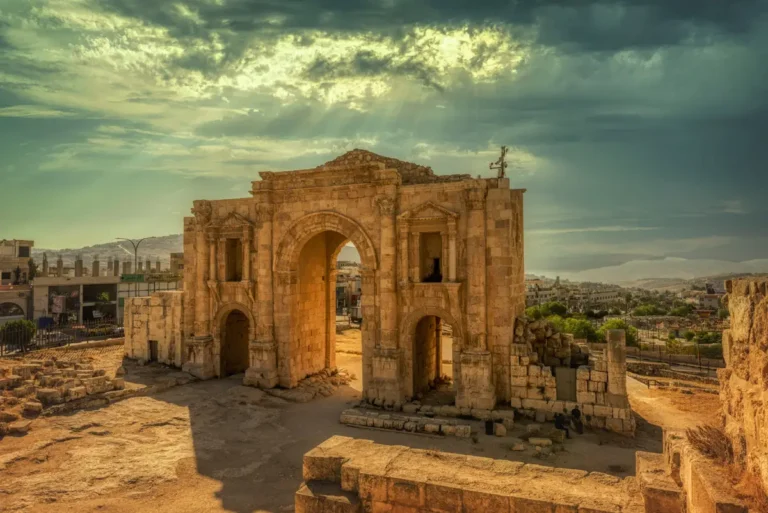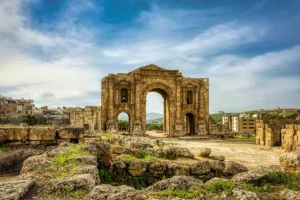
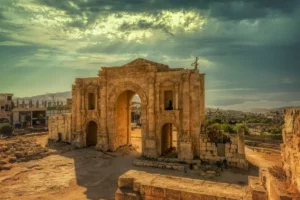
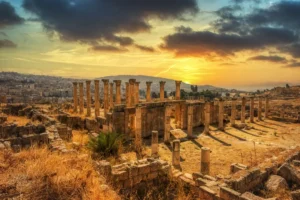
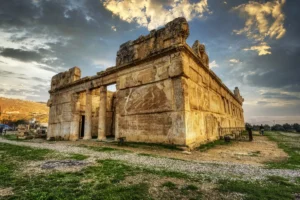
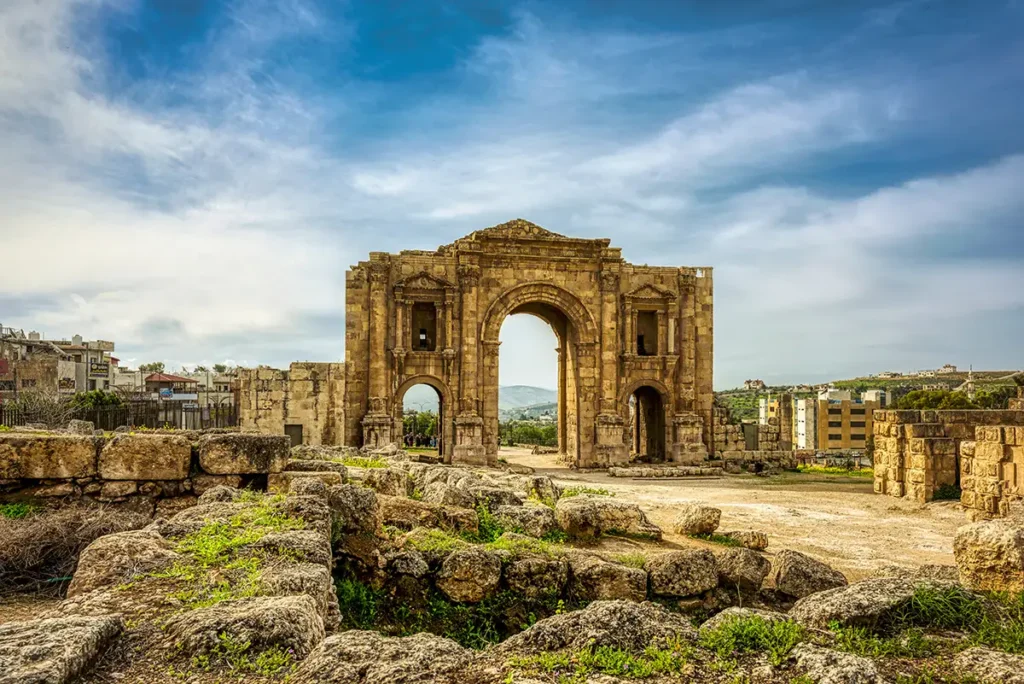
Standing as a colossal sentinel at the southern entrance of the ancient city of Jerash, Jordan, Hadrian’s Arch is one of the most magnificent and historically significant Roman monuments in the Middle East. Originally built to celebrate a royal visit, this triumphal arch has weathered nearly two millennia, offering modern travellers a breathtaking introduction to the ancient city of Gerasa.
Hadrian’s Arch at a Glance
Location: Jerash Archaeological Park, Jordan (Ancient Gerasa)
Built date: Around AD 129–130
Purpose: To commemorate Emperor Hadrian’s visit
Type: Monumental Roman triple-bayed arch
- Architectural Style: Provincial Roman with Nabataean structural influences
- Key Feature: Unique acanthus leaf carvings at the bases of the pillars
- Dimensions: 21 meters (69 feet) high by 25 meters (82 feet) wide
- Current Status: Fully restored via meticulous anastylosis reconstruction
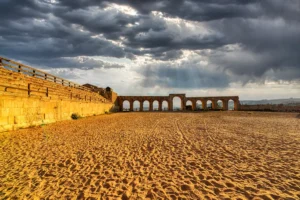
- Nearby monuments: Hippodrome, Church of Marianos, Tickets Office and Parking
- Best way to experience it: Approach from the south, walk through the central arch, then turn back to study the façade and its decorative details.
Where Is Hadrian’s Arch?
Hadrian’s Arch stands at the southern approach to ancient Jerash, immediately south of the Hippodrome and near the site’s southern entrance. It faces the old road that once led from Gerasa toward Philadelphia—modern Amman—and was positioned to greet travellers arriving from the south.
For visitors today, the arch is one of the first major monuments encountered near the archaeological park. Its location outside the dense urban core helps explain its original purpose: it was a grand statement of imperial favour and an intended gateway to a planned southern extension of the city.
Historical Context and Origin
Hadrian’s Arch was constructed between 129 and 130 AD. It was built specifically to honour the visit of the Roman Emperor Hadrian to Gerasa, which was then a prosperous city of the Decapolis—a league of ten Hellenistic cities on the eastern frontier of the Roman Empire.
Emperor Hadrian was renowned for his extensive travels throughout his territories and his deep passion for architecture. His winter stay in Gerasa during 129–130 AD was a monumental event for the local citizens. To demonstrate their wealth, loyalty, and gratitude to the empire, the city’s elite funded the construction of this massive triumphal gateway outside the city’s official southern walls.
Interestingly, the arch was originally intended to become the new southern gate of an expanded city line. However, during times of economic stagnation and subsequent geopolitical shifts, Gerasa’s ambitious expansion plans were never fully realised. As a result, the arch remained standing detached, roughly 400 meters south of the city’s main terminal gate.
First Impressions
Approach Hadrian’s Arch slowly. From a distance, its wide central opening and two smaller side arches frame the sky and the hills beyond. The monument is large enough to feel ceremonial rather than merely practical. It was not simply a doorway in a wall; it was a carefully staged announcement that a visitor had arrived at an important Roman city.
The central passage is the visual focus. It is broad and tall, while the two side openings are lower and narrower. This deliberate contrast directs the eye toward the middle of the monument and gives the structure a rhythm: one grand opening in the centre, balanced by two smaller ones on either side.
Take a moment to imagine the original experience. Travellers approaching Gerasa from the south would have encountered this imposing façade before reaching the city’s main monumental spaces. The message was unmistakable: Gerasa was prosperous, organised, connected to imperial Rome, and capable of building on an impressive scale.
Architectural Design and Features
The arch is a masterclass in provincial Roman architecture, blending classical Roman structural engineering with local Nabataean and Syrian artistic influences.
Dimensions and Scale
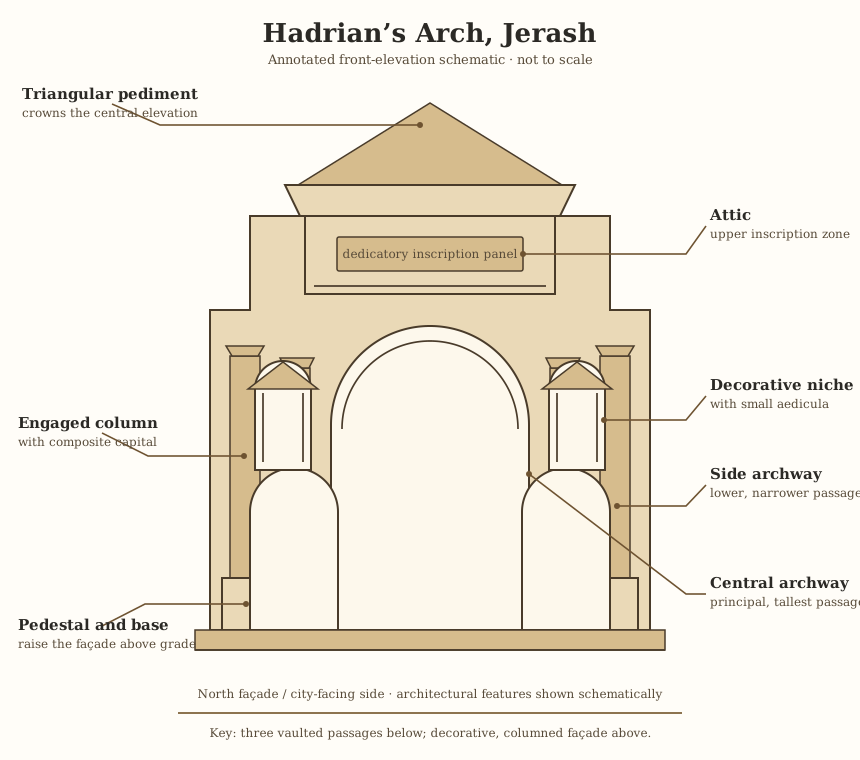
At its peak operational state, the arch stood at an imposing height of roughly 21 meters (69 feet) and stretched more than 25 meters (82 feet) wide. It features a classic triple-arched design, common among Roman triumphal structures.
The Central Arch: Standing at nearly 11 meters high, this main thoroughfare was reserved for royal pageantry, high-ranking officials, and elite processions.
The Flanking Side Arches: Two smaller bays flank the central opening, which accommodated everyday pedestrian traffic.
Unique Architectural Details
What sets Hadrian’s Arch apart from its European counterparts is its unconventional decorative program.
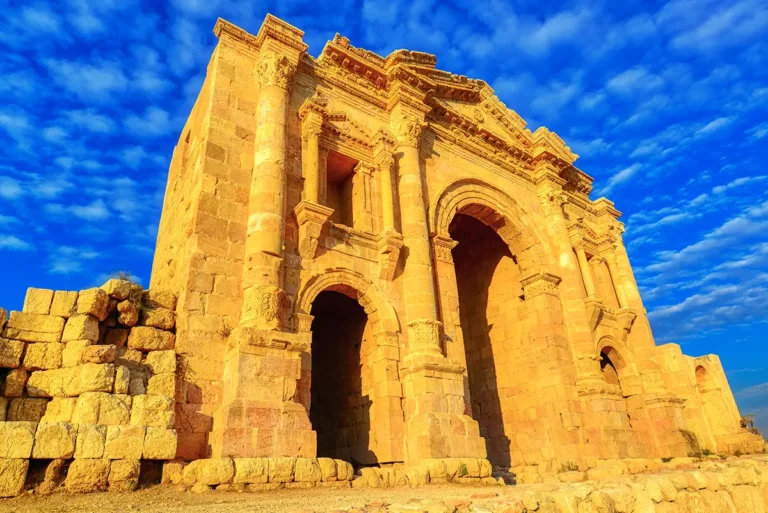
Acanthus Leaf Bases: Unlike standard Roman pillars where decorative carvings sit at the top (capital), the columns of Hadrian’s Arch feature intricate acanthus leaf carvings at their bases, just above the pedestals. This unique design element points directly to the influence of regional Nabataean craftsmen.
The Attic and Niches: Above the side arches sit decorative niches topped with triangular pediments, which likely housed statues of Emperor Hadrian or prominent local deities. Above these structures sits a heavy attic story that once bore a massive dedicatory inscription.
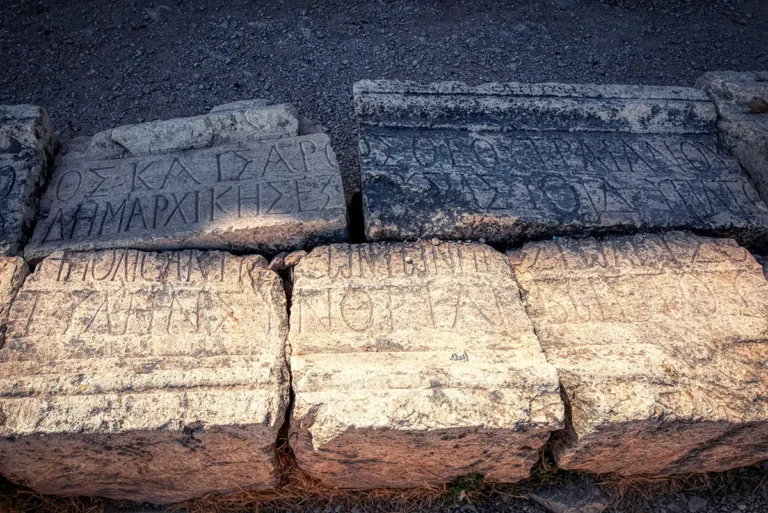
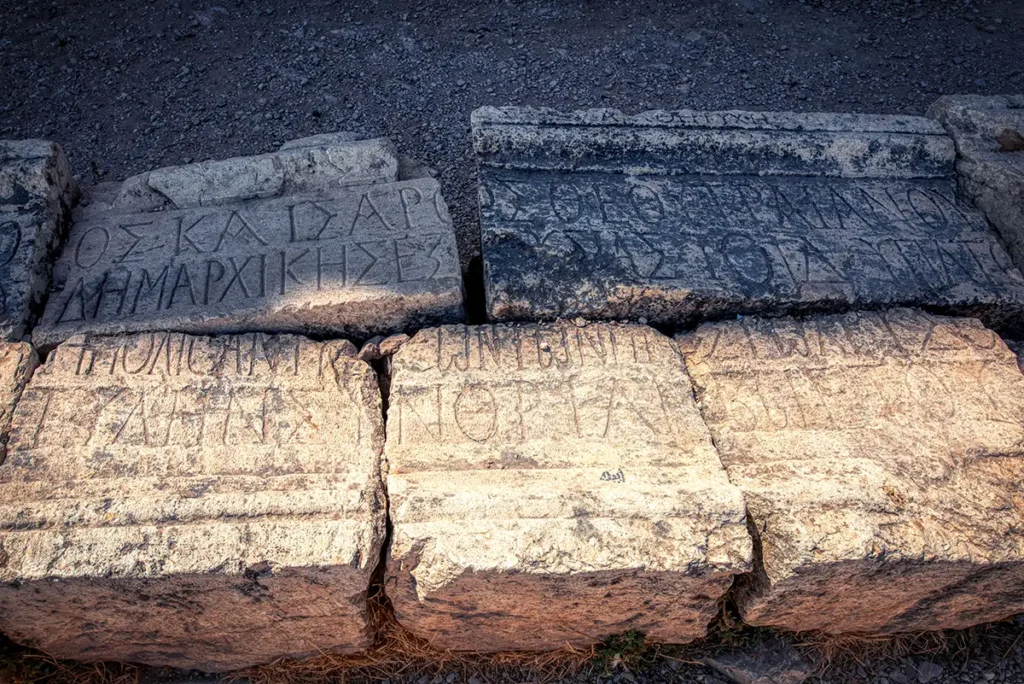
The Greek Dedication: A preserved stone blocks inscription reveals a text written in Greek. It officially dedicates the arch to Emperor Hadrian from the “city of the Gerasenes.”
The Inscription and Its Meaning
An important Greek inscription once appeared on the north façade, the side facing the city. The inscription is now seen on the ground rather than in its original position. It reportedly included the titles “sacred,” “asylum,” and “independent” for the city, but these titles were erased soon after the inscription was made, probably by imperial order.
The Inscription and Its Meaning
An important Greek inscription once appeared on the north façade, the side facing the city. The inscription is now seen on the ground rather than in its original position. It reportedly included the titles “sacred,” “asylum,” and “independent” for the city, but these titles were erased soon after the inscription was made, probably by imperial order.
Original Greek
Ἀγαθῇ τύχῃ.
Ὑπὲρ σωτηρίας αὐτοκράτορος Καίσαρος, θεοῦ Τραιανοῦ Παρθικοῦ υἱοῦ, θεοῦ Νέρουα υἱωνοῦ, Τραιανοῦ Ἀδριανοῦ Σεβαστοῦ, ἀρχιερέως μεγίστου, δημαρχικῆς ἐξουσίας τὸ ιδʹ, ὑπάτου τὸ γʹ, πατρὸς πατρίδος, καὶ τύχης καὶ διαμονῆς τοῦ σύμπαντος αὐτοῦ οἴκου· ἡ πόλις Ἀντιοχέων τῶν πρὸς τῷ Χρυσορρόᾳ, τῶν πρότερον Γερασηνῶν, ἐκ διαθήκης Φλαουίου Ἀγρίππου τὴν πύλην σὺν θριάμβῳ. ἔτους βφρʹ.
English Translation
For good fortune.
For the safety of the Emperor Caesar Trajan Hadrian Augustus, son of the deified Trajan Parthicus, grandson of the deified Nerva; chief priest; holder of tribunician power for the fourteenth time; consul for the third time; father of his country; and for the good fortune and enduring prosperity of all his imperial household:
the city of the Antiochenes by the Chrysorrhoas—formerly the Gerasenes—under the testament of Flavius Agrippa, erected this gateway with its triumphal monument, in the year 602.
Dating Note
“Year 602” uses the local Pompeian era and corresponds to AD 129–130, the period of Hadrian’s visit to Gerasa.
Interpretation Note
The wording calls the community the “city of the Antiochenes by the Chrysorrhoas, formerly the Gerasenes.” Earlier portions of the inscription were deliberately erased and altered. This likely explains the loss of civic honorifics—including “sacred,” “asylum,” and “independent”—reported for the original text.
Destruction, Rediscovery, and Restoration
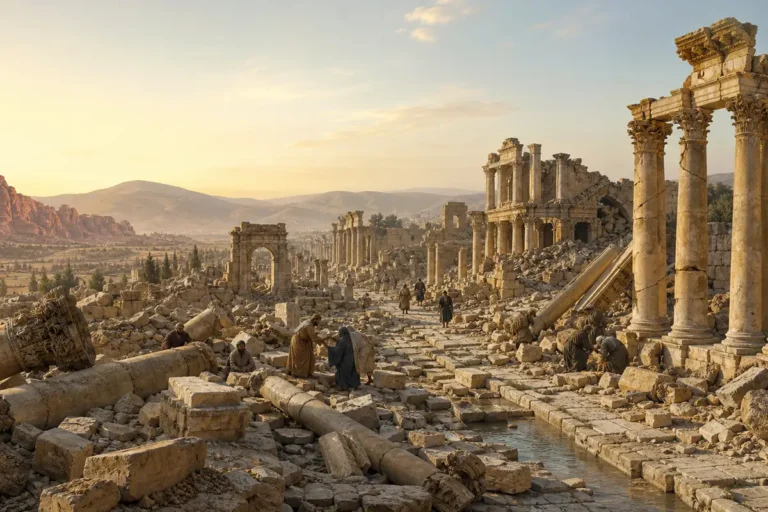
Over the centuries, as the Byzantine and Umayyad empires shifted and trade routes changed, Gerasa fell into a slow decline. A devastating earthquake in 749 AD caused catastrophic damage across the region, toppling much of Jerash and compromising the structural integrity of the arch. The top halves of the monument collapsed, leaving it partially buried under sand and rubble for centuries.
The site was rediscovered by Western travellers in the early 19th century, sparking global archaeological interest. However, it wasn’t until the 20th and early 21st centuries that systematic preservation began.
Between 2005 and 2007, the Jordanian Department of Antiquities, alongside international preservation teams, underwent a massive, meticulous reconstruction project. Using an architectural technique called anastylosis, engineers carefully catalogued the scattered, original fallen stones, reinforced the structural core, and rebuilt the arch to its original height. Today, it stands as one of the most complete Roman triumphal arches in existence.
Visiting Hadrian’s Arch Today
For modern travellers visiting the Jerash Archaeological Scenic Area, Hadrian’s Arch serves as the primary entrance to the ancient world.
Location: Situated right at the entrance of the archaeological park, adjacent to the modern visitor centre and the ancient Hippodrome.
Photographic Vantage: The best time to photograph the arch is during the golden hours of early morning or late afternoon. The low sun striking the local pale-orange limestone gives the monument a brilliant, warm glow.
The Approach: Walking through the arch mirrors the exact pathway taken by Emperor Hadrian nearly 2,000 years ago, leading visitors directly toward the South Gate and the breathtaking Oval Plaza.
Key Takeaway
Hadrian’s Arch is not only a memorial to one emperor’s visit. It is a declaration made by Gerasa itself. Its scale, decoration, inscription, and placement on the southern approach all communicate the same idea: this was a city that wanted to be seen.
As you leave the monument and continue toward the heart of Jerash, keep that message in mind. The arch is the opening statement of a remarkable ancient city—one built to welcome, impress, and endure.
Frequently Asked Questions
Hadrian’s Arch is a monumental Roman triple-arched gateway at the southern approach to ancient Gerasa, now Jerash. It was built to commemorate Emperor Hadrian’s visit to the city in AD 129/130.
The arch honoured Hadrian’s imperial visit and was likely intended to mark a planned southern expansion of the city. That expansion was never fully completed, leaving the arch as a monumental freestanding landmark.
No. Hadrian’s Arch is a ceremonial monument south of the ancient city, while the South Gate was part of Jerash’s later city-wall system and served as a fortified entrance.
It dates to AD 129 or 130, making it almost 1,900 years old.
The monument has three passageways: a large central arch and two smaller side arches. The central opening is about 6 metres wide and 11 metres high, while the side openings are smaller.
Look for the Corinthian columns, carved capitals, decorative niches and the strong symmetry of the three arches. These details show how Roman architecture used scale and ornament to impress arriving visitors.
No. Its principal role was commemorative and ceremonial rather than defensive. The South Gate and the later city wall performed the defensive function.
It stands at the southern end of the archaeological area, close to the Hippodrome and the approach from the modern visitor area.
Absolutely. It is one of Jerash’s most photogenic monuments and a powerful introduction to the scale of the ancient city. Visit early or late in the day for softer light and fewer people.
Key Moments in History
Before the Arch: Gerasa under Rome
By the first and second centuries AD, Gerasa had become a prosperous Roman provincial city. Its collonaded streets, temples, theatres, public baths, and markets reflected a period of major urban development and growing regional importance.
AD 129–130: Emperor Hadrian Visits Gerasa
Roman Emperor Hadrian visited Gerasa during his tour of the eastern provinces. The city marked this important occasion by commissioning a monumental arch on its southern approach. The structure became a public expression of loyalty to the emperor and confidence in the city’s future.
Key Moments in History
Before the Arch: Gerasa under Rome
By the first and second centuries AD, Gerasa had become a prosperous Roman provincial city. Its collonaded streets, temples, theatres, public baths, and markets reflected a period of major urban development and growing regional importance.
AD 129–130: Emperor Hadrian Visits Gerasa
Roman Emperor Hadrian visited Gerasa during his tour of the eastern provinces. The city marked this important occasion by commissioning a monumental arch on its southern approach. The structure became a public expression of loyalty to the emperor and confidence in the city’s future.
Around AD 130: Hadrian’s Arch Is Built
The triple-bayed arch was completed around AD 129–130. It was built outside the existing city walls and was likely intended to serve as the grand southern entrance to an expanded district of Gerasa. The proposed southern expansion was never completed, leaving the arch standing apart from the main urban centre.
Roman Gerasa Continues to Flourish
In the decades after Hadrian’s visit, Gerasa continued to develop. The area south of the city included the Hippodrome, where public entertainments and chariot races were held, while the city centre grew around its collonaded streets, temples, civic buildings, and plazas.
Late Antiquity: A Changing City
As the Roman Empire changed and Christianity became increasingly important, Gerasa’s religious and civic landscape changed with it. Some earlier buildings were adapted, new churches were built, and the city continued to be inhabited through the Byzantine period.
Centuries of Change and Decline
Earthquakes, shifting trade routes, political changes, and changing patterns of settlement altered Gerasa over time. Many monuments fell into ruin or were partly buried, including Hadrian’s Arch, though its massive stone structure remained a visible landmark.
Modern Rediscovery and Conservation
Archaeological exploration and conservation gradually revealed Jerash’s monuments to the modern world. Hadrian’s Arch has been stabilised and partly restored, allowing visitors to appreciate its original scale and architectural ambition.
Today: A Symbol of Jerash
Hadrian’s Arch remains one of the best-known landmarks of Jerash. It continues to welcome visitors much as it once welcomed travellers to ancient Gerasa—offering a powerful first impression of one of the Roman world’s most remarkable cities.