
Qal’at Mudawwara
An 18th-century Hajj fort near the Saudi border, beside the station taken by the Camel Corps in 1918
BuiltAD 1730–33
SizeAbout 19 × 19 m
LocationNear the Saudi border
Access4x4 · passport
Introduction
A fort that recalls two eras of desert travel: the Hajj caravans and the railway that replaced them.
Near Jordan’s southern border, a battered sandstone fort recalls two eras of desert travel: the Hajj caravans that drew water here for centuries, and the railway that replaced them. The fort, its reservoir and a paved road were built in 1730–33 under Abdullah Pasha al-Aydinli, governor of Damascus.
In 1918 the railway station about 3 km to the east was taken in one of the last battles of the Arab Revolt. The fort stands near the village of al-Mudawwara, about 15 km from the Saudi border: there are checkpoints on the way, so carry your passport, and a 4x4 is needed.
Best timeOct–Apr
Time needed30 min
TicketFree
From Amman320 kmAbout 3 hr 45 min
Combine withQal’at Fassu’a · 1 hr 15 min
Google rating4.6 · Reviews
Highlights · A border fort
A sandstone fort in the southern desert
Four things to look for at Qal’at Mudawwara
Mudawwara is remote and fragile, so see it from outside. These are the places that make the visit.
 01 / 04
01 · Defence
The gate
The fort
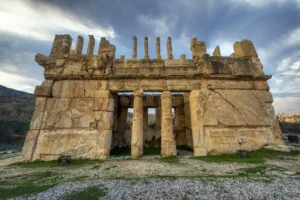
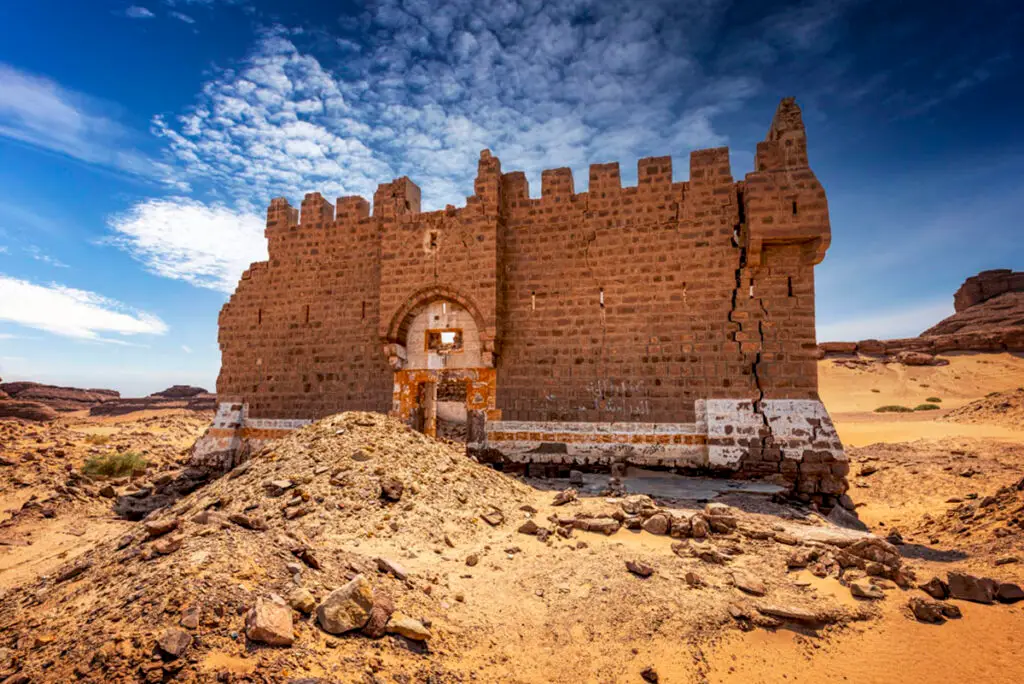
The gate in the east wall is protected by a large machicolation carried on corbels.
Look closely
The corbels under the machicolation.
1 of 4
Part by part
What to see
Three parts of the visit: the walls from outside, the interior in our 360° panorama, and the desert around it. Pick one to see what to look for.
1 / 501 · Sandstone walls
Walk round the fort
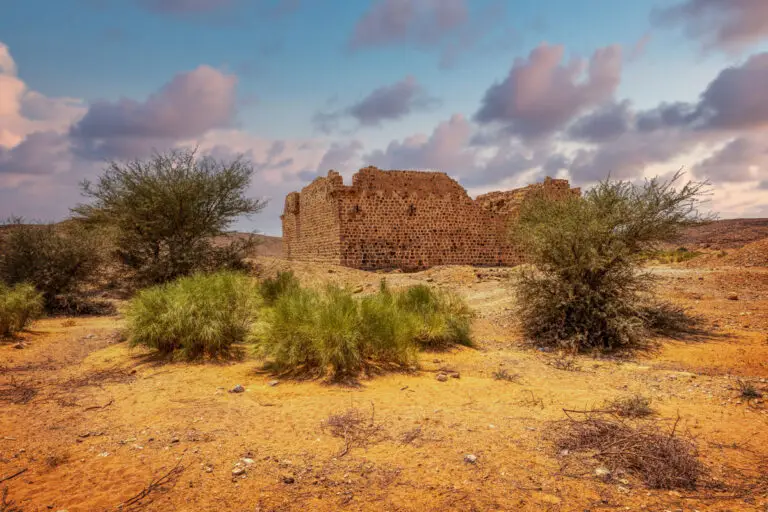
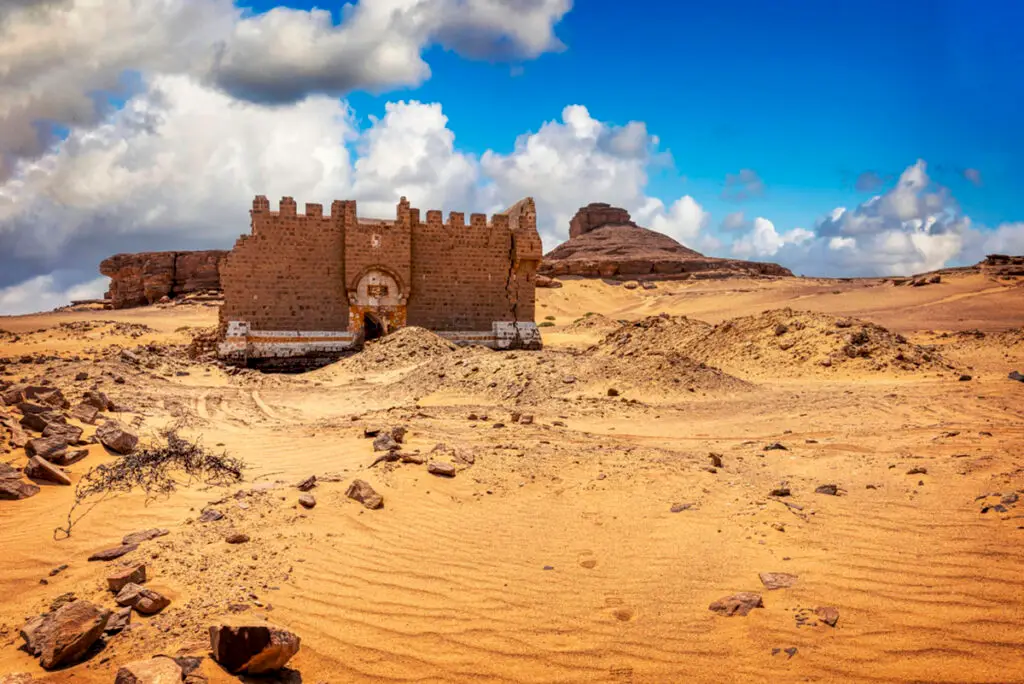
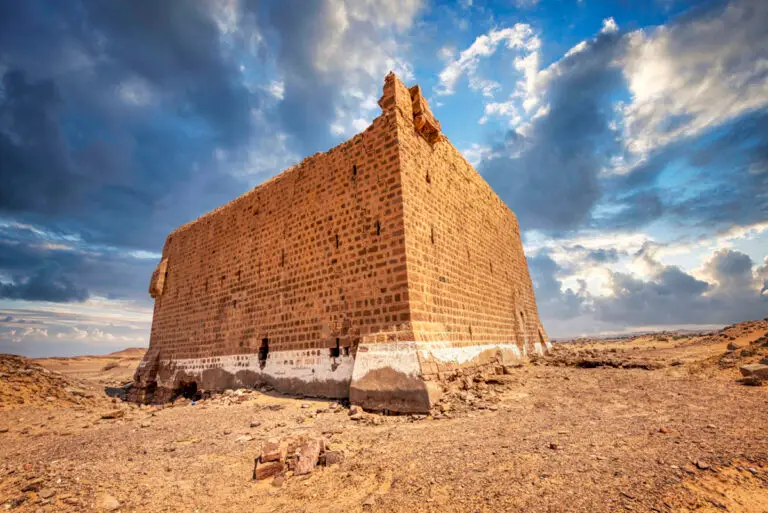
The fort is a square of about 19 × 19 m, built of sandstone and up to about 9 m high, with small towers at the upper corners and two rows of slit windows. The gate in the east wall is protected by a large machicolation carried on corbels.
Treasure hunters undermined the south wall with machinery, and the fort is now close to collapse: keep clear of the south wall.
AD 1730–33About 9 m highMachicolated gate
Look for
- The machicolation over the east gate
- The two rows of slit windows
- The damaged south wall, from a distance
 1 / 4
02 · Around the courtyard
What lies inside
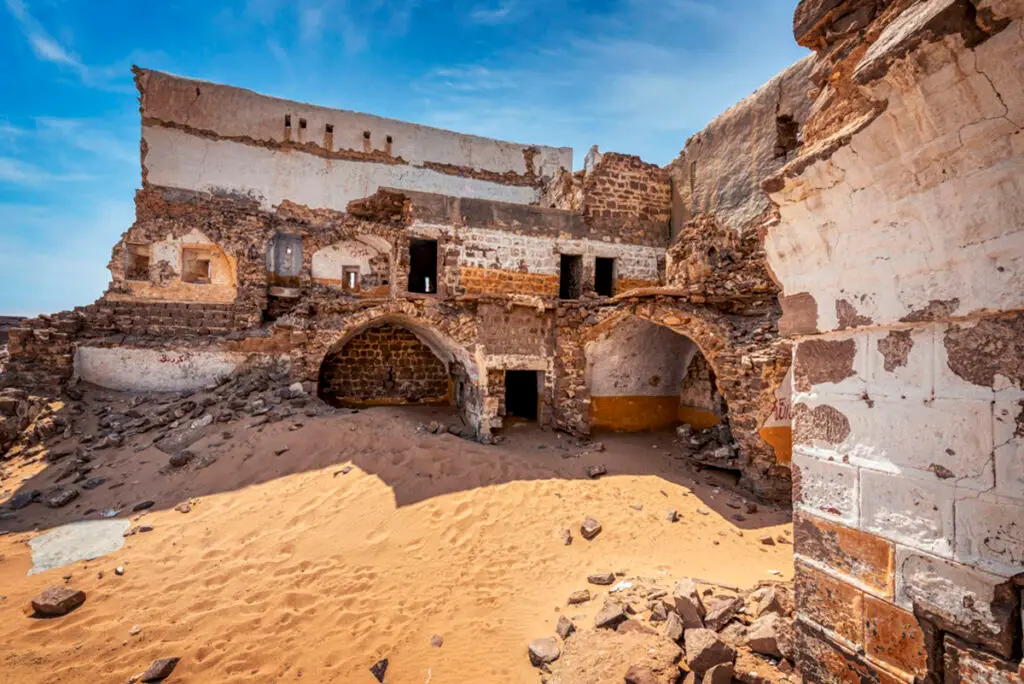
A vaulted passage leads to a courtyard of about 8 × 8 m, surrounded by nine vaulted rooms on each of two floors. Many of the vaults have fallen. More could follow, so we don’t recommend going in: the 360° panorama shows the passage, the courtyard and the rooms.
After the First World War the fort was used by the Transjordan Frontier Force and the Arab Legion.
8 × 8 m courtyard18 roomsView in 360°
Look for
- The vaulted passage, in the 360° panorama
- The rooms on two floors
- Fallen stone from the vaults
Dig deeperLawrence and the battle for the station
In September 1917 T. E. Lawrence scouted Mudawwara station but judged its garrison of about 200 men too strong. On 8 August 1918 two companies of the Imperial Camel Corps under Major Robert Buxton stormed the station before dawn, taking about 150 prisoners, and blew up the wells, the pumps and the great water tower. The day before, British troops had used the empty fort as a first-aid post.
 1 / 5
03 · Near the border
Look around
Mudawwara was a halt on the pilgrim road as early as the 9th century, for one reason: water. When the Hejaz Railway reached Mudawwara in the 1900s, its station, about 3 km east of the fort, became important for the same reason.
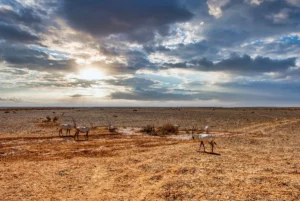
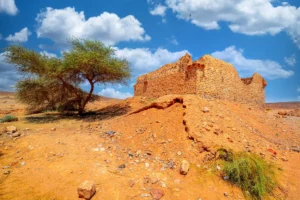
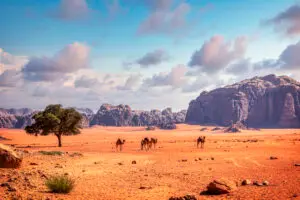
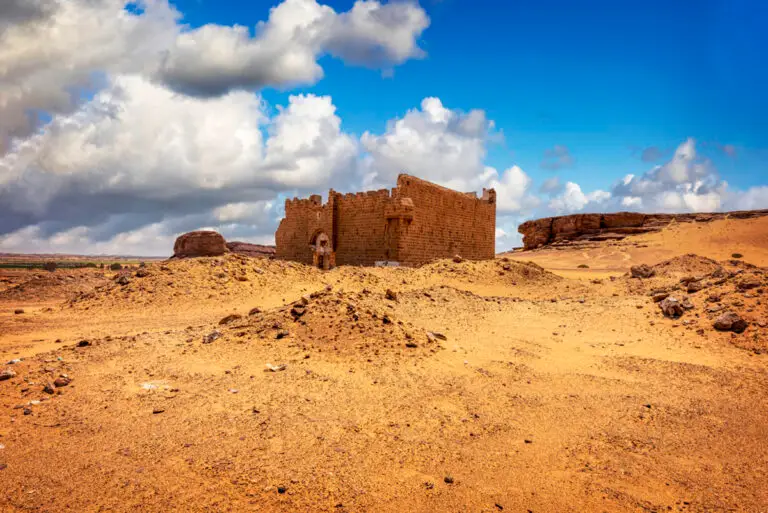
Around the fort the desert is flat sand, with sandstone hills on the horizon.
9th-c. haltStation 3 km eastSandstone hills
Look for
- The fort seen from a distance
- The sandstone hills
- The line of the railway to the east
History & significance
Caravans, a railway and a battle
Mudawwara watered the Hajj caravans and then the trains of the Hejaz Railway. Its station saw one of the last battles of the Arab Revolt in 1918.
- 9th c. ADA halt on the pilgrim road
- AD 1730–33Abdullah Pasha al-Aydinli builds the fort
- AD 1900sThe Hejaz Railway reaches Mudawwara
- AD 1917Lawrence scouts the station
- AD 1918The Imperial Camel Corps takes the station
 ProfileQal’at Mudawwara: the full storyThe history, the railway and the battle of 1918.Read the profile →
Plan your visit
Everything you need to know before you go
The fort stands near the village of al-Mudawwara, Jordan’s southernmost settlement, about 100 km south-east of Ma’an and about 15 km from the Saudi border. There are checkpoints on the way: carry your passport. A 4x4 is needed.
Good to know: the fort is close to collapse and has no protection or facilities. View it from outside and keep clear of the unstable south wall.
Opening hoursOpen accessUnstaffed site · visit in daylight
Entry ticketFreeNo ticket office
Time to visit30 minAbout 30 minutes
From Amman320 kmAbout 3 hours 30 to 4 hours by road
LocationAl-Mudawwara29.3231° N, 35.9913° EGet directions
Opening hours and prices checked October 2026. Spotted a change? Let us know
Facilities by location
At the monument
- Viewpoint
Near the entrance
No designated parking
Access: 4x4 needed.
When to go
October to April is best. From May to September the southern desert is extremely hot.
J
F
M
A
M
J
J
A
S
O
N
D
BestGood, cooler or warmVery hot
Tip: carry your passport for the checkpoints near the border.
Before you go
There are no services at the site.
- Your passportCheckpoints near the border
- WaterNo shade and no services
- Sun hat and sunscreenThe desert is very hot
- Good shoesSand and fallen stone
Common questions
Quick answers before you set off.
Do I need a 4x4?
Yes. A 4x4 is needed, and there are checkpoints on the way, so carry your passport.
Is it safe to go inside?
We don’t recommend it. The fort is close to collapse and many of its vaults have already fallen, so view it from outside and keep well clear of the south wall. Our 360° panorama shows the courtyard and the rooms.
Can I see the railway station?
The station of the 1918 battle lies about 3 km east of the fort.
Is there an entrance fee?
No. The fort is free, with no facilities.
Combine with
Mudawwara combines with Fassu’a on the road from Ma’an. Drive times are from Qal’at Mudawwara.
Explore this site
More from Qal’at Mudawwara
Panoramas, walk-throughs, photos and stories about this site.
ProfileQal’at Mudawwara: history & architecture Photo albumQal’at Mudawwara: A Border Fort in Photos
 360°360° panoramaQal’at Mudawwara – Ancient Desert Outpost in 360°
Nearby
Also in the far south
From guide to visit
Explore the southern Hajj forts with a private guide
Tell us when you’d like to go, and we’ll plan a private 4x4 day to the forts of the southern desert.