














Qasr Deir Al-Kahf
A basalt frontier fort that became a monastery
Builtc. AD 200; enlarged 306
FortAbout 60 × 60 m
LocationDeir Al-Kahf village
WallsUp to 7.5 m high
Introduction
The “Monastery of the Cave”: a Roman fort that found a second life.
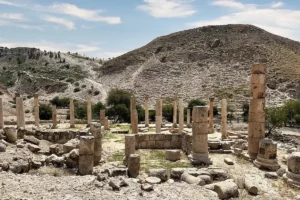
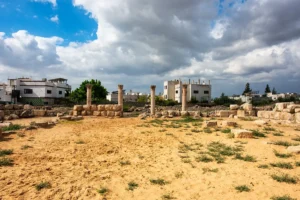
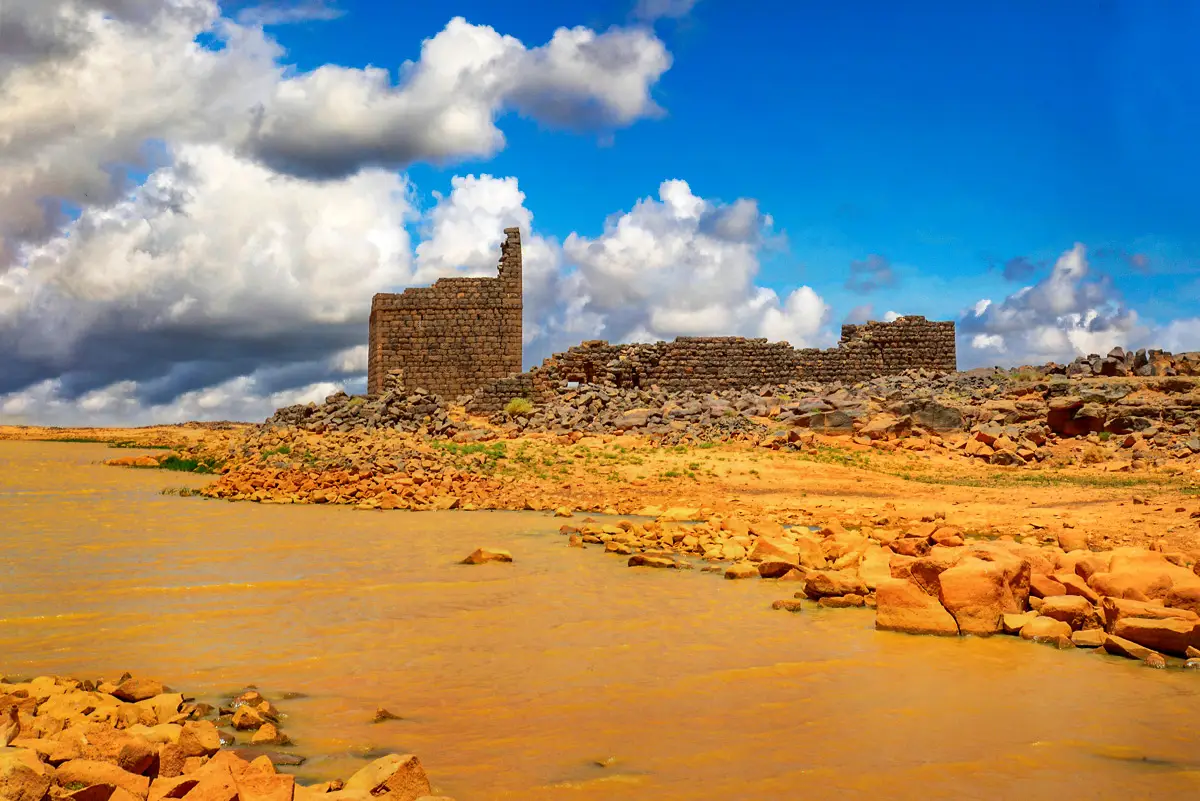
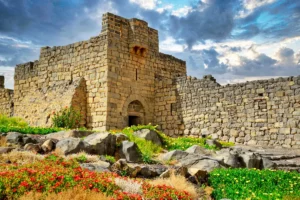
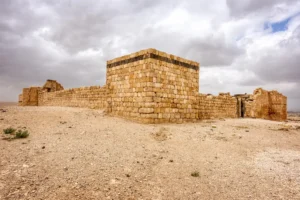
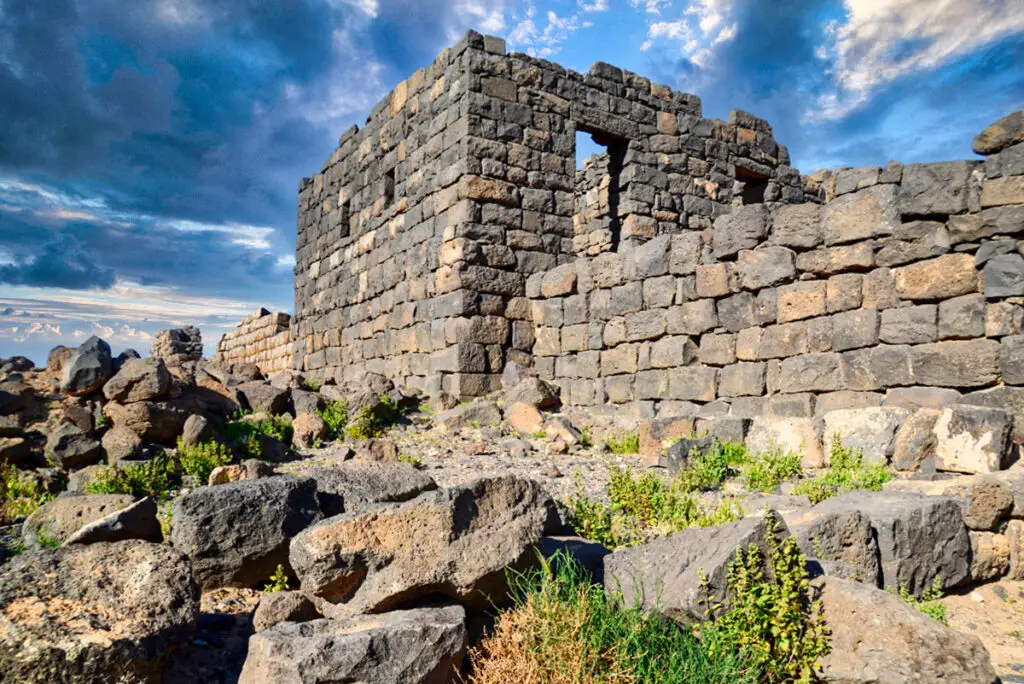
Qasr Deir Al-Kahf is a large basalt fort in the far north-east of Jordan, close to the Syrian border, on the Roman road from Azraq to Bostra. Its walls still stand up to 7.5 m high in places, with square towers at the corners and on two sides.
A small fort was built here around AD 200 and enlarged under the Tetrarchy in AD 306, with repairs in the 360s–370s. When the army left, it became a monastery with a chapel in the courtyard, which gave the village its name, “Monastery of the Cave”. Today the fort stands among the houses of the modern village, behind the police station.
Best timeMar–May · Oct–Nov
Time needed30 min
TicketFree
From Amman125 km · 2 hr 15 min
Combine withJawa · 45 min
Google rating4.2 · Reviews
Highlights · Fort and monastery
Basalt walls with two lives
Roman towers, stone-roofed vaults and a monks’ chapel
Deir Al-Kahf shows how a Roman fort was built, enlarged and then reused. Look for the changes in the masonry as much as for the towers.
 01 / 04
01 · Architecture
The towers
Walls & towers
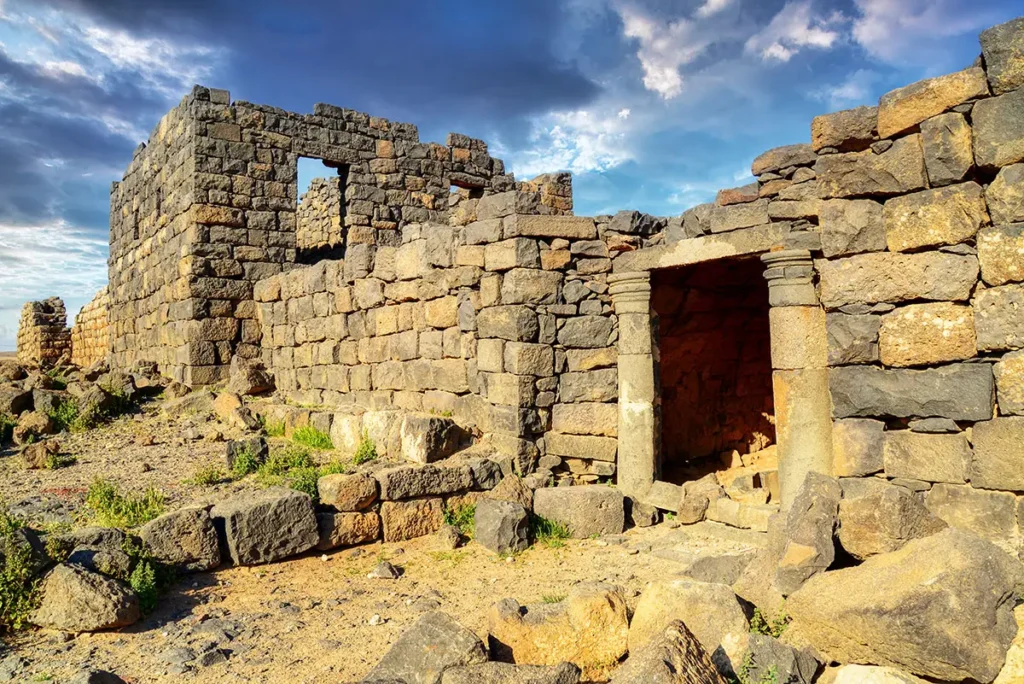
Square corner towers rose three storeys. Extra towers stood in the middle of the north and west walls.
Look closely
Windows high in the tower walls.
1 of 4
Room by room
What to see
Three stops: the walls and towers, the courtyard and chapel, and the stone-roofed vaults. Pick a stop to see what to look for.
1 / 901 · The outside
Walk round the walls
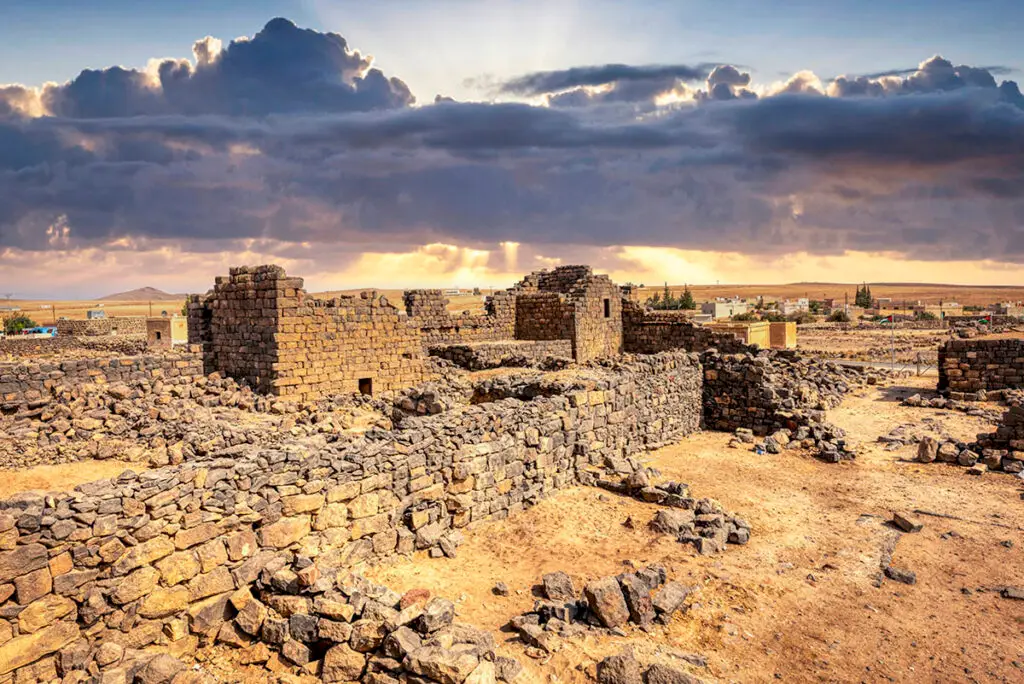
The fort is nearly square, about 60 m a side, with walls about 1.5 m thick that still rise to 7.5 m in places. Square towers of three storeys stood at the corners, with intermediate towers on the north and west sides. The main gate was in the middle of the east wall.
A later entrance was cut through the west wall in the 20th century, when villagers rebuilt part of it. The site is now fenced: check the available entrance locally.
60 × 60 mWalls 1.5 m thickCorner towersBasalt
Look for
- Finer bossed blocks of the first fort
- Rougher stones of the AD 306 work
- The blocked east gate
Dig deeperTwo forts in one
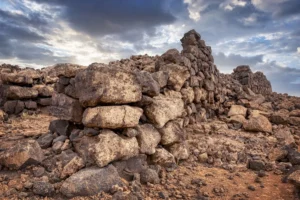
Spanish archaeologists found that the fort was built in two main phases. The first, around AD 200, was a small towerless fort of about 28 × 28 m, of finely jointed bossed blocks. In AD 306 it was enlarged into the big fort you see, with rougher basalt set in lime mortar. Inside, the old walls were thickened to carry the new rooms.
At the south-east corner, the builders wrapped the old corner in a “fake” tower.
 1 / 5
02 · Soldiers and monks
Stand in the courtyard
Two-storey rooms of about 4.5 × 6 m lined the inside of the walls, and some towers probably had stables on the ground floor. Kennedy and Riley estimated a garrison of about 400–500 men.
After the army left, monks moved in, especially in the 6th century. Remains of a later church were identified in the courtyard: a single-aisled chapel. Later, in the Umayyad period, the site was used as a farm, and lime kilns were cut into the chapel.
Two-storey roomsChapelUmayyad reuse
Look for
- Room walls along the inside
- Arches still standing
- The open courtyard where the church stood
Dig deeperLost inscriptions
In 1904 a Princeton expedition copied several inscriptions here: a Latin one of AD 306 over a doorway, a Latin text of AD 367–375 naming the commander Flavius Maximinus, and an undated Greek one crediting a camp prefect named Agrippa with the cistern outside the walls. By 1950 all of them had gone.
 1 / 2
03 · Roofs of stone
Look inside the vaults
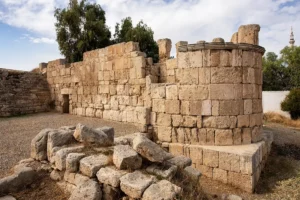
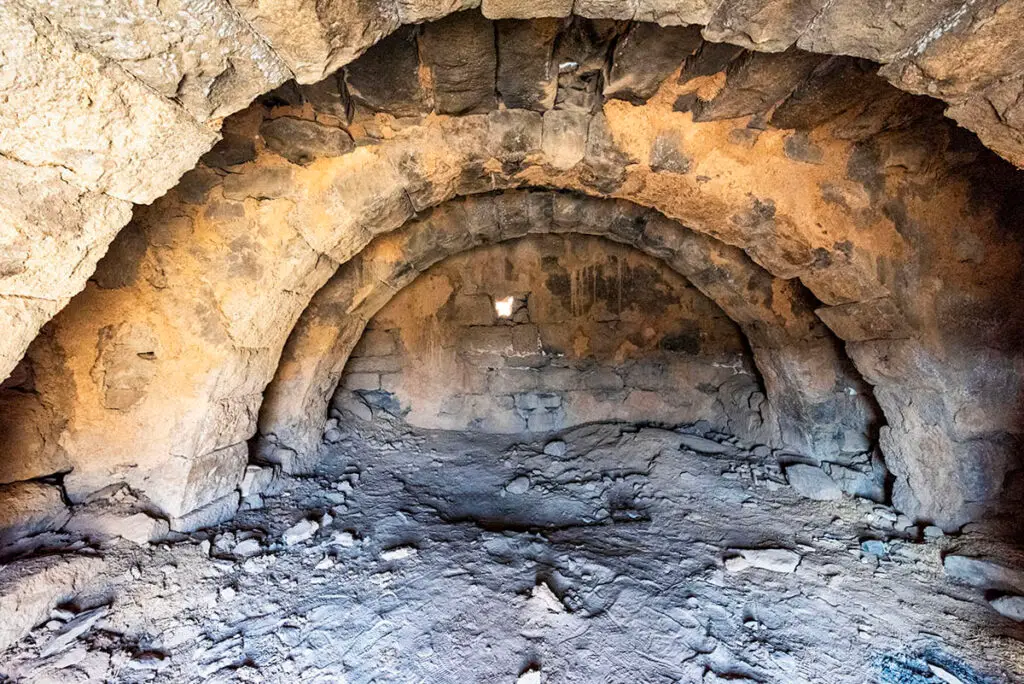
Some spaces inside the fort are still roofed. Basalt arches carry long stone slabs, the corbelled construction typical of the Hauran, where timber was scarce.
Water was the key to a fort in the basalt desert. Archaeologists describe a rock-cut cistern in the courtyard roofed in the same way, a postern near the south-west tower leading to a walled cistern outside, and an oval reservoir about 100 m north-east of the fort.
Stone roofsCorbelled archesCisterns
Look for
- The arches under the roof
- The long roof slabs
- Plaster on the walls
History & significance
From frontier fort to monastery
Deir Al-Kahf began as a small Severan fort around AD 200, was enlarged in AD 306 and repaired in the 360s–370s. It later became a monastery, and in the Umayyad period a farm.
- c. 200A small fort beside the Roman road
- 306The fort is enlarged under the Tetrarchy
- 6th c.A monastery with a chapel
- 1904Princeton expedition makes the first plan
 ProfileQasr Deir Al-Kahf: the full storyHistory, the two building phases, the monastery and the timeline. About 3 min read.Read the profile →
Plan your visit
Everything you need to know before you go
Deir Al-Kahf is in the north-east, between Mafraq and the Iraqi highway, reached from Highway 10 via Salihiyyah or by the road north from Al-Bishriyya. The fort stands in the village, behind the police station, and is accessible by ordinary car via village roads, with roadside parking.
Good to know: the site is fenced and unstaffed, with no facilities; check the available entrance locally. Walls and towers are unstable in places, so don’t climb on them, and be respectful of the village houses around the fort.
Opening hoursOpen accessUnstaffed site · visit in daylight
Entry ticketFreeNo ticket office
Time to visit30 minCombine with Jawa and Umm El-Jimal
From Amman125 kmAbout 2 hr 15 min via Mafraq and Highway 10
LocationDeir Al-Kahf village32.2812° N, 36.8380° EGet directions
Opening hours and prices checked October 2026. Spotted a change? Let us know
On site
What you’ll find at Qasr Deir Al-Kahf
Not on site: visitor centre, ticket office, toilets, designated parking, museum, guide, food & drinks, market / shop, hotels
Access: no 4x4 needed
When to go
Spring and autumn are best. Summers are hot, and winters on the basalt plateau can be cold and wet.
J
F
M
A
M
J
J
A
S
O
N
D
BestGood, cooler or warmVery hot
Tip: compare the fine bossed blocks of the first fort with the rougher stones of AD 306: it is the easiest way to see the two phases.
Before you go
Services are limited out in the desert.
- Water and snacksSmall shops in the village
- Sun hat and sunscreenVery little shade outside
- Comfortable shoesUneven, stony ground
- Cash in Jordanian dinarsFor small purchases
- Toilet paperBring your own, just in case
Common questions
Quick answers before you set off.
Do I need a 4x4?
No 4x4 required. The fort is in the village and accessible by ordinary car via village roads.
Is there an entrance fee?
No. The fort is unstaffed and free to visit.
Why is it called a monastery?
Deir al-Kahf means “Monastery of the Cave”. After the Roman army left, the fort was used as a monastery, especially in the 6th century, and a chapel was built in the courtyard.
How old is it?
A small fort was built around AD 200. It was enlarged in AD 306 and repaired in AD 367–375.
Can I visit it on a tour?
Yes. It is the first stop on our Expedition to Jawa & Umm El-Jimal.
What should I wear?
Comfortable, closed shoes for uneven ground, and light clothing that covers your shoulders and knees, which is respectful in rural Jordan and protects you from the sun.
Combine with
Deir Al-Kahf is on the edge of the Black Desert, close to Jawa. Drive times are approximate, from Qasr Deir Al-Kahf. Jawa: allow additional time for the rough-track approach; use a suitable vehicle and someone familiar with the route.
Private tours
A private day tour that includes Qasr Deir Al-Kahf
The tour is just for you: your own vehicle and driver, hotel pickup in Amman, entry tickets included, and one fixed price for up to three travellers.
Private: only your group
Your own vehicle & driver
Hotel pick-up in Amman
Entry tickets included
 from$250per group (1–3) · 178 JOD
Tour 1 · Full day · Private
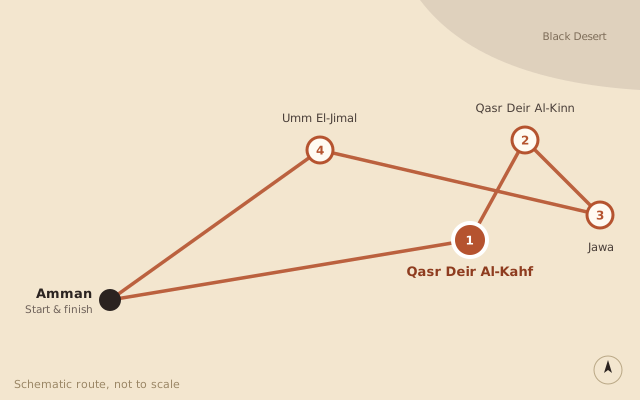
Expedition to JAWA and Umm El-Jimal
Venture far beyond the usual tourist routes on this exclusive full-day expedition into Jordan’s remote northern desert. This private journey takes you to some of the country’s most ancient and least-visited archaeological sites, where history, landscape, and isolation combine to create a truly unique experience.
HistoryArchitectureBlack DesertBasalt towns4 stops
Duration7–8 hr
Pick-up8 or 9 AM
Group1–3, private
Included
- Private luxury transfer
- Entrance fees
- Bottled water, soft drinks, snacks
- Coffee/tea (on request)
- WiFi, Phone charger
Not included
- Professional on-site (local) guide
- Personal expenses
- Lunch
CancellationFull refund if you cancel at least 24 hours before the start. No refunds or changes within 24 hours.
Pick-upFrom your hotel lobby or home in Amman, 5 minutes before your chosen start time.
BringComfortable shoes, sun hat, sunblock and sunglasses. Tours run in English.
Explore this site
More from Qasr Deir Al-Kahf
Panoramas, walk-throughs, photos and stories about this site.
ProfileQasr Deir Al-Kahf: history & architecture Photo albumQasr Deir Al-Kahf: A Basalt Fort in Photos
 360°360° panoramaQasr Deir Al-Kahf: 360° Panorama
Nearby