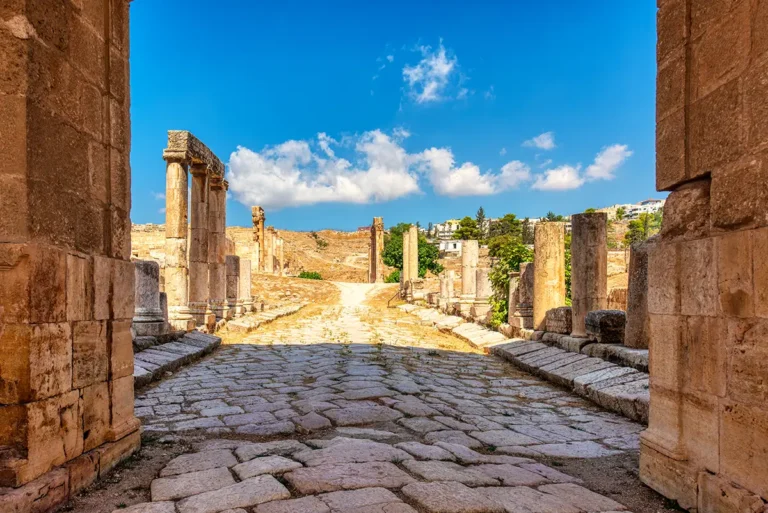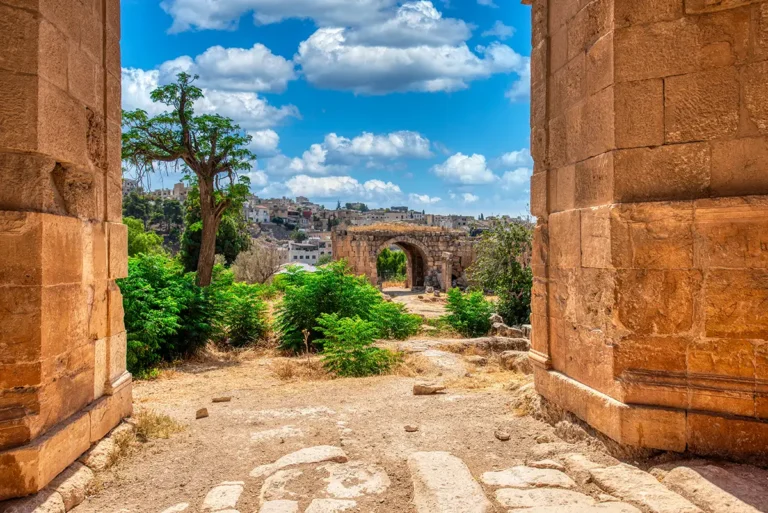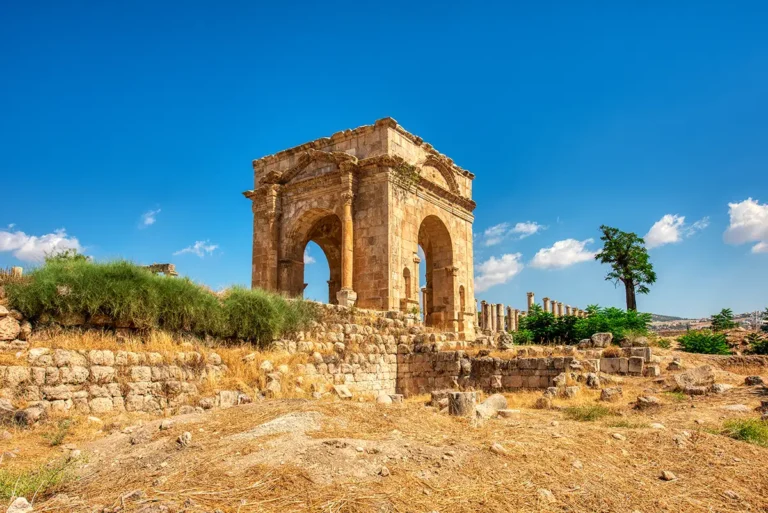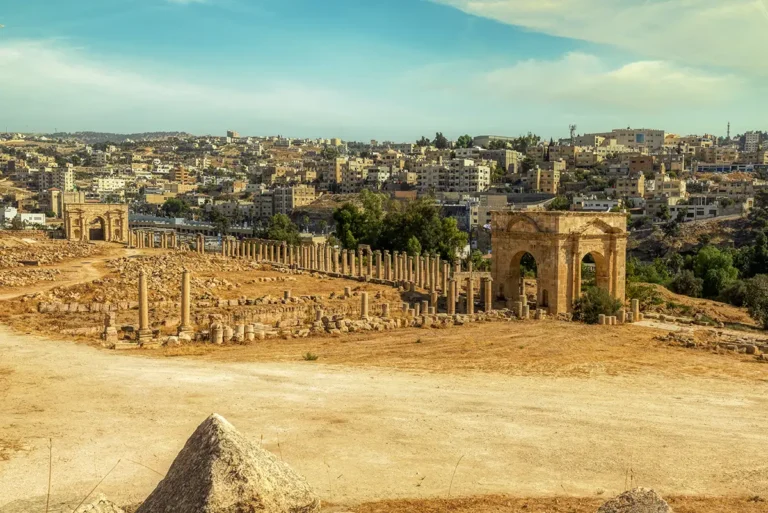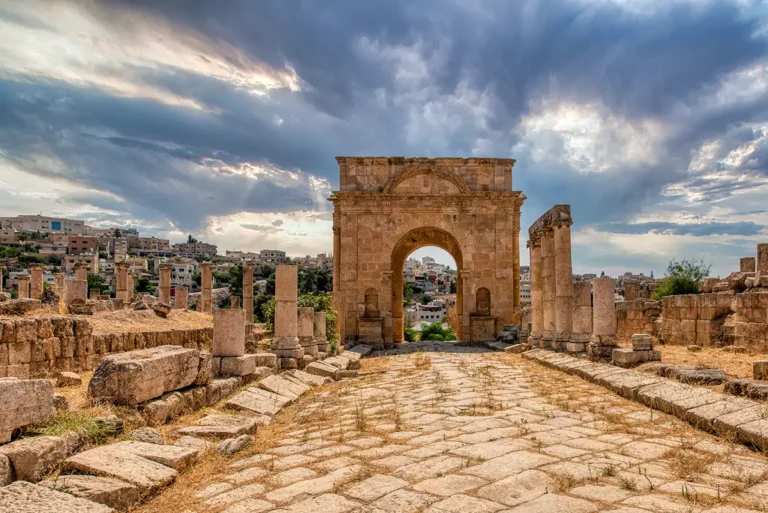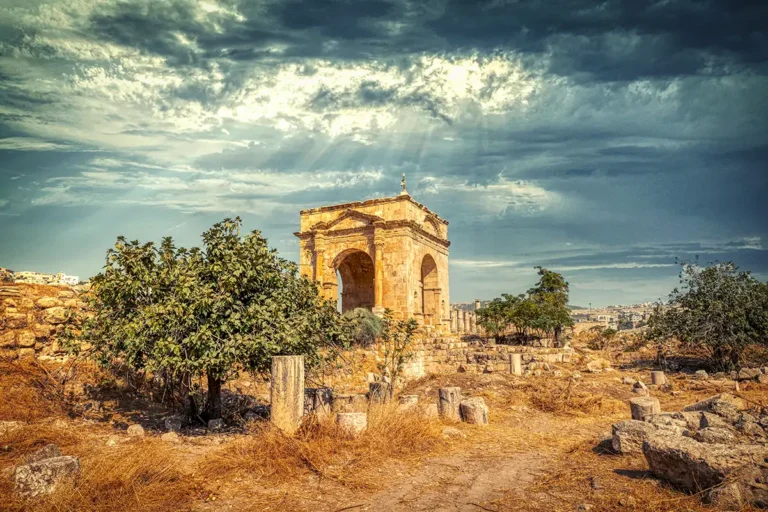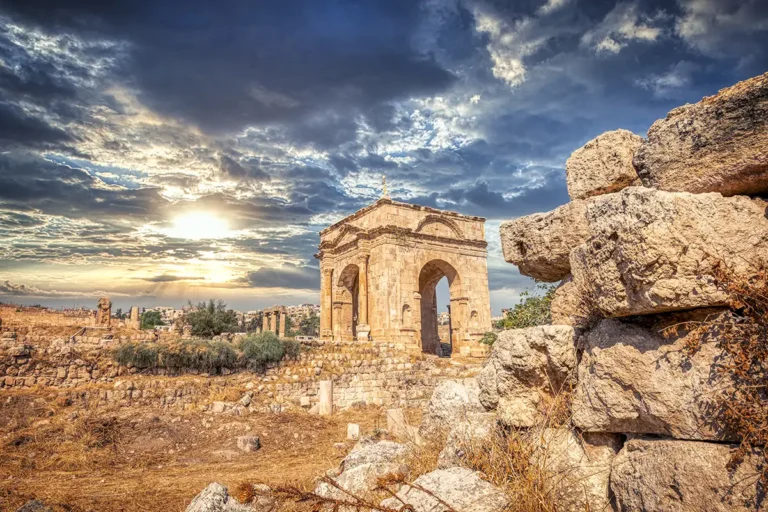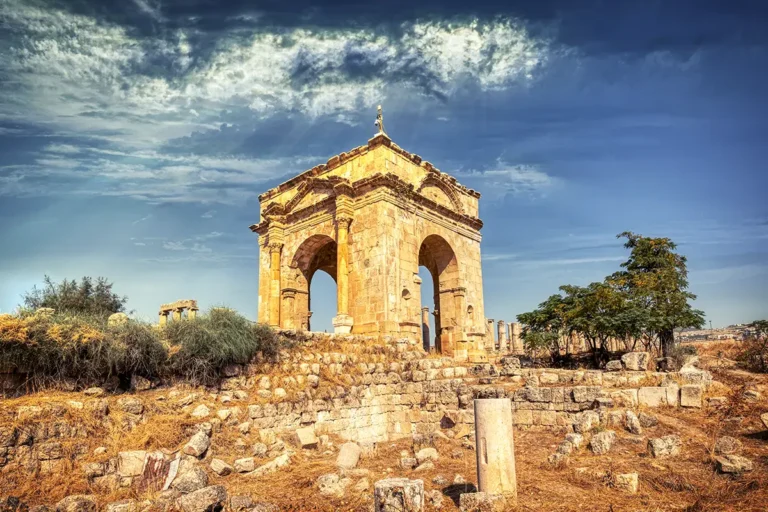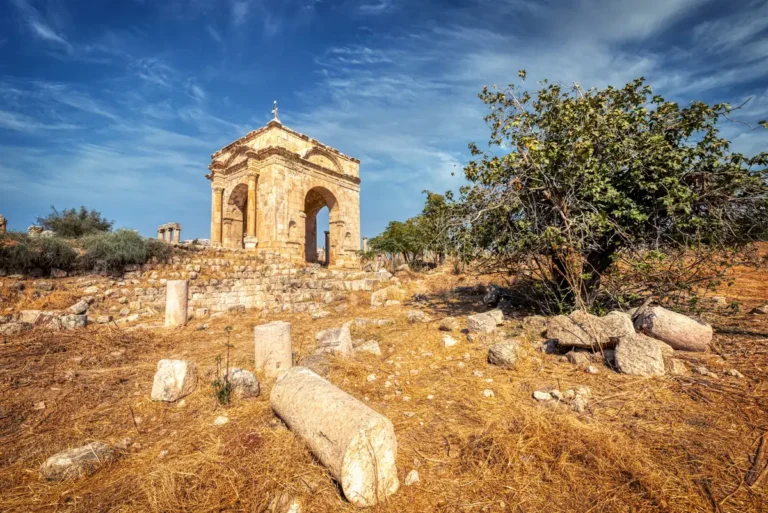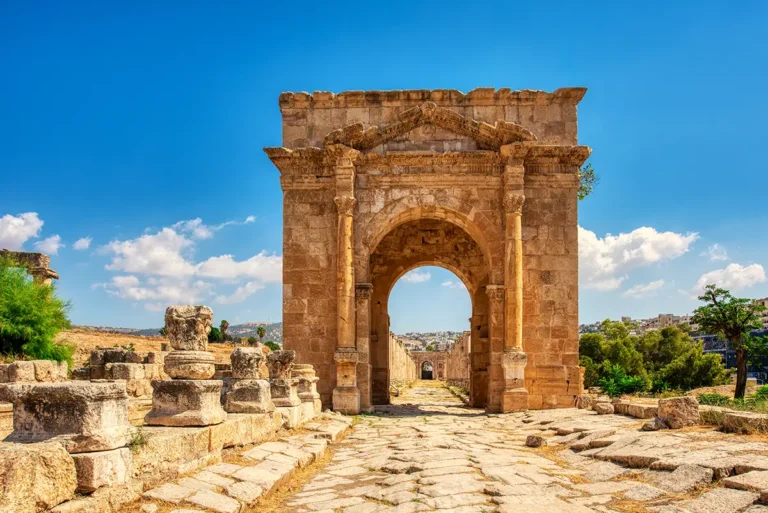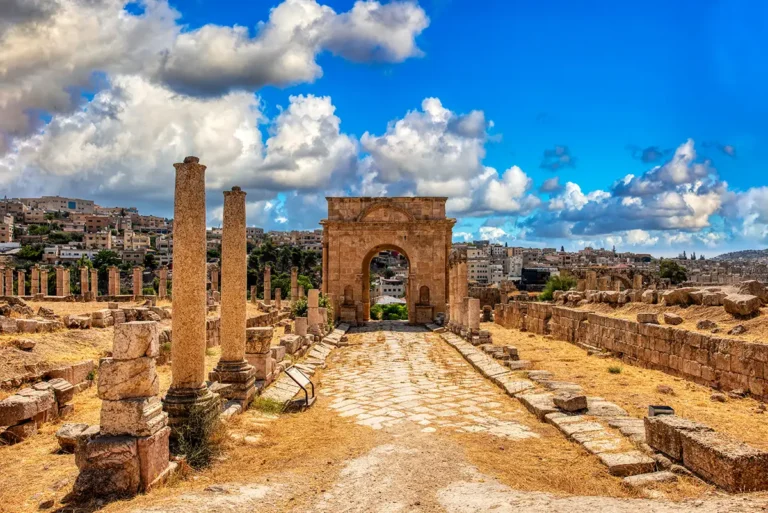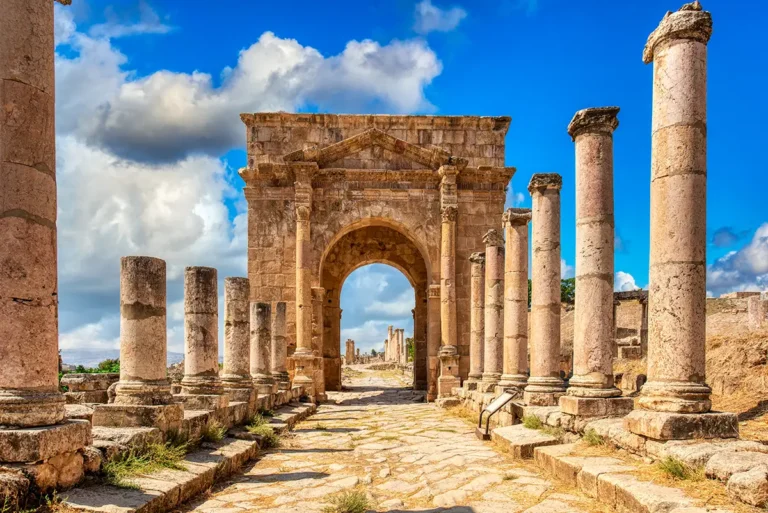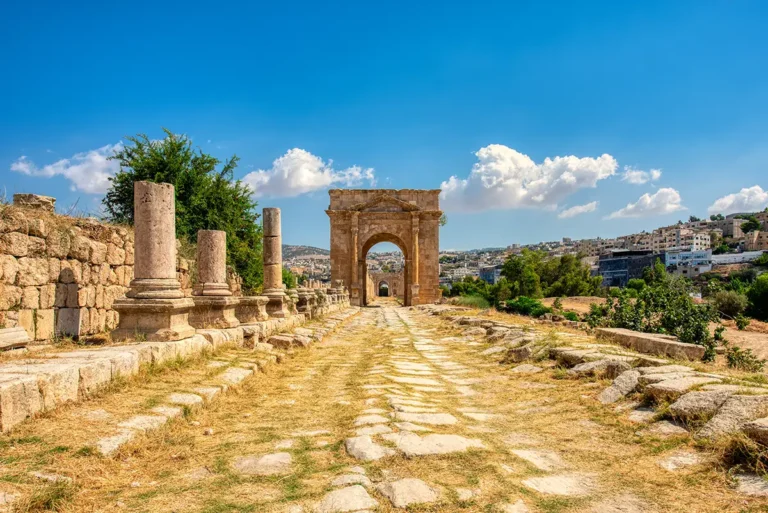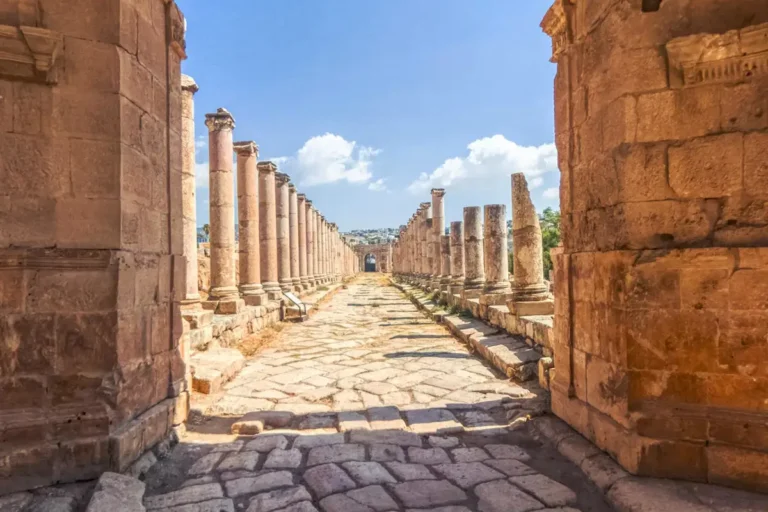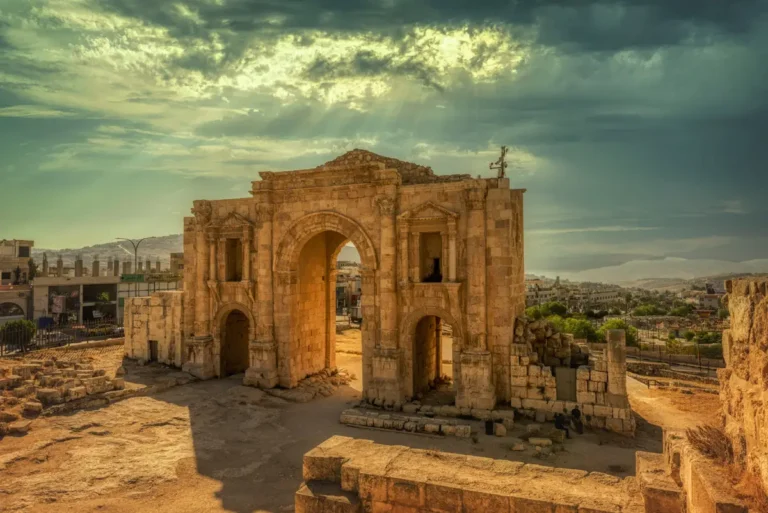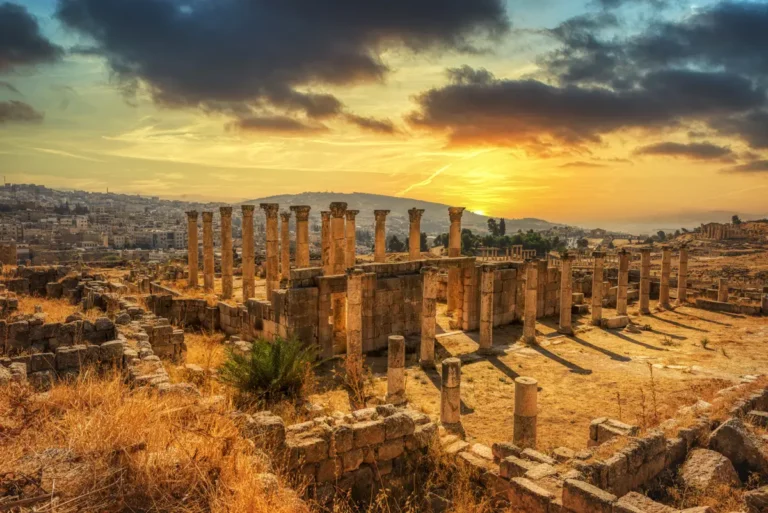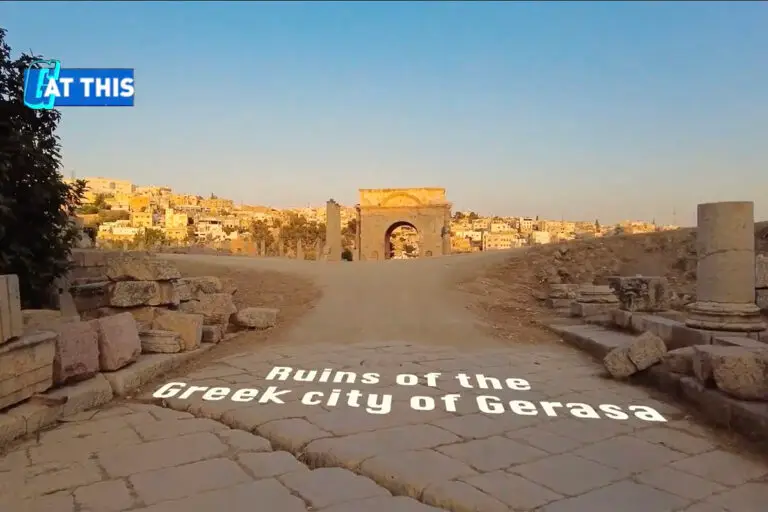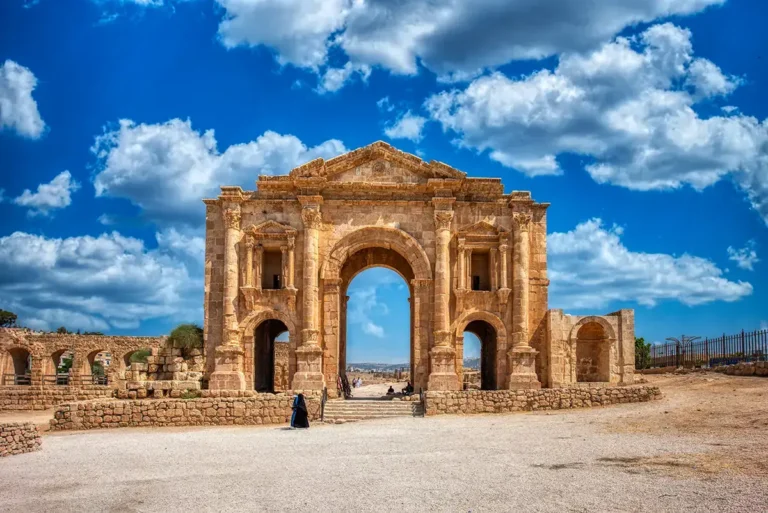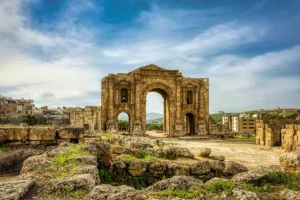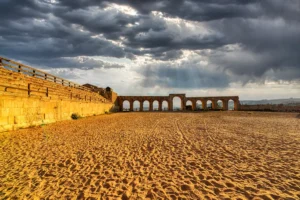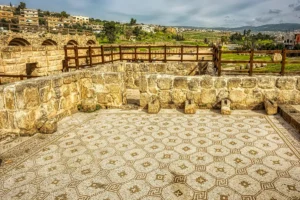
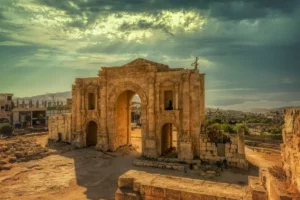
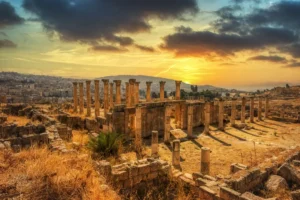
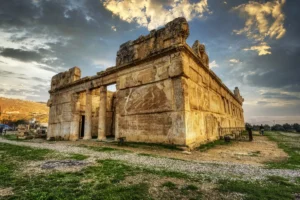
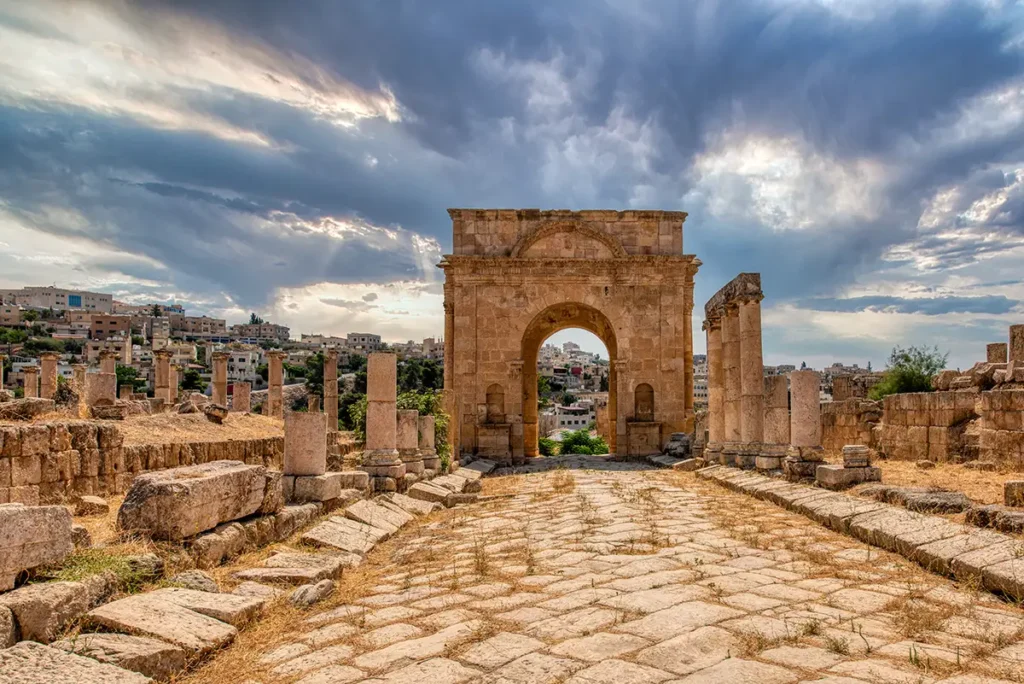
At the northern crossroads of ancient Gerasa, the North Tetrapylon and North Decumanus reveal Roman town planning at its most deliberate. Here, the great north–south Cardo Maximus met an important east–west avenue, creating a point where movement, architecture and civic display converged. The tetrapylon—a four-sided monument with an opening in each direction—once gave monumental form to that crossing, while the North Decumanus led west toward the North Theatre, the civic basilica and agora (Civic Complex), and the West Baths.
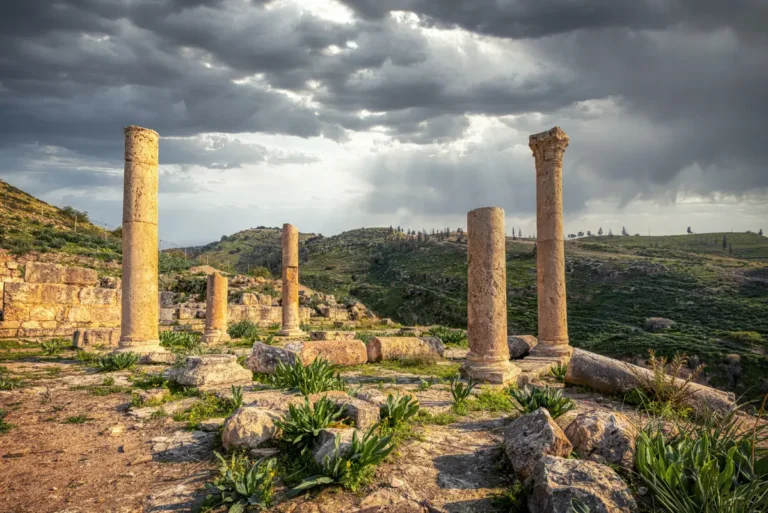
Although less famous than the Oval Plaza or the Temple of Artemis, this area rewards visitors who slow down. Its paving, curbs, colonnades and drainage features make the ancient city feel unusually tangible. Rather than simply looking at a ruin, you can read how pedestrians, carts, officials and theatre audiences moved through Gerasa nearly two thousand years ago.
The North Tetrapylon & Decumanus at a Glance
Location: Jerash Archaeological Park, Jordan (the major intersection along the northern stretch of the Cardo Maximus)
Built date: Late 2nd century AD (around 165–170 AD, during the reign of Emperor Marcus Aurelius)
Purpose: A monumental crossroads monument, decorative city arch, and transit junction
- Dimensions: The core structures form a near-perfect square, measuring 11.45 meters (37.5 feet) by 11.40 meters (37.4 feet) at the base
- Street connection: Runs west from the tetrapylon past the North Theatre toward the West Baths
- Architectural Style: High Roman Imperial style featuring a tetrapylon (four-pillared arch) built over an intersection
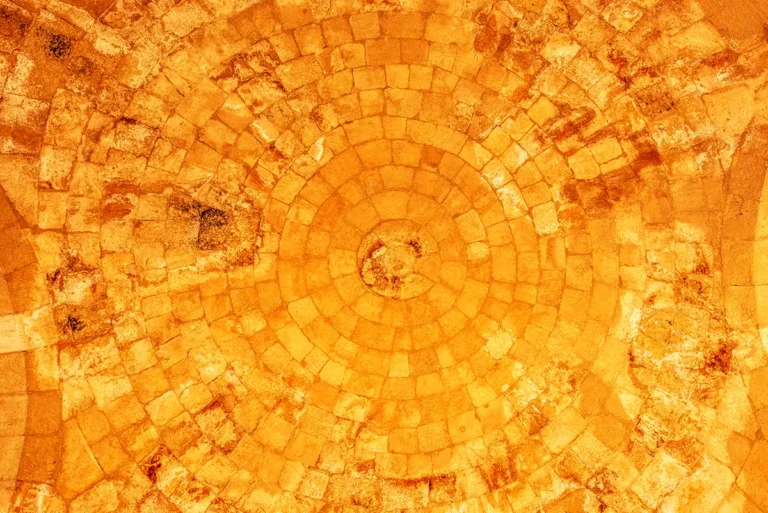
- Key Feature: Four massive, interconnected limestone arches forming a vaulted internal dome
- Nearby monuments: North Theatre, Agora and Civic Basilica, West Baths, Church of Bishop Isaiah, Sanctuary of Artemis and the North Gate
- Current Status: Extensively restored and open to the public; serves as the northern structural anchor of the Cardo.
First Impressions
Approaching from the Cardo, the North Tetrapylon appears less like a freestanding monument than a carefully designed hinge in the city. The broad north–south avenue suddenly meets a paved cross street, and the surviving stonework frames views in several directions at once. Even in ruin, the junction feels purposeful: it is easy to imagine the original monument directing your eye toward the North Theatre to the west, the North Gate to the north and the great civic centre to the south.
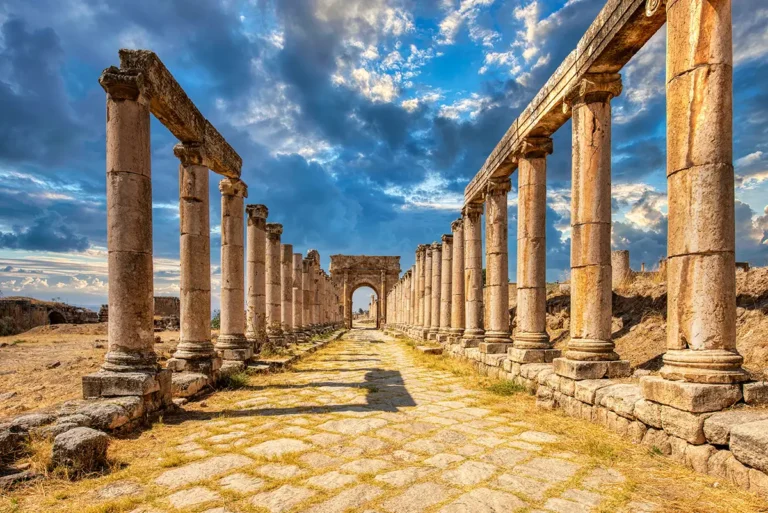
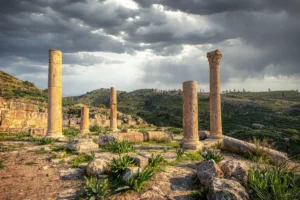
The North Decumanus is equally memorable. Its paving has a quiet beauty, particularly in the low sun, when every slab, curb and drainage opening becomes visible. This was not an informal lane. It was a formal urban street, built with a raised central crown to shed rainwater and bordered by porticoes that once sheltered shops, walkers and visitors.
Historical Context and Origin
Gerasa’s earliest urban core was reshaped dramatically during the Roman period, when new streets, monuments and sanctuaries expressed the city’s prosperity within the province of Arabia. The Cardo Maximus became the principal north–south avenue, while east–west streets connected it to neighbourhoods, civic buildings and religious complexes.
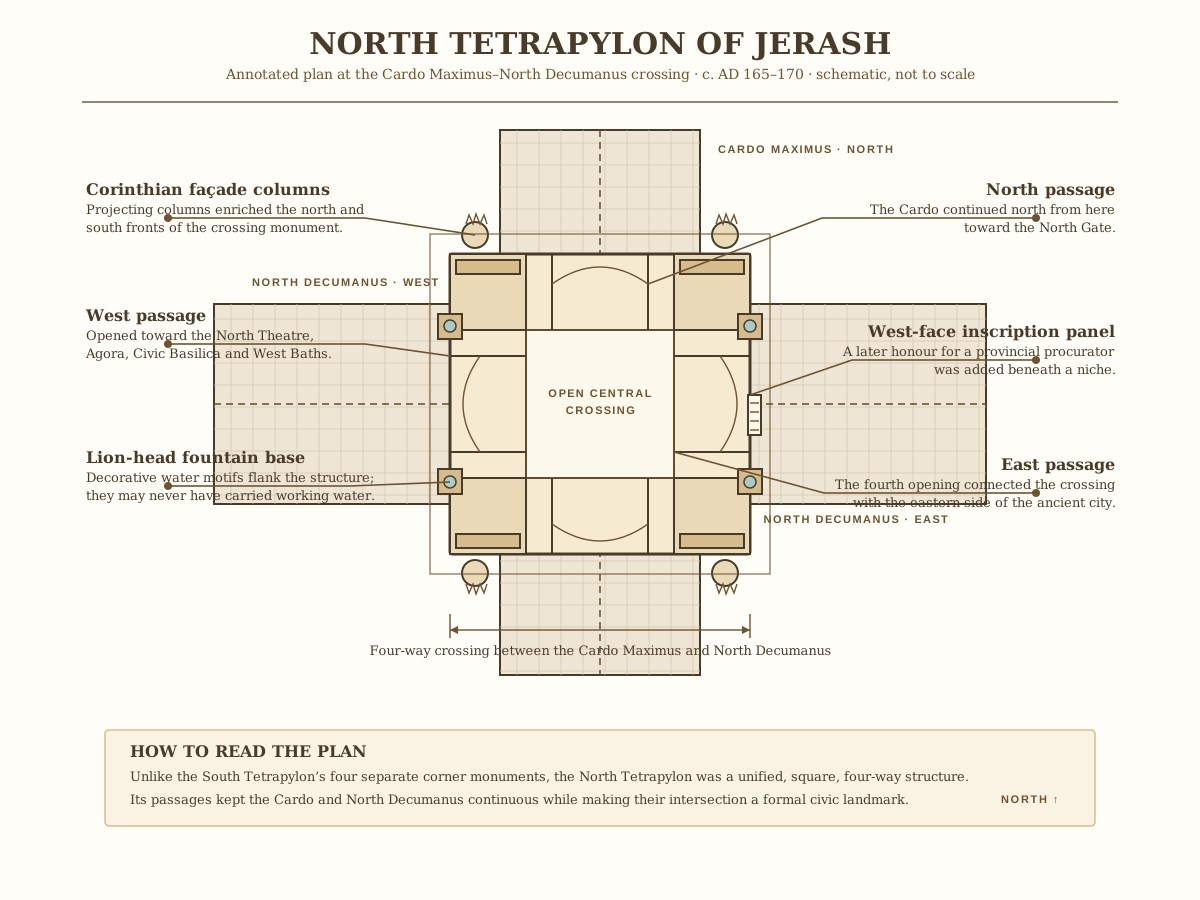
The North Tetrapylon was likely erected around AD 165–170, at a time when Gerasa was refining and monumentalising its street network. Unlike the South Tetrapylon, which is better understood as four separate corner monuments, the North Tetrapylon was a true tetrapylon: a square structure with four openings that allowed traffic and pedestrians to pass through the intersection in every direction.
The North Decumanus received an impressive architectural treatment in the late second century. Its Ionic colonnades resemble those at the north end of the Cardo, but they appear to have been assembled from reused architectural pieces when the central Cardo was widened and remodelled.
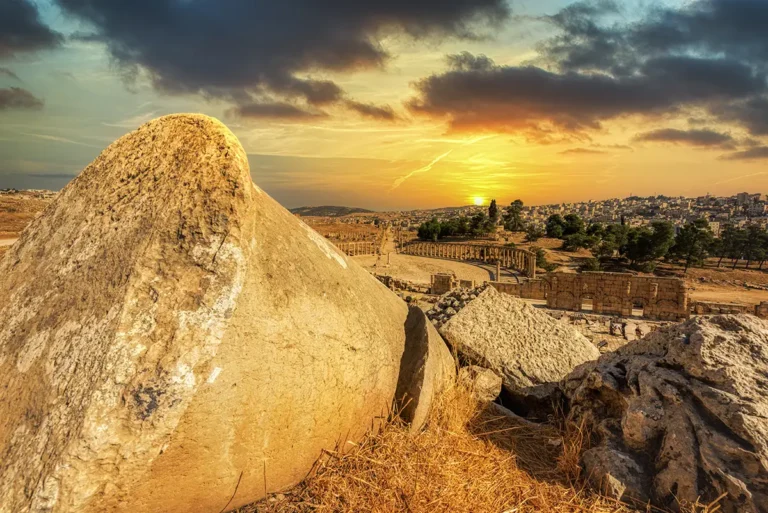
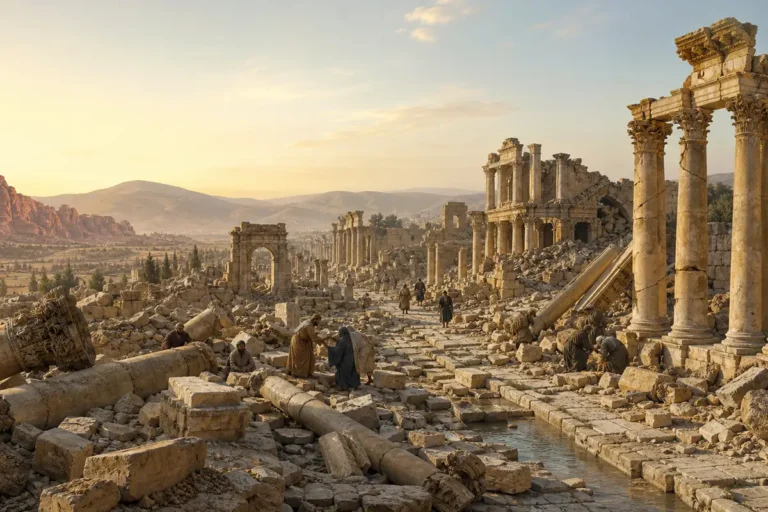
In Late Antiquity, the surrounding quarter changed again. Churches, civic buildings and domestic structures altered the Roman cityscape, while older monuments were repaired, reused or partly dismantled. Earthquakes, abandonment and stone robbing gradually reduced the tetrapylon and colonnades to their present state. Modern excavation and conservation have made the street and crossing legible once more.
Where Are the North Tetrapylon & Decumanus?
The North Tetrapylon stands where the Cardo Maximus crosses the North Decumanus, north of the Nymphaeum and the main church complex. From the Cardo, turn west at the intersection and follow the North Decumanus toward the North Theatre. The street continues through the civic quarter, passing the Agora and Civic Basilica area before reaching the West Baths.
This is an excellent section to include after visiting the Cathedral, Nymphaeum and Sanctuary of Artemis. It also provides a natural route toward the North Theatre and, later, the North Gate.
Architectural Design and Features
The North Tetrapylon was designed as a compact square monument with a passage on each side. Its four openings created a controlled but visually open centre, allowing the Cardo and Decumanus to remain continuous while giving the crossing greater prestige.
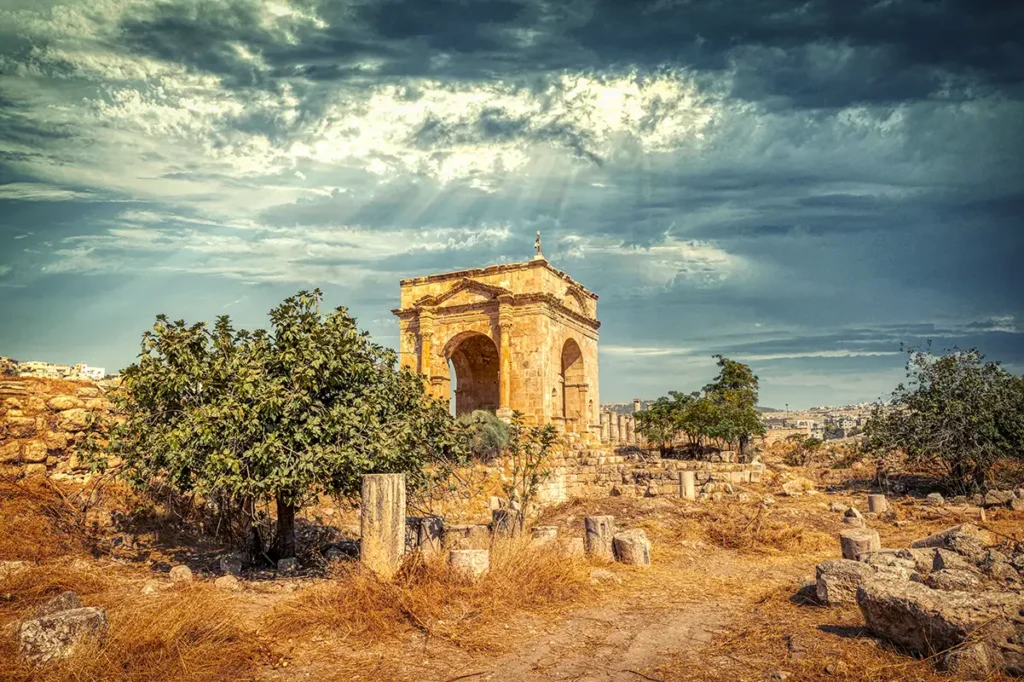
The reconstructed monument visible today should be read as an interpretation of the original structure, based on surviving foundations, architectural fragments and archaeological study. Its original upper form is uncertain in detail, but it probably carried a richly decorated superstructure. Some reconstructions suggest a domed or vaulted crown, while other details remain open to debate.
The façades were elaborated with projecting Corinthian columns. Beneath them were tall bases decorated with lion-head fountain motifs. These striking features may have been primarily ornamental: despite their fountain-like form, they do not appear to have been connected to an operating water supply.
An inscription was later added on the west side, honouring the provincial procurator Decimus Junius Arabianus Socratus and his family. It is a useful reminder that monuments in Gerasa were not static. They could be repaired, rededicated and given new civic meanings generations after their construction.
The Decumanus: A Street Built for Movement
The North Decumanus is among the best places in Jerash to understand the engineering of a Roman street. The paved carriageway is subtly raised in the middle, forming a camber that guided rainwater toward the edges. This simple profile helped protect the surface and keep the street passable.
The paving stones still retain much of their original arrangement. Along the route, look for stone covers over the sewer line; several preserve iron lifting rings. Such details are small but important. They show that Gerasa’s streets were serviced infrastructure, not merely decorative avenues.
The street was flanked by porticoes. Their colonnades provided rhythm and shade, and they created a formal edge between the public roadway and the buildings behind. Archaeological analysis places the roadway at roughly 7.4 metres wide, with broad porticoes to either side; the complete street zone could reach almost 20 metres from one portico back wall to the other.
A Civic Crossroads
The North Tetrapylon was not isolated. It stood beside one of Gerasa’s most important civic districts. To the west and south-west were the Agora and Civic Basilica, spaces associated with assemblies, administration, public business and legal activity. The nearby North Theatre, possibly used for performances as well as civic and religious gatherings, added another layer of public life.
The effect would have been carefully choreographed. A person walking north along the Cardo could see the crossing monument ahead; turning west, they entered a street framed by colonnades and leading toward the theatre and public buildings. The architecture organised traffic, but it also announced that this was a city of institutions, spectacle and order.
Beyond the North Tetrapylon
North Theatre
West of the tetrapylon, the North Decumanus leads toward the North Theatre. Smaller than the South Theatre, it was an intimate but important public building used for performances, speeches, poetry and gatherings. The theatre’s relationship to the Decumanus is deliberate: its entrance court opened toward the street, connecting entertainment and civic life.
Agora and Civic Basilica
Near the North Theatre lay the Agora and Civic Basilica, a broad public zone that formed part of Gerasa’s civic centre. The basilica was a large hall for official business, meetings and possibly legal proceedings, while the agora provided an open area for assembly and exchange.
West Baths
Continuing west, the North Decumanus reaches the West Baths. Roman bath complexes were essential social institutions, combining bathing, exercise, conversation and civic display. Their position at the end of the decumanus underlines the street’s role as a route through a dense and active urban district.
Sanctuary of Artemis
South-west of the junction rises the Sanctuary of Artemis, Gerasa’s great religious complex. The contrast is striking: the tetrapylon and street represent the city’s public movement and civic order, while the sanctuary’s terraces and monumental gateways express sacred authority and local identity.
The North Tetrapylon Inscription Honouring Decimus Junius Arabianus Socratus
The inscription was added to the north side of the North Tetrapylon’s west façade in the early 3rd century AD. It honours Decimus Junius Arabianus Socratus, an imperial procurator, together with his wife, Plotia Vindiciana, and their son, Decimus Junius Heliodorus. The dedication was made by Flavius Munatius, a centurion of the Third Cyrenaican Legion.
The North Tetrapylon Inscription Honouring Decimus Junius Arabianus Socratus
The inscription was added to the north side of the North Tetrapylon’s west façade in the early 3rd century AD. It honours Decimus Junius Arabianus Socratus, an imperial procurator, together with his wife, Plotia Vindiciana, and their son, Decimus Junius Heliodorus. The dedication was made by Flavius Munatius, a centurion of the Third Cyrenaican Legion.
Greek Text
The text below follows the published drawing supplied here. Square brackets indicate lettering lost in the damaged part of the block; accents have been added for readability.
Δέκιον Ἰούνιον Ἀραβιανὸν Σωκράτην
ἐπίτροπον Σεβαστοῦ καὶ Πλω-
τίαν Οὐινδικιανὴν γυναῖκα αὐτοῦ καὶ
Δέκιον Ἰούνιον Ἀραβιανὸν Ἡλι-
οδώρον υἱὸν αὐτῶν,
Φλάουιος Μουνάτιος [ἑκατόνταρχος λεγιῶνος]
τρίτης Κυρηναϊκῆς
Σεουηριανῆς [Ἀλεξανδριανῆς],
τοὺς πατρώνας τιμῆς χάριν.
English Translation
[Statues of] Decimus Junius Arabianus Socrates, imperial procurator; Plotia Vindiciana, his wife; and Decimus Junius Heliodorus, their son. Flavius Munatius, centurion of the Third Cyrenaican Legion, Severan Alexandrian, [dedicated them] to his patrons in their honour.
What the Inscription Means
This is a private honorific dedication rather than a civic decree. Flavius Munatius, a centurion of the Legio III Cyrenaica, dedicated statues—or possibly a statue group—to the procurator and his immediate family. By calling them patronai in Greek (τοὺς πατρώνας), he acknowledges a formal relationship of protection, support and obligation between an influential official household and one of its dependants or associates.
The phrase “procurator of the Augustus” (ἐπίτροπον Σεβαστοῦ) means an imperial procurator: an equestrian official acting on behalf of the emperor. Such officials handled major financial, administrative and legal responsibilities in a Roman province. The dedication therefore illustrates that Gerasa was not only a prosperous Decapolis city, but also a place where provincial administration and military personnel were visibly present.
The reference to the Third Cyrenaican Legion is especially significant. This legion was stationed in the province of Arabia, with its main base at Bostra. Its honorific title Severan Alexandrian associates the inscription with the reign of Emperor Severus Alexander, placing it broadly in AD 222–235. The dedication confirms a close connection between the legionary centurion, the provincial procurator and Gerasa’s prominent northern civic district.
A scholarly study confirms the identification of Junius Arabianus Socrates, his wife and son, and places him under Severus Alexander. Pierre-Louis Gatier, “Onomastique et présence romaine à Gérasa”
Destruction, Rediscovery, and Restoration
Like the rest of Jerash, the North Tetrapylon and Decumanus changed over centuries. Buildings were remodelled in the Byzantine period, while older architectural blocks were reused in new construction. The colonnades of the North Decumanus themselves may preserve this history: their materials were likely taken from parts of the Cardo that were dismantled when that avenue was widened.
Earthquakes, especially the devastating earthquake of AD 749, contributed to the collapse of many structures in Jerash. Over time, surviving stone was reused for later buildings, and parts of the city became buried beneath soil and vegetation.
Archaeological work in the twentieth century and later surveys in the north-west quarter have clarified the street’s route and its relationship with the tetrapylon, theatre and civic centre. The layout beyond the excavated section remains an area of research, particularly toward the north-west.
What to Look For
The four-way geometry: Stand back and imagine the tetrapylon as an open architectural frame at the crossing.
Lion-head bases: Look for the decorative fountain motifs on the monument’s bases.
The road camber: Notice how the street rises gently along its centre and falls toward the sides.
Sewer covers: Some stone covers still retain iron lifting rings.
Ionic colonnades: Compare their style with the colonnades of the northern Cardo.
Changes in stonework: Reused blocks, repairs and different construction techniques reveal the long life of the area.
Views toward the North Theatre: The street was planned to guide movement and sightlines toward the civic quarter.
Visiting Tips
Visit in the morning or late afternoon, when the low light brings out the texture of the paving. This section is often quieter than the Oval Plaza and South Theatre, making it ideal for photographs and for noticing small details.
Wear shoes with good grip. The stone paving is uneven, and the route toward the North Theatre and West Baths includes loose surfaces. Bring water, especially if you plan to continue to the North Gate afterwards.
For a logical route, walk north along the Cardo from the Nymphaeum, stop at the North Tetrapylon, follow the North Decumanus to the North Theatre and civic basilica, then return to the Cardo for the final walk to the North Gate.
Why the North Tetrapylon & Decumanus Matter
This crossroads shows that Roman urbanism was about more than impressive individual monuments. Gerasa’s planners used streets, drainage, colonnades, public buildings and carefully framed intersections to create a coherent city. The North Tetrapylon gave a moment of ceremony to daily movement, while the North Decumanus connected religious, civic, commercial and recreational spaces.
For visitors, it is one of the best places in Jerash to see the city functioning as a whole: not simply as a collection of ruins, but as an organised, sophisticated Roman community.
Frequently Asked Questions
No. Both mark important crossings, but the North Tetrapylon was a true four-sided monument with passages through its centre. The South Tetrapylon is understood as four separate corner structures rather than one unified building.
It linked the Cardo Maximus with the North Theatre, civic basilica, agora and West Baths. It was therefore an important route for public, commercial and social life.
Many are ancient, but the colonnades appear to have been assembled or enhanced later using reused pieces from the central Cardo. They are Roman in material and style, but not necessarily original to the first phase of the street.
No. It was a ceremonial and urban monument at an internal crossroads, not a city gate in the defensive wall.
The North Tetrapylon is south of the North Gate along the Cardo. The walk is short and pleasant, but the North Gate makes a worthwhile final stop after exploring the theatre and civic quarter.
Key Moments in History
Early 2nd century AD — The Cardo becomes Gerasa’s main urban spine
The great north–south avenue was laid out as the city expanded under Roman rule, creating the framework for later crossings, markets, temples and public buildings.
c. AD 165–170 — The North Decumanus and North Tetrapylon are monumentalised
Gerasa developed the northern east–west street as a formal collonaded route toward the North Theatre and civic centre. At its intersection with the Cardo, builders erected the North Tetrapylon: a true four-way monument that transformed the crossroads into a civic landmark.
Key Moments in History
Early 2nd century AD — The Cardo becomes Gerasa’s main urban spine
The great north–south avenue was laid out as the city expanded under Roman rule, creating the framework for later crossings, markets, temples and public buildings.
c. AD 165–170 — The North Decumanus and North Tetrapylon are monumentalised
Gerasa developed the northern east–west street as a formal collonaded route toward the North Theatre and civic centre. At its intersection with the Cardo, builders erected the North Tetrapylon: a true four-way monument that transformed the crossroads into a civic landmark.
Late 2nd century AD — The Cardo is widened and architectural elements are reused
Changes to the central Cardo appear to have supplied recycled Ionic columns and other architectural pieces for the North Decumanus, giving the street its impressive collonaded character.
Early 3rd century AD — The North Theatre and civic quarter gain importance
The nearby North Theatre was enlarged, while the North Decumanus became an increasingly important route between the Cardo, theatre, agora, civic basilica and West Baths.
AD 222–235 — An imperial procurator is honoured at the Tetrapylon
A Greek inscription on the west façade honoured Decimus Junius Arabianus Socrates, imperial procurator of Arabia, his wife Plotia Vindiciana and their son. The dedication, made by a centurion of the Third Cyrenaican Legion, shows the close presence of provincial administration and the Roman army in Gerasa.
4th–6th centuries AD — The district is adapted in the Byzantine city
Gerasa’s urban life continued, but the area’s setting changed as churches, domestic buildings and new civic uses developed around older Roman streets and monuments.
AD 749 — Earthquake damage accelerates decline
The major earthquake of AD 749 damaged Jerash severely. Collapsed structures, abandonment and later stone removal reduced the tetrapylon and its colonnades to ruins.
20th century to today — Excavation and conservation clarify the crossing.
Archaeological work revealed the plan of the North Tetrapylon, the excellent paving and drainage of the North Decumanus, and their connection to the North Theatre and civic centre. Today, the crossroads remains one of the clearest places to understand Roman movement and urban design in Jerash.