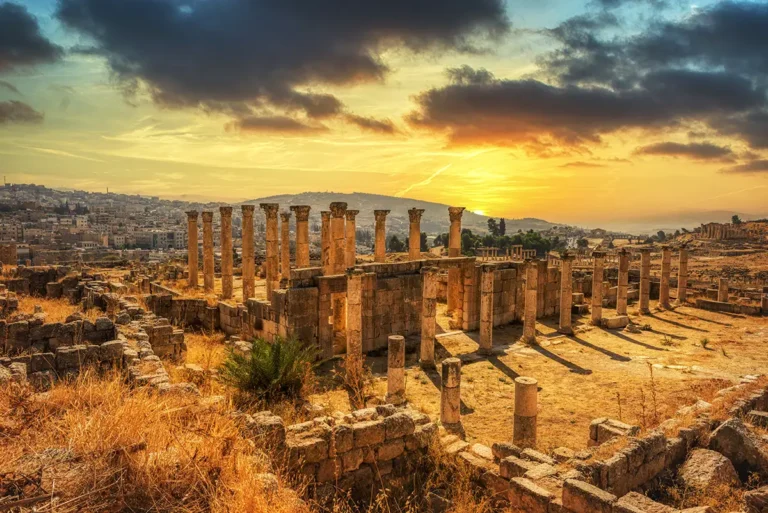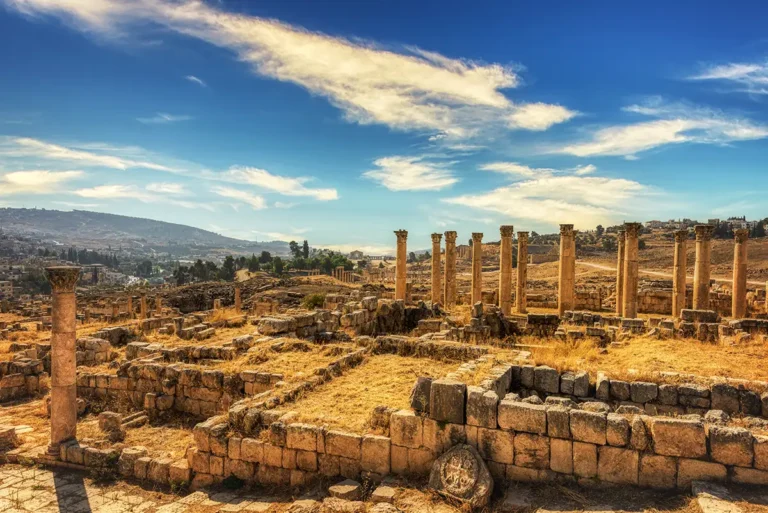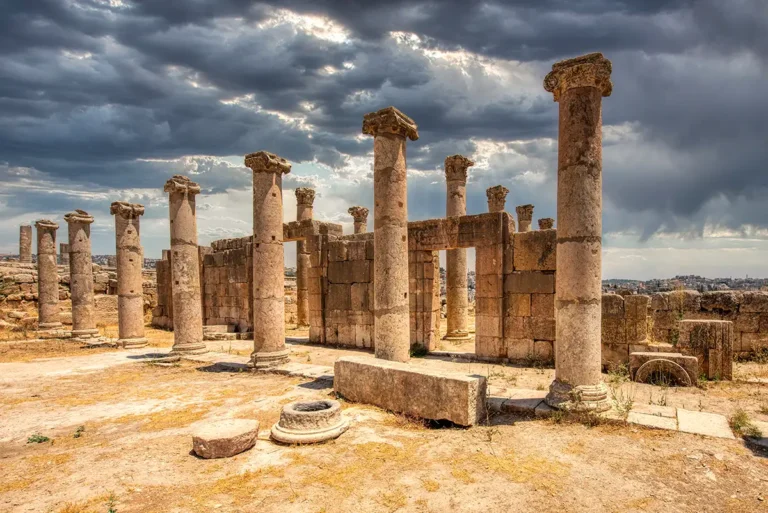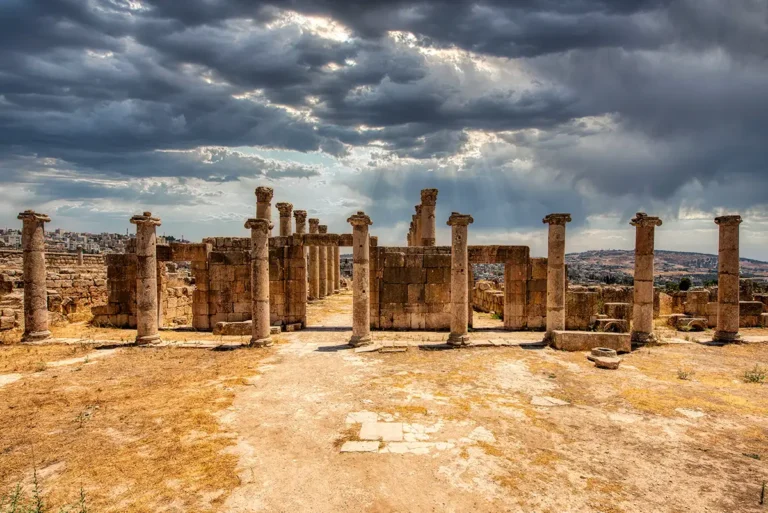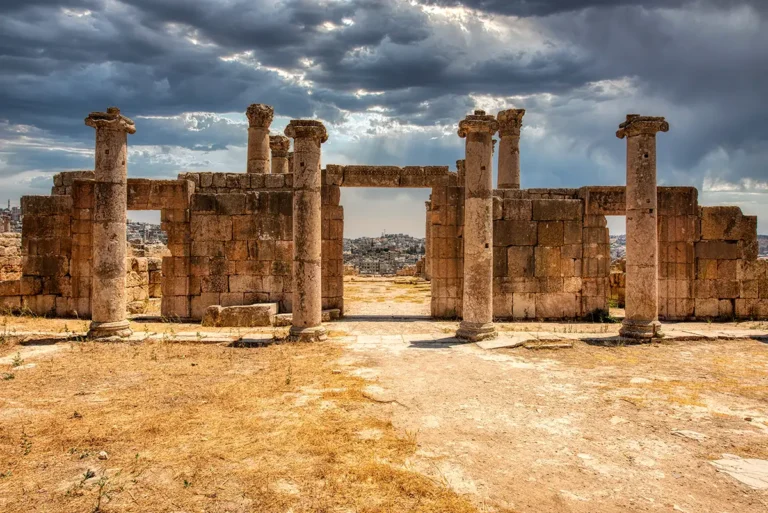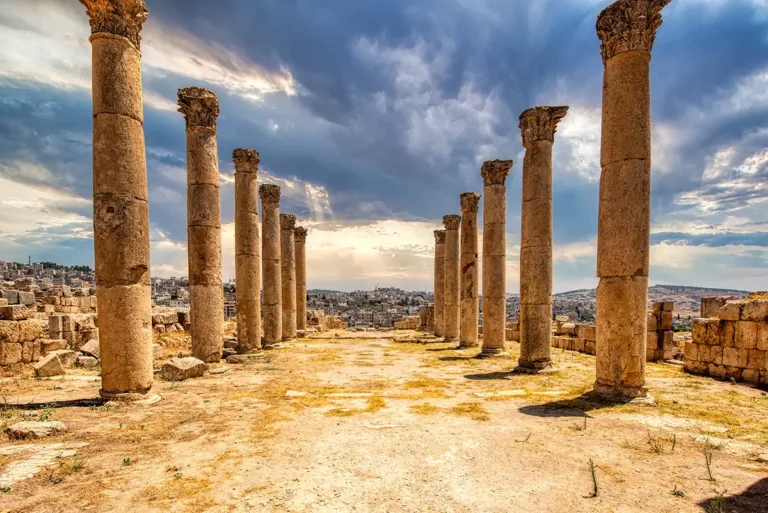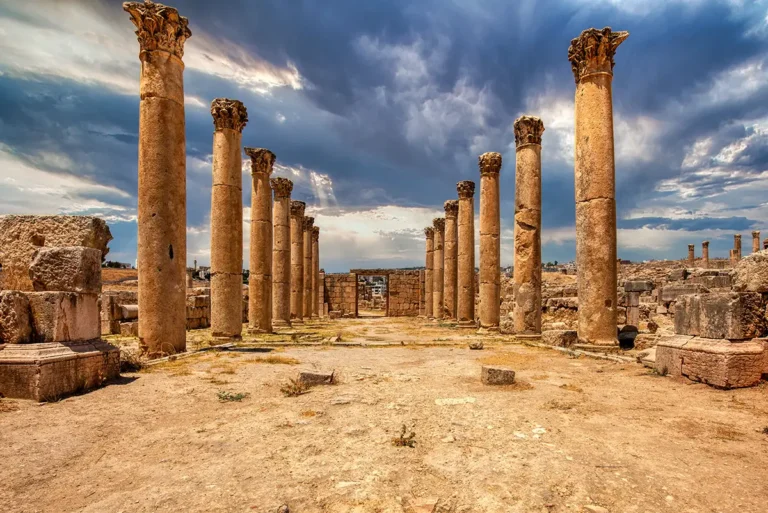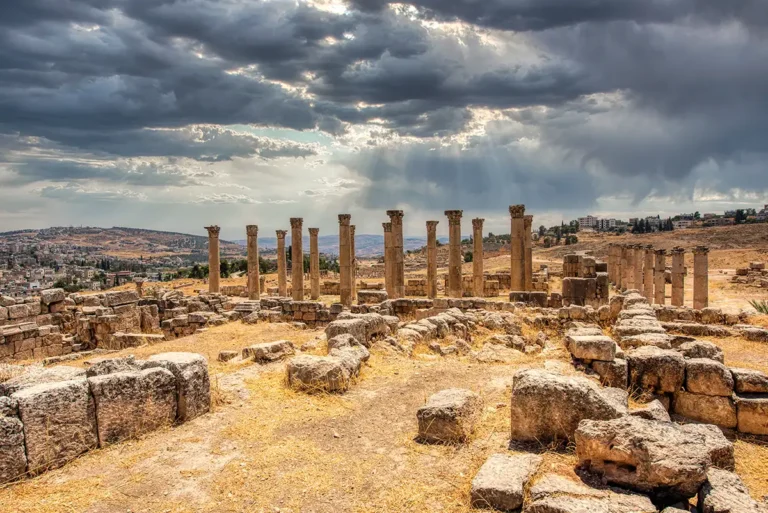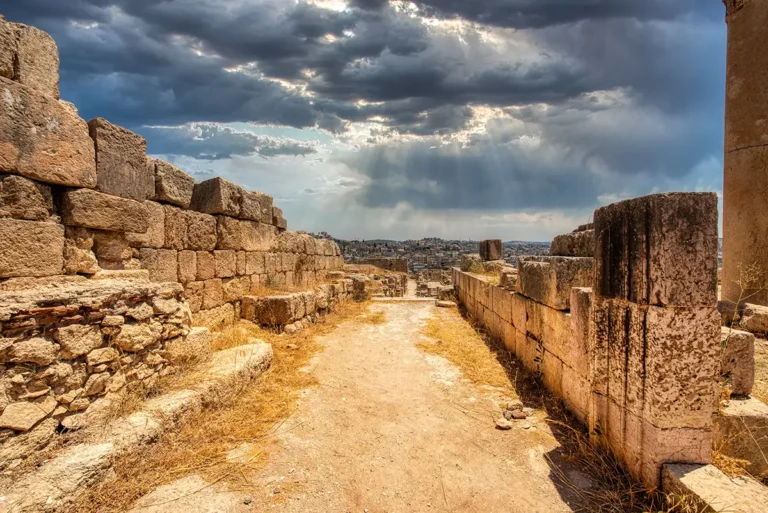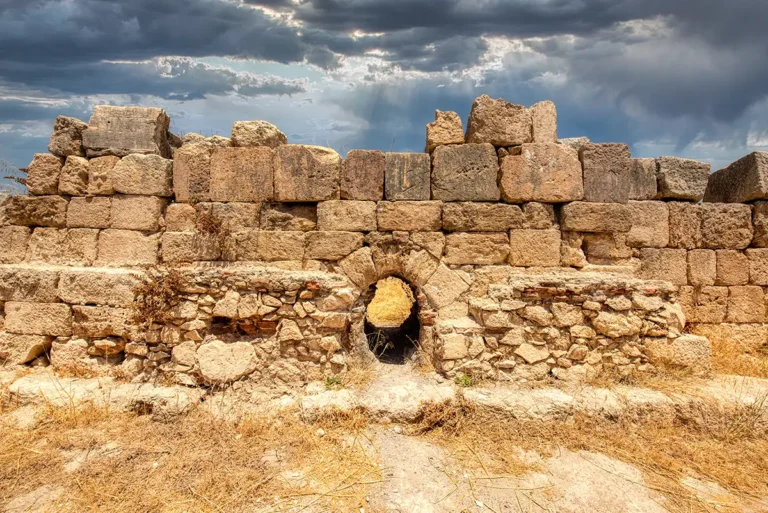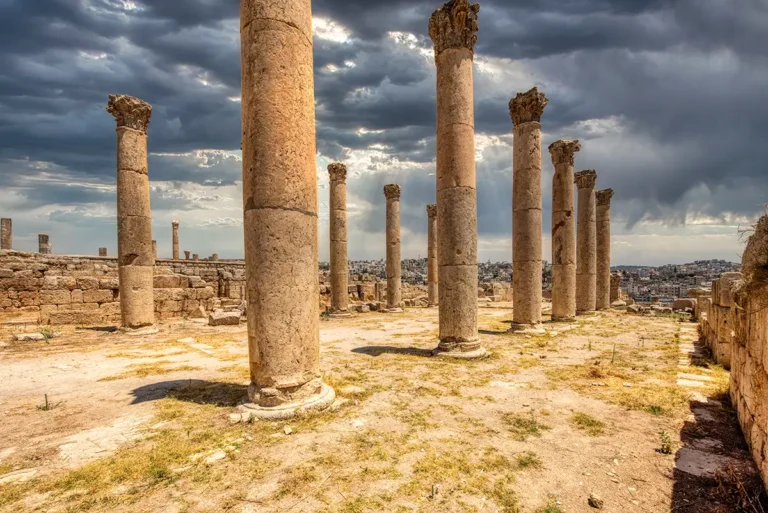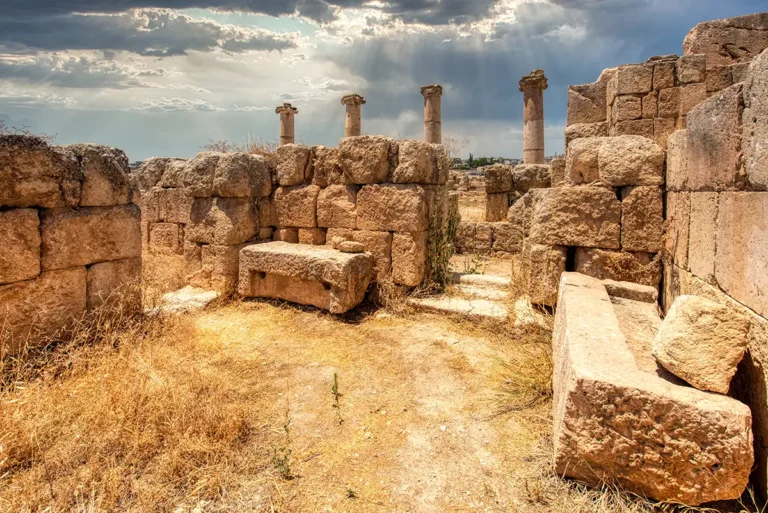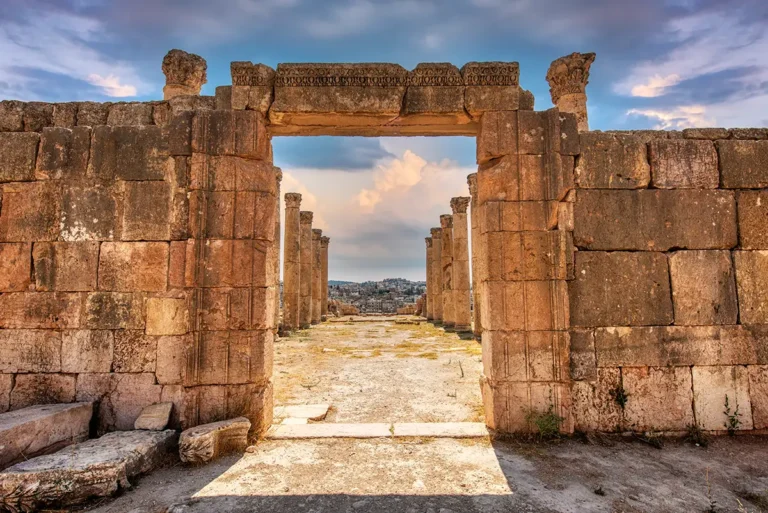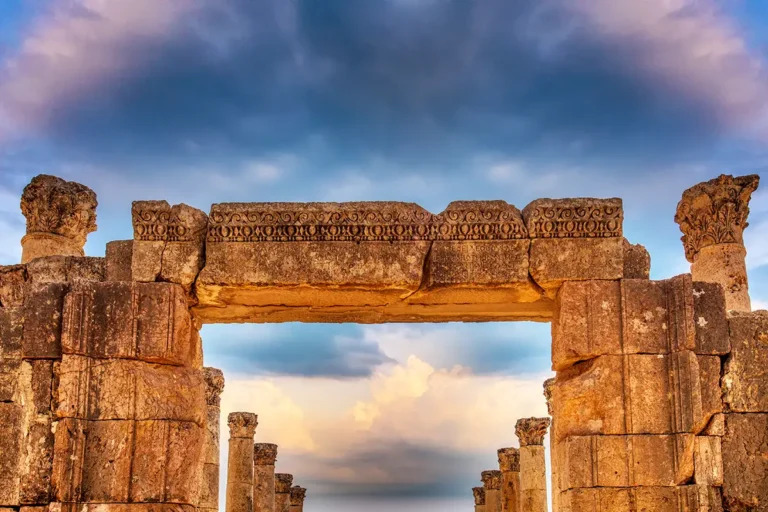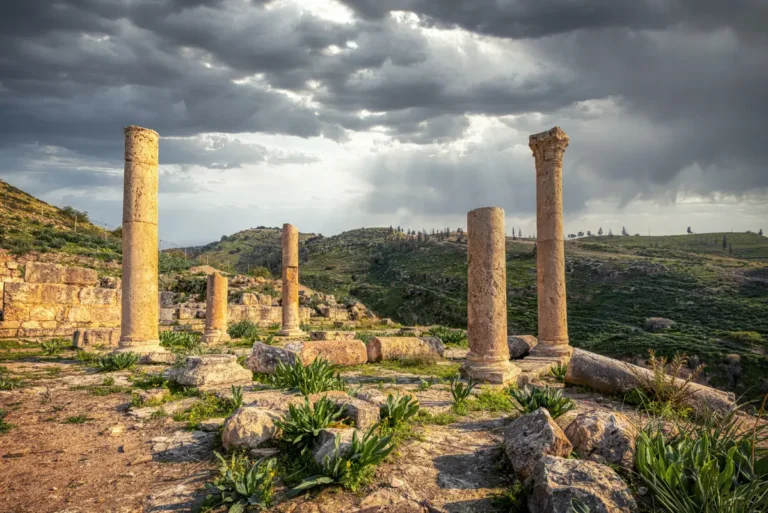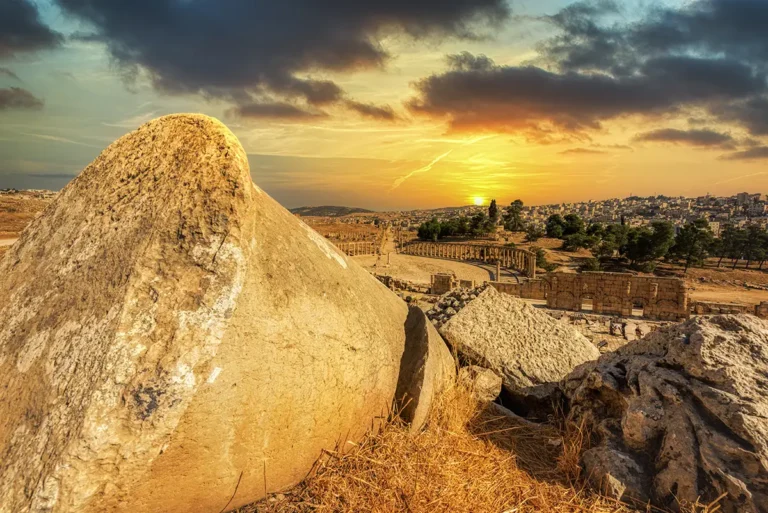
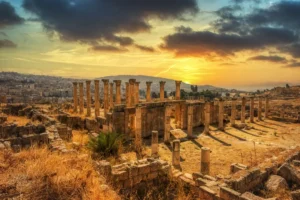
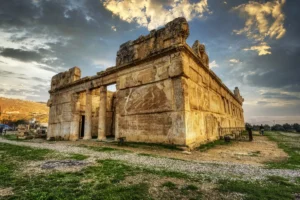
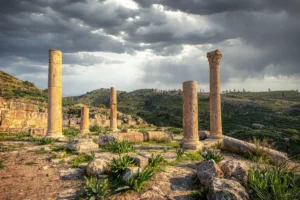
The Church of St Theodore is one of the most important Christian monuments in Jerash. Built in the late 5th century CE beside the Cathedral and close to the Sanctuary of Artemis, it reflects the moment when Christian institutions became central to the identity and architecture of late-antique Gerasa.
Unlike the grand Roman temples that dominate the skyline, St Theodore reveals its importance through a sequence of spaces: a monumental approach from the Cardo Maximus, a Fountain Court, stairways, a large basilica, chapels, a baptistery and service rooms arranged across a sloping site. It was not simply a church building, but a carefully planned religious complex designed for worship, procession, baptism and community life.
The Church of St. Theodore at a Glance
Location: Jerash Archaeological Park, Jordan (west of the Cardo Maximus, beside the Cathedral and near the Sanctuary of Artemis)
Built date: Begun in 494 AD and completed in 496 AD
Purpose: Three-aisled Byzantine basilica within a larger church complex
- Patron: Bishop Aeneas of Gerasa
- Dimensions: The main three-aisled church building itself measures 36 meters (118.1 feet) long by 22 meters (72.2 feet) wide
- Architectural Style: High Byzantine classic basilica layout with an integrated western atrium
- Key Feature: A preserved baptistery chapel and a clear connection to the adjacent Cathedral quarter
- Nearby monuments: The Cathedral, Cardo Maximus, Nymphaeum, Baths of Placcus
- Current Status: Fully excavated ruins open to the public.
First Impressions
The Church of St Theodore is impressive because it unfolds gradually. Rather than presenting a single façade, the complex leads visitors through a sequence of terraces, courtyards, columns and stairs before reaching the church itself. This makes the experience feel ceremonial: the approach is part of the architecture, not merely a route to the entrance.
The building occupies a slope near the great Sanctuary of Artemis. As you move through the complex, differences in level become especially noticeable. The church sits above the Fountain Court and the Cardo, allowing the architects to turn a difficult site into a dramatic processional landscape.
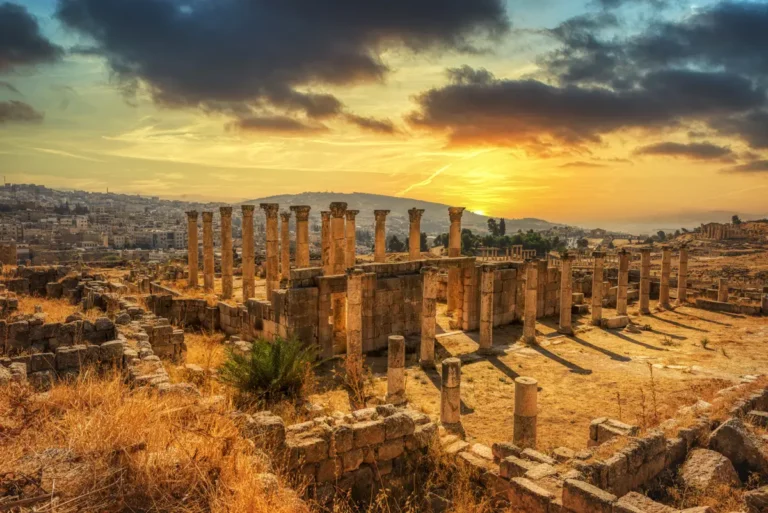
Even in ruin, the main basilica remains legible. Rows of columns once divided its interior, the apse marked the eastern sanctuary, and the surrounding rooms indicate that this was a complex religious institution rather than a simple hall for worship. The scale and richness of the site make it one of the most rewarding stops in the Christian quarter of Jerash.
Historical Context and Origin
The Church of St Theodore was begun in 494 CE under Bishop Aeneas and completed in 496 CE. Its construction was commemorated by Greek dedicatory inscriptions, unusually valuable evidence that allows the church to be dated with confidence.
The church was built during a period when Gerasa was a flourishing Christian city. By the late 5th and 6th centuries, churches, chapels, baptisteries and ecclesiastical complexes had become major elements of the urban landscape. The Church of St Theodore was among the most ambitious of these projects.
Its inscription is especially revealing because it refers to the church’s location beside a place where four-footed animals had formerly been sacrificed. This is generally understood as a reference to the nearby Sanctuary of Artemis. The Christian monument therefore openly acknowledged the religious past of the site while establishing a new sacred identity beside it.
The church was closely connected with the Cathedral through courtyards and access routes. Together, the two formed a major Christian focus in the city, located prominently beside the Cardo and close to the monumental approach to Artemis.
Where Is the Church of St Theodore?
The Church of St Theodore stands west of the Cardo Maximus, close to the Cathedral and immediately beside the monumental precinct of the Temple of Artemis. It belongs to the dense cluster of churches and Christian buildings that developed in the central-western part of ancient Gerasa.
The approach from the Cardo is particularly significant. A stairway and Fountain Court connect the main street to the elevated church complex, making the route from civic avenue to sacred interior visible and memorable.
Visit the church after the Cathedral, or combine it with the Sanctuary of Artemis. Together, these monuments reveal the layered religious history of Jerash: a Roman sanctuary of the city’s patron goddess standing beside one of the city’s most important late-antique churches.
The Meaning of St Theodore
The church is named for Theodore, identified in its dedicatory tradition as a victorious martyr. Saints such as Theodore held a powerful place in late-antique Christian devotion: they were remembered as examples of faith, courage and divine protection.
A dedication to a martyr gave the church a special spiritual status. It connected the local Christian community of Gerasa with a wider religious world of saints, pilgrimage, liturgy and sacred memory. The basilica was not only a place where people gathered; it was a setting shaped by the presence and honour of a holy figure.
The association with Theodore also highlights the change taking place in the city’s sacred geography. Only a short distance away stood the great Temple of Artemis, where traditional sacrifices had once been made. The new church presented a different kind of sacred authority—one centred on Christian worship, martyr veneration and the liturgy of the community.
Architectural Design and Features
The Church of St. Theodore is an exceptional example of classic Byzantine basilica planning, engineered to handle large-scale liturgical movement and communal gathering.
The Monumental Approach
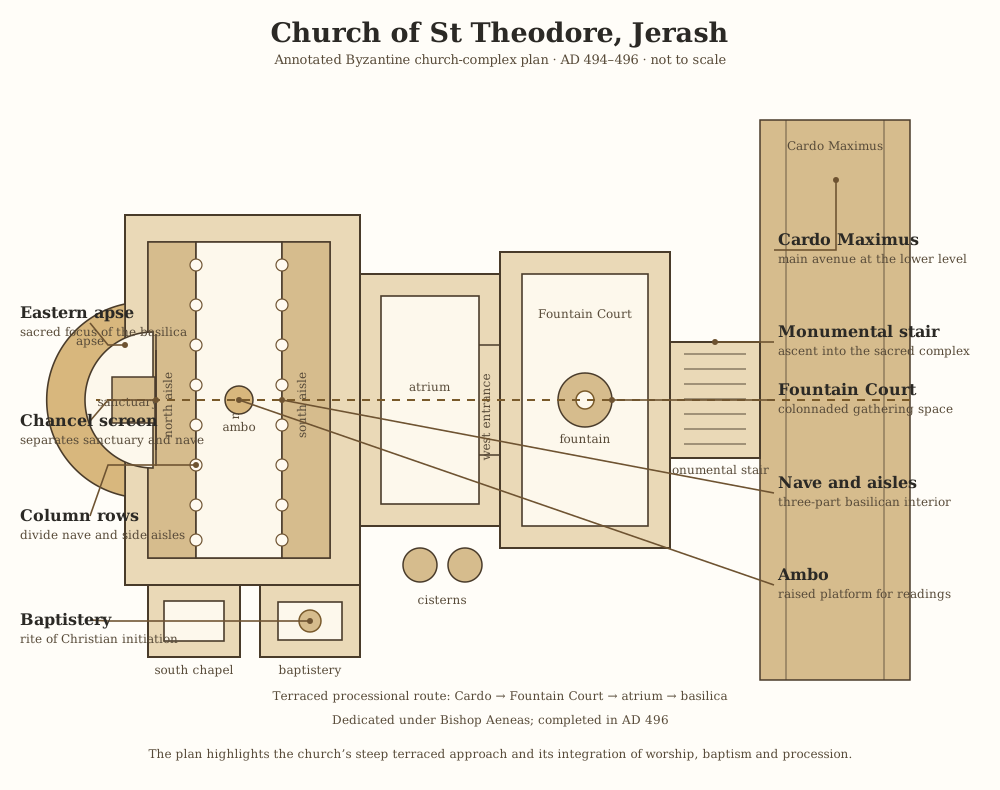
The Church of St Theodore was approached from the Cardo Maximus through a formal sequence of spaces. A stairway rose from the street toward the Fountain Court and the higher church terrace, creating a processional route that separated the church from ordinary urban movement.
This approach was more than practical. It prepared worshippers for entry into the sacred complex, using elevation, water, columns and enclosure to create a gradual transition from city to church.
The Fountain Court
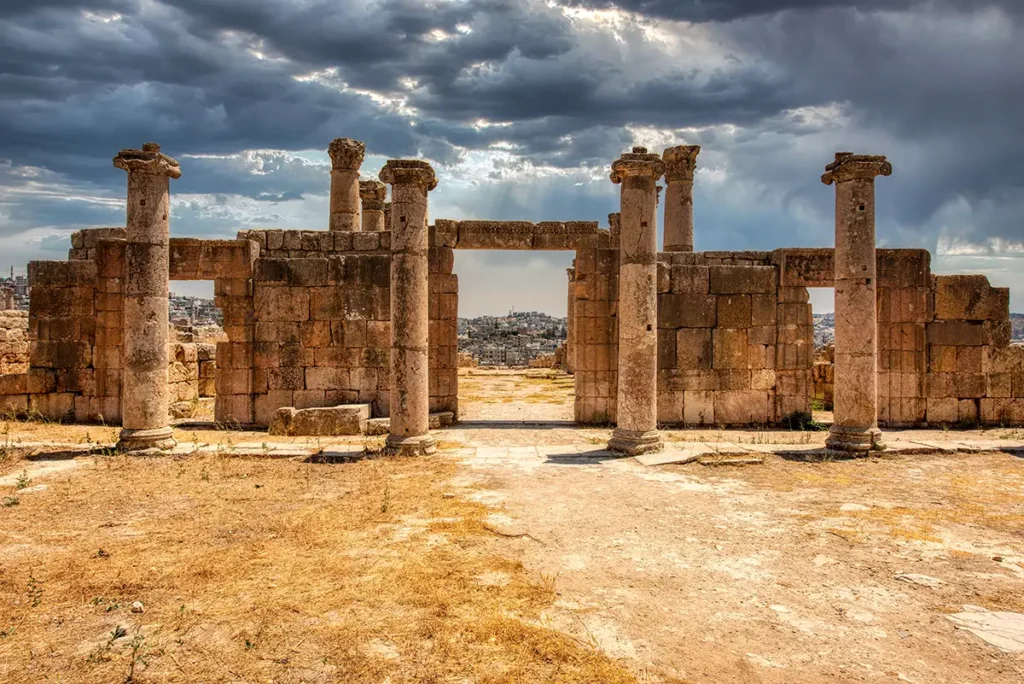
The Fountain Court formed an important open space within the approach to St Theodore. It was surrounded by columns and connected the lower level near the Cardo with the upper church terrace. Water and architecture worked together here: the fountain gave the court a focal point, while the surrounding colonnade created shade, rhythm and a sense of arrival.
Courtyards were essential to large late-antique church complexes. They provided space for gathering, circulation and preparation before entering the main basilica. At St Theodore, the Fountain Court also helped manage the site’s steep terrain, turning a change in level into part of the monument’s visual drama.
The Basilica
The main church was a three-aisled basilica. Two rows of columns divided the interior into a broad central nave and narrower side aisles. This familiar early Christian plan created a clear processional axis, leading from the western entrance toward the sanctuary at the east.
The nave was the principal communal space for worshippers. The side aisles allowed circulation and helped accommodate a large congregation. Although the roof and much of the upper decoration have disappeared, the surviving plan still conveys the building’s considerable scale.
The Eastern Apse and Sanctuary
At the eastern end of the church was the apse, the semicircular sacred focus of the basilica. Here stood the altar and the clergy’s space, separated from the main body of the church by a low chancel screen.
The arrangement of the sanctuary is important because it reflects the developing form of Byzantine liturgy. The church did not simply provide an open room for assembly; it organised space according to degrees of ritual access. Worshippers, clergy, readers and celebrants all had defined positions within the architecture.
The Ambo
A centrally placed ambo, or raised reading platform, was an important feature of the church interior. From such a platform, readings from the Gospels and Epistles could be proclaimed to the congregation.
The ambo made the spoken word physically visible within the church. It stood along the main axis of the basilica, between congregation and sanctuary, reinforcing the ordered sequence of Christian worship: entry, gathering, reading, prayer and Eucharistic celebration.
Chapels and Baptistery
The Church of St Theodore was part of a much larger complex that included chapels, a baptistery, cisterns and domestic or service spaces. These additions demonstrate that the church supported more than regular communal worship.
The baptistery was especially important. Baptism marked entry into the Christian community, and its presence within the complex indicates the church’s role in the major rites of local religious life. Chapels may have served more specialised worship, private devotion, commemoration or the needs of particular groups within the congregation.
Reused Roman Building Material
As at many churches in Jerash, Roman architectural elements were reused in the construction of St Theodore. Earlier columns, blocks and carved fragments offered valuable building material while visually linking the church to the monumental city that preceded it.
This reuse was practical, but it also created a powerful historical continuity. The church did not stand outside Roman Gerasa—it was built from its material resources, placed beside its great sanctuary and connected to its principal street.
The Inscriptions and Their Meaning
Two Greek hexameter inscriptions were found on lintels at the Church of St Theodore, commissioned by Bishop Aeneas and completed in 496 CE. The better-known one, at the outer entrance, contrasts the church with the earlier “unclean” site; a second, at the main doorway, praises Theodore the martyr.
The Outer-Gate Inscription
Original Greek
θάμβος ὁμοῦ καὶ θαῦμα παρερχομένοισιν ἐτύχθην·
πᾶν γὰρ ἀκοσμίης λέλυται νέφος, ἀντὶ δὲ λήμης
τῆς προτέρης πάντη με Θεοῦ χάρις ἀμφιβέβηκεν.
καὶ ποτέ τετραπόδων ὁπόσα μογέοντα δαμείη
ἐνθάδε ῥιπτομένων ὀδμὴ διεγείρετο λυγρή.
πολλὰκι καὶ παριὼν τις ἑῆς ἐδράξατο ῥινός
καὶ πνοιῆς πόρον εἶρξε κακοσμίην ἀλεείνων.
νῦν δὲ δι’ ἀμβροσίου πέδου περόωντες ὁδεῖται
δεξιτέρην παλάμην σφετέρῳ προσάγουσι μετώπῳ,
σταυροῦ τιμήεντος ἐπὶ σφρηγῖδα τελοῦντες.
εἰ δ’ ἐθέλεις καὶ τοῦτο δαήμεναι, ὄφρ’ ἐὺ εἰδῇς,
Αἰνείας τόδε κάλλος ἐμοὶ πόρεν ἀξιεραστόν,
πάνσοφος εὐσεβίῃ μεμελημένος ἱεροφάντης.
The Outer-Gate Inscription
Original Greek
θάμβος ὁμοῦ καὶ θαῦμα παρερχομένοισιν ἐτύχθην·
πᾶν γὰρ ἀκοσμίης λέλυται νέφος, ἀντὶ δὲ λήμης
τῆς προτέρης πάντη με Θεοῦ χάρις ἀμφιβέβηκεν.
καὶ ποτέ τετραπόδων ὁπόσα μογέοντα δαμείη
ἐνθάδε ῥιπτομένων ὀδμὴ διεγείρετο λυγρή.
πολλὰκι καὶ παριὼν τις ἑῆς ἐδράξατο ῥινός
καὶ πνοιῆς πόρον εἶρξε κακοσμίην ἀλεείνων.
νῦν δὲ δι’ ἀμβροσίου πέδου περόωντες ὁδεῖται
δεξιτέρην παλάμην σφετέρῳ προσάγουσι μετώπῳ,
σταυροῦ τιμήεντος ἐπὶ σφρηγῖδα τελοῦντες.
εἰ δ’ ἐθέλεις καὶ τοῦτο δαήμεναι, ὄφρ’ ἐὺ εἰδῇς,
Αἰνείας τόδε κάλλος ἐμοὶ πόρεν ἀξιεραστόν,
πάνσοφος εὐσεβίῃ μεμελημένος ἱεροφάντης.
English translation
I have become both an amazement and a wonder to those who pass by.
For every cloud of disorder has been dissolved, and, instead of the former eyesore,
the grace of God has surrounded me on every side.
Once, when the bodies of four-footed animals slain by labouring death
were thrown here, a grievous stench arose.
Often a passer-by grasped his nose
and stopped the passage of breath, avoiding the foul smell.
But now travellers crossing this fragrant ground
bring their right hands to their foreheads,
making the sign of the precious cross.
And if you wish to learn this as well, so that you may know clearly:
Aeneas bestowed on me this beauty worthy of reverence—
the all-wise priest, devoted to piety.
The Main-Door Inscription
Original Greek
Ἄχραντος δόμος εἰμὶ ἀεθλοφόρου Θεοδώρου,
μάρτυρος ἀθανάτου, θεοειδέος, οὗ κλέος ἔπτη
ἐν χθονὶ καὶ πόντῳ καὶ τέρμασιν ὠκεανοῖο.
Σῶμα γὰρ ἐν γαίῃ, ψυχὴ δ’ εἰς οὐρανὸν εὐρύν,
ἀγγελικῆς μετὰ πότμον ἀεὶ μετέχουσα χορείης.
English translation
I am the undefiled house of Theodore, the victorious athlete,
the immortal and godlike martyr, whose fame has flown
over land and sea and to the limits of Ocean.
For his body is in the earth, but his soul is in broad heaven,
ever sharing, after death, in the choir of angels.
What the Inscriptions Mean
The outer-gate poem lets the church itself speak in the first person. It declares that God’s grace has replaced an earlier polluted and foul-smelling place. The reference to dead four-footed animals probably recalls animal sacrifice or the disposal of carcasses connected with the nearby Sanctuary of Artemis. It is a deliberately forceful Christian statement: the old landscape of sacrifice has been replaced by a place where travellers make the sign of the cross.
The final lines identify Bishop Aeneas as the patron who gave the church its “beauty worthy of reverence.” This is why the inscription is so valuable: it combines a vivid description of the site’s transformation with the name of the bishop responsible for the building.
The second inscription identifies the church as the sacred house of Theodore, described in the traditional language of martyr devotion. Theodore’s body remains on earth, while his soul belongs to the heavenly choir of angels. The phrase “victorious athlete” is a Christian metaphor: his martyrdom is presented as a spiritual victory.
Both texts are composed in elevated, classicising Greek hexameter verse. Their language deliberately echoes the prestige of ancient Greek poetry while proclaiming a Christian victory over the earlier pagan sacred landscape.
Destruction, Rediscovery, and Restoration
The church complex continued to be used and altered after its late-5th-century construction, but it was eventually damaged by the forces that affected much of Jerash: changing settlement patterns, stone reuse and earthquake destruction.
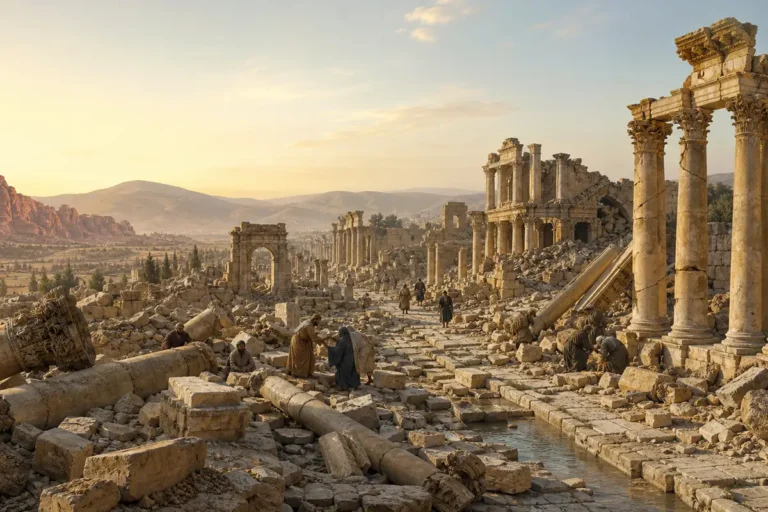
The earthquake of 749 CE devastated the city and is generally associated with the final major collapse of the Church of St Theodore. Unlike some areas of Jerash that were substantially rebuilt or adapted after the disaster, the church was not restored to its earlier form.
The ruins remained buried and partly obscured for centuries. Archaeological work began in the late 1920s, when a joint Yale University–British School of Archaeology in Jerusalem expedition cleared the Church of St Theodore, its atrium, Fountain Court and the stairway leading toward the street. These excavations were central to the modern understanding of the Christian monuments of Jerash.
What Happened Here?
The Church of St Theodore was a setting for the central practices of Christian life: communal worship, sermons, readings, baptism, processions and the celebration of the Eucharist. Its size and complex layout indicate that it served a substantial congregation and had a prominent place within the religious life of Gerasa.
The Fountain Court and stairways may have been used by worshippers arriving from the Cardo, while the basilica organised the congregation within a formal liturgical space. The sanctuary, ambo, chancel and side aisles all helped give structure to worship.
The complex also functioned as a community institution. Its additional rooms, water installations and service spaces imply a broader pattern of activity involving clergy, visitors, catechumens and those preparing for baptism. In late-antique Jerash, churches such as St Theodore were not peripheral monuments; they were major civic and social landmarks.
The Church of St Theodore and the Sanctuary of Artemis
The proximity of St Theodore to the Sanctuary of Artemis is one of the most meaningful features of the site. Artemis was the patron goddess of Roman Gerasa, and her sanctuary was one of the grandest monuments in the city. Its temple, terraces and stairways had once defined the religious identity of the surrounding district.
By the time St Theodore was built, Christian worship had become a major force in the city. The church’s dedicatory inscription appears to acknowledge the earlier sacrificial landscape, referring to the nearby place where animals had been offered. This suggests that the memory of pagan worship remained present even as the Christian community redefined the area.
The two monuments should be visited together. The Artemis sanctuary shows the scale and authority of Roman religion; St Theodore demonstrates the confidence of the Christian city that developed beside it.
The Church of St Theodore and the Cathedral
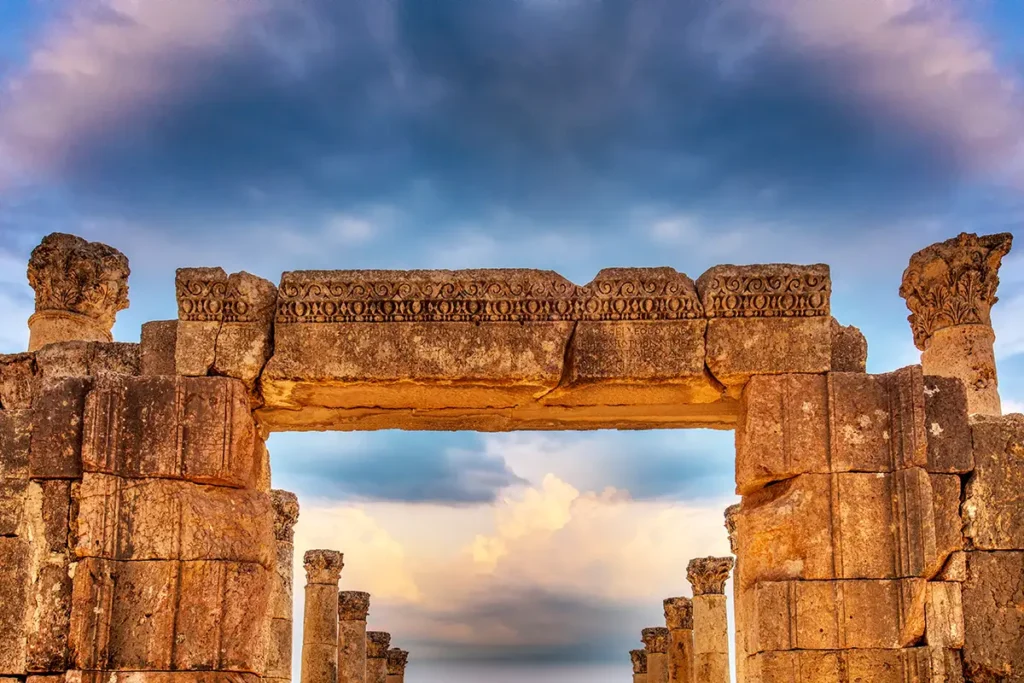
St Theodore adjoined the Cathedral through a central courtyard, creating a connected Christian zone west of the Cardo. The Cathedral was one of the earliest major churches in Jerash, while St Theodore was built later and on a particularly ambitious scale.
Together, the buildings illustrate the growth of ecclesiastical architecture in late-antique Gerasa. Their proximity created a concentration of sacred spaces, courtyards, entrances and service rooms that rivalled the prominence of the nearby Roman sanctuaries.
For visitors, the relationship is easy to appreciate on foot. Walk from the Cathedral’s Fountain Courtyard toward St Theodore and notice how the spaces connect and change in level. The route reveals that the Christian quarter was designed as a sequence of experiences rather than a collection of isolated buildings.
The Church of St Theodore Today
Today, St Theodore is one of the most informative places to explore the Byzantine city of Jerash. Its surviving foundations, columns, courtyards and stairways make the organisation of a major church complex visible in a way that few ruins can match.
The site also rewards visitors who enjoy looking beyond the obvious landmarks. It may not have the towering columns of the Temple of Artemis or the theatrical scale of the South Theatre, but it offers something equally valuable: a vivid sense of how Christians moved through, used and transformed the Roman city.
Take time to follow the sequence from the Cardo to the Fountain Court and up to the church. This route is the key to understanding St Theodore—not merely as a ruined basilica, but as a carefully planned sacred landscape.
Practical Visiting Tips
Visit St Theodore together with the Cathedral and the Sanctuary of Artemis. Allow at least 30 minutes for the three monuments, or longer if you want to study the church plan and explore the connecting courtyards.
Approach from the Cardo Maximus if possible. The route through the Fountain Court and upward stairways makes the original design much easier to understand than entering the complex at random.
Wear comfortable shoes with good grip. The site includes uneven paving, terraces and ancient steps. Morning or late-afternoon light is particularly effective, bringing out the texture of the columns, walls and reused Roman stonework.
Look for the main elements of the basilica: the central nave, side aisles, eastern apse and the surrounding rooms that formed the larger complex. Then compare the church’s architecture with the nearby Sanctuary of Artemis to see how dramatically the religious landscape of Jerash changed.
Why the Church of St Theodore Matters
The Church of St Theodore matters because it shows the Christian transformation of Jerash at an urban scale. Its monumental stairway, Fountain Court, basilica and supporting rooms were designed to bring worshippers from the city’s main street into a carefully ordered sacred environment.
Built beside the Sanctuary of Artemis and connected to the Cathedral, it preserves the dialogue between two religious worlds: the monumental Roman city of Gerasa and the Christian city that grew within it. For anyone seeking to understand Byzantine Jerash, St Theodore is essential.
Frequently Asked Questions
It was begun in 494 CE and completed in 496 CE, during the episcopate of Bishop Aeneas.
Bishop Aeneas was the Christian bishop of Gerasa who financed the construction of the Church of St Theodore. His patronage is recorded in Greek dedicatory inscriptions from the site.
It is one of the largest and most elaborate Christian complexes excavated in Jerash, with a basilica, Fountain Court, chapels, baptistery and monumental approach from the Cardo Maximus.
A basilica is a rectangular church plan with a central nave and side aisles separated by columns. It became one of the most common forms of early Christian church architecture.
An ambo is a raised platform from which scripture readings and sermons were delivered during worship.
The church stands beside the Sanctuary of Artemis, and its dedication refers to the nearby place where animals had once been sacrificed. It is a powerful example of Christian architecture developing beside the city’s earlier Roman sacred landscape.
Key Moments in History
Before 494 CE — A changing sacred landscape: The site stood beside the Sanctuary of Artemis, where animal sacrifice had once formed part of the religious life of Roman Gerasa.
494 CE — Construction begins: Bishop Aeneas commissioned the Church of St Theodore, creating one of the most ambitious Christian building projects in late-antique Jerash.
Key Moments in History
Before 494 CE — A changing sacred landscape: The site stood beside the Sanctuary of Artemis, where animal sacrifice had once formed part of the religious life of Roman Gerasa.
494 CE — Construction begins: Bishop Aeneas commissioned the Church of St Theodore, creating one of the most ambitious Christian building projects in late-antique Jerash.
494–496 CE — The church complex is completed: A three-aisled basilica, Fountain Court, monumental stairway, chapels, baptistery and supporting rooms were established across the sloping site beside the Cardo Maximus.
496 CE — Greek dedicatory inscriptions are installed: Two poetic Greek inscriptions celebrated the completed church. One named Bishop Aeneas and described the transformation of a former foul-smelling sacrificial area into a Christian sacred place; the other honoured Theodore as a victorious and immortal martyr.
Late 5th–6th centuries CE — A major Christian centre: St Theodore functioned alongside the Cathedral and neighbouring churches as part of Jerash’s important Christian quarter. Worship, processions, baptisms and community life were organised through its terraces, courtyards and basilica.
7th–8th centuries CE — Continued change and adaptation: As the city’s population and economy evolved, the church complex, like other parts of Jerash, experienced repair, reuse and gradual decline.
749 CE — Earthquake destruction: The great earthquake that devastated Jerash caused the final major collapse of the Church of St Theodore. The complex was not rebuilt to its former scale.
1928–1930 — Archaeological rediscovery: A joint Yale University and British School of Archaeology in Jerusalem expedition cleared the church, atrium, Fountain Court and monumental stairway, beginning the modern study of Jerash’s Byzantine churches.
Today — A key monument of Christian Jerash: The surviving ruins reveal how late-antique Christians reshaped the Roman city, building a major church complex beside the former Sanctuary of Artemis and connecting it directly to the Cardo Maximus.