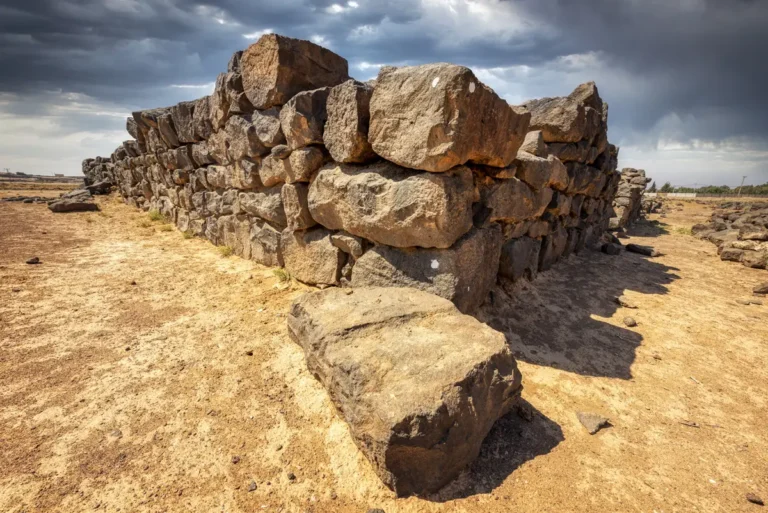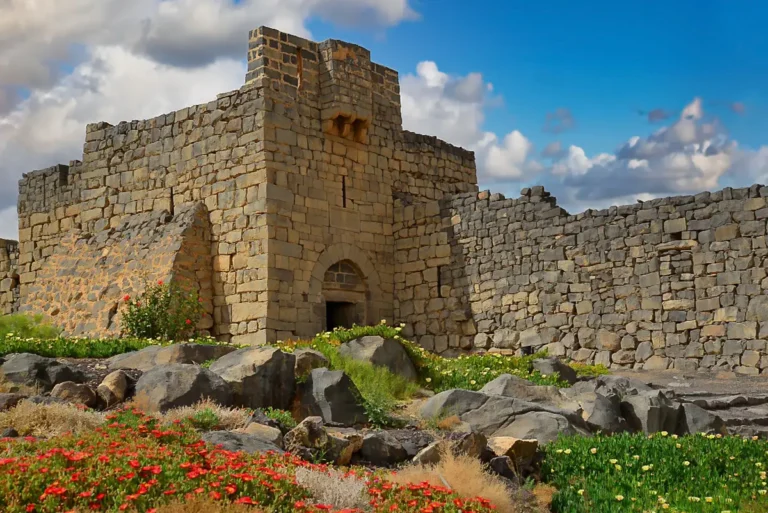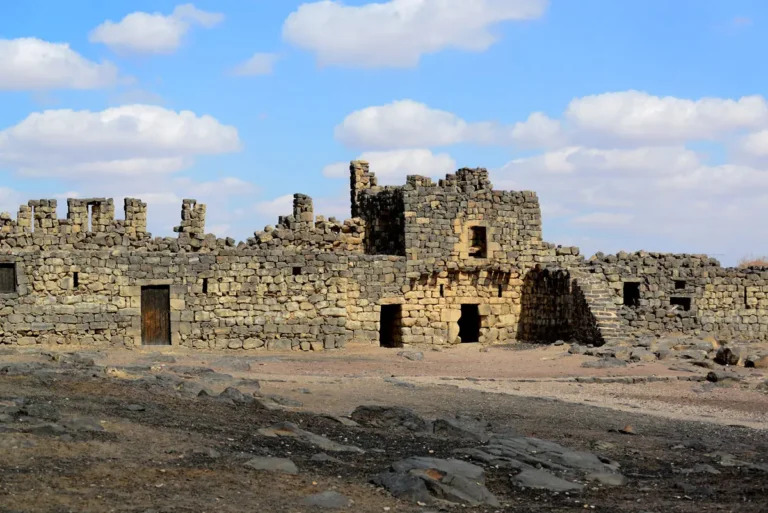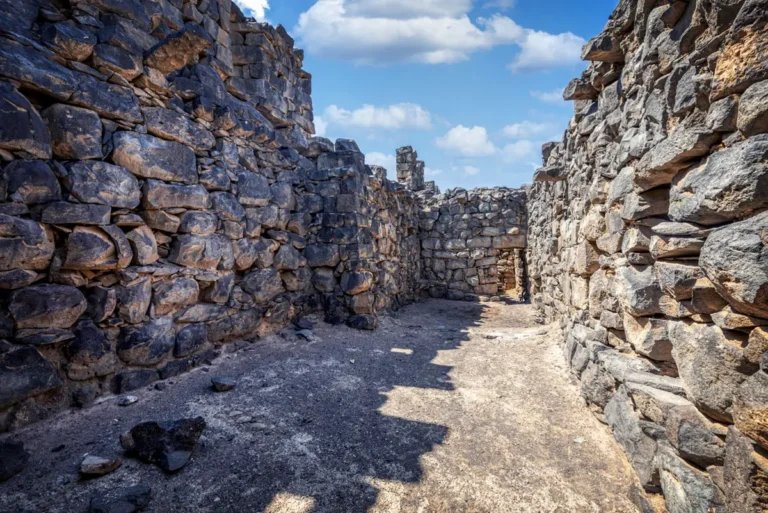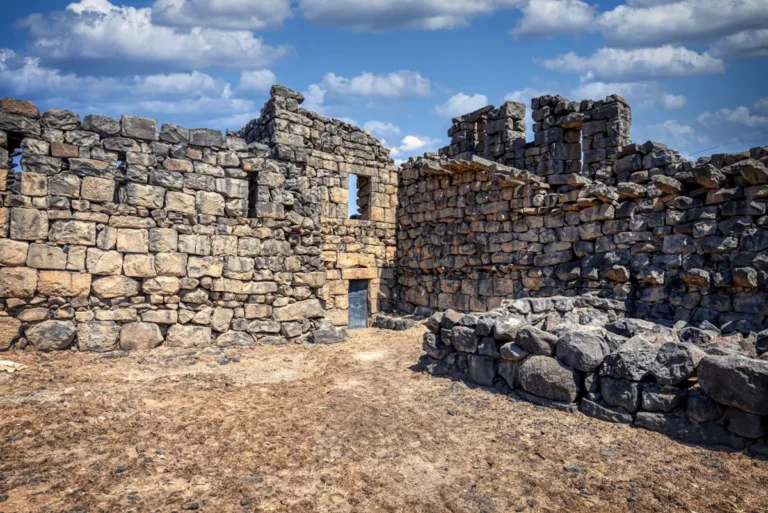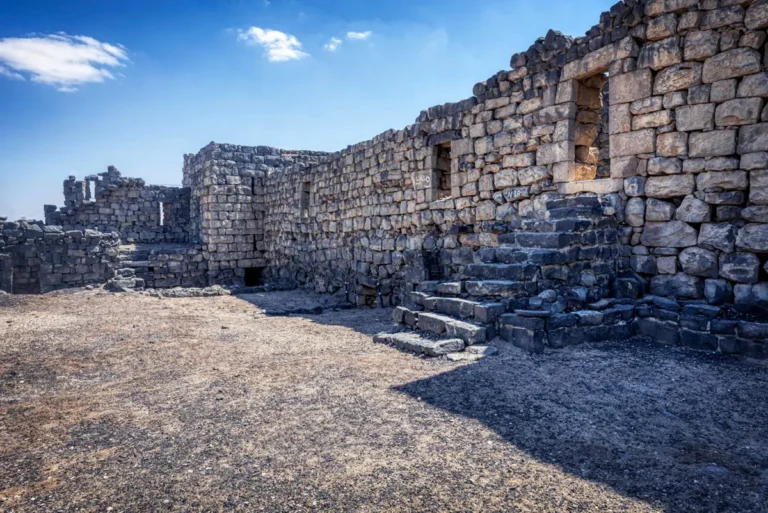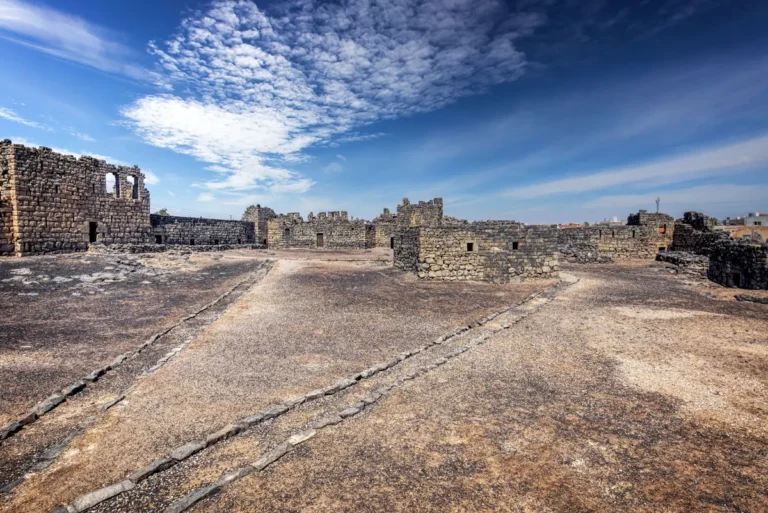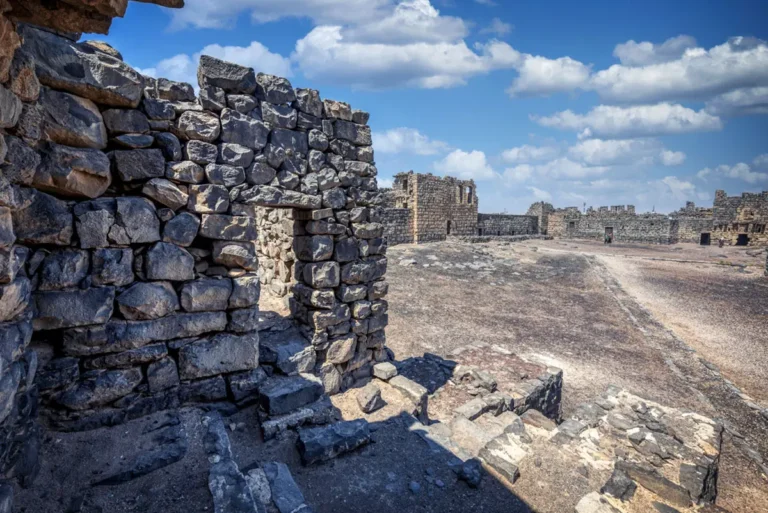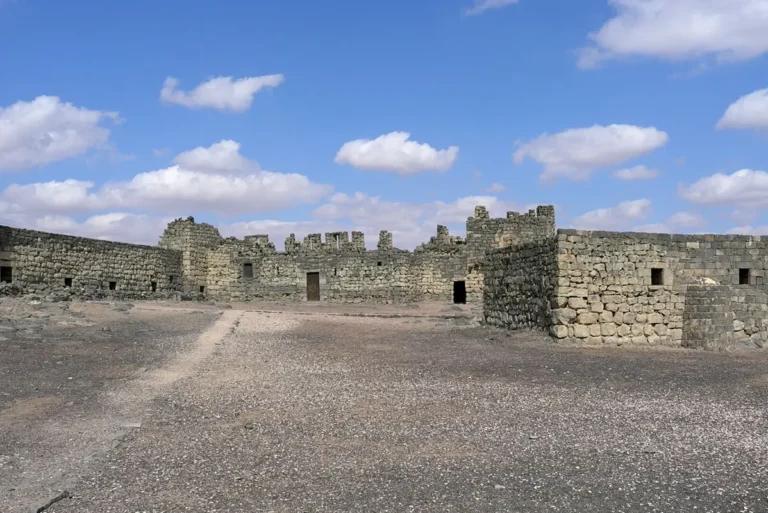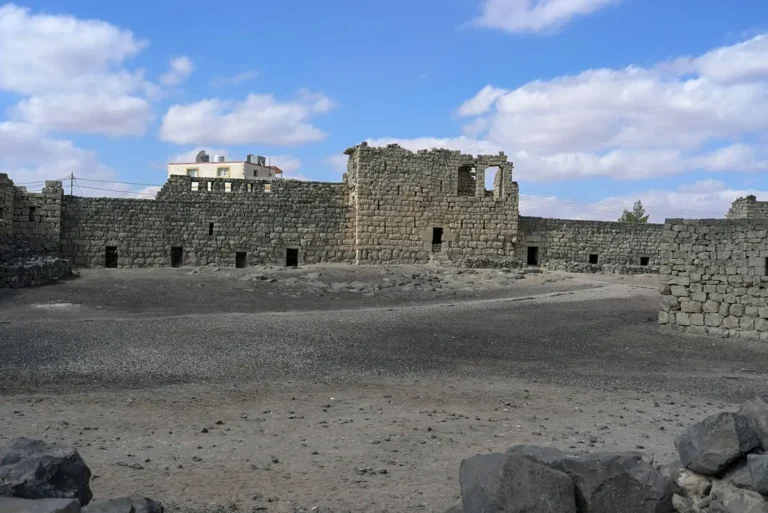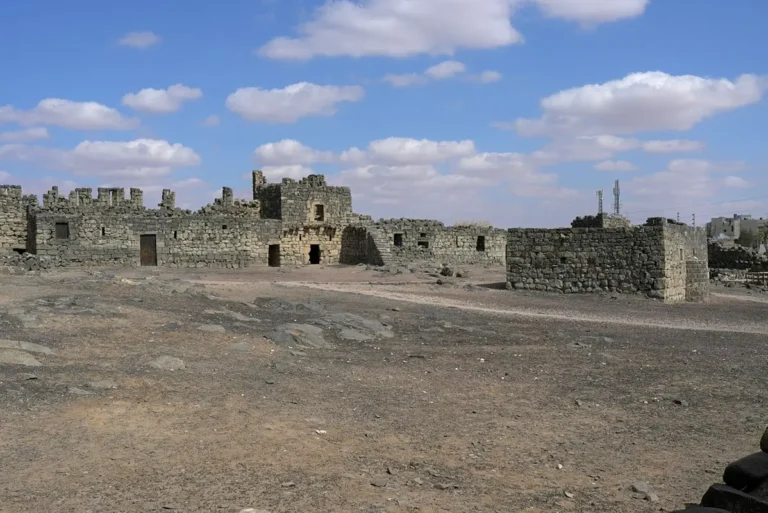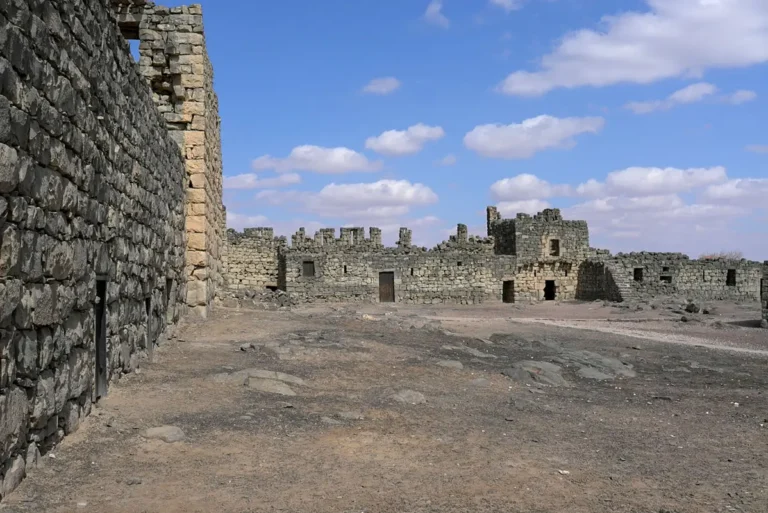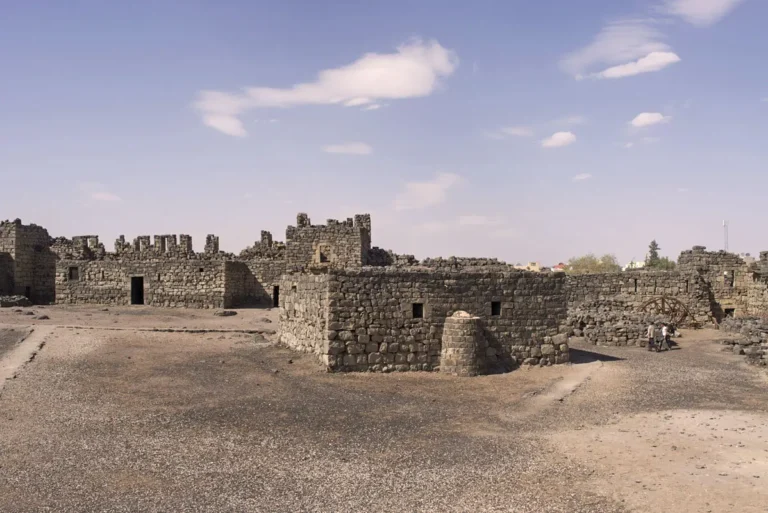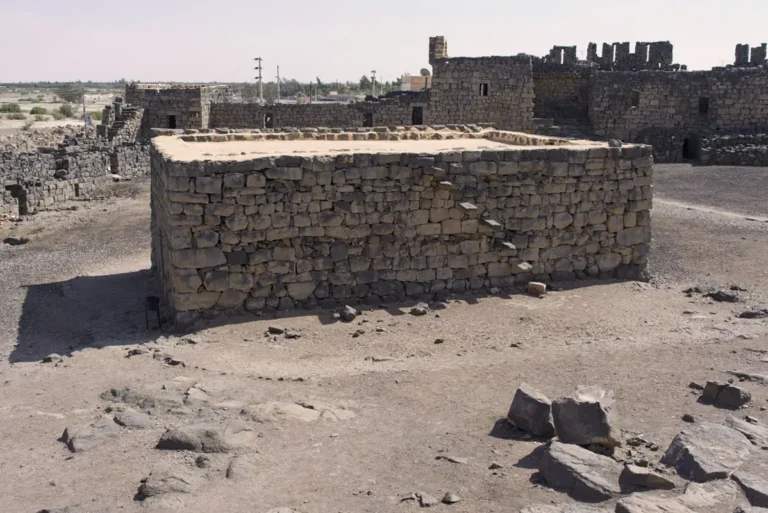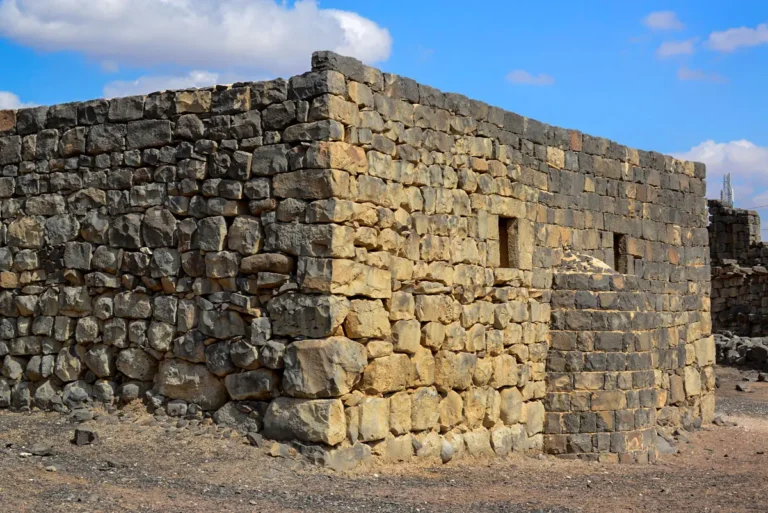
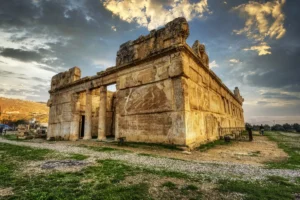
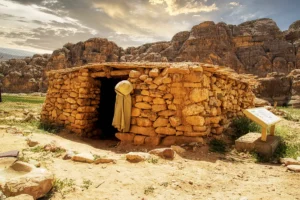
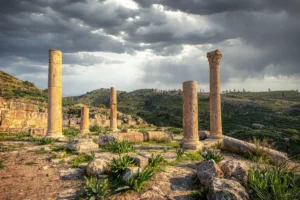
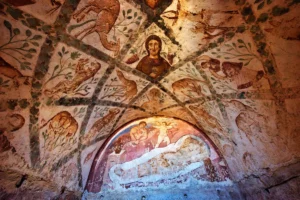
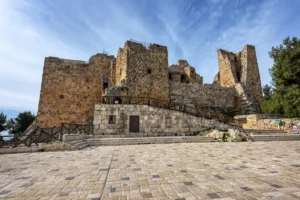
Heavy slabs of dark basalt guard the entrance to a fortress shaped by centuries of occupation. Beyond them, a courtyard opens beneath the desert sky, surrounded by broken walls, shadowed chambers, and stairways worn by generations of inhabitants. The building’s colour immediately distinguishes it from the pale limestone monuments farther west. Here, the volcanic landscape supplied the architecture.
Many visitors arrive knowing its connection with T. E. Lawrence, who stayed here during the Arab Revolt. Yet his presence belongs to a much longer story. Roman soldiers, medieval builders, Ottoman personnel, and displaced families all found reasons to use this stronghold.
The explanation lies beyond its walls. Azraq was an oasis—a place where water sustained settlement and made long journeys possible. To understand the fortress, begin with the resource that made this corner of the desert worth defending.
AT A GLANCE
- Location: Azraq North, Zarqa Governorate, approximately 115–125 kilometres from central Amman, depending on the route
- Historical origins: Roman; inscriptions attest occupation by the late third–early fourth century CE
- Major rebuilding: Ayyubid period, 634 AH / 1236–1237 CE
- Building material: Local volcanic basalt
- Approximate dimensions: 80 × 72 metres
- Main highlights: Stone entrance doors, courtyard mosque, defensive towers, inscriptions, and the chamber associated with Lawrence
- Suggested visit: 20–30 minutes
- Getting there: Accessible by ordinary car on paved roads; no four-wheel drive needed for the castle
FIRST IMPRESSIONS
The approach is through the modern settlement of Azraq North. Houses, shops, and traffic form part of the setting: this is a historic building within a living community.
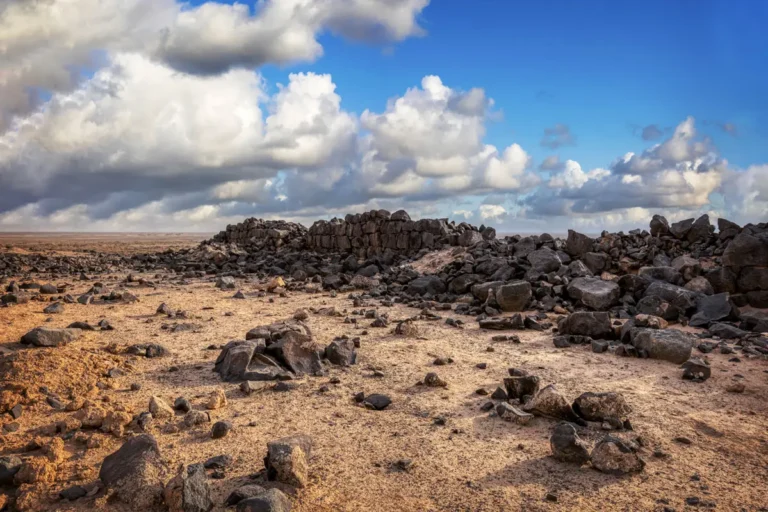
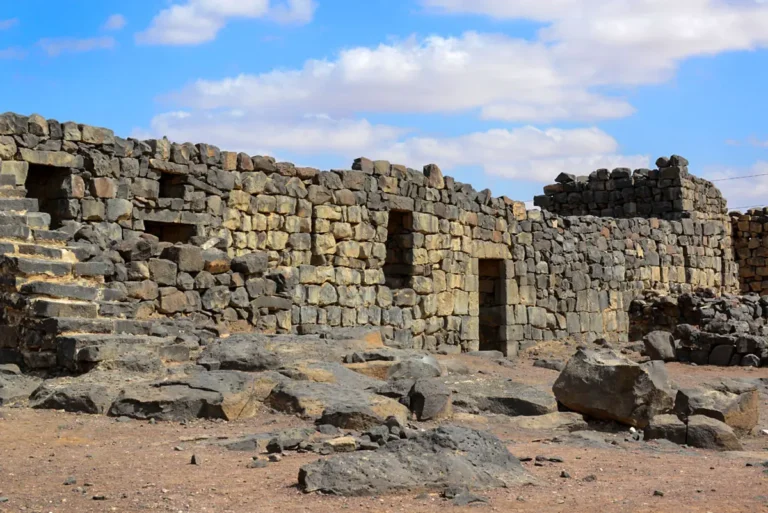
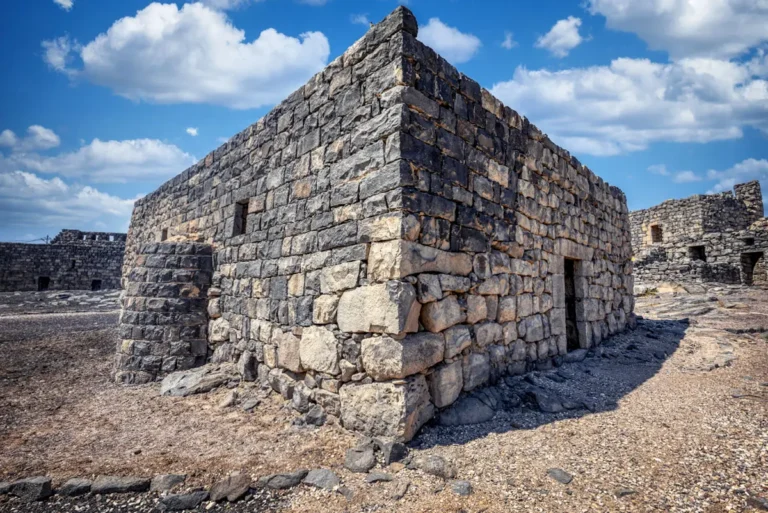
At the entrance, the basalt changes with the light. Sunlit edges appear grey; recessed joints and deep doorways approach black. Its rough surfaces make the fortress feel heavy and grounded, while the surviving arches reveal how carefully that weight was managed.
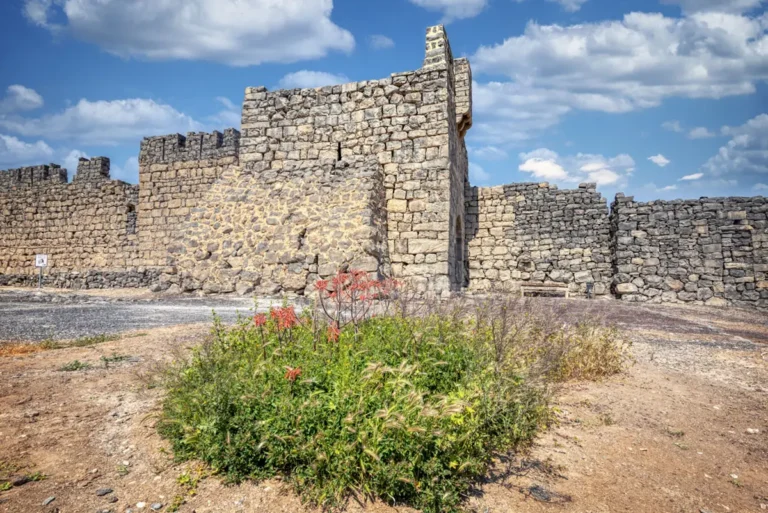
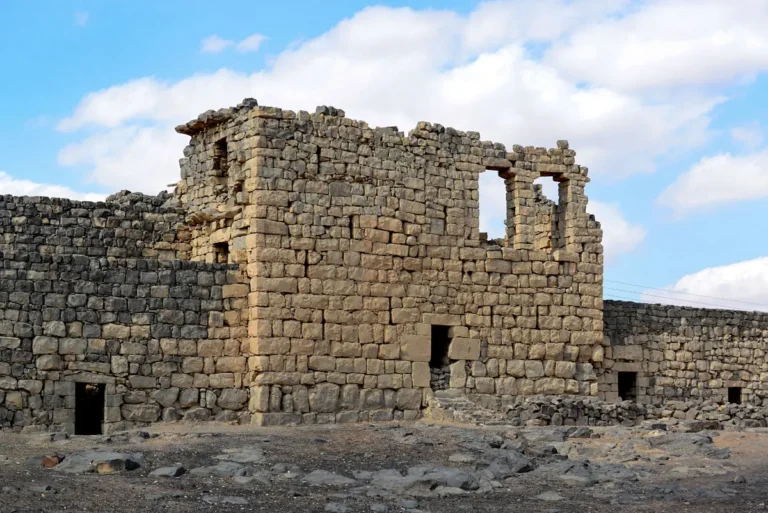
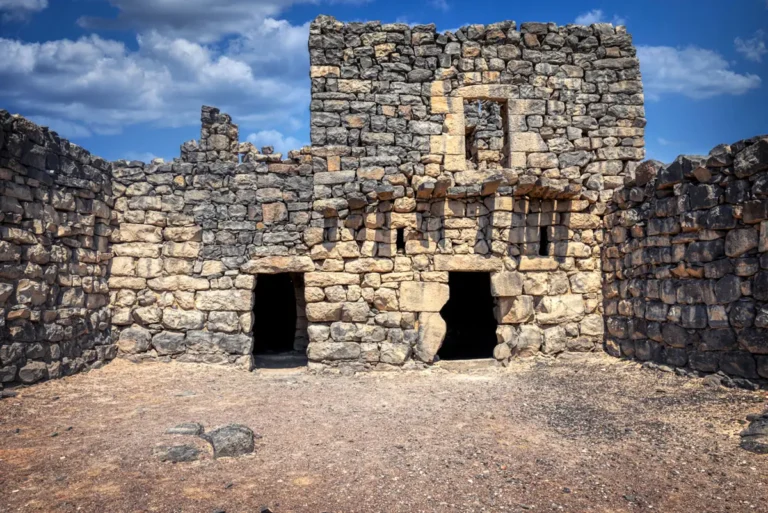
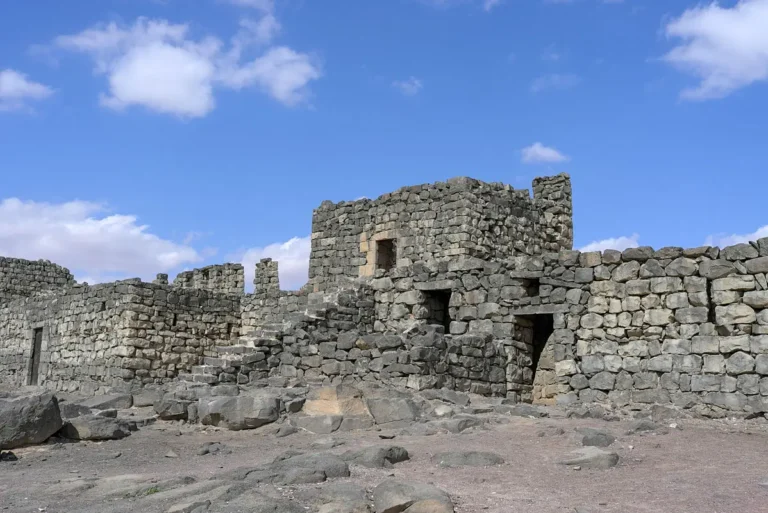
Pause before entering. The southern gate tower concentrates the building’s defensive character into a single view: a controlled entrance, thick masonry, and a projecting defensive feature above the doorway. Inside, the courtyard introduces a different scale. There is room to gather, organise supplies, and move between the surrounding chambers.
The contrast between the enclosed gateway and the open court is one of the pleasures of visiting. Azraq’s architecture becomes understandable through movement.
- Qasr Azraq - Courtyard 3D Panorama
HISTORICAL CONTEXT AND ORIGIN
Qasr Azraq developed through repeated construction and adaptation. Assigning the entire monument to one ruler or century obscures what makes it interesting.
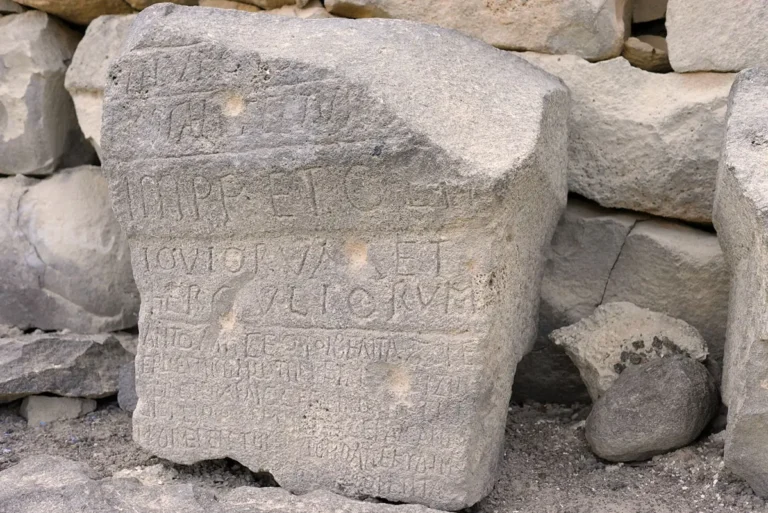
The firm early evidence is Roman. Latin and Greek inscriptions attest occupation by the late third and early fourth centuries. The oasis stood within a network of military sites and routes connecting the settled lands to the west with the desert approaches. Nearby forts at Uweinid and Usaykhim help place Azraq within that wider geography.
Roman inscriptions also record repairs under Constantine, demonstrating that rebuilding began long before the medieval period. Early Islamic traditions connect the oasis with the Umayyad prince al-Walid ibn Yazid and hunting in its formerly wildlife-rich surroundings. The extent to which particular surviving features belong to that phase requires care.
A clearer architectural milestone appears above the southern entrance. An Arabic inscription records major works undertaken by Izz al-Din Aybak in 634 AH, corresponding to 1236–1237 CE. This Ayyubid reconstruction gave the fortress much of its surviving character. The earlier Roman structure remained influential, but later builders adapted it to their own requirements.
WHERE IS IT
Qasr Azraq stands in Azraq North, also known as Azraq al-Shamali, in Jordan’s eastern desert. It is approximately 115–125 kilometres from central Amman by road, with the distance depending on your departure point and route. Qasr Amra lies roughly 30 kilometres to the west.
For planning, allow around 1.5–2 hours from Amman, with additional time for traffic and stops.
Azraq’s location explains its importance. It lies near the northwestern end of Wadi al-Sirhan, a natural corridor extending towards northern Arabia. Water and routes converged here, making the oasis useful to travellers and strategically valuable to those controlling movement through the region.
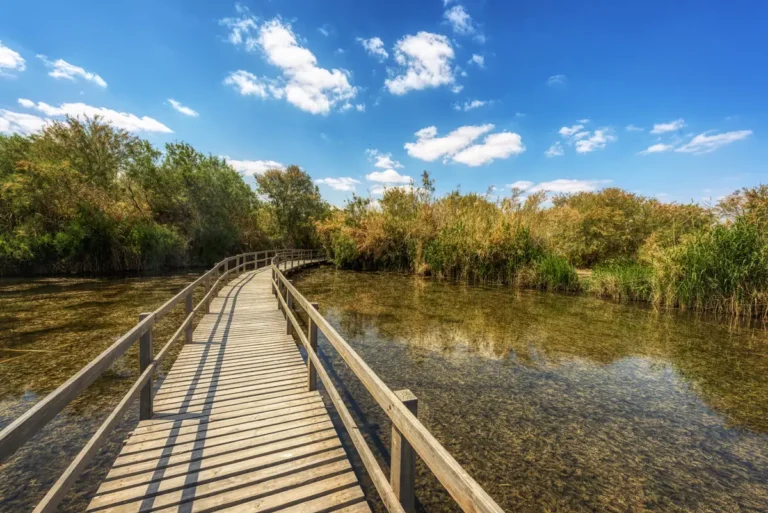
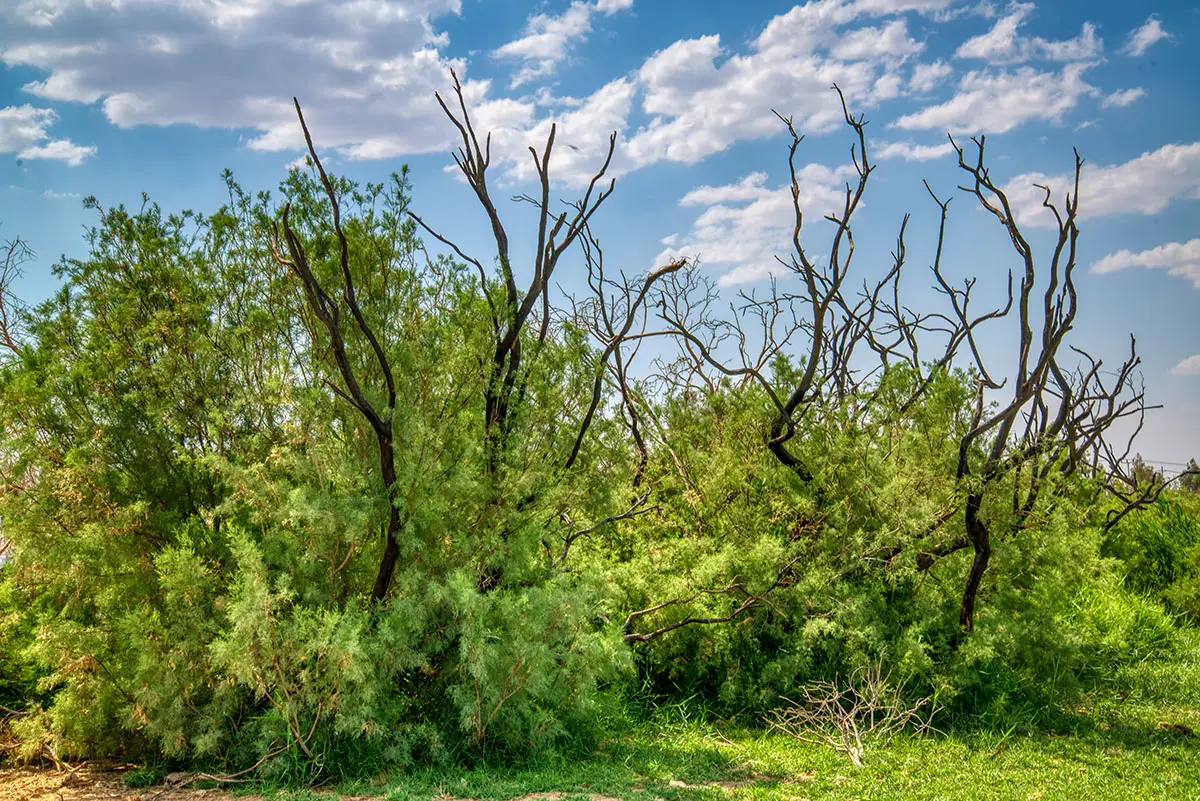
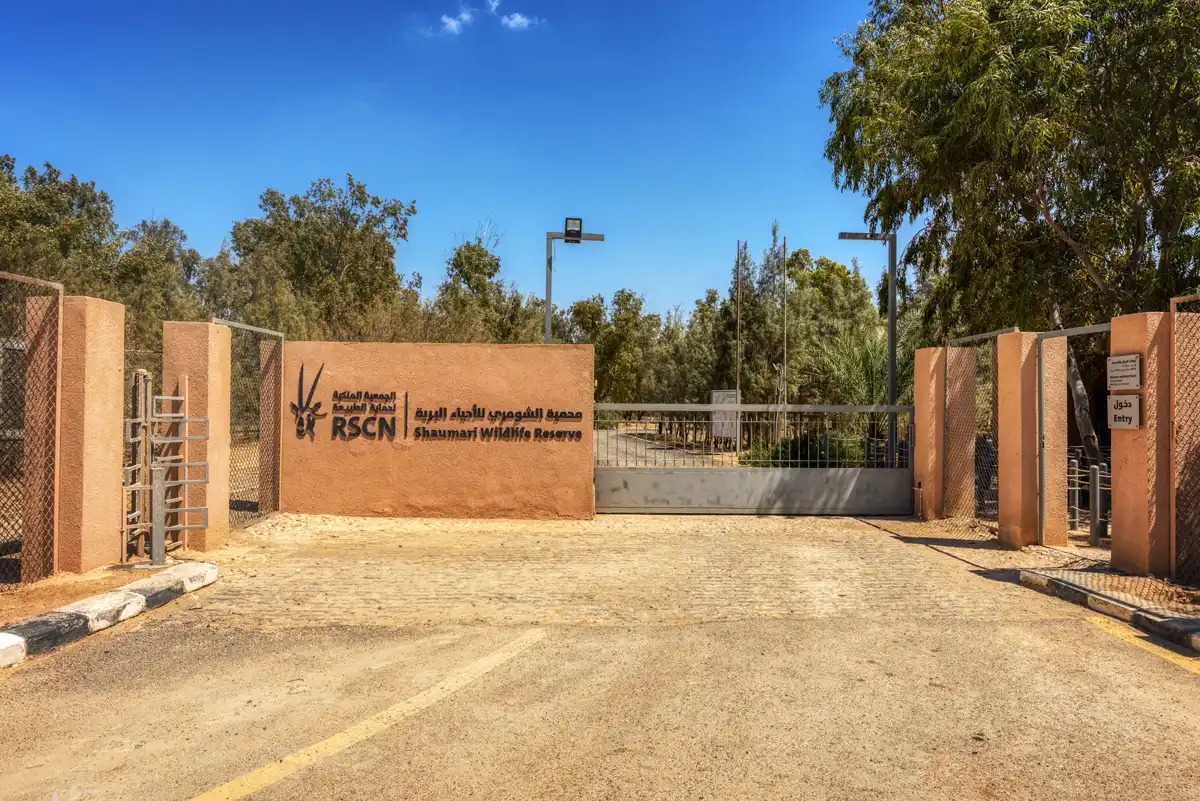
The Azraq Wetland Reserve is a separate attraction farther south. Visiting both helps connect the fortress with its environmental setting: one preserves the architecture of power, the other a surviving fragment of the water landscape that sustained it.
WHAT HAPPENED HERE?
Soldiers, travellers, and the business of an oasis
For much of its history, Azraq’s significance depended on practical needs: access to water, shelter, supplies, and routes across difficult country.
During Ottoman times, the fort helped protect movement towards Arabia and Mecca. Its continued usefulness illustrates how an older stronghold could remain valuable even as political boundaries and military systems changed.
The Arab Revolt
During the winter of 1917–1918, the fortress served as a base associated with Sharif Ali ibn al-Hussein and T. E. Lawrence during the Arab Revolt against Ottoman rule.
Lawrence’s Seven Pillars of Wisdom describes the work of making Azraq habitable and defensible. His account places Ali in the southeastern tower and records the practical demands of maintaining a wartime base. Read alongside the ruins, it brings attention to roofs, rooms, provisions, and the everyday work behind a military campaign.
The room above the entrance is associated with Lawrence’s stay. It has become the castle’s best-known individual chamber, but the larger story belongs to the Arab forces, leaders, and local networks that made operations possible.
A refuge for families
The castle’s later history includes another kind of occupation. In 1925, Druze families arriving during the uprising against French rule in Syria settled within its walls. They repaired rooms and adapted the building for domestic life. Archaeologists subsequently recorded family names and testimonies alongside the architectural evidence.
Remembering these residents changes how the ruins are seen. Some alterations belong to people making homes rather than preparing defences.
ARCHITECTURAL DESIGN AND FEATURES
A fortress built from basalt
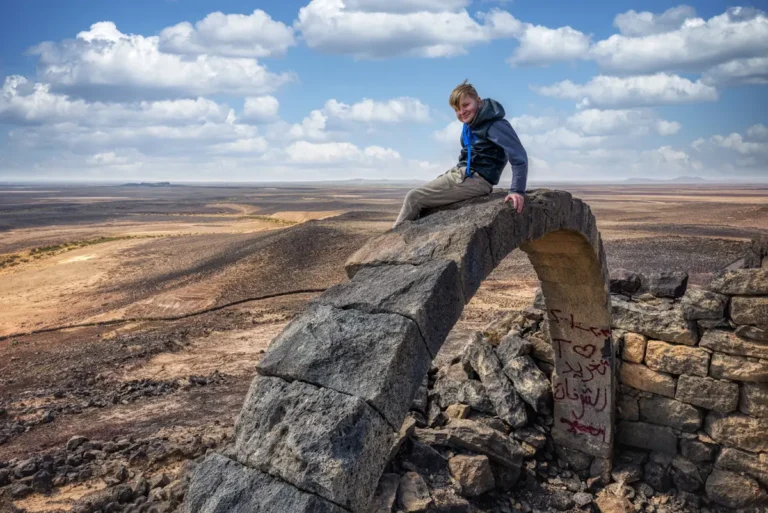
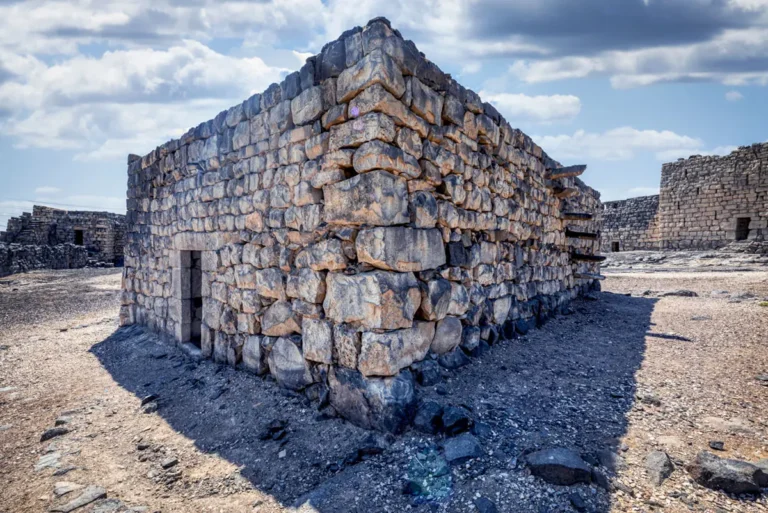
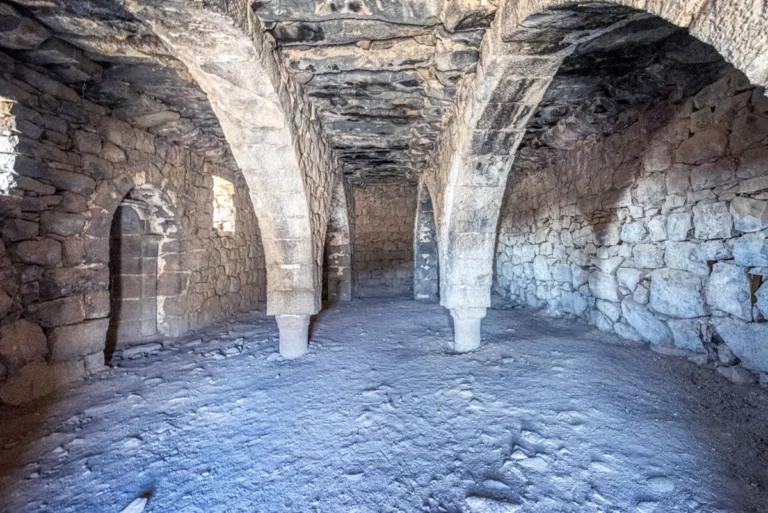
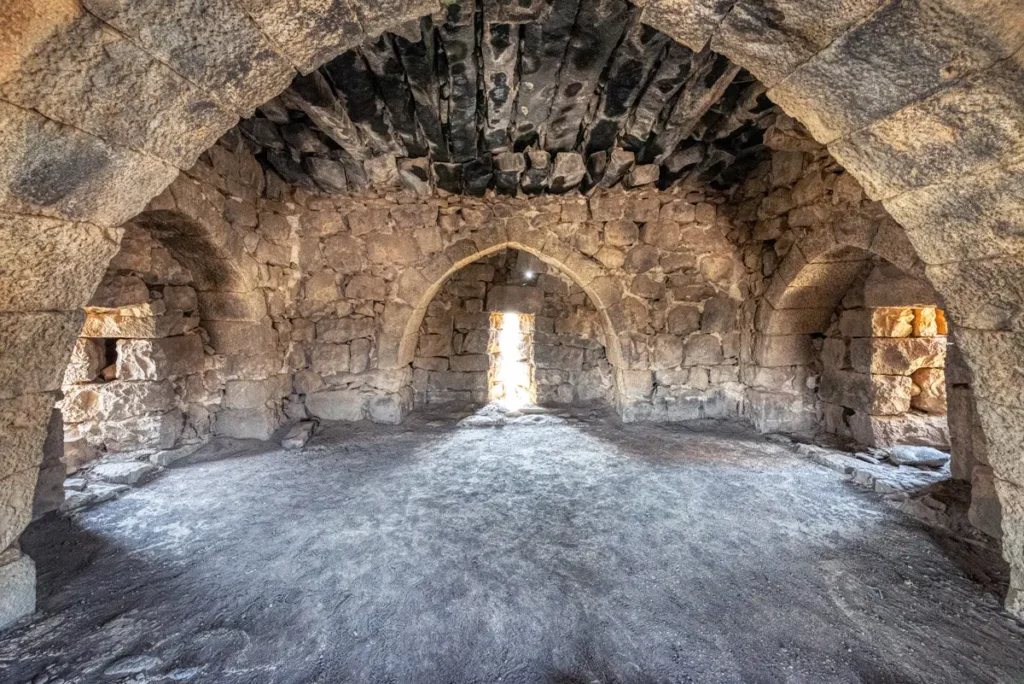
Basalt shapes almost every aspect of Qasr Azraq. The locally available volcanic stone appears in walls, arches, doorways, and roofing elements.
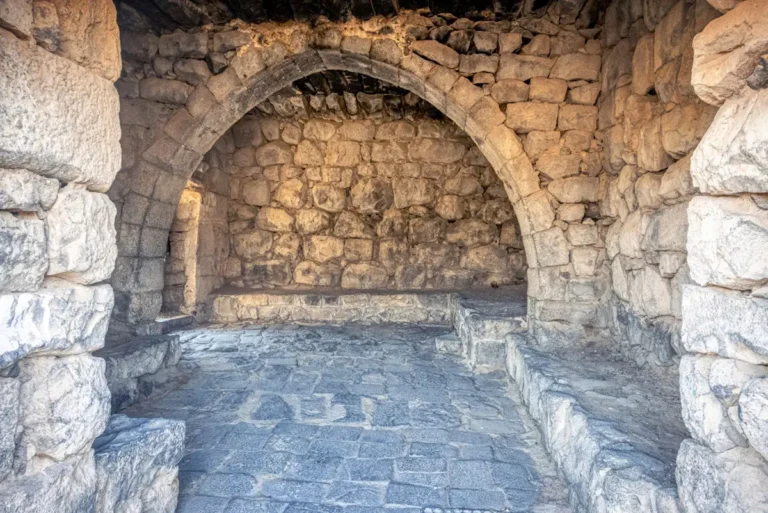
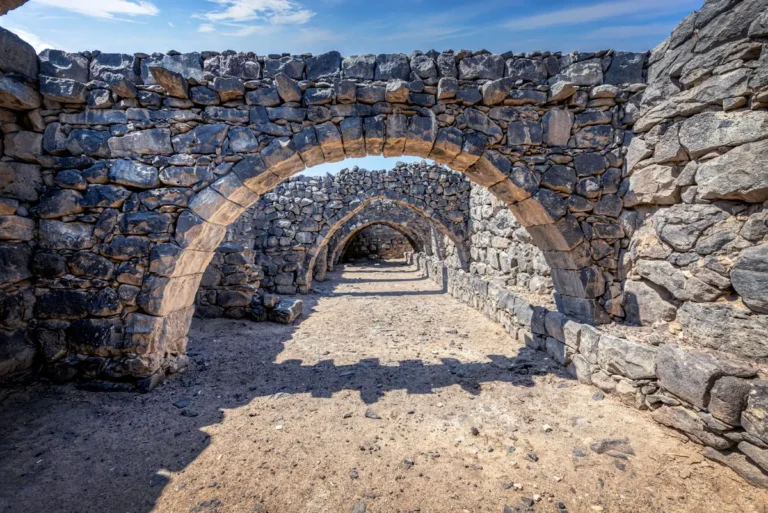
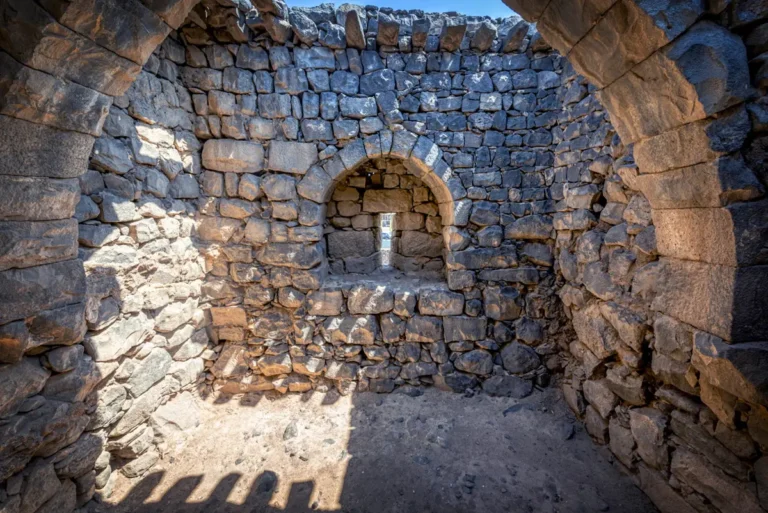
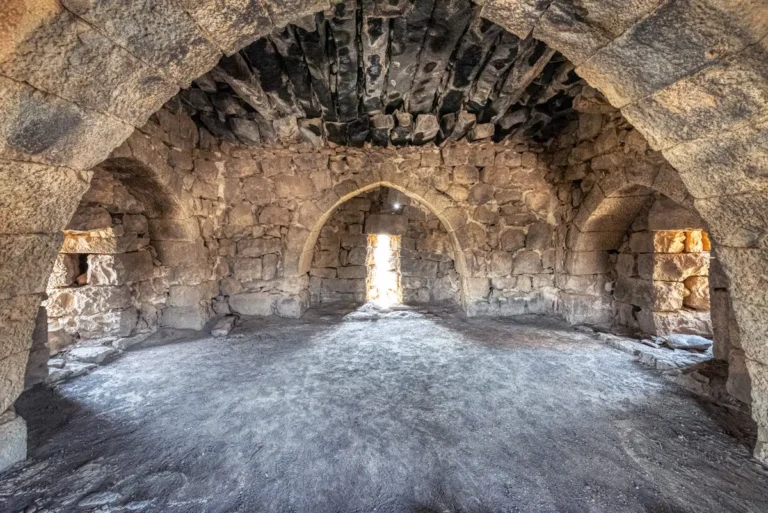
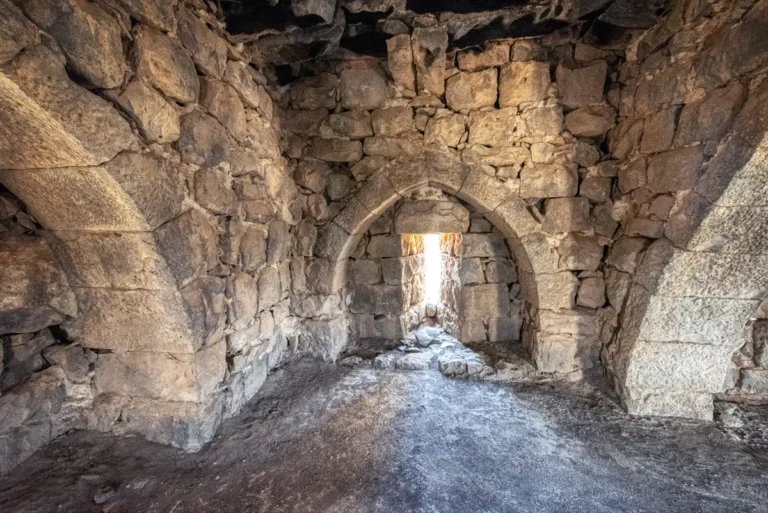
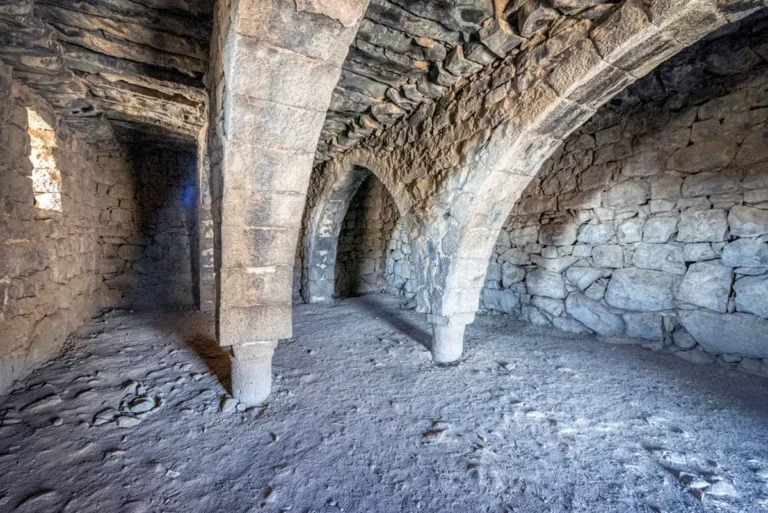
Its structural use is particularly striking. In surviving chambers, arches and projecting stone supports carry slabs across the spaces above. These methods belong to a regional building tradition that used stone extensively where suitable timber was less readily available. Study the supports as carefully as the arches: they explain how the roof’s weight reached the walls.
Courtyard, towers, and perimeter rooms
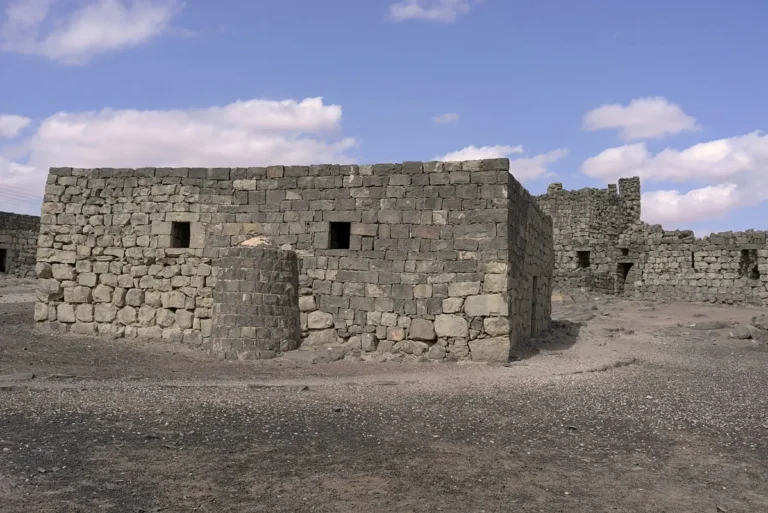
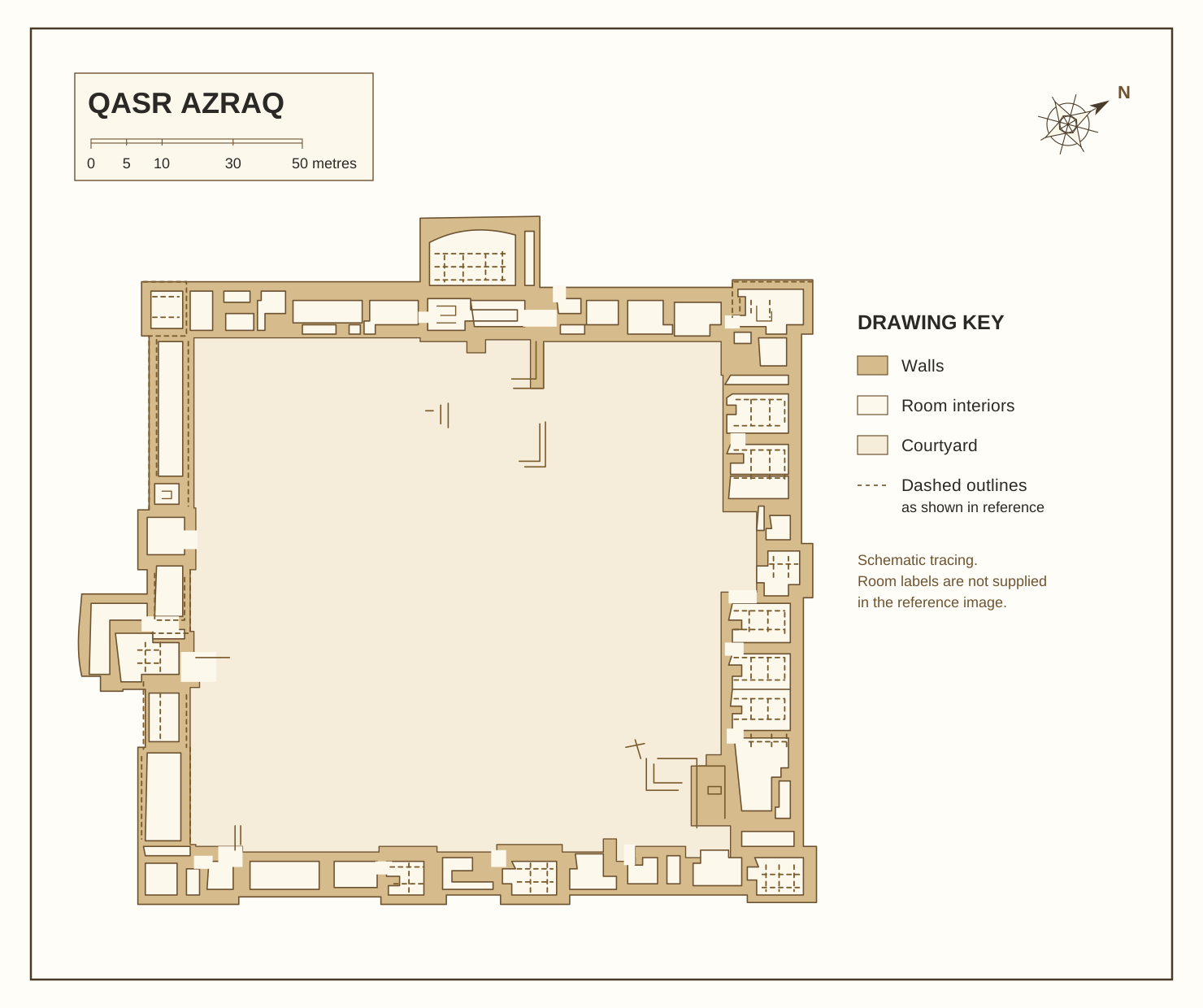
The approximately rectangular enclosure surrounds a broad central court. Rooms line its edges, while projecting towers articulate the outer walls. A substantial complex on the western side has been interpreted as an administrative building, or praetorium, reflecting the fortress’s Roman antecedents.
The plan accommodates both protection and daily activity. The perimeter concentrates enclosed spaces around a shared working area, allowing people and supplies to circulate within the defences.
The stone doors
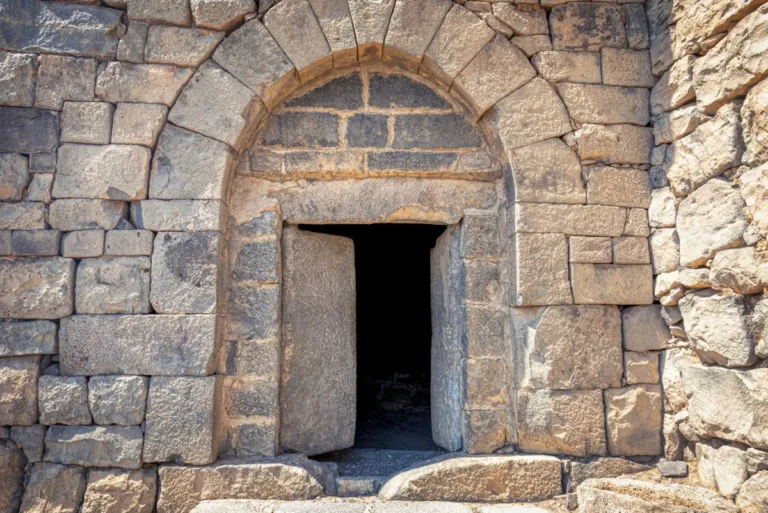
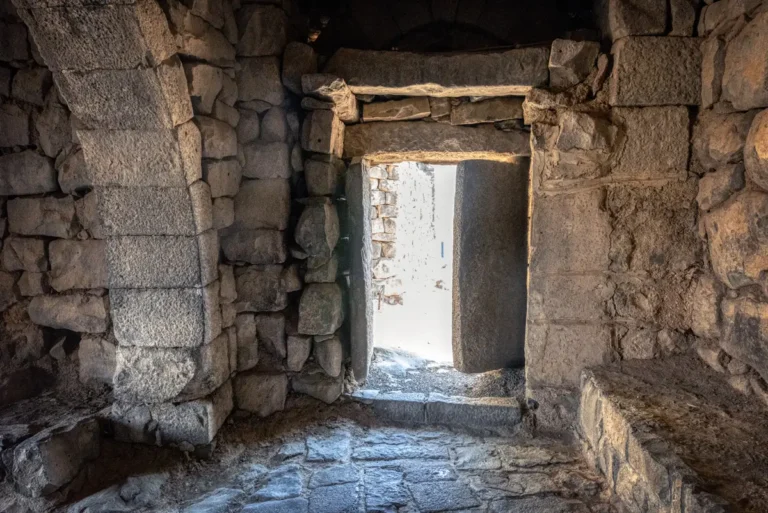
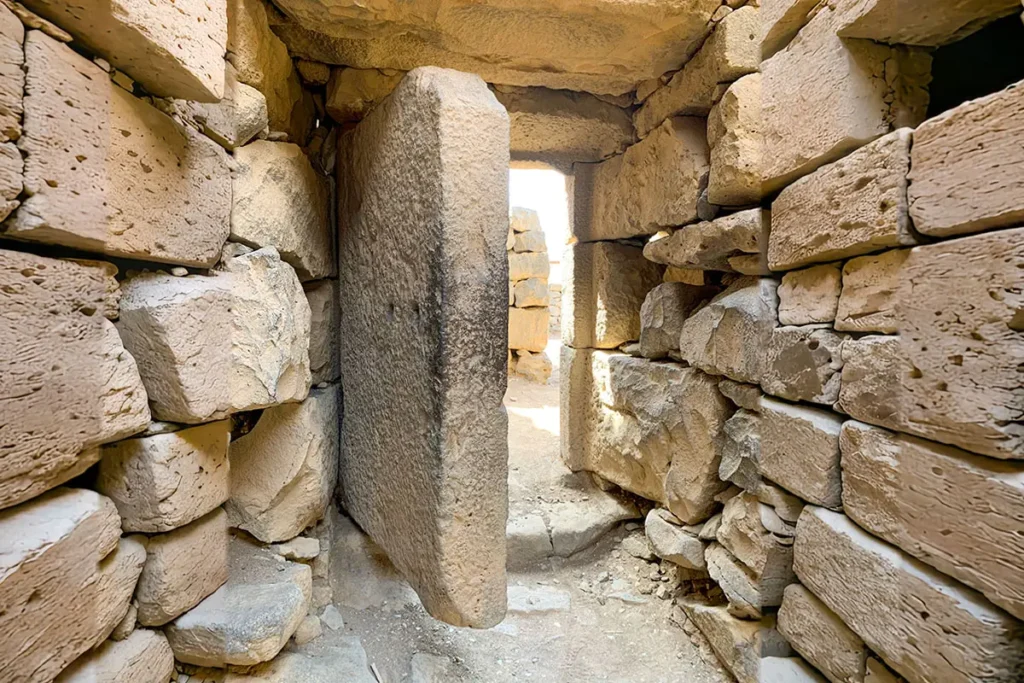
The main gate contains two massive basalt door leaves. Their material links them visually to the surrounding walls, making the entrance appear almost continuous when closed.
Look closely at their edges and how they sit within the doorway. Their engineering is more revealing than the often-repeated estimates of their weight. Leave any demonstration of movement to site staff.
The courtyard mosque
A small, freestanding mosque occupies the courtyard. Its compact scale adds a religious space within the larger military enclosure.
Its dating is presented differently across visitor sources. Jordan Tourism Board material assigns the surviving mosque to the Ayyubid period, while some historical accounts suggest earlier origins. It is best understood as part of the fortress’s evolving Islamic history rather than confidently labelled Umayyad entirely.
DESTRUCTION, REDISCOVERY, AND RESTORATION
Qasr Azraq reached its present condition through accumulated damage, rebuilding, and reuse. Earthquakes, deliberate alterations, collapsing masonry, and changes in occupation all affected its fabric.
“Rediscovery” is an imperfect description here. The fortress remained known and was still being used in the twentieth century. Modern archaeology brought systematic documentation to an existing landmark.
Jordan’s Department of Antiquities carried out restoration and excavation in several campaigns. Work in 2006 and 2008 included recording architectural features, investigating rooms, and reconstructing a threatened section of the western perimeter. Stones were documented before dismantling so that the intervention could be carefully controlled.
Later scientific research examined historic mortars and plasters to distinguish building phases and understand material choices. Such work matters because a wall that looks uniform from across the courtyard may contain evidence of several different occupations.
What survives is therefore a mixture of ancient construction, historic adaptation, and modern conservation. Look for changes in masonry size, blocked openings, and repaired arches rather than expecting every surface to belong to the same period.
WHAT TO SEE TODAY: A WALK THROUGH
Begin outside the southern gateway
Stand back to examine the gate tower before entering. Locate the Arabic inscription and the projecting defensive structure above it.
This is a useful place to establish the distinction between the site’s Roman origins and its substantial medieval rebuilding.
Examine the basalt doors
Move closer to the stone door leaves. Notice their thickness, shaped edges, and relationship to the surrounding masonry.
Photographs work particularly well when they include a little of the passage beyond: the contrast helps communicate both the doors’ mass and the depth of the entrance.
Look down for the carved game
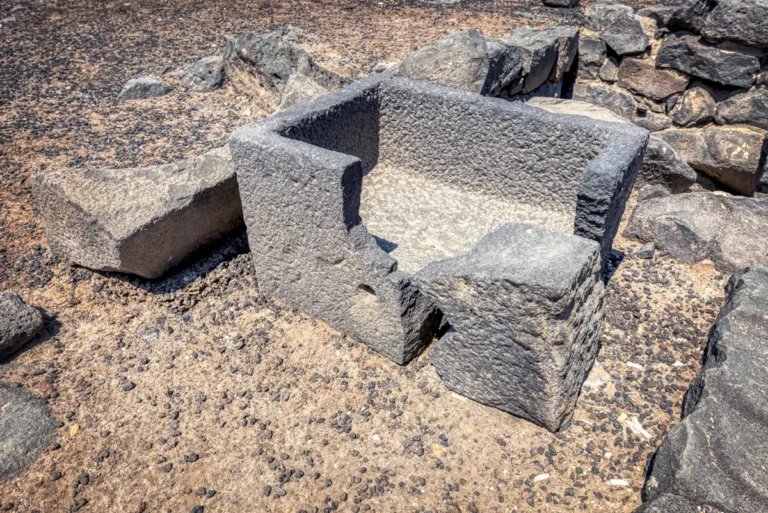
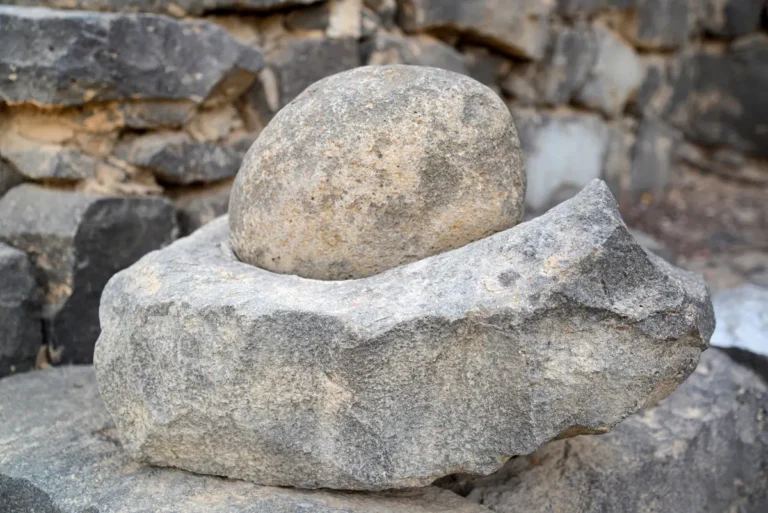
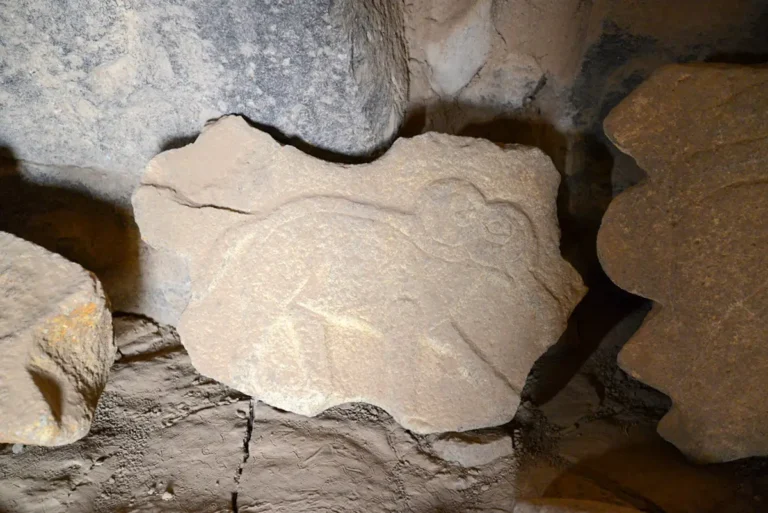
Near the entrance, look for depressions carved into the stone pavement, interpreted as a board for a game played with pebbles.
The small hollows offer a more intimate encounter than the towers. Someone paused here long enough to play. Their precise date and players should not be assumed simply because the fortress has Roman origins.
Enter the courtyard and find your bearings
Walk into the open court before exploring individual chambers. Turn slowly to understand the arrangement of rooms, towers, and stairways.
The mosque provides a central reference point. From here, the scale of the enclosure becomes clearer, as does the relationship between the open space and the sheltered rooms around it.
Visit the mosque
Approach the mosque and, where access permits, identify the prayer niche indicating the direction of Mecca.
Its modest size encourages a slower look. Within a building associated with soldiers and political power, it preserves evidence of daily religious practice.
Explore the accessible perimeter chambers
Choose a few open rooms and examine their roofs and supports. Trace the line of an arch, then look at the stones resting above it.
Compare neighbouring doorways and masonry. Differences can prompt useful questions about alterations, although assigning a date to each feature requires more than appearance alone.
Locate the chamber associated with Lawrence
The chamber above the southern entrance is traditionally identified with Lawrence’s stay. If the staircase and room are open, visit them for a different perspective on the gate and courtyard. Otherwise, the tower can be appreciated from below.
Finish by looking outward
Before leaving, consider the fortress within the modern town and the wider oasis basin. The reason for its location is easier to grasp when the visit extends beyond its walls.
A subsequent stop at the wetlands gives the military architecture an essential environmental context.
Qasr Azraq’s Ayyubid Inscription
Above the entrance, an Arabic inscription records the patron, officials, and date associated with a major medieval building campaign. It provides one of the clearest historical anchors for the fortress visitors see today.
Qasr Azraq’s Ayyubid Inscription
Above the entrance, an Arabic inscription records the patron, officials, and date associated with a major medieval building campaign. It provides one of the clearest historical anchors for the fortress visitors see today.
Arabic text
The following is a modernised transcription of the published reading, with standardised spelling and punctuation. The catalogue abbreviates the opening basmala; its conventional wording is expanded here.
بسم الله الرحمن الرحيم
أمر بعمارة هذا القصر المبارك الفقير إلى الله عز الدين أيبك، أستاذ دار الملك المعظم، بولاية علي بن الحاجب وعلي بن قرجلة، في سنة أربع وثلاثين وستمائة.
English translation
In the name of God, the Most Compassionate, the Most Merciful.
The construction of this blessed fortress was ordered by the one in need of God, Izz al-Din Aybak, steward of al-Malik al-Muʿazzam, under the supervision of Ali ibn al-Hajib and Ali ibn Qarjala, in the year six hundred and thirty-four.
The Arabic reading and this English rendering follow the catalogue entry, which reads the second official’s name as قرجلة, rendered here as Qarjala. Other publications give variants of this name. Répertoire chronologique d’épigraphie arabe, vol. XI, no. 4111, pp. 74–75
What does the inscription mean?
It dates a medieval building campaign.
The final words spell out 634 in the Islamic Hijri calendar, a lunar year spanning parts of 1236 and 1237 CE. This explains why descriptions of the castle sometimes give different Gregorian years. The inscription supplies no month or day.
It does not date the fortress’s earliest origins.
Although the text speaks of “construction,” Qasr Azraq already had a Roman history. Archaeological interpretation connects this inscription with the substantial Ayyubid rebuilding of an older stronghold. Museum With No Frontiers
“The one in need of God” expresses humility.
The phrase الفقير إلى الله — al-faqīr ilā Allāh describes dependence upon God. It is a devotional formula, rather than a statement that the patron lacked wealth.
“Steward” is an official title.
أستاذ دار — ustādh dār, also commonly rendered ustādhār, denotes a senior household administrator or majordomo. Here, the title links Aybak to al-Malik al-Muʿazzam’s household. “Professor,” the familiar modern meaning of ustādh, would be misleading in this context.
The inscription distinguishes patronage from supervision.
Aybak is credited with ordering the work. The phrase بولاية — bi-wilāyat introduces the officials responsible for overseeing it. It does not identify them specifically as the architects or stoneworkers.
For visitors, the inscription turns the gateway into a dated historical document: the building itself names the people responsible for one of its most important transformations.
PRACTICAL VISITING TIPS
Getting there and planning your day
A rental car, private driver, or organised tours are convenient for combining Azraq with the other desert castles. The castle itself is reached by paved roads.
Allow a full day for travel, visits, and lunch. If you also want an unhurried wetland visit, begin early, 7-8 AM.
Opening hours
The official Desert Castles timetable lists:
Winter: 8:00 a.m.–4:00 p.m.
Summer: 8:00 a.m.–6:30 p.m.
April and May: 8:00 a.m.–5:30 p.m.
Ramadan: 9:00 a.m.–5:00 p.m.
The published seasonal categories overlap, and other official listings give different general hours. Confirm locally before planning a late arrival. Official timetable
Timing, clothing, and comfort
Allow 20–30 minutes for a general visit or 30–40 minutes if you enjoy architecture and inscriptions.
For comfort, favour the cooler parts of the day in hot weather. Bring water, sun protection, and shoes with good grip. A windproof layer can be useful during cooler months. Side lighting often brings out the basalt’s texture more effectively than overhead midday sun.
Access and conservation
Expect uneven paving, thresholds, steps, and changes in level. Visitors with limited mobility should confirm current access arrangements in advance; upper chambers require particular care.
Follow barriers and staff guidance. The condition and accessibility of individual rooms can change with conservation work.
WHY QASR AZRAQ MATTERS
Qasr Azraq makes the relationship between water and power unusually tangible. Its walls stand where an oasis made settlement and movement possible. Armies came and went, but the value of that location endured.
The environmental story continues today. Excessive groundwater extraction severely depleted Azraq’s wetlands, and the Royal Society for the Conservation of Nature has worked since the 1990s to restore part of the habitat. Visiting the reserve alongside the castle connects the long history of dependence on water with the modern challenge of protecting it. RSCN
The fortress also preserves histories at different scales: imperial inscriptions, medieval reconstruction, wartime headquarters, and rooms adapted by families seeking refuge. Each changed the building. Together they make it more than a monument to one famous visitor.
As you return through the basalt gateway, the smallest details may remain most vivid: a worn threshold, a stone roof carried across an arch, the shallow hollows of a game. They bring the fortress back to the people who used it—and to the ordinary acts of sheltering, waiting, praying, and beginning another journey.
Frequently Asked Questions
Qasr Azraq is known for its black basalt architecture, massive stone doors, and association with T. E. Lawrence during the Arab Revolt. Its courtyard, towers, and inscriptions reveal a much longer history, extending from Roman military occupation through medieval rebuilding and later reuse.
The fortress developed over several periods. Inscriptions establish occupation by the late third–early fourth century CE, while an Arabic inscription records major Ayyubid building works by Izz al-Din Aybak in 634 AH / 1236–1237 CE. Much of its present appearance reflects that medieval reconstruction.
The castle is built from local basalt, a dark volcanic rock. Builders used it for walls, arches, roof slabs, and doors, giving the fortress its distinctive appearance. The material connects the building directly to the volcanic landscapes of northeastern Jordan.
Azraq’s freshwater springs made the oasis strategically valuable. It stood near routes connecting the surrounding desert with Syria, Arabia, and western Jordan. A fortress here could support military movement and help control access to an important stopping place.
During the winter of 1917–1918, Qasr Azraq served as a base associated with Sharif Ali ibn al-Hussein and T. E. Lawrence during the Arab Revolt against Ottoman rule. Lawrence later described life at the fortress in Seven Pillars of Wisdom. The chamber above the southern entrance is associated with his stay.
Highlights include the basalt entrance doors, the Arabic inscription above the gateway, the courtyard mosque, and the surviving arches and stone roofing. Look for the carved game hollows near the entrance, too. Visit the chamber associated with Lawrence if it is open, and follow staff guidance around restricted areas.
The inscription records that Izz al-Din Aybak ordered the construction of the “blessed fortress,” names the officials supervising the work, and gives the year 634 AH. It commemorates the Ayyubid building campaign rather than the castle’s Roman origins.
The castle stands in Azraq North, approximately 115–125 kilometres from central Amman, depending on your route. It is reached through the town on paved roads, so an ordinary car is suitable. For planning, allow roughly 1.5–2 hours from Amman, with extra time for traffic and stops.
Key Moments in History
Late 3rd–Early 4th Century CE — A Roman stronghold at the oasis
Latin and Greek inscriptions establish a Roman presence at Qasr Azraq by this period. Its position near freshwater springs and desert routes made it an important military site. The surviving fortress developed through later rebuilding, so its walls do not all belong to this earliest phase.
Early 4th Century CE — Repairs under Constantine
Inscriptions record restoration during the reign of Emperor Constantine. Even in Roman times, maintaining the stronghold required investment—a reminder that Azraq’s history is one of repeated renewal as well as endurance.
Key Moments in History
Late 3rd–Early 4th Century CE — A Roman stronghold at the oasis
Latin and Greek inscriptions establish a Roman presence at Qasr Azraq by this period. Its position near freshwater springs and desert routes made it an important military site. The surviving fortress developed through later rebuilding, so its walls do not all belong to this earliest phase.
Early 4th Century CE — Repairs under Constantine
Inscriptions record restoration during the reign of Emperor Constantine. Even in Roman times, maintaining the stronghold required investment—a reminder that Azraq’s history is one of repeated renewal as well as endurance.
8th Century CE — An Umayyad connection
Historical accounts associate the oasis with the Umayyad prince al-Walid ibn Yazid, later Caliph al-Walid II. Azraq’s water and wildlife attracted royal visitors, adding a courtly chapter to its military history. The precise extent of Umayyad alterations to the surviving castle remains uncertain.
1236–1237 CE — The Ayyubids rebuild the fortress
An Arabic inscription above the southern entrance records major building works by Izz al-Din Aybak in 634 AH. This reconstruction shaped much of the fortress visible today, adapting an older stronghold to the strategic demands of medieval Transjordan.
Ottoman Period — Guarding routes towards Arabia
Under Ottoman rule, the fortress continued to serve a practical purpose, helping protect routes towards Mecca. The oasis remained valuable to travellers crossing the region, sustaining Azraq’s importance through another change of empire.
Winter 1917–1918 — A base during the Arab Revolt
Sharif Ali ibn al-Hussein and T. E. Lawrence use Qasr Azraq during operations against Ottoman forces. Lawrence’s later account in Seven Pillars of Wisdom brings international attention to the fortress, describing the repairs and preparations needed to make it a wartime base.
1925 — A fortress becomes a refuge
Druze families arriving during the uprising against French rule in Syria settle inside the castle. They repair chambers and adapt spaces for domestic life, leaving a human history later documented through archaeology and residents’ testimonies.
2006–2008 — Recording and conserving the ruins
Jordan’s Department of Antiquities undertakes detailed documentation, excavation, and restoration. Work includes investigating rooms and rebuilding a threatened section of the western perimeter, preserving the structure while uncovering evidence of its successive occupants.