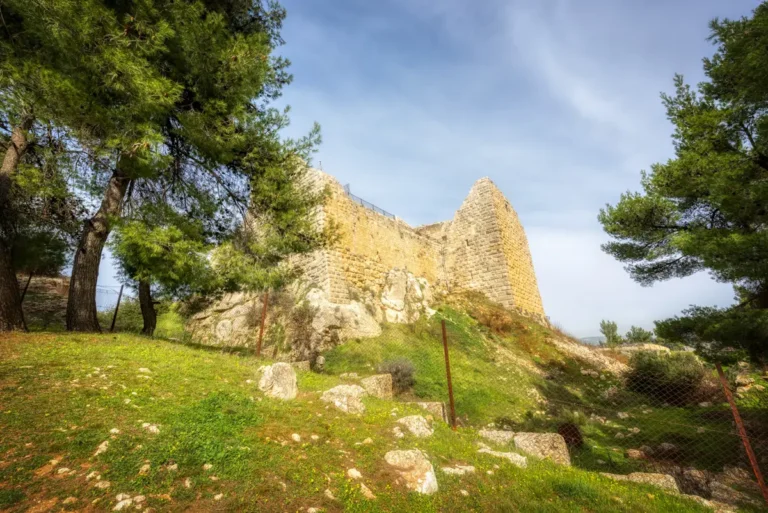












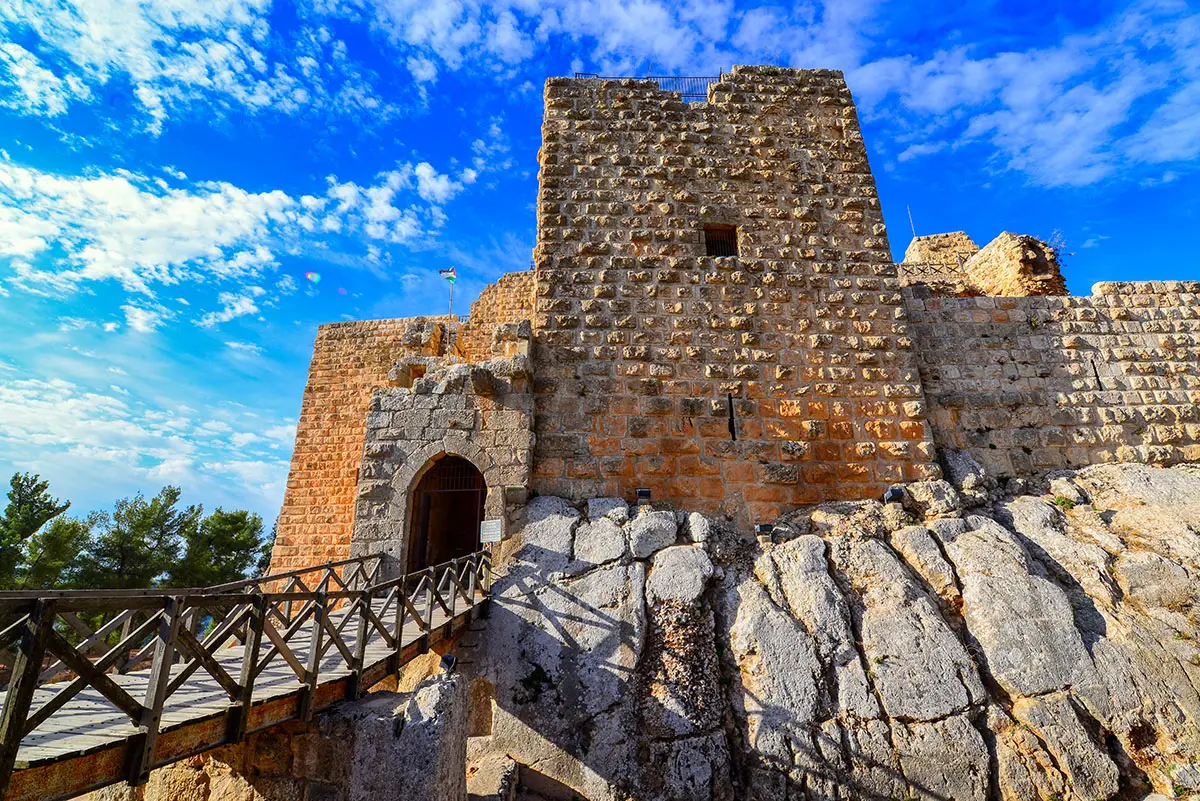


Crowning a summit high above the town of Ajloun, Qal’at ar-Rabad, the “castle of the suburb”, is one of the finest Islamic castles of the Crusader period. Built by one of Saladin’s emirs and enlarged by his successors, it watched over the hills of northern Jordan and the Jordan Valley below.
Where Is Ajloun Castle?
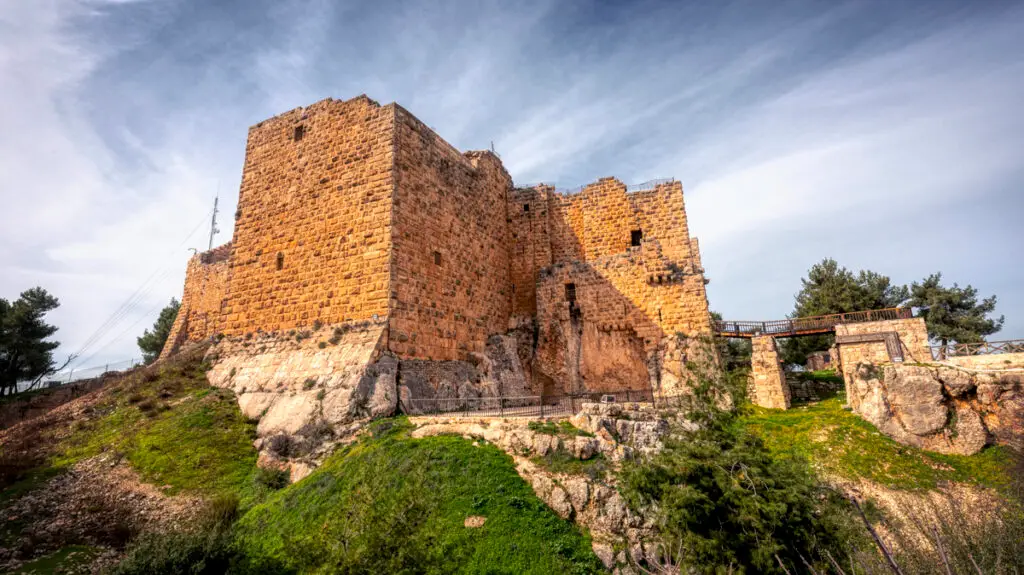
The castle stands on the summit of Jabal ‘Awf, about 3 km west of Ajloun town and about 70–75 km north-west of Amman. From its walls the view reaches over three wadis to the Jordan Valley. The nearby Ajloun Forest Reserve lies a few kilometres to the north.
Historical Context and Origin
The castle was begun in 1184–85 by ‘Izz al-Din Usama, one of Saladin’s emirs. According to the chronicler Ibn Shaddad, it was built to control the Banu ‘Awf tribe of the mountain, and it also secured northern Jordan for Damascus, guarded the iron mines of Ajloun and faced the Crusader castle of Belvoir across the Jordan Valley. In 1211–12 the Ayyubid ruler of Damascus, al-Mu’azzam ‘Isa, took it from Usama, and in 1214–15 his majordomo Aybak enlarged it.
Architectural Design
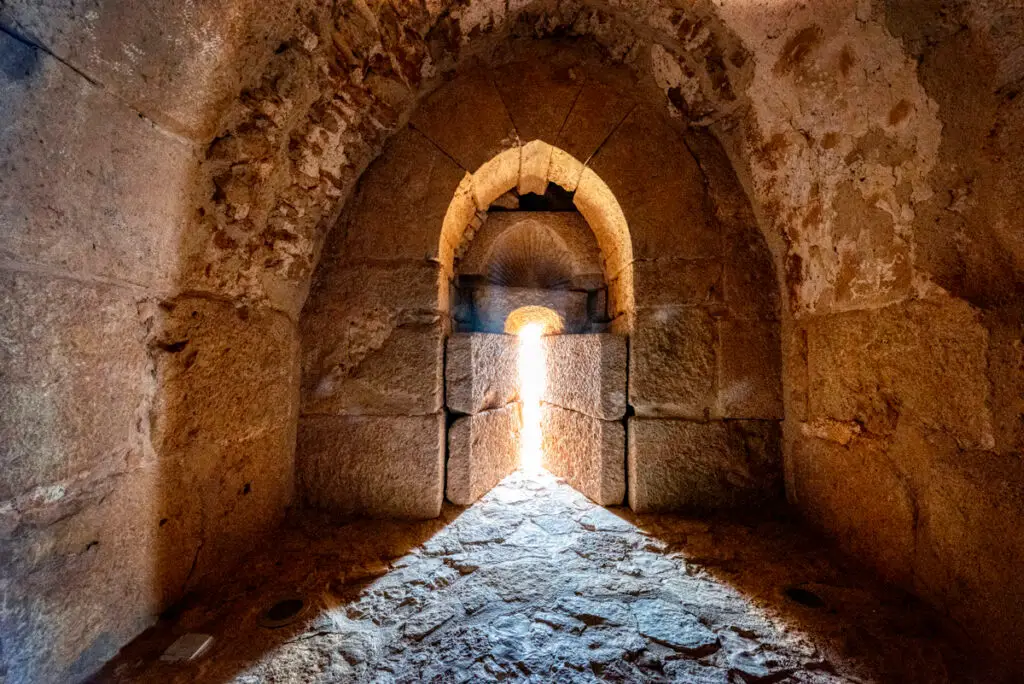
The first castle was a square keep with corner towers and an entrance on the east. Aybak added the great south-eastern tower and outer gates, raised the walls, and probably cut the deep dry moat around the castle. Inside, vaulted halls, passages and stairs link the towers, built of limestone that was probably quarried from the moat itself. A small Byzantine chapel with a mosaic floor was incorporated into the castle.
Aybak’s Tower
The great south-east tower added in 1214–15.
Dry Moat
A deep ditch cut in the rock around the castle.
Vaulted Halls
Long stone halls and passages inside the keep.
Castle Museum
Pottery, coins, inscriptions and a Byzantine mosaic.
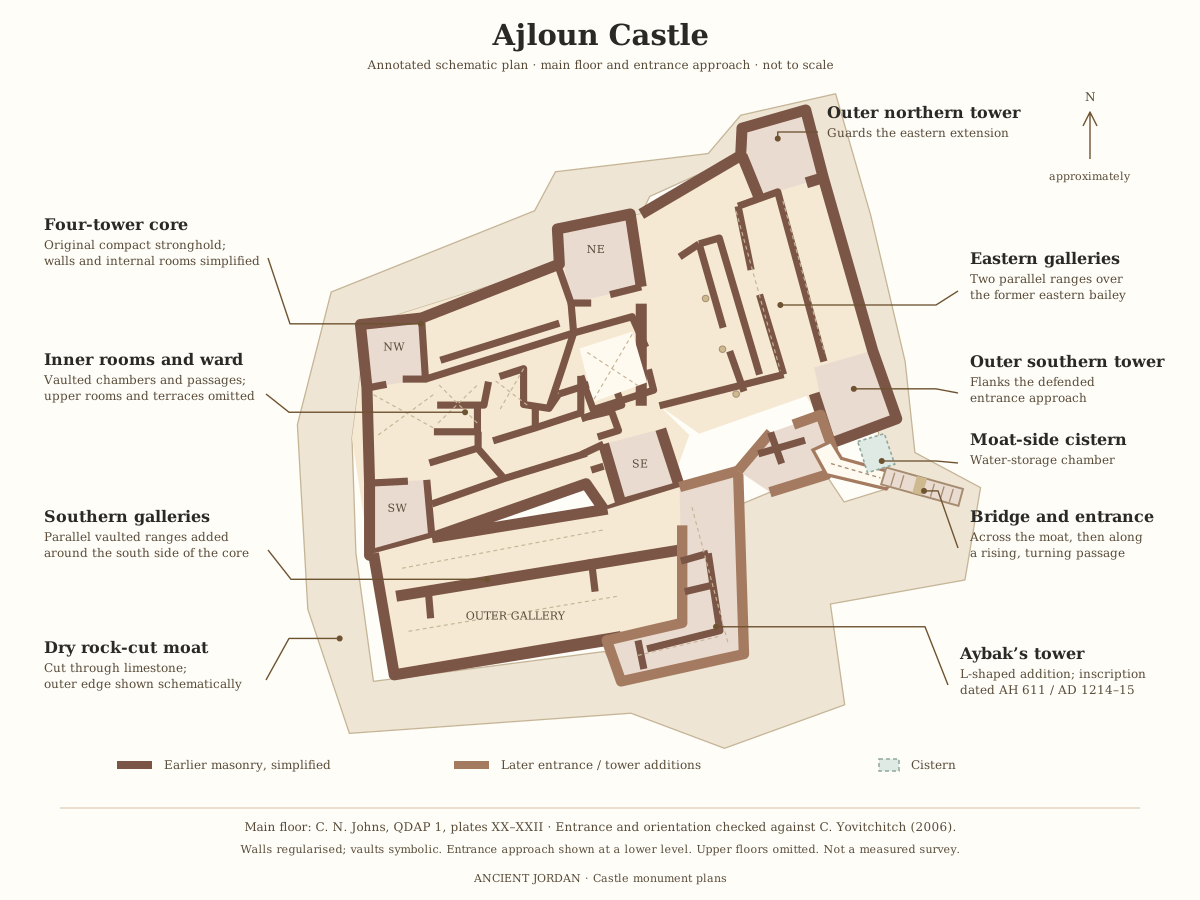
Ajloun Castle
Schematic main-floor plan of Ajloun Castle, after Johns's 1929 survey; not to scale
Open drawingAybak’s building inscription (RCEA 3746)
Aybak’s building inscription is dated AH 611 (AD 1214–15) and records the construction of the large southern tower at Ajloun Castle. It is catalogued as RCEA no. 3746. Répertoire chronologique d’épigraphie arabe, vol. X, p. 101
[بسم الله الرحمن الرحيم] أنشأ هذا البرج
المبارك أيبك بن عبد الله أستاذ الدار المعظمي
في شهور سنة أحد عشر وستمائة
“[In the name of God, the Most Compassionate, the Most Merciful.]
Aybak son of ʿAbd Allāh, majordomo in the service of al-Muʿaẓẓam, built this blessed tower during the months of the year six hundred and eleven.”
This follows the published reading, with spelling lightly normalised. The catalogue abbreviates the opening as “basmala”; its conventional wording is expanded here in square brackets.
Aybak son of ʿAbd Allāh was the Ayyubid official responsible for this addition. The inscription credits him with the tower’s construction, rather than naming its architect or craftsmen.
Ustādh al-dār (أستاذ الدار) means “majordomo” or chief officer of the ruler’s household. Al-Muʿaẓẓamī (المعظمي) identifies his association with the Ayyubid ruler al-Malik al-Muʿaẓẓam ʿĪsā.
“This blessed tower” identifies a particular building campaign. The inscription dates the tower addition, not the foundation of the entire castle.
“During the months of the year…” is a dating formula; no particular month or day is specified. The inscription occupies three lines on the tower’s eastern façade, on a window lintel. Architectural record and inscription photograph
Mongols and Mamluks
In 1260 the Mongols occupied the castle, ate its stores and threw down its battlements, but held it only until the battle of ‘Ain Jalut. In 1261 the Mamluk sultan Baybars had it repaired and restocked, and under the Mamluks Ajloun became an administrative centre and arsenal. Later, an Ottoman garrison was stationed here, and in 1812 Burckhardt found a family of about forty people living in the castle.
Destruction, Rediscovery, and Restoration
Earthquakes in 1837 and 1927 badly damaged the castle. The Department of Antiquities began restoring it in 1927–29, and later work consolidated the walls and rebuilt the bridge over the moat. A museum opened in one of the halls in 1993, displaying pottery, coins, glass, inscriptions and the Byzantine mosaic.
Visiting Ajloun Castle Today
Admission is 3 JOD for foreign visitors and 0.25 JOD for residents, and is covered by the Jordan Pass. The museum inside the castle keeps the same hours. The Ajloun cable car, opened in 2023, runs about 2.5 km up to the castle, but its ticket does not include castle admission. Allow about an hour. See our Ajloun Castle travel guide for practical details.
Further reading: Johns, Medieval ‘Ajlun I: The Castle (QDAP 1932); Creighton University — Ajlun castle virtual tour.