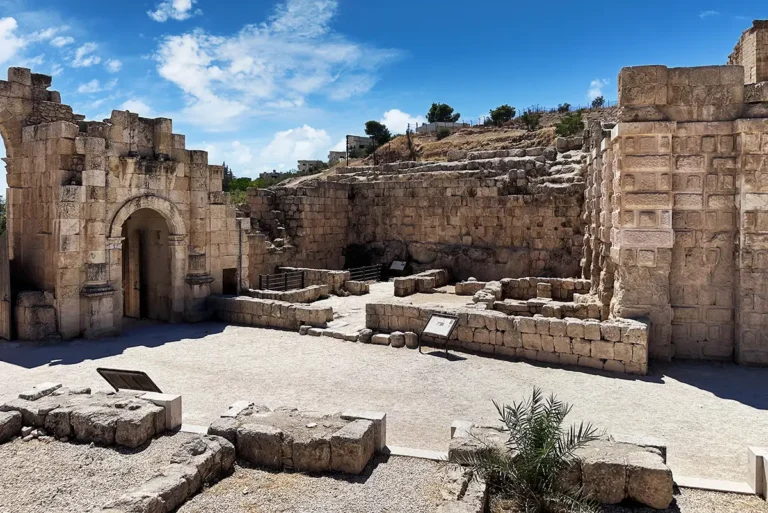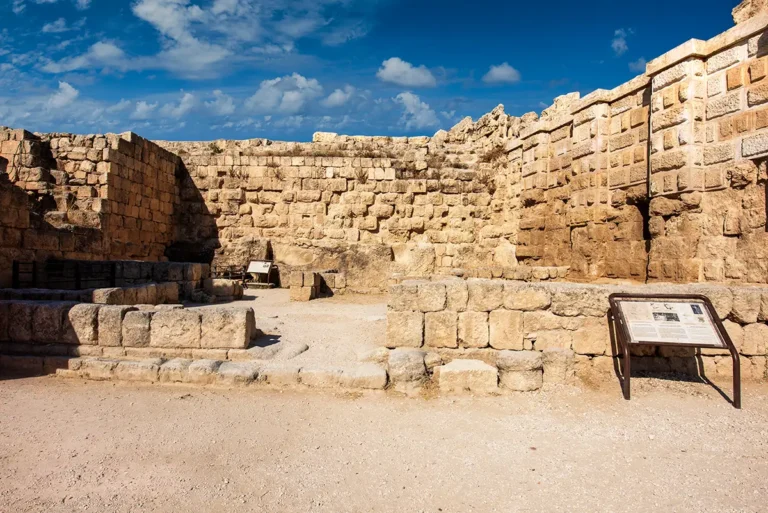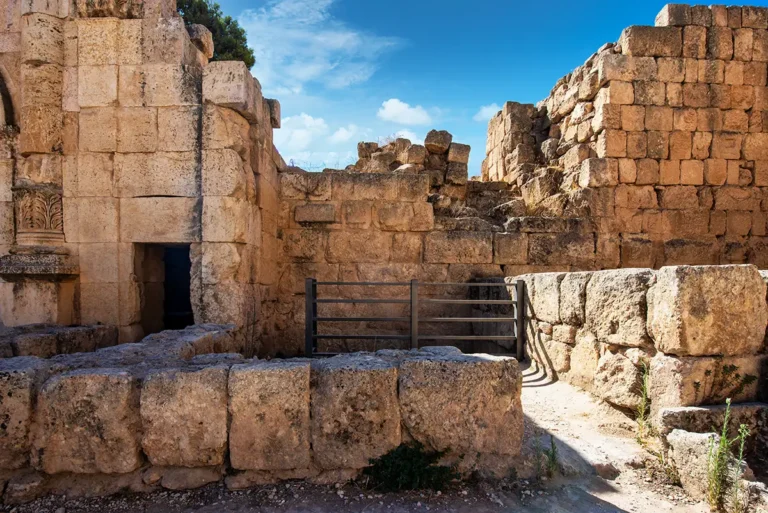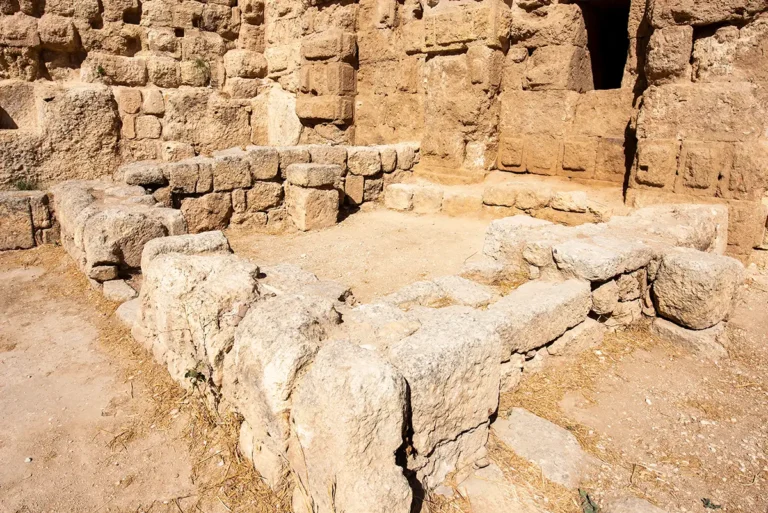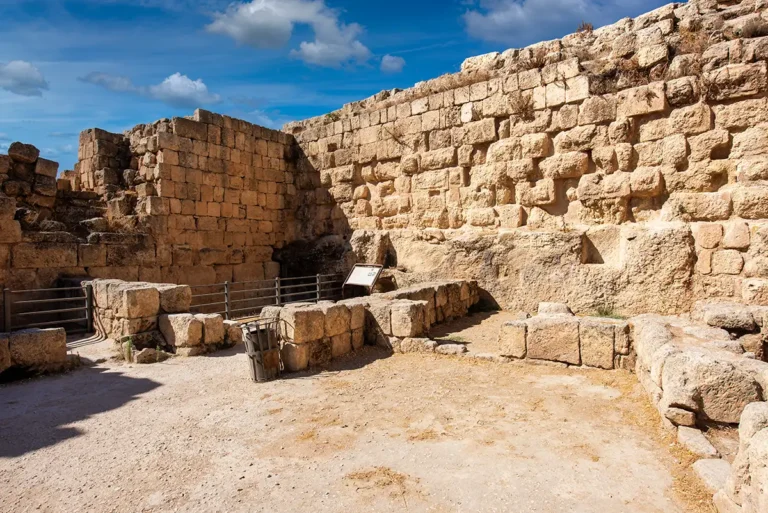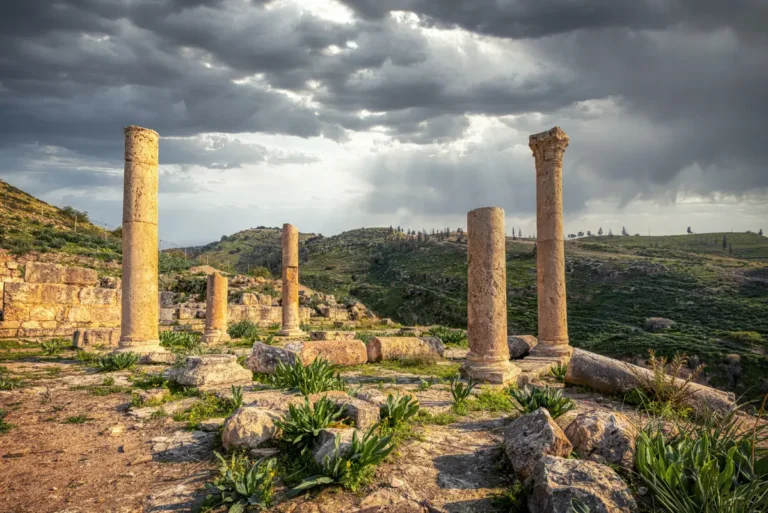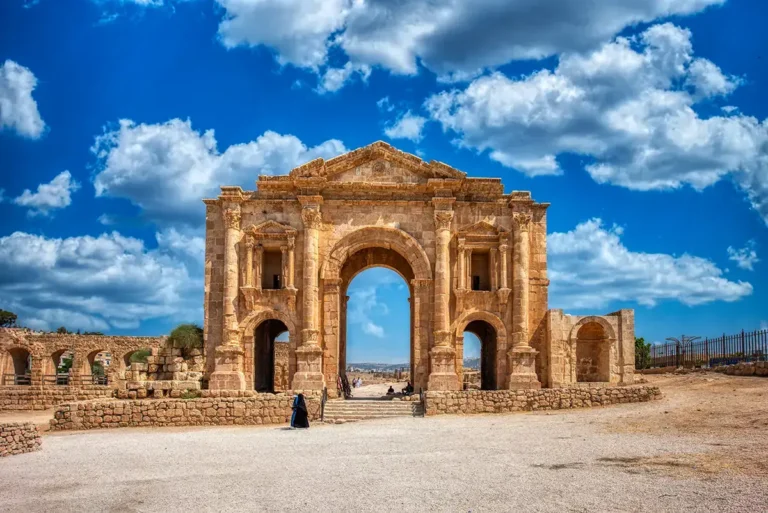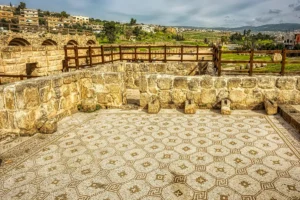
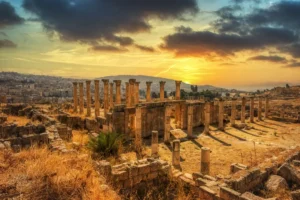
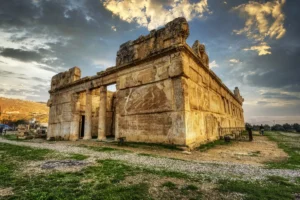
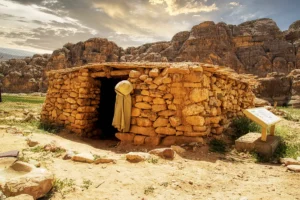
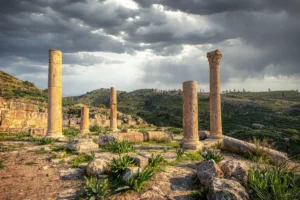
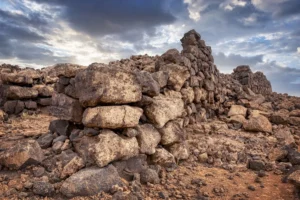
At the southern edge of ancient Jerash, beneath the Sanctuary of Zeus and beside the approach to the South Gate, a modest group of ruins preserves an unusually vivid story of the city’s changing life. The West Souk began as a roadside commercial quarter, where travellers, craftspeople and merchants met on the Gerasa–Philadelphia road. After destruction in the late 3rd century, the same ground was transformed into a small military barracks guarding Jerash’s newly fortified southern entrance.
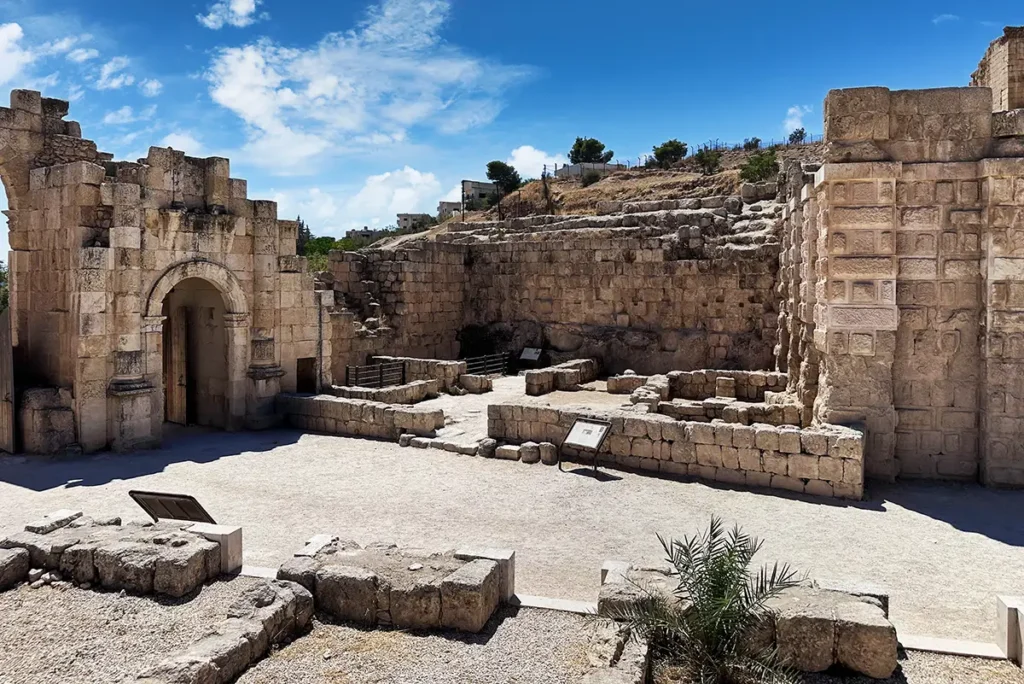
This is not one of Jerash’s grandest monuments, but it is one of its most revealing. In a compact area, the remains trace a transition from commerce and domestic life to security, defence and late-antique urban change.
The West Souk & Military Barracks at a Glance
Location: Jerash Archaeological Park, Jordan (at the foot of the Sanctuary of Zeus, immediately north-west of the South Gate)
Built date: 2nd–late 3rd century AD as the West Souk; early 4th–7th century AD as barracks
Original function: A roadside commercial quarter with workshops, shops and upper-floor dwellings
Later function: Small military barracks guarding the South Gate and city wall
Highlights: Rock-cut workshops, evidence of woodworking, an olive-oil press, central barracks courtyard and proximity to the South Gate
What makes it special: One site reveals Jerash’s shift from a thriving Roman market district to a fortified late-antique city
Allow: 10–15 minutes
Combine with: South Gate, East Souk & South Street, Sanctuary of Zeus, and the Oval Plaza.
Where is the West Souk?
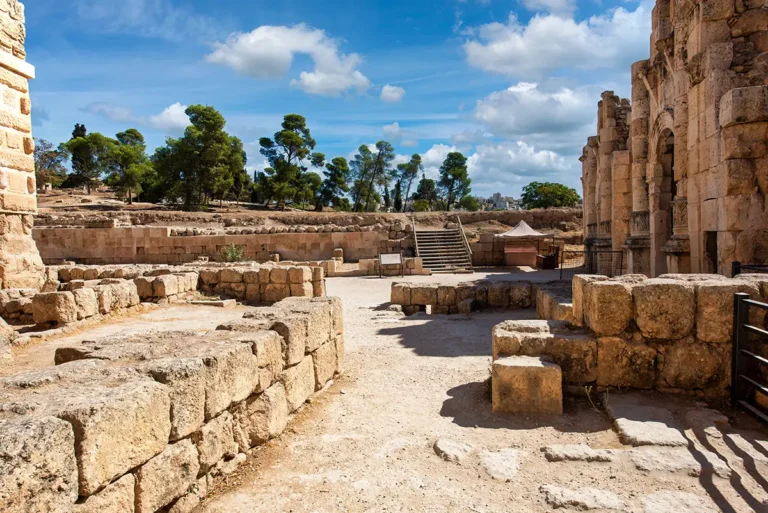
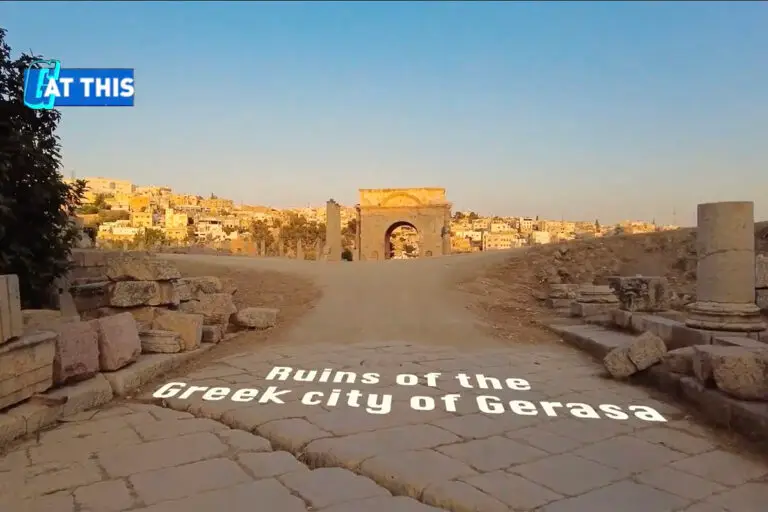
The West Souk lies at the foot of the Sanctuary of Zeus, on the west side of the ancient road leading from Gerasa to Philadelphia—modern Amman. It stands immediately north-west of the South Gate, close to the city wall and the southern approach to the archaeological park.
Its position was ideal for trade. Before entering the city, travellers would have passed workshops and shops here, while the Sanctuary of Zeus rose on the higher ground nearby. The location linked a major road, a sacred precinct and the city entrance.
The West Souk: a roadside market
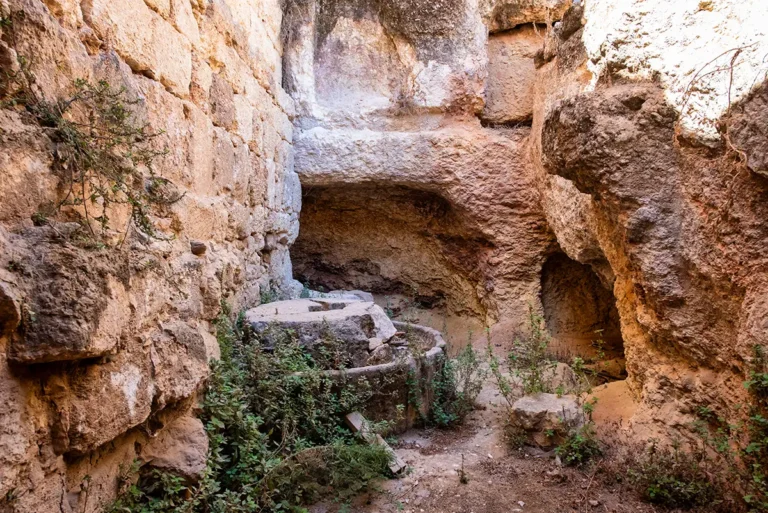
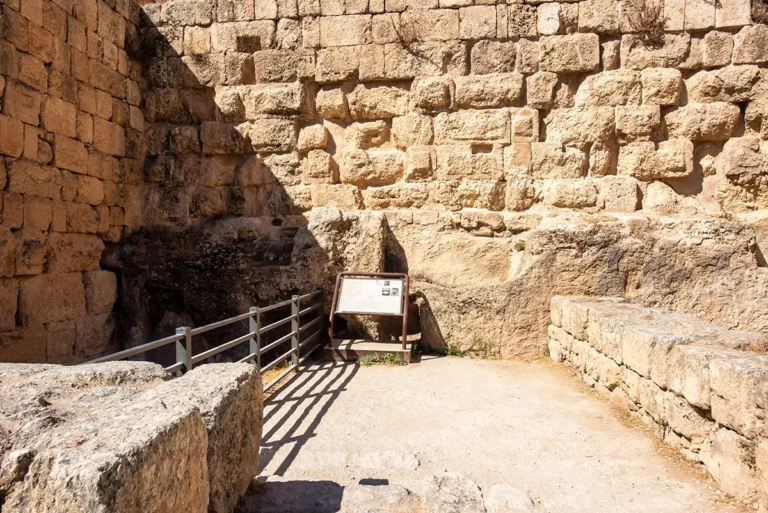
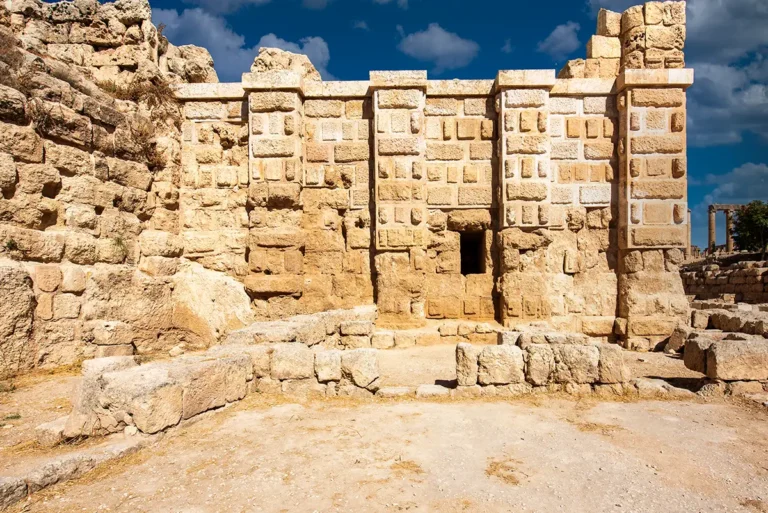
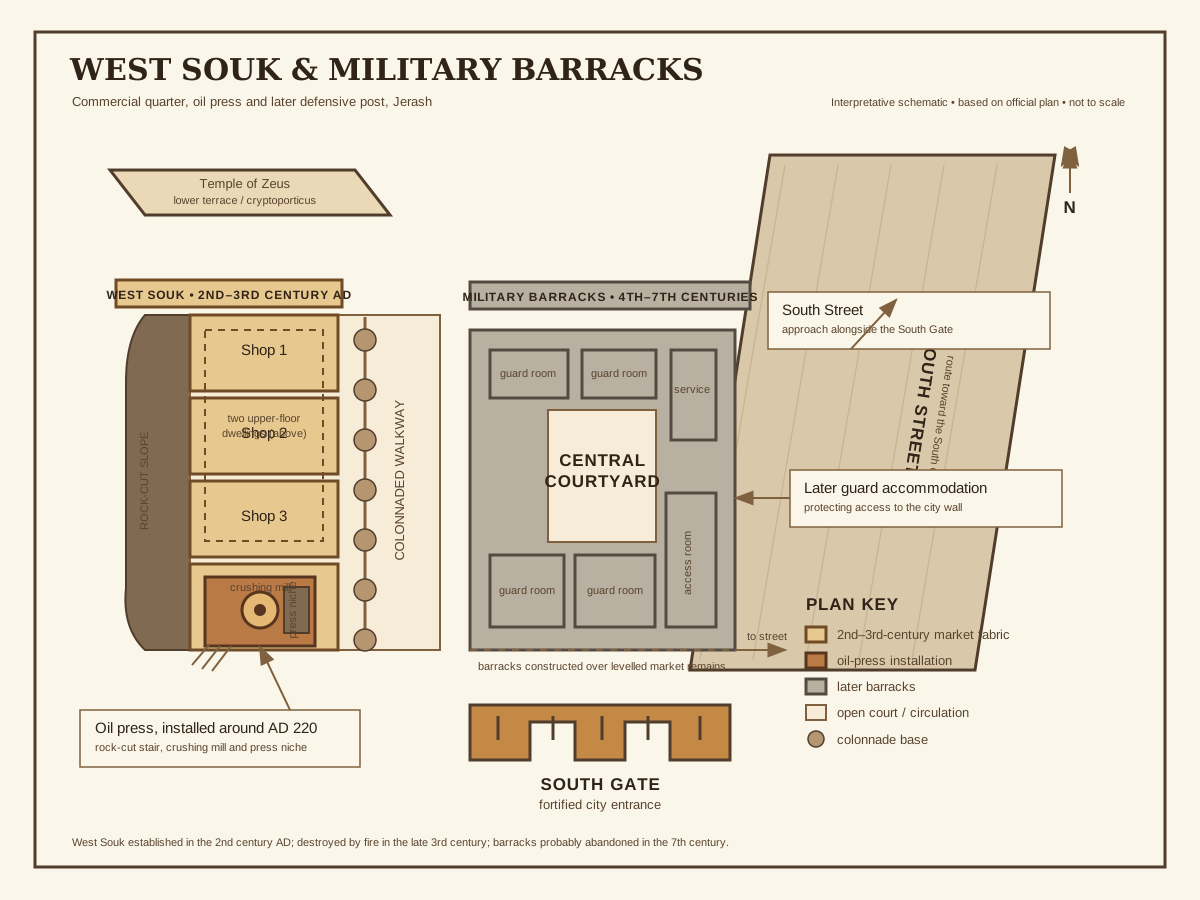
The market quarter was established in the 2nd century AD, when at least four shops were built along the road. Some were partly cut into the bedrock, an efficient use of the sloping terrain below the sanctuary.
Evidence from the excavations suggests that woodworking craftspeople occupied the shops. Carpenters’ tools were among the finds, offering a rare glimpse of the practical work once carried out here. The souk was therefore more than a place to buy goods: it was a working district where objects were made, repaired and sold to local residents and travellers.
A colonnade stood in front of the shops, sheltering the commercial frontage. Above it were two small but comfortably appointed dwellings, together covering around 100 square metres. This combination of workshops below and homes above was a practical Roman urban arrangement, allowing artisans and traders to live directly beside their work.
The Oil Press at the West Souk
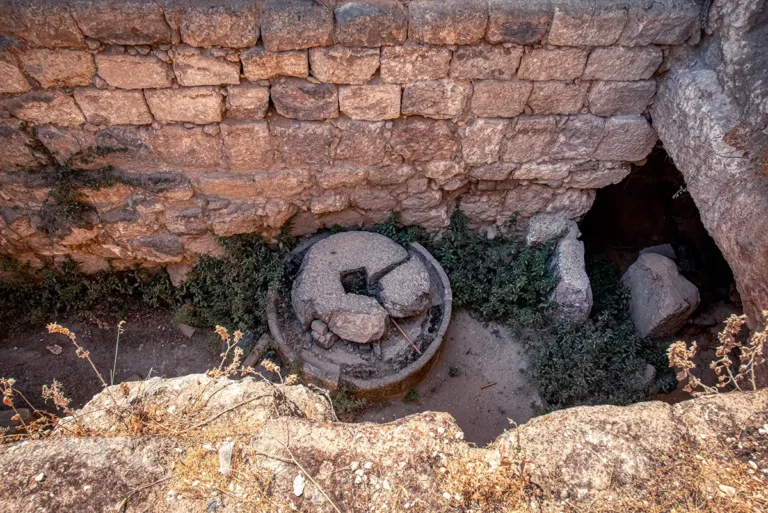
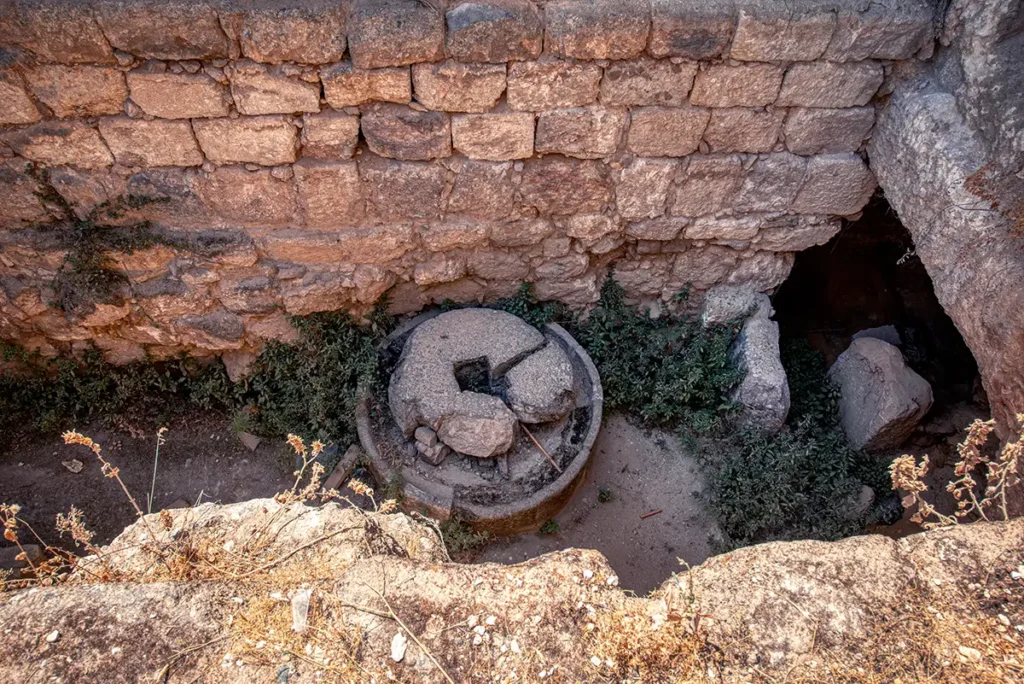
Around AD 220, the southernmost shop of the West Souk was substantially altered to create an olive-oil press. Its rocky floor was cut deeply into the ground, and visitors originally descended from the covered walkway by a staircase carved into the bedrock.
The installation reveals the industrial side of this commercial quarter. At the centre of the room are remains of the crushing mill, where olives were ground beneath an upright millstone. The press itself stood in a large niche on the western side. Olives were first crushed, then the resulting pulp was pressed to separate the oil.
The oil press shows that the West Souk was not simply a row of retail shops. It was also a place of production, where local agricultural products could be processed and prepared for sale. Its conversion shortly before the market’s late-3rd-century destruction is a striking example of how individual shops at Jerash could be adapted to changing economic needs.
Fire and destruction in the late 3rd century
The West Souk did not survive unchanged for long. In the late 3rd century AD, a fire destroyed the buildings. The official site interpretation associates the destruction with a raid by looters on the city.
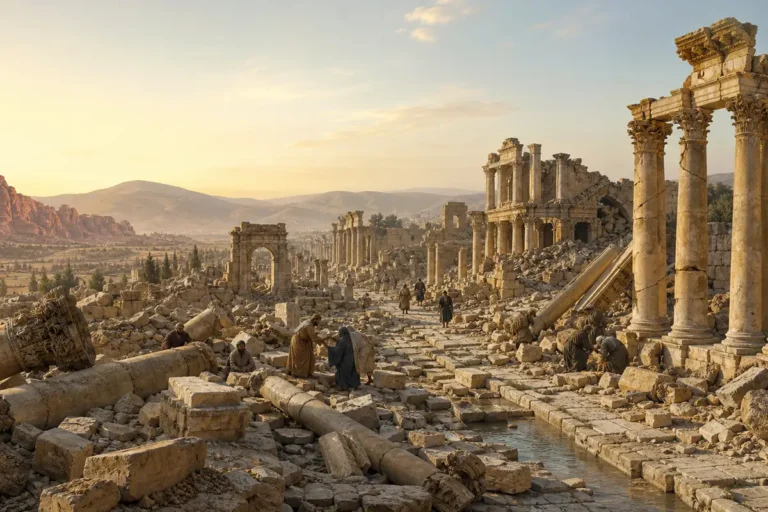
The event belongs to a period of uncertainty in the wider Roman world, when cities increasingly invested in their defences. At Jerash, the damage to the commercial quarter was followed not simply by repair, but by a complete change of purpose.
From market to military barracks
After the raid, Jerash began to fortify itself. The city walls were constructed in the early 4th century, and the ruined West Souk stood directly beside the newly important South Gate.
Rather than rebuilding the shops, the remains were levelled and reused as the foundation for a small military barracks. The barracks were arranged around a central courtyard and housed the guards responsible for protecting access to the gate and the fortifications.
This transformation is especially significant because it shows how the city’s priorities had changed. The lively commercial strip had once welcomed people approaching Gerasa; now the same space was adapted to control and defend that approach.
What to look for
The ruins are low and can be easy to overlook, but they become much more meaningful when read as two successive places.
Look for:
Rock-cut and masonry remains of the former workshops.
The relationship between the buildings and the slope below the Temple of Zeus.
The central-courtyard arrangement of the later barracks.
The immediate proximity of the South Gate and city wall.
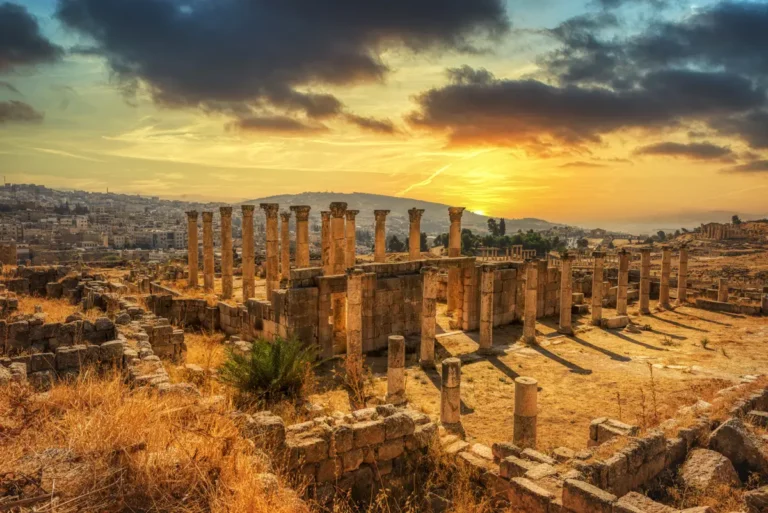
The contrast between the practical, small-scale structures here and the monumental architecture of the sanctuary above.
The artefacts displayed on the site information board—including carpenter’s tools, a bronze lamp, jewellery and a marble altar—also help evoke the people who lived and worked in the district.
The end of the barracks
The barracks were altered several times during their use. By the 7th century AD, they were probably abandoned. Their long history reflects the changing character of Jerash after the Roman period: an imperial city of sanctuaries, streets and markets gradually became a fortified late-antique settlement whose public spaces were repeatedly adapted to new needs.
Practical visiting tips
The site is best explored on foot as part of a walk around the southern end of the archaeological park. Visit in the morning or late afternoon, when the light makes the low walls and changes in ground level easier to see. Take a moment to compare the remains with the plan on the information board; the market-to-barracks transformation is much clearer once you identify the central courtyard and the gate nearby.
The ruins may appear quiet today, but they once stood in one of the busiest and most strategically important parts of ancient Gerasa.
Why visit the West Souk and Military Barracks?
Visit this small complex for its human scale and its clear historical sequence. The grand temples, theatres and colonnaded streets of Jerash show the city at its most monumental. The West Souk and Military Barracks show how ordinary people worked, lived, travelled and protected the city.
It is also an excellent stop to combine with the South Gate, the East Souk and South Street, and the Sanctuary of Zeus. Together, these sites reveal how Jerash’s southern entrance developed from a commercial approach into a fortified gateway.
Frequently Asked Questions
The West Souk was a small 2nd-century AD commercial quarter beside the Gerasa–Philadelphia road, near the South Gate. Its rock-cut shops were used by craftspeople, including woodworkers, and had small dwellings above them.
Yes. The oil press was installed in the southernmost shop of the West Souk around AD 220, adapting a commercial space for the processing of olives.
Olives were crushed with a millstone in the centre of the room. The crushed pulp was then pressed in a western niche to extract the oil, which could be stored, traded or used locally.
The market buildings were destroyed by fire in the late 3rd century AD, probably during a raid on the city. They were not rebuilt as shops.
The ruins stood beside the newly fortified South Gate. In the early 4th century, the area was levelled and turned into a small barracks around a central courtyard for guards protecting the gate and city wall.
The barracks were modified several times but were probably abandoned in the 7th century AD, long after the commercial quarter had disappeared.
Yes, especially when combined with the South Gate and the Temple of Zeus. It is a compact but important site for understanding ordinary work, olive-oil production and the later defence of ancient Jerash.
Key Moments in History
2nd century AD — West Souk established: At least four shops were built beside the Gerasa–Philadelphia road, below the Temple of Zeus. Workshops, a collonaded frontage and upper-floor dwellings made it a busy commercial quarter.
Around AD 220 — Oil press installed: The southernmost shop was cut deeper into the bedrock and converted into an olive-oil press, adding food processing to the area’s craft and trading activities.
Key Moments in History
2nd century AD — West Souk established: At least four shops were built beside the Gerasa–Philadelphia road, below the Temple of Zeus. Workshops, a collonaded frontage and upper-floor dwellings made it a busy commercial quarter.
Around AD 220 — Oil press installed: The southernmost shop was cut deeper into the bedrock and converted into an olive-oil press, adding food processing to the area’s craft and trading activities.
Late 3rd century AD — Destructive fire: The West Souk was destroyed by fire, probably during a raid on Jerash. The workshops and homes were not rebuilt in their earlier form.
Early 4th century AD — City fortifications constructed: As Jerash strengthened its defences, the ruined market beside the South Gate was levelled.
4th century AD — Military barracks created: A small barracks was built around a central courtyard to accommodate guards responsible for the South Gate and adjacent city wall.
4th–7th centuries AD — Barracks altered and reused: The complex was modified several times as Jerash continued to adapt its southern entrance to changing needs.
7th century AD — Probable abandonment: The military barracks were likely abandoned, ending the long sequence of commercial, industrial and defensive use at the site.