













Qasr Bshir
Rome’s best-preserved desert fort in Jordan, with its inscription still over the gate
BuiltAD 293–305
FortAbout 57 × 54 m
UNESCOTentative List
Access4x4 track
Introduction
A Roman fort that still carries its name over the door.
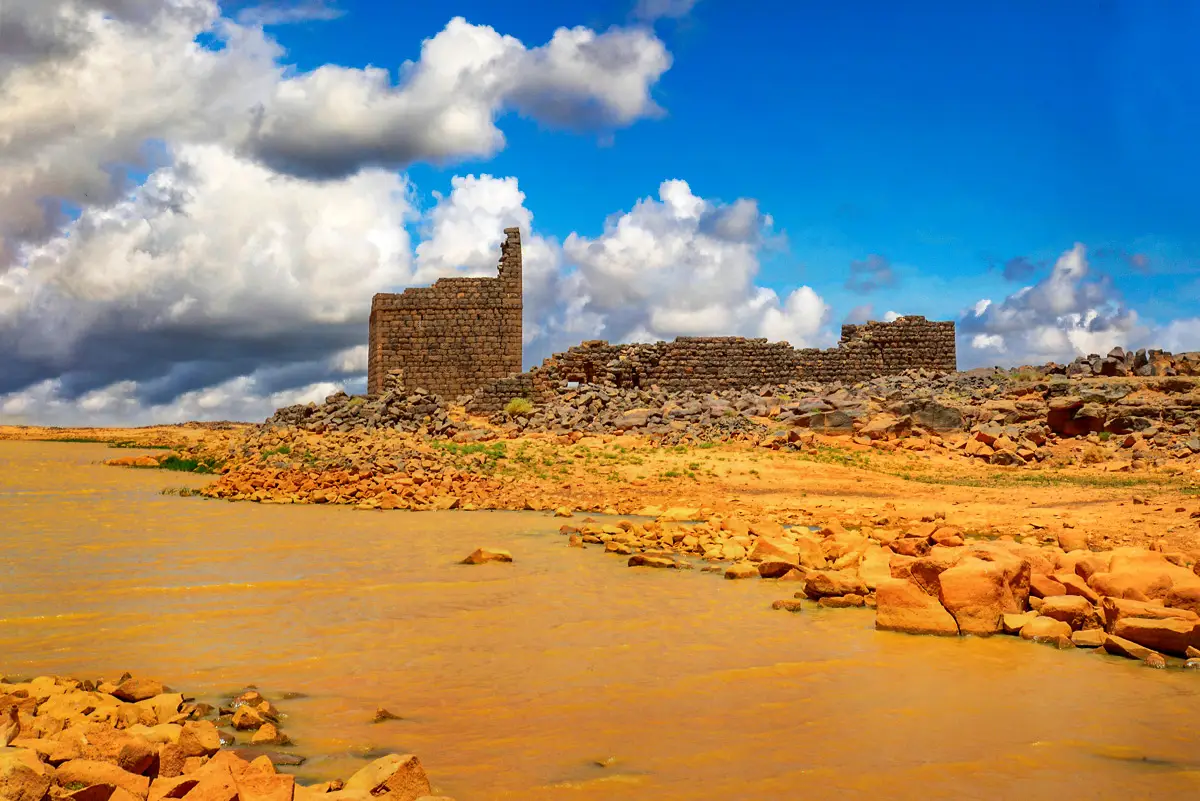
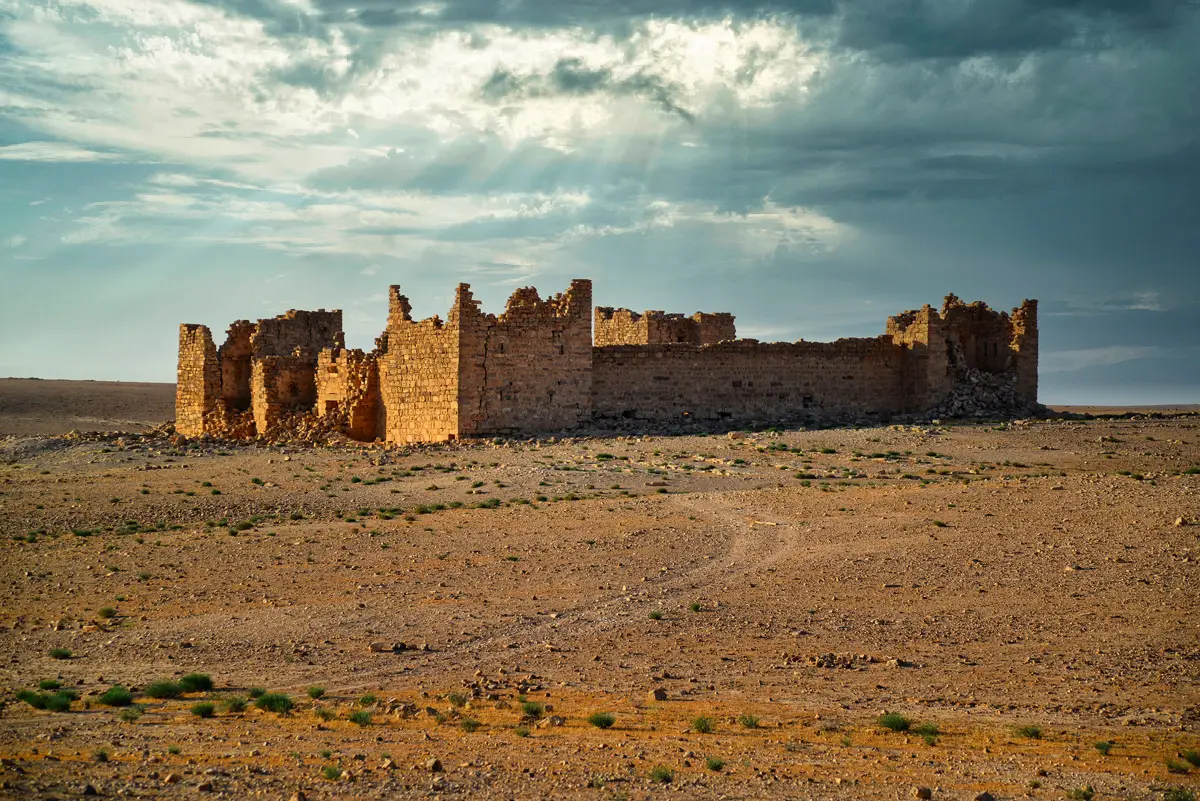
Qasr Bshir stands alone on the stony steppe of the Karak plateau, its four corner towers visible from far across the plain. It is the best-preserved Roman fort in the Jordanian desert, and one of the very few whose original building inscription is still in place over the gate.
The Latin inscription names the four rulers of the First Tetrarchy, Diocletian, Maximian, Constantius and Galerius, and the governor of Arabia, Aurelius Asclepiades, who had the “Castra Praetorii Mobeni” completed between AD 293 and 305. Inside, 23 ground-floor rooms with mangers show that it housed horses as well as men.
Best timeMar–May · Oct–Nov
Time needed40 min
TicketFree
From Amman100 km · 1 hr 45 min
Combine withQasr Abu El-Kharaq · 20 min
Google rating4.2 · Reviews
Highlights · A complete Roman fort
Towers, stables and a dated gate
How a Tetrarchic frontier fort worked
Few places in Jordan show a Roman fort as clearly as Qasr Bshir. You can still read its whole plan: gate, towers, stables, barracks and cisterns.
 01 / 05
01 · History
The gate inscription
Main gate
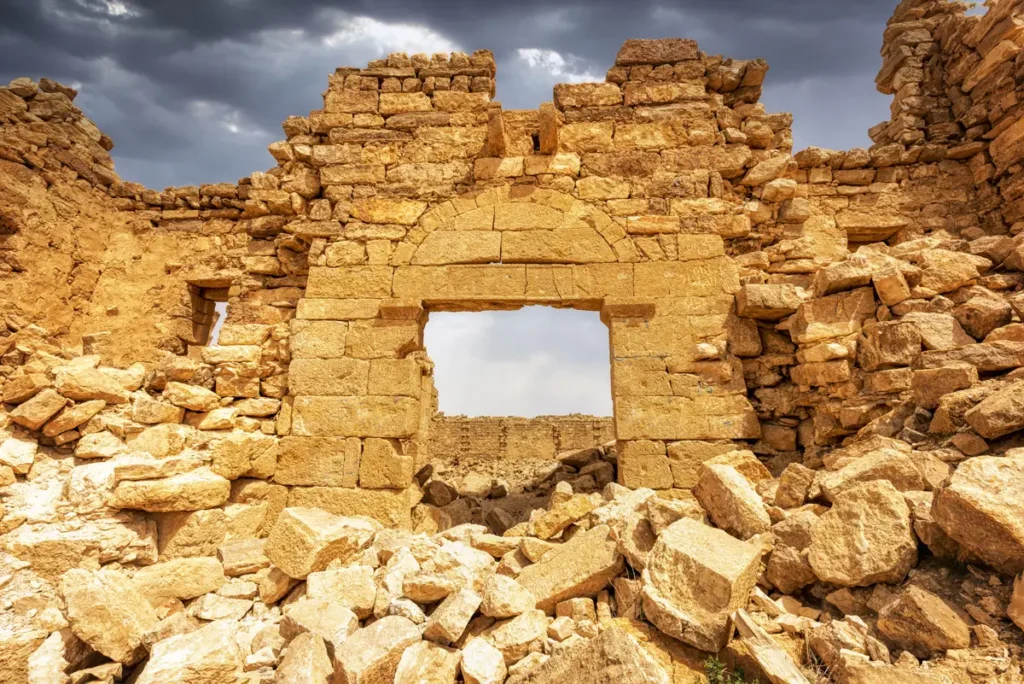
The Latin building inscription is still on its lintel over the main gate, dated AD 293–305.
Look closely
The frame with “ears” around the text.
1 of 5
Room by room
What to see
Five stops: the approach, the towers and walls, the main gate, the courtyard and the cisterns. Pick a stop to see what to look for.
 1 / 6
01 · Setting
See it from the plain
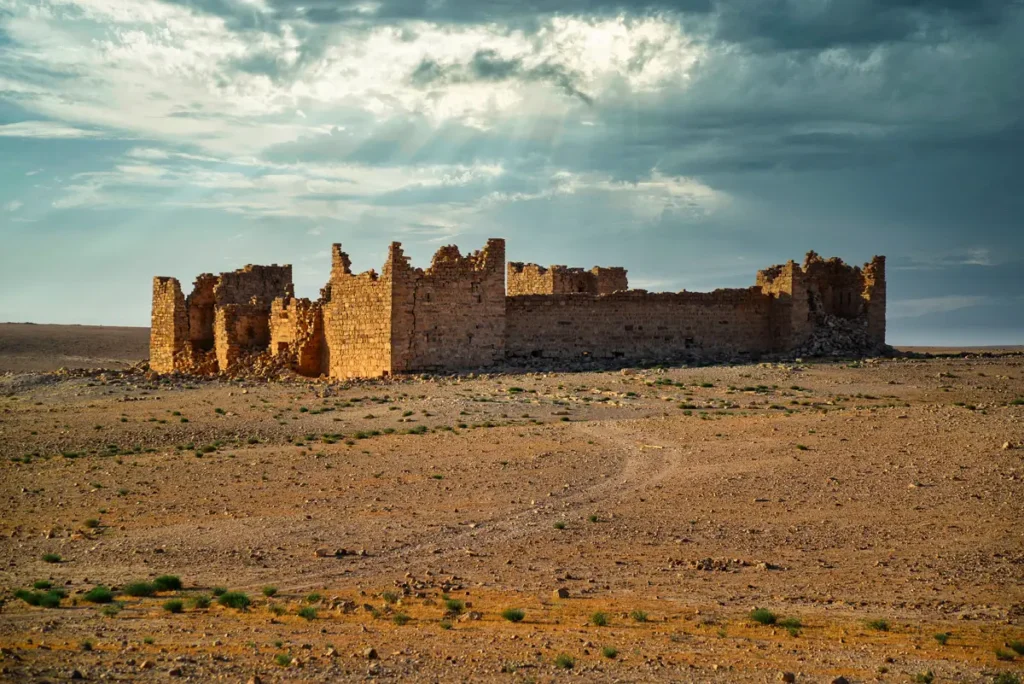
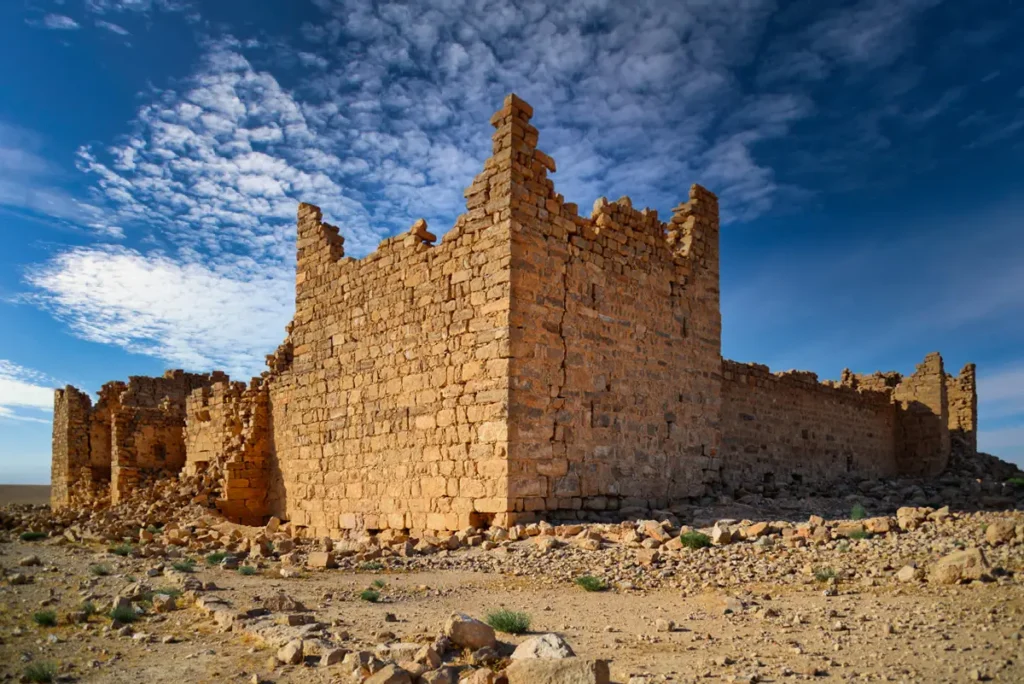
Qasr Bshir stands at about 800 m on a stony plain cut by shallow wadis that drain west towards Wadi Mujib. From the track you see it for kilometres, its towers breaking the flat horizon.
It was part of the late Roman frontier east of the Dead Sea, about 15 km north-east of the legionary fortress at Lejjun.
Karak plateauOpen steppe800 m
Look for
- The four towers on the horizon
- Shallow wadis with fields
- The nearby towers of Abu El-Kharaq and El-Al
 1 / 6
02 · Walls and towers
Walk round the walls
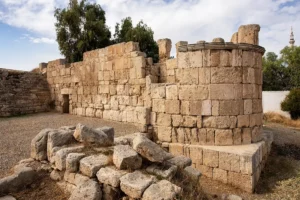
The fort is almost square, about 57 × 54 m. Its curtain walls are 1.5 m thick and stood about 6.5 m high with their battlements. The four corner towers, about 11–12 m square, project about 3 m from the walls and rose three storeys; their stairs wind round a square central pier.
Parts of the walls and towers have collapsed, and one tower now rests on a single cornerstone. Don’t climb the towers: they are not safe.
57 × 54 mWalls 1.5 m thick3-storey towers
Look for
- Windows on the upper floors
- Cracks and collapsed faces
- The small postern by the west tower
1 / 603 · The inscription
Read the gate
The main gate is in the south-west wall, flanked by two smaller towers about half the size of the corner ones. Over it, the Latin building inscription is still in place in its frame.
The gateway and its inscribed lintel have undergone conservation by a project led by Leiden University and Al-Hussein Bin Talal University, which also made a 3D scan of the fort.
South-west gateLatin inscriptionConserved
Look for
- The inscription frame over the gate
- The two gate towers
- The vaulted passage behind it
Dig deeperEnglish translation of the Latin building inscription
For our best and greatest emperors Gaius Aurelius Valerius Diocletianus and Marcus Aurelius Valerius Maximianus, Pious, Fortunate, Unconquered Augusti, and Flavius Valerius Constantius and Galerius Valerius Maximianus, most noble Caesars: Aurelius Asclepiades, governor of the province of Arabia, had the Castra Praetorii of Mobene completed from the foundations.
Translation based on the published text at Livius.org. Mobene was the fort’s ancient name. The inscription names no unit, so who was stationed here is unknown.
 1 / 7
04 · Inside
Enter the courtyard
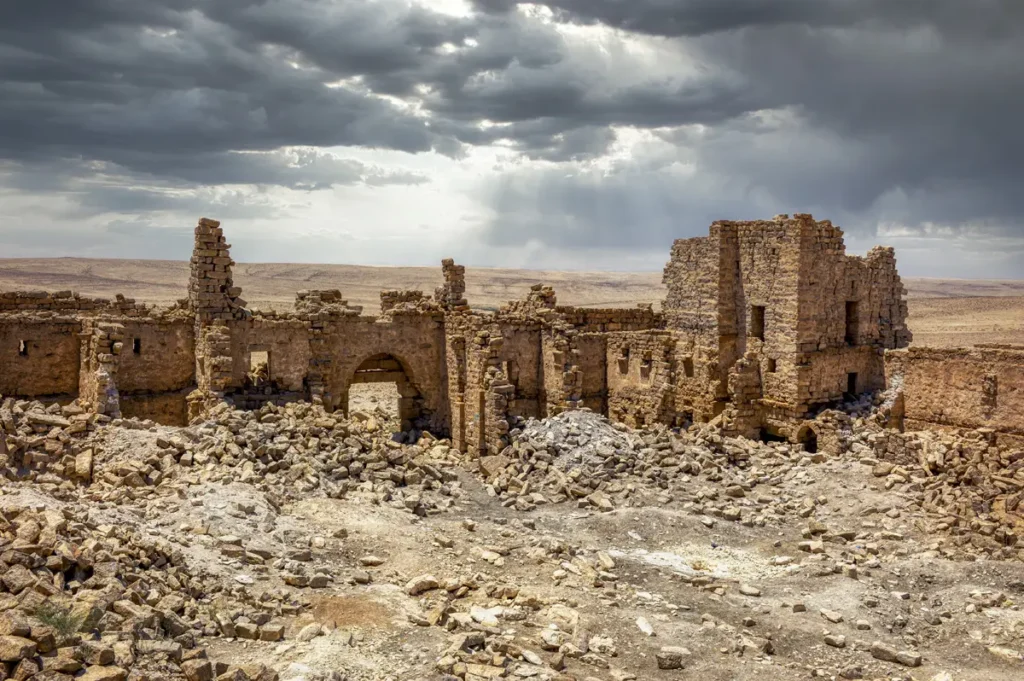
Enter the courtyard where access permits: much of it is filled with fallen stone. Around it, 26 two-storey rooms backed onto the walls. Twenty-three of the ground-floor rooms have mangers: stables for about 69 horses, three to a room. Soldiers lived above and in the towers, and the barrack roofs formed a fighting platform level with the rampart walk.
The room opposite the gate has no mangers. It was probably the headquarters, and perhaps a shrine for the unit’s standards.
26 rooms23 stablesHeadquarters room
Look for
- Mangers in the ground-floor rooms
- The room opposite the gate
- Piles of fallen stone from the upper floors
Dig deeperAfter the army
Excavations in 1982 and 1985 showed that the army stayed until about AD 500. After a period of abandonment the fort was reused in the Umayyad period, and the barracks probably collapsed in the earthquake of AD 747. Bedouin and squatters used it afterwards.
 1 / 4
05 · Water
Find the cisterns
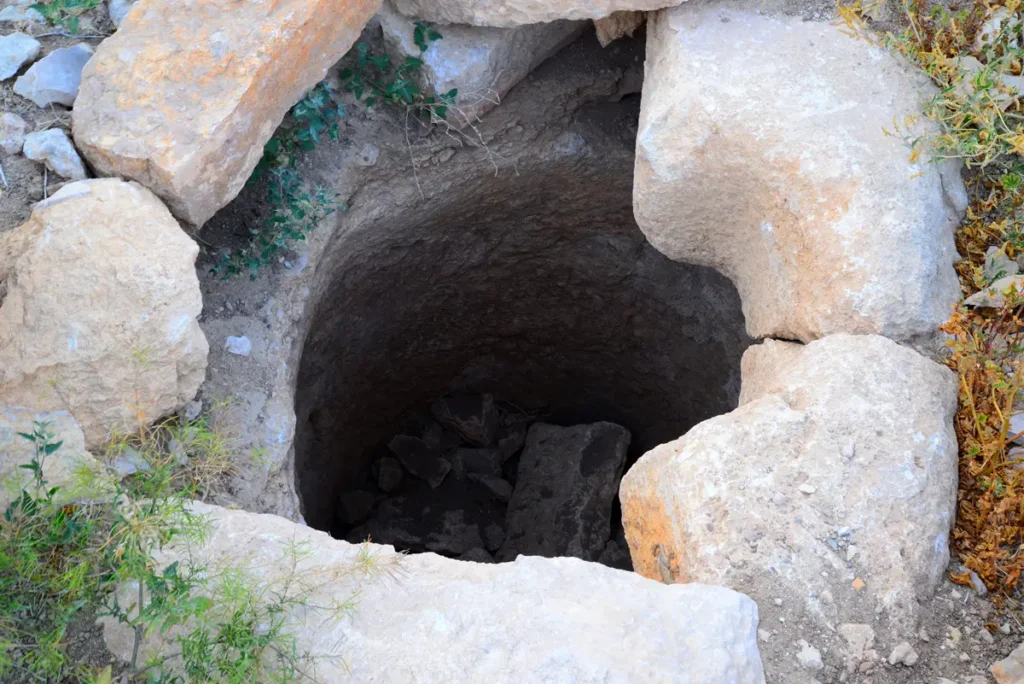
Two cisterns in the courtyard collected rainwater from the roofs. A rainwater reservoir lies several hundred metres south of the fort, showing how the garrison collected water beyond the courtyard.
The cistern openings are unfenced, so watch your step.
2 cisternsReservoir to the southUnfenced openings
Look for
- Round openings in the courtyard
- Channels leading to them
History & significance
A Tetrarchic fort on the desert frontier
Qasr Bshir was completed between AD 293 and 305, when Diocletian strengthened Rome’s eastern frontier. The army left around AD 500, and the fort was reused in the Umayyad period.
- 293–305The fort is completed (gate inscription)
- c. 500The garrison leaves
- 747Earthquake brings down the barracks
- 2001Added to UNESCO’s Tentative List
 ProfileQasr Bshir: the full storyHistory, the gate inscription, research and the timeline. About 3 min read.Read the profile →
Plan your visit
Everything you need to know before you go
Qasr Bshir is off the Desert Highway near Qatrana, about 15 km north-west of the town, reached by a desert track. You need a 4x4 and a driver who knows the way.
Good to know: the site is unfenced and unstaffed, with no facilities and no shade. The towers are not safe to climb, and cistern openings in the courtyard are unfenced.
Opening hoursOpen accessUnstaffed site · visit in daylight
Entry ticketFreeNo ticket office
Time to visit40 minAdd Qasr Abu El-Kharaq, 5 km away
From Amman100 kmAbout 1 hr 45 min via the Desert Highway, the last part on a track
LocationNear Qatrana31.3373° N, 35.9812° EGet directions
Opening hours and prices checked October 2026. Spotted a change? Let us know
On site
What you’ll find at Qasr Bshir
- Viewpoint
Not on site: visitor centre, ticket office, toilets, designated parking, museum, guide, food & drinks, market / shop, hotels
Access: 4x4 needed
When to go
Spring and autumn are best. After heavy rain the track can be muddy, and in summer there is no shade at all.
J
F
M
A
M
J
J
A
S
O
N
D
BestGood, cooler or warmVery hot
Tip: walk once round the outside before going in: the towers and the gate make much more sense when you have seen the whole plan.
Before you go
Services are limited out in the desert.
- Water and snacksShops in Qatrana
- Sun hat and sunscreenVery little shade outside
- Comfortable shoesUneven, stony ground
- A 4x4 and a guideThe last part is a desert track
- Toilet paperBring your own, just in case
Common questions
Quick answers before you set off.
Do I need a 4x4?
Yes. The last part is a desert track, and a driver who knows the way is essential.
Is there an entrance fee?
No. The site is unfenced, unstaffed and free to visit.
Can I climb the towers?
No. The towers are cracked and parts have collapsed, so they are not safe to climb.
Who was stationed here?
Nobody knows. The gate inscription names the emperors and the governor but no unit. The stables show that horses were kept here.
Can I visit it on a tour?
Yes. It is the first stop on our Expedition to Qasr Bshir, Lejjun, Umm ar-Rasas & Karak.
What should I wear?
Comfortable, closed shoes for uneven ground, and light clothing that covers your shoulders and knees, which is respectful in rural Jordan and protects you from the sun.
Combine with
Qasr Bshir is the centre of a small group of desert towers near Qatrana. Drive times are from Qasr Bshir and include the tracks.
1 Qasr Abu El-KharaqIron Age tower5 km · ~20 min drive · Tour 12Qasr El-AlIron Age fort6 km · ~25 min drive3Qal’at QatranaOttoman pilgrim fort18 km · ~25 min drive · Tour 14Karak CastleCrusader castle58 km · ~1 hr 10 min drive · Tour 1
 Qasr Abu El-KharaqIron Age tower5 km · ~20 min drive · Tour 12
 Qasr El-AlIron Age fort6 km · ~25 min drive3
 Qal’at QatranaOttoman pilgrim fort18 km · ~25 min drive · Tour 14
 Karak CastleCrusader castle58 km · ~1 hr 10 min drive · Tour 1
Tour 1 Qasr Bshir, Lejjun, Umm ar-Rasas & Karak. Compare the tours
Private tours
A private day tour that includes Qasr Bshir
The tour is just for you: your own vehicle and driver, hotel pickup in Amman, entry tickets included, and one fixed price for up to three travellers.
Private: only your group
Your own vehicle & driver
Hotel pick-up in Amman
Entry tickets included
from$250per group (1–3) · 178 JOD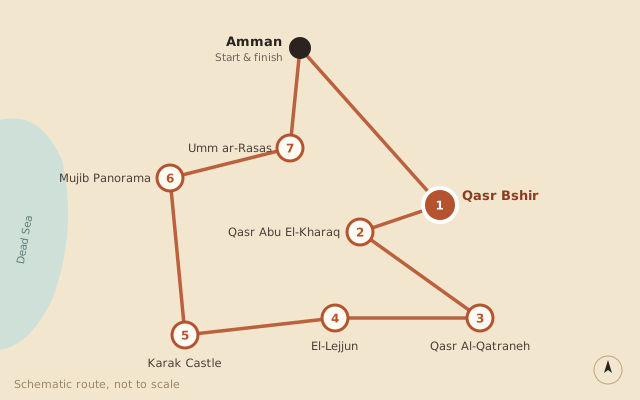
Tour 1 · Full day · Private
Expedition to Qasr Bshir, Lejjun, Umm Ar-Rasas, Karak
Set high at around 800 meters above sea level, deep within a vast and rugged basalt plain, Qasr Bshir (Castra Praetorium Mobene) remains one of Jordan’s most remote and best-preserved Roman frontier forts. Its isolated location makes it difficult to reach for the average traveller—but that’s exactly what makes this journey so rewarding.
HistoryArchitectureRoman fortsCrusader castleUNESCO site7 stops
Duration8–9 hr
Pick-up8 or 9 AM
Group1–3, private
Included
- Private luxury transfer
- Entrance fees
- Bottled water, soft drinks, snacks
- Coffee/tea (on request)
- WiFi, Phone charger
Not included
- Professional on-site (local) guide
- Personal expenses
- Lunch
CancellationFull refund if you cancel at least 24 hours before the start. No refunds or changes within 24 hours.
Pick-upFrom your hotel lobby or home in Amman, 5 minutes before your chosen start time.
BringComfortable shoes, sun hat, sunblock and sunglasses. Tours run in English.
Explore this site
More from Qasr Bshir
Panoramas, walk-throughs, photos and stories about this site.
ProfileQasr Bshir: history & architecture Photo albumQasr Bshir: A Roman Desert Fort in Photos
 360°360° panoramaQasr Bshir – Central Courtyard: 360° Panorama
Nearby