












Qasr Tuba
An unfinished brick palace, far out in the desert
Begunc. AD 743–744
Planned size140 × 72 m
LocationWadi al-Ghadaf
Access4x4 and a guide
Introduction
One of the hardest desert castles to reach, and for many the most romantic.
Qasr Tuba is one of the most captivating desert castles you can visit, and one of the hardest to reach. To find it you need a four-wheel drive and a guide who knows the tracks, but the journey across the desert is part of the reward for anyone seeking the romance of history in the open expanse of the Jordanian desert.
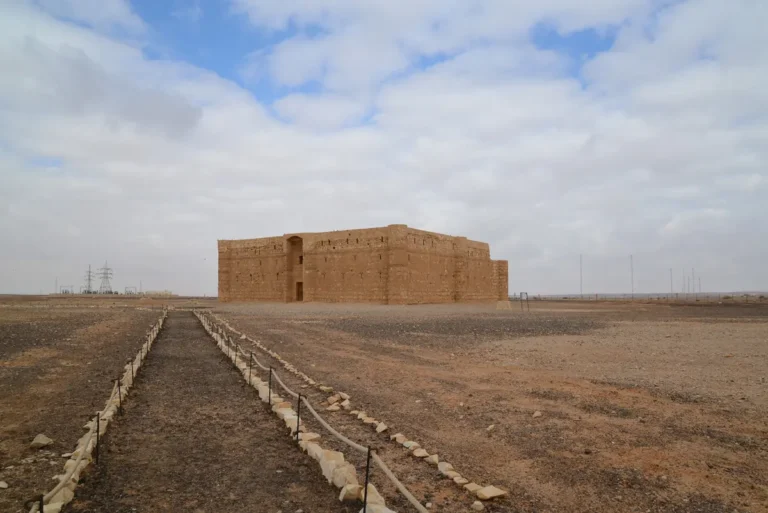
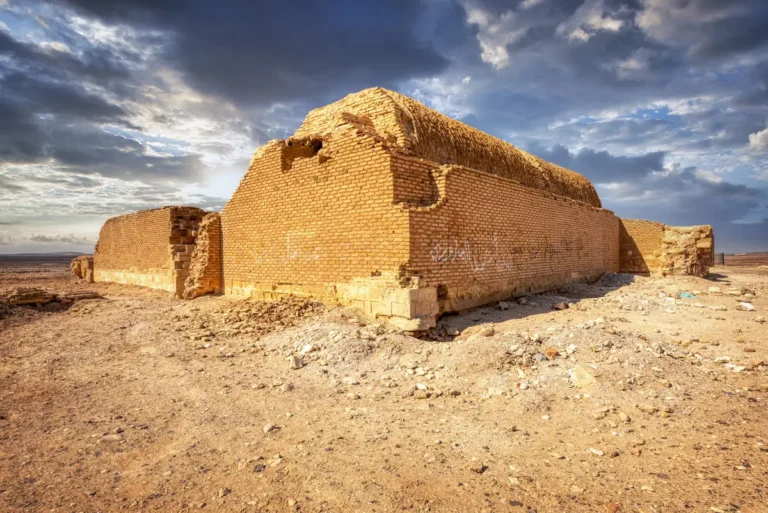
Its name comes from tub, Arabic for brick: the walls are built of fired brick on limestone footings, like Qasr Al-Mushatta. It was planned as two square palaces side by side, attributed to Caliph al-Walid II, but only part of the western half was built before work stopped in AD 744.
Best timeMar–Apr · Oct–Nov
Time needed30 min
TicketFree
From Amman130 km · 3 hr
Combine withQasr Amra · 1 hr 30 min
Google rating4.2 · Reviews
Highlights · Brick and stone
A palace of fired brick
Brick vaults, a carved gate and wells deep in the wadi
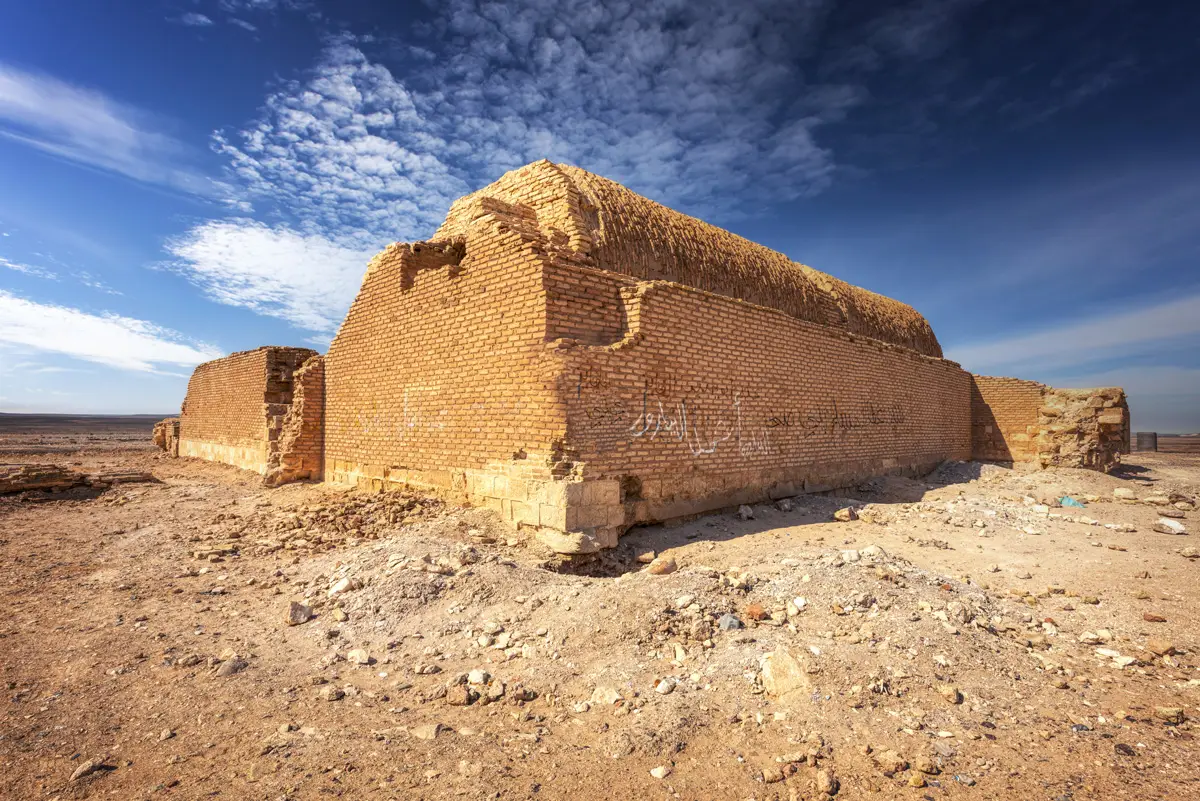
Fired brick is very rare in stone-rich Jordan, and Tuba and Mushatta are the two Umayyad palaces in Jordan built with it. The walls were never plastered, so you can still see how the masons worked.
 01 / 05
01 · Architecture
The north gate
North gate
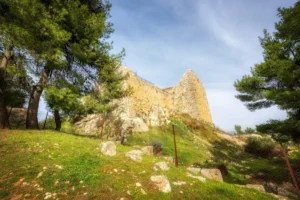
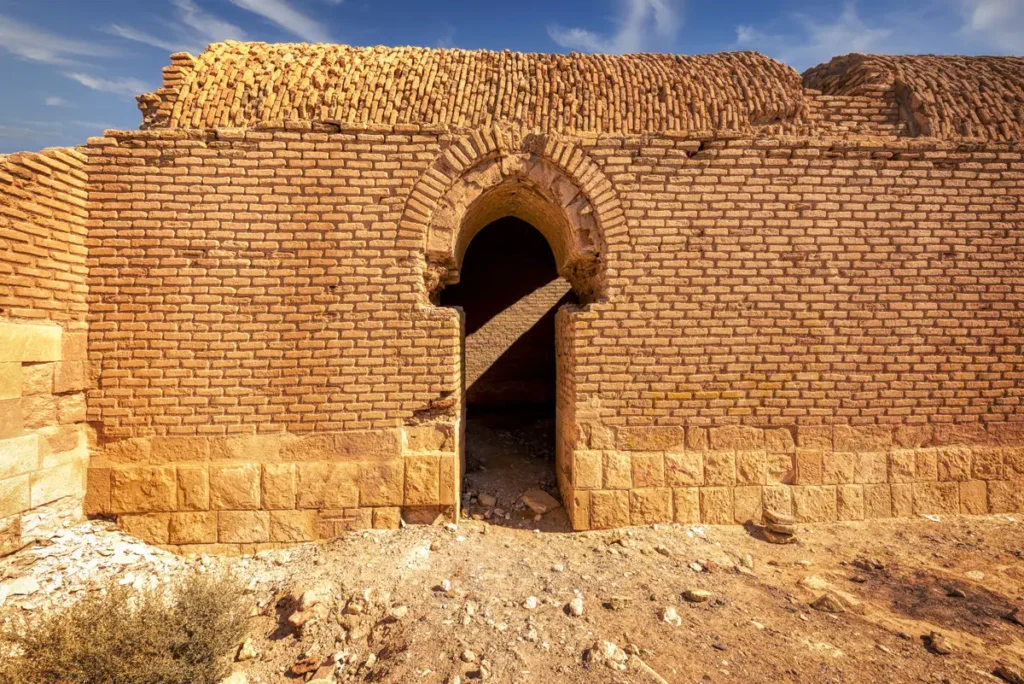
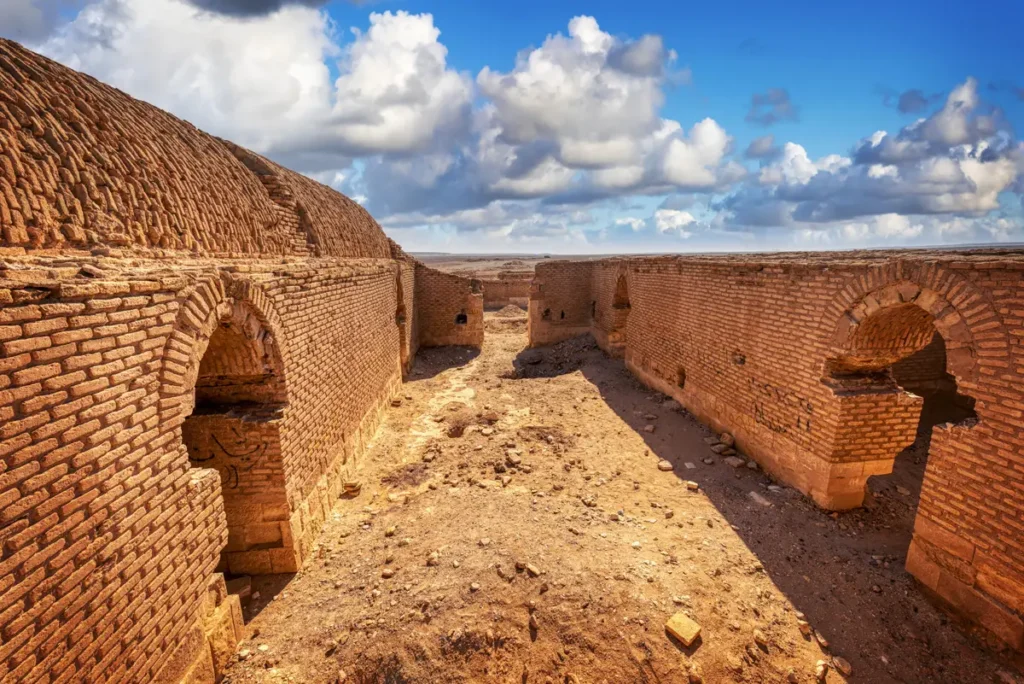
Each half was entered through a gate in the middle of its north side, flanked by two small square rooms. The main gate was restored in the 1970s.
Look closely
The brick arch over the stone door frame.
1 of 5
Room by room
What to see
Five stops: the north gate, the courtyard of the western half, the brick-vaulted rooms, the unfinished eastern half and the wadi beyond. Pick a stop to see what to look for.
1 / 601 · The entrance
Approach the north gate
Each half of the palace was entered through a gate in the middle of its north side, flanked by two small square rooms. From the gate, a long hall led into a courtyard ringed by suites of rooms (bayts).
The main gate was restored by the Department of Antiquities in the 1970s. Its carved stone lintel, still in place when Alois Musil arrived in 1898, is now in The Jordan Museum in Amman.
North gateFlanking roomsRestored 1970sCarved lintel in Amman
Look for
- The stone door frame under the brick arch
- The two small rooms beside the gate
- The long entrance hall beyond
Dig deeperCarvings in two museums
The doorways of Tuba were framed with carved stone: panels of fleurons and a central medallion with alternating fleurons and pine cones, very close to the work at Mushatta. Most of these stones had already been taken before 1898.
The best lintel is in The Jordan Museum in Amman, and two fragments are in the Museum für Islamische Kunst in Berlin. Seeing them before or after your visit completes the picture.
 1 / 8
02 · The western half
Stand in the western courtyard
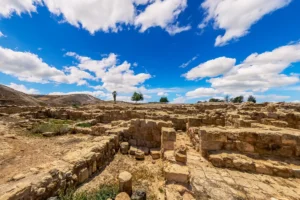
Only the western half was partly built: 28 rooms around a central courtyard, with four smaller courtyards. The plan called for two identical squares of about 70 m, side by side and sharing a wall, with a gate passage between them.
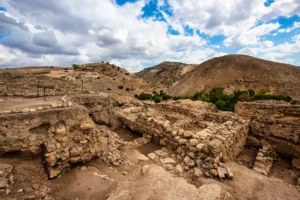
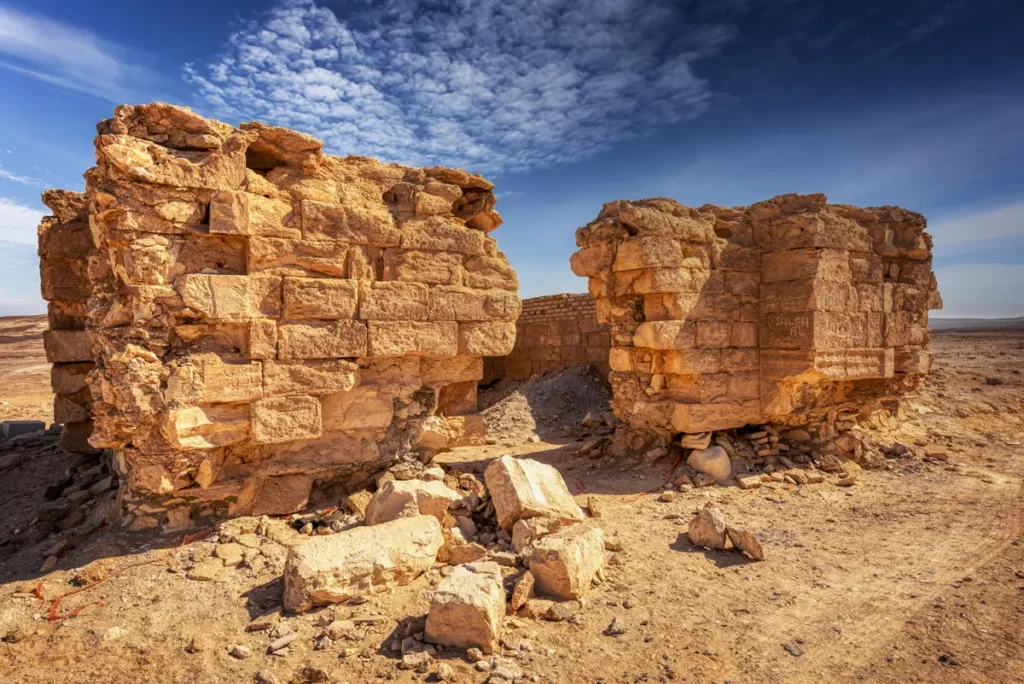
Look at the walls around you. They are about 1.4 m thick: limestone courses below and fired brick above, never plastered.
Western half28 roomsTwin squaresFired brick
Look for
- The limestone footing under the brick walls
- The doorways into the suites
- The line of the shared wall to the east
Dig deeperA palace in two halves
Planned as an oblong of about 140 × 72 m, Tuba was to have 14 semicircular towers: four at the outer corners, two where the halves join and the rest at intervals. Some tower rooms held latrines, as at Mushatta.
The attribution to al-Walid II rests on the shared plan, materials and carving with Mushatta, and on pottery from the 2009 excavation pointing to the late Umayyad period. No dated inscription has been found.
 1 / 6
03 · Brick vaults
Look up at the brick vaults
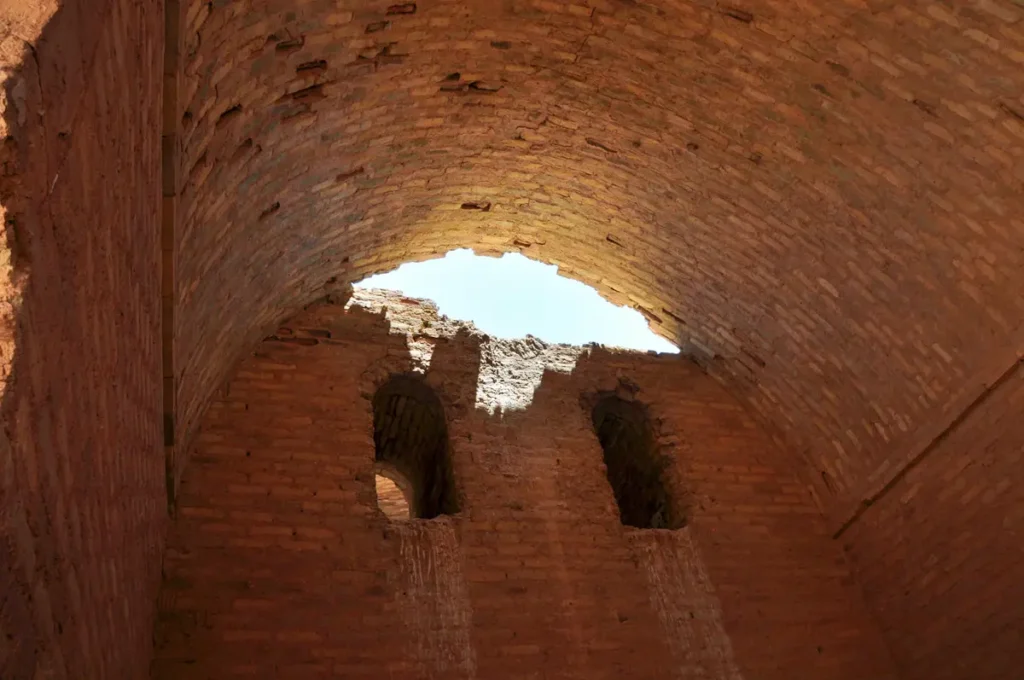
Step into the rooms that still have their vaults. Some are about 8 × 4.5 m, with pointed brick vaults rising to about 9 m. Because the walls were never plastered, the masons’ finger grooves are still visible in the mortar.
Stay out of rooms with cracked or leaning vaults, and don’t climb on the walls.
Pointed vaultsAbout 9 m highFinger-marked mortarUnplastered walls
Look for
- The finger grooves in the mortar
- The way the bricks are laid in the vault
- Light through the broken crown of a vault
 1 / 7
04 · Unfinished
Walk the unfinished eastern half
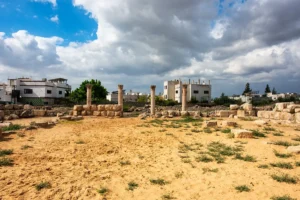
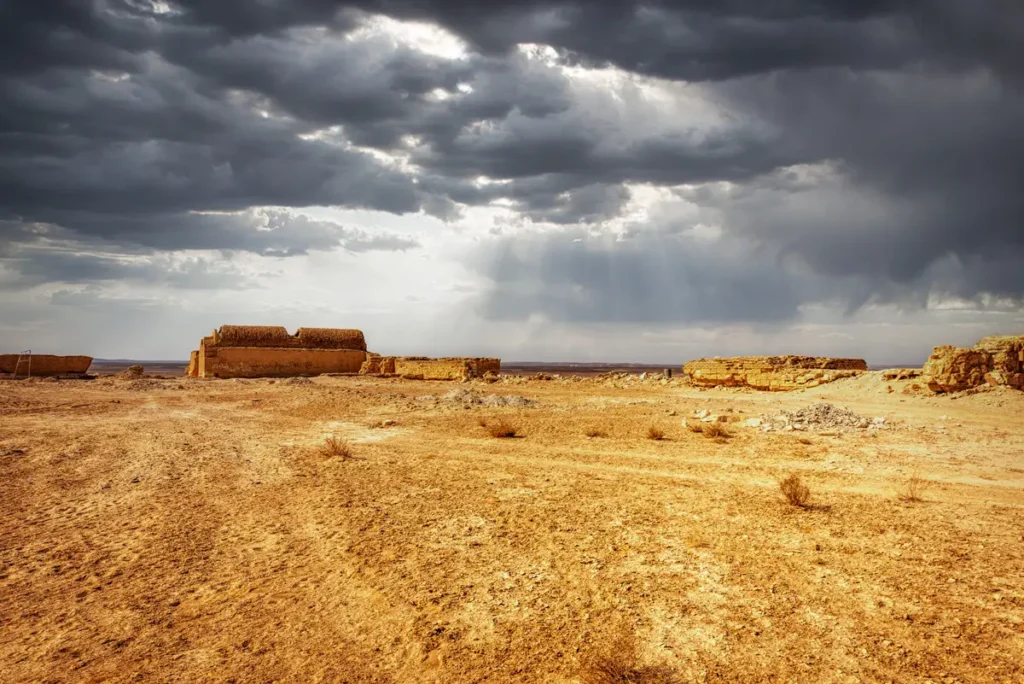
Walk east across the line of the shared wall. The eastern half was never built above its foundations, and scattered brick fragments and stumps of wall show where work stopped.
This is one of the best places in Jordan to see a building frozen mid-construction. Work stopped, probably when al-Walid II was killed in AD 744.
FoundationsFallen brickUnfinished towersAbandoned 744
Look for
- Stone footings with nothing on top
- The rounded base of a planned tower
- Brick fragments lying where they fell
Dig deeperProtecting a fragile site
Erosion, flash floods and treasure hunters all threaten Tuba. In 2007 the Department of Antiquities cleared the site, collected loose bricks, re-covered exposed foundations and built an earth bank against floods. In 2009 it surveyed and excavated the palace and about 21 km² around it.
Please don’t take bricks or pottery, and keep vehicles off the ruins.
 1 / 5
05 · Setting and water
Look out over the wadi
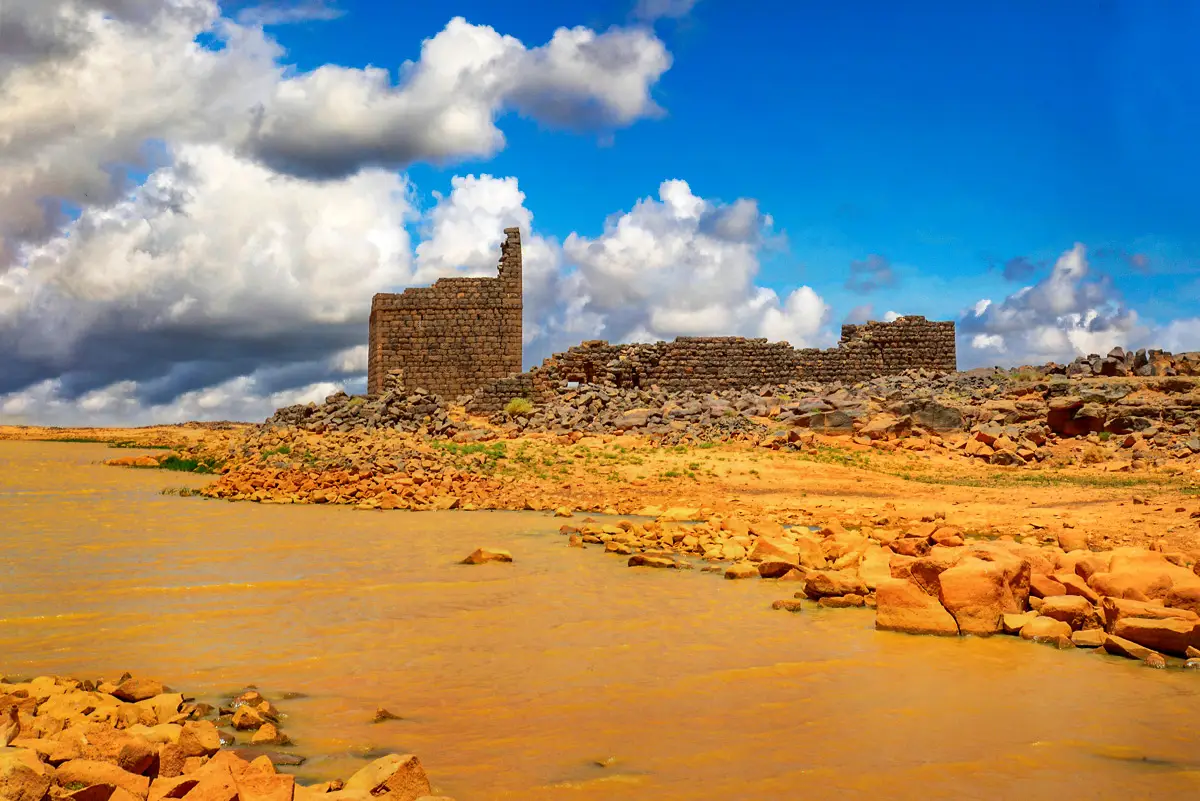
The palace sits low in the valley of Wadi al-Ghadaf, so it is hard to spot until you are close. North of it, near the dry wadi bed, are three wells more than 30 m deep, some lined with stone, with plastered troughs and pools and round platforms for animal-powered lifting. Two stone dams cross the wadi about 100 m and 250 m from the palace.
The water probably served the building work above all, for mixing clay for the bricks and mortar.
Wadi al-GhadafThree wellsTwo damsOpen desert
Look for
- The wadi bed to the north
- The dams across the wadi
- The palace low on the horizon from the track
History & significance
A palace abandoned mid-construction
Tuba is attributed to Caliph al-Walid II and dated to about AD 743–744. When he was killed in 744, work stopped and never resumed. Alois Musil heard about it from the Bedouin in 1896 and reached it in 1898, the first modern visit.
- c. 743–744Begun, attributed to al-Walid II
- 1898Alois Musil’s first modern visit
- 1970sThe main gate is restored
- 2009Survey and excavation by the DoA
 ProfileQasr Tuba: the full storyHistory, architecture, the timeline and the Mushatta connection. About 3 min read.Read the profile →
Plan your visit
Everything you need to know before you go
Tuba is one of the hardest desert castles to reach, about 120 km south-east of Amman in a straight line. The usual way in is by desert track from Qasr Amra, so plan a full day with an experienced driver.
Good to know: the site is unstaffed, with no facilities and no shade. Bring everything you need, including spare water and fuel.
Opening hoursOpen accessUnstaffed site · visit in daylight
Entry ticketFreeNo ticket office
Time to visit30 minPlus about 3 hours each way from Amman
From Amman130 kmVia Qasr Amra, then about 50 km of desert track
LocationWadi al-Ghadaf31.3258° N, 36.5712° EGet directions
Opening hours and prices checked October 2026. Spotted a change? Let us know
On site
What you’ll find at Qasr Tuba
- Viewpoint
Not on site: visitor centre, ticket office, toilets, designated parking, museum, guide, food & drinks, market / shop, hotels
Access: 4x4 needed
When to go
Go in spring or autumn. Summer heat on the open tracks is extreme, and after winter rain the tracks can be muddy.
J
F
M
A
M
J
J
A
S
O
N
D
BestGood, cooler or warmVery hot
Tip: a lightly cloudy day is ideal: there is no shade on site, and the walls photograph beautifully under a dramatic sky.
Before you go
Services are limited out in the desert.
- Water and snacksNo shops after Qasr Amra
- Sun hat and sunscreenVery little shade outside
- Comfortable shoesUneven, stony ground
- A 4x4 and a guideThe tracks are unmarked
- Toilet paperBring your own, just in case
Common questions
Quick answers before you set off.
Do I really need a 4x4?
Yes. The last part of the journey is on unpaved desert tracks, and a driver who knows them is essential.
Is there an entrance fee?
No. The site is unstaffed and there is no ticket office.
Was Tuba a caravanserai?
Probably not. Scholars mostly see it as a planned residence or hunting retreat; a halt on routes to the Hijaz has also been suggested. Building stopped before the palace was finished, so it never served its intended purpose, although that does not show the finished rooms were never used at all.
Where are the carvings?
The finest carved lintel from the gate is in The Jordan Museum in Amman, and two fragments are in Berlin. Very few carved stones remain on site.
How long does the trip take?
Plan a full day: about 3 hours each way from Amman via Qasr Amra, plus an hour at the site.
What should I wear?
Comfortable, closed shoes for uneven ground, and light clothing that covers your shoulders and knees, which is respectful in rural Jordan and protects you from the sun.
Combine with
Tuba is a day out on its own. The track starts at Qasr Amra, so combine it with Amra and Kharana on the way. Drive times are from Qasr Tuba.
Explore this site
More from Qasr Tuba
Panoramas, walk-throughs, photos and stories about this site.
ProfileQasr Tuba: history & architecture Photo albumQasr Tuba: The Brick Palace in the Desert in Photos
 360°360° panoramaQasr Tuba: 360° Panorama
 360°360° panoramaWhat to See Inside Qasr Tuba: 360° Panorama
Nearby
Also in the Eastern Desert
From guide to visit
See Qasr Tuba with a private guide
Tuba isn’t part of our regular tours, but we can arrange a private 4x4 day with an experienced driver. Tell us when you’d like to go.