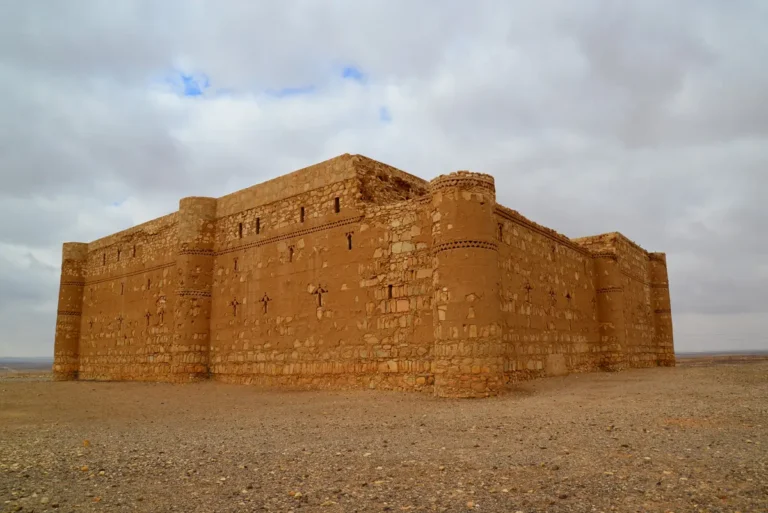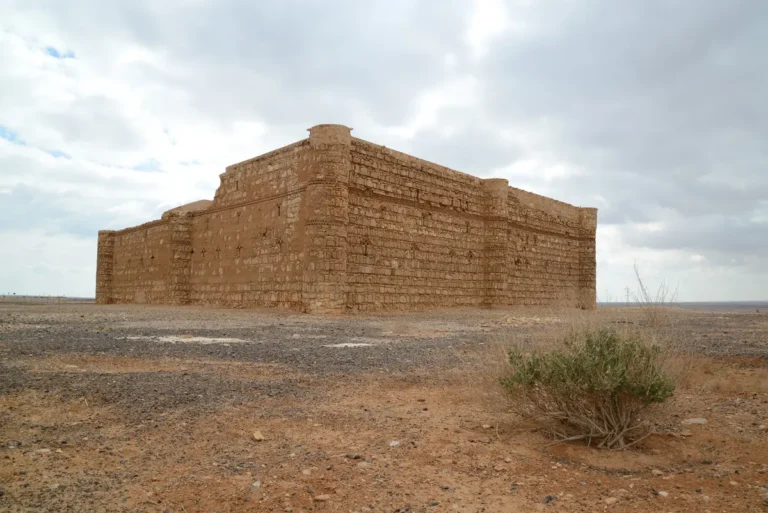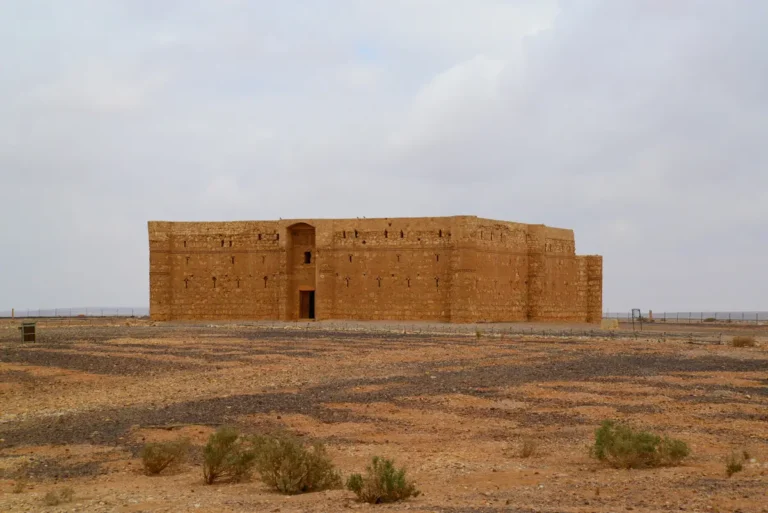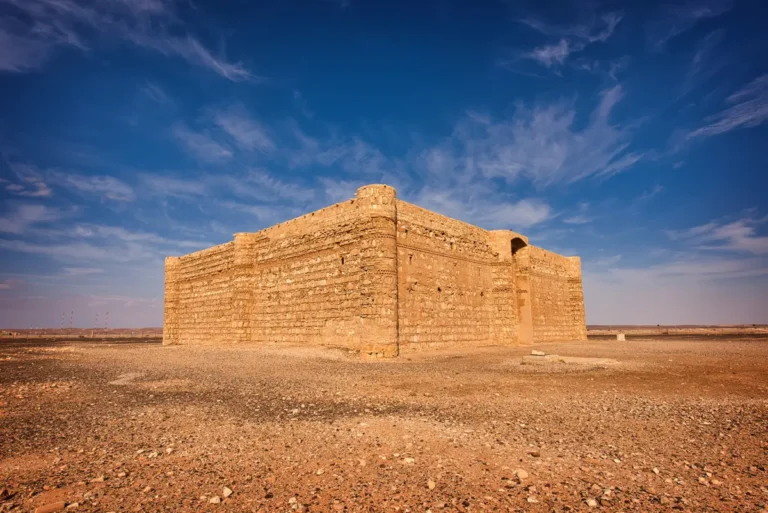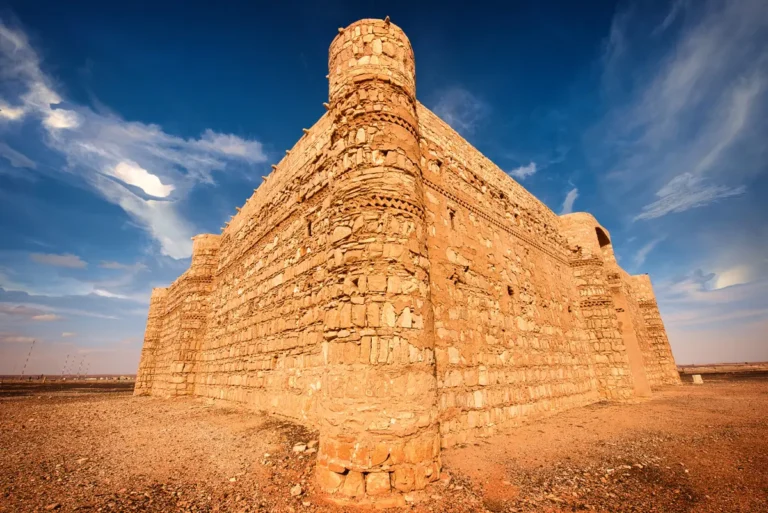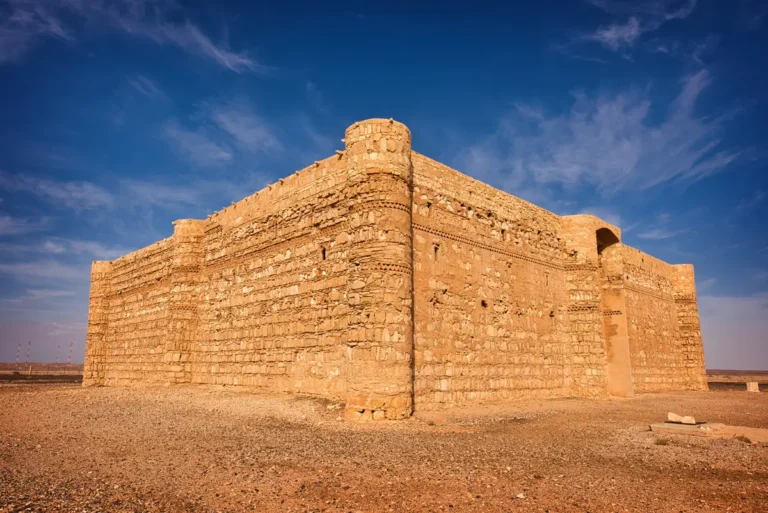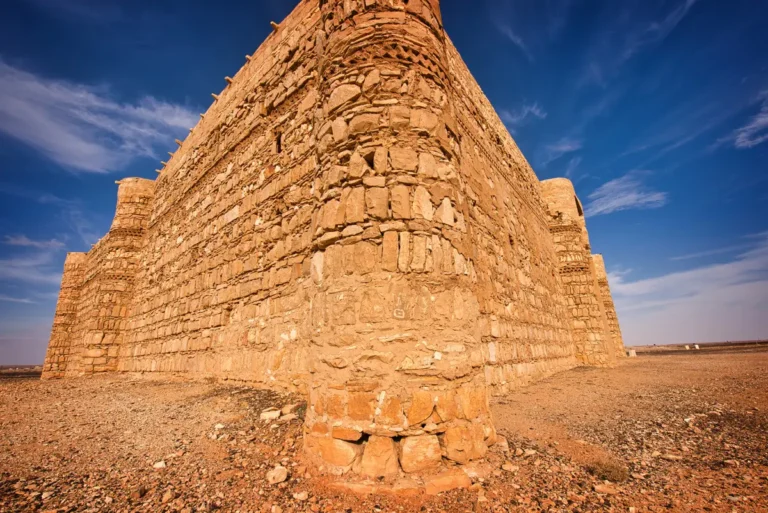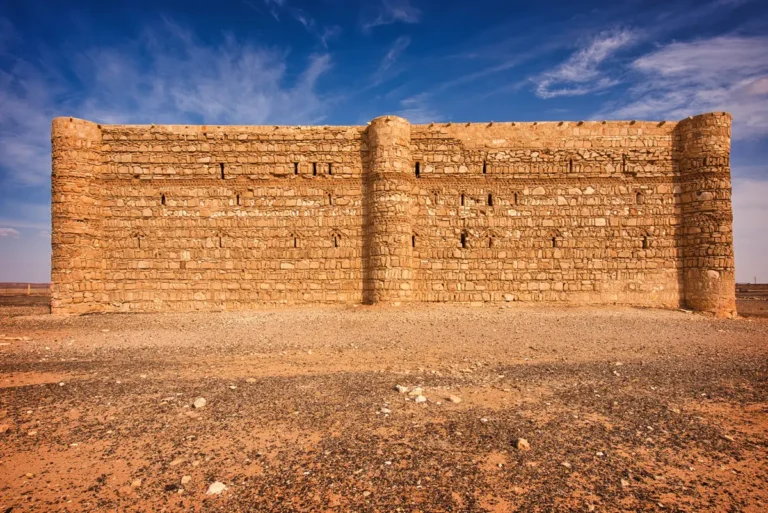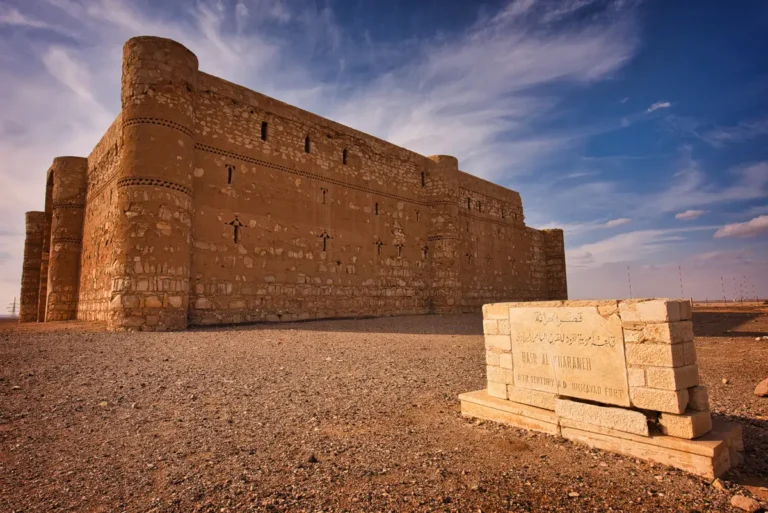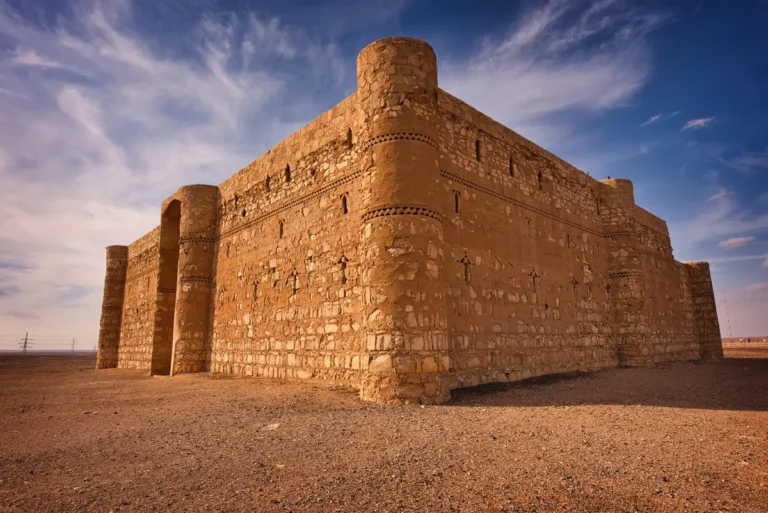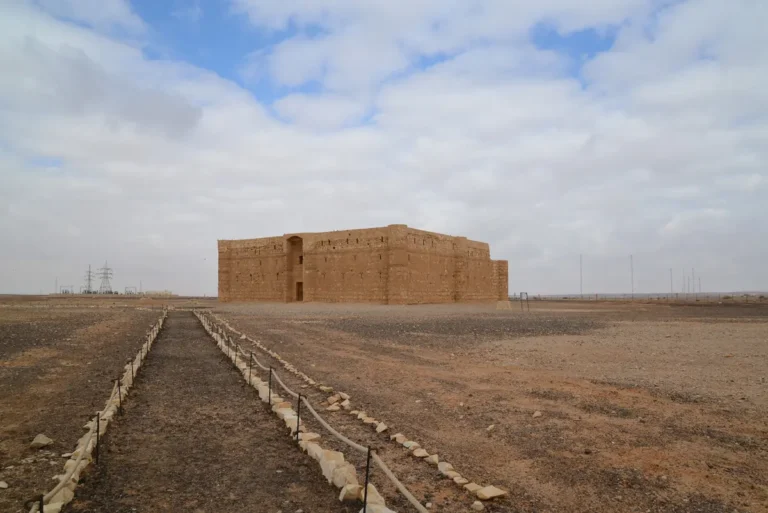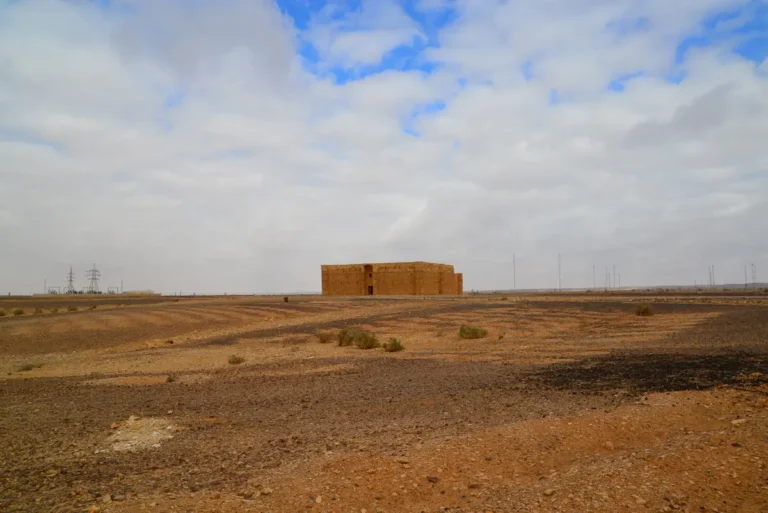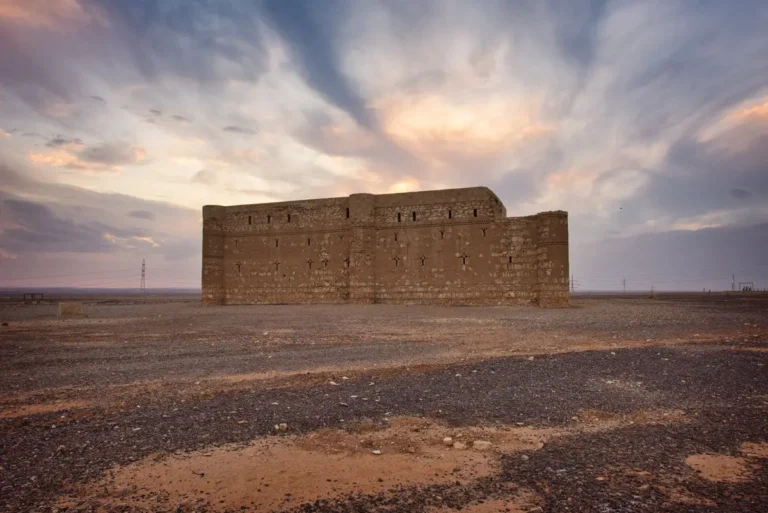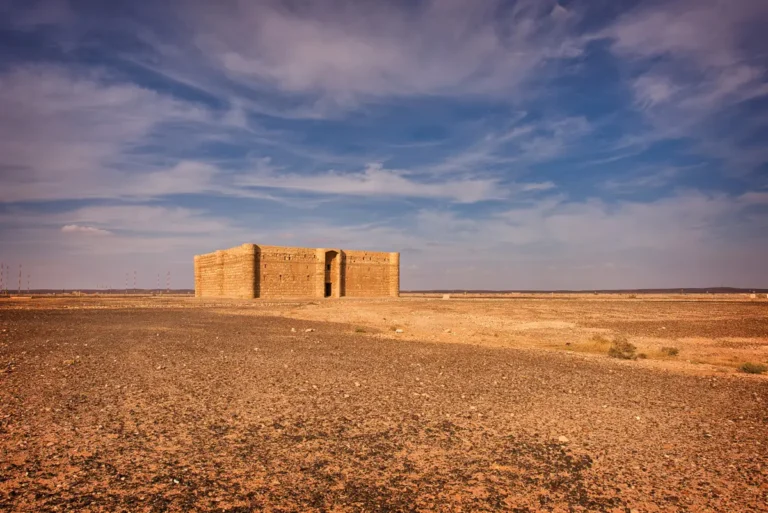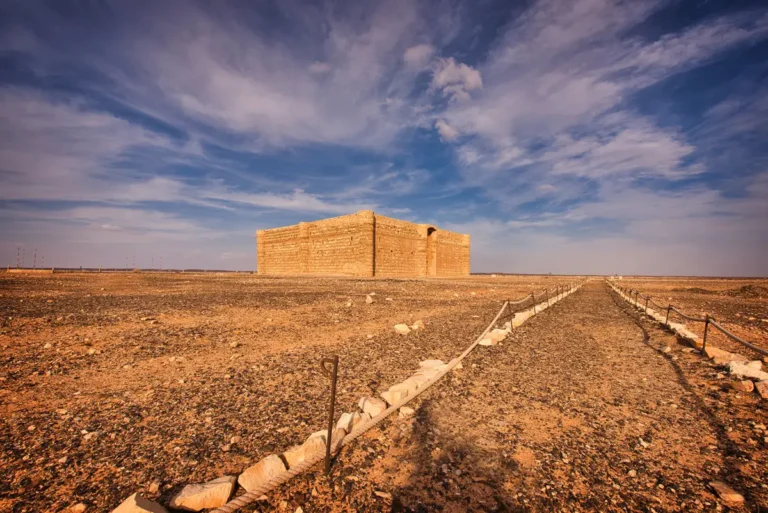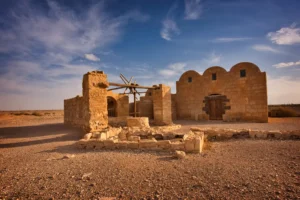
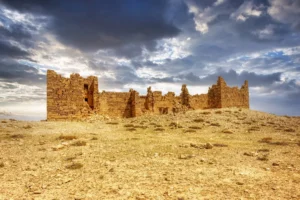
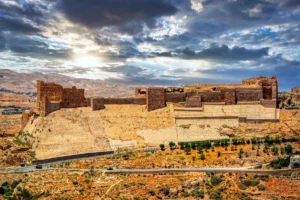
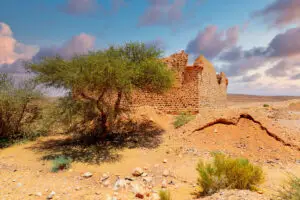
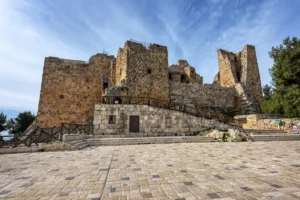
From the road across Jordan’s Eastern Desert, Qasr Kharana appears almost self-explanatory: a formidable stone building, its walls reinforced by rounded towers, standing against an open horizon. It looks like a fortress. Yet the closer you examine it, the less certain that first impression becomes.
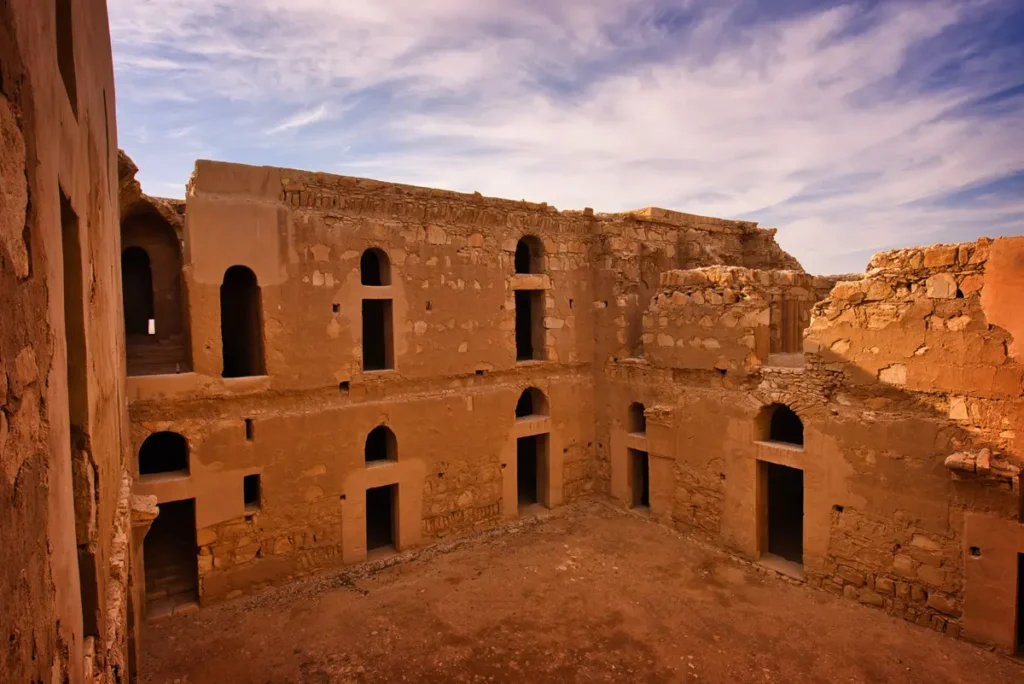
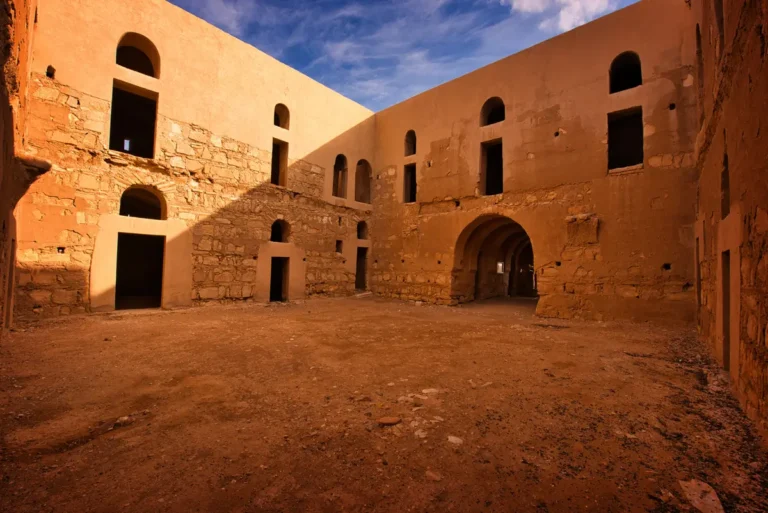
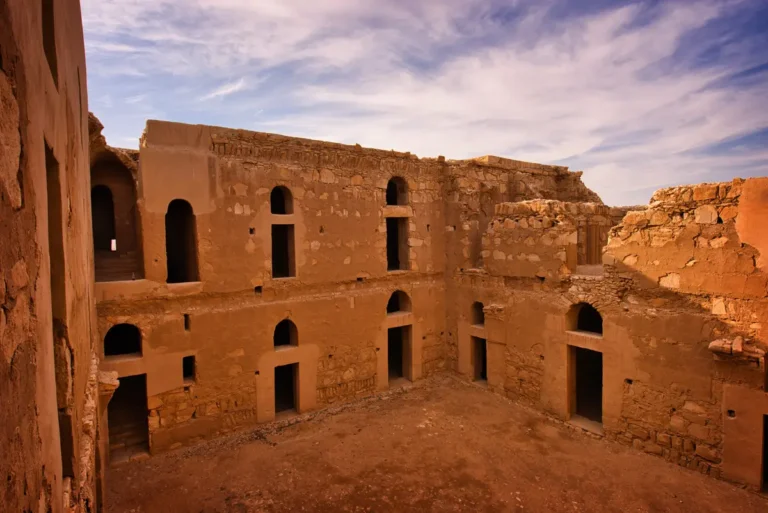
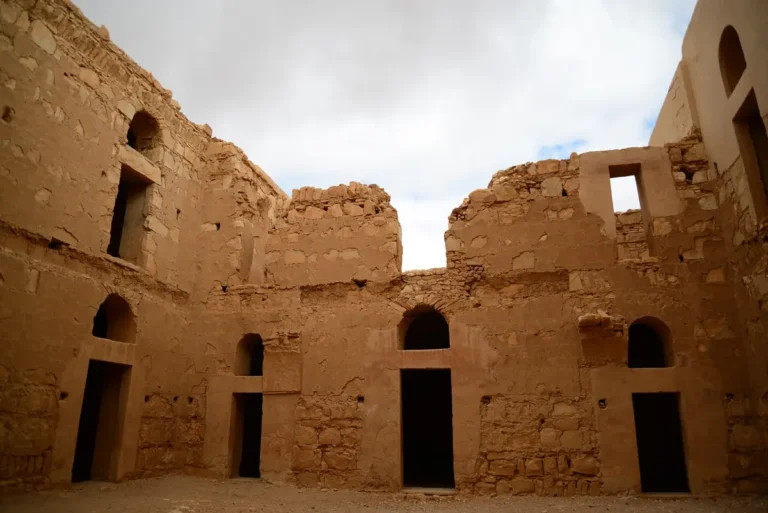
Beyond the entrance lies a courtyard surrounded by rooms whose arrangement suggests accommodation, reception, and privacy. The building survives remarkably well, but its original purpose remains unresolved. One leading interpretation places it within the political world of the early Islamic empire—a setting where representatives of the Umayyad rulers might have met local tribal leaders.
That uncertainty is central to Kharana’s appeal. Here, understanding the past begins with looking carefully at the evidence preserved in the walls.
AT A GLANCE
- Location: Eastern Jordan, beside Highway 40 between Amman and Azraq
- Distance from Amman: Approximately 60 km (37 mi), depending on the route
- Historical period: Umayyad; already standing by 710 CE
- Original purpose: Debated; possibly a place for political meetings and hospitality
- Principal attractions: Exterior, courtyard, vaulted rooms, and surviving architectural decoration
- Suggested visit: 45–60 minutes; longer for photography and detailed exploration
FIRST IMPRESSIONS
Kharana’s setting gives its architecture unusual clarity. With little around it to compete for attention, the eye follows the outline of the walls, the rounded projections, and the dark opening of the entrance. A building of modest dimensions acquires considerable presence against the desert.
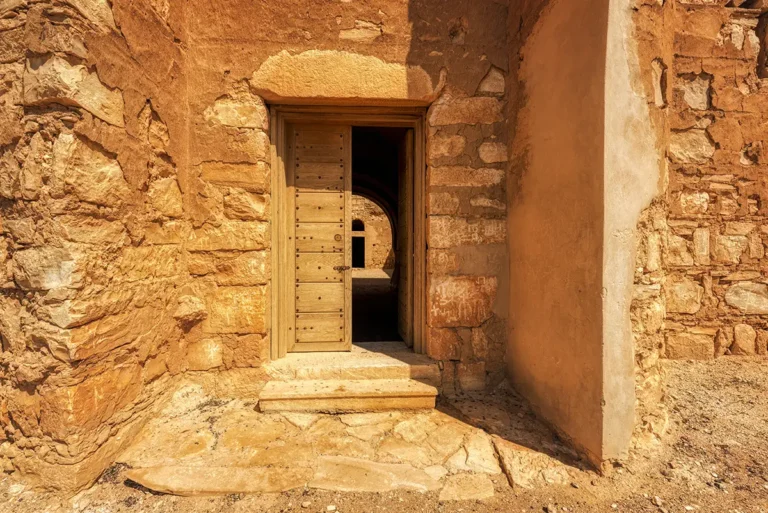
Pause before approaching the doorway. From an angle, the projections become more pronounced; seen straight on, the entrance façade resolves into a measured composition. Light brings out the texture of the masonry, while the narrow openings interrupt otherwise substantial stretches of wall.
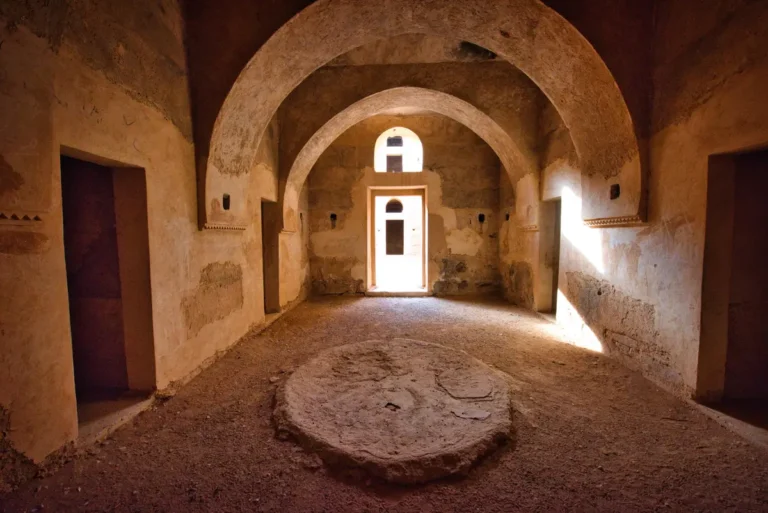
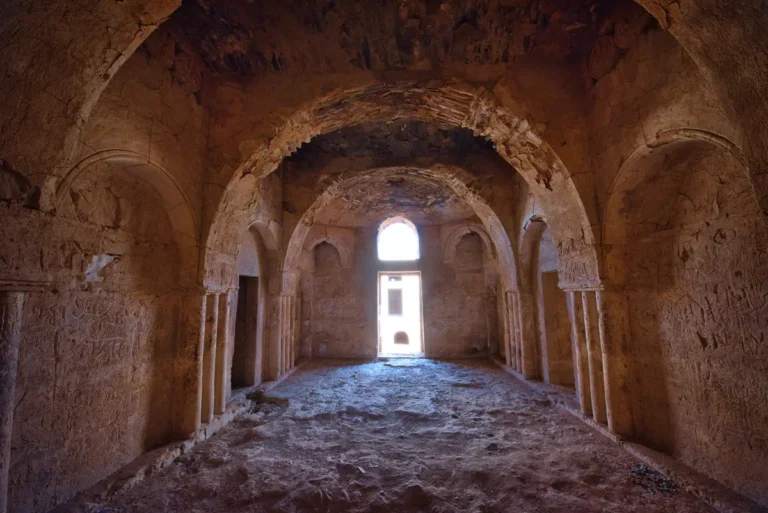
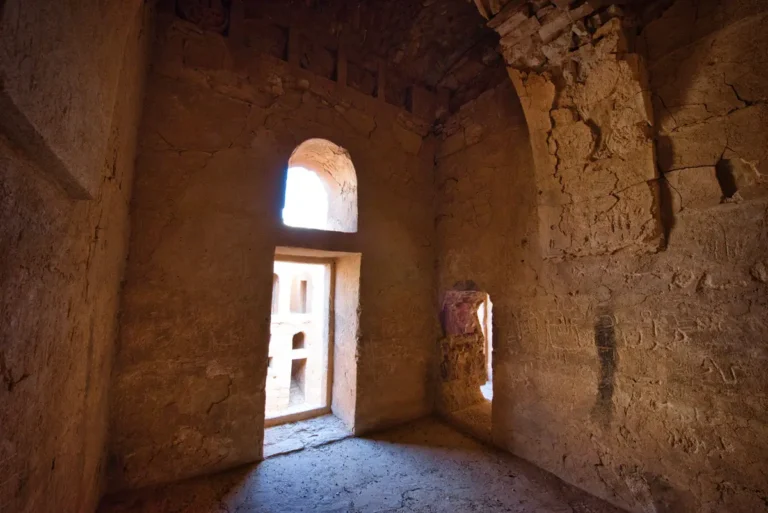
Inside, the experience changes. The surrounding landscape disappears from view, and attention shifts to doorways, enclosed spaces, and the sky above the courtyard. The transition encourages a slower pace. What appeared to be a single solid mass reveals itself as a carefully organised interior.
- Qasr Kharana - Upper Level Room 3D Panorama
HISTORICAL CONTEXT AND ORIGIN
Kharana belongs to the architectural world of the Umayyads, the dynasty that ruled from Damascus between 661 and 750 CE. Across the region, buildings now grouped under the name Desert Castles served different purposes, from agricultural estates to places of leisure and political contact. The term describes a diverse collection rather than a single building type.
At Kharana, a dated Arabic graffiti supplies a crucial chronological marker: 24 November 710 CE. The inscription establishes that the relevant part of the building existed by then. It is not a foundation inscription and does not identify the date construction began.
The precise patron remains uncertain. Construction during the reign of al-Walid I has been proposed, but an earlier origin is also possible. “Umayyad, built by 710 CE” is therefore more reliable than assigning the monument confidently to a particular ruler.
WHERE IS IT
Qasr Kharana stands beside Highway 40, the road running east from Amman towards Azraq. It is approximately 60 kilometres from Amman, making it accessible as part of a day trip into the Eastern Desert.
Allow roughly one to one and a half hours from central Amman as a planning estimate, depending on traffic and your departure point. Check live directions before setting out, and follow the designated approach to visitor parking.
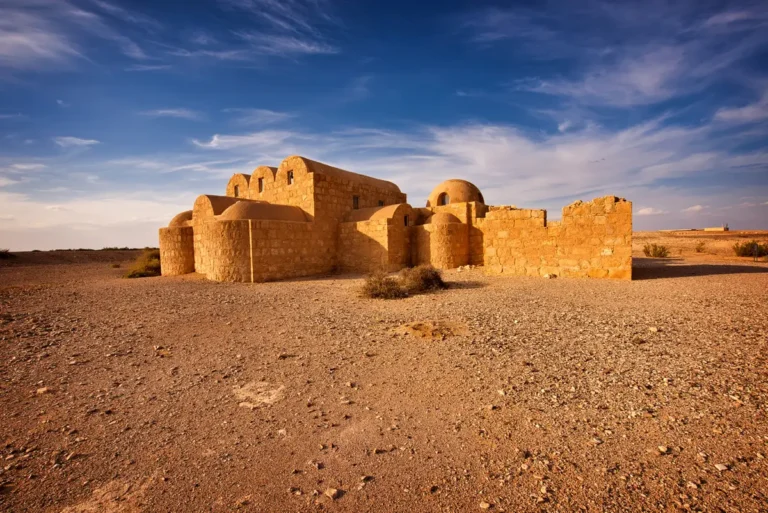
Its roadside location makes Kharana a convenient introduction to the region. Pair it with Qasr Amra, then continue to Qasr Azraq if you have a full day. Together, these stops offer markedly different encounters with Jordan’s historic architecture.
WHAT HAPPENED HERE?
Imagine people arriving at the entrance, passing into the courtyard, and separating into adjoining rooms. The architecture makes such movements easy to picture. Identifying those people, or the business that brought them together, is more difficult.
The meeting-place interpretation suggests occasional gatherings involving urban authorities and tribal leaders. It would make Kharana a setting for hospitality and negotiation, where political relationships depended on personal encounters. This is a plausible reconstruction, not a documented account of a particular meeting.
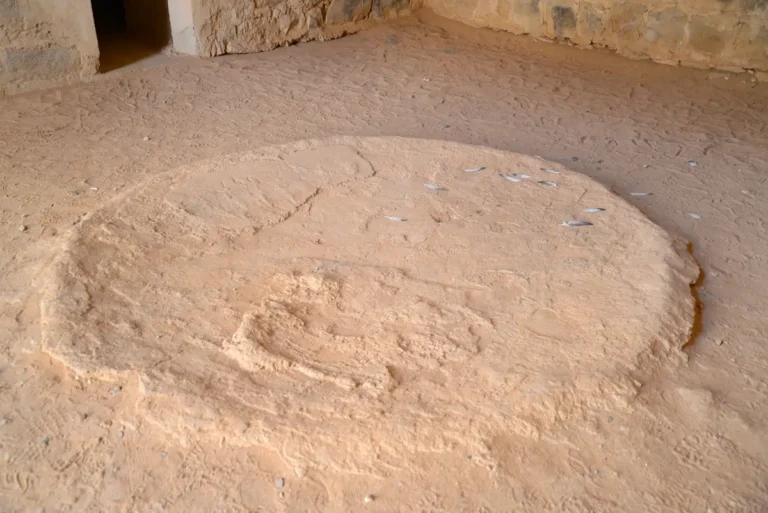
Water provides another piece of evidence. Excavation identified a plastered courtyard cistern, and researchers proposed supplies from collected rainwater and the nearby wadi. The modest system raised doubts about accommodating large caravans and their animals.
The surviving rooms cannot tell us exactly what was said within them. They do, however, invite questions about privacy, status, and access: who entered first, who waited, and who was received in the more carefully decorated spaces?
ARCHITECTURAL DESIGN AND FEATURES
Kharana’s plan measures approximately 36.5 by 35.5 metres. The entrance occupies the southern façade, and two storeys surround an internal courtyard. Despite their defensive appearance, the solid towers and high wall slits do not provide convincing arrangements for a conventional garrison.
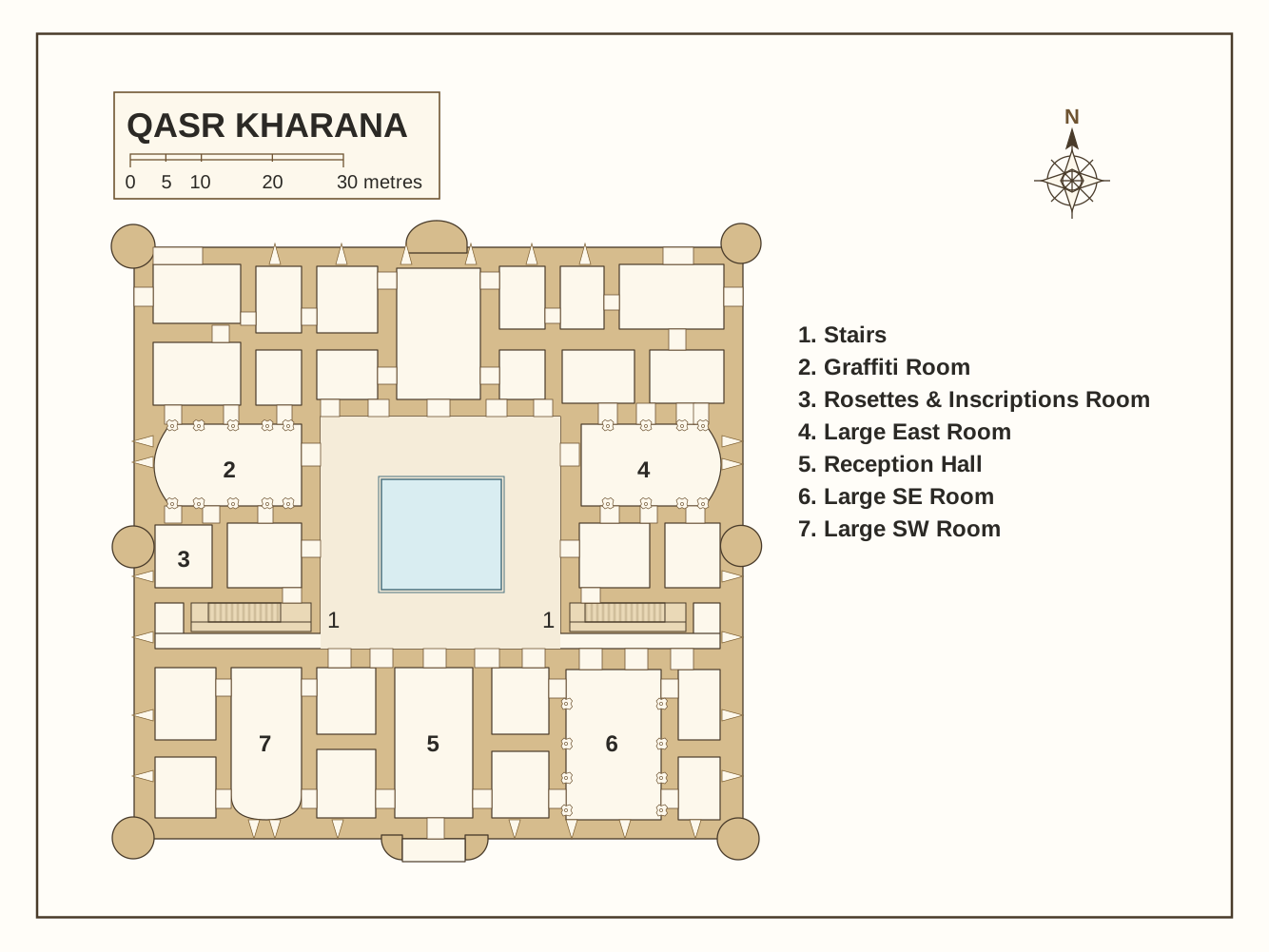
- Qasr Kharana - Upper Level Floor Plan (click on the image to enlarge)
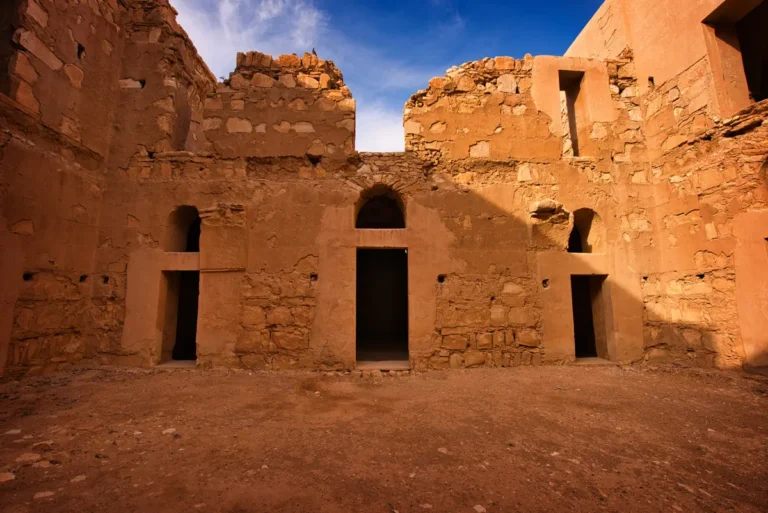
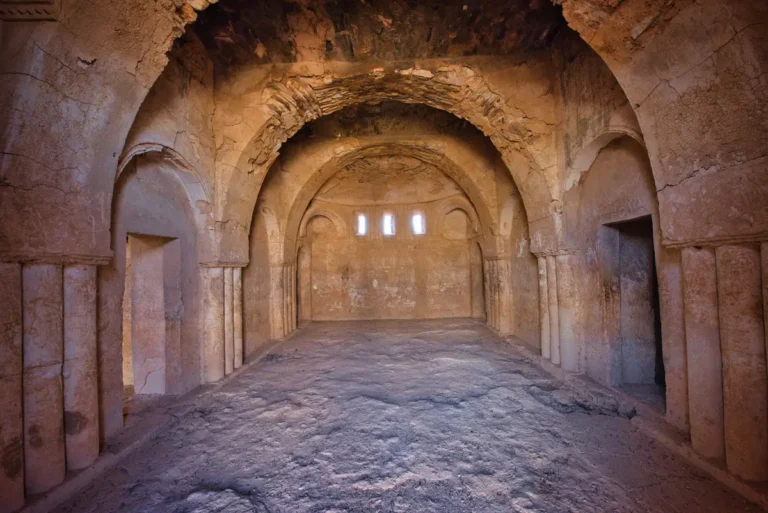
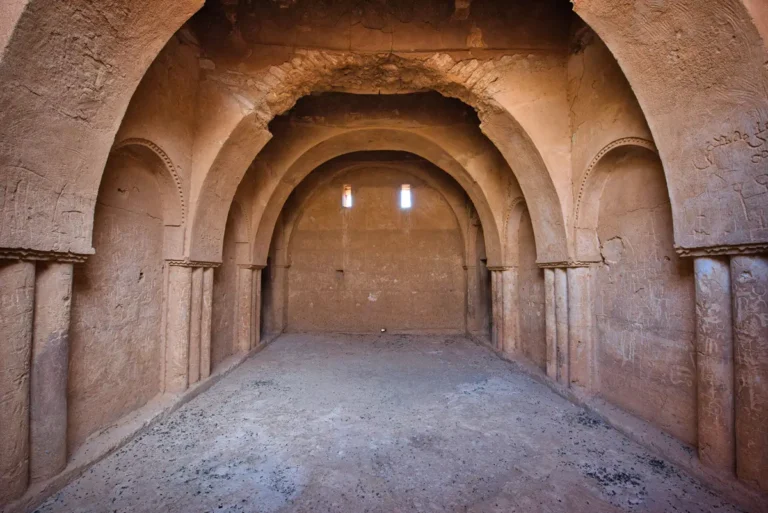
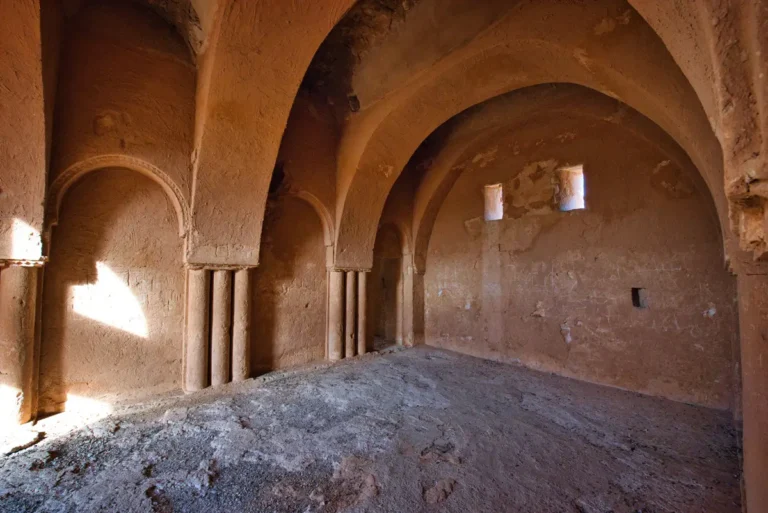
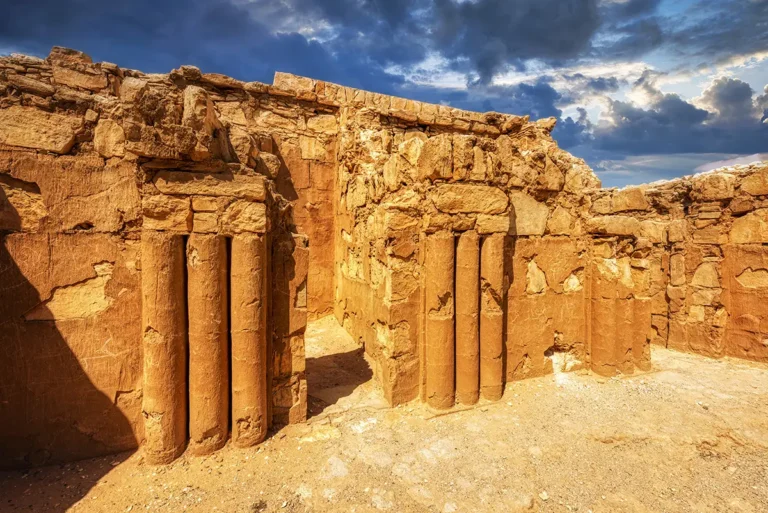
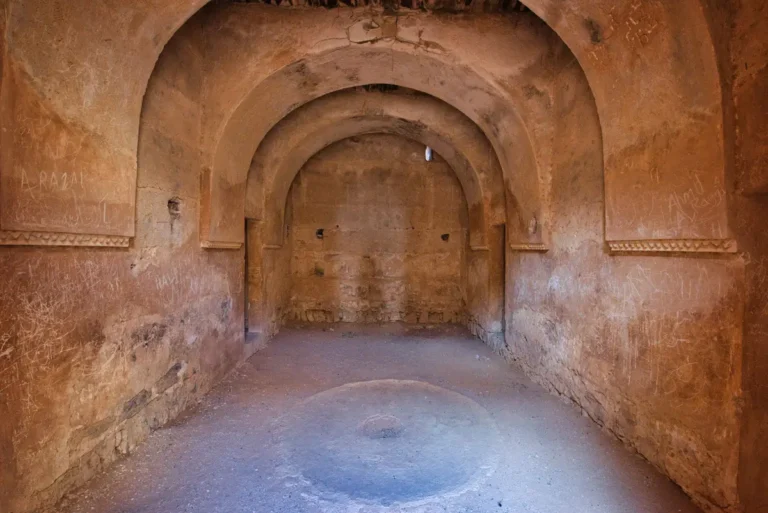
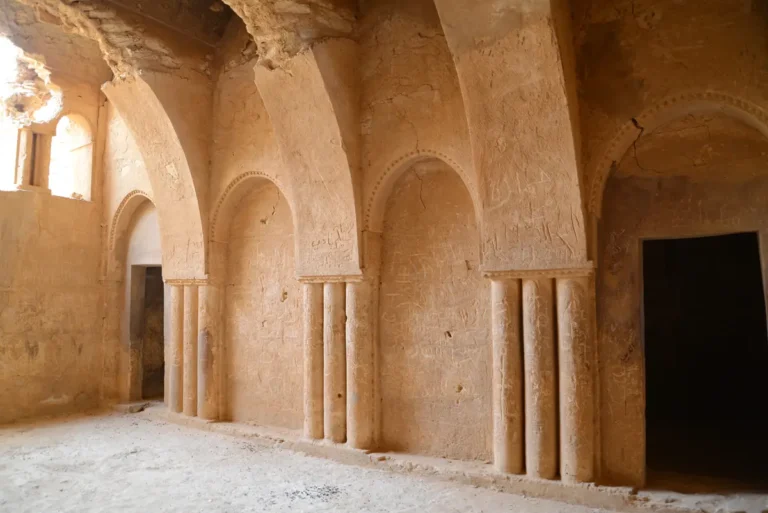
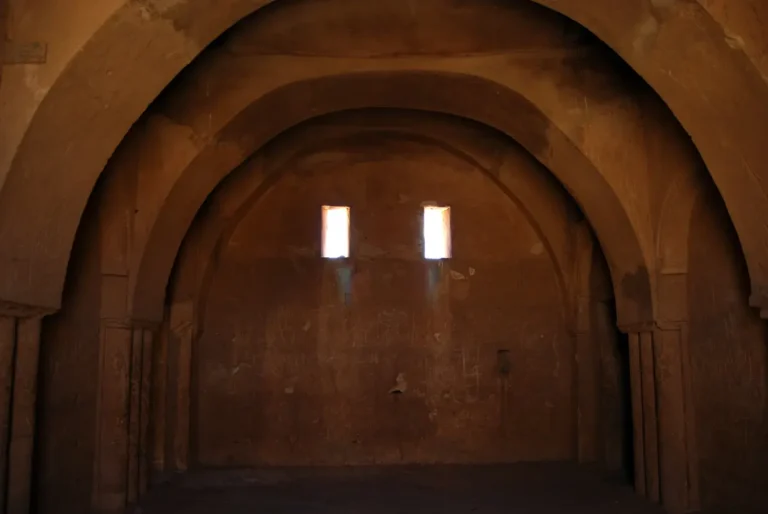
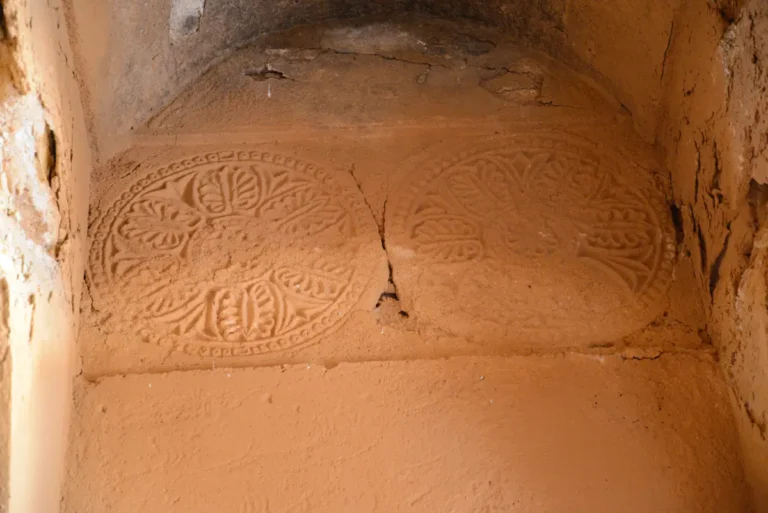
Inside, groups of rooms are arranged around larger halls. This organisation, described as a bayt, creates distinct suites within the building. Surviving plaster decoration, attached columns, and arcades give some interiors a more elaborate character than the exterior initially suggests.
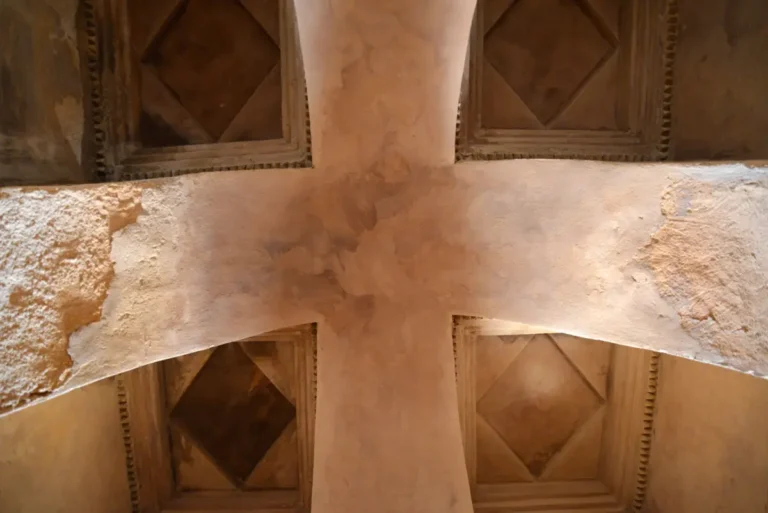
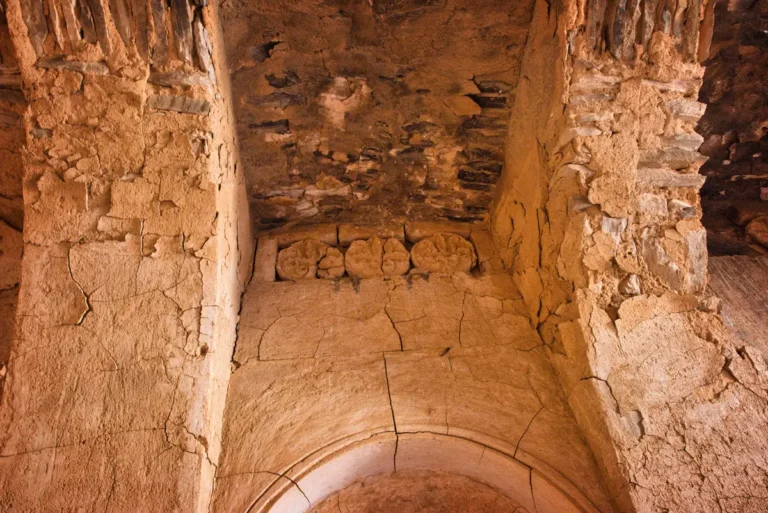
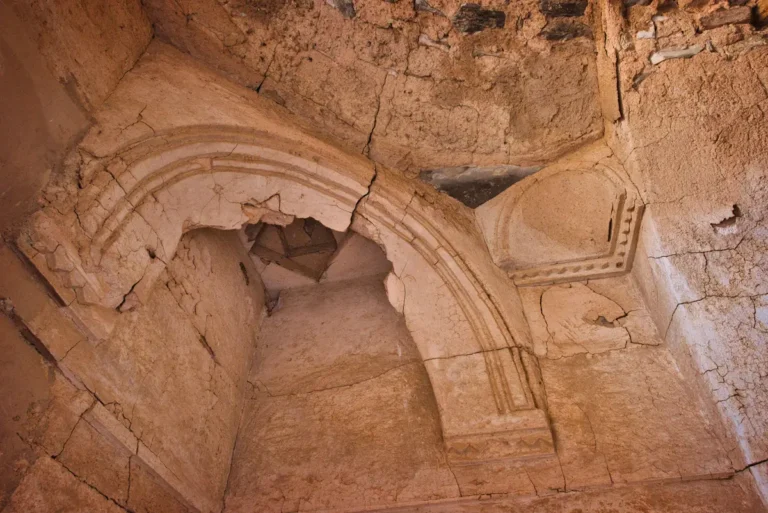
The architecture also points beyond Jordan. Scholars have identified connections with Sasanian Iranian traditions, particularly in the use of half-domes and squinches—the devices that bridge corners beneath curved overhead structures. At Kharana, these forms help place an early Islamic monument within a wider history of construction and design.
To appreciate them, follow a wall upwards. Look at how its vertical surface meets the ceiling and how the corners are resolved. These small transitions reveal the builders’ technical choices more clearly than a distant view of the room.
DESTRUCTION, REDISCOVERY, AND RESTORATION
Kharana’s later history is less securely documented than its surviving architecture.
There is no firm basis for assigning its decline to one dramatic attack or for claiming that occupation ended precisely with the fall of the Umayyads in 750 CE.
Accounts of the monument describe abandonment, earthquake damage, and restoration during the late 1970s. Repairs helped preserve the building, but also mean that its present appearance includes modern interventions.
Western scholarly documentation began in the late nineteenth century. “Rediscovery” is an imperfect description: the arrival of outside researchers does not establish that a place had vanished from local knowledge.
A significant advance came in 1979, when Stephen Urice surveyed and excavated the site. His research challenged familiar explanations of Kharana as a defensive castle or caravanserai. Rami G. Khouri’s account of Urice’s work.
For visitors, this history offers a useful reminder: a well-preserved building is not necessarily a fully understood one.
WHAT TO SEE TODAY: A WALK THROUGH
Read the exterior
Begin far enough from the building to see its complete outline. Walk towards an oblique view, where the corner projections and depth of the façade become clearer.
Examine the narrow openings and consider how they would have worked from inside. This is the first opportunity to test the impression of a fortress against the physical evidence.
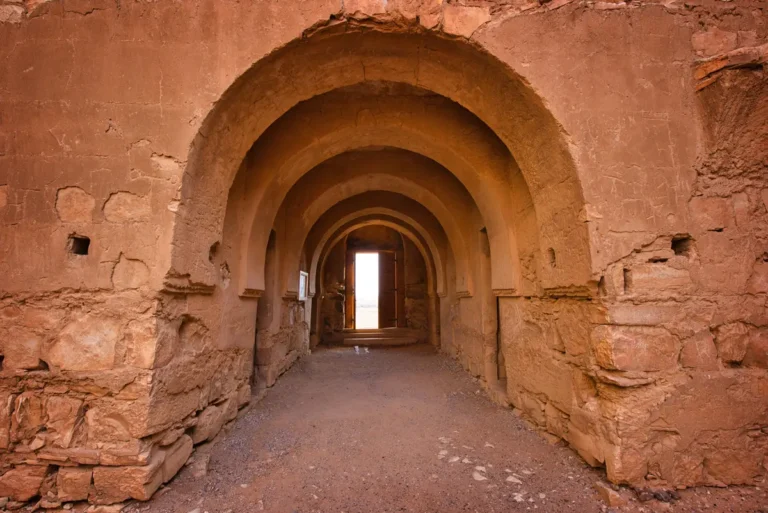
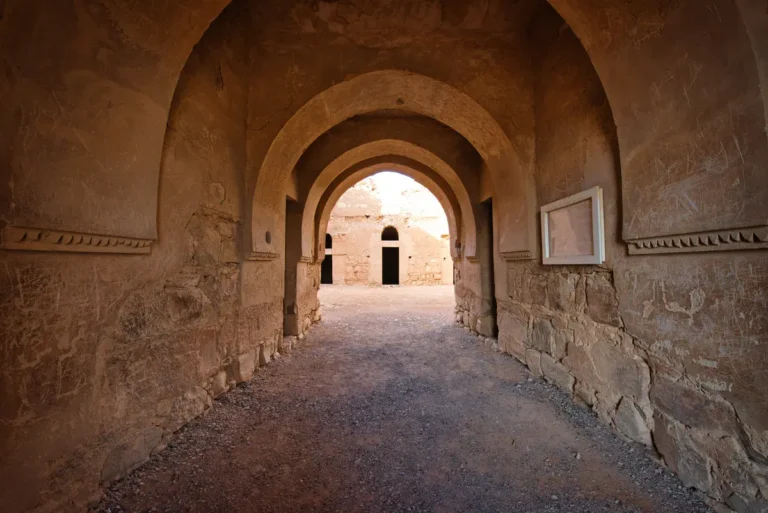
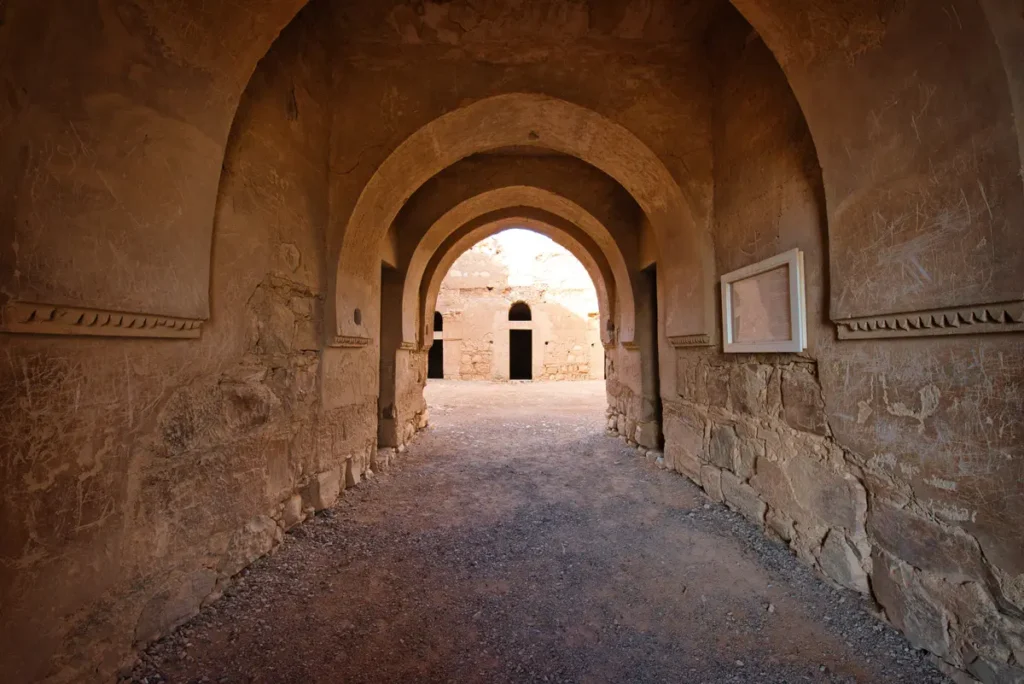
Pause in the entrance passage
Vaulted chambers flank the entrance passage; these have been interpreted as service spaces, including storage or stabling.
Before continuing, notice the relationship between this passage and the courtyard beyond. The entrance controls the transition from the open landscape to a more private interior.
Orient yourself in the courtyard
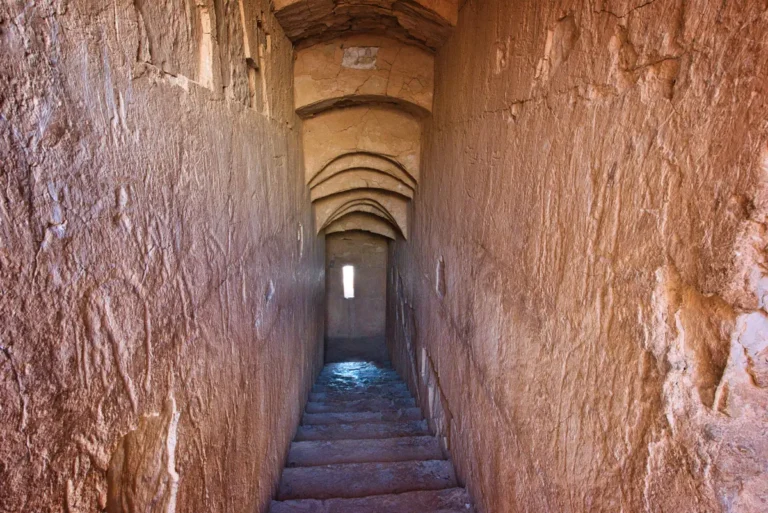
Stand near the centre and look around before entering individual rooms. Identify the entrance behind you, the accessible doorways, and the routes upstairs.
Use the courtyard as your reference point. Explore one group of rooms, return, and compare another. This makes the plan easier to understand than following doorways at random.
Explore the room groups
Pay attention to connections rather than simply counting rooms. Which spaces open directly towards shared areas? Which can only be entered through another room?
These distinctions suggest different degrees of privacy. Resist giving every chamber a definite label: an evocative interpretation can be useful without becoming a claim of certainty.
Look above eye level
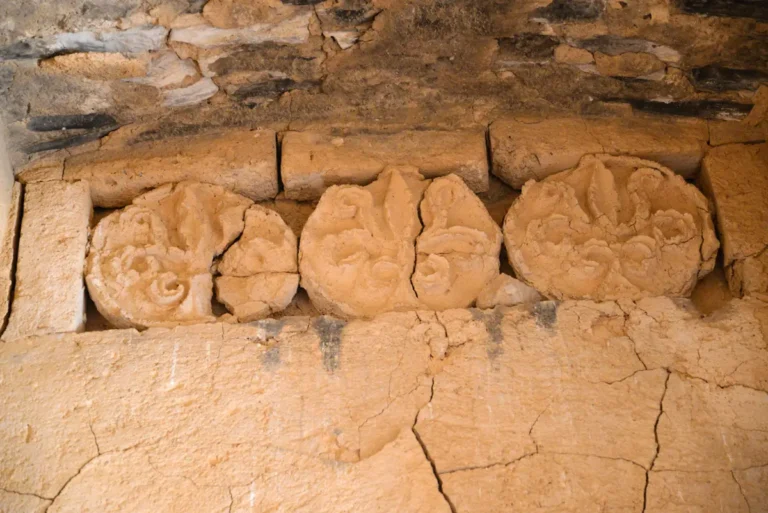
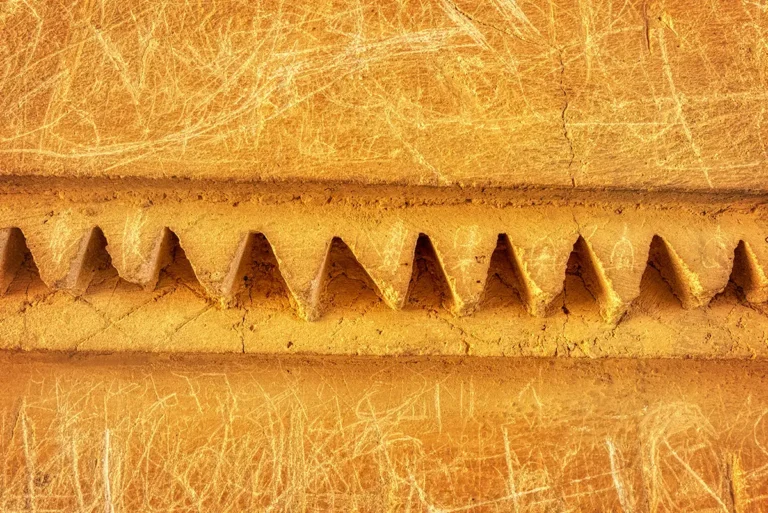
Where upper-floor access is permitted, examine the junctions between walls and ceilings. Documented features include rosette friezes, small attached columns, and squinches supporting semi-domes.
Allow your eyes to adjust in dim interiors. Details that are difficult to see immediately may become clearer after a few moments.
Ask about the inscription
Ask the attendant whether the early-dated inscription can currently be identified and viewed. Do not expect a large, easily legible display.
Its importance lies in the evidence it preserves. Avoid touching the surface or attempting to make faint markings more visible.
The Inscription at Qasr Kharana
Among Kharana’s most revealing traces of human presence is a prayer written in ink. It asks for forgiveness, calls on the reader to respond, and records a date. The text brings an individual voice into a building whose original purpose remains uncertain.
The Inscription at Qasr Kharana
Among Kharana’s most revealing traces of human presence is a prayer written in ink. It asks for forgiveness, calls on the reader to respond, and records a date. The text brings an individual voice into a building whose original purpose remains uncertain.
Arabic text
Modern-script rendering of the reading adopted by Lindstedt, inscription no. 39. Paragraph breaks are editorial.
اللهم ارحم عبد [ا]لملك بن عمر واغفر له ذنبه ما تقدم منه وما تأخر وما أسر وما أعلن وما أنت أعلم به هو …
إلا تغفر لي وترحمني أكن من الخاسرين. ربّ تمنّ عليّ فإنك أنت المنّان، وترحم عليّ فإنك أنت الرحمن.
اللهم إني أسألك أن تقبل منه دع[اءه] وصلاته … آمين رب العالمين، رب موسى وهارون.
رحم الله من قرأه ثم قال آمين آمين رب … العزيز العظيم.
وكتب عبد الملك بن عمر يوم الاثنين لثلاث بقين من المحرم من سنة اثنتين وتسعين.
اللهم اغفر لـ … أن يجتمع بيني وبينه في الدنيا والآخرة.
English translation
An English rendering of the ancient text as transcribed above; uncertain passages remain incomplete.
“O God, show mercy to ʿAbd al-Malik ibn ʿUmar. Pardon his sins: what came before and what followed, what he concealed and what he disclosed, and what You know better. He …
“Unless You pardon me and show me mercy, I shall be among those who lose. My Lord, You grant me favour, for You are the Bestower; You show me mercy, for You are the Merciful.
“O God, I ask You to receive his supplication and his prayer … Amen, Lord of all worlds, Lord of Moses and Aaron.
“May God show mercy to whoever reads this and then says: ‘Amen, amen, Lord … the Mighty, the Magnificent.’
“ʿAbd al-Malik ibn ʿUmar wrote this on Monday, with three [nights] remaining in al-Muharram, in the year ninety-two.
“O God, pardon … that he and I might be brought together in this life and the hereafter.”
The final sentence follows Lindstedt’s proposed reading and should be treated as uncertain. Arabic transliteration and scholarly apparatus.
What does it tell us?
It dates the writing, not the building’s construction.
The date is conventionally understood as 27 Muharram 92 AH, commonly given in monument references as 24 November 710 CE. The wall receiving the inscription must already have existed. The text therefore supplies a latest possible date for that part of the building, rather than a record of when the entire complex was completed. Museum With No Frontiers.
It names a person, not an identified royal builder.
In this reading, ʿAbd al-Malik ibn ʿUmar is both the person named in the opening prayer and the writer named near the end. The inscription does not call him a caliph or credit him with constructing Kharana.
Its language echoes the Qur’an.
The plea about forgiveness and being among the losers parallels Qur’an 11:47. The invocation of the Lord of Moses and Aaron recalls Qur’an 26:47–48. Lindstedt suggests that such borrowed devotional language may help explain the shifts between “him” and “me”.
The reader is invited to participate.
The request that a reader say “amen” turns the inscription into an ongoing prayer: someone encountering the words is asked to join the appeal for mercy.
Some passages remain disputed.
Earlier readings differ in the writer’s name and the final sentence. Lindstedt’s interpretation of the ending as a wish for two people to be reunited differs from readings referring to “my prophet and his prophet”. Neither should be presented without identifying the scholarly interpretation being followed. Discussion of wording and uncertainties.
Return outside
Finish with another view of the exterior. After exploring the interior, the walls should read differently: as the enclosure of a complex arrangement of spaces, each raising questions about the building’s use.
PRACTICAL VISITING TIPS
Allow enough time. Plan on 45–60 minutes, or 75–90 minutes if you enjoy photographing details and examining room layouts. These are suggested allowances.
Confirm opening hours. Jordan Pass publishes seasonal Desert Castles hours of 8:00 am–4:00 pm in winter, 8:00 am–6:30 pm in summer, 8:00 am–5:30 pm in April and May, and 9:00 am–5:00 pm during Ramadan. Its winter date range overlaps April, while the attractions page gives a general 8:00 am–5:00 pm listing. Confirm the schedule for your date rather than relying on a late arrival. Official seasonal hours.
Bring your pass or admission money. Published admission is 3 JOD for foreign visitors and 0.25 JOD for Jordanians. Foreign residents should confirm any concession; the official table does not specify one for Kharana.
Prepare for the conditions. Bring water, sun protection, and footwear suitable for uneven surfaces. A light layer can be useful in cool or windy weather.
Check accessibility beforehand. Upper-floor exploration involves stairs. Visitors requiring step-free access should confirm the current parking approach, entrance thresholds, and ground-floor route.
Facilities. On-site facilities include parking, toilets, visitor centre/ticketing office, and a small market.
Photograph with care. Avoid touching decorated surfaces or climbing masonry. Follow current restrictions on equipment, closed rooms, and upper-level access.
WHY QASR KHARANA MATTERS
Qasr Kharana rewards a kind of travel that begins with observation. A tower raises a question about defence. A doorway suggests controlled access. A decorated ceiling hints at the importance of a room. An inscription gives the building a place in time without explaining everything that happened there.
Its significance lies partly in those incomplete answers. The monument shows how archaeology builds understanding from different kinds of evidence—and how an attractive story must sometimes give way to uncertainty.
Walk through Kharana slowly, and the familiar image of a desert castle becomes more interesting. The building remains imposing, but it also becomes intimate: a sequence of rooms once entered and occupied by people whose names and conversations are largely lost. What survives is the setting they created, and the opportunity to look closely.
Frequently Asked Questions
Qasr Kharana is an early Islamic building in Jordan’s Eastern Desert, traditionally grouped among the country’s Desert Castles. Its imposing exterior encloses a courtyard, vaulted rooms, and surviving architectural decoration.
It was built during the Umayyad period and was already standing by 710 CE. An Arabic inscription dated to that year provides the strongest chronological evidence, although the exact construction date and patron remain uncertain.
Its original purpose remains debated. One leading interpretation suggests that it accommodated meetings between Umayyad representatives and local tribal leaders. A military fortress and a caravanserai have also been proposed, but aspects of its architecture and water supply challenge those explanations.
“Desert castle” is the conventional name. Kharana’s original function remains uncertain, and a venue for meetings and reception is a leading interpretation.
The inscription is a prayer asking God for mercy and forgiveness. It also asks readers to respond with “amen” and records a date in 92 AH, corresponding to 710 CE. Some names and damaged passages have different scholarly readings. It is a personal devotional text, not a dedication recording the castle’s construction.
Generally, no. A normal car is sufficient for the standard approach. This does not apply automatically to other, more remote desert sites.
Yes. The official attractions list includes it under “Qasr Al-Kharranah”. Jordan Pass coverage.
A short visit can work well for children who enjoy exploring historic spaces. Supervise them around stairs, changes in level, and masonry, and adapt the visit to the temperature and their interest.
Yes, particularly if you enjoy architecture or are already exploring the eastern castles. Allow time to investigate the rooms and details rather than treating it only as a roadside photograph.
Key Moments in History
Late 7th–Early 8th Century — An Umayyad Beginning
Qasr Kharana takes shape during the Umayyad period. Its precise construction date and patron remain uncertain, although the building was already standing by 710 CE.
710 CE — A Prayer Preserves a Date
A visitor leaves an Arabic prayer dated to 92 AH, conventionally identified as 24 November 710 CE. This small inscription becomes crucial evidence for dating the monument: it records the writing of the prayer, rather than the completion of the building.
Key Moments in History
Late 7th–Early 8th Century — An Umayyad Beginning
Qasr Kharana takes shape during the Umayyad period. Its precise construction date and patron remain uncertain, although the building was already standing by 710 CE.
710 CE — A Prayer Preserves a Date
A visitor leaves an Arabic prayer dated to 92 AH, conventionally identified as 24 November 710 CE. This small inscription becomes crucial evidence for dating the monument: it records the writing of the prayer, rather than the completion of the building.
Later Centuries — An Uncertain History
The circumstances of Kharana’s decline remain poorly understood. Its surviving walls do not establish a single destructive event or prove that occupation ended with the Umayyad dynasty in 750 CE.
1946 — The Inscription Re-examined
Scholar Nabia Abbott publishes a new reading of the early Arabic inscription, advancing understanding of its prayer, names, and date. Later researchers continue to revisit difficult passages.
1979 — Archaeology Challenges the Castle Story
Stephen Urice surveys and excavates Kharana. His research questions its identification as a military fortress or caravanserai and develops the interpretation of a building used for occasional political gatherings.
Today — A Monument with Unanswered Questions
Kharana stands among Jordan’s best-preserved Umayyad buildings. Visitors can explore its architecture while considering the question that still occupies scholars: what brought people together within these walls?