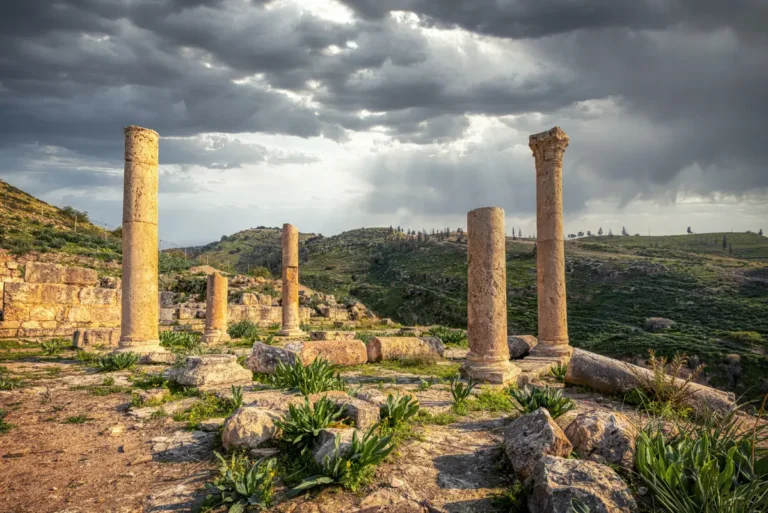

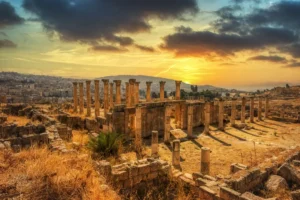
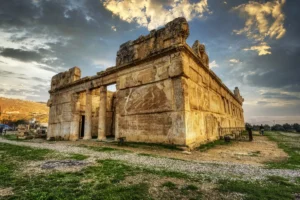
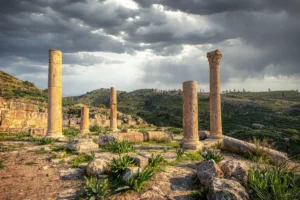

Tucked quietly on a slight rise just past the monumental entrance of ancient Gerasa, the Church of Marianos is an enchanting testament to the early Christian presence in northern Jordan. Frequently bypassed by visitors rushing toward larger structures, this 6th-century Byzantine funerary chapel provides an intimate look at the religious transformation, neighborhood life, and artistic mastery that bloomed long after Rome’s political decline.
The Church of Marianos at a Glance
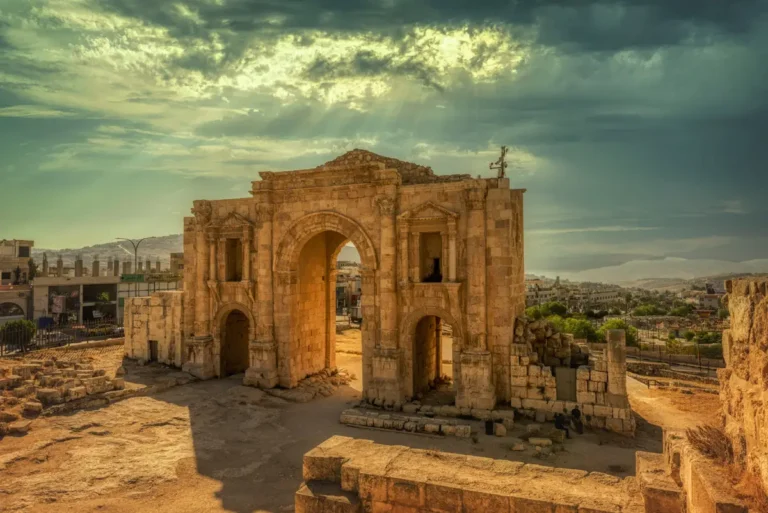
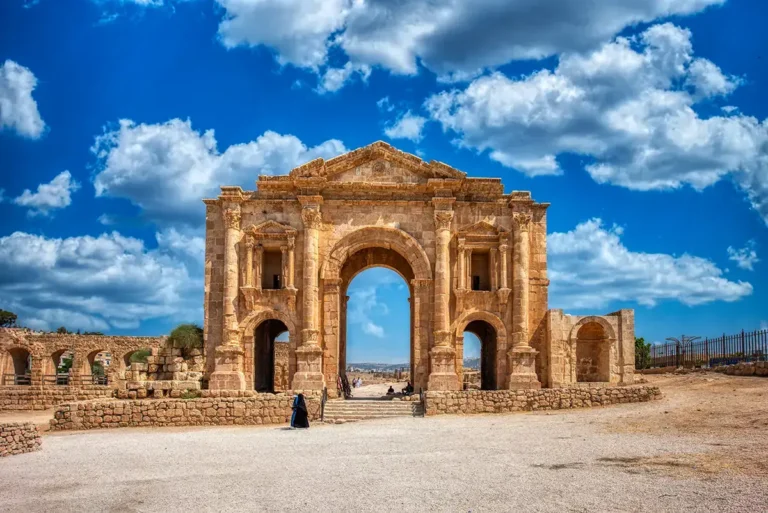
Location: Jerash Archaeological Park, Jordan (50 meters north of Hadrian’s Arch)
Built date: 570 AD
Purpose: Dedicated as a sacred house of worship and funerary chapel under Bishop Marianos
- Architectural Style: Early Byzantine, featuring a simple single-nave layout and reused Roman masonry
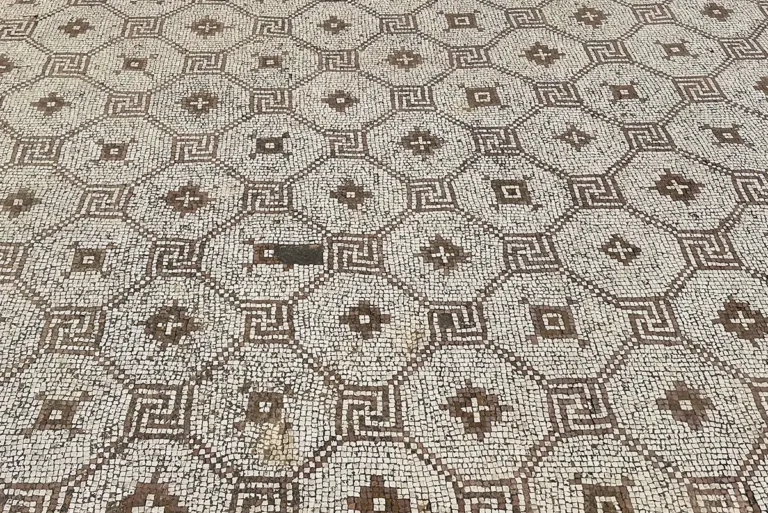
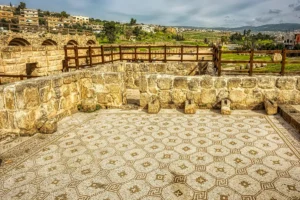
- Key Feature: An incredibly intact, vibrant geometric-patterned mosaic floor
- Dimensions: 13.50 meters long by 8.10 meters wide (Exterior)
- Nearby monuments: Hippodrome, Hadrian’s Arch, Ticket Office and Parking
- Current Status: Extensively excavated ruins open to the public
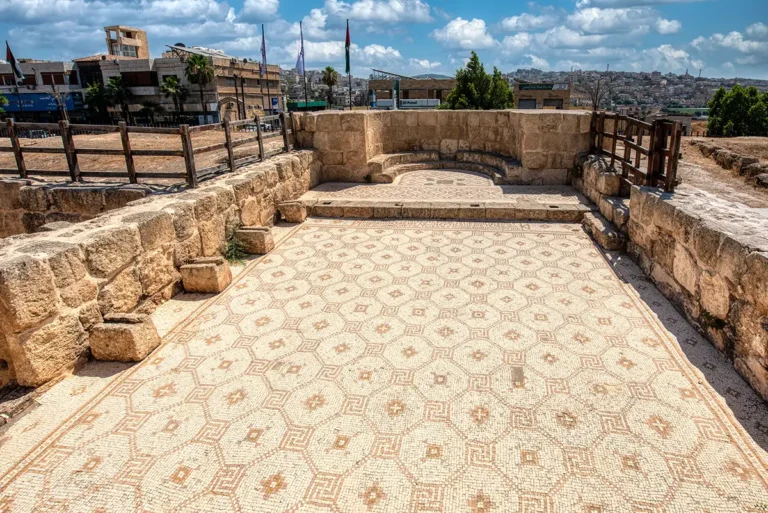
- Best way to experience it: Stand right at the entrance of the nave to admire the entire interlocking circle pattern of the mosaic carpet.
Historical Context and Origin
The Church of Marianos was constructed in 570 AD during the height of the Byzantine golden age in Jordan. At this point in history, the classical Roman sporting culture that once filled the nearby Hippodrome had completely ceased. In its place, early Christian communities began establishing smaller, sacred footholds across the landscape.
According to its pristine foundational text, the chapel was built under the direct oversight of the regional leader, Bishop Marianos. The geographic positioning of the church is highly unique; it sits directly atop a sprawling network of subterranean Hellenistic and early Roman tombs. Because of this placement, historians characterise it primarily as a funerary or mortuary chapel.
The congregation itself tells a fascinating socio-economic story. By the late 6th century, the adjacent Hippodrome was already sliding into ruin. The area surrounding the church was occupied by a tight-knit community of working-class squatters, artisans, potters, and dyers who repurposed the abandoned imperial architecture for domestic life and constructed this small, collective chapel for communal prayer.
First Impressions
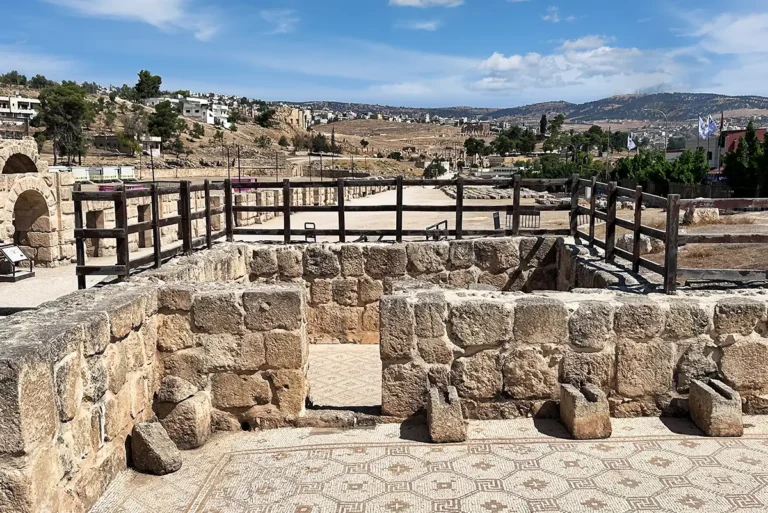
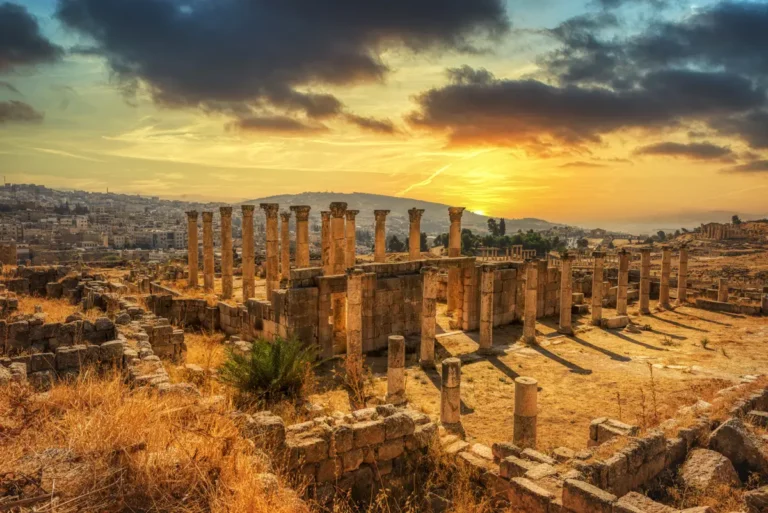
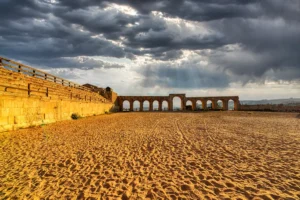
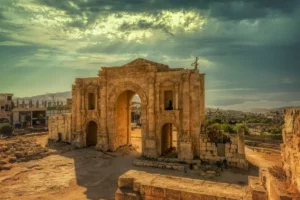
The Church of Marianos makes a very different impression from the monumental Roman buildings around it. Hadrian’s Arch rises high above the southern approach, while the Hippodrome stretches across the landscape as a vast arena for crowds and chariot races. The church is more intimate. Its low walls and compact plan ask visitors to look downward rather than upward, toward the patterned floor that preserves much of its character.
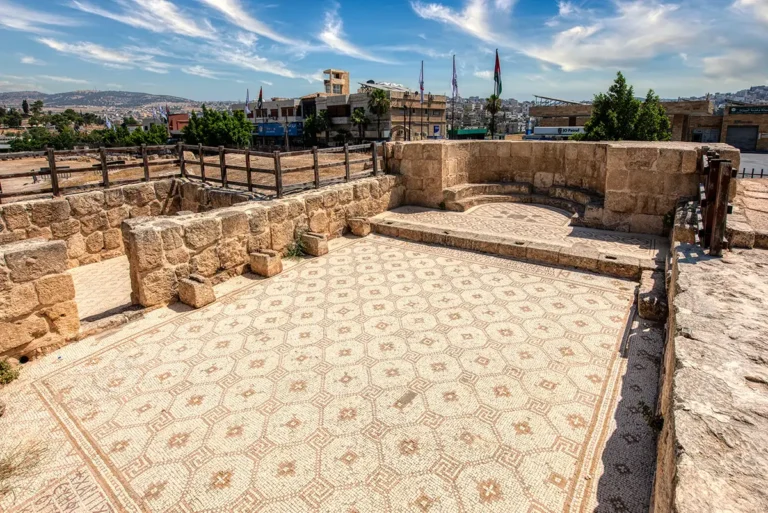
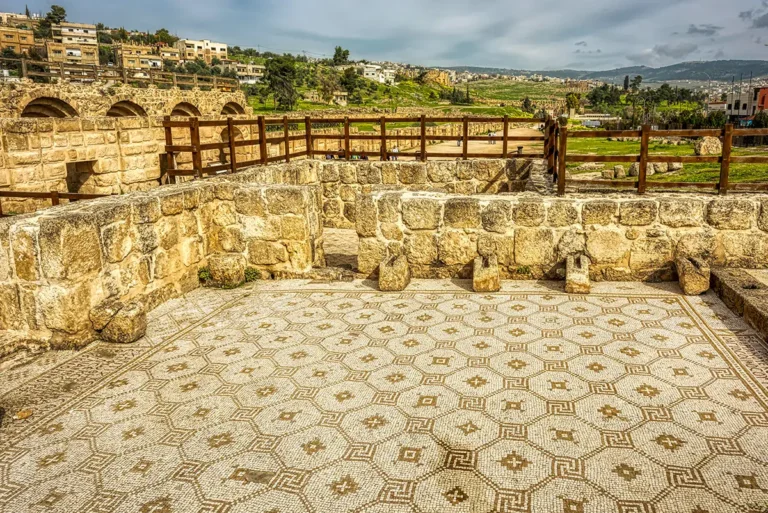
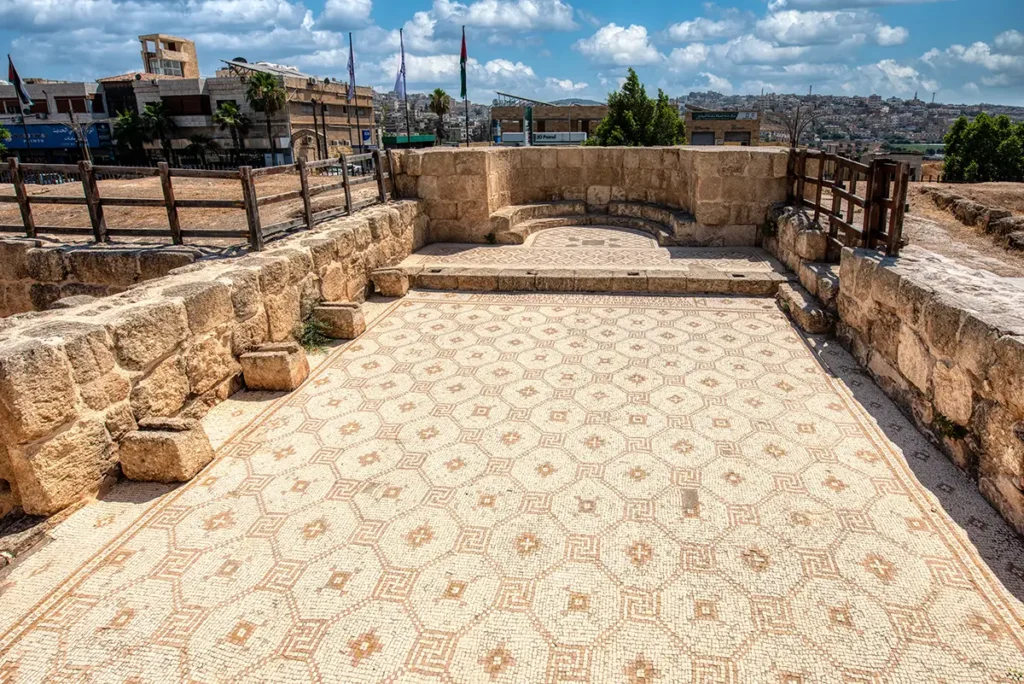
The first feature most visitors notice is the mosaic pavement. Geometric designs of interlocking forms, circles, and framed panels animate the nave, turning the floor into the church’s main visual statement. Even without its original roof, timber fittings, furnishings, or wall decoration, the mosaic makes the interior feel carefully planned and richly finished.
The building also gives Jerash a sense of historical continuity. It stands in a Roman entertainment district, using and adapting the setting of an earlier monument.
Architectural Design and Features
Unlike the sprawling, multi-aisled cathedrals found deeper within the ancient city centre, the Church of Marianos exhibits a wonderfully minimalistic and efficient spatial plan.
Dimensions and Capacity
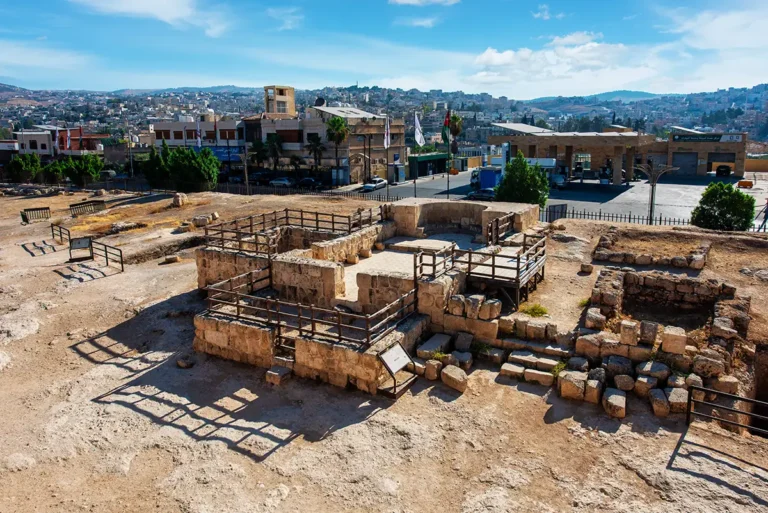
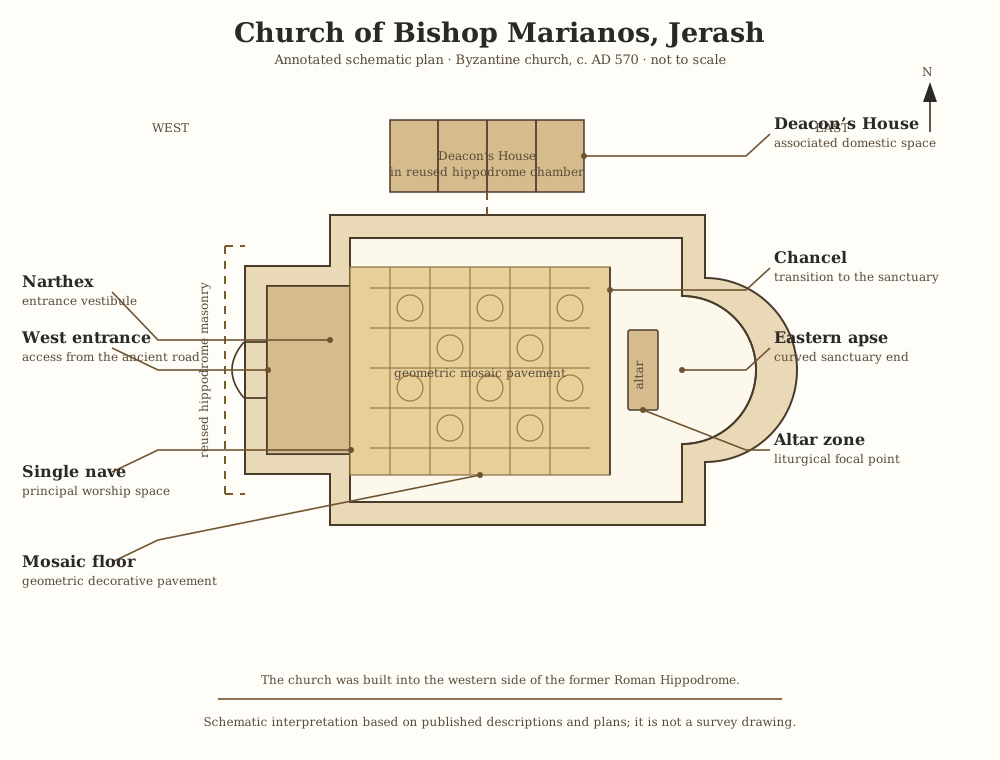
The church is a compact, rectangular structure measuring 13.50 meters (E-W) by 8.10 meters (N-S) on its outer edge.
The Narthex: Visitors originally entered the sanctuary via a narrow passage or narthex opening toward the historic highway that connected Philadelphia (modern Amman) directly to Gerasa.
The Single Nave: Devoid of columns separating the floor into aisles, the single nave provides an unobstructed, open view directly toward the altar.
The Semicircular Apse: The eastern terminal point curves out into a single, raised chancel platform designed specifically for the officiating clergy.
Unique Interior Details & Mosaics
What the Church of Marianos lacks in physical scale, it completely makes up for in internal artistic decoration.
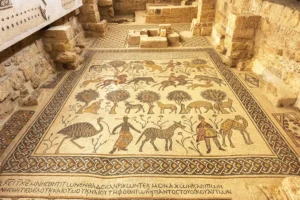
The Geometric Mosaic Floor: The entire nave floor is blanketed by an incredibly preserved, intricately woven mosaic carpet. The composition features repeating interlocking circles, precise diamonds, and stylised early Christian motifs that reflect the high-calibre artisan culture of the 6th-century Gerasene workshops.
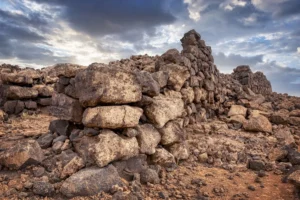
Reused Roman Spolia: In a classic display of late antiquity adaptation, the builders heavily relied on structural stones quarried from the nearby Hippodrome and classical tombs to build the foundational chapel walls.
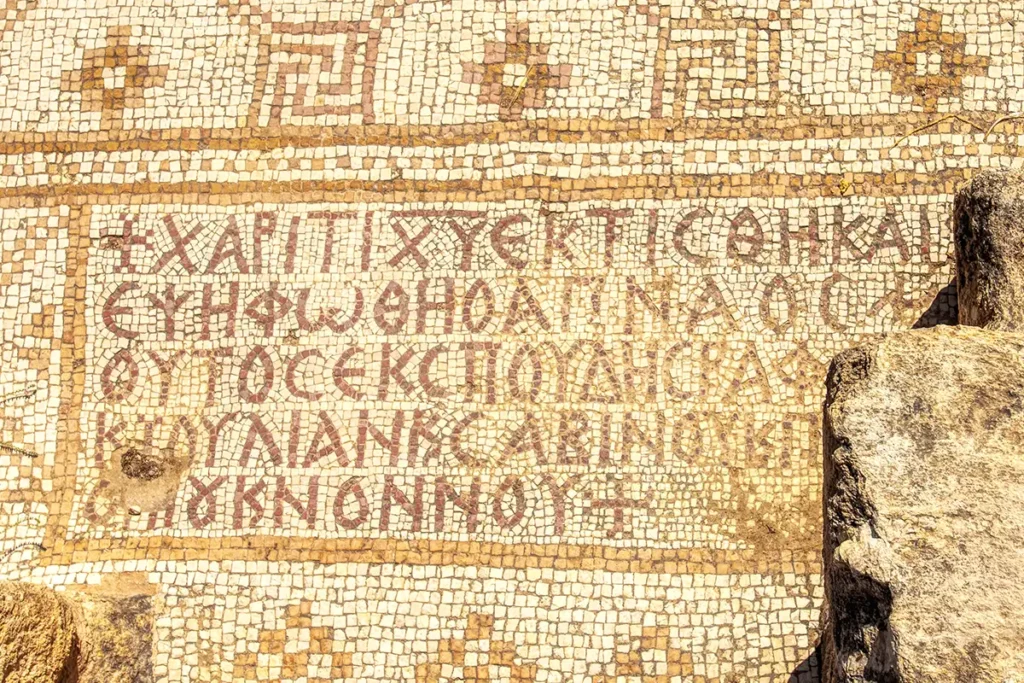
Foundation Inscription of the Church of Bishop Marianos
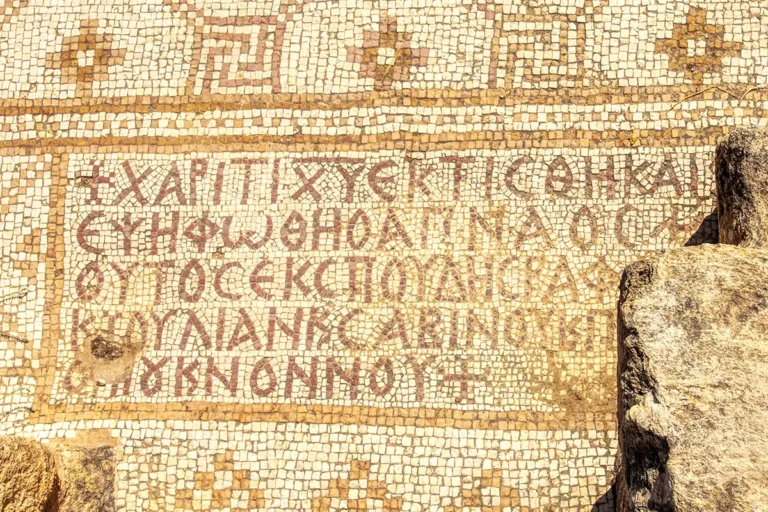
The mosaic inscription is among the church’s most important historical documents. It records the completion of the building under Bishop Marianos and provides the date of AD 570. Such inscriptions transformed a church floor into a public record: they commemorated patrons, clergy, donors, and the community’s act of construction.
Foundation Inscription of the Church of Bishop Marianos
The mosaic inscription is among the church’s most important historical documents. It records the completion of the building under Bishop Marianos and provides the date of AD 570. Such inscriptions transformed a church floor into a public record: they commemorated patrons, clergy, donors, and the community’s act of construction.
Original Greek
Ἐπὶ τοῦ ἁγιωτάτου καὶ θεοφύλακτου ἡμῶν ἐπισκόπου Μαριανοῦ, ἐκ θεμελίων ἐκτίσθη καὶ ἐτελειώθη ὁ ἅγιος οἶκος οὗτος, τῷ βλχʹ ἔτει, μηνὶ Ξανθικοῦ, χρόνων γʹ ἰνδικτιῶνος.
English Translation
Under our most holy and God-protected Bishop Marianos, this holy house was built from the foundations and completed in the year 632, in the month of Xanthicus, in the third indiction.
Date
Year 632 of the Gerasa era corresponds to April AD 570.
Destruction, Rediscovery, and Restoration
The operational lifespan of the Church of Marianos was relatively brief compared to its Roman predecessors. While the neighbouring residential spaces inside the Hippodrome’s vaults were abandoned by the early 7th century, the chapel remained an active local holy site for nearly two full centuries.
Its ultimate demise came swiftly in 749 AD. A massive, historic earthquake shattered the Jordan Rift Valley, collapsing the church’s roof, fracturing portions of the walls, and sealing the interior beneath a protective layer of mortar and debris.
Modern excavations conducted by international teams in the late 20th century cleared away the rubble to reveal the stunningly preserved floor layout below. Today, ongoing preservation work by the Jordanian Department of Antiquities ensures that the exposed mosaic tiles are stabilised and shielded against weather erosion, leaving them clearly visible to passing travellers.
Visiting the Church of Marianos Today
The Church of Marianos offers a unique, peaceful contrast to the colossal Roman monuments nearby.
- Location: Situated roughly 50 meters north of Hadrian’s Arch, resting on the right (east) side of the main entry path directly opposite the long western walls of the Hippodrome.
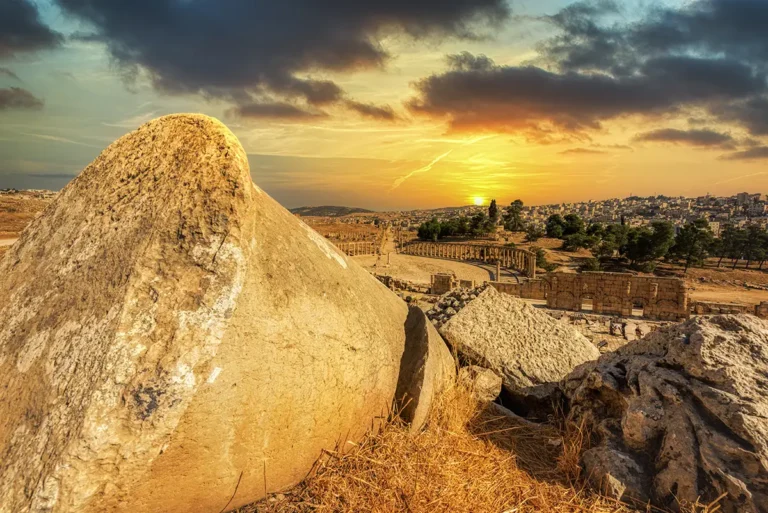
- Photographic Vantage: Climb the small earthen rise overlooking the low-cut perimeter walls. Looking straight down from this angle allows your camera to capture the entire geometric layout of the mosaic floor with the massive stone arches of the Hippodrome framed in the distance.
- The Experience: Pause at the information placard near the threshold to read the ancient text. Standing at this specific point bridges two eras: the massive sports complex of pagan Rome sits to your left, while the intimate, artisan-crafted chapel of Byzantine Christianity rests directly at your feet.
Key Takeaway
The Church of Marianos beautifully demonstrates the concept of sacred adaptation and social continuity in late antiquity. Rather than erasing the architectural footprint of the Roman Empire, the early Christian community selectively utilised its remaining materials to build an intimate place of community focus. It stands as a vital reminder that the history of Jerash is not solely defined by emperors and grand gladiatorial games, but also by the ordinary artisans who carved out beautiful lives amid the changing tides of empire.
Frequently Asked Questions
The Church of Marianos is a small single-nave Byzantine church near Hadrian’s Arch and the southern end of the Hippodrome in Jerash.
A mosaic inscription dates the church to AD 570, during the episcopate of Bishop Marianos.
It is named after Bishop Marianos, whose name appears in the church’s dedicatory inscription. The inscription provides the building’s unusually precise date.
The most striking feature is the surviving geometric mosaic floor, including the framed dedication inscription. Visitors can also identify the narthex, nave, sanctuary and semicircular apse.
A narthex is an entrance porch or vestibule at the western end of an early Christian church. At Marianos, worshippers entered the church through this narrow space before reaching the nave.
It is a synthronon, a stepped or curved bench reserved for members of the clergy. It stood behind the altar area within the apse.
Probably. The church was built beside the Hippodrome after the Roman arena had fallen out of use and its vaults were occupied by workshops and homes. It may have served craftspeople and their families living and working nearby.
Possibly. The church stands among rock-cut tombs of the southern necropolis, so it may have had a funerary role as well as serving the local community. This remains an archaeological interpretation rather than a certainty.
It is approximately 30 metres north of Hadrian’s Arch, on the eastern side of the main approach road, opposite the Hippodrome.
Yes. It is a brief but rewarding stop, especially for visitors interested in Byzantine Jerash. Its mosaic floor provides an intimate contrast to the enormous Roman monuments nearby.
Key Moments in History
Roman Origins of the Site
Before the church was built, this southern area of Gerasa formed part of the Roman city’s entertainment district. Nearby stood the Hippodrome, where chariot races and public spectacles took place, while Hadrian’s Arch marked the grand approach from the south.
Key Moments in History
Roman Origins of the Site
Before the church was built, this southern area of Gerasa formed part of the Roman city’s entertainment district. Nearby stood the Hippodrome, where chariot races and public spectacles took place, while Hadrian’s Arch marked the grand approach from the south.
Sixth-Century Transformation
By the Byzantine period, the Hippodrome had fallen out of its original use. Parts of its structure and surrounding area were adapted for new purposes, reflecting Jerash’s transition from a Roman provincial city into an important Christian center.
AD 570: The Church Is Built
The Church of Bishop Marianos was constructed and completed in AD 570. Its Greek foundation inscription identifies Bishop Marianos and records that the “holy house” was built from the foundations during the month of Xanthicus.
A Byzantine Place of Worship
The church served a local Christian congregation. Its single nave, eastern sanctuary, entrance vestibule, and richly patterned mosaic floor created a compact but carefully designed place for worship, procession, and community gathering.
Reuse of the Hippodrome District
The church was built beside the western side of the former Hippodrome, incorporating the character and materials of the older Roman landscape. Nearby Hippodrome chambers were reused as living and working spaces, including an associated deacon’s residence.
Survival through Change
Over the centuries, the church lost its roof and much of its upper structure. Its lower walls, apse, and mosaic pavement nevertheless remained, preserving evidence of its Byzantine plan and decoration.
Archaeological Discovery and Conservation
Modern archaeological work revealed the church’s plan, mosaic inscription, and relationship to the Hippodrome. Conservation has helped protect its fragile floor while allowing visitors to understand its place within the wider history of Jerash.
Today: A Link between Roman and Byzantine Jerash
The Church of Bishop Marianos remains a powerful reminder that Jerash is not only a Roman city. Standing beside the Hippodrome and near Hadrian’s Arch, it shows how the city’s people reshaped inherited Roman spaces for Byzantine Christian life.