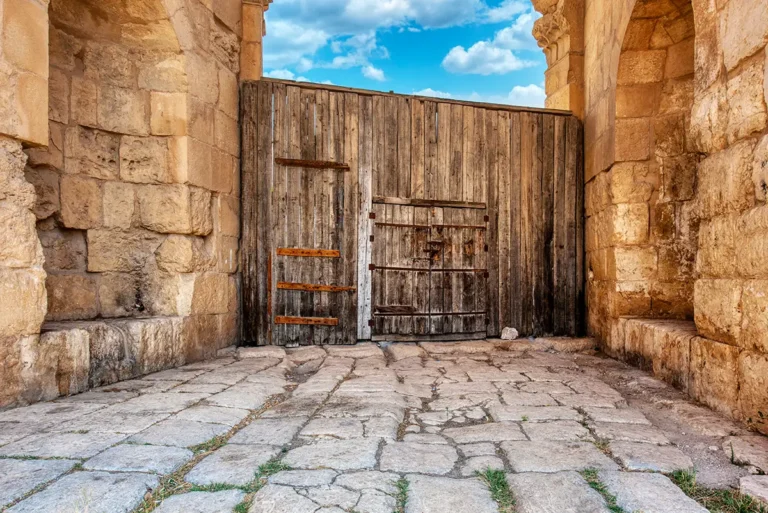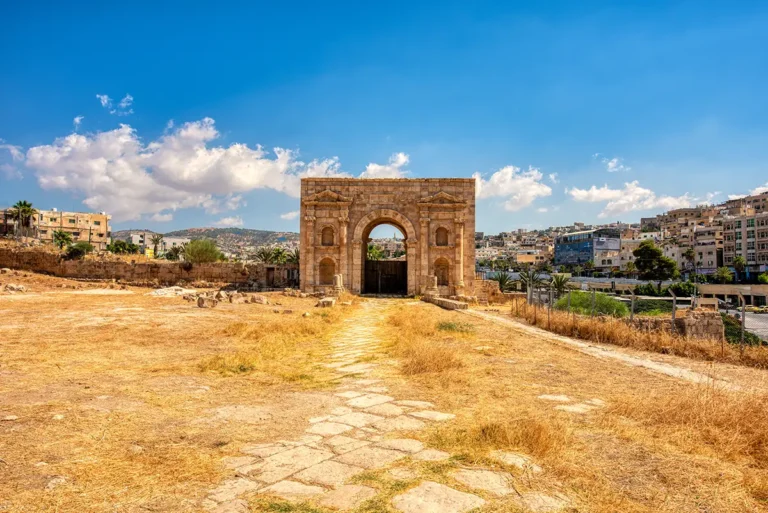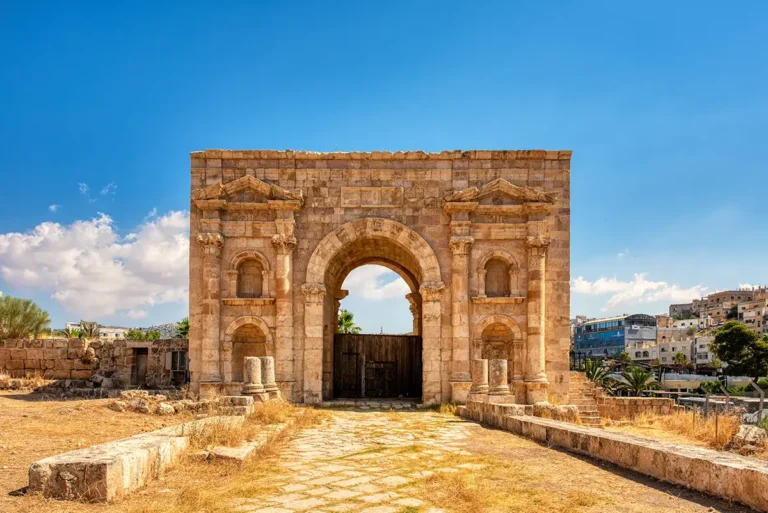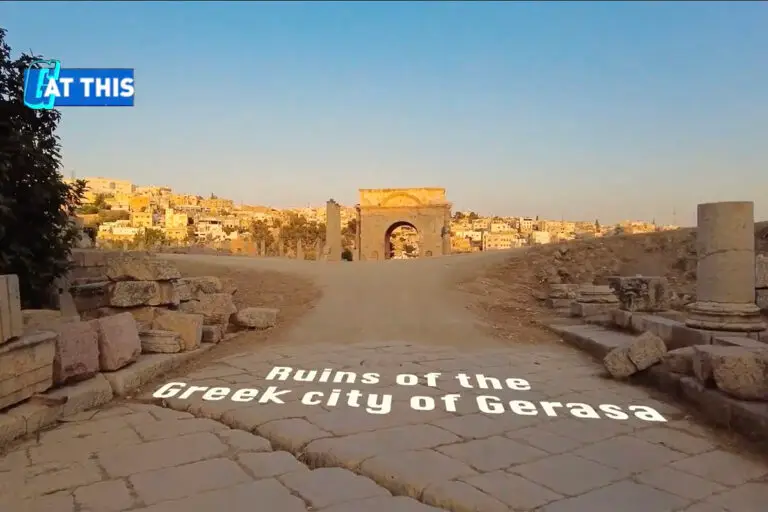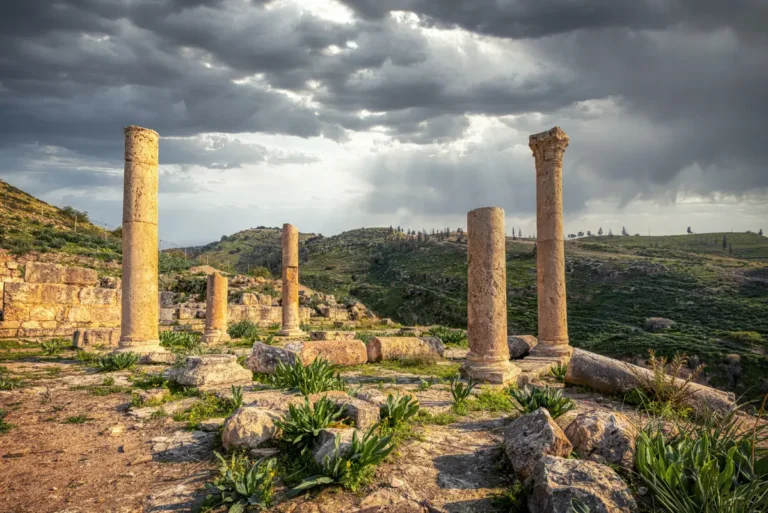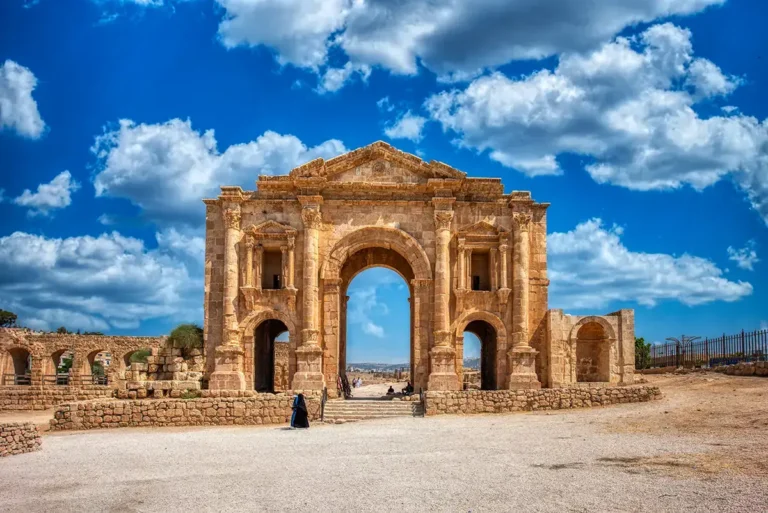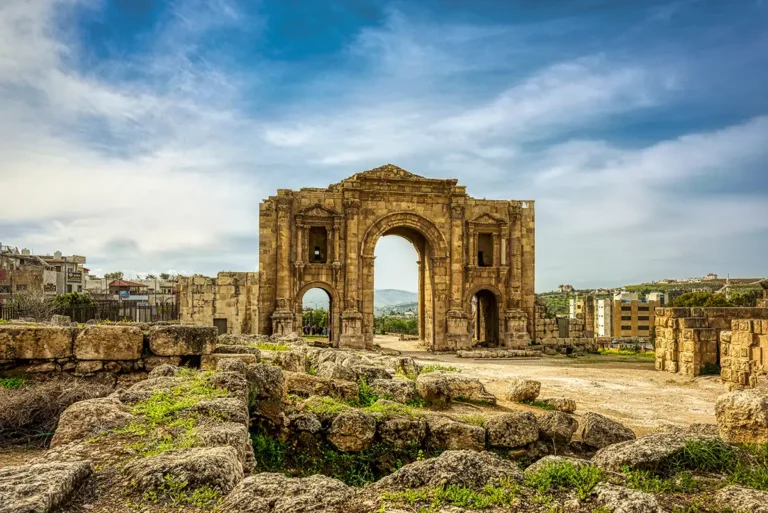
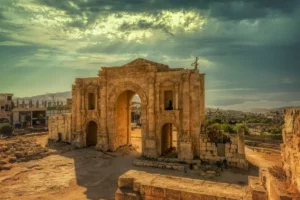
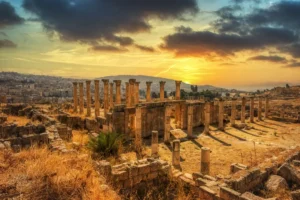
At the far northern end of ancient Jerash, the Cardo Maximus reaches its final destination: the North Gate. This is one of the most satisfying parts of the archaeological site because it reveals the city as a complete urban system. The great collonaded avenue does not simply fade into ruins; it leads to a formal exit, a city gate that directed travellers between Gerasa and the roads of northern Jordan.
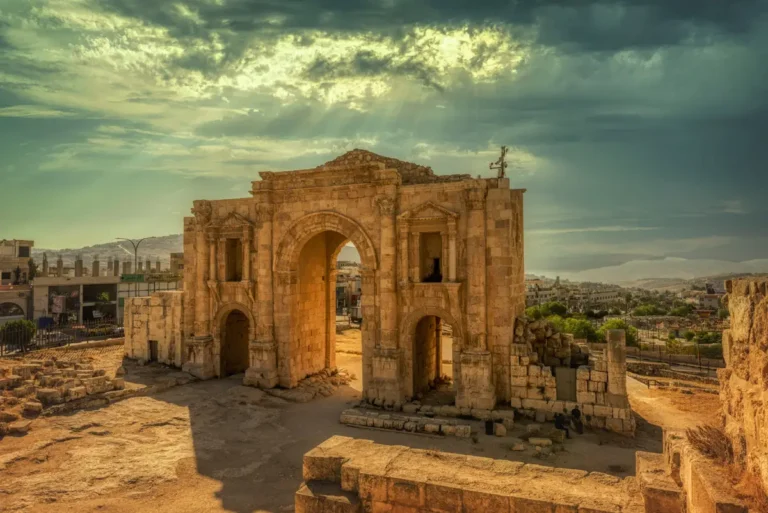
The North Gate is less ornate than Hadrian’s Arch and less imposing than the South Gate, yet it is historically essential. It stood at the northern terminus of the Cardo, marked the edge of the protected city, and connected Gerasa with routes toward Pella and the northern Decapolis. The approach also includes the North Tetrapylon, the North Decumanus, and the North Theatre—monuments that turn this final stretch of the Cardo into a compact guide to Roman movement, ceremony, civic life, and defence.
The North Gate & Upper Cardo at a Glance
Location: Jerash Archaeological Park, Jordan (northern end of the ancient city)
Built date: 115 AD (under the reign of Emperor Trajan)
Purpose: A defensive city gate, customs checkpoint, and architectural terminal for the Cardo Maximus
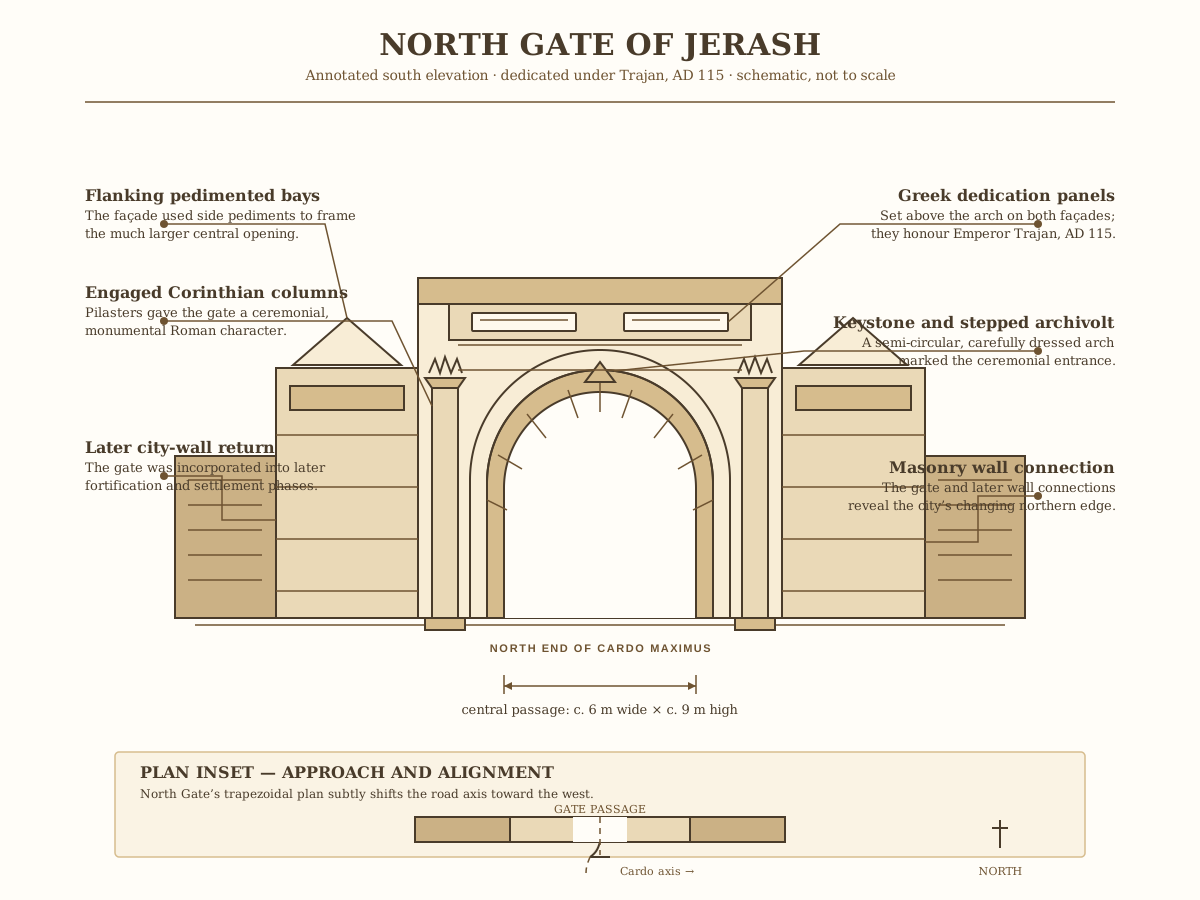
- Dimensions: about 21.75 m (71.4 ft) wide and stands at an impressive 20 meters (65.6 feet) high
- Gate form: One broad central passage, approximately 9 metres (29.5 ft) high and 6 metres (19.7 ft) wide
- Street connection: The Cardo Maximus runs about 805 metres (2,641 ft) from the Oval Plaza to the North Gate
- Architectural Style: High Roman Imperial military and civic architecture featuring an asymmetric wedge design
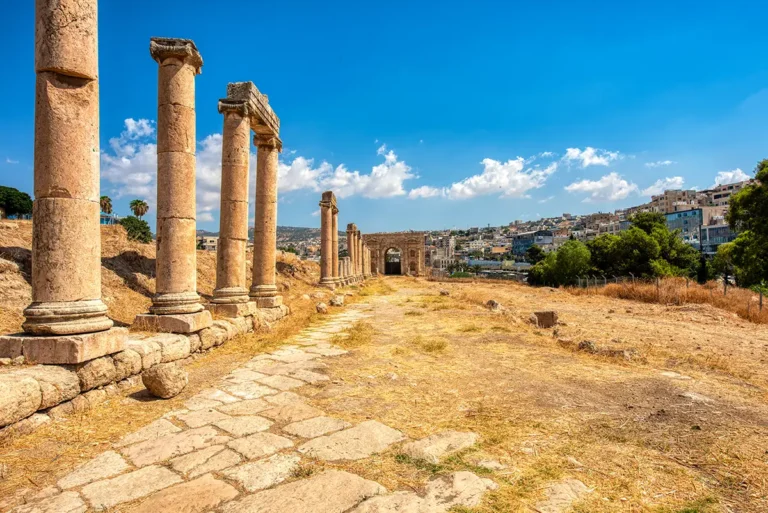
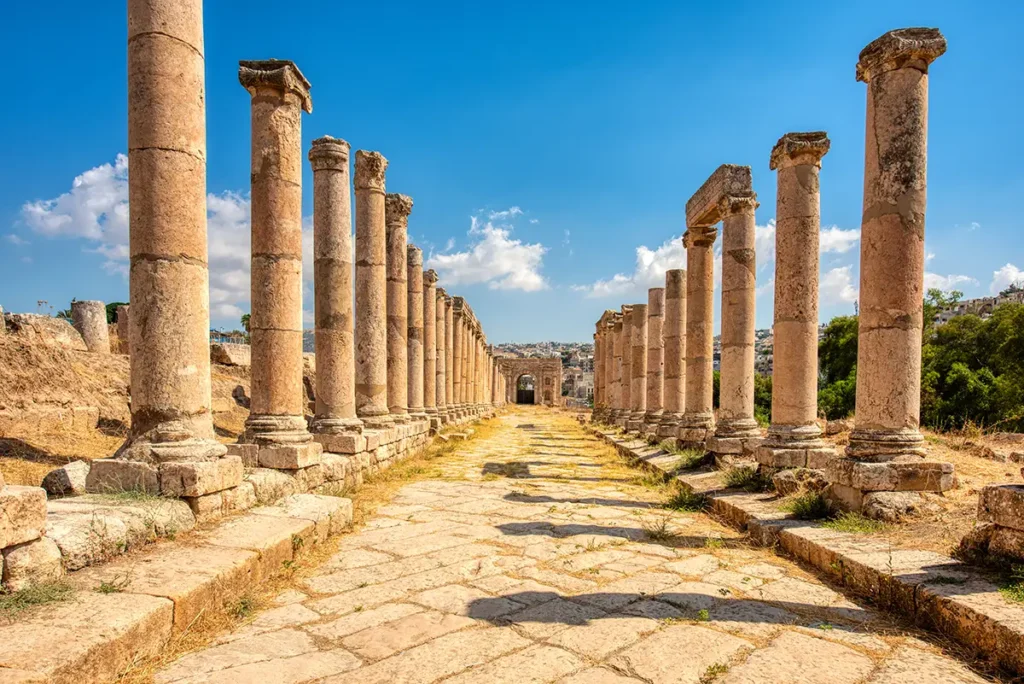
- Key Feature: Original stone pavement showing a dramatic transition from Corinthian to Ionic columns
- Nearby monuments: North Tetrapylon, North Decumanus, North Theatre, Sanctuary of Artemis, West Baths
- Current Status: Beautifully excavated and stabilised ruins open to the public.
First Impressions
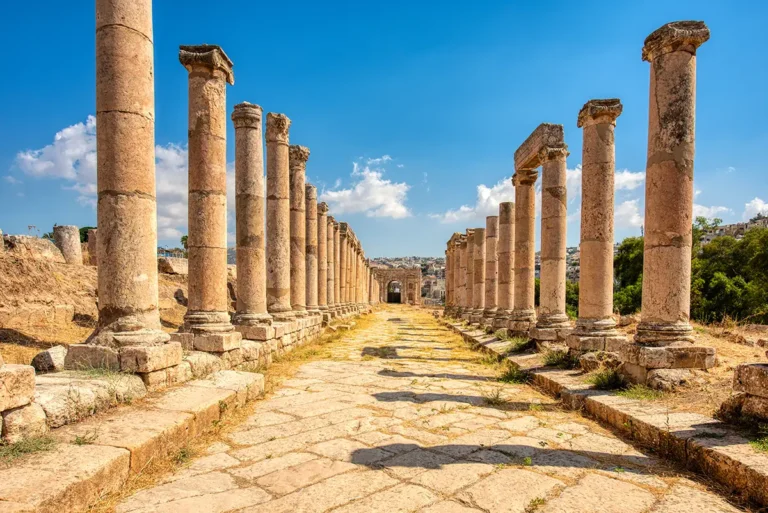
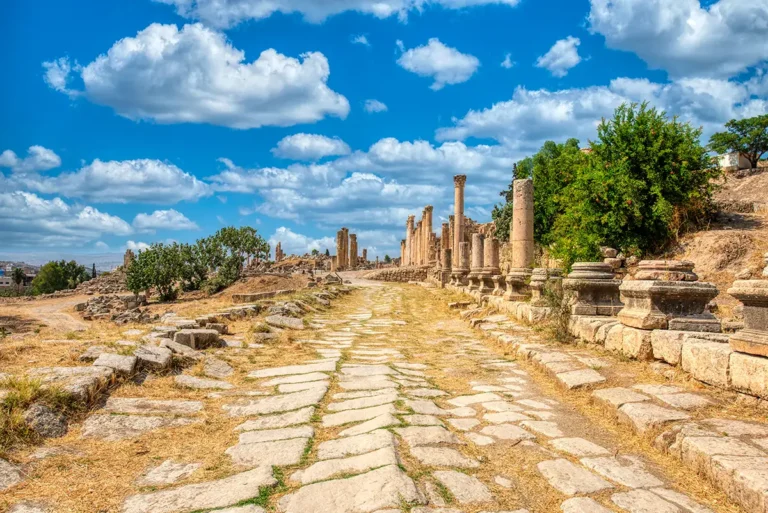
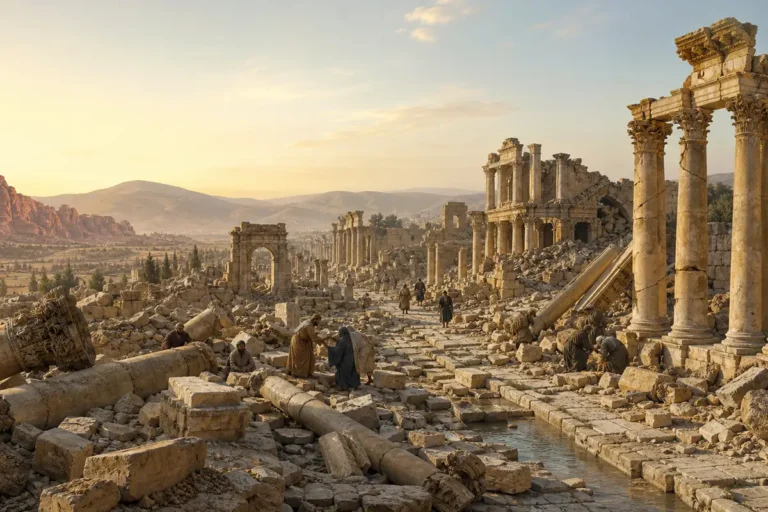
The northern Cardo feels calmer and more spacious than the busy central stretch around the Nymphaeum, Macellum, and Cathedral. Here, the avenue narrows into a more direct route between Ionic colonnades, leading the eye toward the North Gate. The surviving street, columns, paving, and drainage details create an unusually clear impression of what it meant to travel through a Roman city on foot, by animal, or in a cart.
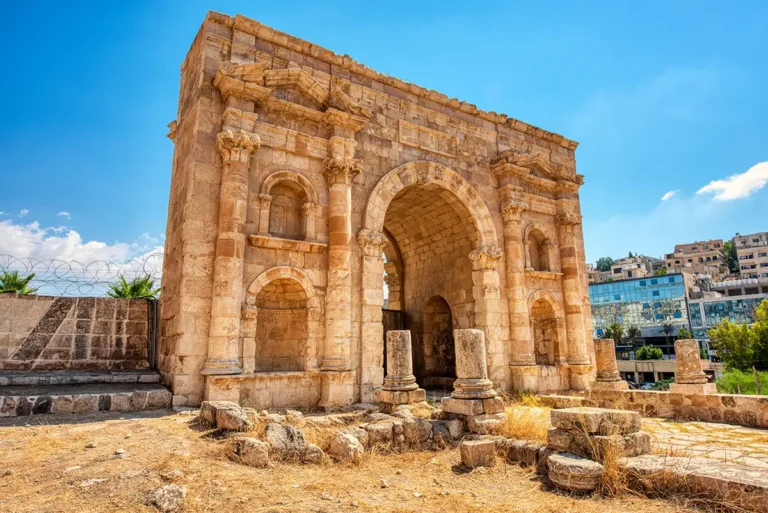
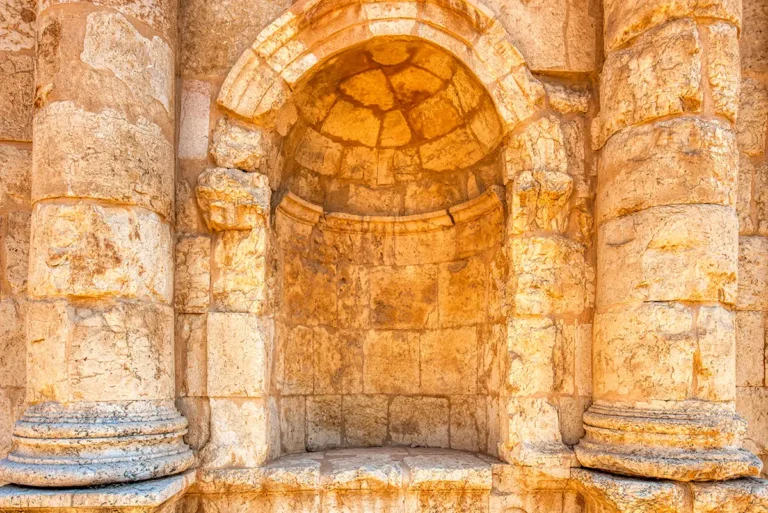
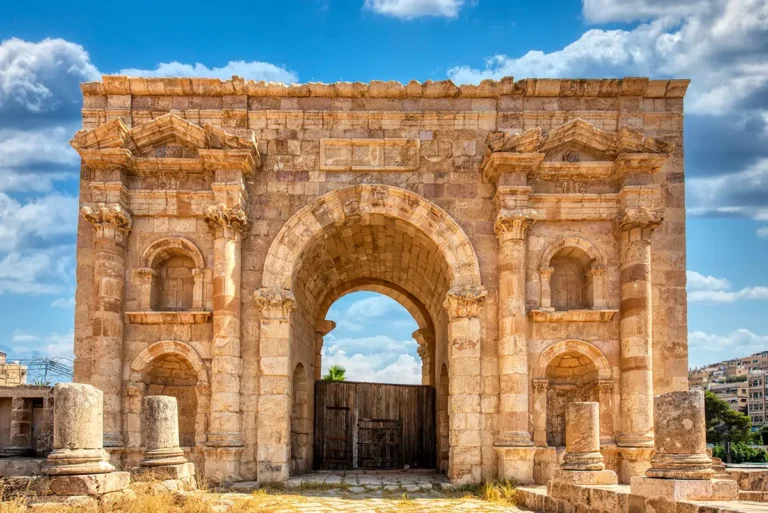
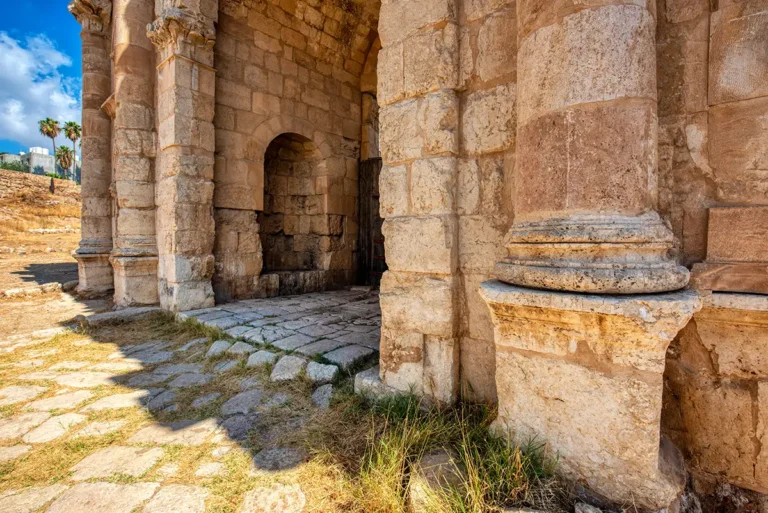
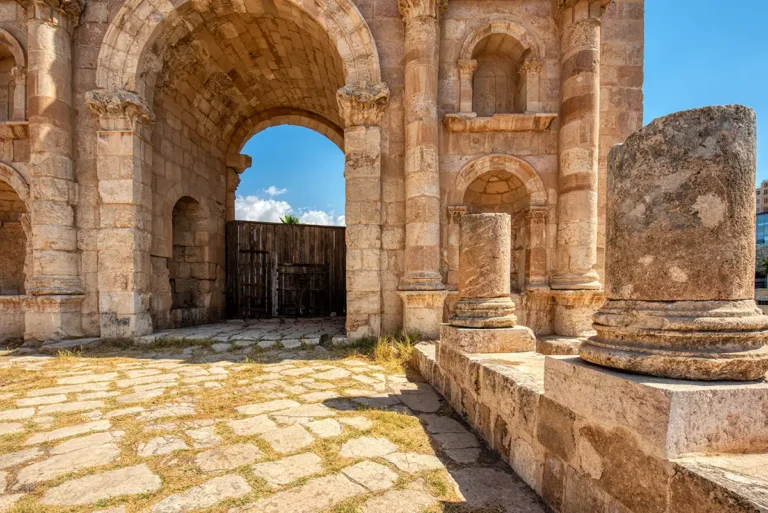
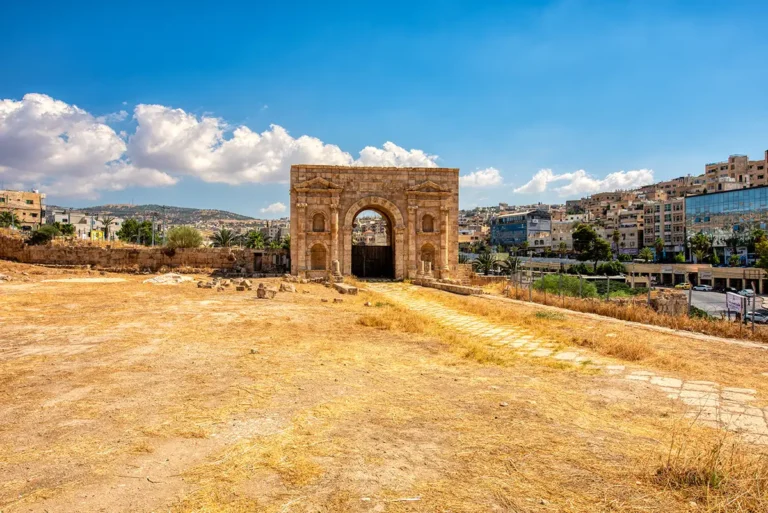
The North Gate itself is a measured and dignified monument rather than a theatrical one. Its single large arch frames the road beyond the city, while its thick masonry, pilasters, and integrated walls convey a more practical purpose than the ceremonial arches elsewhere in Jerash. Standing beneath it, you can feel the transition from the ordered urban world of Gerasa to the roads, farms, villages, and landscapes beyond.
Historical Context and Origin
The North Gate was dedicated in AD 115, during the reign of Emperor Trajan. A Greek dedicatory inscription was carved on matching panels above the arch on both the north and south faces of the gate. It is one of the most useful pieces of evidence for dating the monument.
The inscription honours Trajan with his imperial titles and may have called him ktistes, or “founder.” This restoration is debated: if the word was originally present, it may refer to special benefits or a new constitutional status granted to Gerasa rather than to Trajan literally founding the city. The inscription nevertheless shows that the gate was strongly connected to Roman imperial authority.
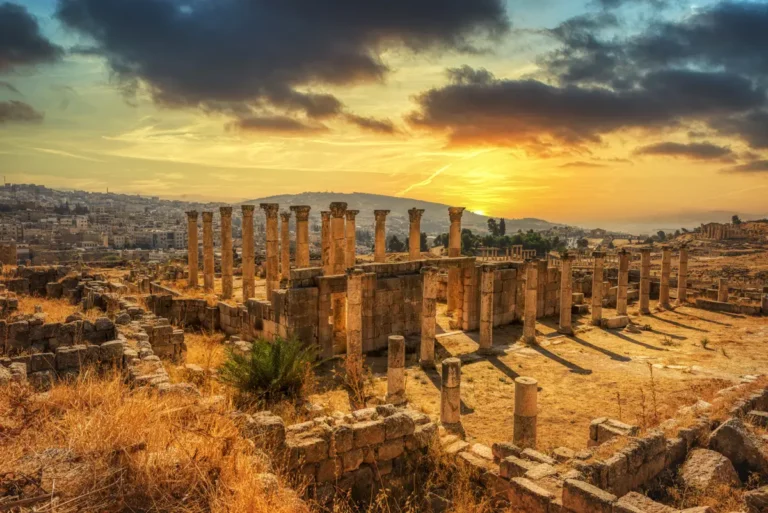
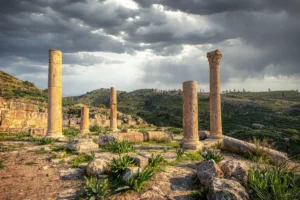
The Cardo itself developed over time. Its earliest route may have followed the city’s pre-Roman street pattern, while later Roman rebuilding gave it the long, collonaded form seen today. The central and southern stretches were heavily monumentalised in the 2nd century AD, but the northern section retained a simpler character. This difference is visible in the column orders: Corinthian columns dominate many of the grander parts of Jerash, while Ionic columns appear between the North Tetrapylon and the North Gate.
In later centuries, the gate and surrounding street were altered, repaired, and partly rebuilt. Archaeological study suggests that some of the visible fabric may belong to a 4th-century reconstruction of the earlier gate, while exterior additions reflect later Byzantine activity.
Where Are the North Gate and the Upper Cardo?
The North Gate stands at the far northern end of the Cardo Maximus, Jerash’s principal north–south avenue. The Cardo begins at the Oval Plaza in the south and runs approximately 805 metres to the gate.
Before reaching the gate, visitors pass the North Tetrapylon, where the Cardo meets the North Decumanus. The North Theatre lies just west of this intersection, while the Sanctuary of Artemis, the Cathedral, and the Church of St. Theodore are close by to the south.
The North Gate was therefore more than an isolated monument at the edge of town. It was the endpoint of the main urban route and the point at which traffic entered or left Gerasa from the north.
Architectural Design and Features
The North Gate and the upper end of the Cardo Maximus display a highly sophisticated example of spatial engineering, intentionally built to resolve a major topological challenge.
A Single Monumental Passage
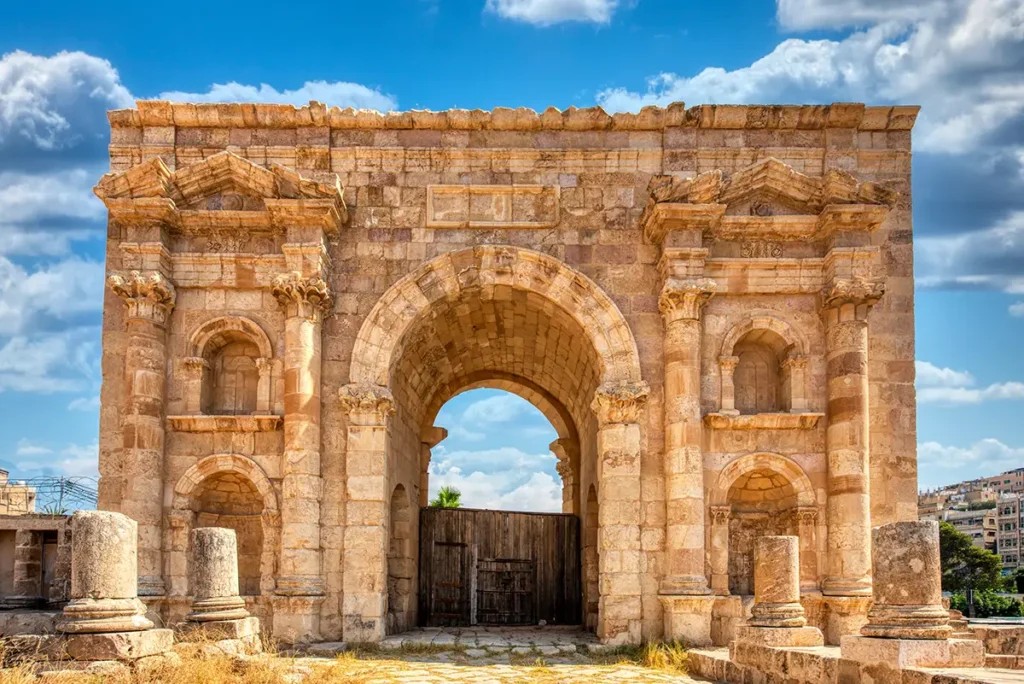
Unlike the South Gate, with its richer architectural composition, the North Gate was built around one broad central opening. This passage was large enough for both pedestrians and wheeled traffic, making it an effective point for regulating access to the city.
The arch was framed by a formal façade. On either side, engaged columns and Corinthian capitals added architectural dignity to what was also a defensive and administrative structure. The gate demonstrated that Roman urban infrastructure could be practical without being plain.
A Trapezoidal Plan
The gate was built with a slightly trapezoidal plan. This was not an accident. Its geometry shifted the road’s alignment slightly westward so that the route beyond the gate could connect more effectively with the line of the Cardo.
This small adjustment is a good example of Roman planning responding to actual terrain and existing routes. Roman cities could be highly ordered, but they were rarely designed on a perfectly abstract grid. At Jerash, monumental architecture, topography, earlier paths, and practical circulation all had to work together.
A Threshold Between City and Countryside
A city gate had several functions at once. It marked the legal and symbolic boundary of the city; channelled pedestrians, animals, carts, goods, and visitors; helped control security; and displayed the confidence of the community to people arriving from outside.
For Gerasa, the North Gate connected the city to northern roads and settlements. It was not merely a wall opening. It was the public face of the city for travellers arriving from that direction and the last great architectural statement encountered by citizens leaving the Cardo.
The Northern Cardo: A Different Character
Ionic Colonnades
The final northern stretch of the Cardo has a notably different appearance from the avenue farther south. Between the North Tetrapylon and the North Gate, the columns are Ionic rather than Corinthian. Their capitals have the characteristic spiral volutes associated with the Ionic order.
This simpler treatment helps visitors see that the Cardo was not built all at once. It was an evolving urban corridor, improved and monumentalised in different phases. The northern section was never widened to the same grand scale as other parts of the avenue, preserving a more restrained and perhaps earlier character.
Paving, Wheel Ruts, and Drainage
The Cardo was paved with limestone slabs designed to withstand heavy use. In places, wheel ruts still show the long movement of carts through the city. These marks are among the most immediate traces of everyday Roman life in Jerash.
Along the street edges, drainage openings led rainwater into an underground sewer system. Raised sidewalks offered pedestrians a safer route beside the carriageway, while steps connected the street to shops, public buildings, fountains, and religious complexes. The Cardo was therefore not only a ceremonial avenue; it was the city’s working infrastructure.
From the Oval Plaza to the North Gate
Walking from the Oval Plaza to the North Gate is one of the best ways to understand Jerash. The route passes the Sanctuary of Zeus, South Theatre, Macellum, South Tetrapylon, Nymphaeum, Cathedral, Sanctuary of Artemis, North Theatre, and North Tetrapylon before reaching the city’s northern edge.
Every section of the road tells a different part of the story. The southern Cardo is tied to the Temple of Zeus and the grand public centre; the middle section concentrates markets, fountains, churches, and sanctuaries; the northern section becomes quieter, more civic, and more transitional as it approaches the gate.
The North Tetrapylon and the North Decumanus
The North Tetrapylon marked the major intersection of the Cardo Maximus and North Decumanus. A tetrapylon was a four-sided monument placed at a crossroads, helping organise and decorate the meeting point of two important streets.
This northern intersection also created a visual and practical connection with the North Theatre. The theatre’s entrance court lies just west of the Cardo, reached by the North Decumanus. Its position suggests that the crossroad was not simply a traffic junction but part of a carefully designed civic district.
The North Tetrapylon should be understood as the threshold to the final stage of the Cardo. South of it, the avenue leads through the crowded monumental heart of Gerasa. North of it, the road becomes a direct approach to the city gate and the landscape beyond.
The Trajan Dedication Inscription on the North Gate
A Greek dedication was carved on two matching panels above the main arch of the North Gate, one on the south façade and one on the north façade. The surviving fragments allow the text to be reconstructed almost completely. It dates the gate to AD 115 and honours Emperor Trajan as the city’s own “Saviour and Founder.”
Square brackets indicate letters restored by editors; the word ktistēs (“founder”) is a scholarly restoration and remains slightly uncertain.
The Trajan Dedication Inscription on the North Gate
A Greek dedication was carved on two matching panels above the main arch of the North Gate, one on the south façade and one on the north façade. The surviving fragments allow the text to be reconstructed almost completely. It dates the gate to AD 115 and honours Emperor Trajan as the city’s own “Saviour and Founder.”
Square brackets indicate letters restored by editors; the word ktistēs (“founder”) is a scholarly restoration and remains slightly uncertain.
Original Greek Text
Αὐτοκράτορι Καίσαρι
θεοῦ Νέρ[ου] υἱῷ Νέρουα Τραιανῷ
ἀρίστῳ
Σεβαστῷ Γερμανικῷ Δακικῷ, ἀρχιερεῖ μεγίστῳ, δημαρχικῆς
ἐξουσίας τὸ ιθʹ, αὐτοκράτορι τὸ θʹ, ὑπάτῳ τὸ εʹ, πατρὶ πατρίδος,
Ἀντιοχέων τῶν πρὸς τῷ Χρυσορόᾳ τῶν πρότερον Γερασηνῶν
ἡ [πόλ]ις τῷ ἰδίῳ σ[ω]τῆρι κ[αὶ κ]τί[στῃ(?)] ἐπὶ Κλαυδίου
Σεουήρου
[ὑπ]ατικοῦ πρεσ[βευτοῦ Σ]εβασ[τοῦ ἀντ]ιστρατήγου.
English Translation
To Emperor Caesar Nerva Trajan Optimus Augustus, son of the deified Nerva, conqueror of the Germans and Dacians, chief priest, holding tribunician power for the nineteenth time, acclaimed imperator for the ninth time, consul for the fifth time, Father of his Country: the city of the Antiochenes by the Chrysorhoas, formerly the Gerasenes, [dedicated this] to its own Saviour and Founder, during the governorship of Claudius Severus, imperial legate with praetorian authority.
Meaning and Historical Importance
The inscription records a dedication by the city itself, not by a private donor. Its formal imperial titles identify the emperor precisely as Trajan, and his nineteenth tribunician power and ninth imperial acclamation date the text to early AD 115.
The city calls itself:
“the Antiochenes by the Chrysorhoas, formerly the Gerasenes”
This was Gerasa’s formal civic name in the Roman period. Chrysorhoas, meaning “Golden-flowing,” was the ancient name of the stream now known as Wadi Jerash. The phrase “formerly the Gerasenes” preserved the city’s older identity while advertising its official Greek-Roman status as Antioch on the Chrysorhoas.
The most striking words are:
τῷ ἰδίῳ σωτῆρι καὶ κτίστῃ
“to its own Saviour and Founder”
Calling Trajan a saviour was a conventional expression of gratitude and loyalty, but it may also reflect a specific benefit he granted to the city. Calling him founder did not necessarily mean that he established Gerasa from nothing; the city was already ancient. In Roman civic language, ktistēs could honour an emperor as a refounder, benefactor, or renewer of a city.
The inscription names Claudius Severus, the Roman governor of the province of Arabia. His presence shows that the North Gate was part of a building programme carried out within the framework of Roman provincial administration.
Some scholars have suggested that the gate’s construction may have followed earthquake damage in the region around AD 113–114, making Trajan’s title “Saviour and Founder” especially meaningful. This remains an interpretation rather than something stated directly in the inscription. The published inscription record dates the text to AD 115 and explains the Trajanic titles in detail. North Gate inscription record, discussion of the AD 115 dedication
The North Theatre and the Civic District
The North Theatre stands close to the North Decumanus, a short walk west of the North Tetrapylon. Smaller and more intimate than the South Theatre, it probably served as both an odeon for music and speech and a civic meeting place.
Its lower seating carries Greek inscriptions assigning places to Gerasa’s civic tribes and probably to the city council. These inscriptions demonstrate that the northern district was not only a route out of the city; it was also an area of public administration, formal gatherings, and civic representation.
Together, the North Theatre, North Decumanus, North Tetrapylon, and North Gate create a coherent urban sequence. A visitor could arrive from outside the city, pass through the gate, walk along the Cardo, turn at the tetrapylon, and enter a theatre where the civic structure of Gerasa was literally written onto the seats.
Destruction, Rediscovery, and Restoration
The North Gate and northern Cardo changed as Gerasa changed. Earthquakes, weathering, stone reuse, and the contraction of the city damaged the gate and its surrounding colonnades over many centuries. Later repairs and additions modified the original Roman appearance.
By the Byzantine period, Jerash remained an active city but its religious and urban priorities had changed. Churches and practical structures occupied former Roman public spaces, while roads and gates were adapted to continuing local needs. Archaeological evidence indicates later building work around the exterior of the North Gate.
Modern archaeological work clarified the gate’s plan, recovered fragments of its inscription, and supported reconstruction and conservation. The gate visible today preserves both ancient masonry and carefully restored elements, allowing visitors to understand its original position at the end of the Cardo.
The North Gate and Northern Cardo Today
The northern route is often quieter than the central monuments, which makes it especially rewarding. It is an excellent place to slow down after the busiest part of a Jerash visit and notice the details that larger monuments can overshadow: different column styles, drains, paving, side streets, threshold spaces, and the relationship between city architecture and the wider landscape.
The North Gate is also a powerful final stop. If you begin your visit at the South Gate, Hadrian’s Arch, or Visitor Centre, reaching it means you have effectively crossed the full length of Roman Gerasa. Looking back through the arch toward the Cardo offers one of the clearest visual summaries of the ancient city.
Practical Visiting Tips
Allow 30–45 minutes to explore the northern Cardo, North Tetrapylon, North Theatre, and North Gate together.
Visit late in the day if possible; the northern area is often quieter and offers softer light for photography.
Look for the change from Corinthian to Ionic columns as you move north from the North Tetrapylon.
Examine the paving for wheel ruts and drainage openings.
Combine the route with the North Theatre, Sanctuary of Artemis, Cathedral, Church of St. Theodore, and Nymphaeum.
Wear shoes with good grip. The paving and steps can be uneven, especially after rain.
Why the North Gate and Northern Cardo Matter
The North Gate and northern Cardo reveal Jerash as a functioning Roman city rather than a collection of separate monuments. Here, roads, drainage, colonnades, civic buildings, a theatre, a crossroads monument, walls, and a gate all work together.
This northern route is where the scale of Gerasa becomes most understandable. The city’s main street is not simply beautiful; it is purposeful. It carries visitors, goods, ceremonies, civic life, and imperial authority from the central monuments to the edge of the city—and from there, into the wider Roman world.
Frequently Asked Questions
The North Gate was dedicated in AD 115, during the reign of Emperor Trajan. Its Greek inscription is the key evidence for this date.
Yes. The gate formed part of the northern entrance and defensive boundary of the city, although its monumental façade also gave it a strong civic and ceremonial role.
The two gates served different architectural moments and urban contexts. The South Gate belongs to a more monumental southern approach, while the North Gate is a practical but dignified single-passage entrance at the end of the Cardo.
The Cardo runs approximately 805 metres from the Oval Plaza to the North Gate.
The northern stretch of the Cardo retained a simpler architectural phase and was not widened or redesigned to the same extent as the grander central sections. Its Ionic columns make this difference easy to see.
The North Tetrapylon was a four-sided monument at the intersection of the Cardo Maximus and North Decumanus. It marked a key junction near the North Theatre and helped structure the northern civic district.
Key Moments in History
AD 114–115 — The North Gate is built and dedicated.
Gerasa constructed its monumental northern entrance during the reign of Emperor Trajan. The gate’s Greek inscription records the dedication in AD 115 and honours Trajan as the city’s benefactor and “saviour,” during the governorship of Claudius Severus.
Early 2nd century AD — A new northern approach is formalised.
The gate marked the end of the Cardo Maximus and welcomed travellers arriving from the north, including routes toward Pella, Gadara and other cities of the Decapolis. Its carefully angled, trapezoidal layout reconciled the approach road with the line of the Cardo inside the city.
Key Moments in History
AD 114–115 — The North Gate is built and dedicated.
Gerasa constructed its monumental northern entrance during the reign of Emperor Trajan. The gate’s Greek inscription records the dedication in AD 115 and honours Trajan as the city’s benefactor and “saviour,” during the governorship of Claudius Severus.
Early 2nd century AD — A new northern approach is formalised.
The gate marked the end of the Cardo Maximus and welcomed travellers arriving from the north, including routes toward Pella, Gadara and other cities of the Decapolis. Its carefully angled, trapezoidal layout reconciled the approach road with the line of the Cardo inside the city.
2nd–3rd centuries AD — Gerasa expands as a prosperous Roman city.
The North Gate operated as both a practical entrance and a civic statement. Its single high vaulted passage, classical façade and imperial inscription advertised Gerasa’s Roman connections, wealth and public ambition.
4th–6th centuries AD — The gate becomes part of a changing fortified city.
As Gerasa entered the Late Roman and Byzantine periods, the city’s defences were altered and repaired. Wall connections around the gate reflect this later history, when the monument was incorporated into a more heavily fortified urban edge.
AD 749 — Earthquake damage and urban decline.
The great earthquake of 749 badly affected Jerash, as it did many settlements in the region. Parts of the city were abandoned or reused, and the North Gate gradually lost its original role as the formal entrance to a living Roman city.
19th–20th centuries — Rediscovery, excavation and conservation.
Archaeological work brought the North Gate back into view and clarified its plan, inscription and relationship to the northern end of the Cardo. Conservation has helped stabilise the remaining masonry and preserve one of Jerash’s most important Roman gateways.
Today — The northern threshold of ancient Gerasa.
The gate remains a quieter but rewarding endpoint to the Cardo Maximus. Its inscription, monumental arch and unusual alignment make it an excellent place to understand how Roman Gerasa connected architecture, movement and imperial identity.