


Hidden beneath the Sanctuary of Artemis in Jerash is one of the site’s most remarkable technological discoveries: a sixth-century hydraulic stone saw machine. Unlike the city’s temples, theatres and collonaded streets, this monument reveals the practical engineering that supported monumental architecture. It was a workshop where flowing water powered large, multi-bladed saws used to cut hard limestone into building elements.
The installation dates to around AD 550, during Jerash’s Byzantine period, when the ancient city remained an active and prosperous urban centre. Its surviving channels, basins and sawn column drums provide rare physical evidence for sophisticated water-powered machinery in Late Antiquity.
The Hydraulic Stone Saw Machine at a Glance
Location: Jerash Archaeological Park, Jordan (an underground room within the Sanctuary of Artemis)
Built date: 550 AD
Purpose: Cutting large limestone blocks and architectural elements
Power source: Water-driven wheel
Saw system: Two frames, each equipped with four blades
Key mechanism: Crank-and-connecting-rod system converting rotary motion into back-and-forth movement
Evidence on site: Water channels, cisterns, mill race and limestone column drums bearing parallel saw marks.
First Impressions
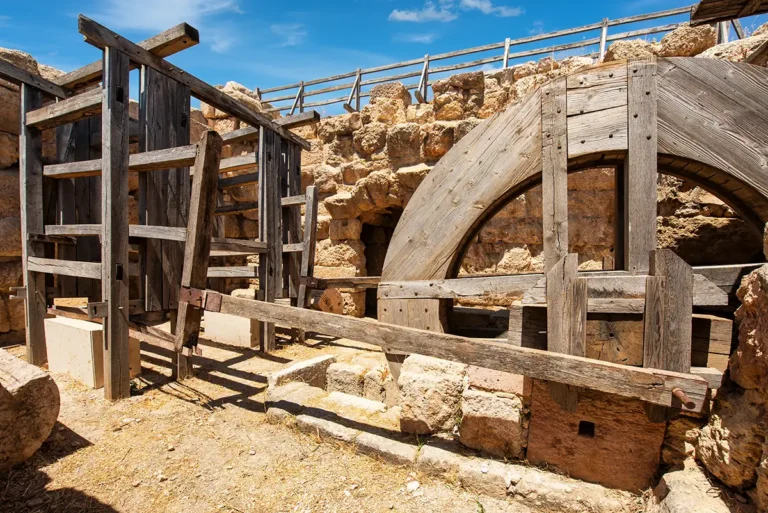
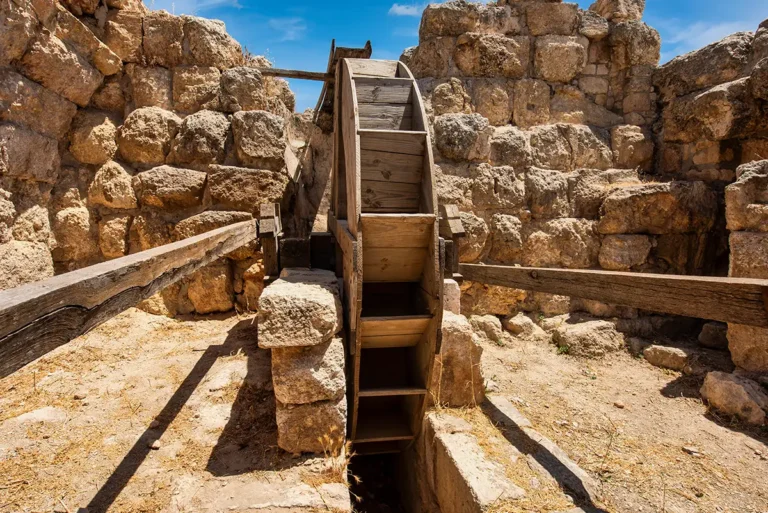
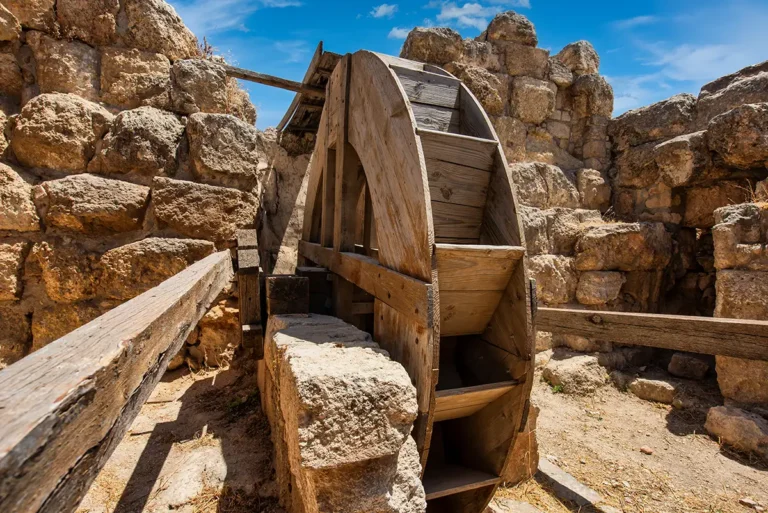
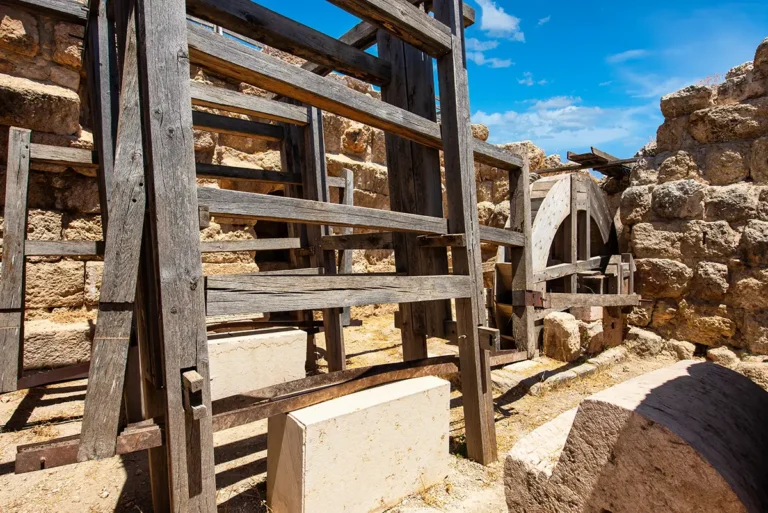
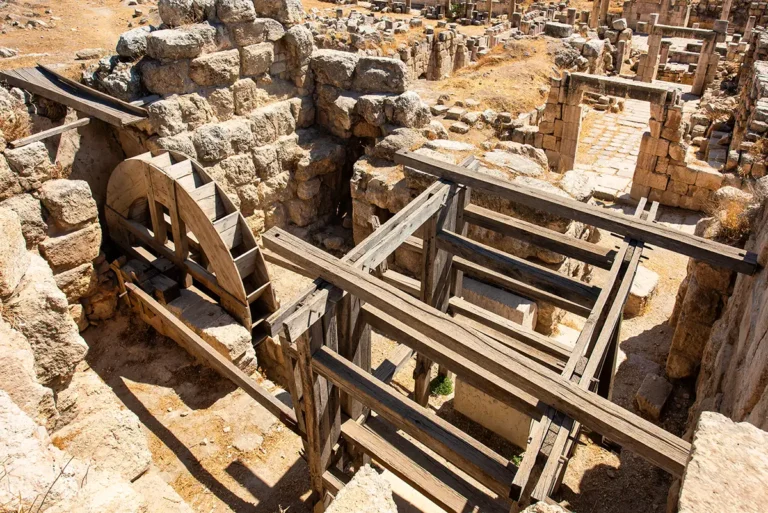
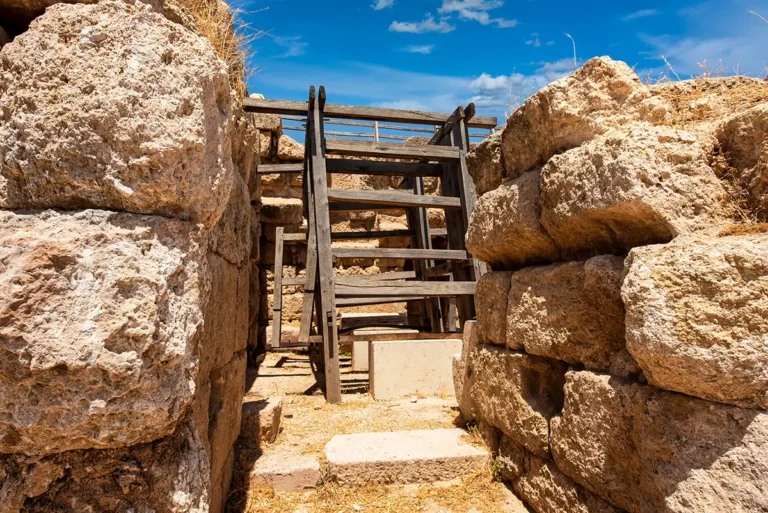
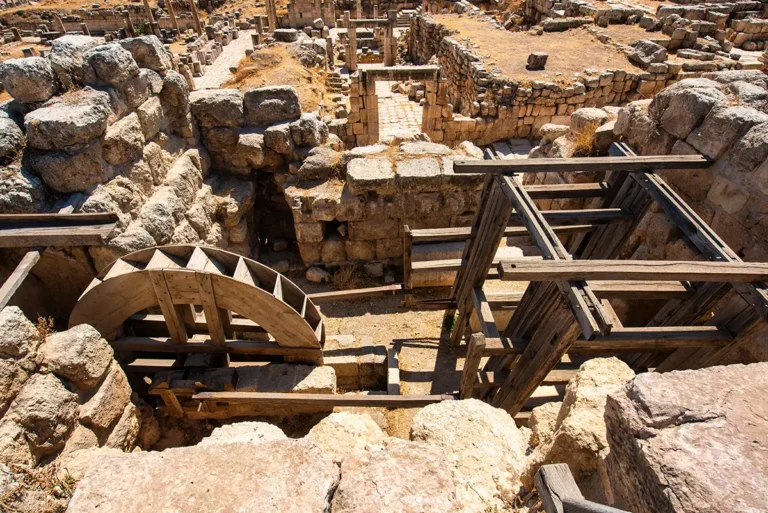
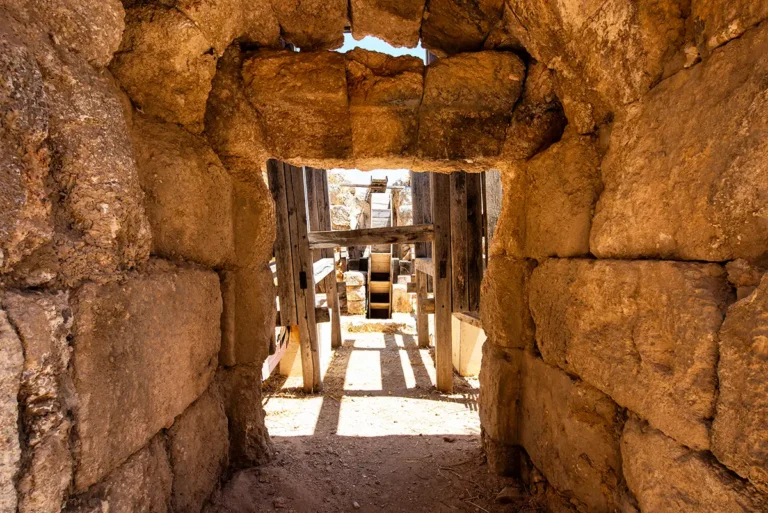
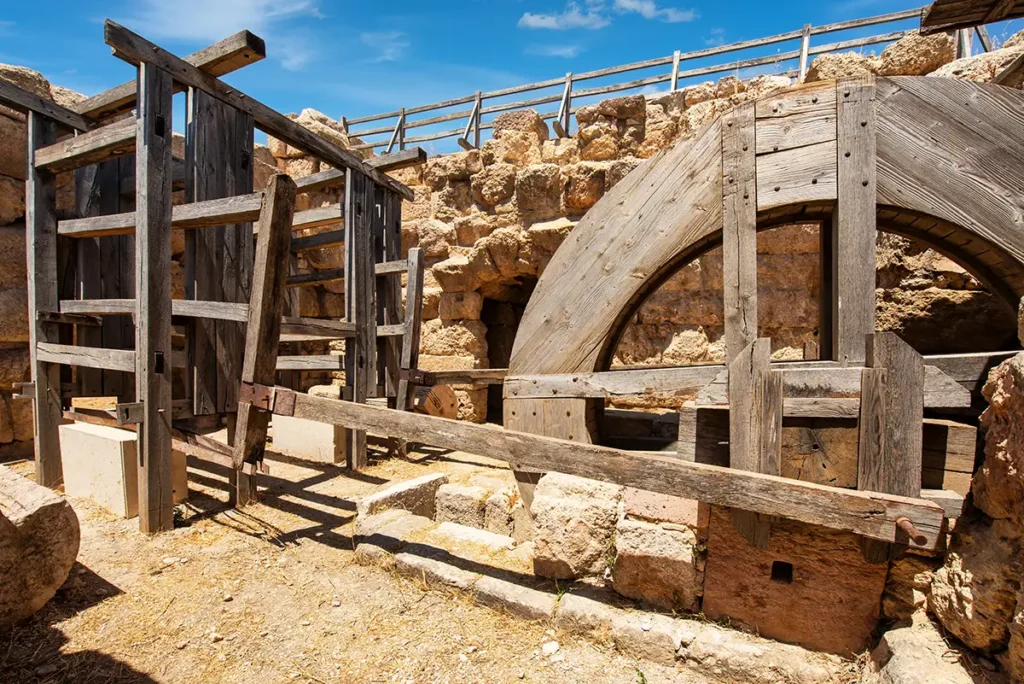
The first thing that catches your eye is the working-scale replica of the hydraulic stone saw, now installed within the underground workshop beneath the Sanctuary of Artemis. Its timber frame, waterwheel and paired saw assemblies make an otherwise difficult archaeological installation immediately understandable.
Seen beside the surviving channels, reservoirs and stone supports, the reconstruction brings the process to life: water was directed downward to turn a wheel, while a crank-and-rod system converted its circular motion into the back-and-forth movement of the saws. The replica transforms a quiet service room into one of Jerash’s most compelling examples of Byzantine engineering, revealing how water power could be harnessed to cut hard stone with impressive precision.
Where Is the Hydraulic Saw Machine?
The machine was installed in one of the underground rooms of the Sanctuary of Artemis, Jerash’s great sacred complex on the western side of the ancient city. The choice of location was practical: the sanctuary’s large-scale water infrastructure could collect, store and channel water to the workshop below.
Its position within the sanctuary also reminds visitors that ancient religious precincts were not isolated ceremonial spaces. They could contain storerooms, passages, water systems, workshops and other service areas necessary to support the life of the city.
How the Machine Worked
The machine combined carefully managed water flow with a mechanical system of saw frames.
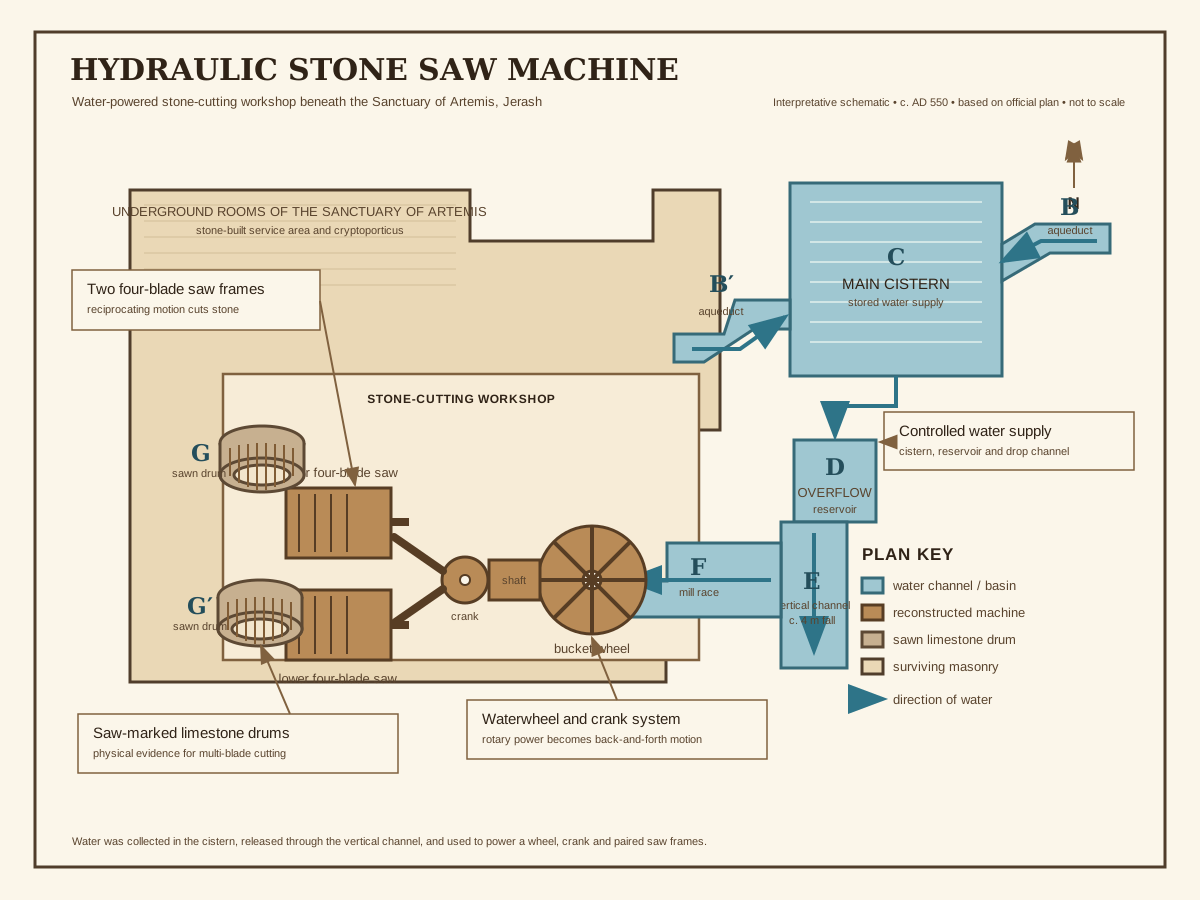
Water arrived through two aqueducts and entered a large cistern. Overflow was collected in a smaller reservoir before being released through a steep vertical channel. Falling roughly four metres, the water gained enough force to turn a bucket wheel set in a mill race below.
The wheel’s circular rotation was then transferred through a crank-and-connecting-rod mechanism. This was the essential innovation: instead of merely turning a millstone, the wheel drove a pair of saw frames back and forth. Each frame is understood to have carried four parallel blades, allowing several narrow cuts to be made at the same time.
The blades would have moved repeatedly across the stone, gradually producing slabs or architectural components. The installation therefore transformed water power into controlled, repetitive labour—an ancient version of mechanised production.
The Water System
The official plan identifies the principal parts of the installation:
Aqueducts B and B′: channels supplying water to the workshop.
Cistern C: the main reservoir, which stored the incoming water.
Reservoir D: a smaller basin collecting overflow from the cistern.
Vertical channel E: the drop through which water descended to drive the wheel.
Mill race F: the channel housing the waterwheel and its axle supports.
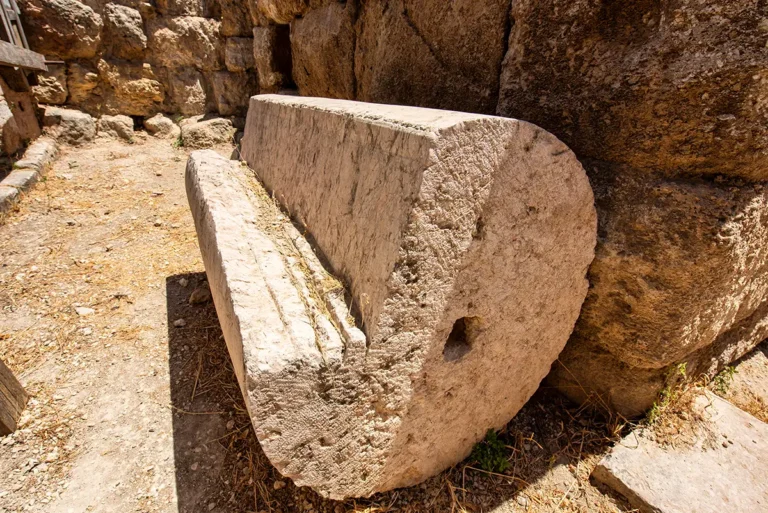
Column drums G and G′: limestone drums preserving the unmistakable parallel marks left by the saw blades.
This sequence was not accidental. The cistern stabilised the water supply, the reservoir regulated flow, and the vertical drop delivered useful force to the wheel. Together, the system shows that water management and machine design were inseparable.
The Evidence: Saw-Marked Stone
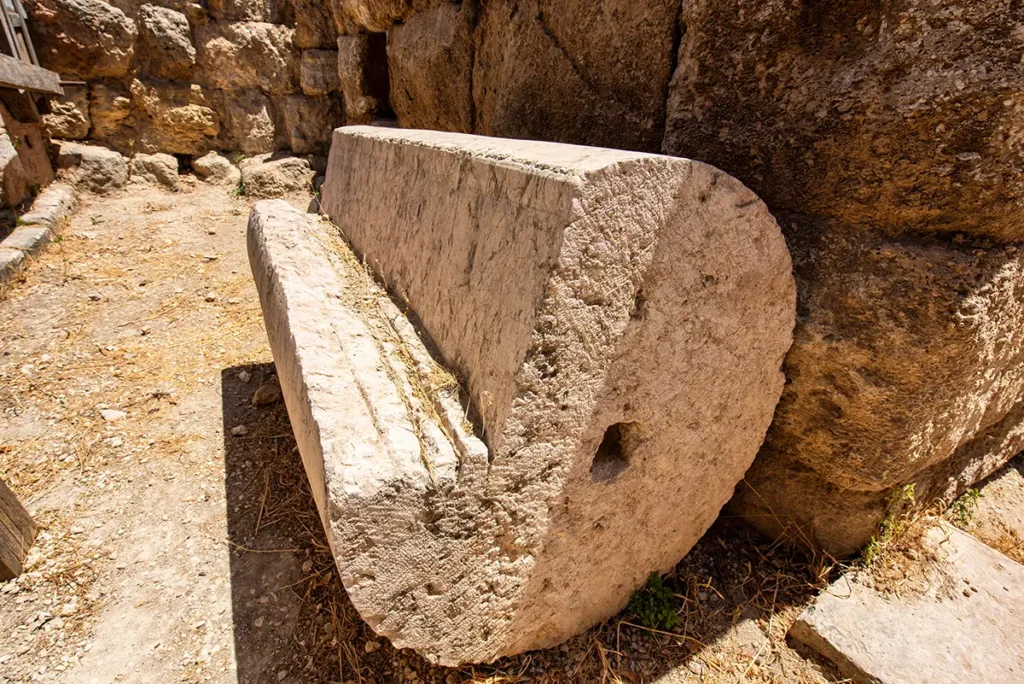
The strongest evidence for the workshop’s function comes from two hard-limestone column drums found at the site. Their surfaces preserve evenly spaced, straight parallel grooves, consistent with repeated cuts by a multi-bladed saw.
These marks are especially important because wood, iron blades and moving mechanisms rarely survive archaeologically. The column drums preserve the result of the process: stone shaped by an organised mechanical action rather than by hand tools alone.
The saw mill was excavated during early twentieth-century work at the Sanctuary of Artemis, and later study has continued to test how the installation may have operated. A modern engineering study notes that the remains include reservoirs, a mill race and the saw-marked drums, while recognising that some details of the machine’s precise performance remain open to reconstruction. Stone Sawing Machine at the Temple of Artemis in Jerash
Why the Crank Mechanism Matters
The Jerash installation is important not only because it used water power, but because it converted circular motion into reciprocal motion. A wheel turns continuously; a saw must travel back and forth. The crank-and-rod arrangement bridged that difference.
This principle lies behind many later machines. At Jerash, it was applied to an arduous task: cutting hard stone into usable architectural material. The site information board describes the hydraulic saw as the earliest machine of its kind found to date. More cautiously, the archaeological remains at Jerash are among the clearest surviving evidence for sophisticated water-powered stone sawing in Late Antiquity.
The discovery challenges the old assumption that mechanised work was primarily a medieval or modern European development. Research on the Jerash installation has emphasised its importance as material evidence for early experimentation with mechanised labour in the Roman and Byzantine Near East. Jacques Seigne’s study of the Gerasa/Jerash hydraulic sawmill
A Working Reconstruction
Because the original wheel, saw frames and wooden transmission system did not survive, archaeologists and engineers have relied on the masonry remains and saw marks to propose reconstructions. A working replica of the Byzantine saw was prepared in France and later assembled at Jerash by students from the Diderot Professional Technical School.
Such reconstructions are valuable because they turn a plan into a practical question: could the wheel provide enough power, how would the blades be guided, and how would the saw frames be raised, weighted and controlled? The reconstruction does not make every detail certain, but it helps visitors appreciate the skill required to build and operate the original machine.
The Machine and the Building of Jerash
Jerash is often admired for its monumental façades, temples, churches, baths and paved streets. The hydraulic saw adds the less visible story of production behind those monuments.
Stone blocks, columns, paving slabs and decorative components required enormous labour. A water-powered cutting machine could not replace all stonemasons, but it could make particular stages of preparation more regular and efficient. It is evidence that the city’s builders understood not only architecture, but also hydraulic engineering, motion transfer and the value of mechanising repetitive work.
What to Look For
When visiting the installation, look for:
The channels and basins that controlled the water supply.
The pronounced drop where water descended toward the wheel.
The narrow mill race and its stone supports for the wheel’s axle.
The saw-marked limestone column drums, whose parallel grooves are the workshop’s most direct testimony.
The underground setting, which places industrial activity within the wider infrastructure of the Sanctuary of Artemis.
A site plan or reconstruction image is especially helpful here. The monument becomes much easier to read once you trace the path of the water from aqueduct to cistern, wheel and saws.
Visiting the Hydraulic Stone Saw Machine Today
The hydraulic saw is a rewarding stop for visitors who want to look beyond Jerash’s famous monuments. It is less visually dramatic than the Oval Plaza or the Temple of Artemis, but historically it is one of the site’s most surprising discoveries.
Take a moment to imagine the space when it was working: water rushing through the channel, the wheel turning, wooden rods moving and eight blades cutting steadily across stone. In that small underground workshop, Jerash preserves a rare glimpse of ancient technology in action.
Why It Matters
The Hydraulic Stone Saw Machine changes the way we see Jerash. It is not a monument built for display, worship or public gathering. It is evidence of knowledge applied to work: water collected, force controlled and motion converted into production.
Among Jerash’s grand ruins, this hidden workshop offers one of the clearest reminders that the ancient city was not only beautiful—it was ingenious.
Frequently Asked Questions
It was used to cut large limestone blocks and architectural elements into more regular pieces, slabs or sections for construction.
The installation is generally dated to around AD 550, in the mid-sixth century Byzantine period.
The reconstructed arrangement consists of two saw frames, each carrying four blades—eight blades in total.
No. It was powered by falling water that turned a bucket wheel.
It is a device that changes circular movement, such as the rotation of a waterwheel, into back-and-forth movement. At Jerash, this motion drove the saw frames.
The wooden wheel, saw frames and blades have not survived. What remains are the stone-built hydraulic installation and saw-marked limestone column drums.
It is rare archaeological evidence for advanced water-powered stone cutting in Late Antiquity and demonstrates that sophisticated mechanised work was practised in the Byzantine Near East.
Key Moments in History
c. AD 550 — Hydraulic sawmill installed: A water-powered stone-cutting machine was built in an underground room of the Sanctuary of Artemis. Water from the sanctuary’s supply system drove a bucket wheel and two four-bladed saw frames.
6th century — Stone-cutting workshop in operation: The machine cut hard limestone blocks and column drums. Parallel saw marks preserved on two surviving drums provide the clearest evidence for its function.
Key Moments in History
c. AD 550 — Hydraulic sawmill installed: A water-powered stone-cutting machine was built in an underground room of the Sanctuary of Artemis. Water from the sanctuary’s supply system drove a bucket wheel and two four-bladed saw frames.
6th century — Stone-cutting workshop in operation: The machine cut hard limestone blocks and column drums. Parallel saw marks preserved on two surviving drums provide the clearest evidence for its function.
Late Byzantine period — Workshop falls out of use: The installation was eventually abandoned, while its wooden wheel, saw frames and mechanical parts decayed or disappeared. Its stone-built water system remained.
1920s–1930s — Archaeological discovery: Excavations in the Sanctuary of Artemis uncovered the channels, reservoirs, mill race and saw-marked stone drums, identifying the space as an ancient hydraulic sawmill.
2000s — Research and reconstruction: Archaeologists and engineers developed detailed reconstructions to understand how the wheel, crank-and-rod mechanism and multi-bladed saws could have worked.
Today — Replica installed on site: A full-scale replica now stands in the workshop, helping visitors visualise one of the most remarkable surviving examples of water-powered stone cutting from Late Antiquity.