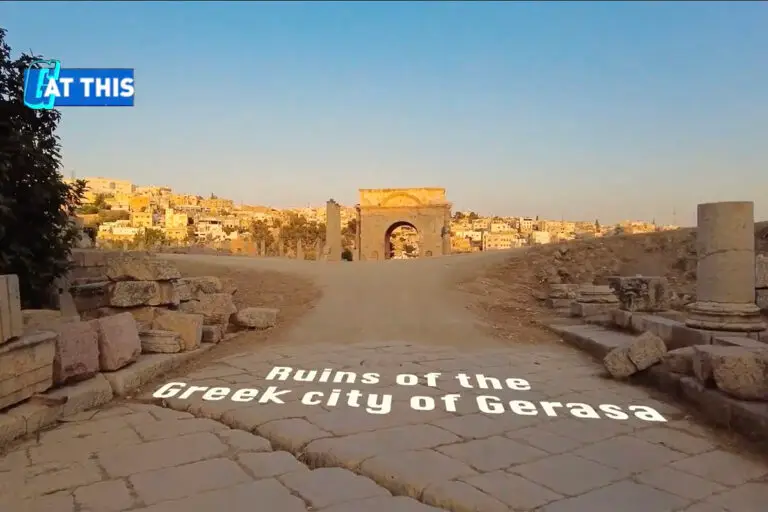

Away from the dramatic temples, theatres and monumental gates of Jerash lies a quieter but equally revealing part of ancient Gerasa: its civic complex. Comprising the Agora and the Civic Basilica, and closely associated with the nearby North Theatre, this large area formed the administrative and public heart of the Roman city.
Here, citizens could meet in the open air, officials could conduct public business, cases could be heard, and civic records may have been kept. The surviving remains are less complete and less visually theatrical than the Oval Plaza or the Temple of Artemis, but they help explain how Jerash functioned as a living city. This was not a place built primarily for spectacle or worship; it was where civic life was organised.
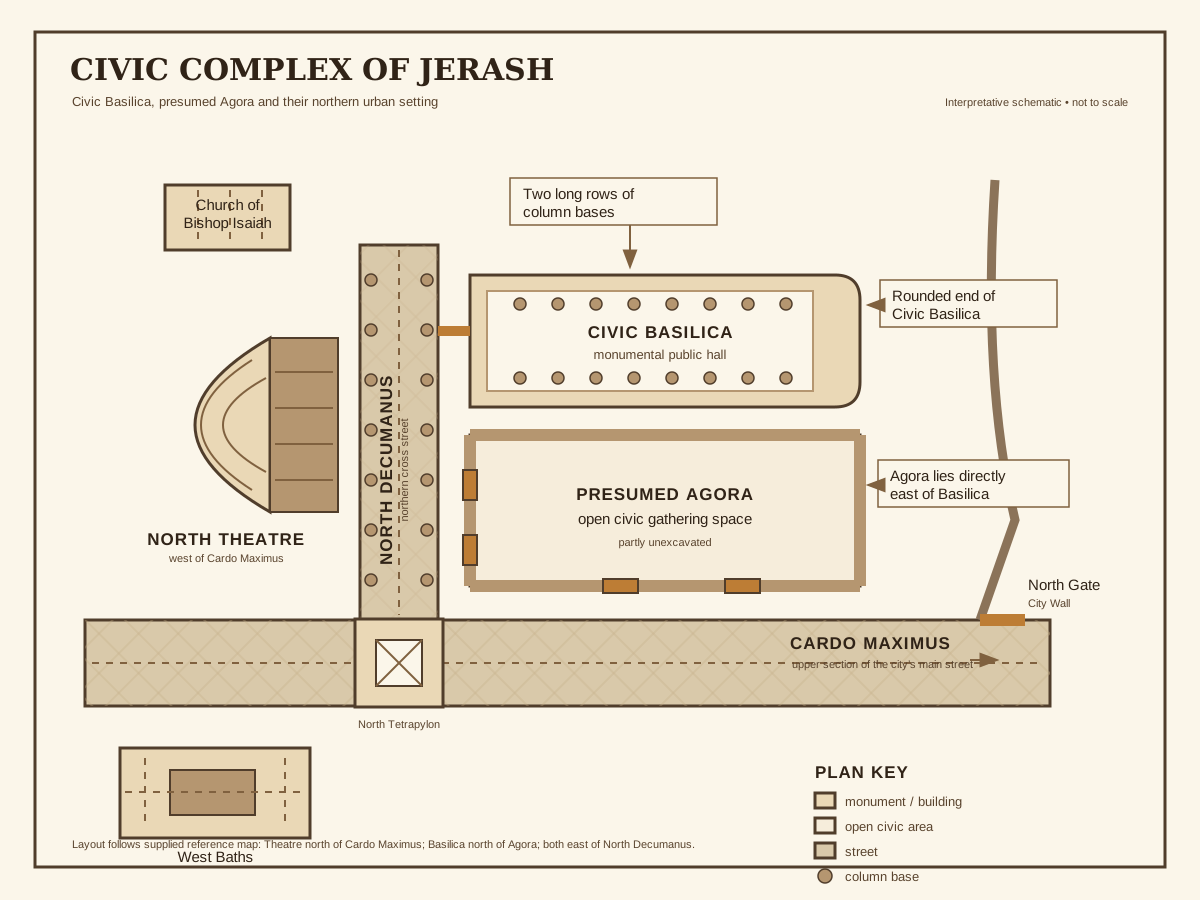
Although much of the complex remains unexcavated, its position at the junction of the Cardo Maximus and North Decumanus, its immense scale, and its direct relationship with the North Theatre make its importance unmistakable.
The Civic Complex at a Glance
Location: Jerash Archaeological Park, Jordan (at the north end of the Cardo Maximus, near the North Decumanus and opposite the North Theatre)
Built date: Probably planned under Trajan and constructed under Hadrian, c. 130 AD
Purpose: Civic assemblies, administration, legal activity, commercial and social exchange
- Main elements: Open agora, monumental civic basilica
- Basilica size: More than 100 metres long and over 30 metres wide
- Associated monument: North Theatre, probably first used as a bouleuterion or council chamber
- Street connection: Entrances from the Cardo and North Decumanus
- Nearby monuments: North Theatre, Church of Bishop Isaiah, North Decumanus, North Tetrapylon, Cardo Maximus
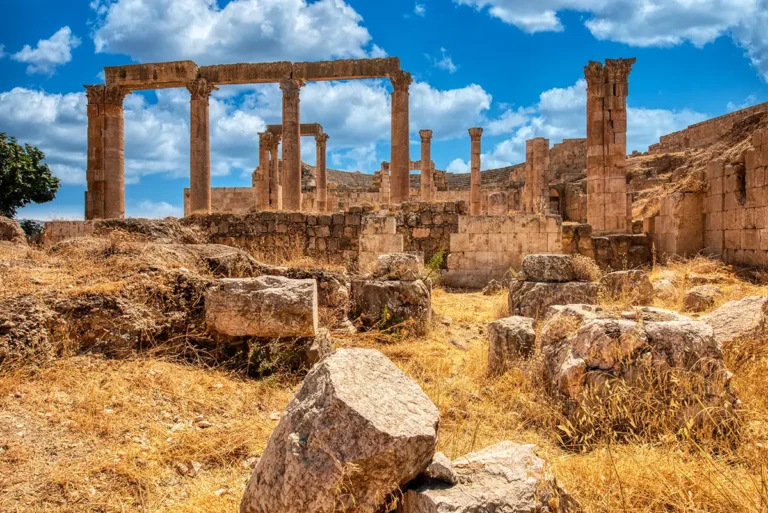
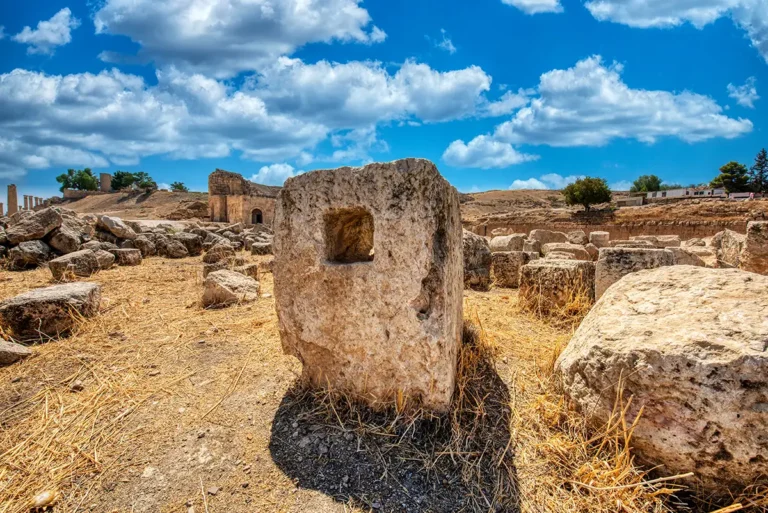
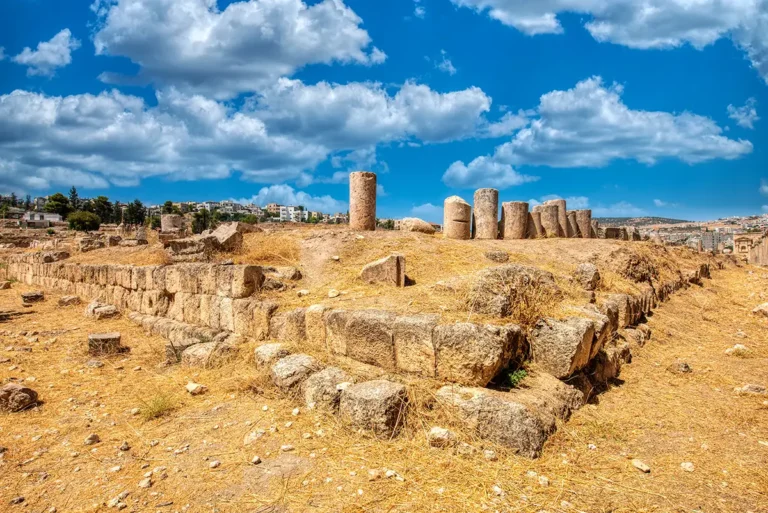
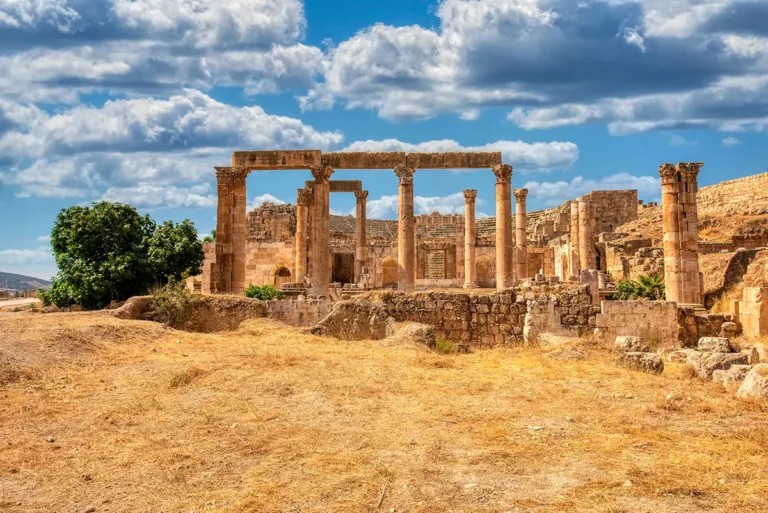
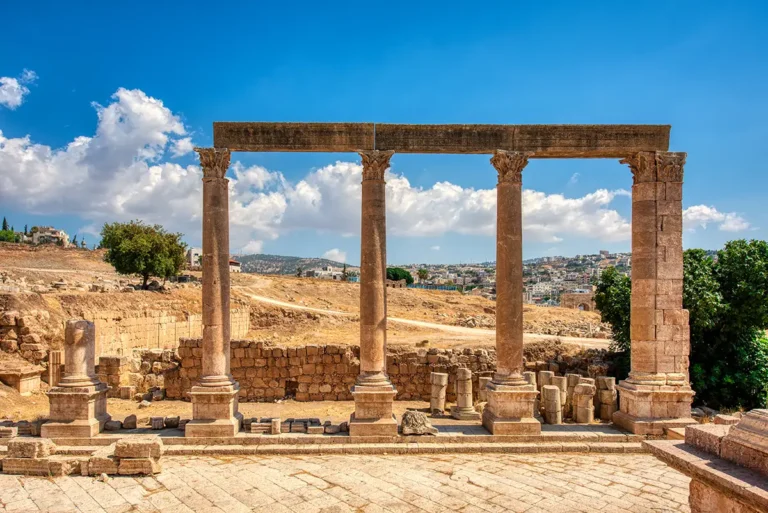
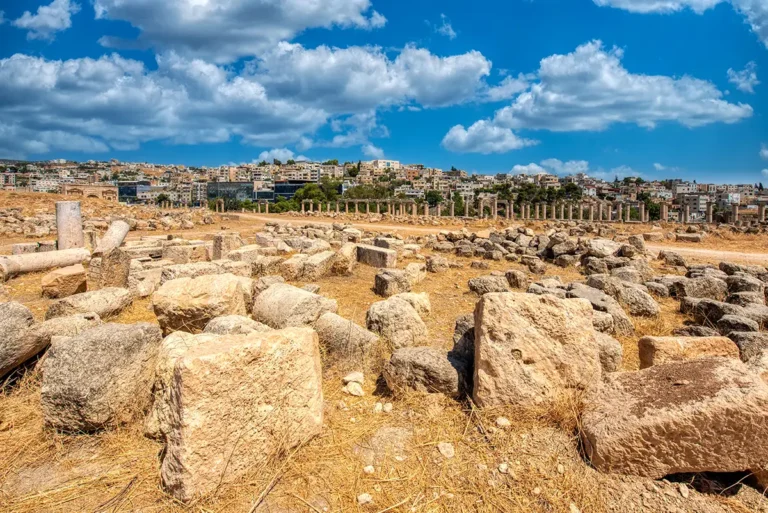
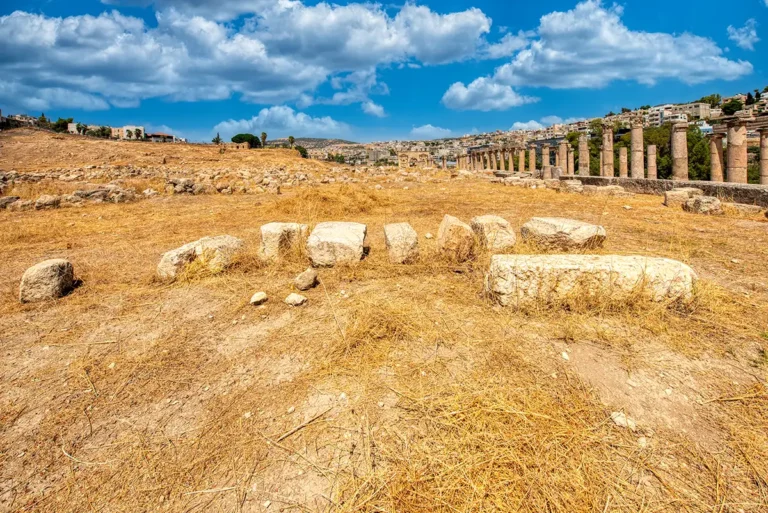
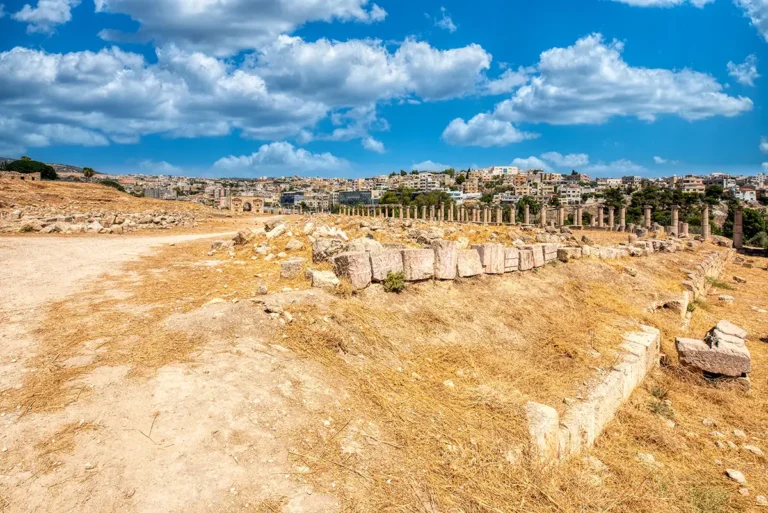
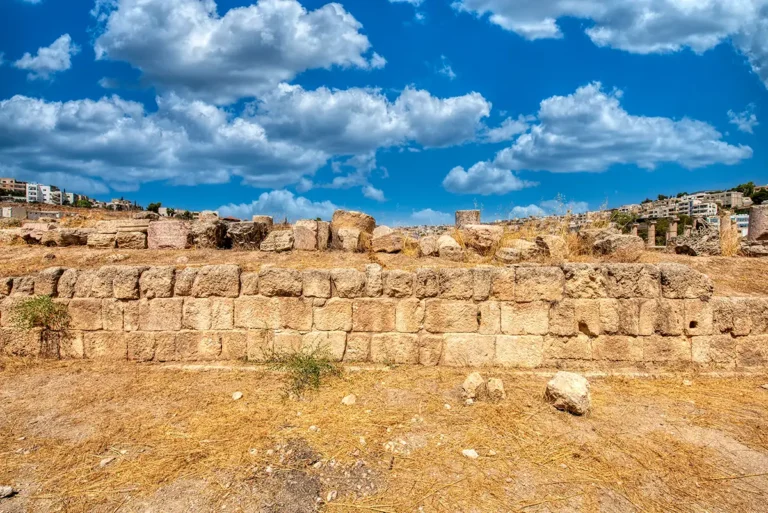
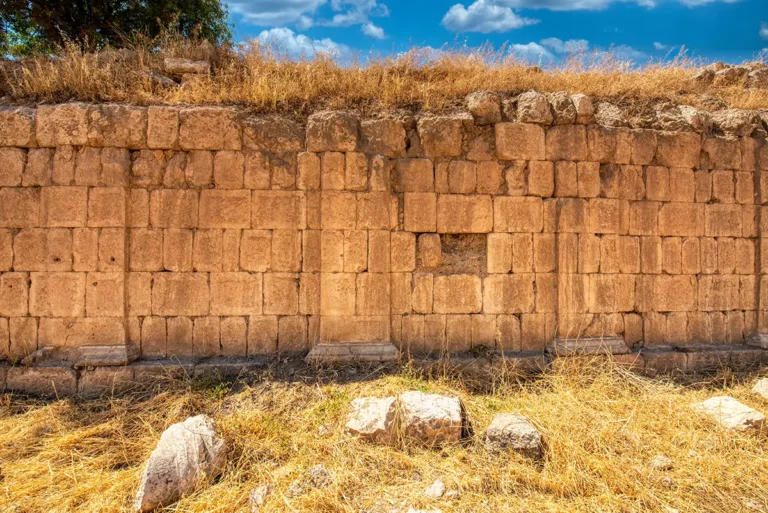
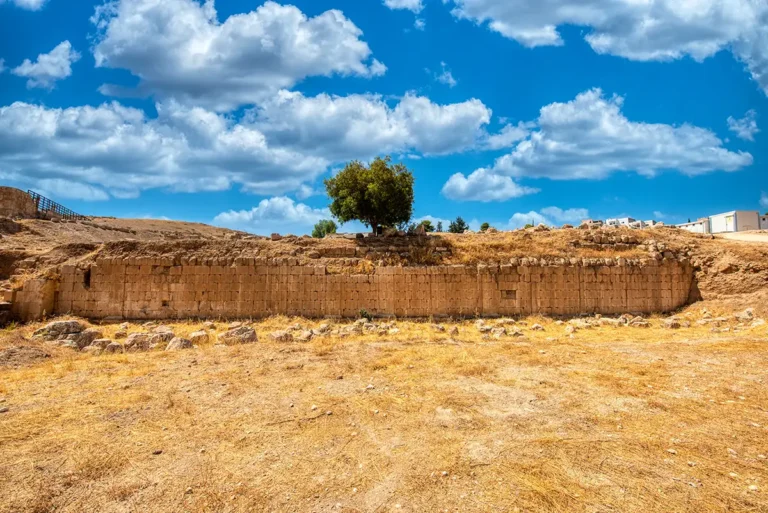
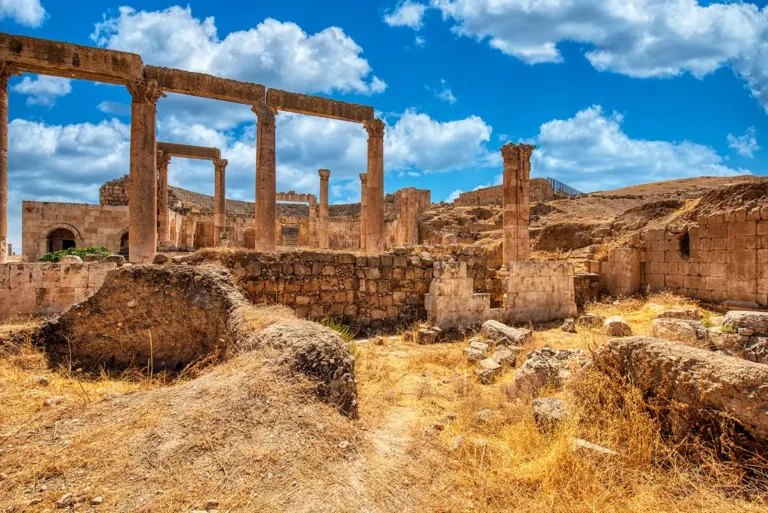
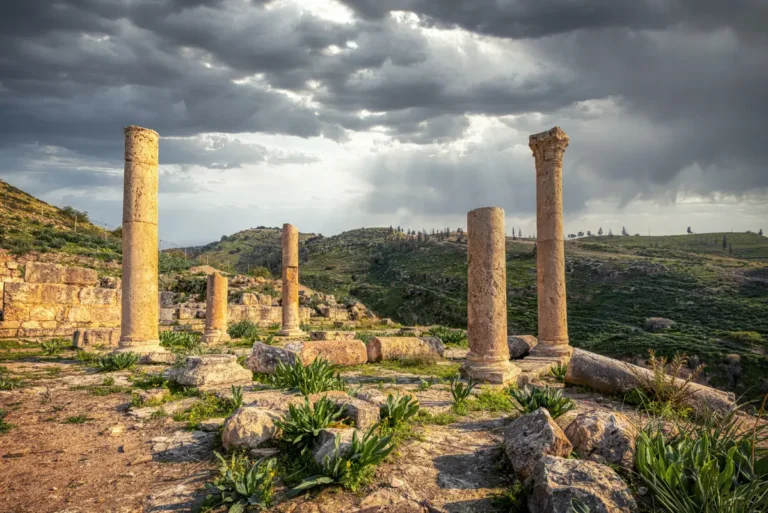
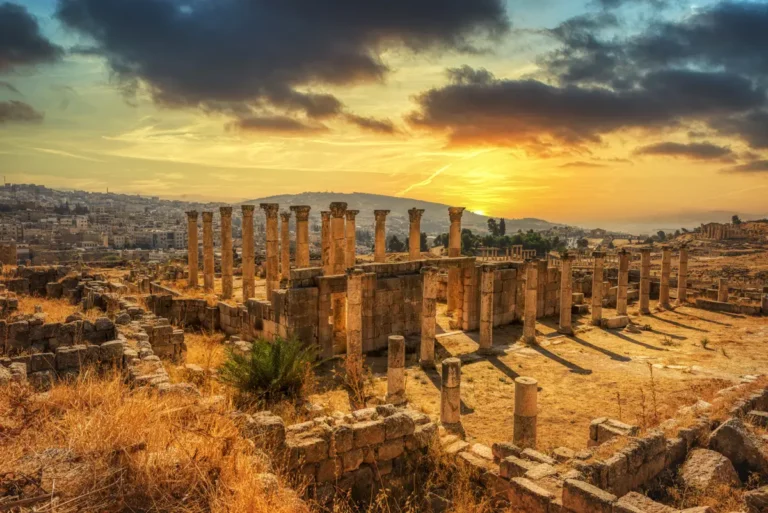
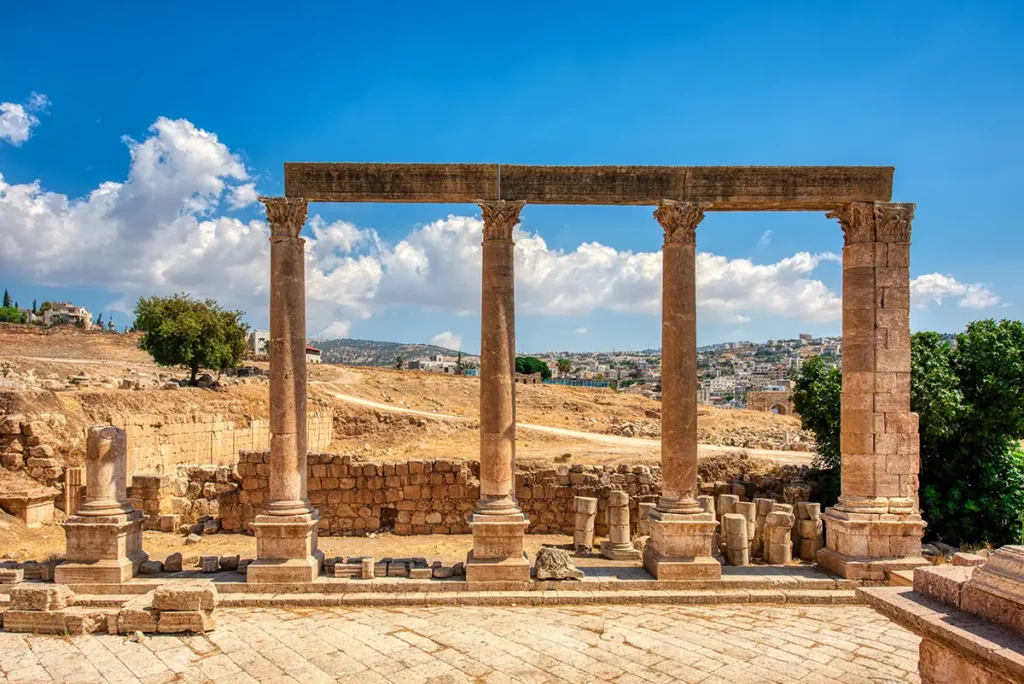
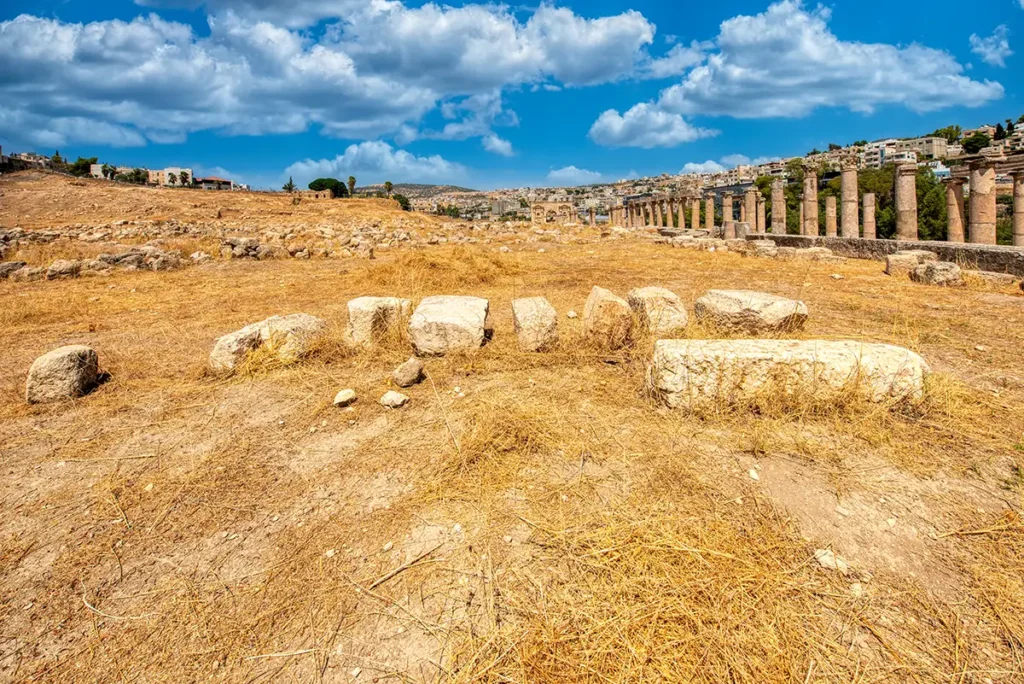
- What survives: A long basilica wall, two rows of column bases, the broad open area of the agora, street connections and surrounding ruins.
First Impressions
The Civic Complex does not announce itself with a towering façade. Instead, it reveals its scale gradually. Standing near the North Theatre and looking across the broad, open ground, it becomes clear that this was one of the largest planned public spaces in ancient Jerash. The Cardo runs beside it, the North Decumanus crosses nearby, and the theatre faces it from across the street—a carefully arranged urban setting rather than a collection of isolated monuments.
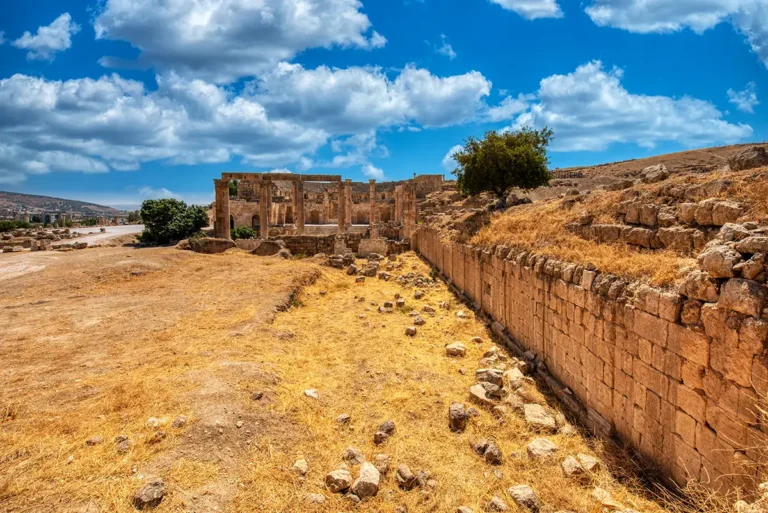
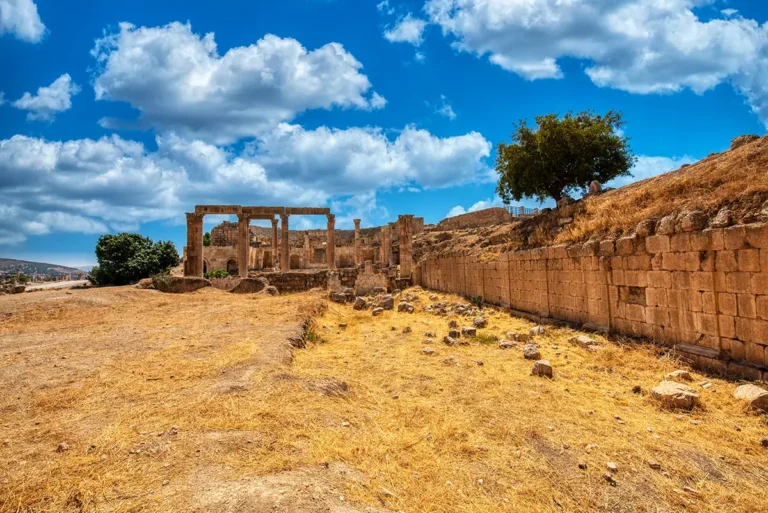
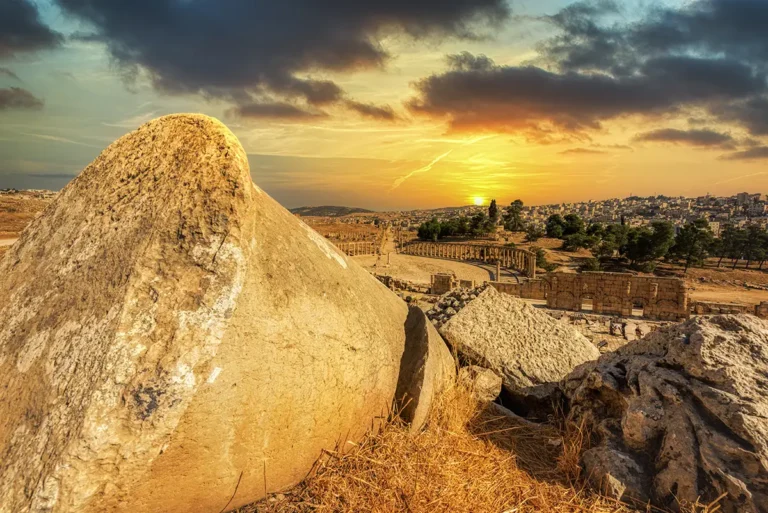
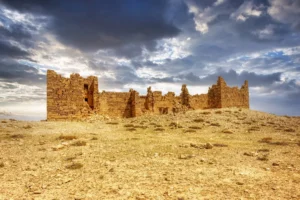
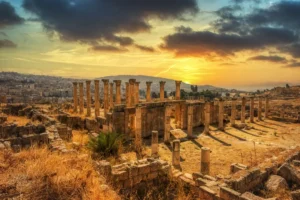
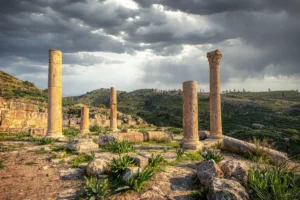
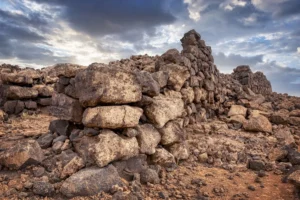
The most striking surviving feature is the enormous wall of the Civic Basilica. Its length gives a sense of the building’s original ambition, while two extended rows of column bases outline the vast hall that once stood beside the agora. The remains may appear sparse, but the footprint is powerful: this was a building on the scale of a major public institution, not an ordinary commercial hall.
Because the complex has not been fully excavated, visiting it also requires imagination. That is part of its appeal. You are looking at the framework of a civic district whose public life once filled the open square, covered halls, streets and theatre opposite.
Where Is the Civic Complex?
The Agora and Civic Basilica occupy a key position in northern Gerasa. They lie beside the upper Cardo Maximus and close to the North Decumanus, one of the city’s principal east–west streets. The North Theatre stands directly opposite the basilica, creating an impressive civic grouping at the crossroads.
This location was deliberate. A Roman city’s main streets did more than carry people from one monument to another: they connected spaces of worship, trade, administration, entertainment and social life. In Jerash, the Civic Complex stood where these functions could meet.
For visitors walking north along the Cardo from the Nymphaeum and North Tetrapylon, the complex appears shortly before the North Gate. It is easy to pass through quickly on the way to the theatre or gate, but it deserves a pause. This is one of the best places to understand the city as an organised civic landscape.
The Civic Heart of Roman Gerasa
Roman cities needed spaces for formal public life. Temples served the gods; theatres hosted performances and civic gatherings; markets supplied goods; baths supported health and sociability. The agora and basilica supported another essential function: the running of the city itself.
The Agora was an open public square where citizens could gather, meet, debate, transact business and observe civic activity. The Civic Basilica was a vast covered hall, flexible enough to accommodate official meetings, legal proceedings, administrative work and commercial dealings. It may also have contained or protected official archives.
Together with the nearby North Theatre—probably constructed initially as a bouleuterion, or council chamber—the agora and basilica created a civic centre comparable to those found across the Greco-Roman world. Jerash was not simply a prosperous provincial city adorned with monuments; it had the institutions, spaces and urban planning expected of a self-governing city of the Roman East.
The Agora: Jerash’s Open-Air Public Square
The word agora comes from the Greek tradition of the public gathering place. In a city such as Gerasa, it was a space where social, commercial and civic activity could overlap. It was not simply a market in the modern sense, though trade and exchange would naturally have taken place around it.
Jerash’s agora was accessible from several directions. Three entrances led from the Cardo Maximus, while another opened from the North Decumanus. This multiple-access design made the square highly connected to the city’s circulation network. A resident approaching along the Cardo, a visitor arriving from the east or west, and an official coming from the theatre district could all enter the same civic space.
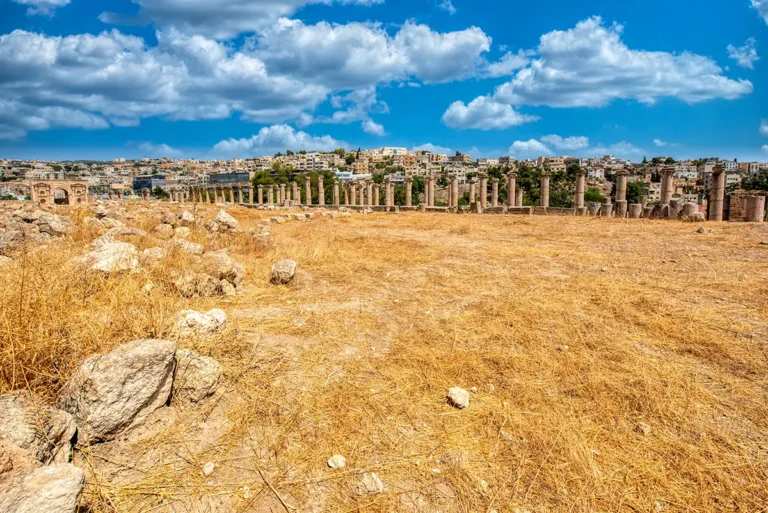
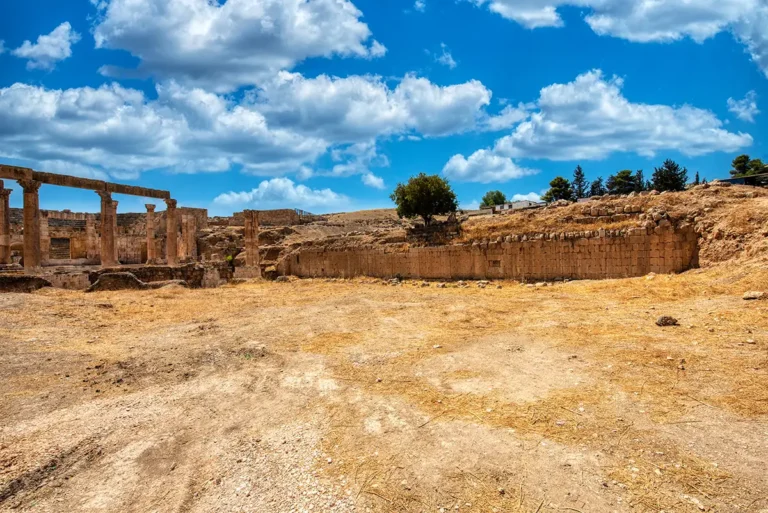
Today, the agora is not fully excavated, and its precise architectural detail remains uncertain. What survives most clearly is the scale of the open area and its relationship with the adjacent basilica and theatre. The absence of complete reconstruction should not be mistaken for a lack of importance. On the contrary, the size of the space suggests that it was intended to accommodate a substantial part of the city’s public life.
The Civic Basilica: A Monumental Public Hall
The Civic Basilica was one of the largest secular buildings in Jerash. Its hall stretched for more than 100 metres and was over 30 metres wide. Two long rows of column bases indicate the internal arrangement of the structure, probably dividing the immense hall into a central nave-like space and side aisles.
Despite the name, this was not originally a Christian church. In Roman architecture, a basilica was a large, multi-purpose public hall. It could host judicial hearings, business negotiations, official announcements, administrative procedures and civic meetings. The form later became influential in Christian church architecture, which is why the word “basilica” is now often associated with churches.
The basilica stood next to the agora and faced the North Theatre across the North Decumanus. This arrangement brought the city’s major civic functions together:
the open square for public gathering;
the covered basilica for administration and legal business;
the theatre or bouleuterion for council meetings and civic assemblies;
the Cardo and Decumanus for movement through the city.
The surviving wall remains one of the clearest visual clues to the building’s original scale. Stand beside it and look along the line of column bases: the sheer length of the hall becomes easier to grasp.
Architectural Design and Features
The Four Corner Podiums
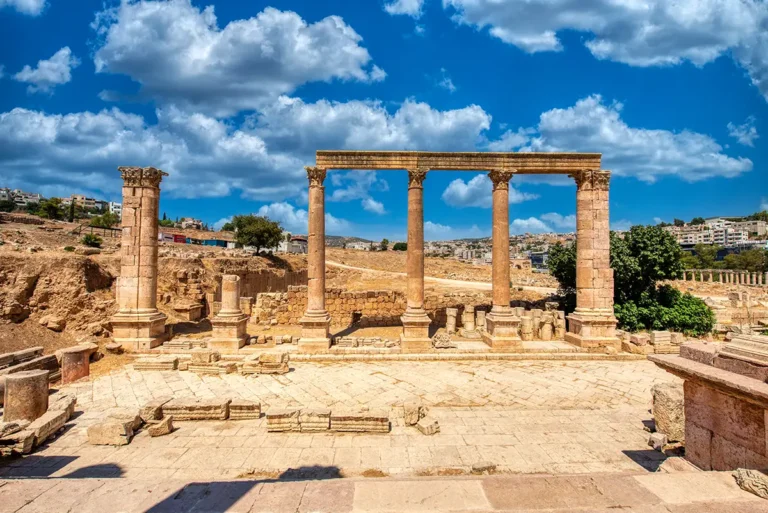
The Civic Basilica was designed on a monumental rectangular plan. Its great length, broad interior and columned arrangement made it suitable for large gatherings while creating a dignified setting for official business. The two rows of bases visible today show where the internal colonnades once stood, supporting the roof and structuring the hall.
The Agora, by contrast, was an outdoor urban space. Its importance depended less on a single building than on accessibility, visibility and location. Open to the Cardo on three sides and to the North Decumanus on another, it was integrated into Jerash’s street plan rather than secluded from it.
The civic district also demonstrates the sophistication of Roman urban planning in Jerash. Major monuments were positioned not only for beauty but for function. Streets provided access; public buildings framed activity; and the theatre, basilica and square reinforced one another as parts of a coherent civic centre.
A Civic Centre Linked to the North Theatre
The North Theatre is central to understanding the Civic Complex. Although it later functioned as an odeon for performances, inscriptions and architectural evidence suggest that it was originally associated with civic gatherings and the city council. Its proximity to the agora and basilica was therefore no coincidence.
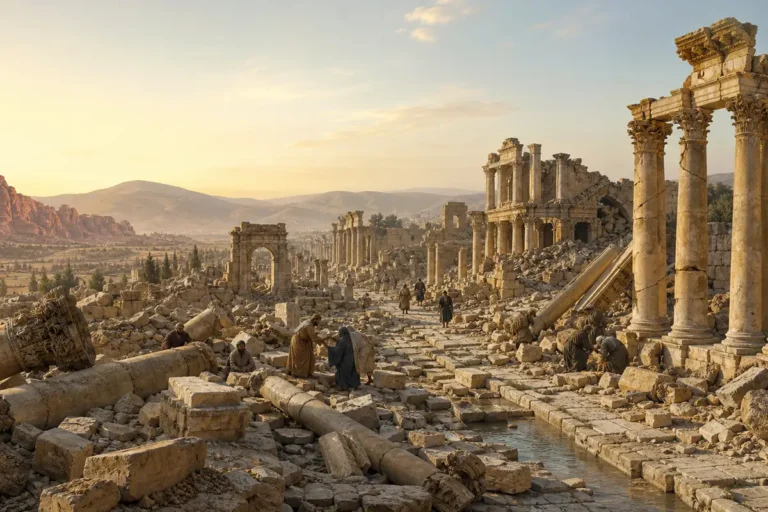
Imagine the area in the 2nd century AD. Citizens might assemble in the agora before a public announcement. Council members could meet in the theatre. Magistrates, petitioners and witnesses could enter the basilica for hearings. Merchants and visitors would pass along the Cardo or North Decumanus. The district would have been busy with movement, conversation and formal civic ritual.
This relationship makes the Civic Complex particularly valuable for visitors who want to look beyond individual ruins. The basilica, agora and theatre form one urban story: the machinery of city government in Roman Gerasa.
Everyday Life in the Civic Complex
The ruins make it easy to focus on architecture, but the real significance of the Civic Complex lies in the people who used it.
Here, city councillors may have debated local policy. Magistrates could have heard disputes. Property matters, contracts, taxes and public works may have been discussed or recorded. Visiting traders, local landowners, craftsmen, messengers and ordinary citizens would have moved through the agora, met acquaintances and waited for official decisions.
The basilica offered shade and shelter from weather, while the square allowed gatherings on a larger scale. In a city as prosperous as Roman Gerasa, such a district would have been a daily point of contact between the governing institutions and the people they served.
This is also why the complex should not be understood only as an “administrative zone.” It was social. Public life in a Roman city was highly visible. Politics, justice, commerce, reputation and conversation happened in public, often in the same spaces.
Construction in the 2nd Century AD
The Agora and Civic Basilica were probably conceived during the reign of Emperor Trajan and built during the reign of Hadrian, around AD 130. This was a period of major expansion and monumental construction at Jerash, when the city developed many of the buildings and streets visitors see today.
The proposed date fits the wider transformation of Gerasa into a major Roman provincial city. During the 2nd century, its civic, religious and commercial infrastructure expanded dramatically: streets were collonaded, sanctuaries enlarged, theatres developed and public monuments built on an ambitious scale.
The Civic Complex was therefore part of a broader statement. It showed that Gerasa possessed not only wealth and religious importance but also a functioning civic identity—a city with public institutions, urban planning and an active citizen body.
Destruction and Decline
Archaeological evidence suggests that the basilica and agora were damaged or destroyed by a major fire toward the end of the 3rd century AD. Charred remains found in the area have been linked to a violent episode, possibly involving raiding or looting during a period of regional instability.
The exact circumstances remain uncertain, and caution is necessary. Ancient destruction layers do not always identify the people responsible. What is clear is that the original civic complex did not retain its early Roman form indefinitely.
By Late Antiquity, the focus of urban life in Jerash was changing. Christian churches, new institutions and altered patterns of movement reshaped the city. Some streets and buildings continued in use, while others were adapted, reduced or abandoned. The civic centre’s earlier importance did not disappear overnight, but its role gradually changed as Gerasa evolved from a Roman city into a Byzantine and then early Islamic settlement.
Rediscovery and Archaeology
The Civic Complex remains one of the more intriguing areas of Jerash because much of it is still unexcavated. Archaeologists have identified the main components and recognised their relationship, but large parts of the agora and basilica have not been fully exposed.
This creates an important distinction for visitors: the complex is not a fully restored monument, and some interpretations remain provisional. The open space is identified as an agora and the long hall as a basilica because of their plan, location and relationship with the North Theatre. These interpretations are strongly supported, but further excavation may refine our understanding.
Rather than reducing its value, this unfinished archaeological picture makes the site especially interesting. It offers a glimpse of how archaeology works: large-scale urban history is often reconstructed from walls, foundations, column bases, streets, inscriptions and patterns of space.
What to Look For
When visiting the Civic Complex, look beyond the individual blocks of stone and focus on the layout.
The long basilica wall: This is the clearest surviving indicator of the hall’s vast scale.
Rows of column bases: Follow their alignment to visualise the basilica’s long interior.
The open ground of the agora: Think of it as a public square rather than an empty archaeological field.
Entrances from the Cardo: These reveal how the agora connected directly with the city’s main north–south street.
The North Decumanus: Notice how the civic district opened onto this major east–west route.
The North Theatre opposite: Together with the agora and basilica, it completes the picture of Jerash’s civic centre.
The North Tetrapylon and North Gate nearby: These show how the district was integrated into the northern end of the city.
How to Visit the Civic Complex
The easiest approach is to walk north along the Cardo Maximus. After passing the Nymphaeum, at the North Tetrapylon, turn left to the North Decumanus. The Civic Basilica and Agora occupy the open area beside the street and across the North Theatre.
Allow at least 15 to 25 minutes if you want to walk around the remains, study the basilica wall and combine the visit with the North Theatre. The site is especially rewarding if you have already visited the theatre, because the civic relationship between the monuments becomes immediately clear.
As with much of Jerash, there is limited shade. Visit earlier or later in the day in warmer months, bring water, and wear shoes suitable for uneven paving and ground.
Why the Civic Complex Matters
The Agora and Civic Basilica show another side of Jerash. The city is famous for its temples, theatres and colonnaded streets, but these monuments alone do not explain how Gerasa was governed. The Civic Complex does.
It reveals a Roman city built around institutions as well as ceremony: a place where citizens assembled, councils met, legal issues were addressed and public administration was carried out. Its relationship with the North Theatre, Cardo and North Decumanus makes it one of the clearest surviving examples of civic planning in Jerash.
Even in its partially excavated state, the site rewards visitors willing to slow down. It is a place to imagine not a procession or performance, but the ordinary business of an ancient city.
Frequently Asked Questions
No. The Civic Basilica was originally a Roman public building, probably used for administration, law courts, meetings and other civic activities. The later Christian use of the word “basilica” comes from this Roman architectural form.
The Agora was an open-air public gathering space. Citizens could meet, conduct business, hear announcements, exchange news and take part in civic life.
No. Much of the area remains unexcavated. The identification of the open space as an agora is based on its location, scale, access points and relationship with the Civic Basilica and North Theatre.
The main hall was more than 100 metres long and over 30 metres wide, making it one of the largest public buildings in ancient Jerash.
The North Theatre probably began as a bouleuterion, or council chamber. Together with the Agora and Civic Basilica, it formed the city’s main civic centre.
Evidence of burning suggests that the original complex was badly damaged or destroyed in the late 3rd century AD. Its role then changed as the city developed through the Byzantine and early Islamic periods.
Key Moments in History
c. AD 106: Gerasa becomes part of the Roman province of Arabia, encouraging new investment in the city’s streets, public buildings and civic institutions.
Early 2nd century AD: The northern sector of the city is planned as a formal civic district around the main streets.
Key Moments in History
c. AD 106: Gerasa becomes part of the Roman province of Arabia, encouraging new investment in the city’s streets, public buildings and civic institutions.
Early 2nd century AD: The northern sector of the city is planned as a formal civic district around the main streets.
c. AD 130: The Agora and Civic Basilica are probably designed under Emperor Trajan and built or completed under Hadrian.
2nd century AD: The vast open Agora becomes a place for public gathering, meetings and daily civic exchange. Three entrances connect it with the Cardo Maximus, while another opens from the North Decumanus.
2nd century AD: The Civic Basilica serves as a monumental public hall for official assemblies, legal discussions, administration and perhaps the storage of city archives.
2nd century AD: Together with the nearby North Theatre—probably first used as a bouleuterion or council chamber—the Agora and Basilica form the administrative heart of Roman Gerasa.
Late 2nd century AD: The North Theatre is adapted for performances as an odeon, while remaining closely linked to the civic district across the street.
Late 3rd century AD: Evidence of burning suggests that the Civic Basilica and Agora are severely damaged or destroyed by a violent fire, possibly during a period of raiding and instability.
4th–6th centuries AD: As Jerash develops into a Christian city, the importance of the old Roman civic centre declines and urban activity increasingly shifts toward new religious and neighbourhood centres.
Modern era: Archaeological work identifies the open space as the presumed Agora and the long, columned hall as the Civic Basilica. Much of the complex remains unexcavated, leaving further discoveries possible.