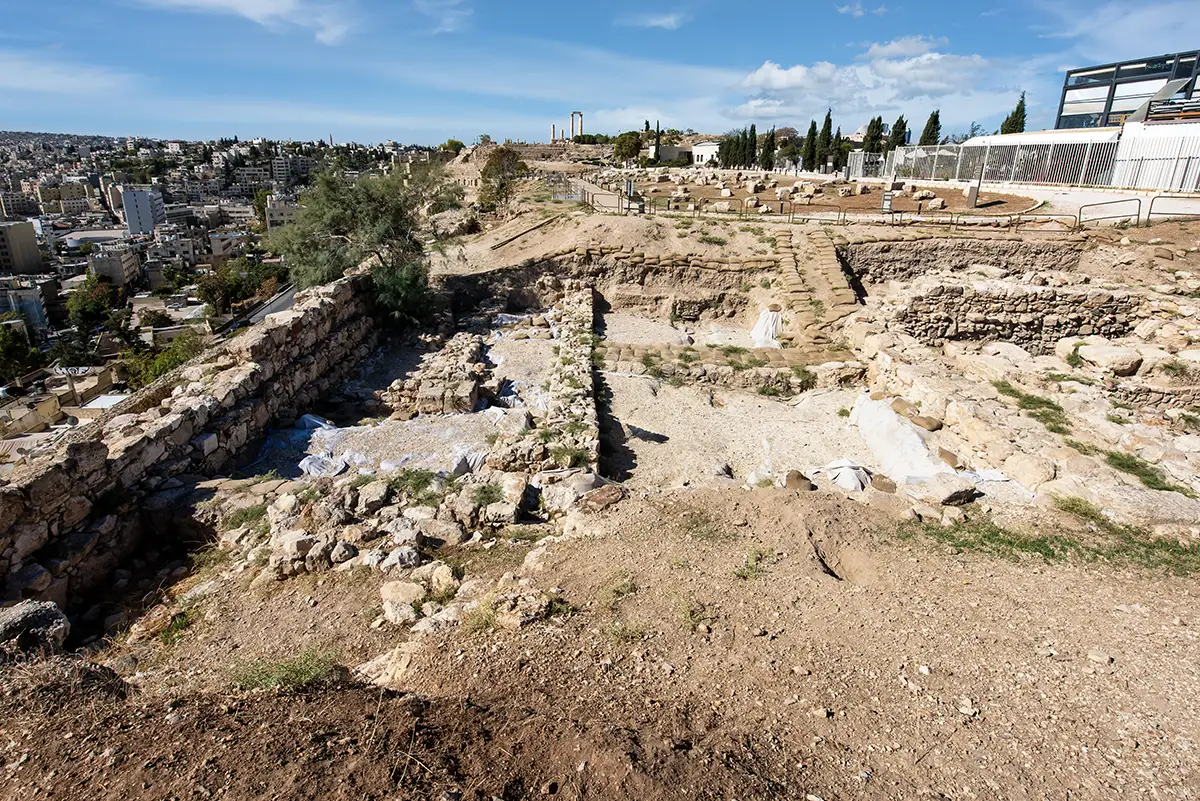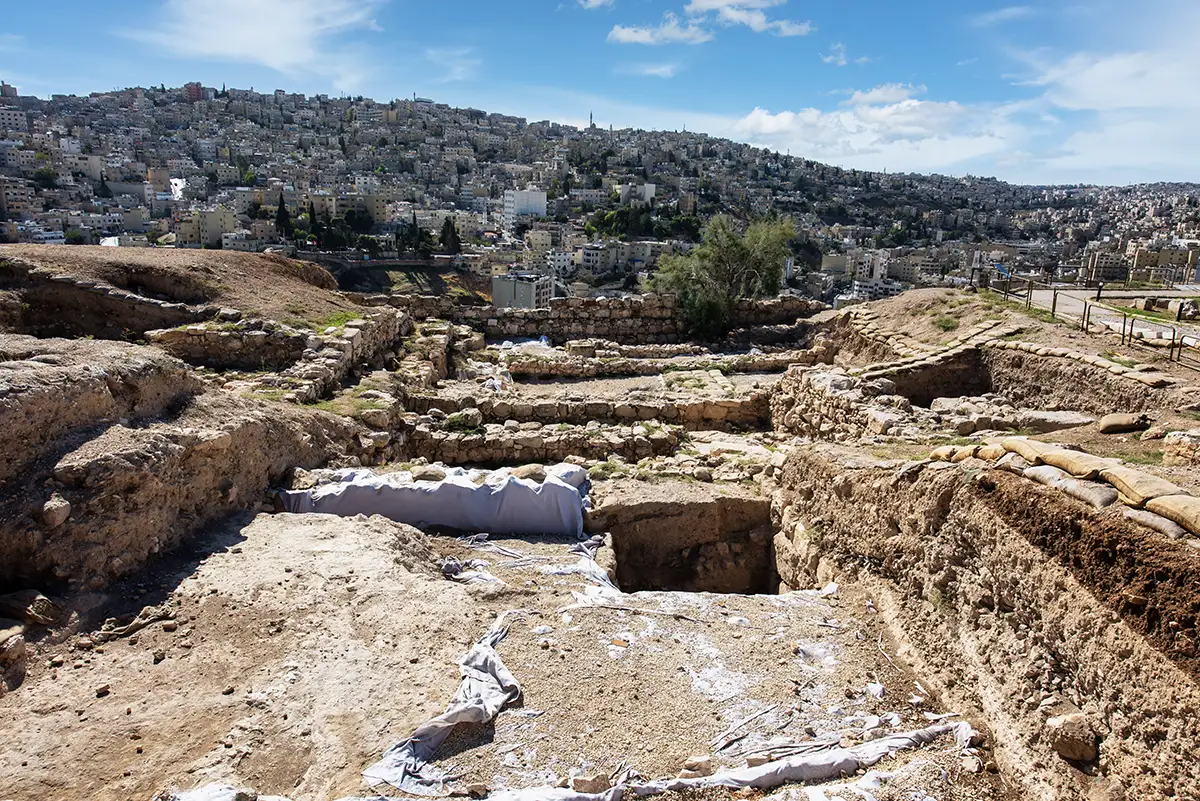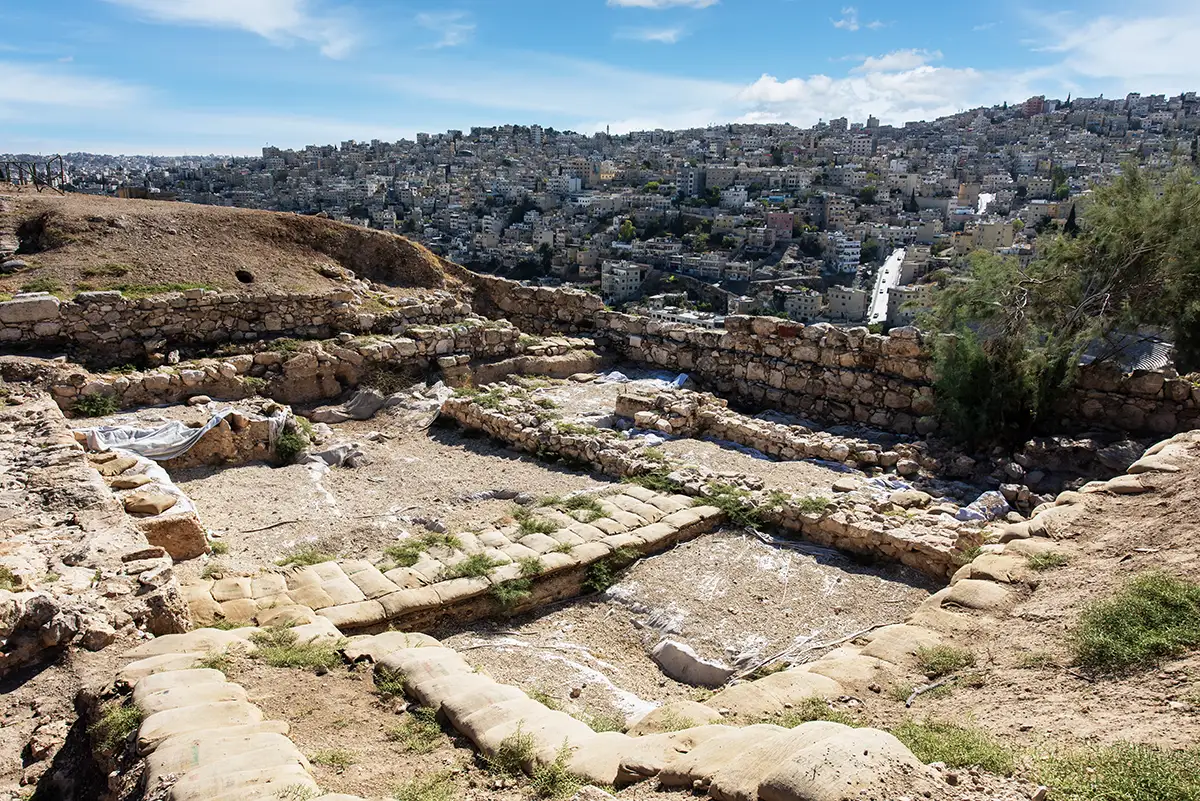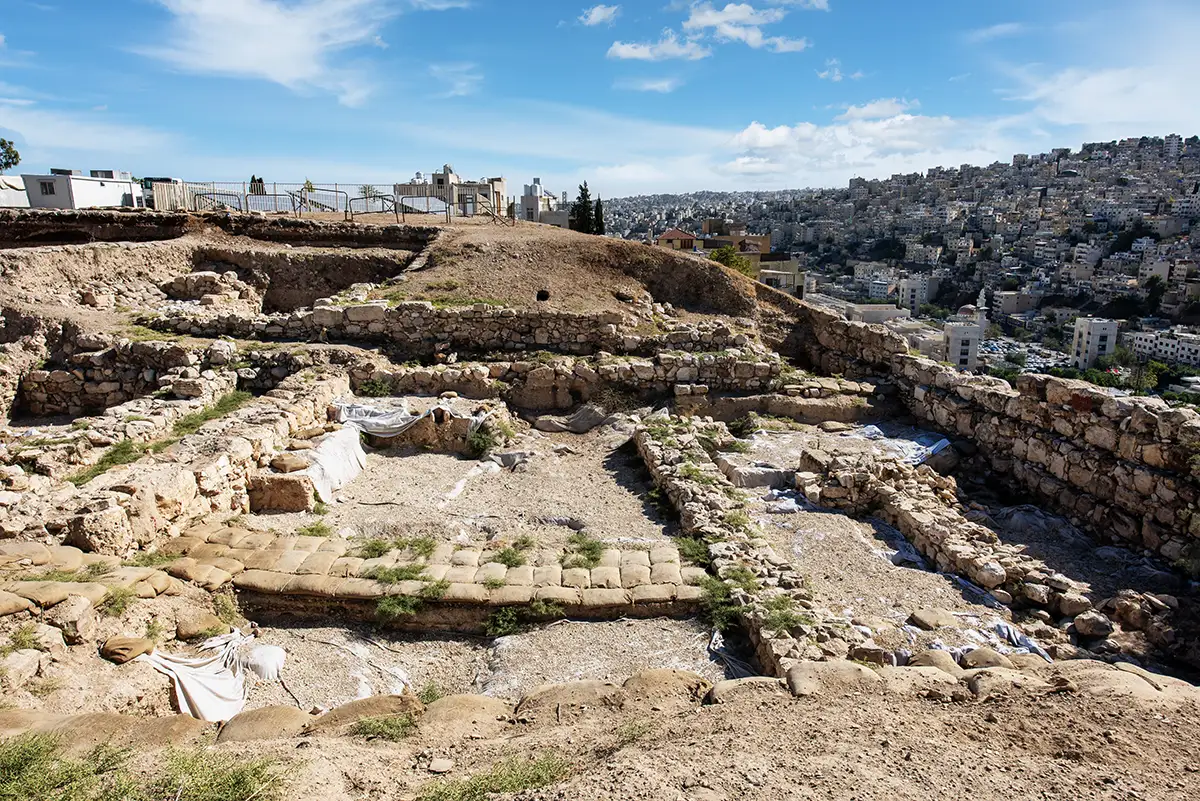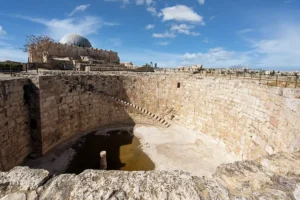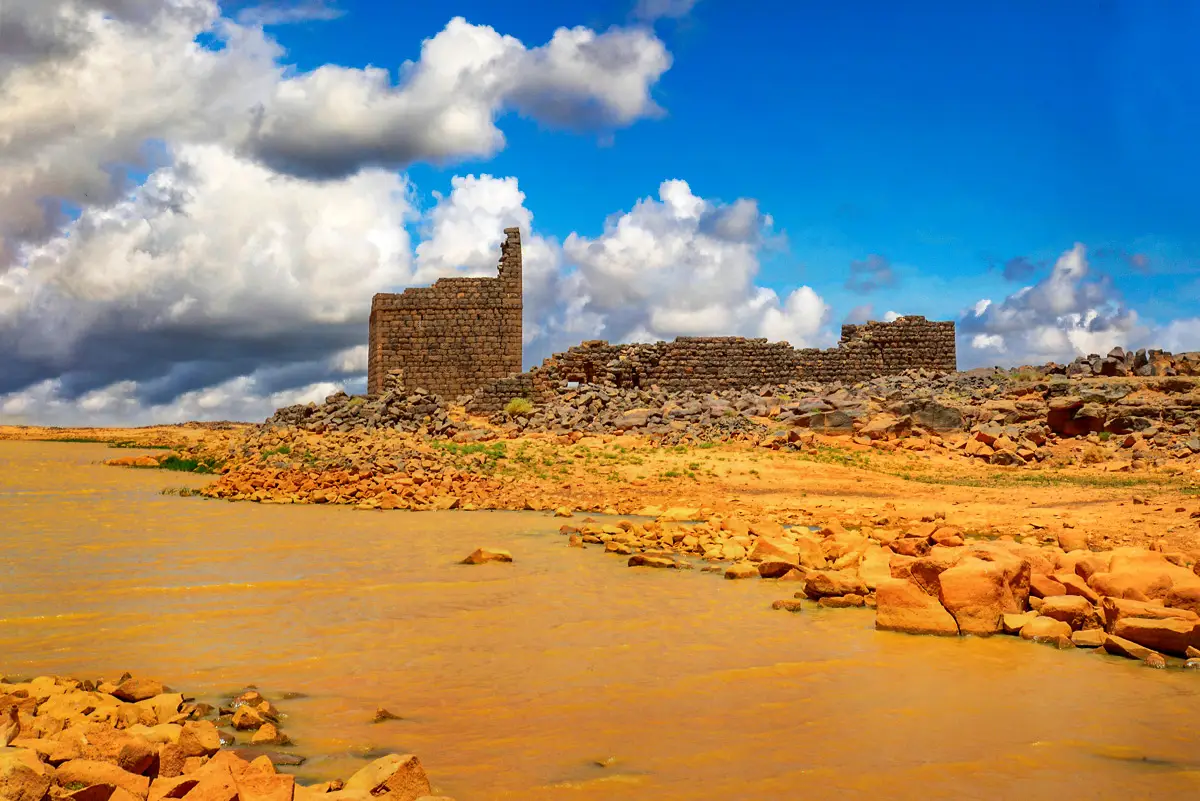












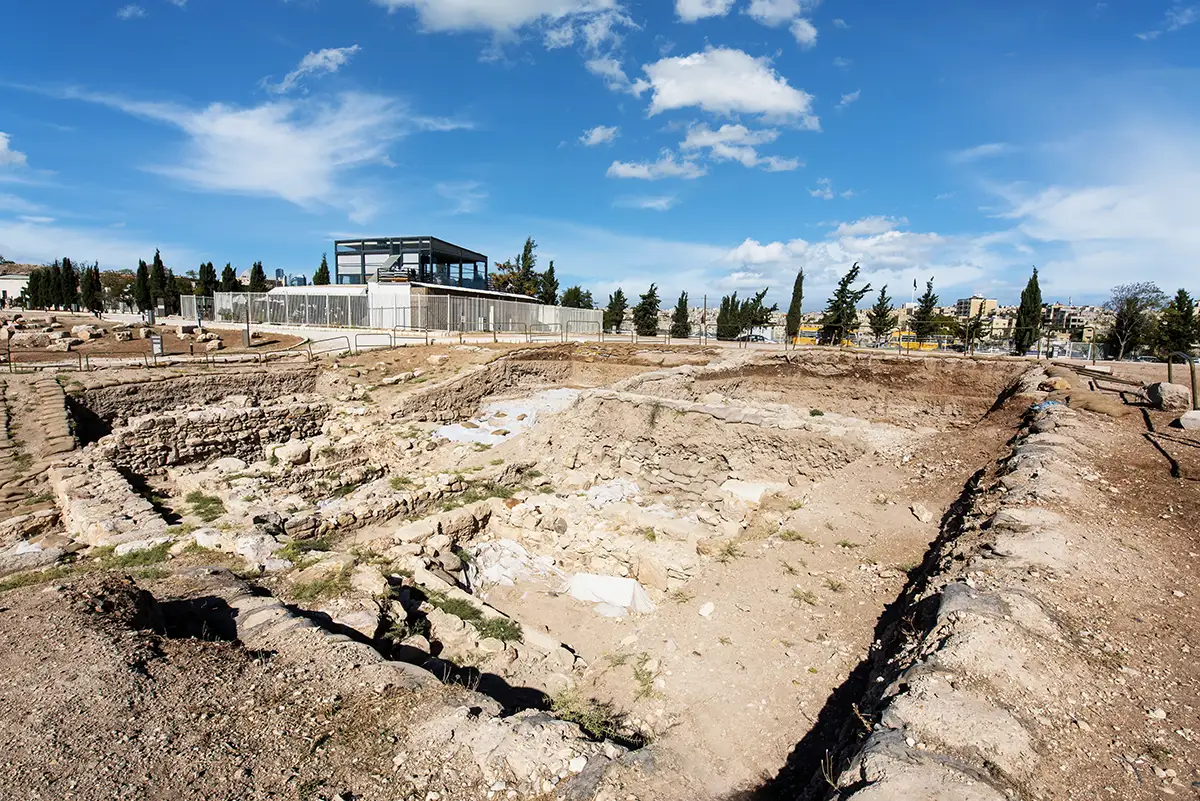

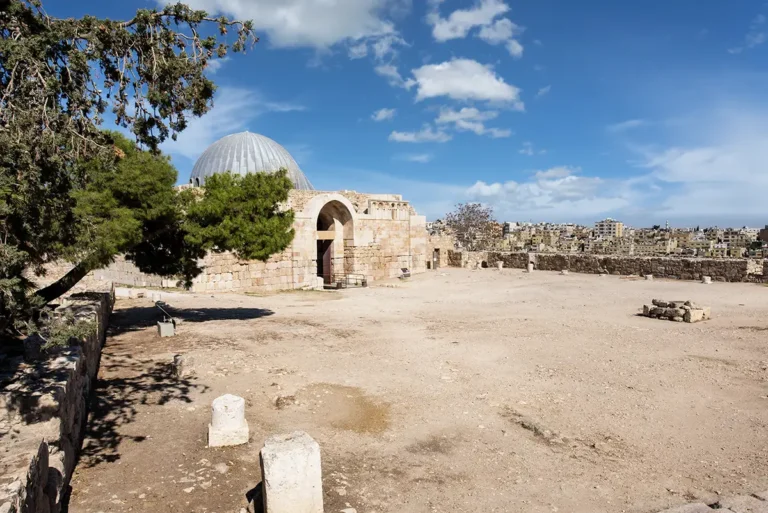
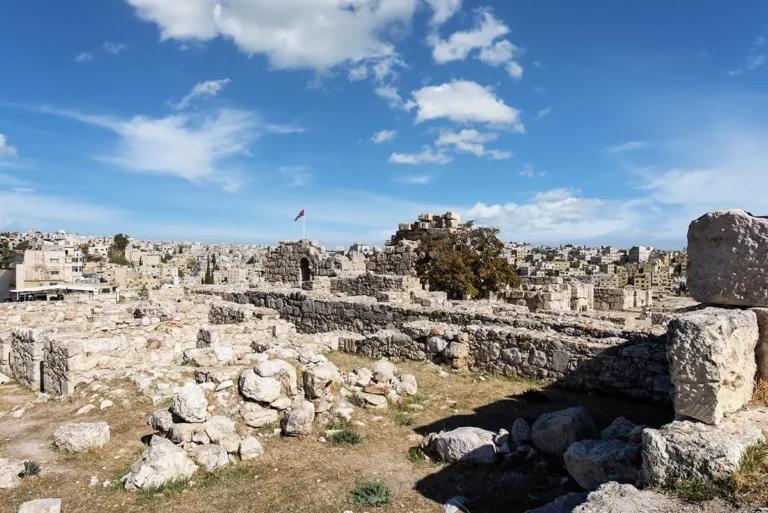

The Ammonite Palace is the Iron Age building on the Lower Terrace of the Amman Citadel, and the best evidence on the hill for the Ammonites, whose capital was Rabbat-Amman, “the great city of Ammon”. Only part of it has been excavated: a large plastered courtyard framed by massive walls, with rooms to the south. Whether it was an elite residence or the palace of the Ammonite kings is still being tested.

Where Is the Ammonite Palace?
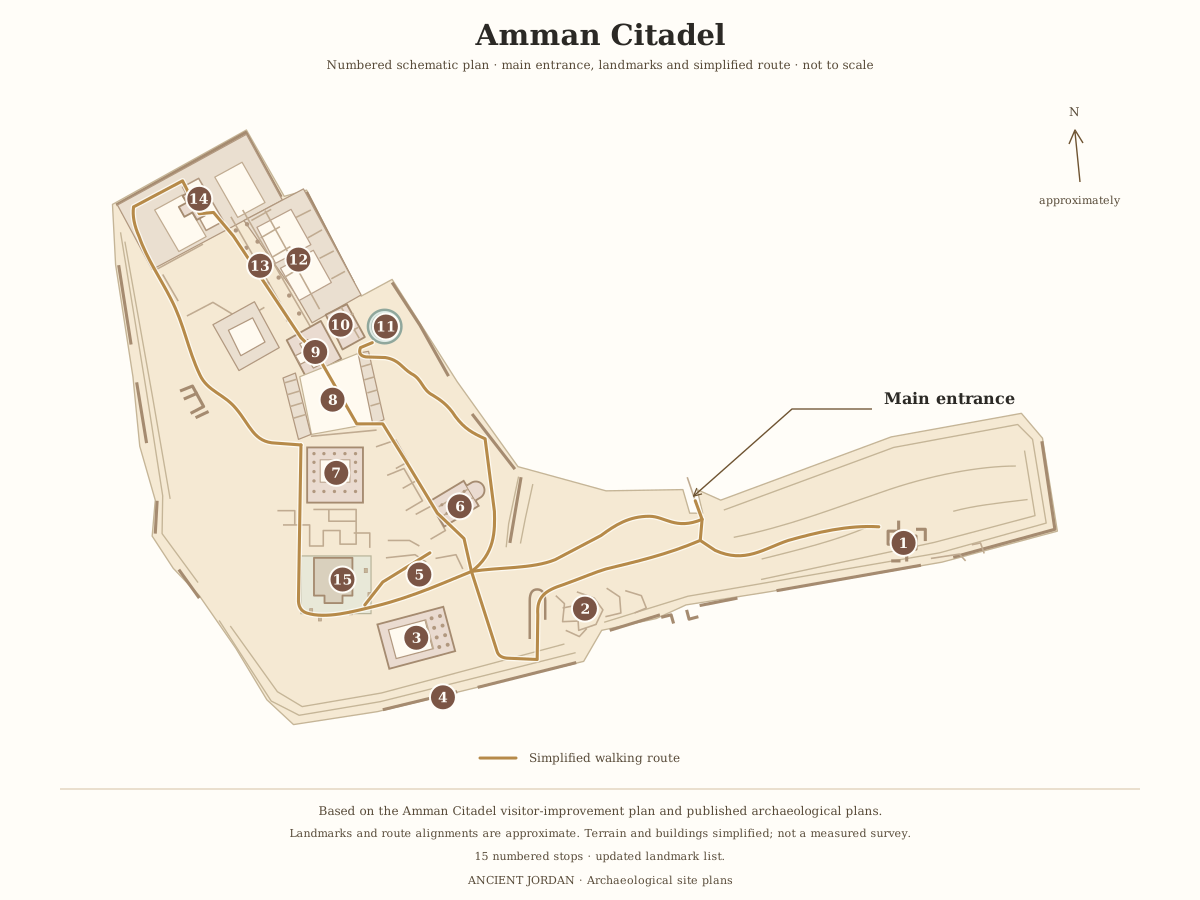
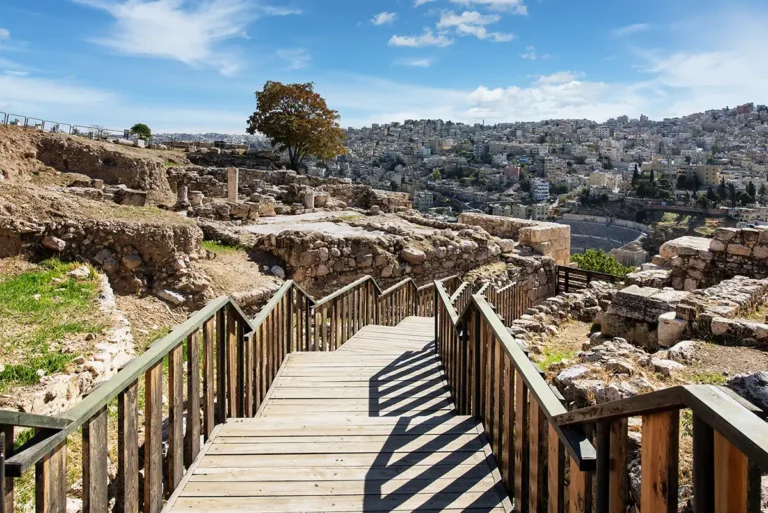
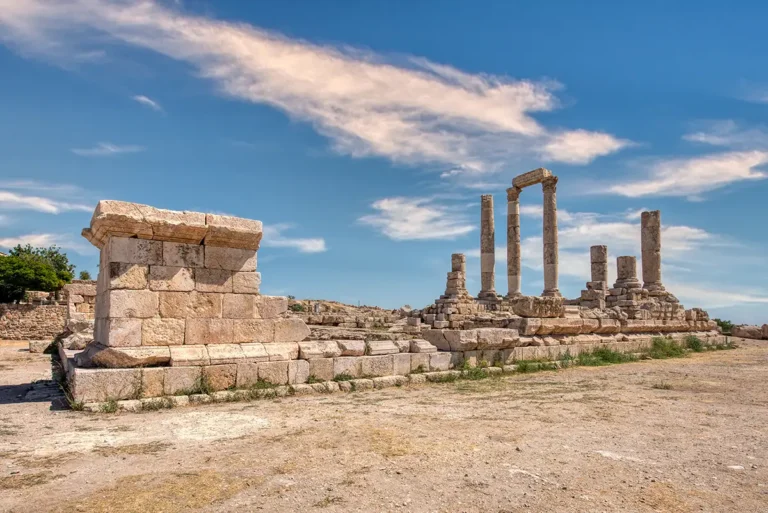
The palace lies on the Lower Terrace, on the eastern side of the Amman Citadel (Jabal al-Qala’a). Most visitors head west to the Temple of Hercules and the Umayyad Palace, so this part of the hill is often missed. It is about 100 m to the left of the main entrance and the first stop on our Amman Citadel route, and from the walls you look across the crowded hills of modern Amman.
Historical Context and Origin
Amman was the capital of the Iron Age kingdom of Ammon, and the Citadel was its centre. The building was first excavated in 1987–1991 and dated to the 7th century BC. New work by the Amman Archaeological Project of the University of Münster has changed that picture: radiocarbon and pottery analysis from the 2025 season places the earliest phase in the 10th century BC. The building was remodelled later in the Iron Age, when a water-channel system was added and carved stone was reused as building material.
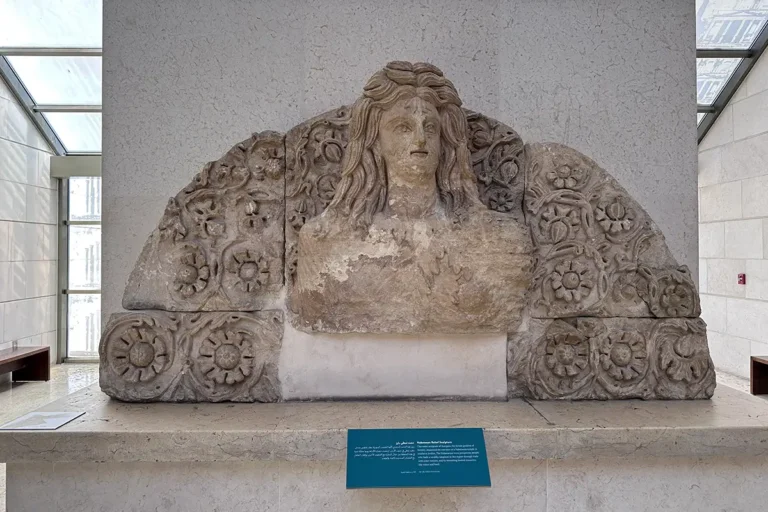
The finds point to wealth and far-reaching contacts. They include ivory and glass inlays, alabaster vessels, decorated shell, a life-size terracotta mask and a glass drinking cup with parallels at the Assyrian city of Nimrud. The best known are the stone heads with a female face on each side, at least six of them, probably from a stone balustrade.
Architectural Design
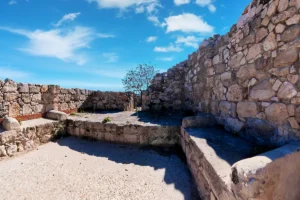
The excavated part centres on a large courtyard with a plastered floor, bounded by massive walls. Rooms with plastered walls adjoin it. On the south, the early excavation recorded a plastered space between two parallel walls, and farther south a pavement of brownish limestone slabs about 1.90 m wide (locus 0612), which the excavators tentatively read as part of a street along the city wall. A stone toilet seat, otherwise known in the region only from elite residences in Edom and Judah, is another sign of status.

Plastered Courtyard
A large central courtyard with a plastered floor, bounded by massive walls. Only part of it has been exposed.
Massive Walls
Two parallel walls bound the courtyard on the south, with a plastered space between them.
Double-Faced Heads
Stone heads of women with curly hair and ornaments, probably from a balustrade. At least six have been found since the late 1960s.
Stone Toilet Seat
A rare sign of status: in the region such seats are known only from elite residences in Edom and Judah.
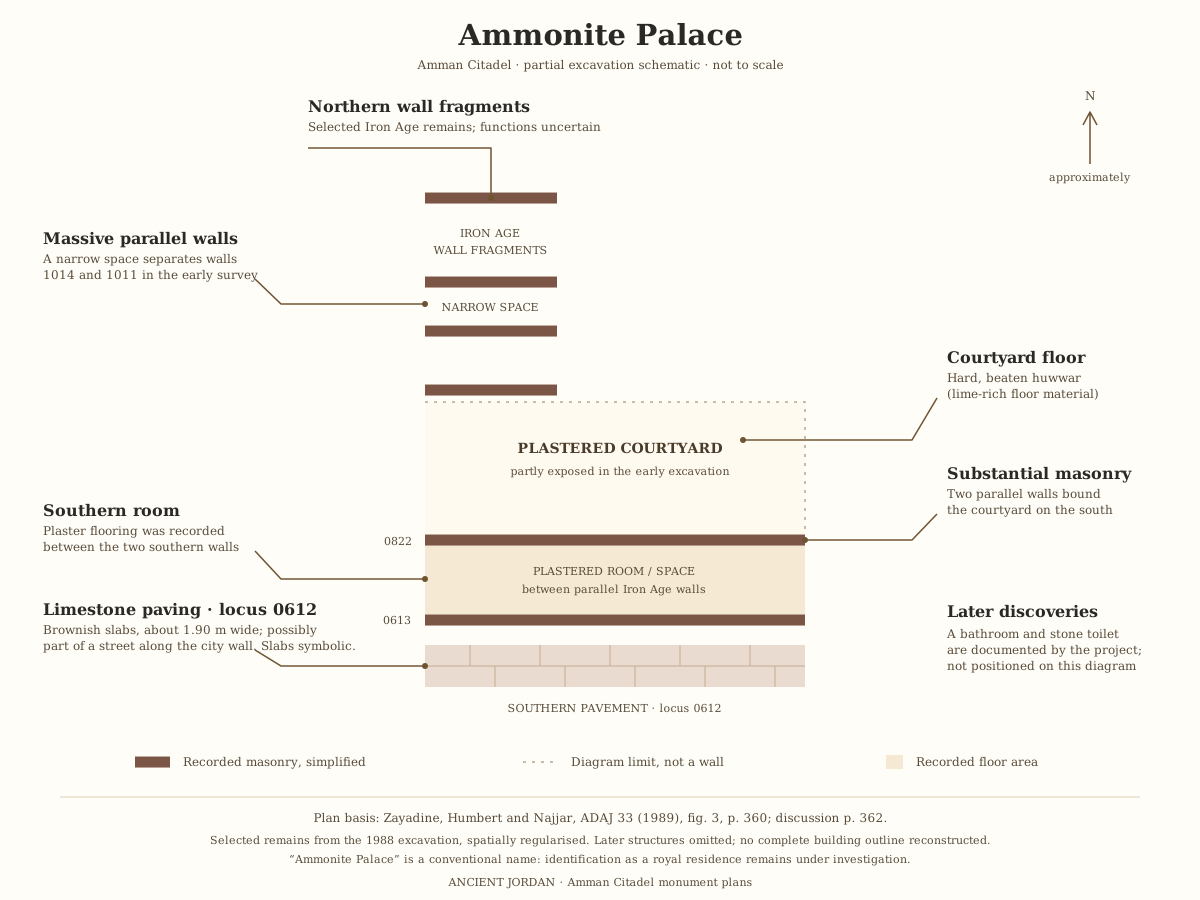
Ammonite Palace, Amman Citadel
Schematic plan of the partly excavated Ammonite Palace, after Zayadine, Humbert and Najjar (1989)
Open drawingExcavation and Rediscovery
The Jordanian archaeologist Fawzi Zayadine began the formal excavation, and the first double-faced heads came to light between 1968 and 1973. The Münster project, led by Katharina Schmidt with Zeidan Kafafi, began in 2024 and has since found two more heads, a cistern and, in 2026, rooms with a bathroom and a paved area to the south. Only part of the building is known, so no full plan, entrance or visitor route can be drawn yet, and the schematic plan shown here is partial.
Visiting the Ammonite Palace Today
The palace is open to visitors inside the Amman Citadel, about 100 m to the left of the main entrance. It is covered by the Citadel ticket (3 JOD for visitors, 0.25 JOD for residents) and by the Jordan Pass. The Citadel is open from 8:00 to 16:00 from November to March, to 17:30 in April and May, and to 18:30 from June to September; in Ramadan it is open from 9:00 to 17:00.
The remains are low, so look for the white patches of plaster, the thick walls and the paving, and use the edge of the terrace for the overview. Excavations are ongoing, so some areas may be covered. About 10 minutes is enough.
The earliest Ammonite writing from the Citadel, a 9th-century BC stone fragment that names the god Milkom, was not found here. It is held by the Jordan Archaeological Museum, the last stop of our route. See our Amman Citadel travel guide for tickets, hours and the rest of the hill.
Further reading: University of Münster — Amman Citadel Excavation; Jordan Times — Ammonite structure discovered on eastern side of Amman Citadel; ANE Today — The Citadel of Amman; Zayadine, Humbert and Najjar, “The 1988 Excavations on the Citadel of Amman: Lower Terrace, Area A”, ADAJ 33 (1989), pp. 357–363.