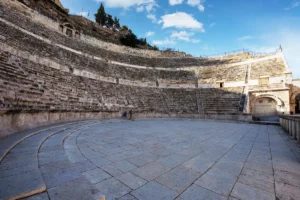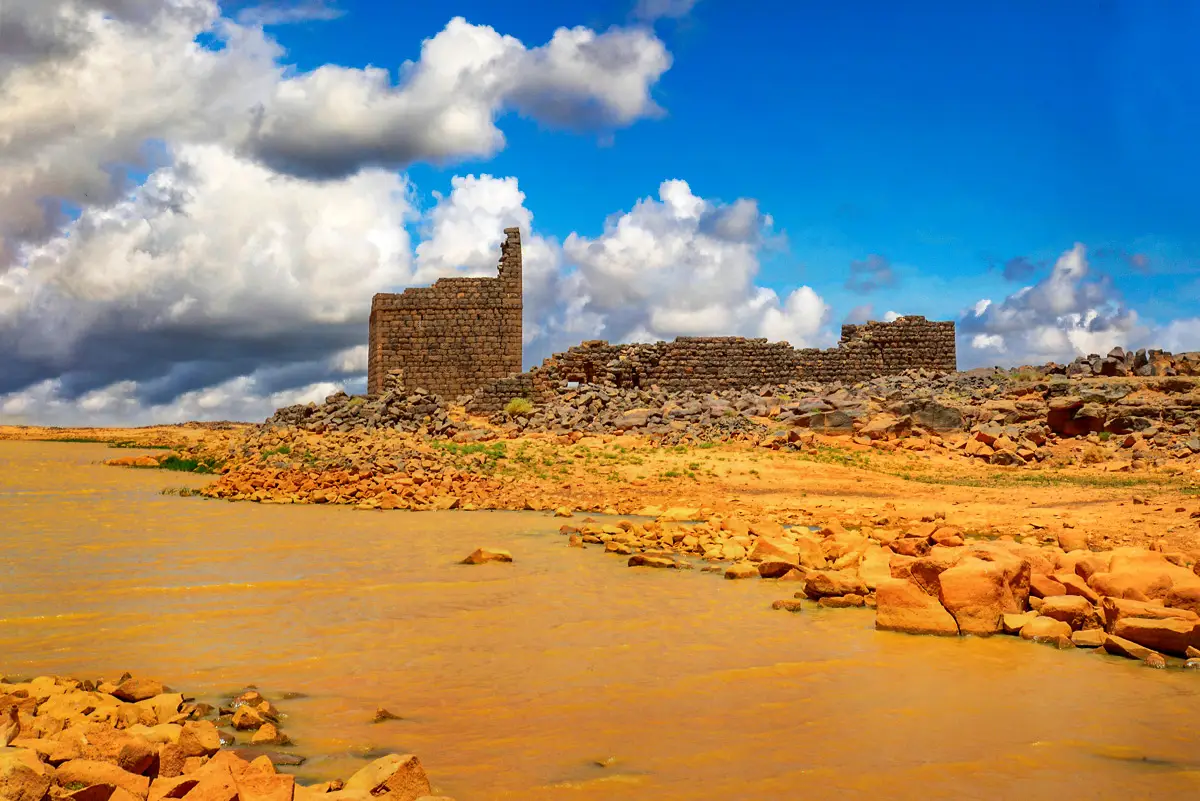













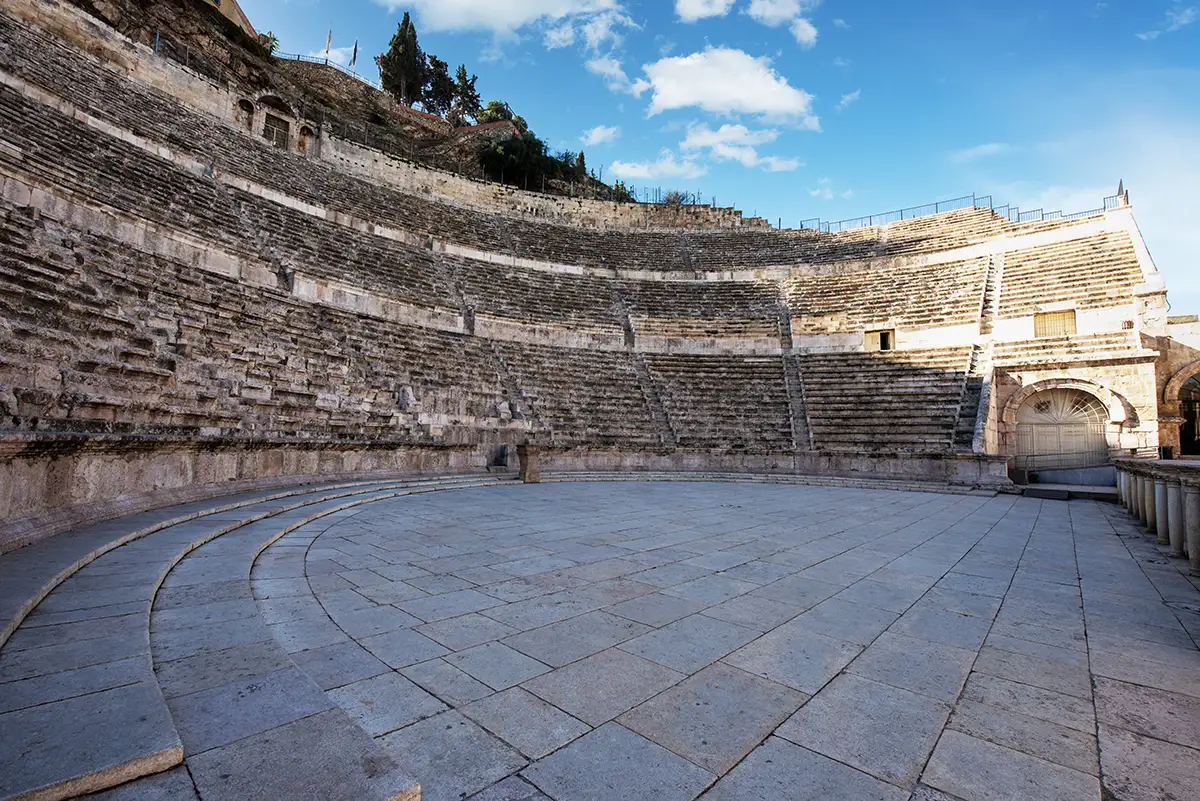
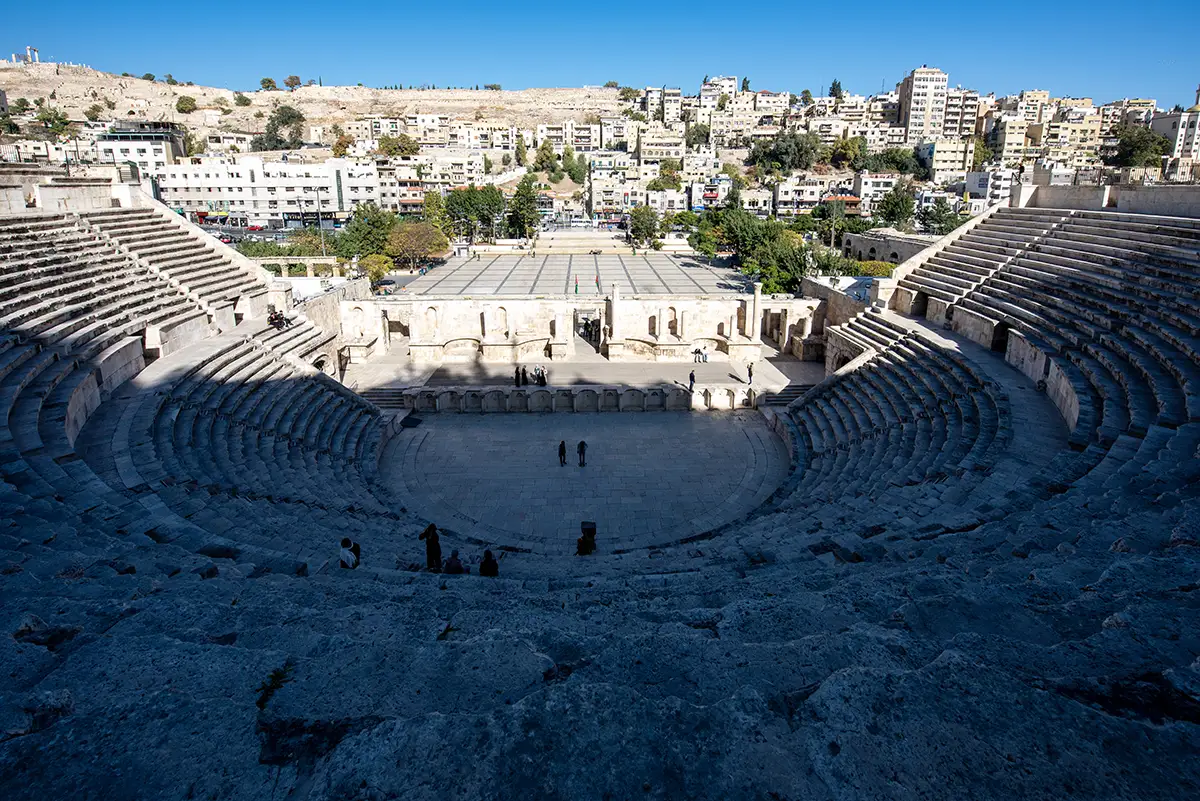
The Roman Theatre is built into a hillside in the heart of downtown Amman, once the Roman city of Philadelphia. Its three tiers of stone seating look down on a semicircular orchestra and a stage building, and the theatre held about 6,000 spectators. Restored from 1957, it again hosts concerts and cultural events, and two museums of traditional Jordanian life occupy its vaulted spaces.
Where Is the Roman Theatre?
The theatre stands in downtown Amman, built into the hillside south of the ancient Roman forum. The Department of Antiquities places it south of the Roman street and east of the Amman Stream.
Historical Context and Origin
The theatre belonged to Roman Philadelphia, as Amman was then called. The Department of Antiquities dates it to the 2nd century AD, in the reign of Emperor Antoninus Pius (AD 138–161), and a published study of the site gives the middle of the century. This rests on a Greek inscription carved on an architrave, the beam above a row of columns, which honours the emperor and his household.
The inscription is linked with the decoration or renovation of the stage building; it does not securely date the original construction. F. el-Fakharani proposed an earlier first phase in the Augustan period, with the Antonine work as an expansion and renovation. Estimates of the capacity range from about 6,000 spectators, the figure given by the Department of Antiquities, to more than 11,000.
Architectural Design
Like other Roman theatres, it is a semicircular bowl of seating (the cavea) facing a stage. Two curved walkways divide the seating into three tiers. According to the Department of Antiquities, the lowest tier, nearest the orchestra, was for senators, who had honorary seats; the middle tier was for citizens; and the highest was for the poor, foreigners, slaves and women. Published figures give the cavea a diameter of about 102 m and the semicircular orchestra about 27 m. At the top of the third tier, a niche honoured the city’s deities, Hercules and his mother.
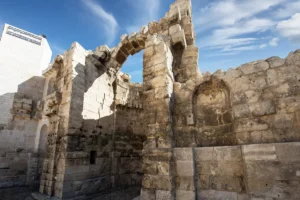
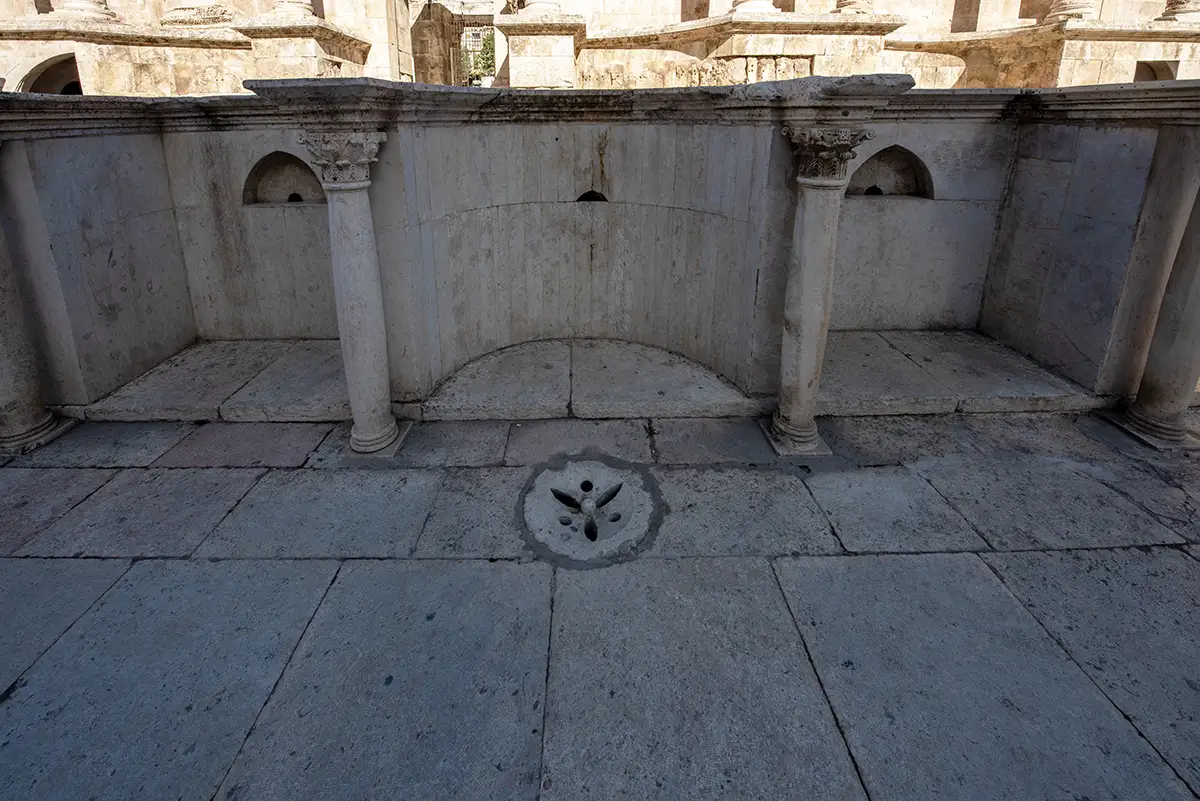
The stage building (scaenae frons), the monumental wall behind the stage, is now largely lost, but columns and niches survive. Its front had three doors, and the front of the stage alternates round and rectangular niches.
Three Tiers of Seating
Two curved walkways divide the seating into lower, middle and upper tiers.
Stage-Front Niches
Round and rectangular niches alternate along the front of the stage.
Upper Shrine Niche
A niche above the highest tier honoured the city’s deities.
Two Museums
Traditional Jordanian costume, jewellery and daily life, in the theatre’s vaults.

Roman Theatre, Amman
Schematic plan of the Roman Theatre in Amman, after the Department of Antiquities; interpretive, not a measured survey
Open drawingGreek dedication to Emperor Antoninus Pius
The inscription is fragmentary. Words in square brackets are scholarly restorations, and the translation incorporates them; it is not a completely preserved sentence.
[ὑπὲρ σωτηρίας Αὐτοκράτορος] Τ̣[ί]τ̣[ου] Αἰλίου Ἁδριανοῦ Ἀντω̣[νείνου Εὐσεβοῦς Σεβα]
στοῦ τ̣οῦ κ̣υρί[ου καὶ τοῦ σύμπαν]
τ̣ος αὐτοῦ [οἴκου — — —]
For the well-being of Emperor Titus Aelius Hadrianus Antoninus Pius Augustus, our lord, and his entire household …
It was carved on an architrave and is attributed to the stage façade (scaenae frons) in ADAJ 54 (2010); the Theatrum catalogue lists the block among architraves of the forum in front of the theatre, so its original position is not certain. It associates the stage building’s decoration or renovation with Antoninus Pius but does not securely date the theatre’s original construction.
Corpus reference: IGLS XXI 2, no. 16. Earlier publications: E. Littmann, Greek and Latin Inscriptions, Princeton Archaeological Expedition to Syria III A, 1 (1907), p. 14, no. 8; F. el-Fakharani, ‘Das Theater von Amman in Jordanien’, Archäologischer Anzeiger (1975), pp. 400–403.
The Two Museums in the Vaults
Two museums of traditional life share the theatre’s vaulted spaces. The Jordanian Museum of Popular Traditions was established in 1971 in one of the vaults, through the Heritage Club of Jordan led by Sa’deyyah al-Tall, with the Department of Antiquities providing the building. The Jordan Folklore Museum opened in 1975 in the opposite vault. Their collections date from the 19th to the mid-20th century and show traditional costume, jewellery, weaving and daily life in Jordan. One ticket covers both museums.
Excavation, Restoration, and Revival
In 1957 the Department of Antiquities began a major programme to excavate and restore the monument. It was eventually returned to use as a performance venue, and it continues to host concerts and cultural events.
Visiting the Roman Theatre Today
Admission is 2 JOD for visitors and 0.25 JOD for residents, and the ticket includes both museums. The theatre is covered by the Jordan Pass, which lists opening hours of 8:00 to 17:00; hours can change with the season, so check locally. Allow about 30 minutes to walk across the orchestra, climb the tiers for the view over downtown, and look into the two museums. The Roman Nymphaeum, a Roman public fountain, is a short walk away.
Further reading: Department of Antiquities, The Roman Theatre (The Grand Theatre); ADAJ 54 (2010), pp. 177–188; SHAJ 10, pp. 41–52 (the two museums); Theatrum, Amman Theatre; IGLS XXI 2, 16 (PHI Greek Inscriptions).