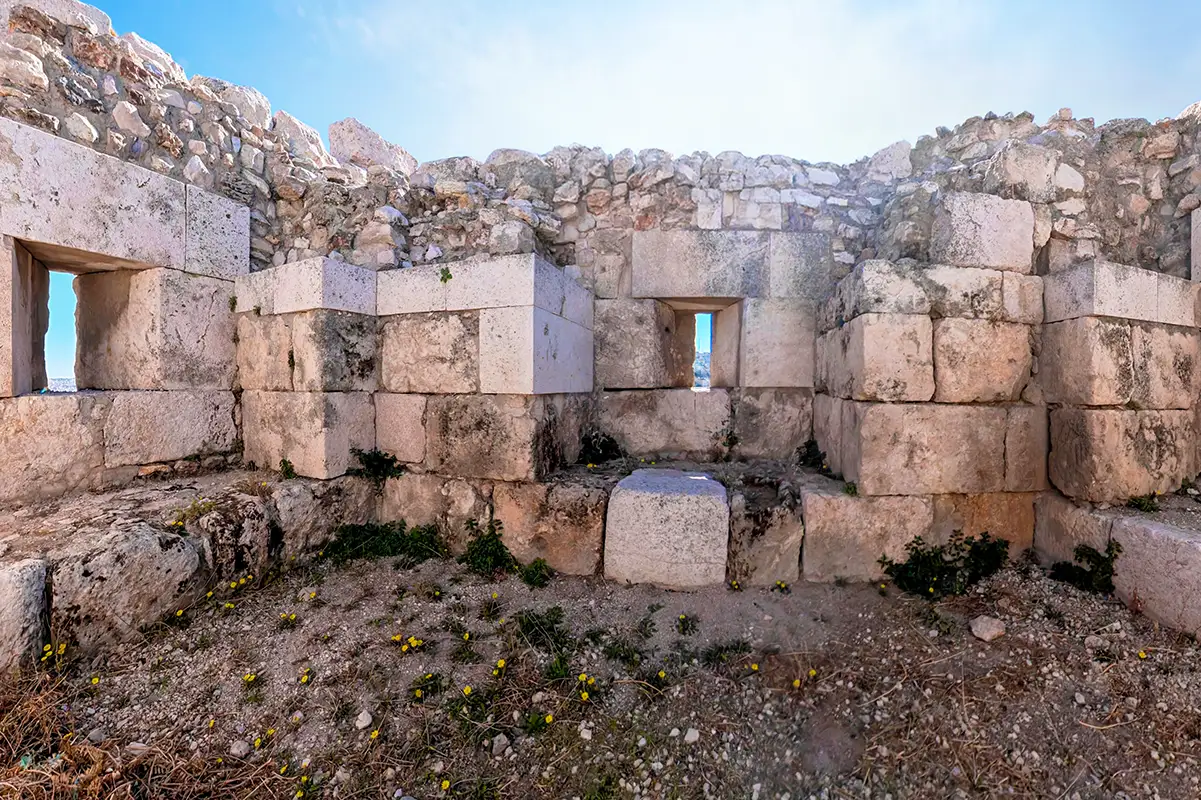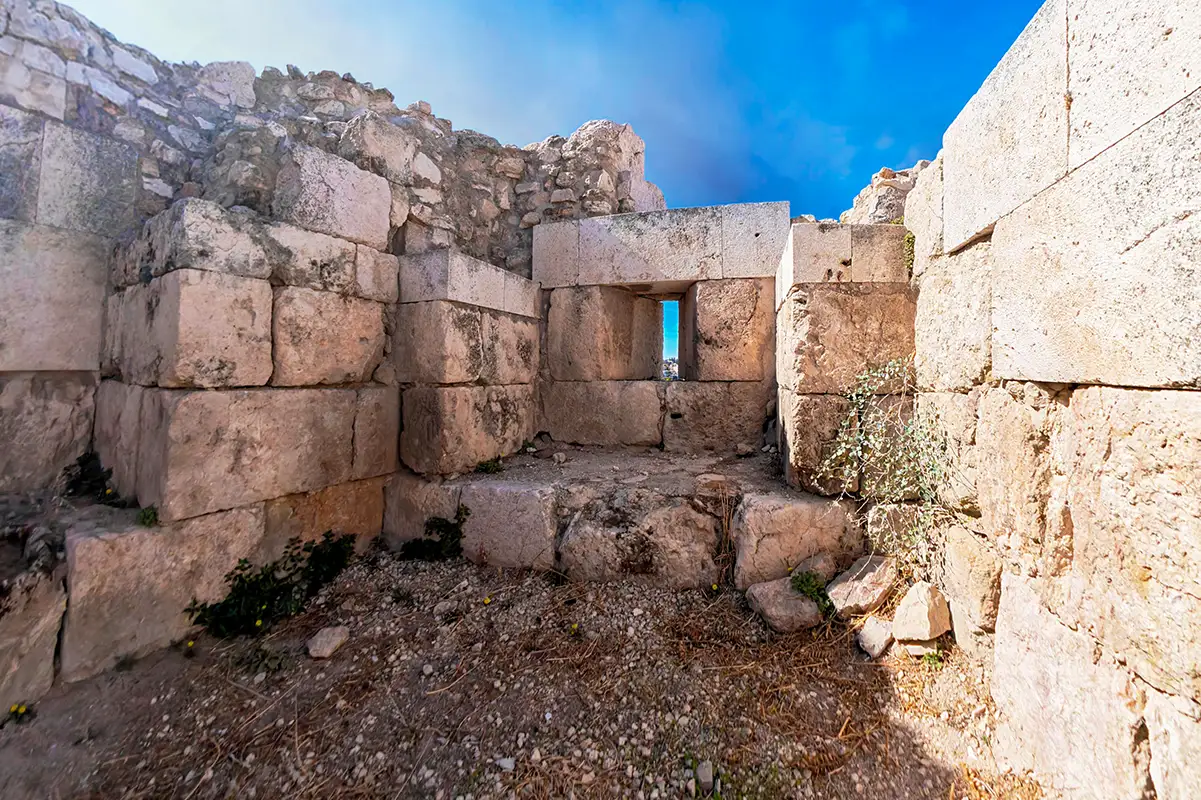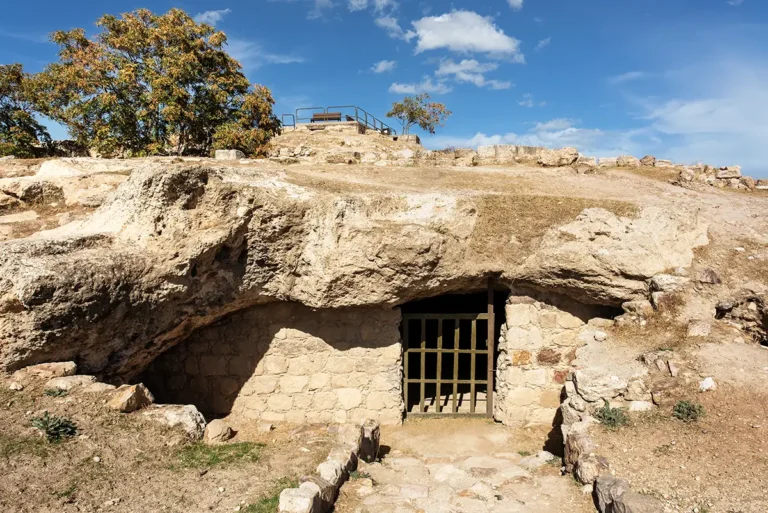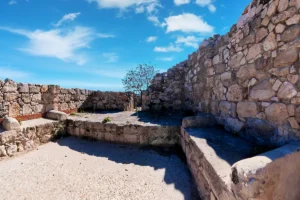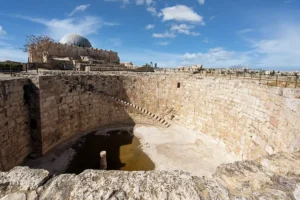













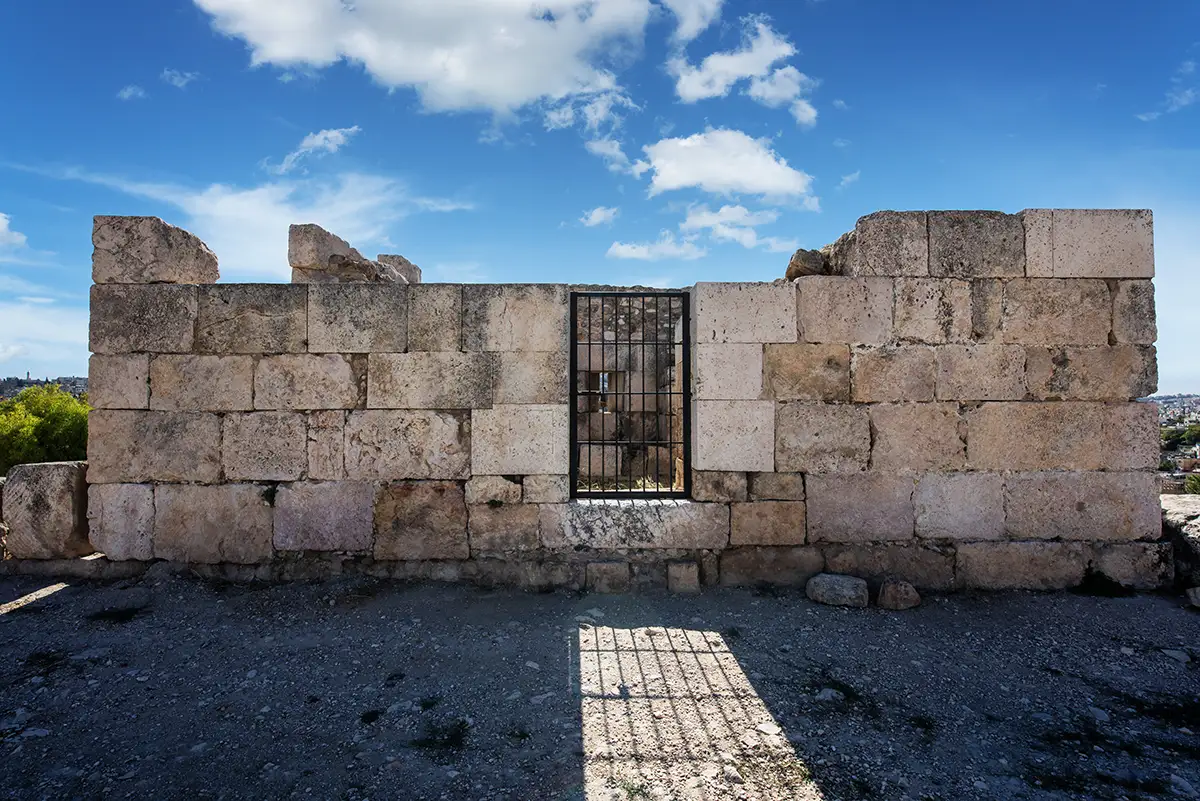

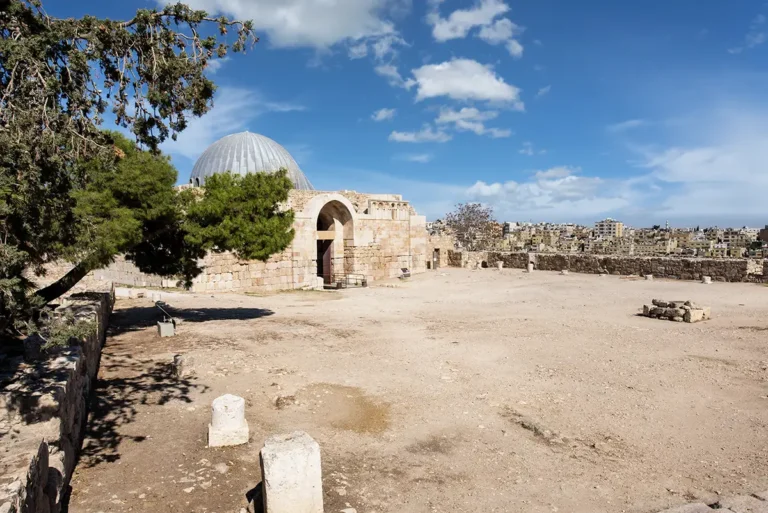
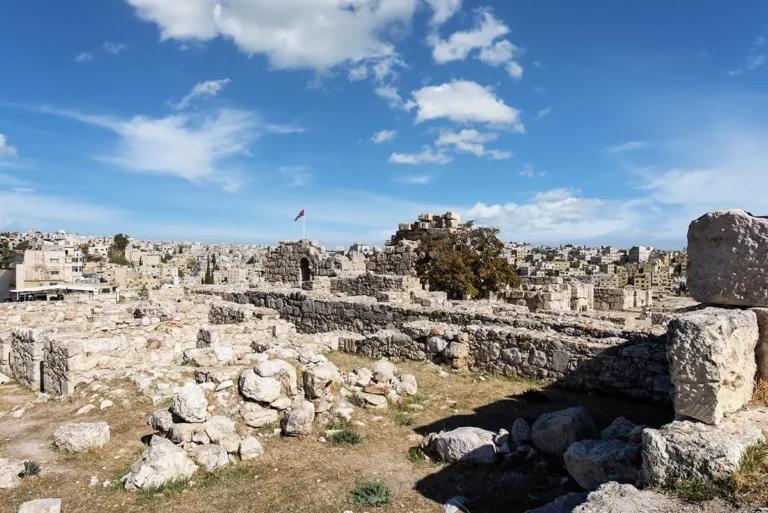


The Ayyubid Watch Tower is a small medieval fortification on the southern edge of the Amman Citadel. It is a one-room stone tower with arrow slits, a stair inside its walls and a view over the centre of the city, built largely from stone taken from the Roman temple next door.

Where Is the Ayyubid Watch Tower?
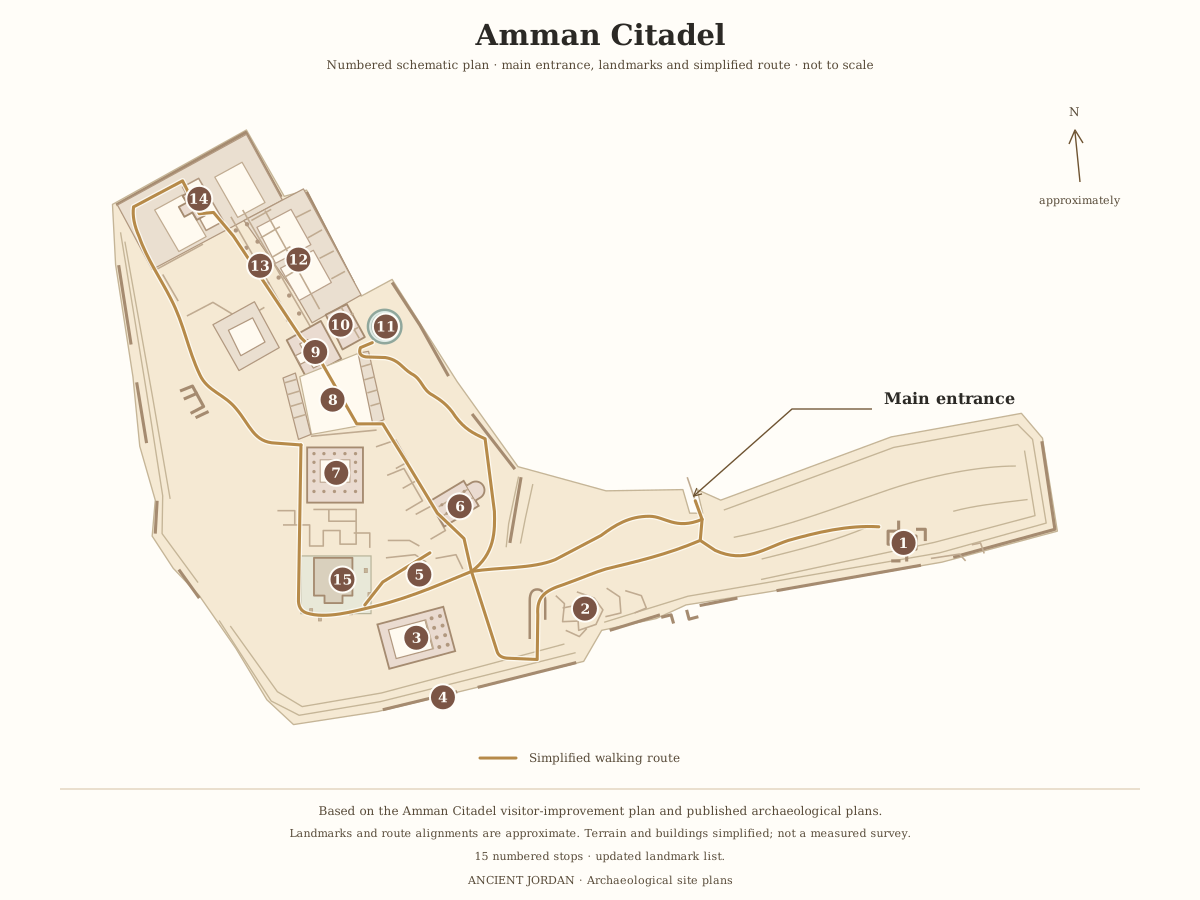
The tower stands on the south side of the Amman Citadel, just south of the Temple of Hercules and about 160 m west of the Byzantine Residential Complex. It is the fourth stop on our Amman Citadel route, after the Temple of Hercules. From the walls around it you look down over downtown Amman and the hills beyond.
Historical Context and Origin
The tower is the only medieval fortification still visible on the Citadel. It was first thought to be Crusader work, but is now dated to the Ayyubid period, in the late 12th or early 13th century. A coin found in its construction fill gives a date no earlier than 1190–91. The Ayyubids, whose military architecture was highly developed, built it as a watch post over the city below.
By then the Citadel had lost much of its earlier importance. The tower was a lookout and a strongpoint rather than the centre of a town, and it was put up with whatever good stone lay close at hand.
Architectural Design
According to the official information board, the tower is a rectangle of about 9.4 by 7.6 m with a single room inside. It has an arrow slit in each of three sides, and a staircase built into the thickness of the eastern wall leads up to the roof. The published plan marks an entrance on the north side.

One-Room Tower
A rectangular tower of about 9.4 by 7.6 m with a single room inside and its entrance on the north side.
Arrow Slits
A narrow arrow slit opens in each of three sides, set in a recess inside the wall.
Stair in the Wall
A staircase built into the eastern wall led up to the roof.
Reused Roman Drums
Large column drums from the Roman Temple of Hercules are set into the south facade.

Ayyubid Watch Tower, Amman Citadel
Annotated plan of the Ayyubid Watch Tower, after Ostrasz (1997)
Open drawingReused Roman Stone
Large cylindrical drums that once belonged to the Roman Temple of Hercules are built into the tower’s south facade. The temple went out of use centuries earlier, and its fallen stone became a ready quarry for the Ayyubid builders. Seeing the tower beside the restored temple columns shows how one building supplied the next.
The tower was in danger of collapse, and ACOR carried out conservation and restoration work on it in 1996.
Visiting the Ayyubid Watch Tower Today
The tower is part of the Amman Citadel visit and is covered by the Citadel ticket (3 JOD for visitors, 0.25 JOD for residents) and by the Jordan Pass. The Citadel is open from 8:00 to 16:00 from November to March, to 17:30 in April and May, and to 18:30 from June to September; in Ramadan it is open from 9:00 to 17:00.
An information board in English and Arabic stands beside it, with a plan, a south elevation and a photograph from 1921. The gate is currently closed and locked, and visitors are not allowed inside the tower, so you see it from outside. About 10 minutes is enough.
Further reading: Ministry of Tourism and Antiquities and Department of Antiquities information board at the site; Antoni A. Ostrasz, “The Citadel of Amman: The Conservation and Restoration of the Ayyubid Tower”, Annual of the Department of Antiquities of Jordan 41 (1997); ACOR, The Amman Citadel.