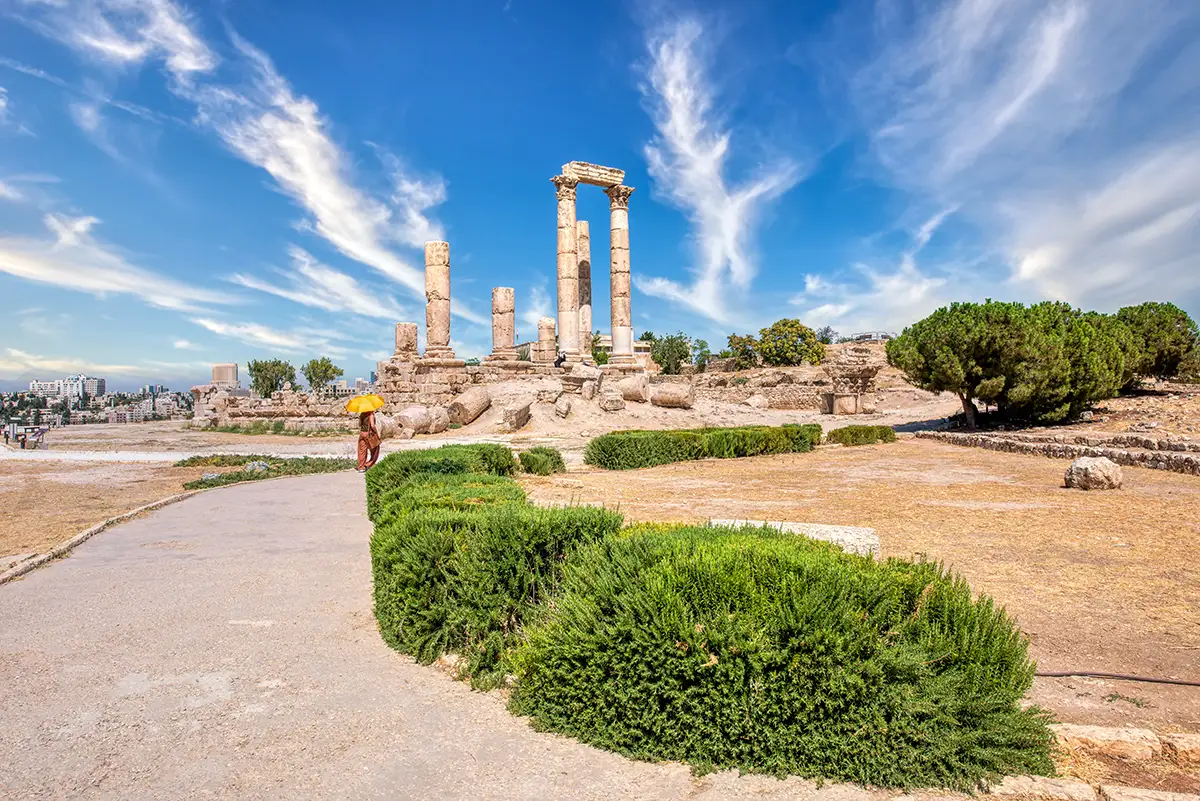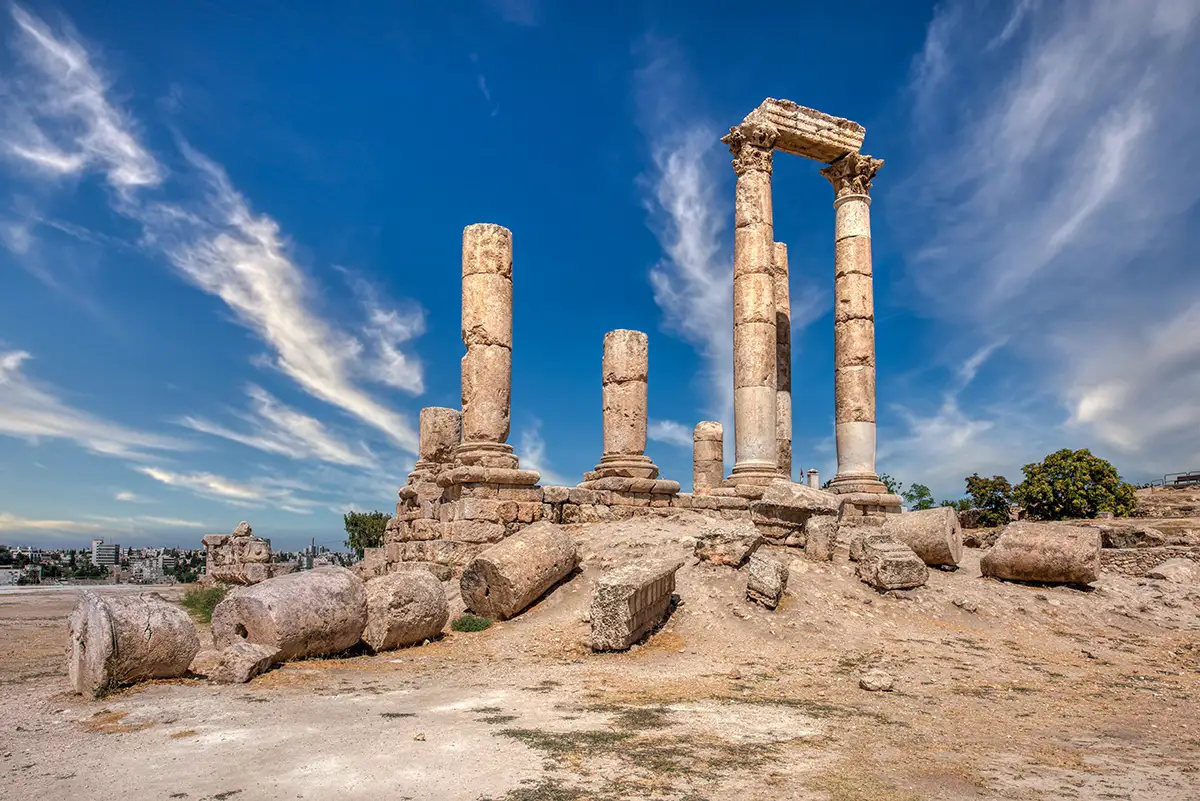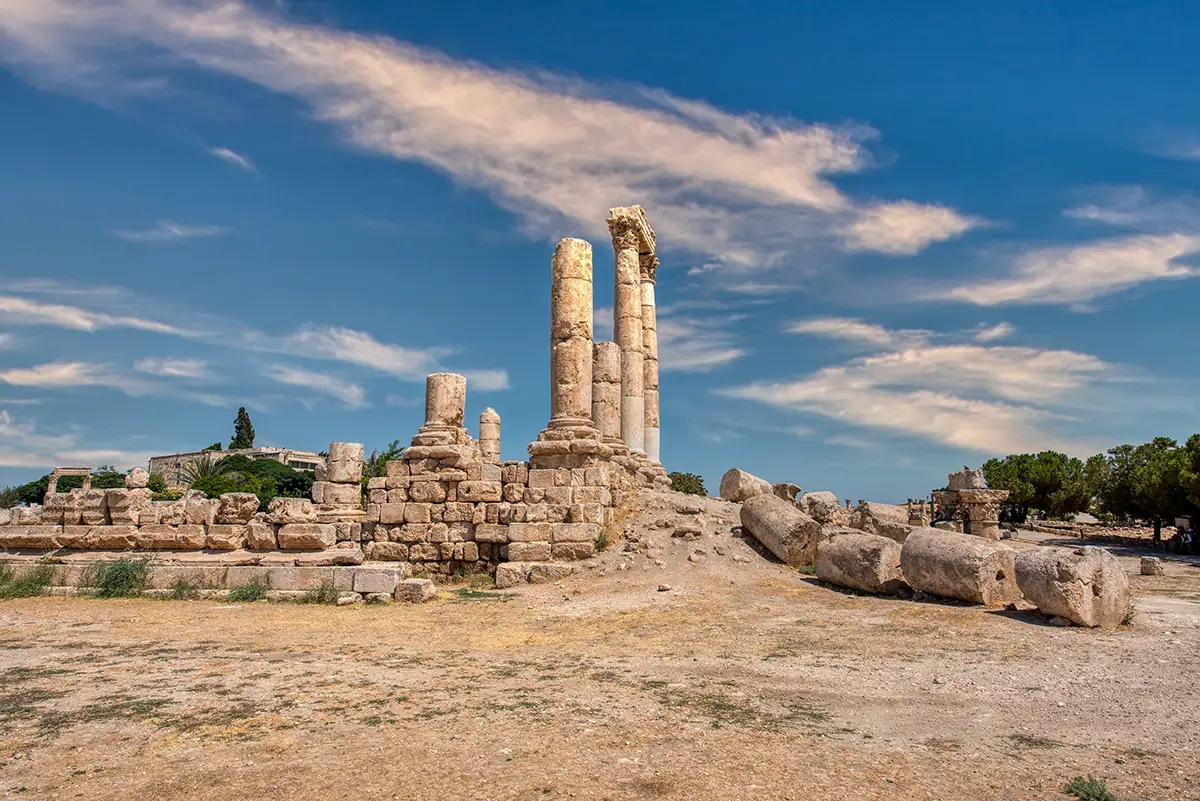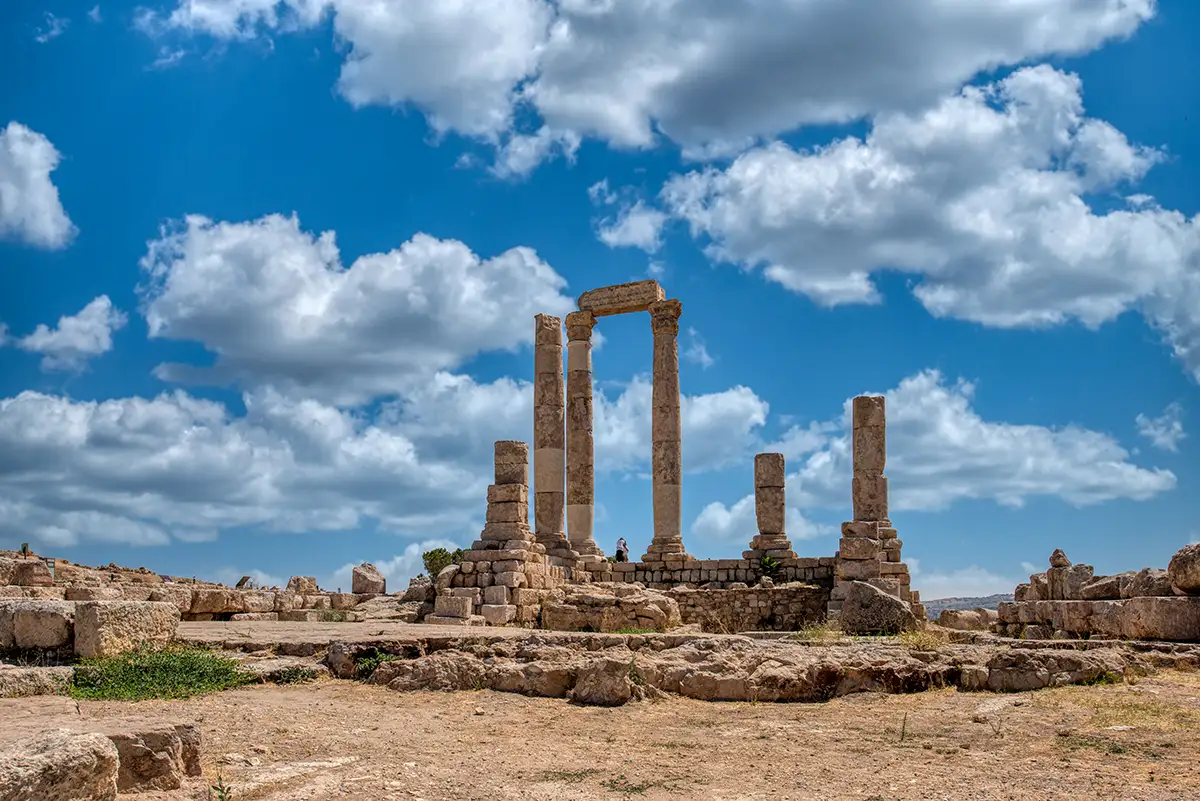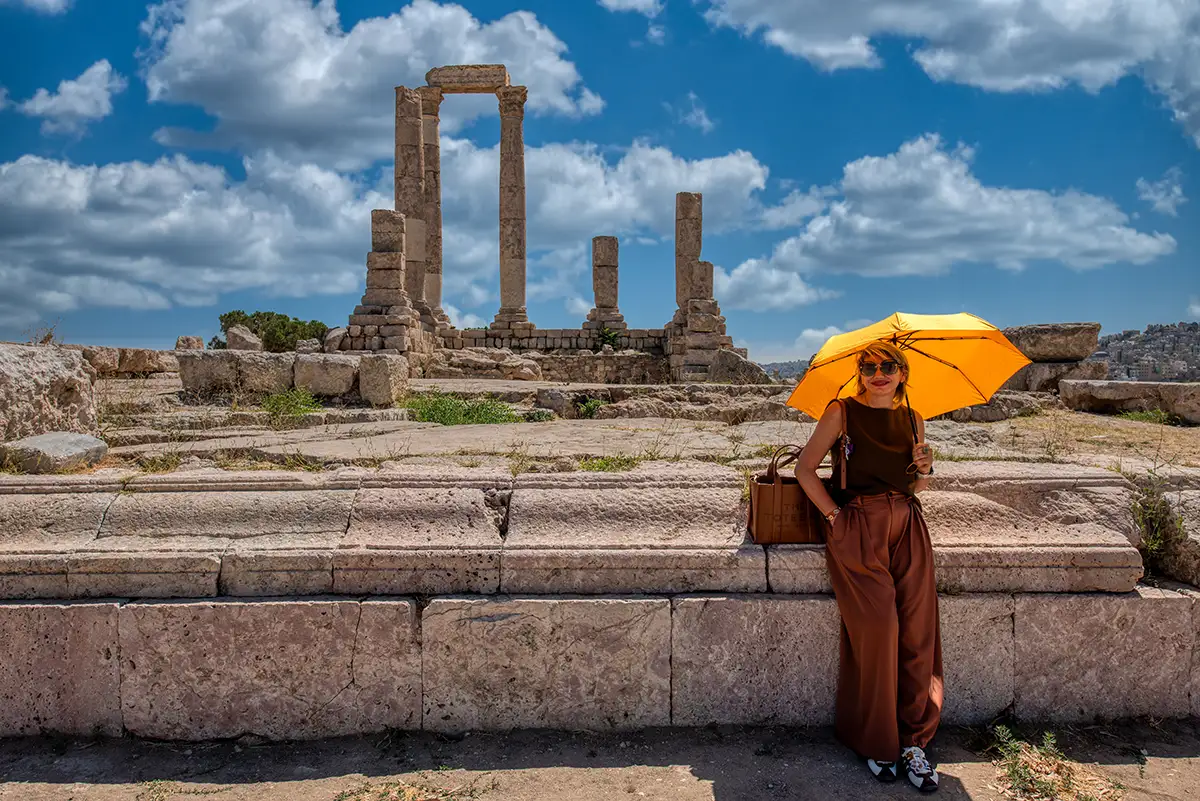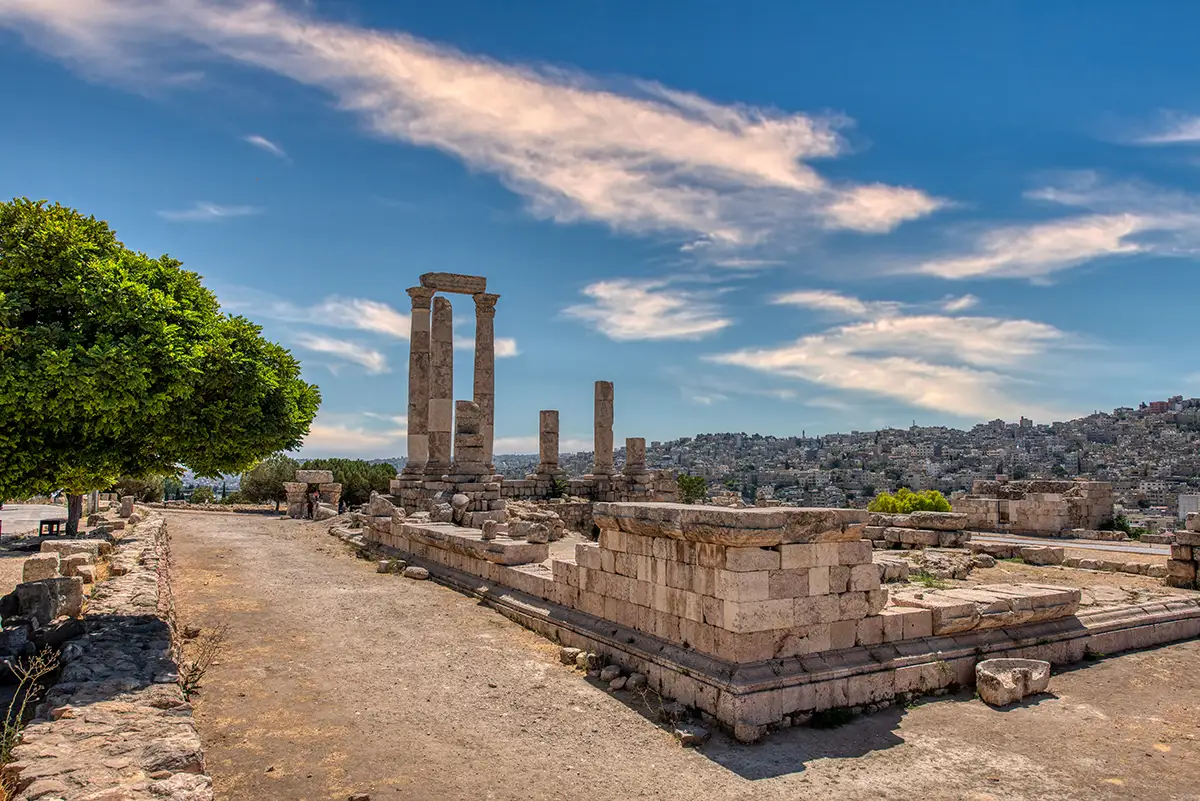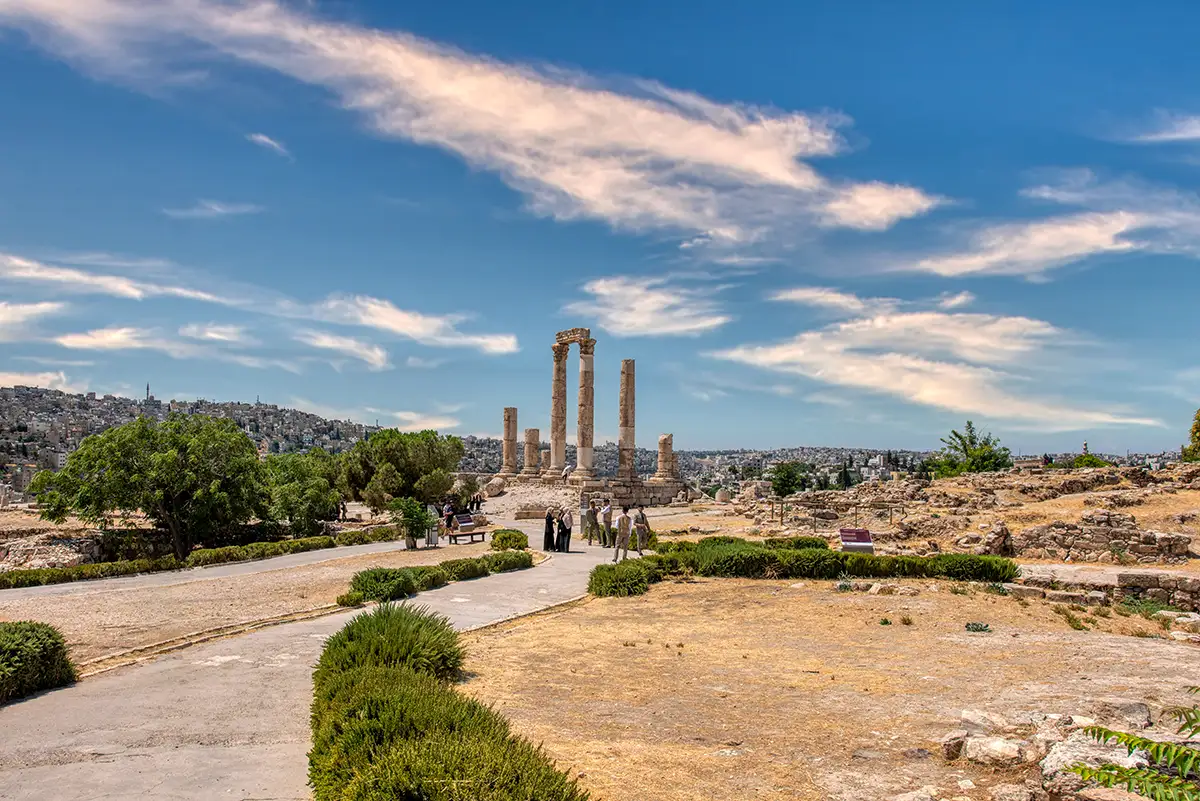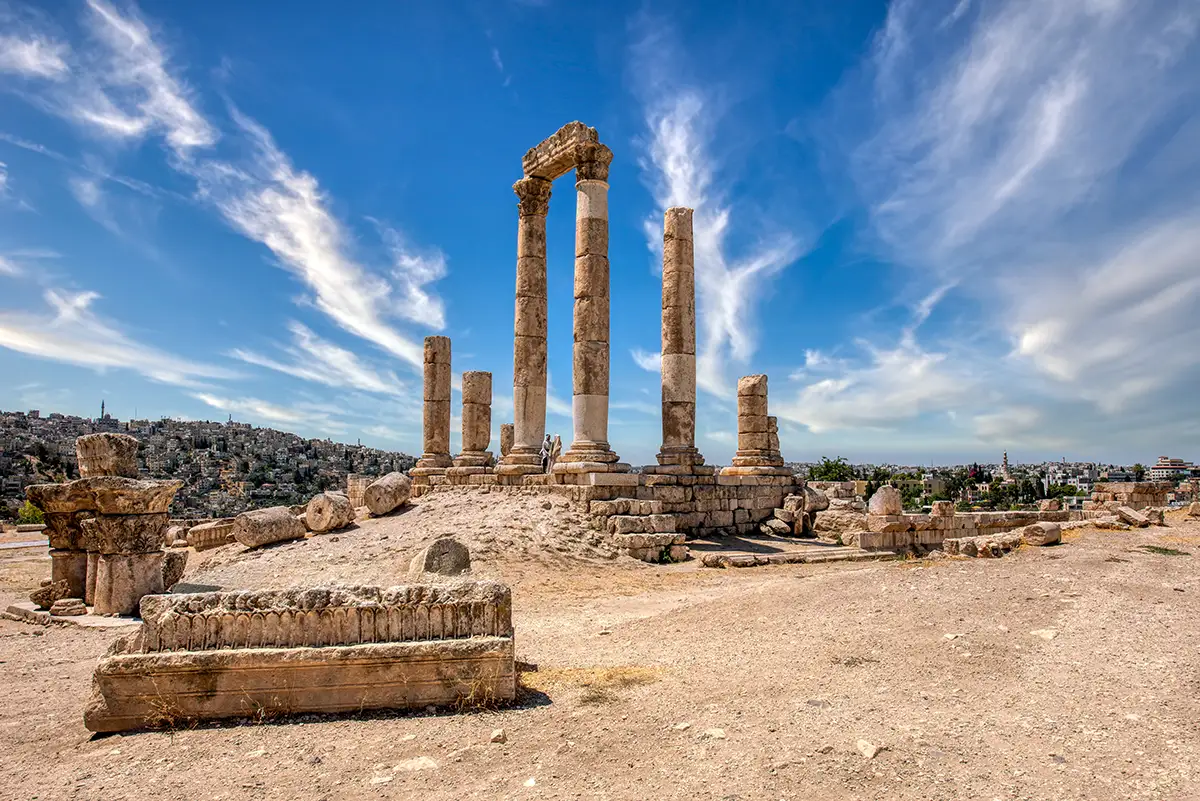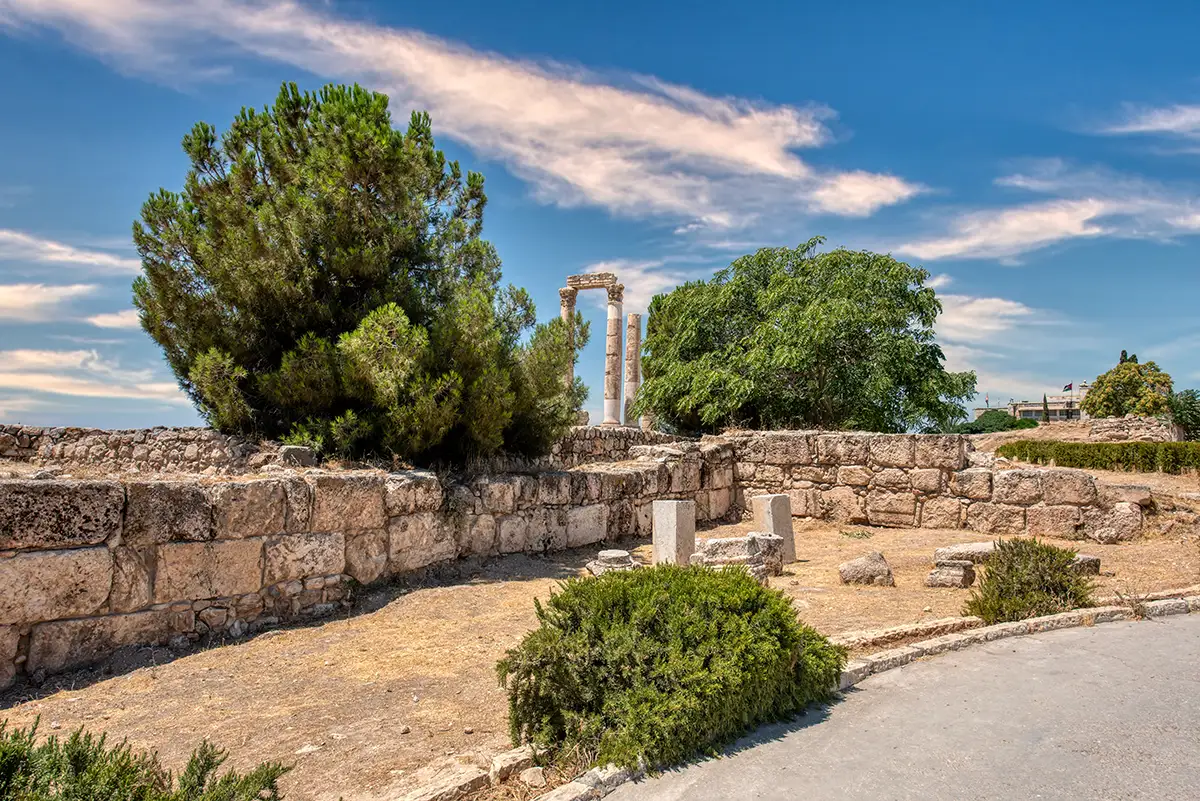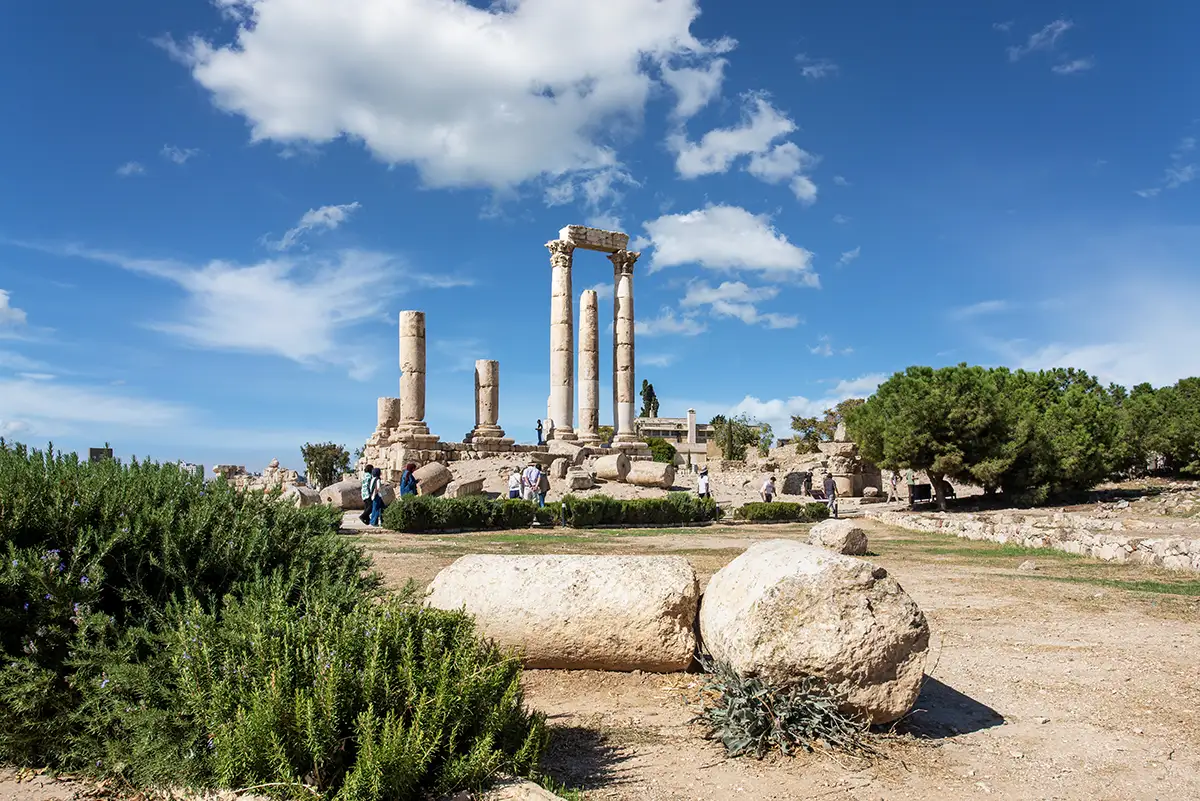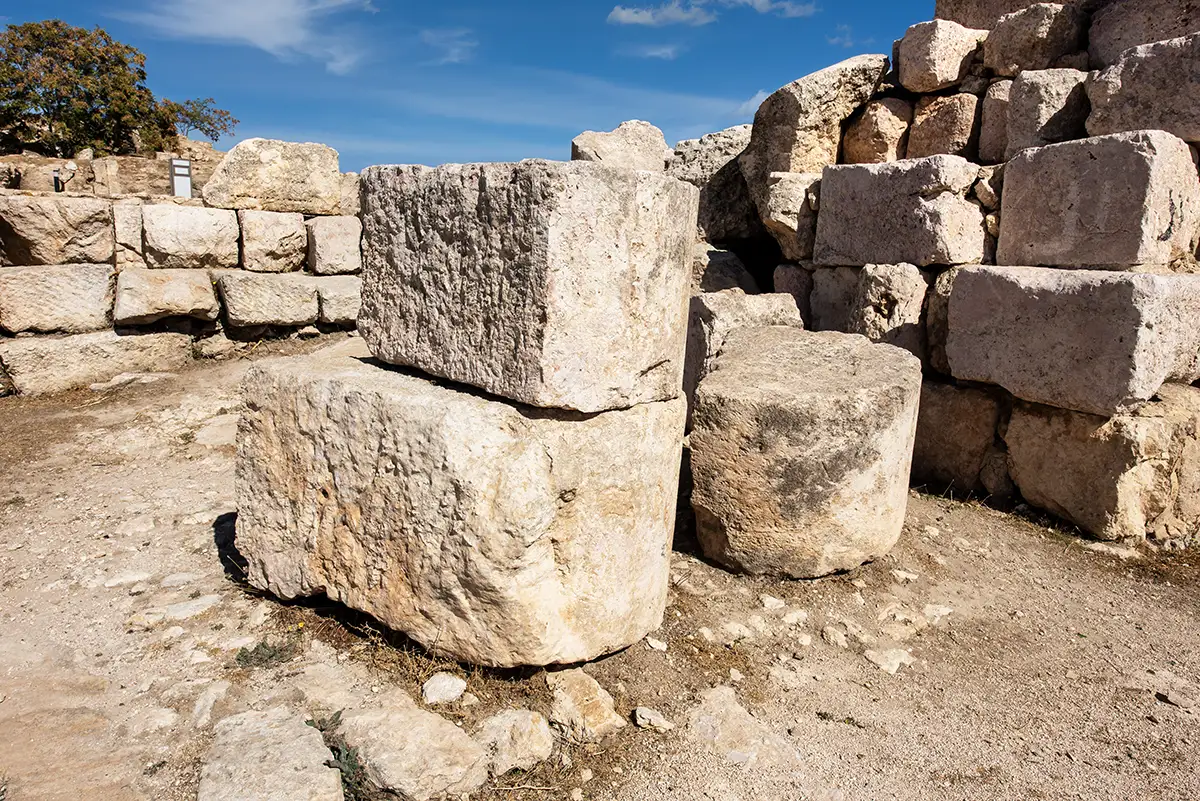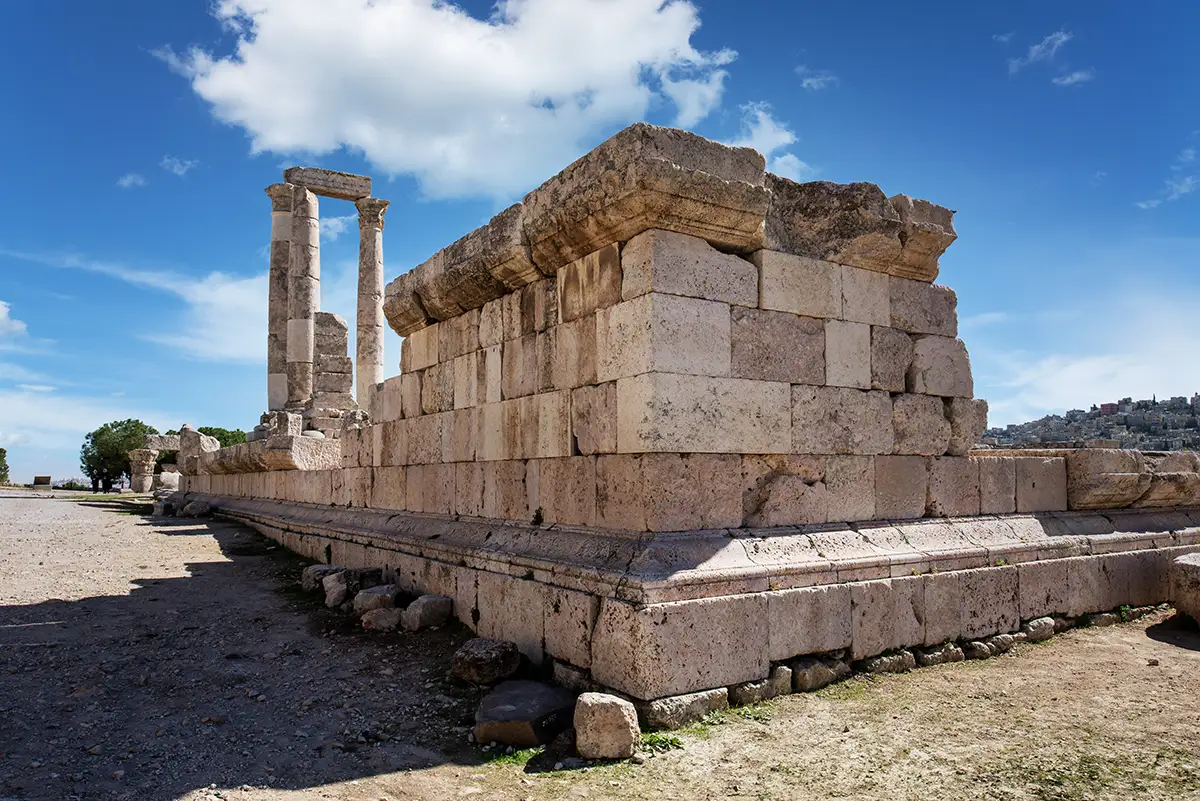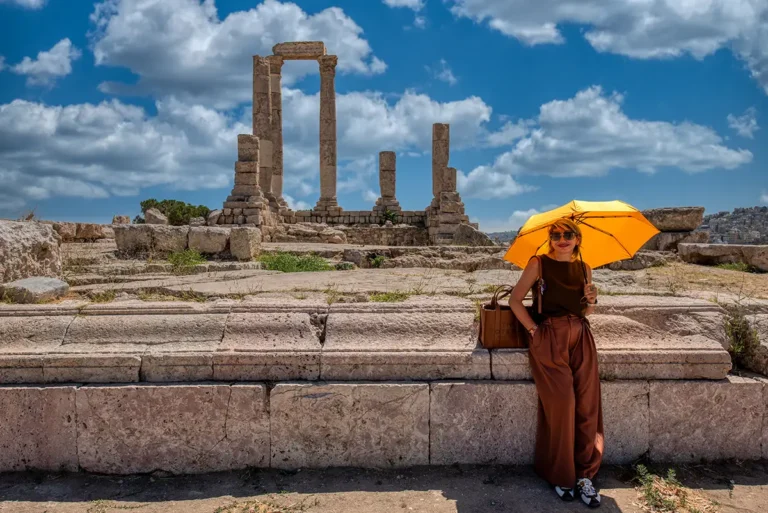













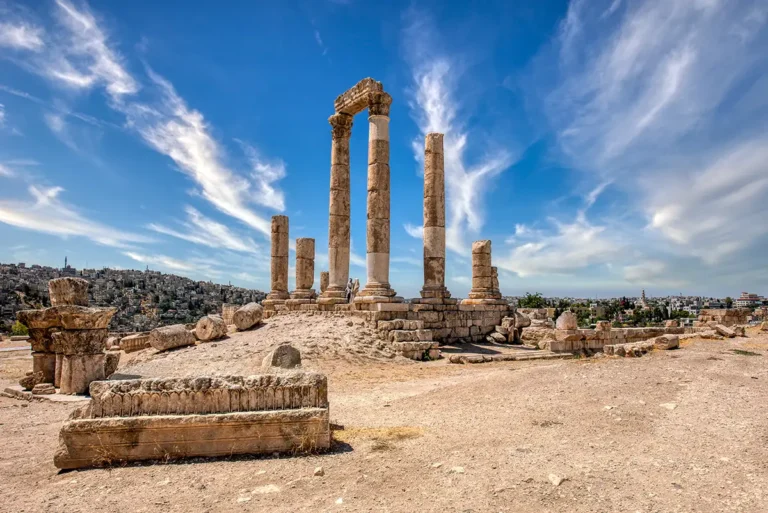
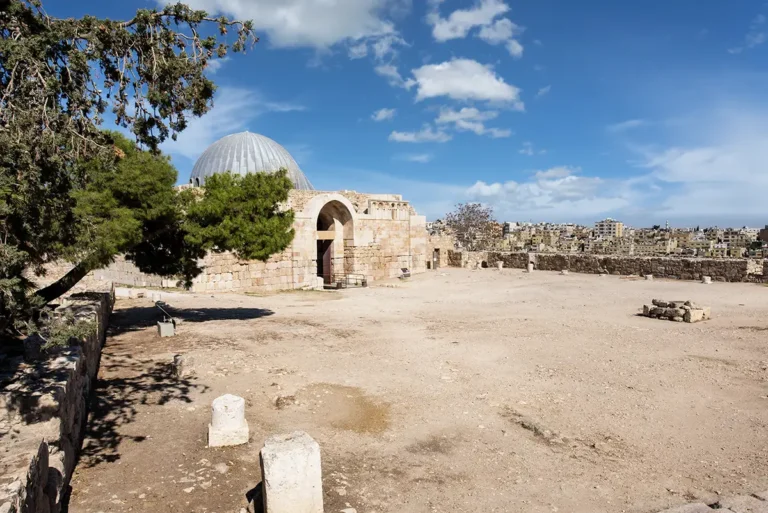
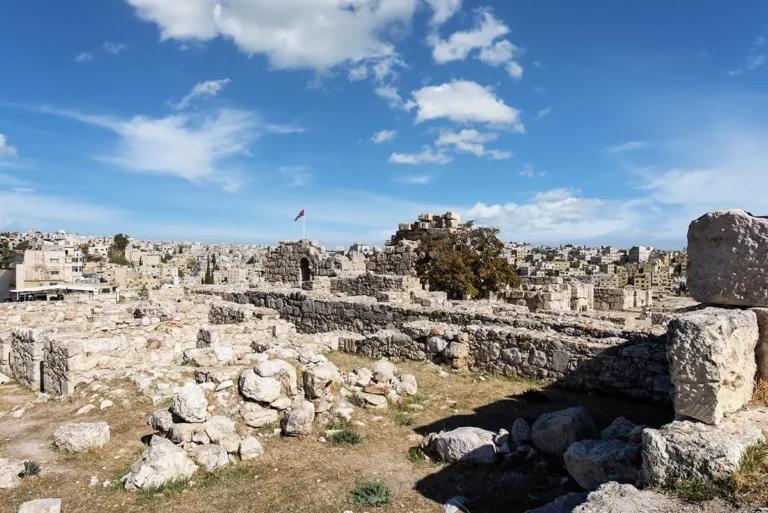
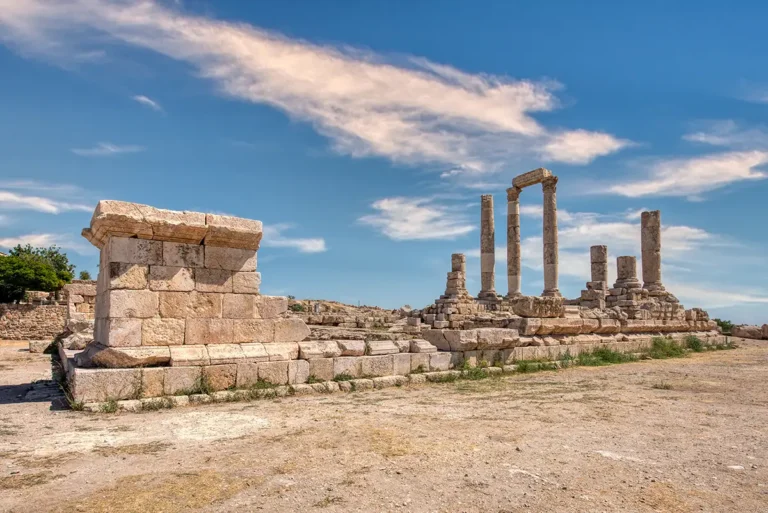

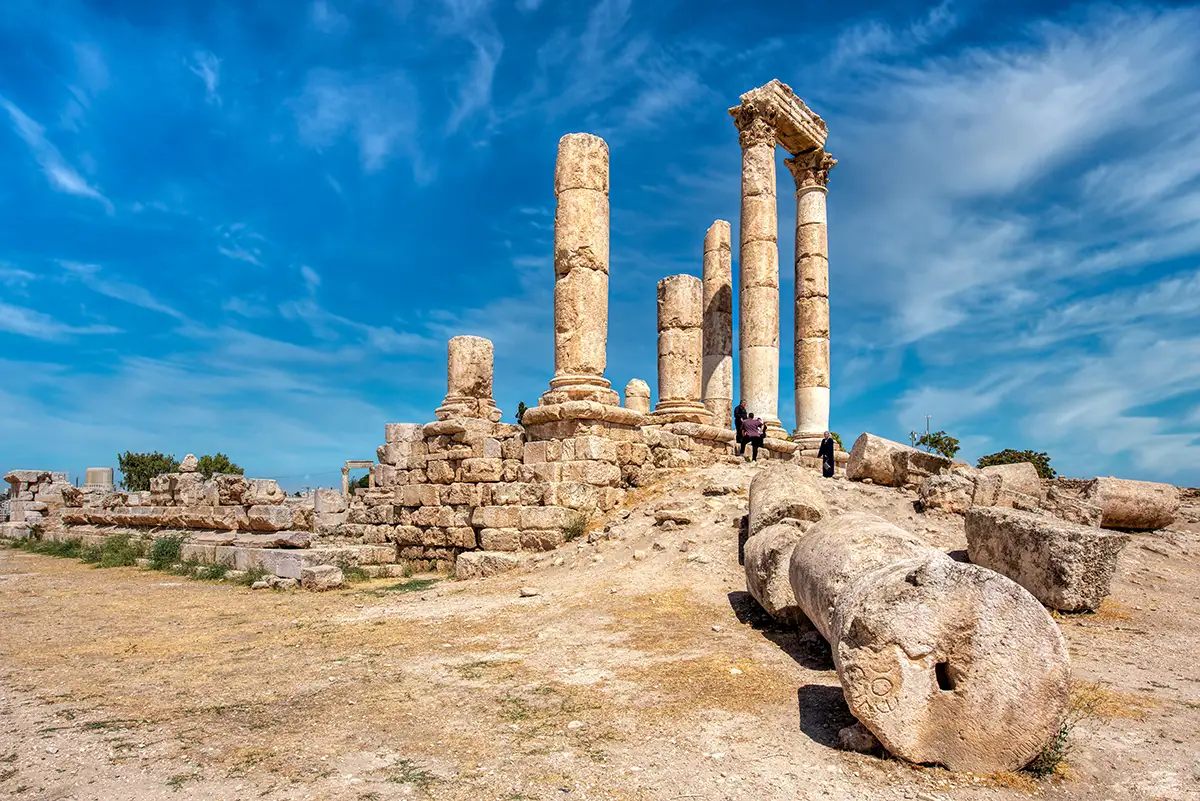
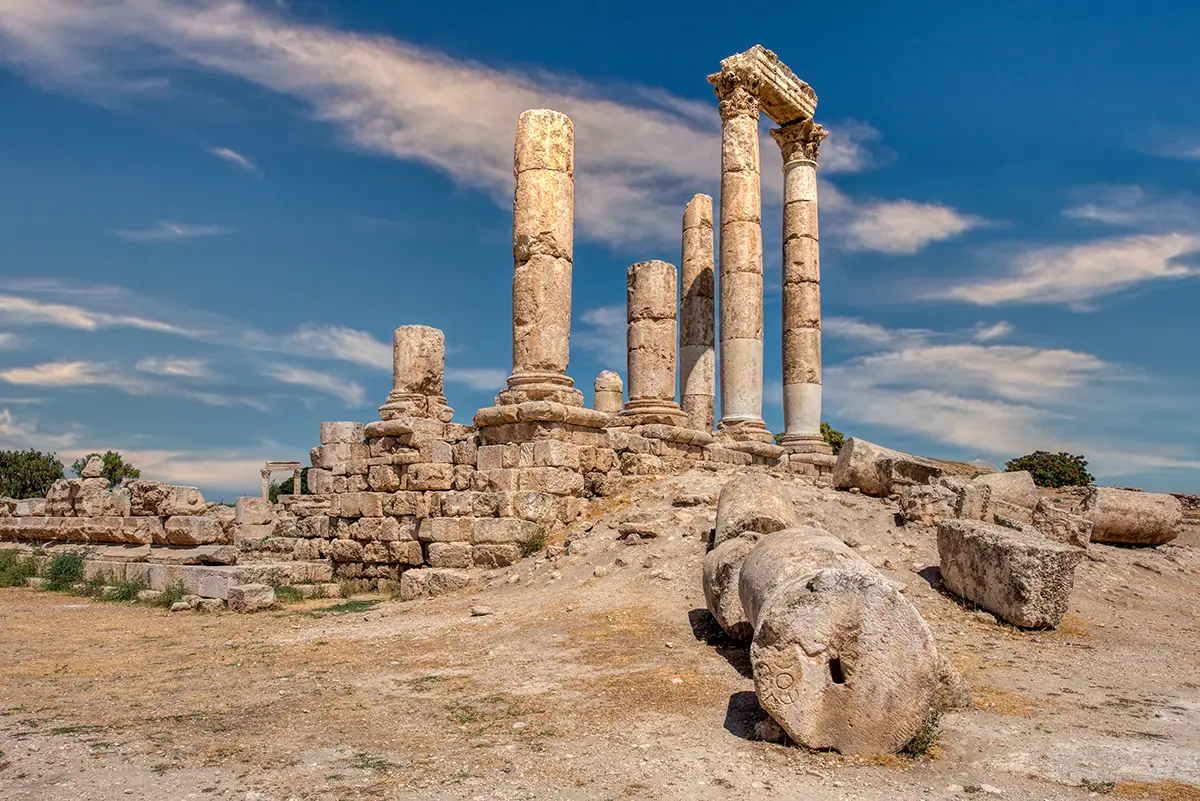
The Temple of Hercules is the best-known landmark of the Amman Citadel: a Roman temple of the 2nd century AD whose giant restored columns can be seen across the centre of the city. Only part of the building survives, but the columns, the platform and the fallen drums at their feet show how large it was.
Where Is the Temple of Hercules?
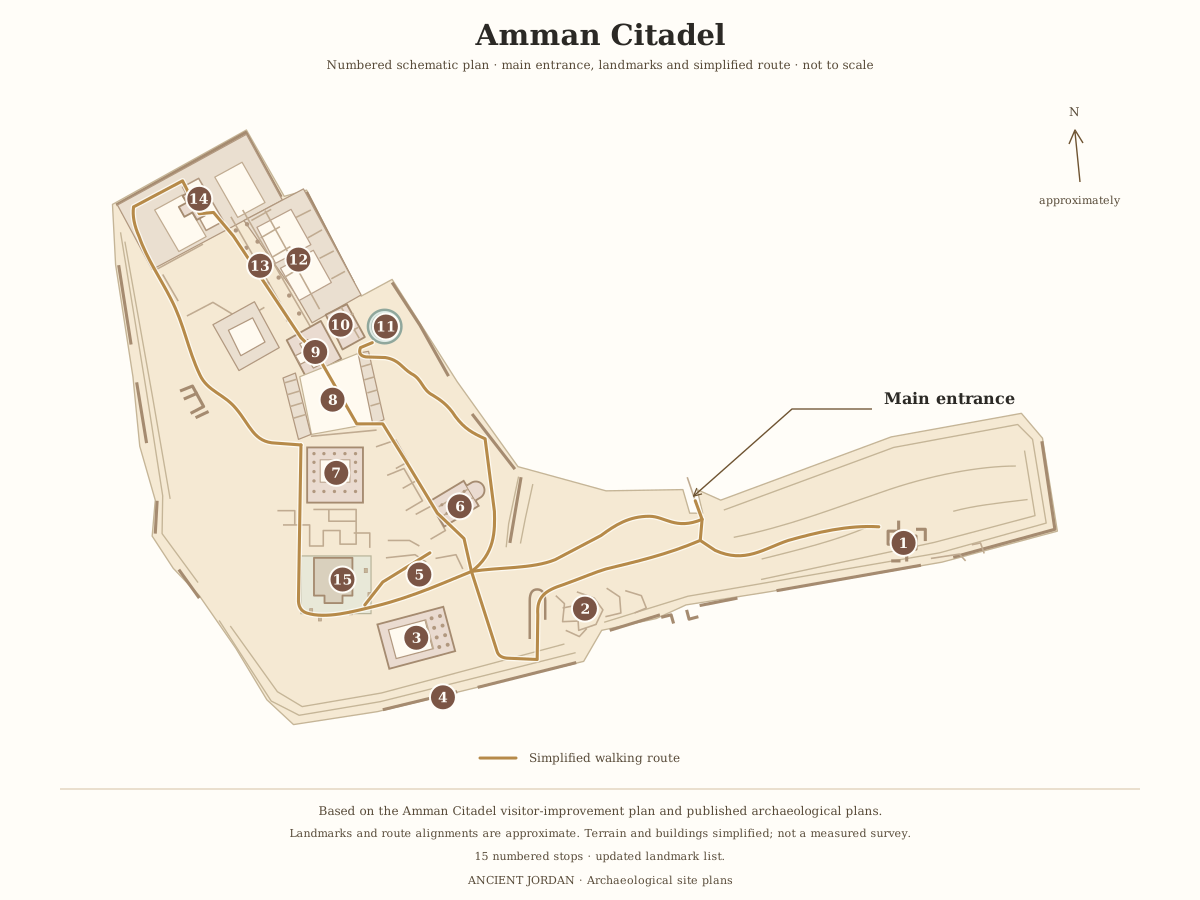
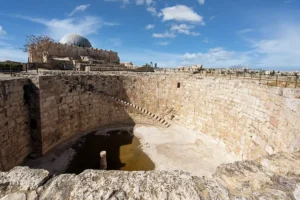
The temple stands in the middle of the Amman Citadel, about 55 m north of the Ayyubid Watch Tower. It is the third stop on our Amman Citadel route, after the Byzantine Residential Complex. The temple stood inside a large walled precinct, and from the platform you look out over the hills of Amman.
Historical Context and Origin
According to the official information boards, the temple was built in the Roman period and dated to the 2nd century AD by an inscription on its architrave. It was dedicated to Hercules, the Roman son of Zeus and a mortal woman, Alcmene. The board also suggests that it was built over the foundations of an earlier temple linked with the Ammonite god Milkom.
A yearly festival of Hercules was held in Philadelphia, the ancient name of Amman. The boards propose that the precinct was the setting for this festival, which was an important part of the city’s economy. The builder is named as Martas Diogenes, known from another Greek inscription found in the ruins of the Church of Saint George at Jabal al-Weibdeh. Archaeologists often call the building the Great Temple of Amman.
Architectural Design
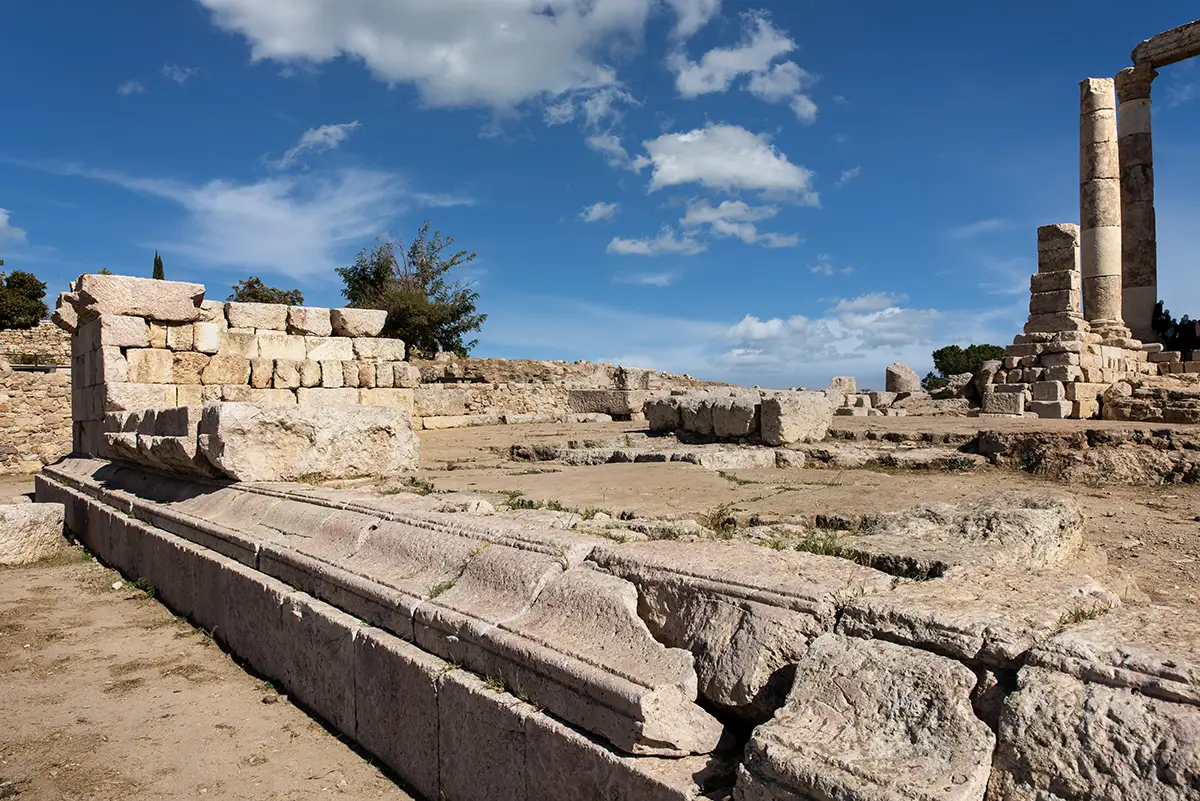
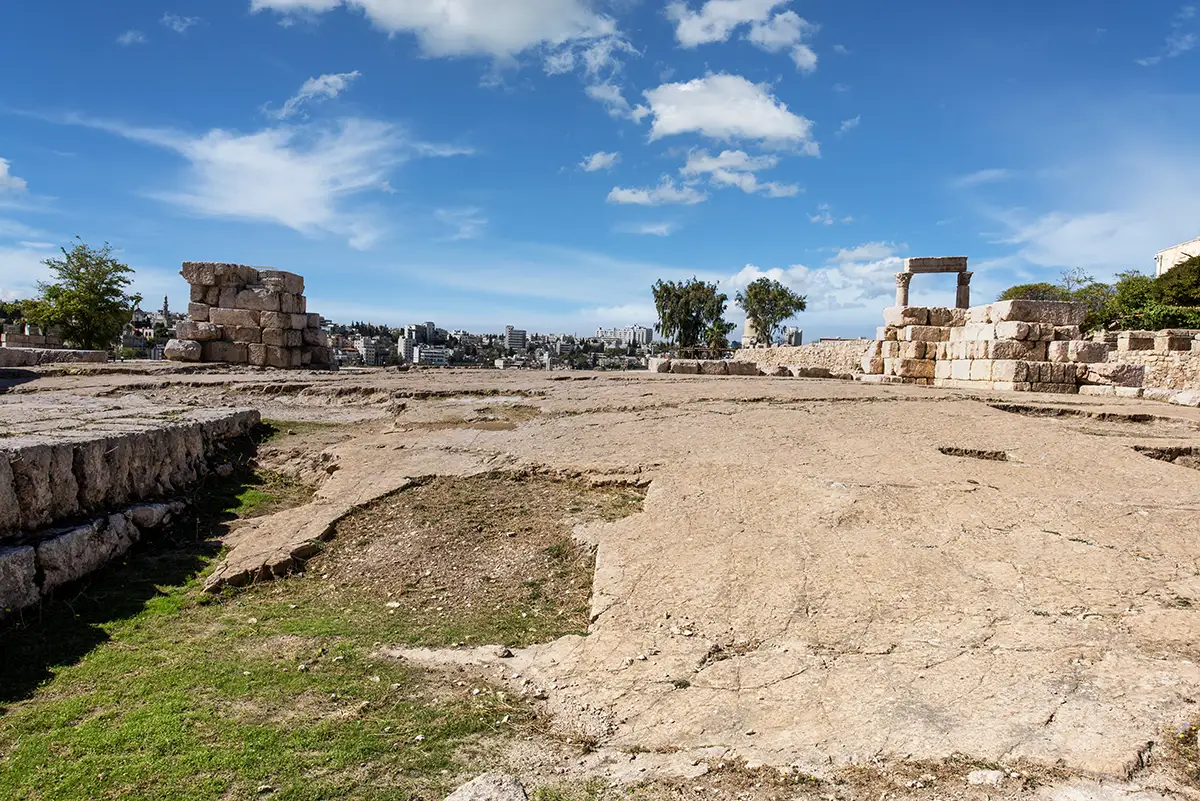
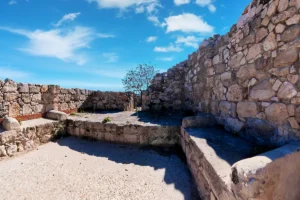
The temple was hexastyle, with six columns across the front. It had a portico of free-standing columns and an inner room, the cella, with columns engaged in its walls. A large precinct, the temenos, surrounded it, enclosed on all four sides by roofed corridors. The entrance was on the east, and the temple was reached by a staircase of which parts can still be seen.
Six-Column Front
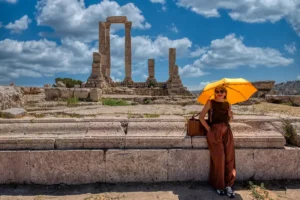
The temple was hexastyle, with six columns across its front. Three have been restored, each about 13.5 m tall.
The Temenos
A large precinct around the temple, enclosed on all four sides by roofed corridors.
Eastern Staircase
The entrance faced east, reached by a staircase of which parts are still visible.
Colossal Statue
The plan marks a statue of Hercules in the precinct; fragments of a colossal marble statue have been found near the temple.

Temple of Hercules, Amman Citadel
Interpretive plan of the Great Temple of Amman, after Kanellopoulos
Open drawingThe Temple Inscription
A Greek dedication on the architrave dates the temple to the reign of the emperors Marcus Aurelius and Lucius Verus. The second information board gives its text.
Dedicatory Inscription of the Temple of Hercules
Translation as given on the Ministry of Tourism and Antiquities and Department of Antiquities information board at the site. The inscription is carved on the temple's architrave, and the board shows its Greek fragments. Marcus Aurelius and Lucius Verus ruled together from AD 161, and Geminius Marcianus governed the province of Arabia in AD 161–166.
[To the well-being] of our emperors Marcus Aurelius Antoninus and Lucius Aurelius Verus, together with whom he dedicated this Herculean sanctuary and festival-place. In the term of Geminius Marcianus, legate of the righteous emperor's (…)
Herakleion: Hercules temple.
Fall and Restoration
The building stayed in use for centuries, but most of its stone was later taken for other buildings. The Ayyubid Watch Tower beside it was built largely from temple stone. Earthquakes in the mid-8th century brought down the rest of the temple and the four columns still standing at its front.
The American Center of Oriental Research (ACOR) restored part of the temple from 1992. Three of the front columns, each about 13.5 m tall, were put back together and carry a section of the inscribed architrave.
Visiting the Temple of Hercules Today
The temple is part of the Amman Citadel visit and is covered by the Citadel ticket (3 JOD for visitors, 0.25 JOD for residents) and by the Jordan Pass. The Citadel is open from 8:00 to 16:00 from November to March, to 17:30 in April and May, and to 18:30 from June to September; in Ramadan it is open from 9:00 to 17:00.
Information boards in English and Arabic stand beside the temple, with a plan of the precinct and a reconstruction drawing. Look for the fallen column drums, the edge of the podium and the part of the stair that survives, and do not climb the ancient stones. About 20 minutes is enough.
Further reading: Ministry of Tourism and Antiquities and Department of Antiquities information boards at the site; ACOR, The Amman Citadel; Chrysanthos Kanellopoulos, The Great Temple of Amman: The Architecture (ACOR, 1994); Anthi Koutsoukou and others, The Great Temple of Amman: The Excavations (ACOR, 1997).