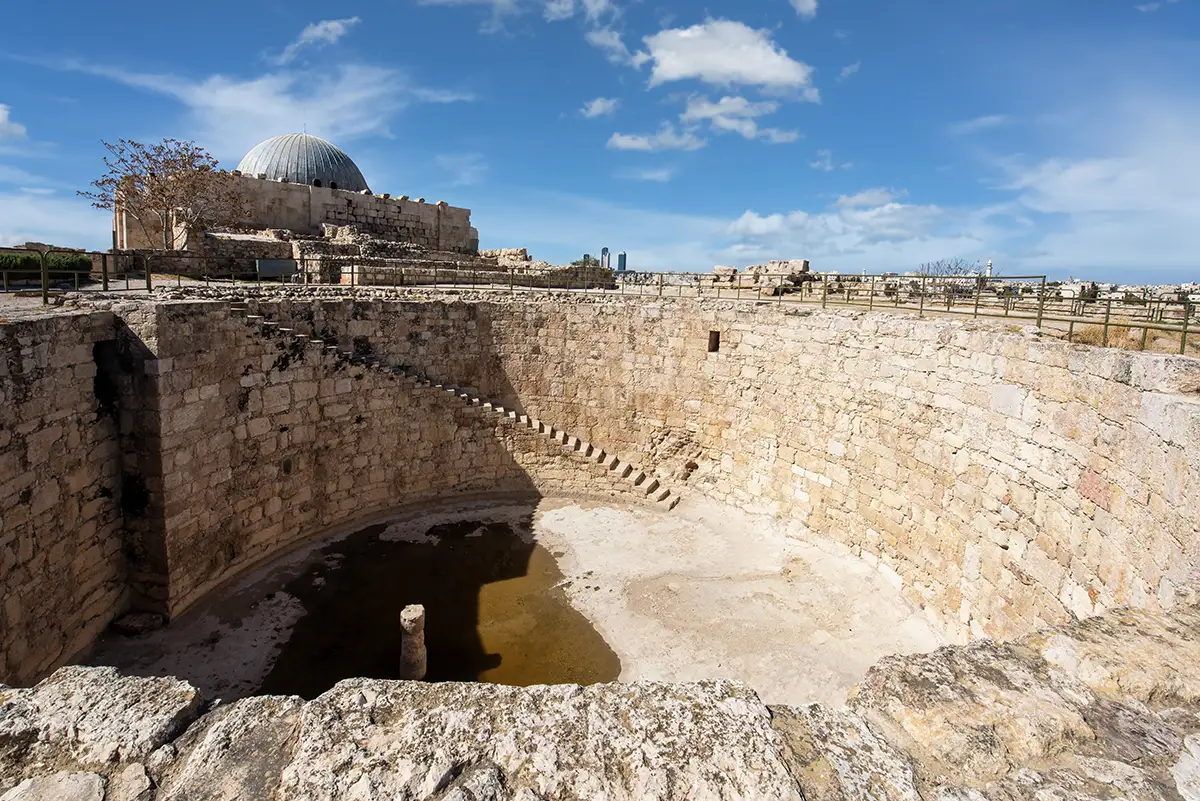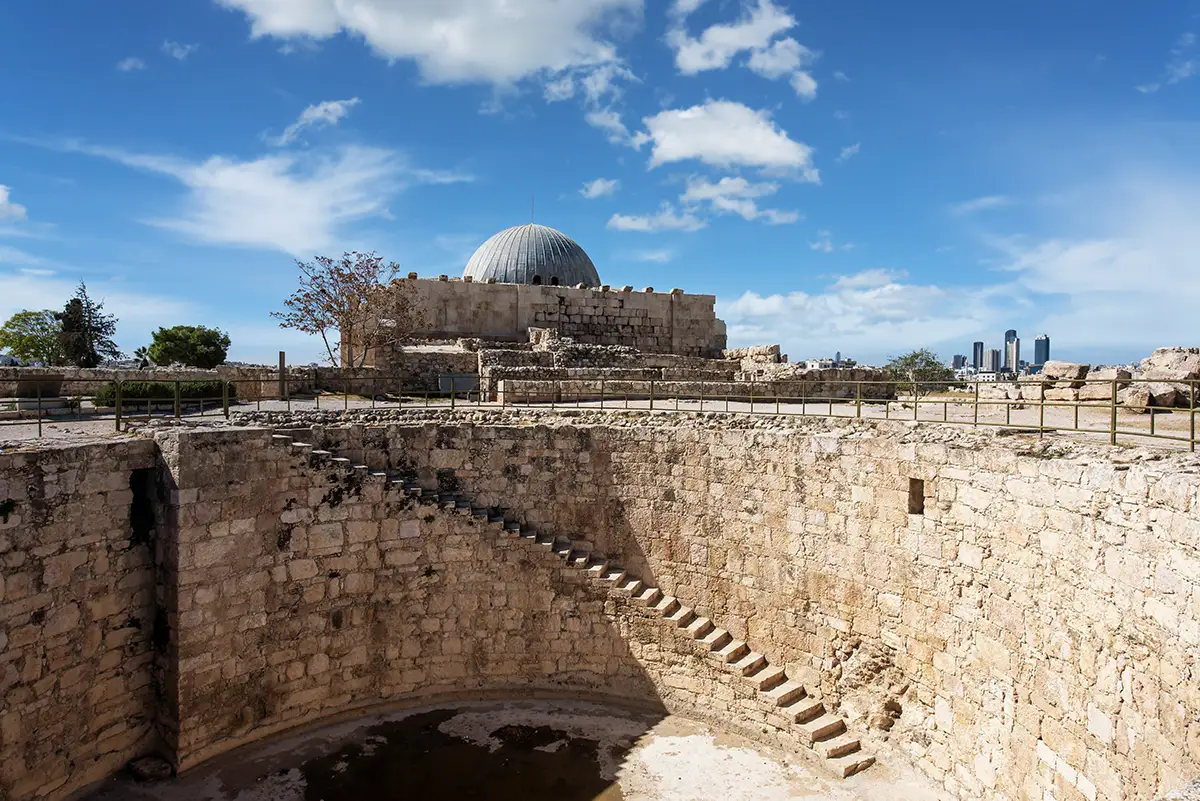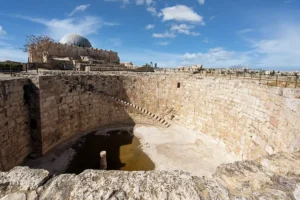












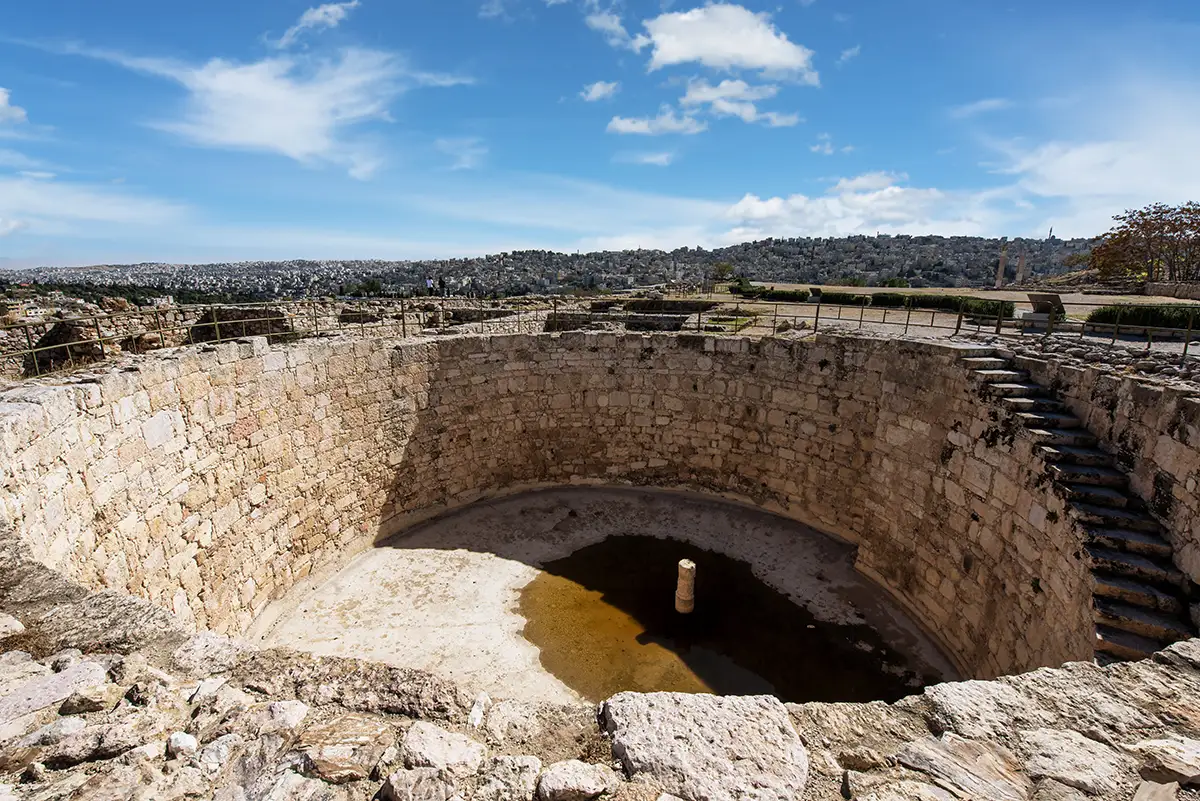


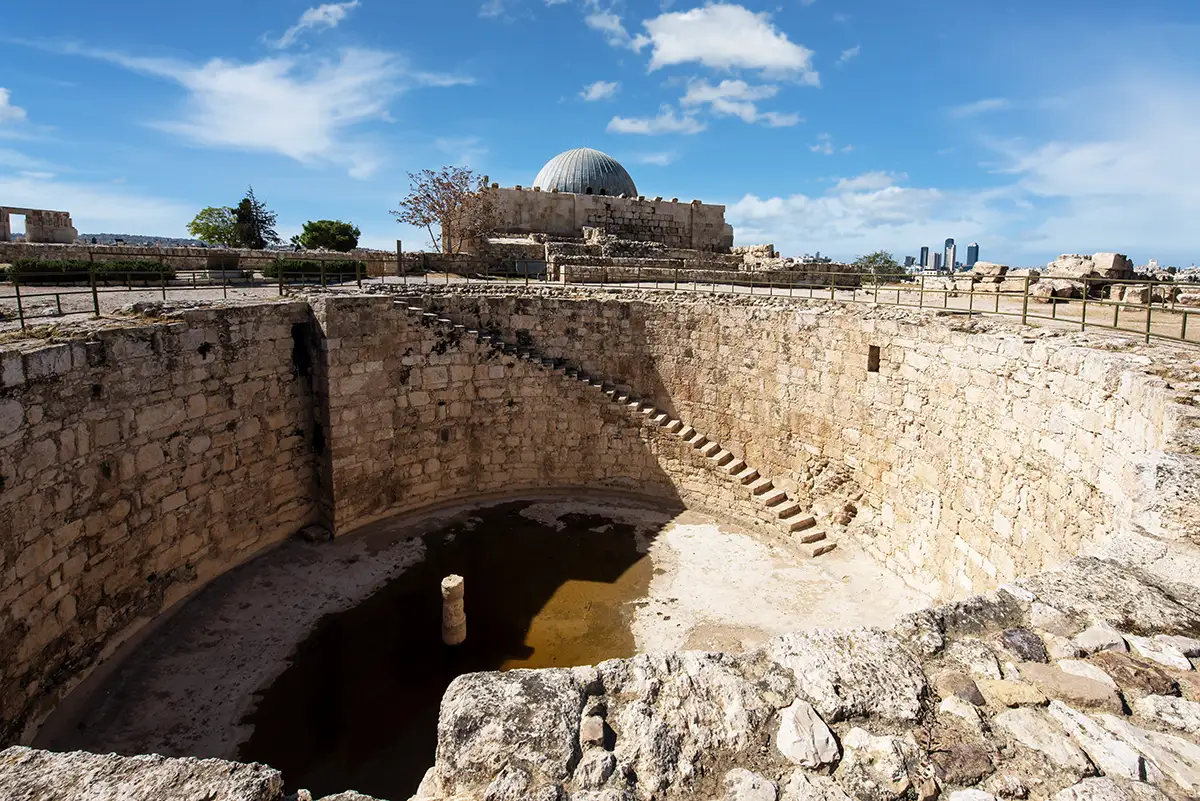
The Open Reservoir, known in Arabic as Al Birkah, is a large circular water tank of the Umayyad palace complex on the Amman Citadel. It is about 17.5 m across and 7 m deep, and it stored rainwater collected from the roofs and open ground of the complex.

Where Is the Open Reservoir?
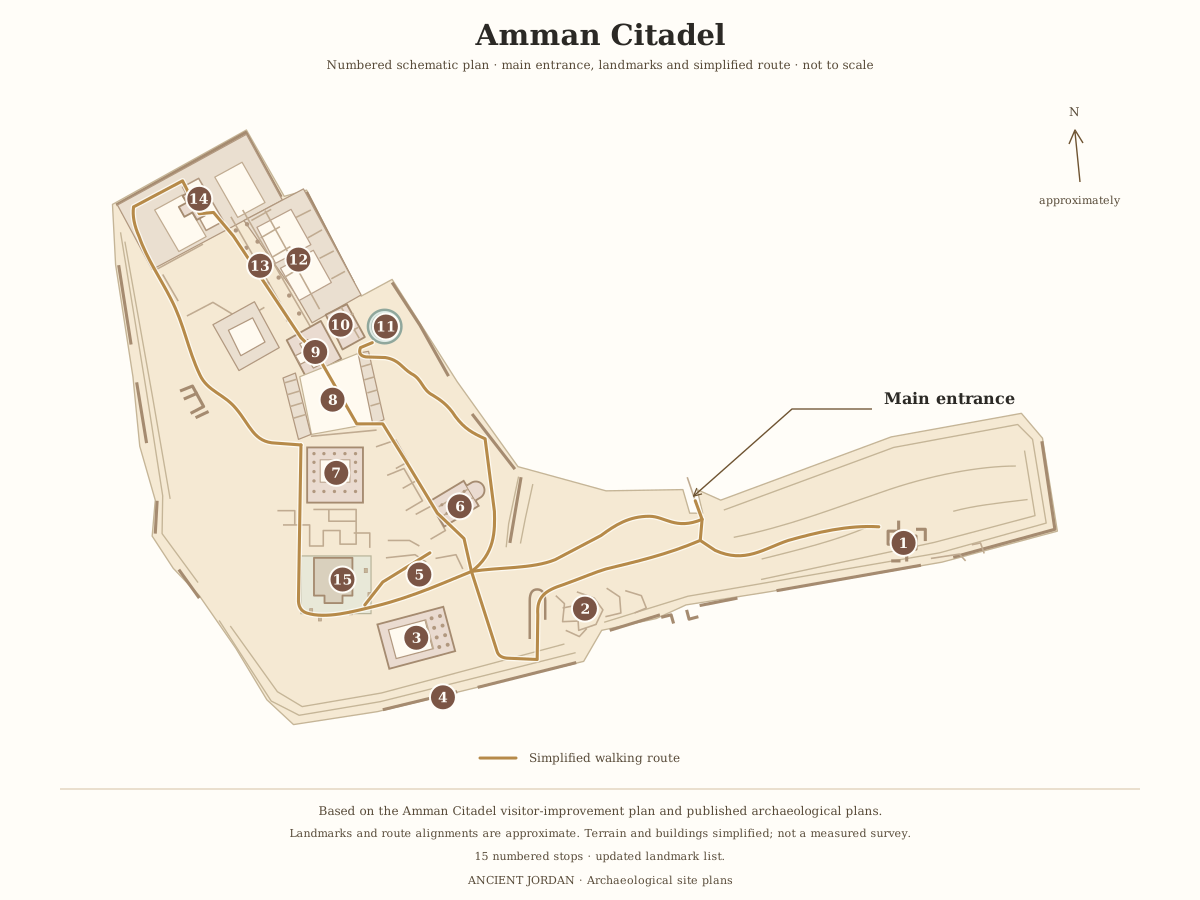
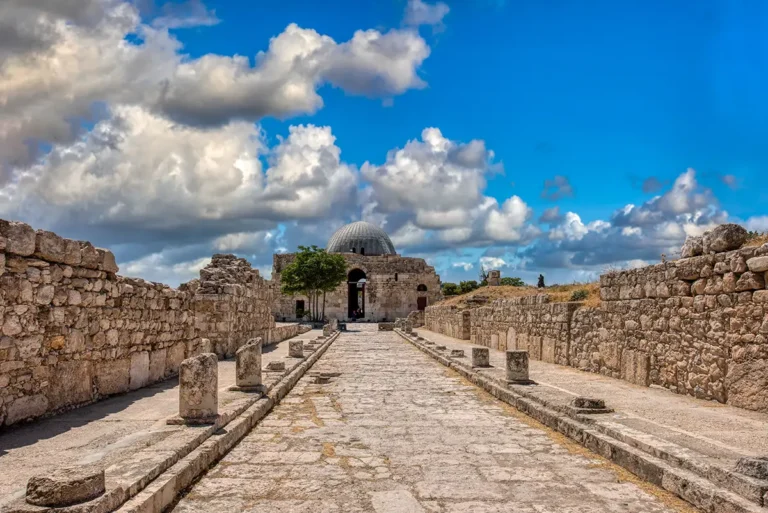
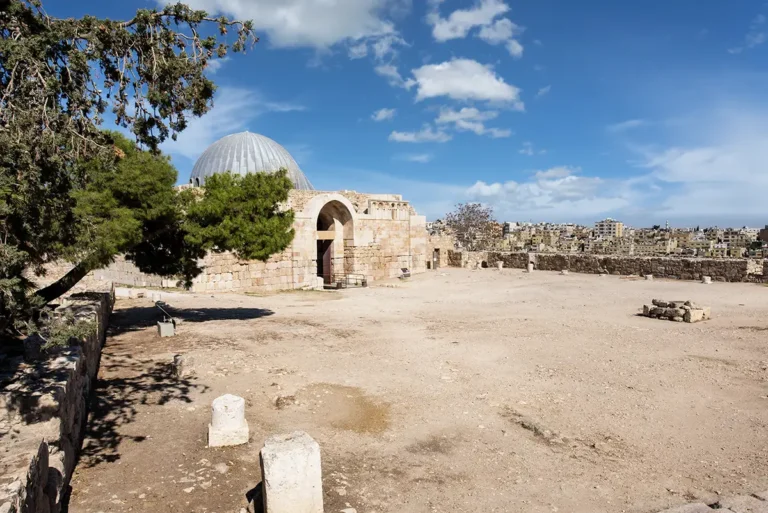
The reservoir stands on the open ground east of the Umayyad Bath House, which it probably supplied with water. It lies a short walk from the Reception Hall and is the eleventh stop on our Amman Citadel route.
Historical Context and Origin
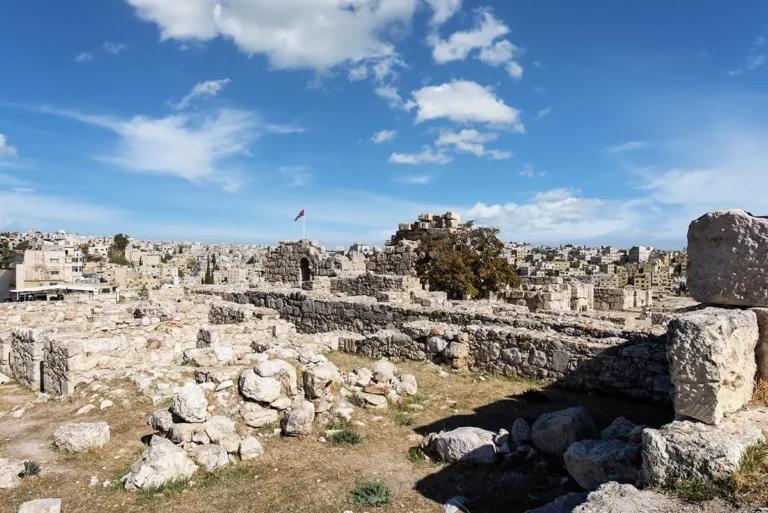
Buildings of the Byzantine period occupied this area before the reservoir was built. In the early 8th century the Umayyads demolished the earlier structures and levelled the ground, then built the circular reservoir with retaining walls and waterproof plaster.
Channels brought runoff from the surrounding roofs, the souk square and nearby open ground into the tank. According to the official information board, two canals on the north and west sides carried the water in, and the reservoir could hold about 1,700 cubic metres.
Patches in the waterproof lining show that the reservoir was repaired many times during its use. Modern conservation has restored its cylindrical profile, its perimeter staircase and the rainwater channels.
Architectural Design
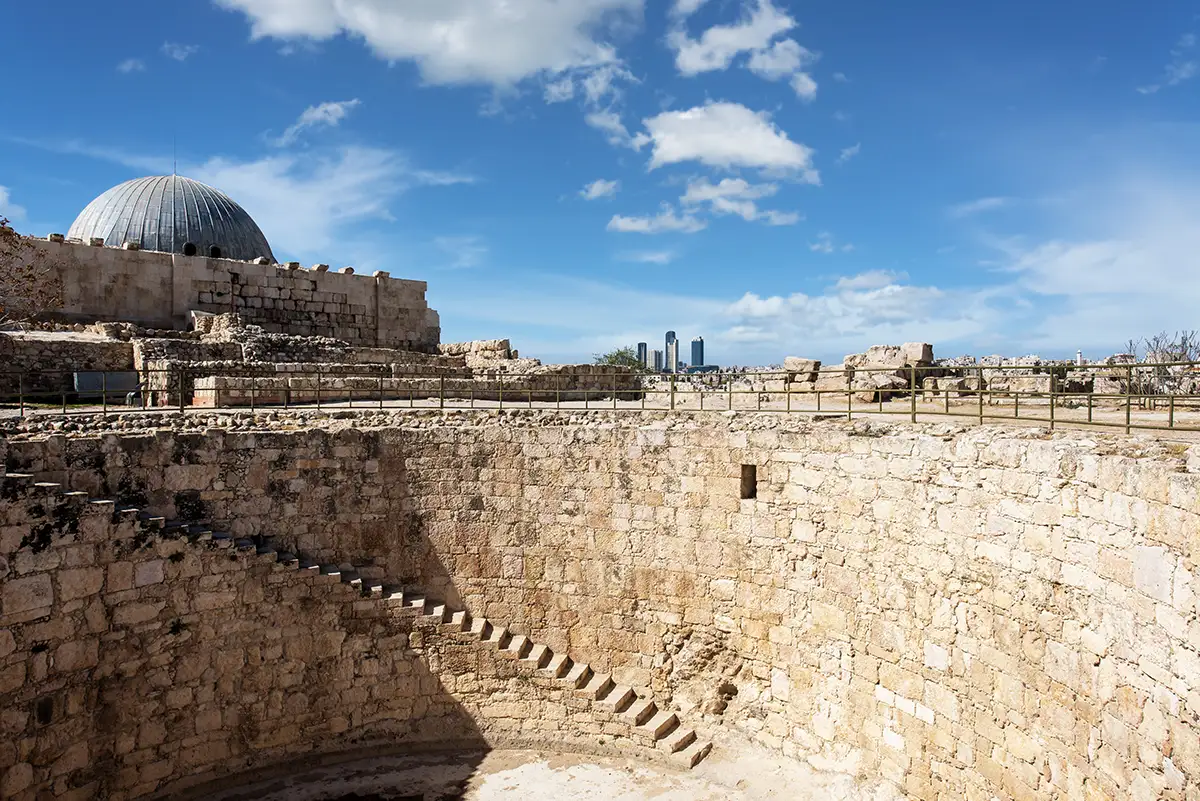
The board gives the reservoir a diameter of 17.5 m, a depth of 7 m and walls 3.5 m thick. A thick layer of mortar covers the inner walls and keeps the water from seeping out. The floor slopes so that silt and impurities settle in a pit at the bottom. When the reservoir dried out, people could walk down a stone staircase to clean it.
A stone column stands in the middle of the floor and was used to read the water level.
Circular Pool
About 17.5 m across and 7 m deep, with walls 3.5 m thick.
Waterproof Lining
A thick mortar lining on the walls and a sloping floor that lets silt settle in a pit.
Measuring Column
A stone column in the middle of the floor was used to read the water level.
Perimeter Staircase
Steps along the wall gave access for inspection and cleaning; they have been restored.

The Open Reservoir, Amman Citadel
Interpretive plan of the Open Reservoir (Al Birkah), after Arce
Open drawingWater for the Bath
The board explains that the reservoir was probably the water source of the bath house next to it. A small well on the north side was joined to the reservoir by a channel, which kept the water level in both the same. The bath house board adds that the reservoir was fed by water from the palace roof and from the northern half of the souk square through an efficient system of channels.
Visiting the Open Reservoir Today
The reservoir is part of the Amman Citadel visit and is covered by the Citadel ticket (3 JOD for visitors, 0.25 JOD for residents) and by the Jordan Pass. The Citadel is open from 8:00 to 16:00 from November to March, to 17:30 in April and May, and to 18:30 from June to September; in Ramadan it is open from 9:00 to 17:00.
Visitors can walk around the reservoir and look down into it, but they are not allowed to go down. An information board in English and Arabic stands at the site, with a plan and a section. Look for the measuring column and the staircase on the curved wall. Rainwater sometimes collects in the central depression. About 10 minutes is enough.
Further reading: Ministry of Tourism and Antiquities and Department of Antiquities information board at the site; Ignacio Arce, “The Umayyad Hydraulic System at Amman Citadel: Collection, Storage, Distribution, Use and Sewage”, section 2.2; Ignacio Arce, Syria 92 (2015), pp. 133–141.