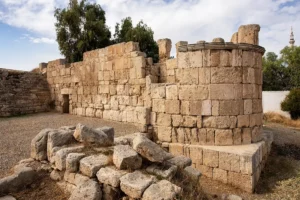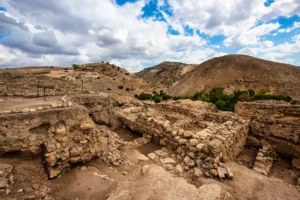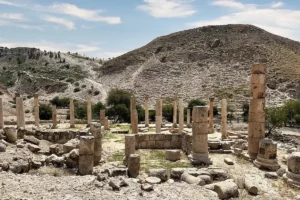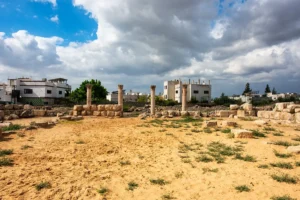












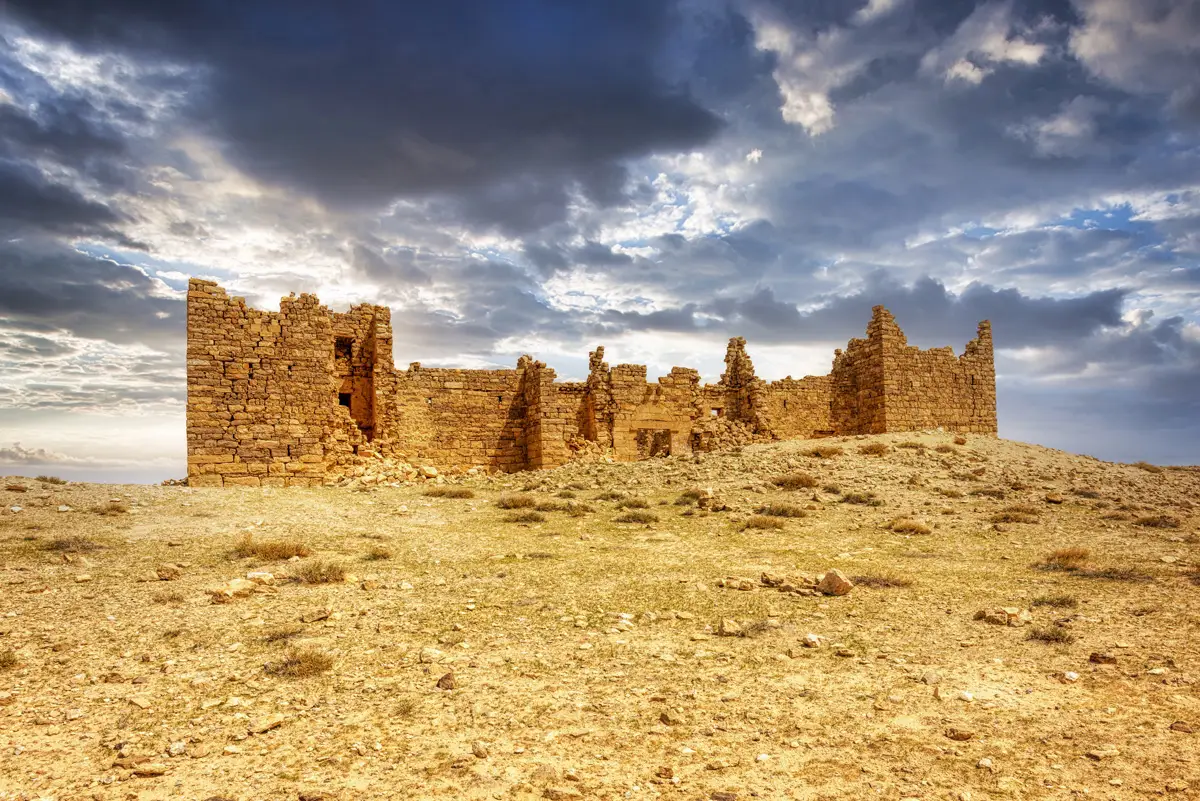


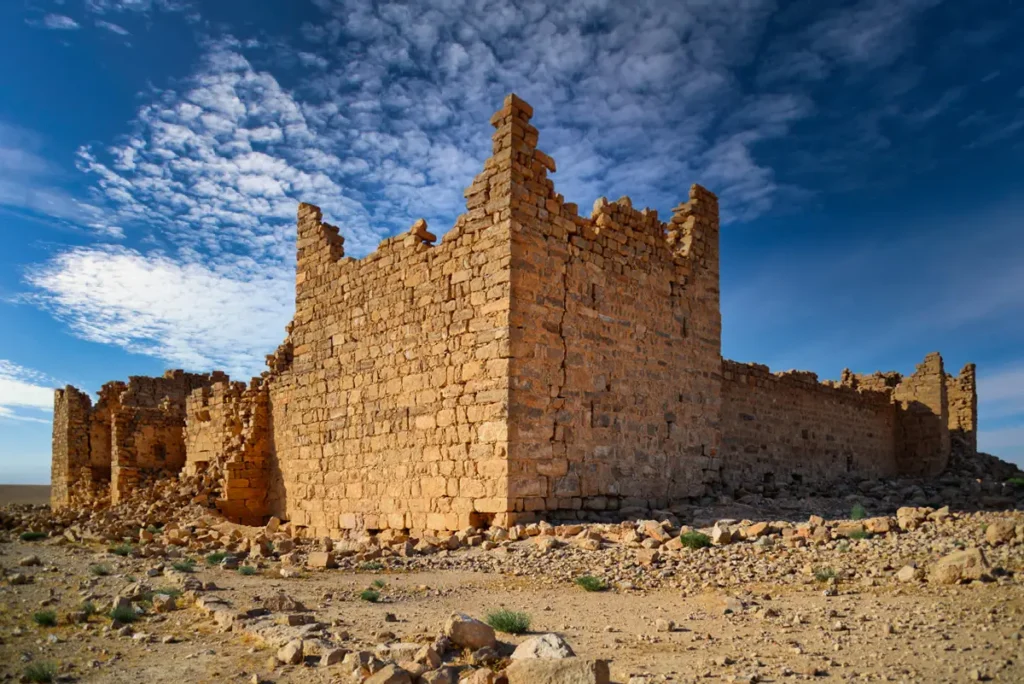
Alone on the steppe east of the Dead Sea, Qasr Bshir still looks like a Roman fort: four corner towers, high walls and a gate with its original Latin inscription. Built under Diocletian at the end of the 3rd century AD, it is the best-preserved Roman fort in Jordan.
Where Is Qasr Bshir?
The fort lies about 80 km south of Amman on the Karak plateau, about 15 km north-west of Qatrana and 15 km north-east of the legionary fortress of El-Lejjun. From the Desert Highway, a tarmac road and then a desert track lead to the site.
Historical Context and Origin
The Latin inscription over the gate dates the fort to AD 293–305, when four emperors, the Tetrarchs, ruled the Roman world. It records that Aurelius Asclepiades, governor of the province of Arabia, built the Castra Praetorii Mobeni, the “praetorian camp of Mobene”. The fort was part of Diocletian’s strengthening of the desert frontier, the Limes Arabicus. The inscription names no unit, so its garrison is unknown. Excavations show Roman use until about 500, a later Umayyad reoccupation, and the collapse of the barracks probably in the earthquake of 747.
Architectural Design
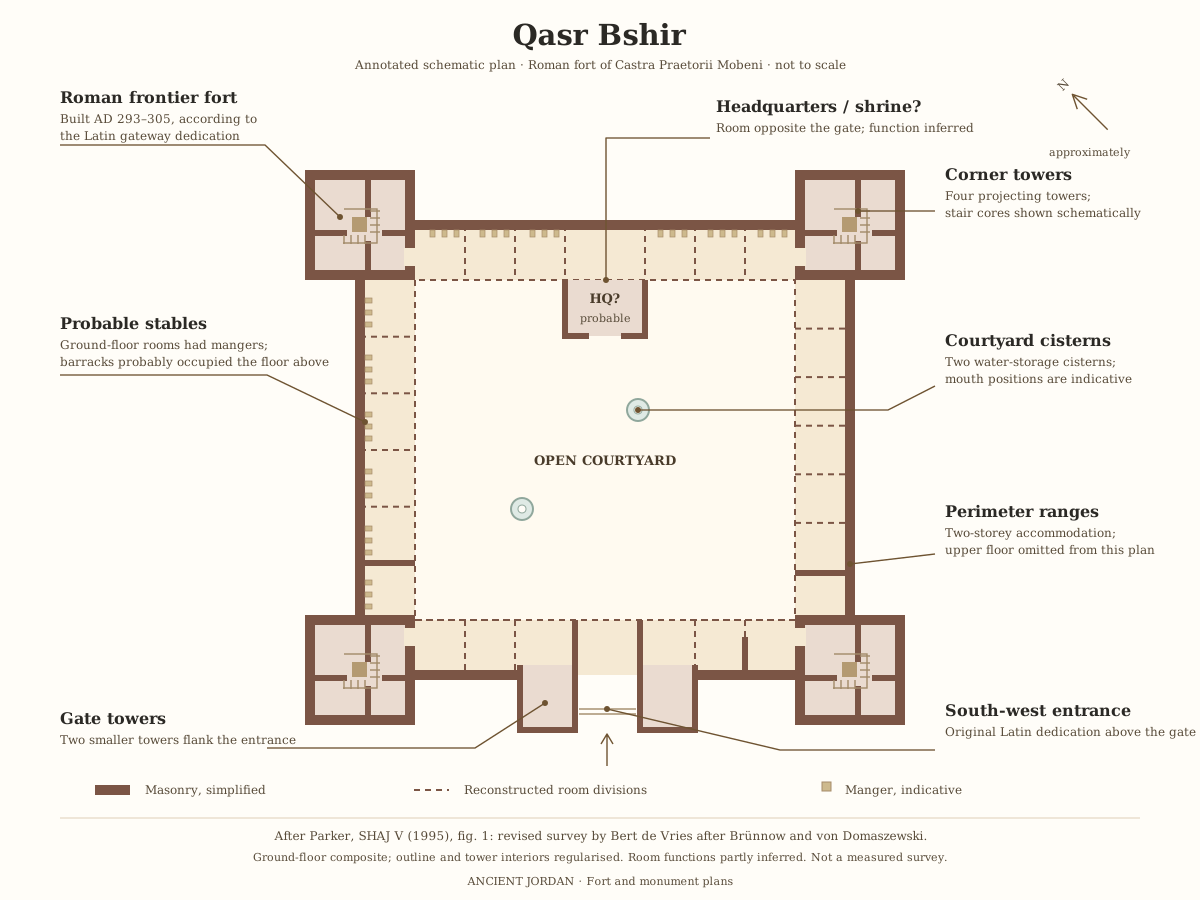
The fort is almost square, about 57 × 56 m, with walls about 6 m high. Square towers project at the four corners and rise three storeys, with stairs winding round a central pier. Two smaller towers flank the gate in the south-west side. Around the courtyard, 26 two-storey rooms lined the walls: 23 on the ground floor had stone mangers for about 69 horses, with the soldiers above. The room opposite the gate, without mangers, was probably the headquarters and shrine for the standards. Two cisterns lie in the courtyard.
Gate Inscription
The Latin building inscription is still in place over the gate.
Corner Towers
Four towers still stand up to three storeys high.
Stables
Ground-floor rooms with stone mangers for about 69 horses.
UNESCO Tentative List
Listed since 2001 as a model Roman castellum.
The building inscription of Mobene (CIL III 14149)
The building dedication above Qasr Bshir’s gateway is CIL III 14149, also catalogued as EDCS-29900168. It names the fort Castra Praetorii Mobeni. It is carved in a tabula ansata on the lintel of the main gate, still in place.
OPTIMIS MAXIMISQVE PRINCIPIBVS NOSTRIS GAIO AVRELIO
VALERIO DIOCLETIANO PIO FELICI INVICTO AVGVSTO ET
MARCO AVRELIO VALERIO MAXIMIANO PIO FELICI INVICTO AVGVSTO ET
FLAVIO VALERIO CONSTANTIO ET GALERIO VALERIO MAXIMIANO
NOBILISSIMIS CAESARIBVS CASTRA PRAETORII MOBENI A FVNDAMENTIS
AVRELIVS ASCLEPIADES PRAESES PROVINCIAE ARABIAE
PERFICI CVRAVIT
In honour of our most excellent and greatest rulers: Gaius Aurelius Valerius Diocletianus, pious, fortunate, unconquered Augustus; Marcus Aurelius Valerius Maximianus, pious, fortunate, unconquered Augustus; and Flavius Valerius Constantius and Galerius Valerius Maximianus, most noble Caesars—Aurelius Asclepiades, governor of the province of Arabia, saw to the completion, from its foundations, of the fort of Praetorium Mobene.
The Latin is a normalised transcription, retaining V for both Latin u and v. The reading follows Brünnow and von Domaszewski’s publication, Die Provincia Arabia, volume II, p. 53. Original publication The English translation was prepared from the Latin above for this site.
The four rulers belong to the First Tetrarchy: Diocletian and Maximian were the senior emperors (Augusti), while Constantius I and Galerius were their junior colleagues (Caesares). Their combination dates the dedication to AD 293–305. Parker, SHAJ V, p. 252
A fundamentis means “from the foundations,” presenting the work as a complete construction. Perfici curavit means “saw to its completion”: the governor supervised or commissioned the work. The inscription names no military unit, so it does not identify the fort’s original garrison.
The Gate Inscription
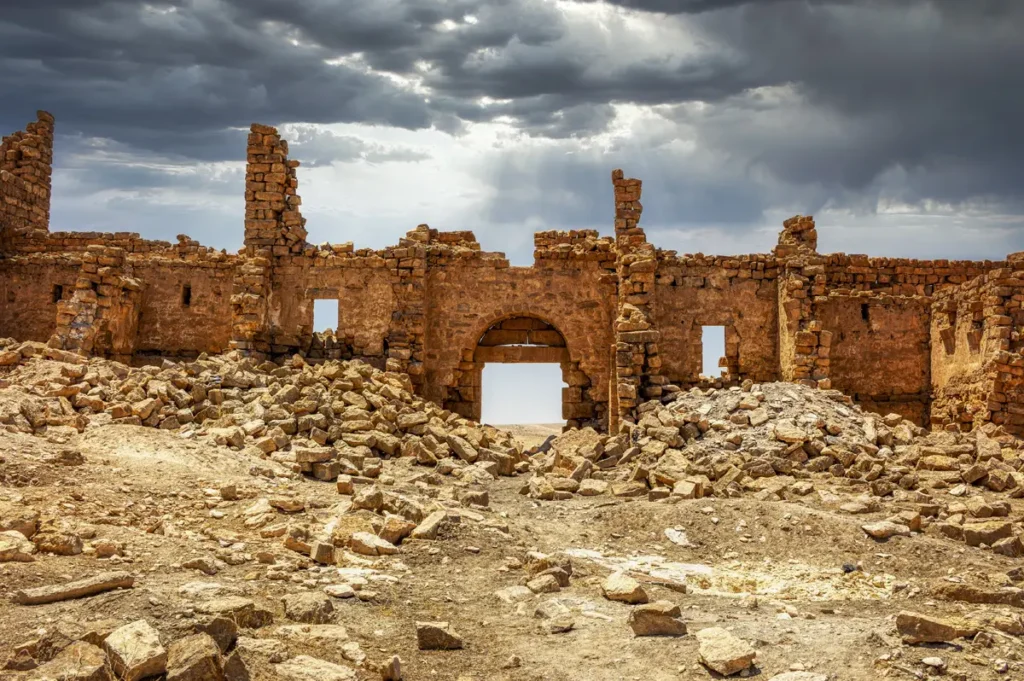
Qasr Bshir is described as the only Roman fort whose original building inscription is still in place over its gate. Brünnow and Domaszewski recorded it in 1897–98, and their photographs already show cracks in the lintel. In 2023 a conservation project consolidated the cracked inscription stone.
Destruction, Rediscovery, and Restoration
S. Thomas Parker’s Limes Arabicus Project excavated the fort in 1982 and 1985, and Ignacio Arce surveyed it in 2006. Parts of the walls have collapsed, and one tower rests on a single cornerstone. Since 2023 a conservation project of Leiden University, Al-Hussein bin Talal University and the Department of Antiquities has been documenting and stabilising the fort. Qasr Bshir has been on Jordan’s UNESCO Tentative List since 2001.
Visiting Qasr Bshir Today
The site is unfenced and free, with no facilities. A 4×4 is required for the final track. The fort is in ruins, so climbing the towers is not safe. Allow about 40 minutes. See our Qasr Bshir travel guide for directions.
Further reading: UNESCO Tentative List — Qasr Bshir; Livius — Mobene (Qasr Bshir); Leiden University — Qasr Bshir Conservation Project.