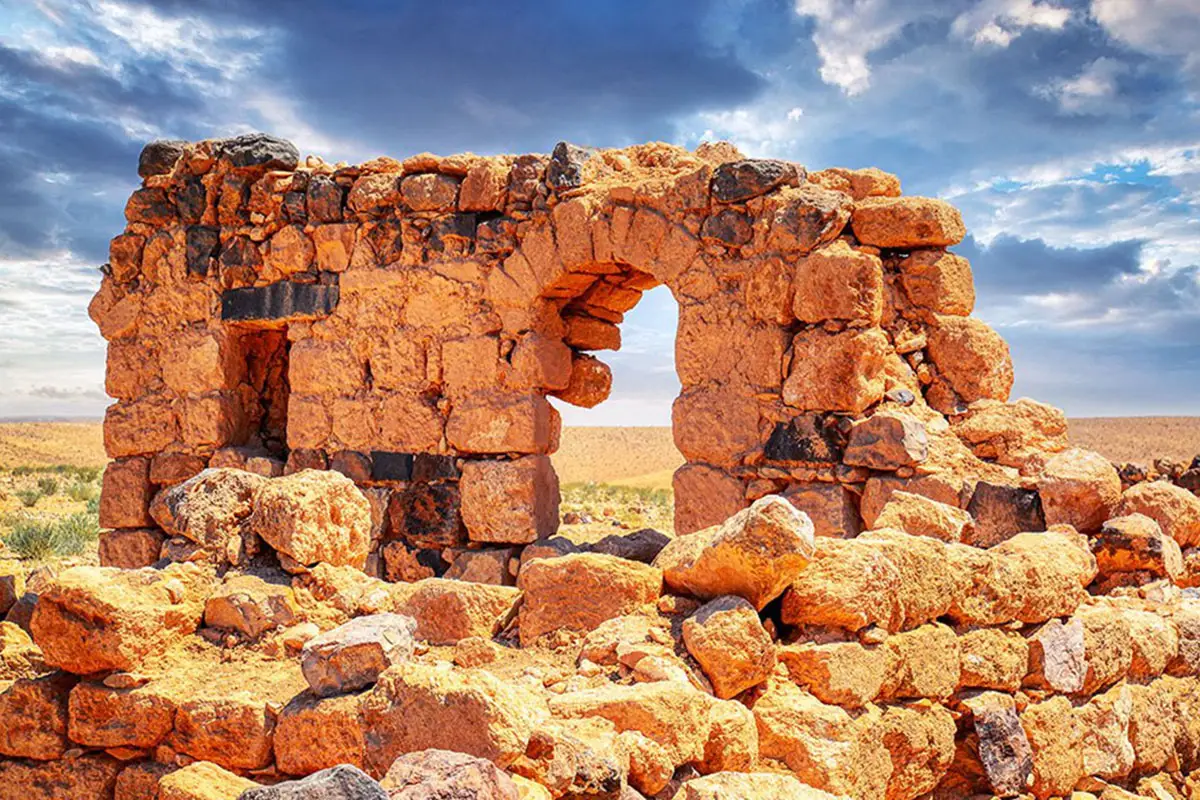


On the open plateau north-east of Karak, where the farmland gives way to the desert steppe, the walls of a Roman fortress enclose a rectangle the size of a small town. El-Lejjun — the name echoes the Latin legio — was built around AD 300 to house a legion, and its excavation in the 1980s made it a key site for the study of Rome’s eastern frontier.
Where Is El-Lejjun?
El-Lejjun lies about 16–17 km north-east of Karak, at roughly 700 m above sea level, in Karak Governorate. It was placed beside a perennial spring, ‘Ain Lejjun, whose stream flows west down Wadi Lejjun towards the upper Wadi Mujib. Two Roman roads passed along the east side of the fortress.
Historical Context and Origin
The fortress was built around AD 300, in the reign of Diocletian (284–305), when the eastern frontier of the province of Arabia was reorganised and strengthened. This line of forts, roads and watchtowers is known today as the Limes Arabicus. El-Lejjun was its largest base in central Jordan: a full legionary fortress, with smaller forts and watchposts around it.
The Notitia Dignitatum, a late Roman list of commands, places the prefect of the Fourth Legion Martia (Legio IV Martia) at Betthorus, under the military governor of Arabia. El-Lejjun is generally identified with Betthorus, although the legion’s presence has not been proven by finds on the site itself. Estimates of the original garrison range from about 1,500 to 2,000 men.
Architectural Design
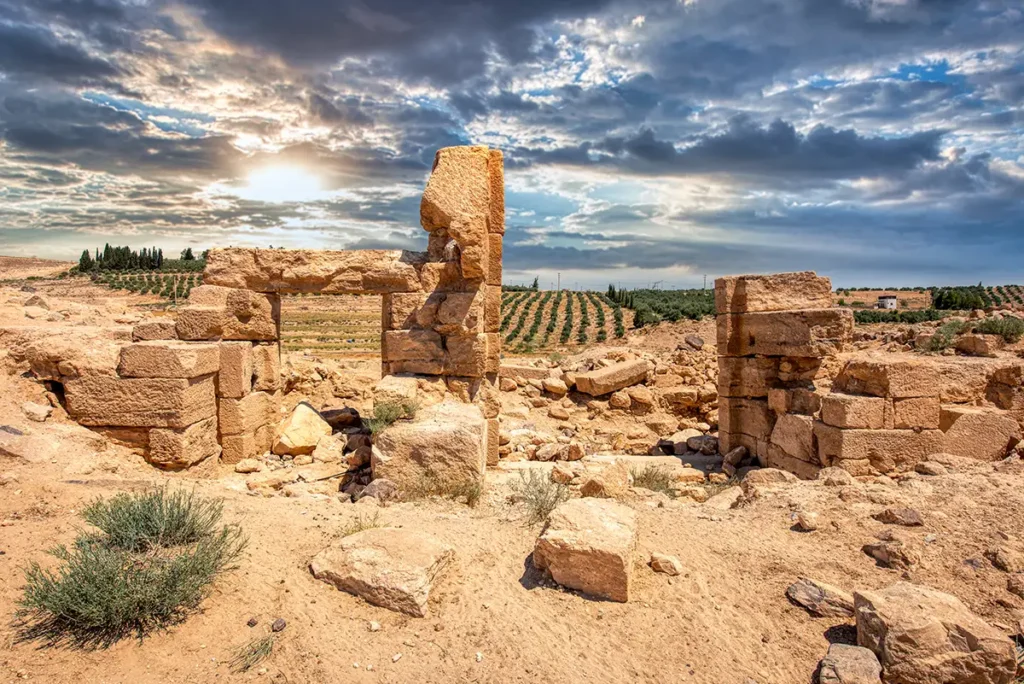
The fortress measures about 242 × 190 m, an area of some 4.6 hectares, enclosed by walls about 2.4–2.5 m thick. Four large fan-shaped towers stood at the corners and twenty U-shaped towers projected at intervals along the walls. A gate opened in the middle of each of the four sides.
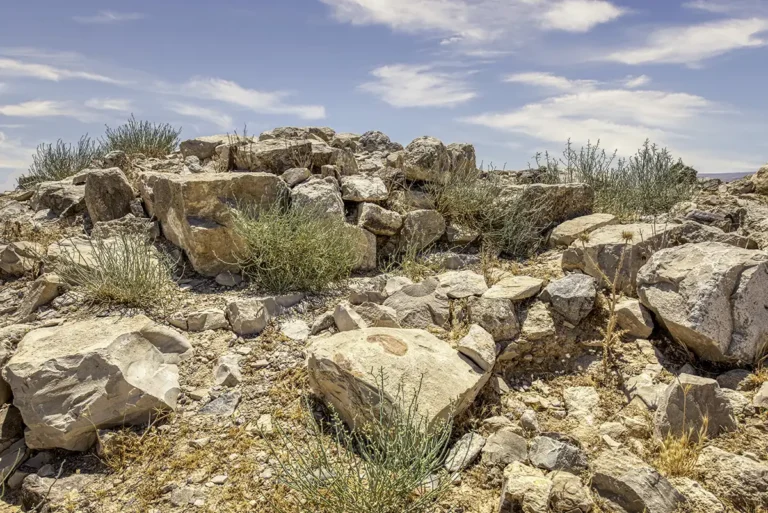
Inside, excavation identified the headquarters building (principia), rows of barracks, a bath, a granary (horreum), a reservoir and, later, a church. The walls and buildings were of local limestone; today they stand as long lines of coursed masonry, doorways and collapsed rooms.
Legionary Fortress
About 4.6 ha inside walls some 2.4–2.5 m thick — built for a legion, not a small garrison.
Twenty-Four Towers
Four fan-shaped corner towers and twenty U-shaped interval towers projected from the walls.
Four Gates
A gate in the middle of each wall led to the main streets inside.
Inside the Walls
Headquarters (principia), barracks, a bath, a granary, a reservoir and a church.
A Frontier Landscape
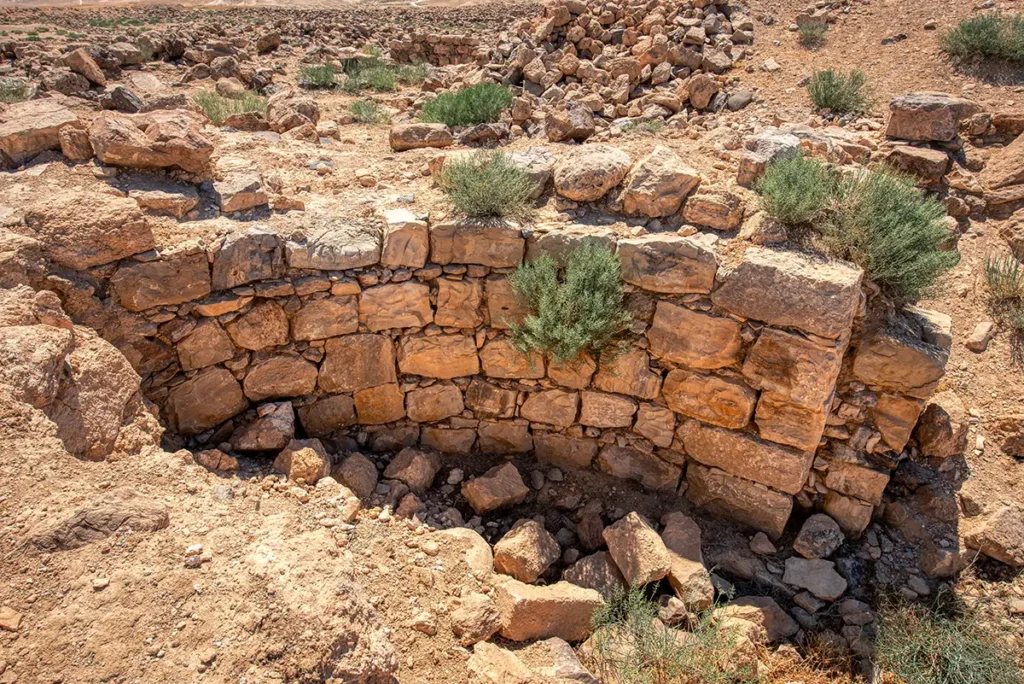
El-Lejjun was the centre of a network. About 1.5–2 km to the north-west, the small fort of Khirbet el-Fityan was built at about the same time, over an Iron Age structure. About 1 km east of the spring, the watchpost of Rujm Beni Yasser — first built by the Nabataeans — was rebuilt around AD 300. Nearby lies an unexcavated fortified town of the Early Bronze Age, and below the spring are water mills built by an Ottoman garrison shortly before the First World War.
Destruction, Rediscovery, and Restoration
The earthquake of AD 363 caused heavy damage, and fewer barracks were rebuilt afterwards; the garrison seems to have been reduced. Further damage followed in the early 6th century. Around AD 530, under Justinian, the legion was disbanded. Some people stayed on until a later destruction, often linked to the earthquake of 551, and there was limited reuse in the Umayyad period.
Between 1980 and 1989 the Limes Arabicus Project, directed by S. Thomas Parker, excavated at El-Lejjun and four other forts over five seasons and surveyed more than 500 sites in the region. The final report was published by Dumbarton Oaks in 2006. The fortress has not been restored.
Visiting El-Lejjun Today
El-Lejjun is an open, unfenced and unrestored site in farmland, free to visit. There are no facilities, so bring water and sturdy shoes: the ground is uneven and strewn with fallen blocks. Allow about an hour to walk the circuit of the walls and through the gates. Our photo album and 360° panorama show the site in detail.
Further reading: Dumbarton Oaks — The Roman Frontier in Central Jordan; Karak Resources Project — Legionary fortresses in Arabia.