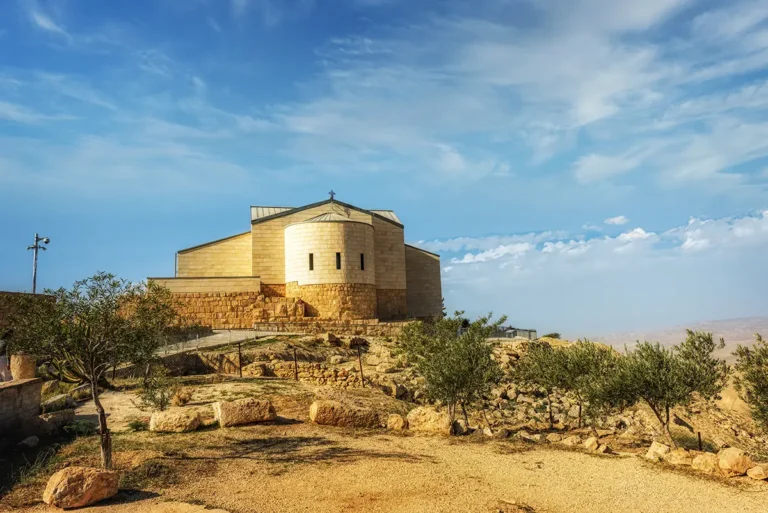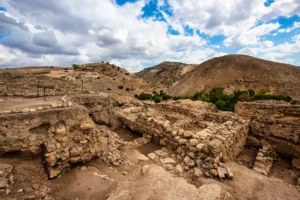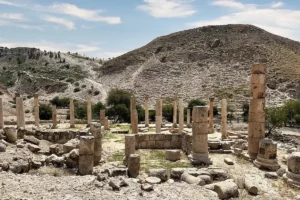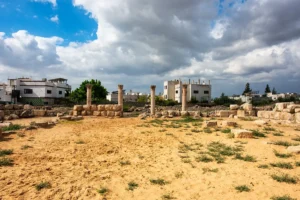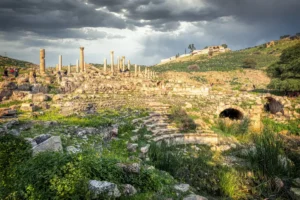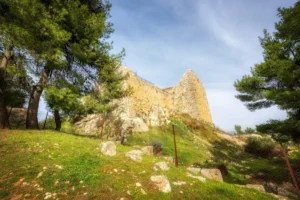














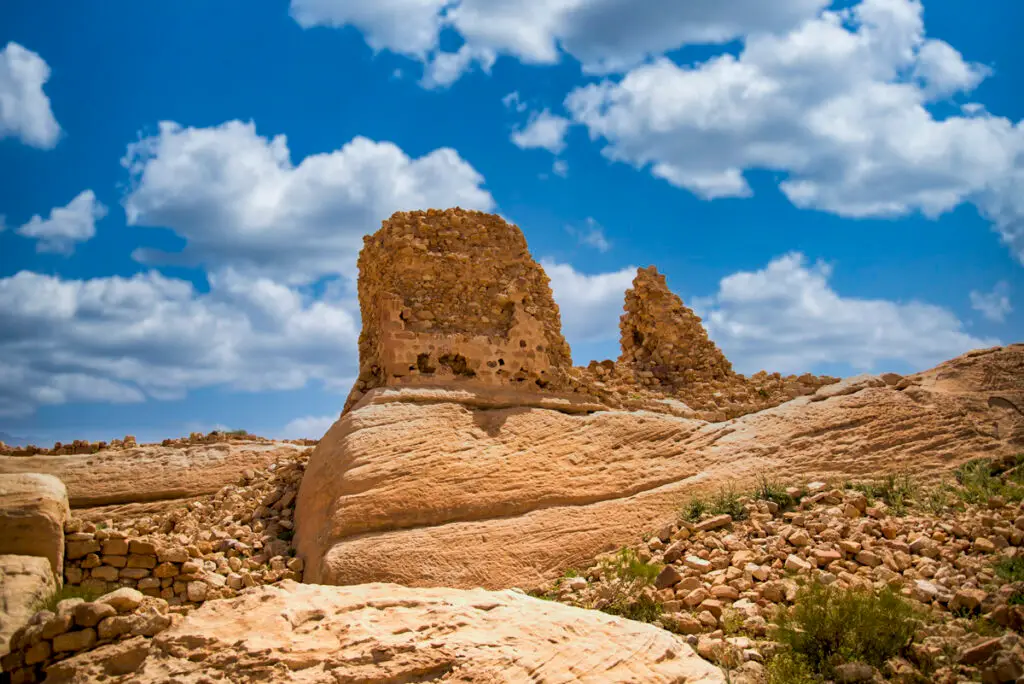
On a narrow ridge of sandstone just north of Petra, cut off by deep ravines, stand the ruins of al-Wu’ayra, the Crusaders’ Li Vaux Moïse, the castle of “the Valley of Moses”. Its strength came less from its walls than from the rock itself: the only way in was across a bridge over the gorge.
Where Is Vaux Moise?
The castle stands about 1 km north of Petra’s main entrance, beside the road from Wadi Musa to Little Petra. It lies within the Petra Archaeological Park, and together with al-Habis in the city centre it formed the Crusader defence of the Petra valley. The larger castle of Shobak lies about 25–30 km to the north.
Historical Context and Origin
The castle was built in the first half of the 12th century. It is traditionally credited to King Baldwin I, whose campaign reached Petra and Aqaba in 1116, but some scholars date it to the 1130s, and it is first mentioned in 1144. That year, after the death of King Fulk, Turkish forces took it with local help, and the young King Baldwin III recaptured it. In 1158 it was besieged again but held. It passed to Saladin in 1188 or 1189, shortly before Shobak surrendered, and was then occupied by the Ayyubids.
Architectural Design
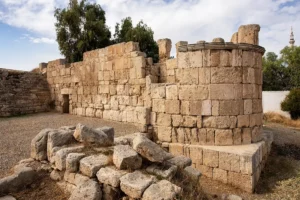
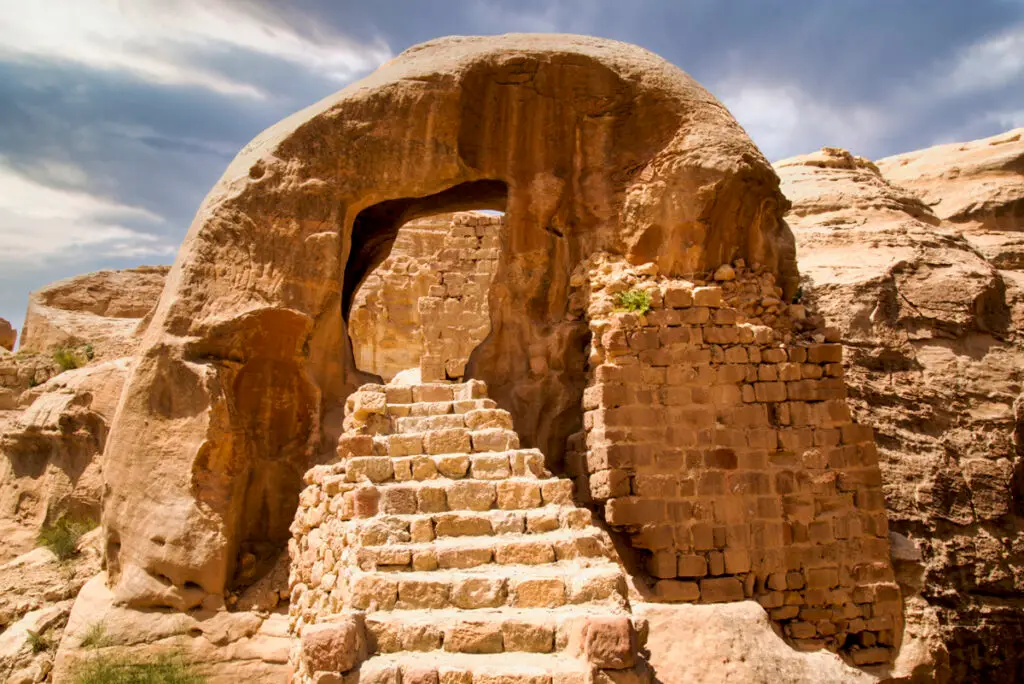
The castle runs along a narrow ridge with steep, smooth sides. An isolated foregate with movable bridges controlled the crossing of Wadi al-Wu’ayra on the east, and the main gate was cut through a reused Nabataean tomb. Inside, a double line of walls with fourteen square towers enclosed the ridge, with the keep at the only access. A fortified church, reached by a ramp, guarded the main water tank, and a Crusader graveyard was found beside it.
Rock-cut Gate
A gate cut through an older Nabataean tomb.
Bridge over the Gorge
The only way in crosses the ravine of Wadi al-Wu’ayra.
Towers and Walls
A double line of walls with fourteen towers.
Rock-cut Chapel
A Byzantine chapel and hermit cells older than the castle.

Vaux Moise (al-Wu’ayra)
Schematic plan of the citadel of Vaux Moise (al-Wu’ayra), after Bini and Bertocci (1997)
Open drawingArabic graffiti on the Crusader church’s altar slab
Arabic inscriptions and graffiti were recorded at Vaux Moise (al-Wu’ayra), particularly on the altar slab inside the Crusader church. An epigraphic survey in November 2018 identified a graffito quoting Qur’an 61:13, referring to help from God and an approaching victory, and another beginning with the basmala, “In the name of God, the Merciful, the Compassionate.” The researcher provisionally dated them to the Ayyubid–Mamluk period through their letter forms. They provide evidence of Muslim activity at the church after its Crusader occupation. Julia Maczuga, ASOR 2021 research abstract
نَصْرٌ مِنَ اللَّهِ وَفَتْحٌ قَرِيبٌ
بِسْمِ اللَّهِ الرَّحْمَٰنِ الرَّحِيمِ
“Help from God and a victory near at hand.”
“In the name of God, the Most Compassionate, the Most Merciful.”
1. Qur’anic graffito on the church’s altar slab. Julia Maczuga identifies one inscription as quoting the passage about divine help and victory in Qur’an 61:13. Survey abstract, ASOR 2021 This is part of verse 13 of Sūrat al-Ṣaff, rather than the complete verse. The wording expresses confidence in divine assistance; fatḥ can mean “victory” or “conquest” in this context. Arabic verse and commentary, King Saud University Maczuga notes the phrase’s association with celebrating military success. However, the available abstract does not identify a particular victory, author or dated event behind this graffito.
2. Graffito beginning with the basmala. A second inscription reportedly begins with the familiar invocation. The published abstract does not supply the remaining text. The basmala commonly opens Muslim prayers, documents and inscriptions, so its presence alone does not establish the graffito’s particular purpose. Maczuga, ASOR 2021
These graffiti illuminate the church’s later history and Muslim visitors or users; they do not provide a construction date for the Crusader castle.
Before the Crusaders
The ridge was used long before the castle. Its gate reuses a Nabataean tomb, and a rock-cut room once thought to be Nabataean was identified in 2016 as a Byzantine Christian chapel of the 5th–6th century, surrounded by at least ten cells of hermits who lived here.
Destruction, Rediscovery, and Restoration
The geographer Yaqut still mentioned the castle in the 1220s. Robin Brown excavated here in 1987, and the University of Florence’s “Medieval Petra” mission has surveyed and excavated the site since the late 1980s, most recently at the north-east tower in 2022. The castle was conserved in 1999–2001, and the north-east tower was later restored.
Visiting Vaux Moise Today
The site is open, with no fence, gate or guard, and entry is free. The turn-off is not signposted and there is no car park, so leave the car by the side of the road and cross the old bridge over the gorge to the gate. It is a large site; allow about an hour. See our Vaux Moise travel guide for directions.
Further reading: Nucciotti & Ranieri, Medieval Petra 2022 (Spolia 2024); Vanni Desideri & Leporatti, The Rupestrian Chapel of al-Wu’ayra (SHAJ XIV).