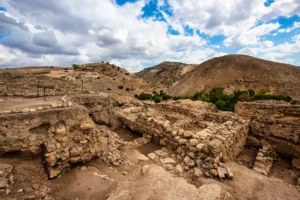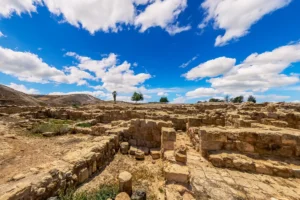














In a sandy valley near Little Petra lie the stone foundations of one of the oldest villages in the Middle East. Some ten thousand years ago the people of Beidha built houses here, farmed, herded and buried their dead beneath their floors — and today you can step inside reconstructions of their homes.

Where Is Al Beidha?
Beidha lies about 5 km north of Petra, near Little Petra (Siq al-Barid), within the Petra World Heritage property. The archaeologist Diana Kirkbride first published it as “Seyl Aqlat, Beidha”.
Historical Context and Origin
Long before the village, Natufian hunter-gatherers camped here again and again. The Neolithic village belongs to the Middle Pre-Pottery Neolithic B, about 7200–6600 BC. Its people grew barley and emmer wheat, herded goats — perhaps on the way to domestication — hunted wild animals and gathered wild plants, and worked in specialised workshops. Obsidian from Anatolia and mother-of-pearl from the Red Sea show that they were part of long-distance exchange networks. The settlement was used again much later, in the Nabataean period.

Architectural Design
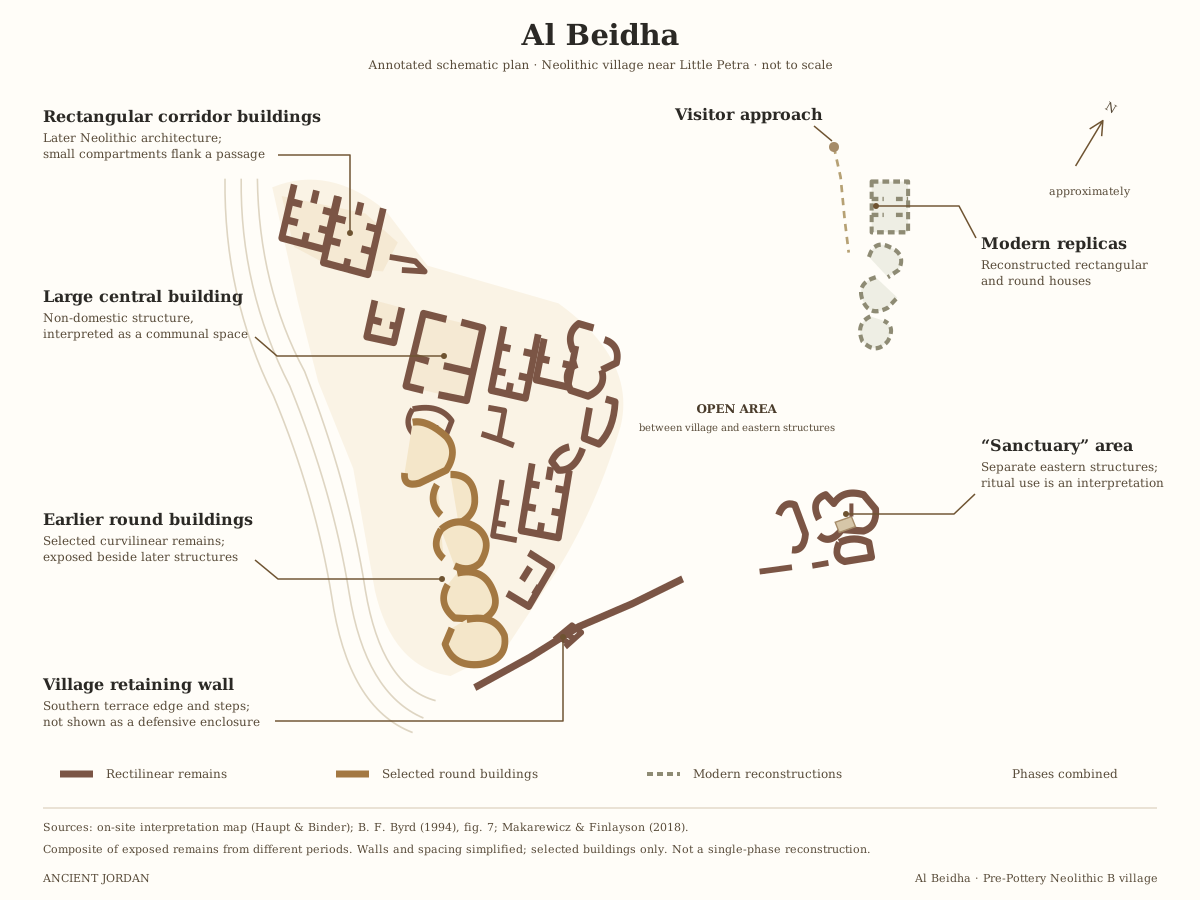
The excavators traced six building stages. The earliest houses were round, one-room dwellings sunk into the ground, about 5 m across, with stone walls about 1.2 m high and wooden posts set along the walls. After a fire destroyed the village around 6650 BC, it was rebuilt with rectangular, above-ground houses with plastered interiors, including “corridor” buildings with small rooms used for storage and work. The archaeologist Brian Byrd has used Beidha to show how households became more private while the community developed new ways of binding itself together.
Six Building Stages
From round one-room houses to rectangular houses with plastered floors.
Sunken Round Houses
Early houses about 5 m across, dug into the ground with stone walls.
Sanctuary Area
Basins, standing stones and paved enclosures outside the village.
Reconstructed Houses
Four Neolithic buildings rebuilt in 2001–2006 with Bedouin builders.
Al Beidha
Schematic plan of the Neolithic village of Beidha, composite of exposed remains, after Byrd (1994) and Makarewicz and Finlayson (2018)
Open drawingA Neolithic Sanctuary
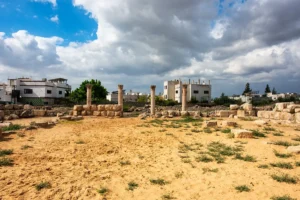
Outside the village, an area with basins, standing stones and paved enclosures is thought to have been a sanctuary. Burials beneath house floors and special buildings point to a rich ritual life alongside daily farming and herding.
Destruction, Rediscovery, and Restoration
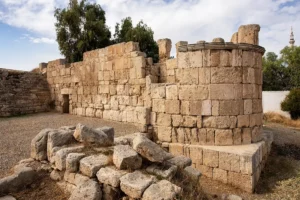
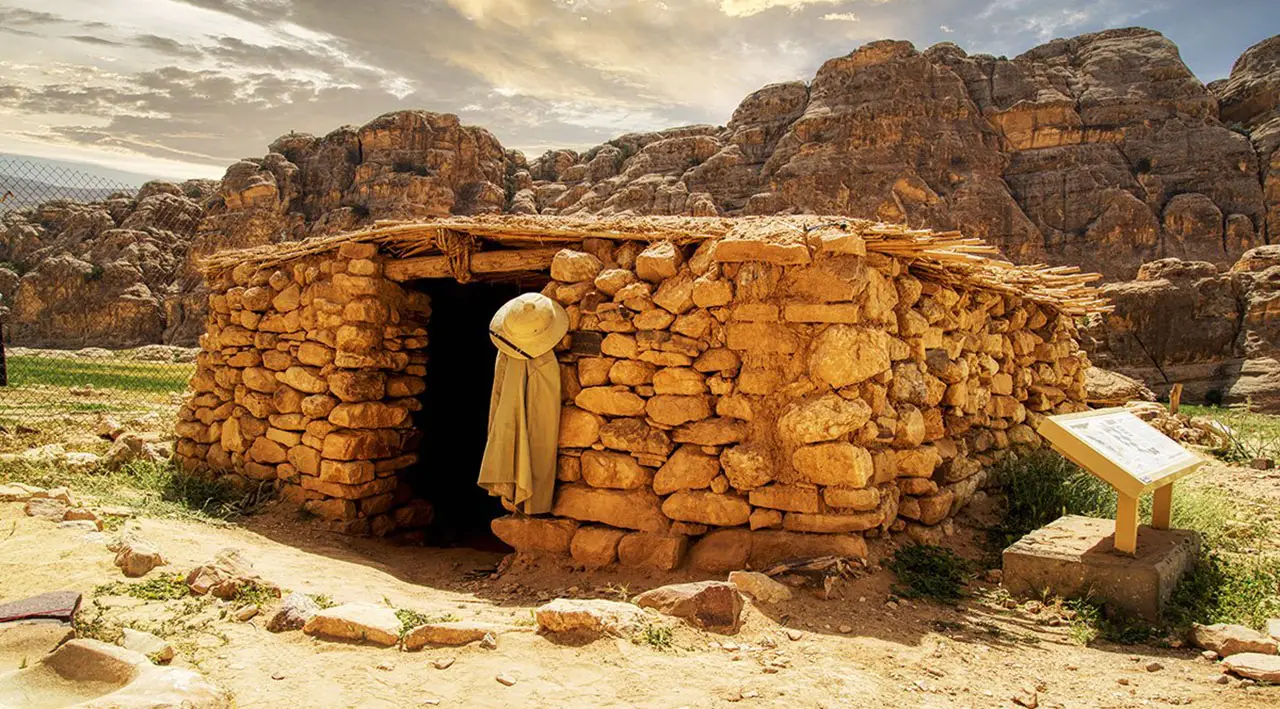
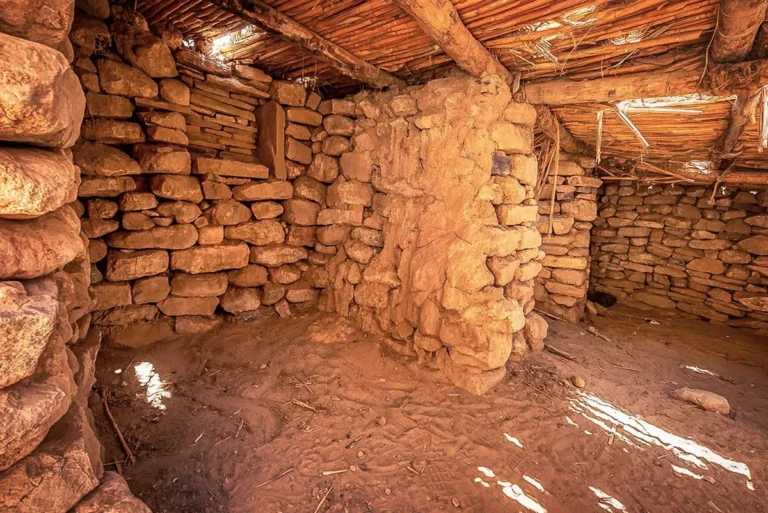
Around 6500 BC the village was abandoned, for reasons that are still unknown. Diana Kirkbride, with Peter Parr, began excavating in 1958, and worked here in several seasons up to 1967 and again in 1983; Brian Byrd published the final report in 2005. From 2001 the Beidha Project of the Council for British Research in the Levant and the Department of Antiquities, working with Ammarin and Bdul Bedouin, built four experimental Neolithic houses using ancient techniques, so that visitors can see what the village once looked like.

Visiting Al Beidha Today
Beidha is a short walk from Little Petra and free to enter. Walk around the excavated foundations, then step inside the reconstructed houses. Allow about an hour. Read our guide to Al Beidha and explore the 360° view inside a Stone Age hut.
Further reading: Dennis, Finlayson & Najjar, “Conservation and presentation of Neolithic Beidha”, Antiquity 76 (2002); Petra authority — Beidha Neolithic Village.