











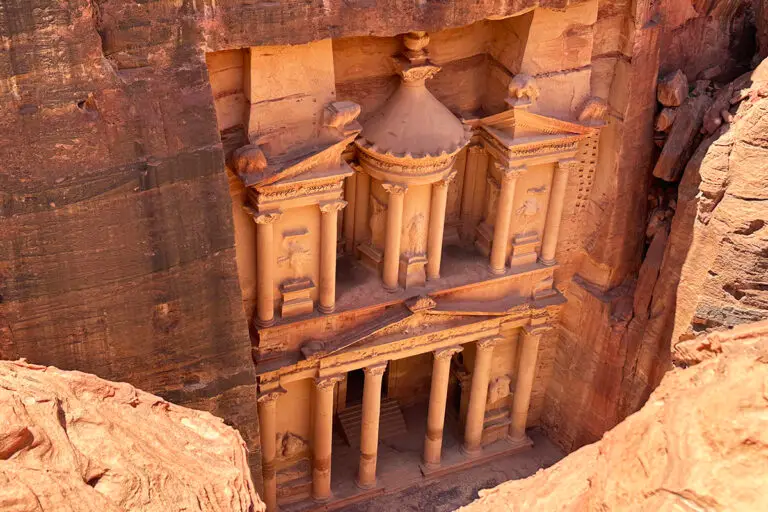

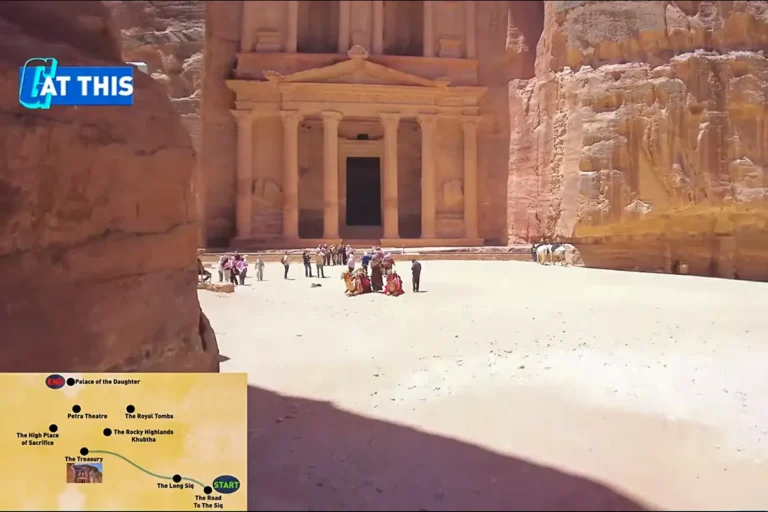

Hidden among the sandstone mountains of southern Jordan, Petra was the capital of the Nabataeans, Arab traders who grew rich on the caravan routes of incense and spice. Over about two centuries they carved hundreds of tombs, temples and dining halls into the rock and channelled water through the desert to supply a city of perhaps 20,000 people.
Where Is Petra?
Petra lies beside the town of Wadi Musa in the Ma’an Governorate, about 235 km south of Amman and 130 km north of Aqaba. The Petra Archaeological Park covers about 264 km², including Little Petra and the Neolithic village of Al Beidha to the north. The main entrance is through the Siq, a winding gorge about 1.2 km long and in places only 3 m wide.
Historical Context and Origin
People lived in the area from prehistory, and Edomites settled on the summit of Umm al-Biyara in the 7th century BC. The Nabataeans first appear in history in 312 BC, when Greek forces attacked them at a refuge on “the rock”. By the 2nd century BC Petra had become their capital, and it reached its height in the 1st century BC and 1st century AD, especially under King Aretas IV (9 BC–AD 40). In AD 106 Rome annexed the kingdom as the province of Arabia, and in AD 130 the emperor Hadrian visited the city.
Architectural Design
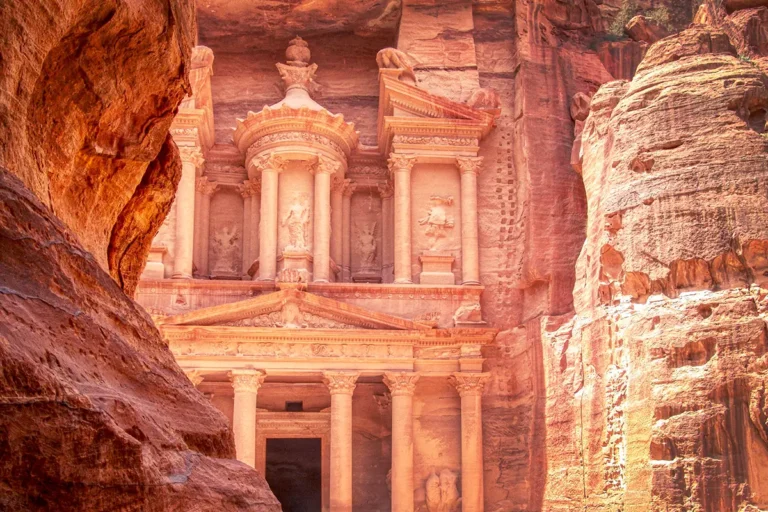
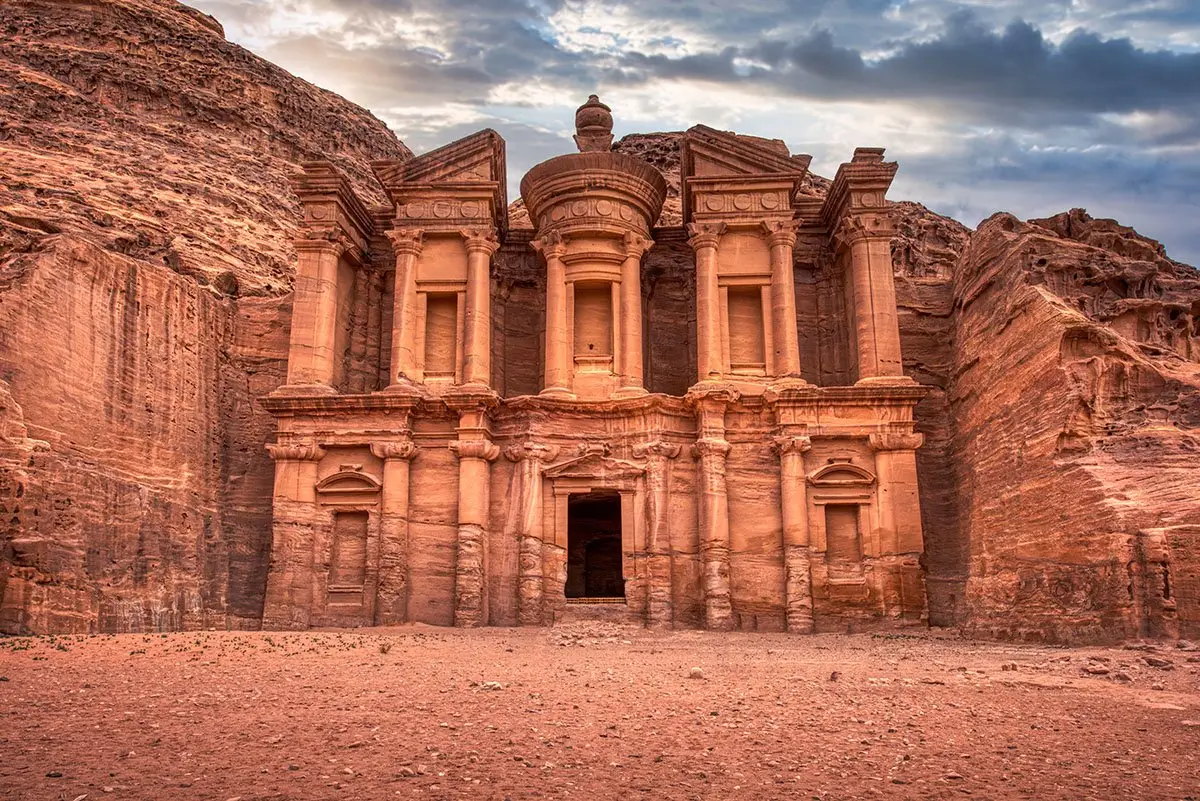
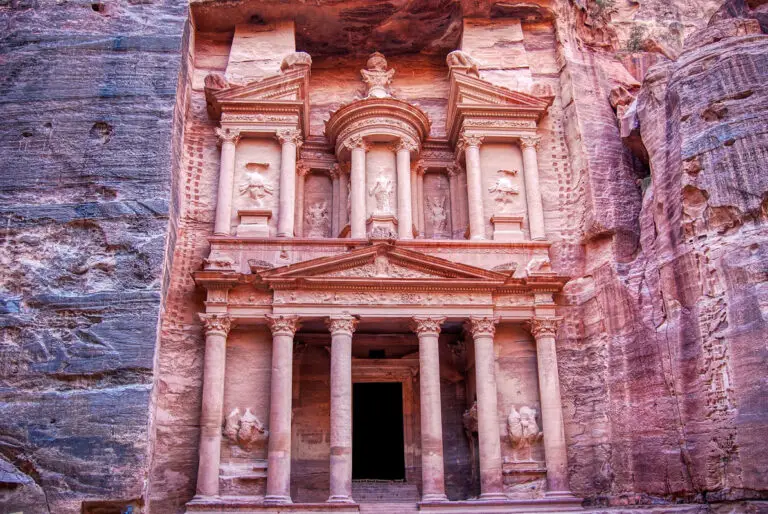
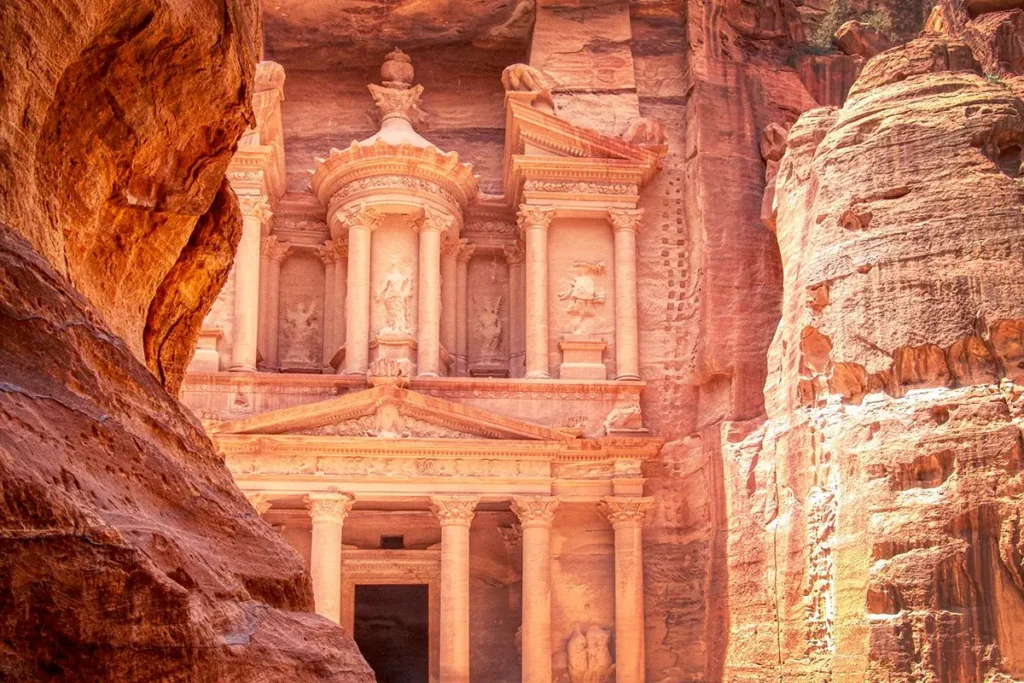
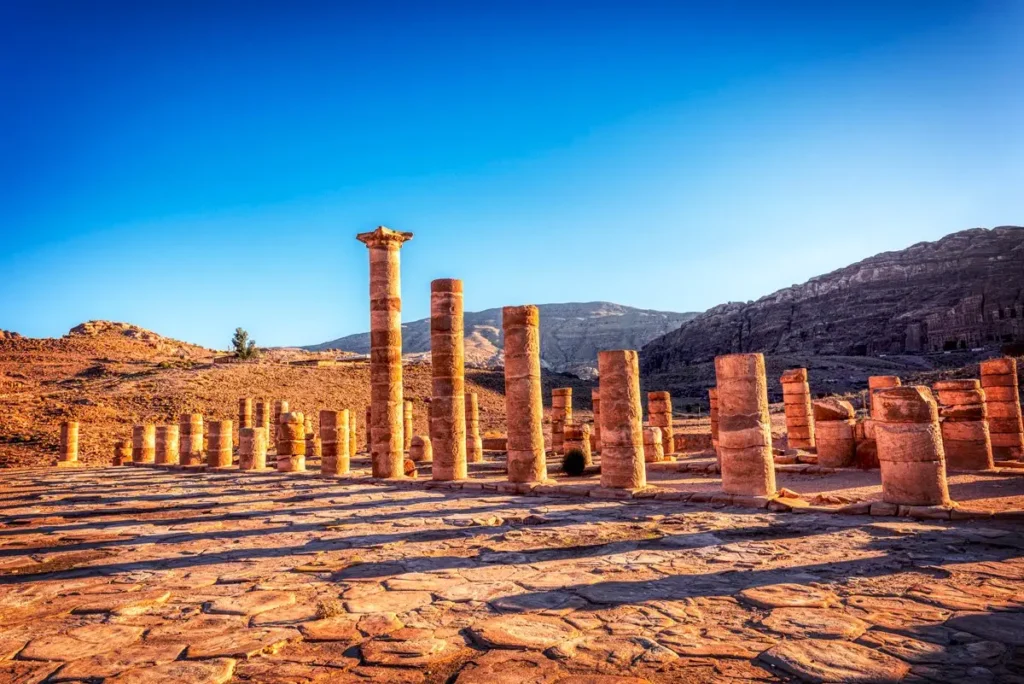
Nabataean architecture blended local traditions with Hellenistic and Egyptian styles. The Treasury, about 40 m high, was probably the tomb of Aretas IV; the Monastery, with a façade about 47 m wide, was probably a hall for religious feasts. Royal tombs line the cliff of al-Khubtha, and in the city centre stand the rock-cut Theatre, the Colonnaded Street, the Great Temple and the temple of Qasr al-Bint. High places for sacrifice crown the surrounding peaks, and dams, channels and cisterns kept the city supplied with water.
The Siq
A narrow gorge about 1.2 km long, the main entrance to the city.
The Treasury
A tomb façade about 40 m high, probably of King Aretas IV.
The Monastery
The largest façade in Petra, reached by about 800 steps.
The Royal Tombs
The Urn, Silk, Corinthian and Palace Tombs above the city centre.
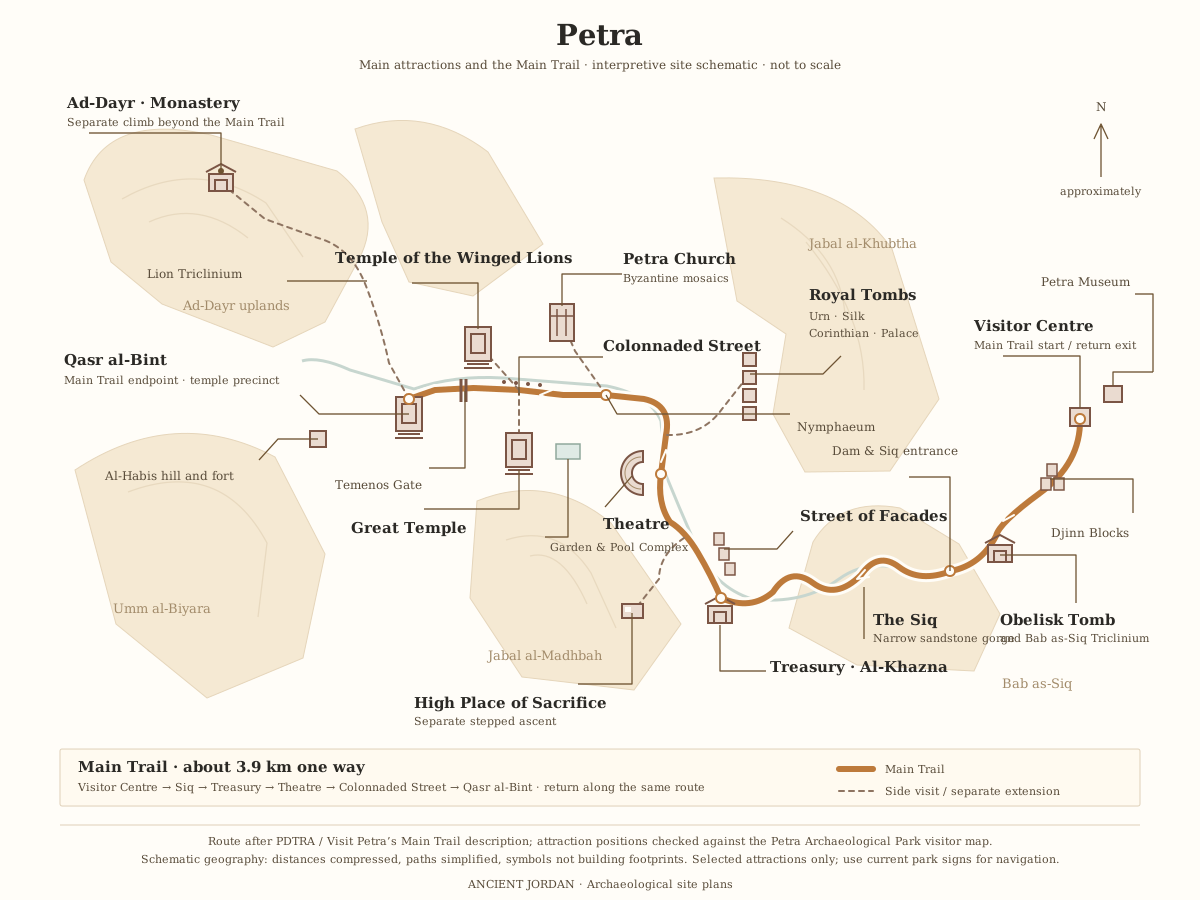
Petra: main trail schematic plan
Schematic map of Petra's Main Trail, after the official VisitPetra route
Open drawingThe Turkmaniyya Tomb inscription
The longest Nabataean inscription in Petra, carved on the façade of the Turkmaniyya Tomb. It dedicates the tomb and its associated property, including chambers, a courtyard, gardens, a dining hall, cisterns and walls, to Dushara and the gods, prohibits alterations, and restricts burial to those authorised in the dedication documents. It names no owner and gives no date, and some of its architectural terms are still debated.
1. qbrʾ dnh wṣryḥʾ rbʾ dy bh wṣryḥʾ zʿyrʾ dy gwʾ mnh dy bh bty mqbryn ʿbydt gwḥyn
2. wkrkʾ dy qdmyhm wʾrkwtʾ wbtyʾ dy bh wgnyʾ wgnt smkʾ wbʾrwt myʾ wṣhwtʾ wṭwryʾ
3. wšʾryt kl ʾṣlʾ dy bʾtryʾ ʾlh ḥrm wḥrg dwšrʾ ʾlh mrʾnʾ wmwṯbh ḥryšʾ wʾlhyʾ klhm
4. bšṭry ḥrmyn kdy bhm ppqdwn dwšrʾ wmwṯbh wʾlhyʾ klhm dy kdy bšṭry ḥrmyʾ ʾnw ytʿbd wlʾ ytšnʾ
5. wlʾ ytpṣṣ mn kl dy bhm mndʿm wlʾ ytqbr bqbrʾ dnh ʾnwš klh lhn mn dy ktyb lh tnʾ mqbr bšṭry ḥrmyʾ ʾnw ʿd ʿlm
This tomb, its large burial chamber, and the smaller chamber farther inside, containing burial places arranged as niches; the enclosure before them; its porticoes and rooms; the seats and garden for funerary dining (?); the water wells, chapel (?) and courtyards (?); together with all other property belonging to these places, are consecrated and reserved for Dushara, the god of our lord, his holy throne, and all the gods, under the provisions of the consecration documents.
Dushara, his throne and all the gods command that the provisions of those documents be observed. Nothing covered by them may be altered or taken away. No person may be interred in this tomb unless those same consecration documents record permission for that person’s burial. These provisions apply forever.
The original text is shown as a scholarly Latin transliteration that preserves the five inscribed lines; it is not a reconstruction of how the words were pronounced. ʾ represents aleph and ʿ represents ʿayin.
The reading follows Healey’s edition, with typographical normalisation. Several architectural terms remain disputed. Text and commentary, pp. 63–67
The English is a readable rendering; question marks identify uncertain architectural meanings.
Byzantine Petra
A great earthquake in AD 363 damaged much of the city, but Petra lived on as the seat of a bishop. In 446 the Urn Tomb was turned into a church, and the Petra Church, with its mosaic floors of the Four Seasons, was built in the 5th–6th centuries. In 1993 more than 140 carbonised papyrus scrolls of the 6th century were found beside it, recording property, marriages and inheritances. The city declined in the 7th century.
Destruction, Rediscovery, and Restoration
In the 12th century the Crusaders built small forts at al-Wu’ayra and on al-Habis. Local Bedouin always knew Petra, but the first European to describe it was Johann Ludwig Burckhardt, who arrived on 22 August 1812 disguised as Sheikh Ibrahim. Petra became a UNESCO World Heritage Site in 1985, and from the mid-1980s the Bdul who lived in its caves were resettled in the village of Umm Sayhun. In 2007 it was named one of the New Seven Wonders of the World.
Visiting Petra Today
The park opens at 6:00 in summer and 6:30 in winter. Tickets cost 50, 55 or 60 JOD for one, two or three days for visitors who stay at least one night in Jordan, including day trips from a hotel in Amman, and 90 JOD for visitors who do not stay overnight anywhere in Jordan. A valid passport is required at the ticket office, and the Jordan Pass includes Petra. Petra by Night runs Sunday to Thursday, 8:30–10:30 pm, for an extra 30 JOD, together with a daytime ticket or Jordan Pass. Allow at least a full day. See our Petra travel guide for routes and practical details.
Further reading: UNESCO — Petra; ACOR — The Petra Church and the Petra Papyri; Wadeson — The Turkmaniyya Tomb; Petra Archaeological Park (official).