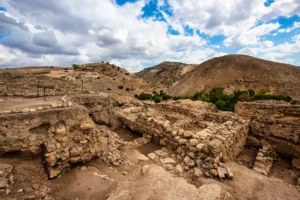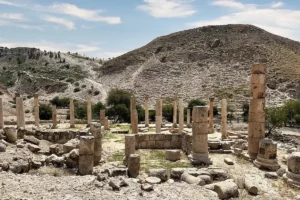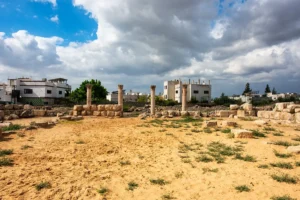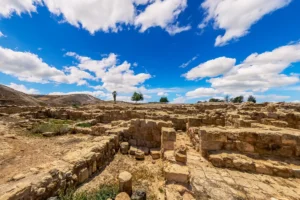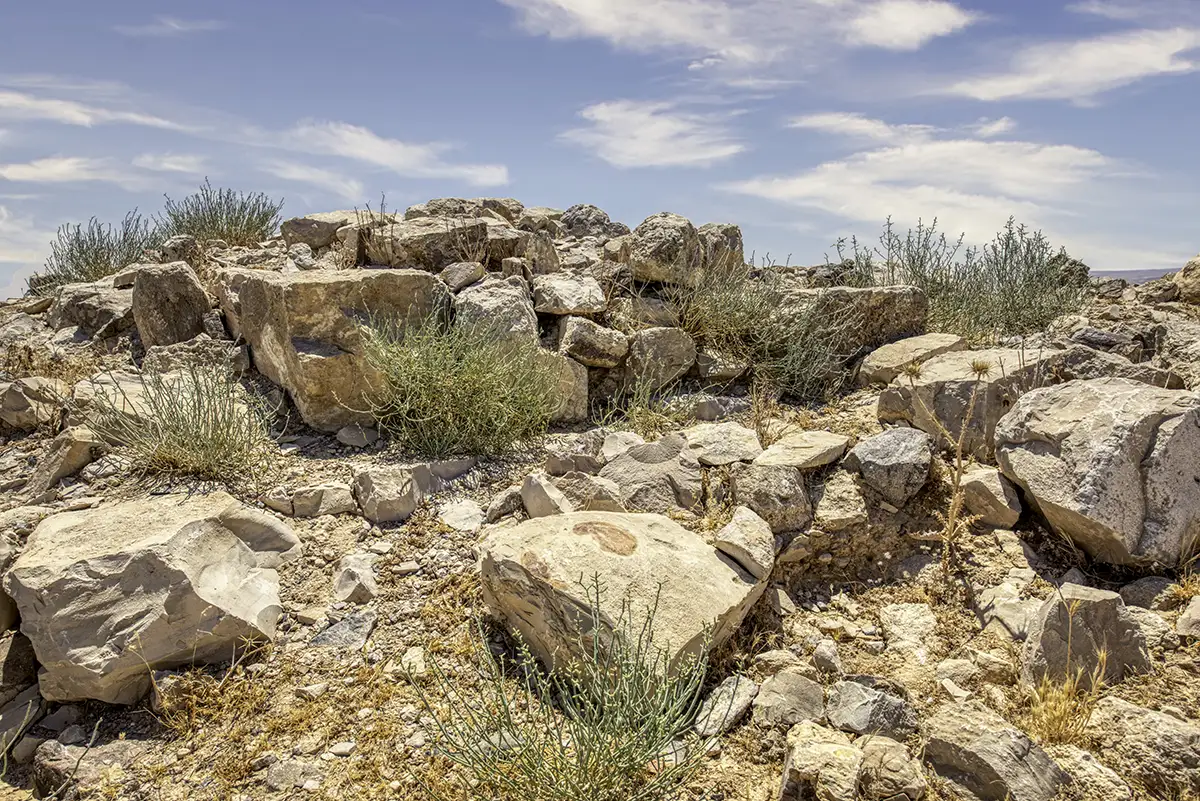


On the ridge above El-Lejjun, a low square of tumbled walls marks a small Roman fort. Khirbet el-Fityan was the eyes of the legionary fortress below: from here its soldiers could see far across the plateau and pass signals along the frontier.
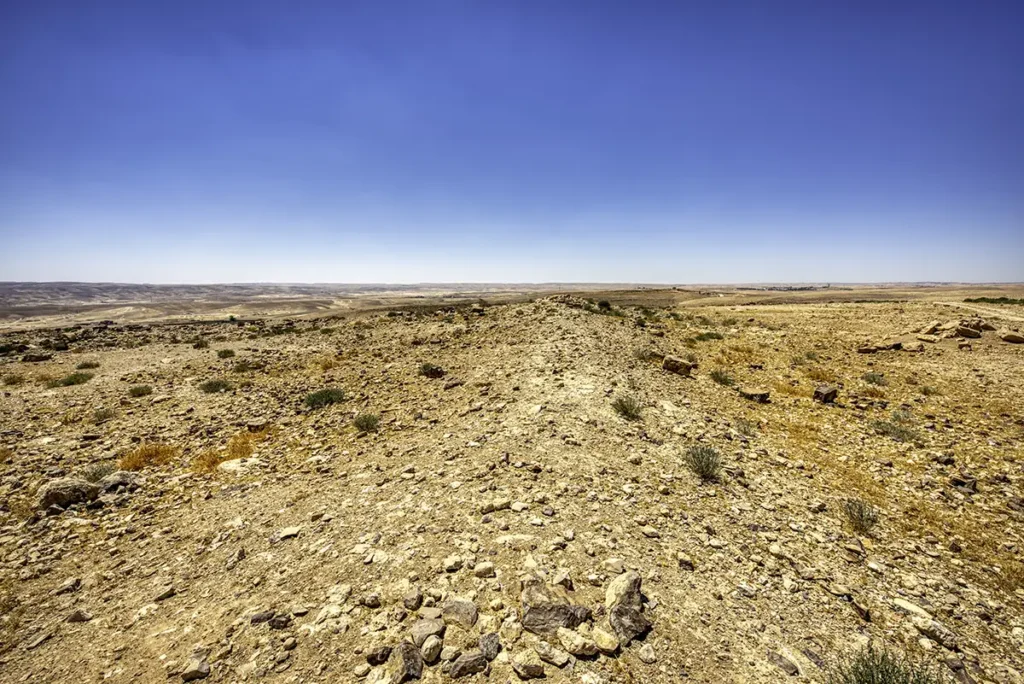
Where Is Khirbet el-Fityan?
The fort stands about 1.5 km north-west of the fortress of El-Lejjun and its spring, on the edge of the ridge above Wadi Lejjun, some 17 km north-east of Karak.
Historical Context and Origin
Khirbet el-Fityan was built around AD 300, at about the same time as El-Lejjun, as part of the Diocletianic frontier network east of the Via Nova Traiana. The legionary fortress lay low beside its spring and could see little; the fort on the ridge could watch the approaches and signal to the neighbouring watchtowers. The excavator, S. Thomas Parker, described it as an observation post.
Architectural Design
The fort is a near-square enclosure of about 79 × 77 m, built of local limestone. Rectangular towers stood at the four corners, with further towers midway along the west and south walls and a tower beside the north gate. Excavation uncovered the west tower with its stair corridor, the north gateway, barrack rooms against the enclosure wall, and cisterns inside.
Lookout Fort
A castellum of about 79 × 77 m on high ground overlooking the Lejjun valley.
Corner Towers
Rectangular towers at the corners and midway along the west and south walls.
North Gate
A gateway on the north side with a tower beside it.
Iron Age Roots
The Roman wall rests on an older Iron Age foundation, perhaps a Moabite fort.
An Older Fort Beneath
Part of the Roman enclosure wall rests on an Iron Age II foundation wall, suggesting an earlier fort here — perhaps Moabite. The evidence is still slight, a wall and a few sherds, and the excavator called for more work. Early Bronze Age sherds show that people came to the ridge long before.
Destruction, Rediscovery, and Restoration
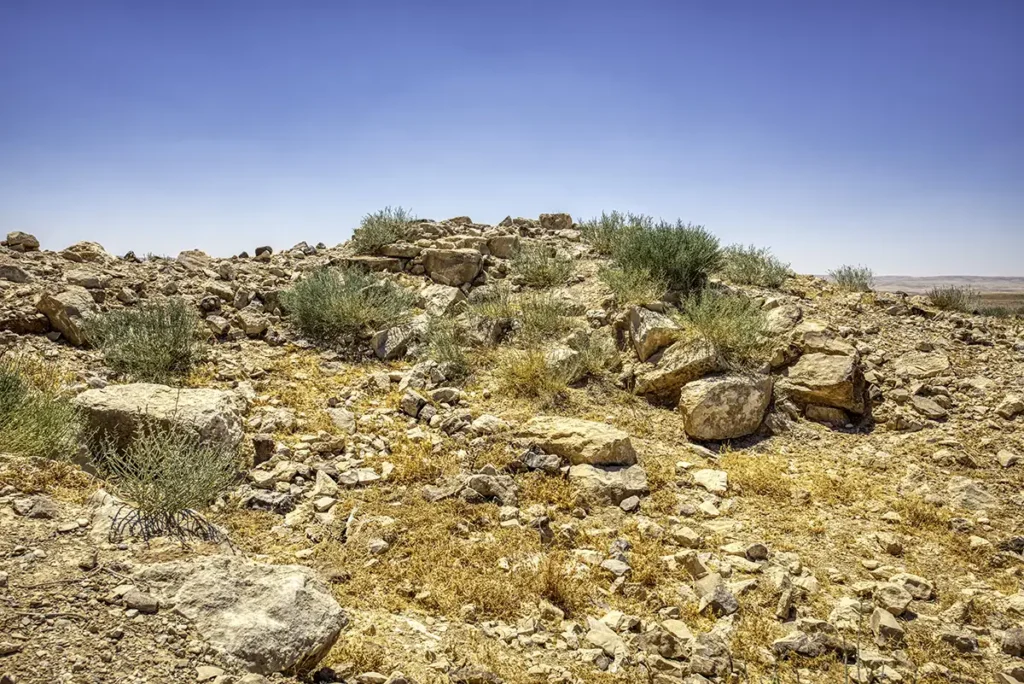
Khirbet el-Fityan was abandoned by the end of the 5th century — at least fifty years before the legion left El-Lejjun; no 6th-century pottery has been found. The site was surveyed in 1976, and in 1980 the Limes Arabicus Project dug four soundings here. Among the fallen stones lay much later finds: Late Ottoman material, glass and amber beads, rings and a child’s grave. The fort has not been restored.
Visiting Khirbet el-Fityan Today
Khirbet el-Fityan can be reached by 4×4 vehicle and is easy to combine with a visit to El-Lejjun, 1.5 km to the south-east. The walls survive as low lines of rubble, but the view over the Lejjun valley explains why the fort was built here. See our photo gallery and 360° panorama.
Further reading: Karak Resources Project — Castella in Arabia; Khirbet el-Fityan in the Dead Sea earthquake catalogue (after Parker).