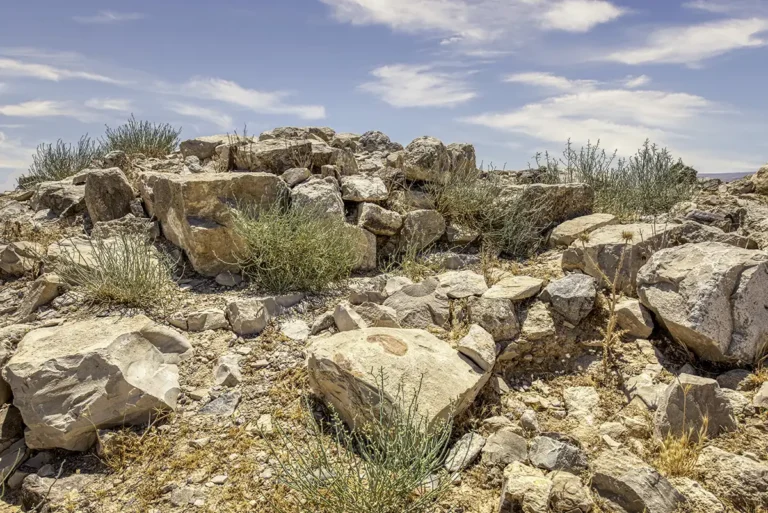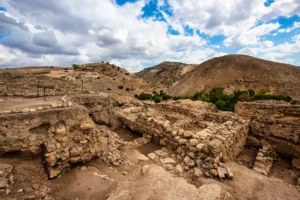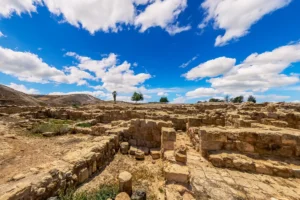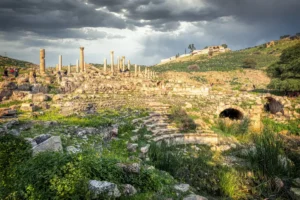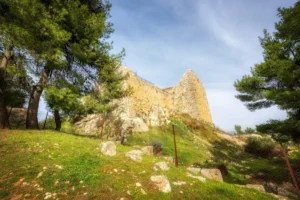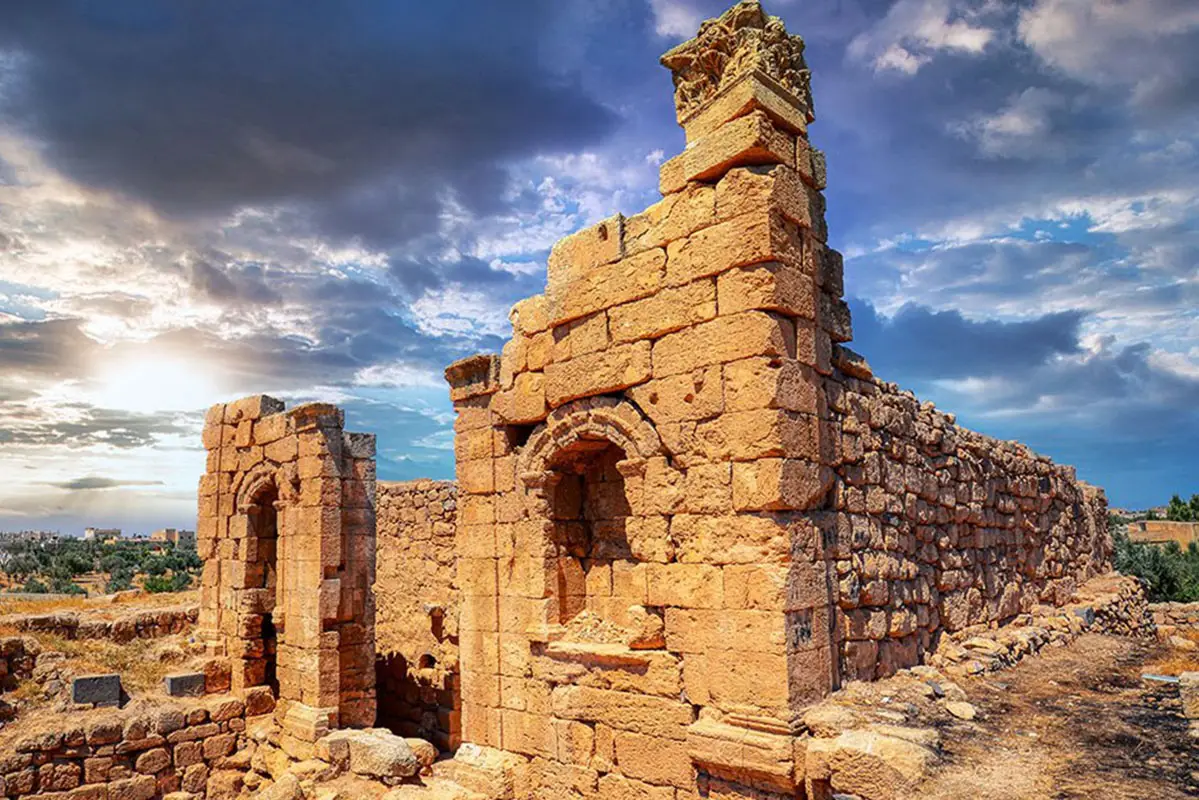

On the King’s Highway north of Karak, a tall wall of dressed limestone with two niches rises beside the road. It belongs to a temple of ancient Rabbathmoba, the “Rabbah of Moab”, which the Greeks and Romans called Areopolis — the city of Ares, the god of war.
Where Is Al-Rabba?
Al-Rabba is about 15 km north of Karak on the King’s Highway, roughly 22 km south of Wadi Mujib, in Karak Governorate. The ruins lie in and around the modern village, on the Karak plateau.
Historical Context and Origin
The geographer Ptolemy recorded the town as Rabbathmoba. The church historian Eusebius called it Areopolis and identified it with Ar, a city of Moab named in the Bible. In the Severan period, between about AD 193 and 222, the city struck its own coins; they show a statue of Ares with sword, spear and shield, alongside other types such as Tyche and Poseidon. In the late Roman army lists a cavalry unit, the Equites Mauri Illyriciani, was stationed here.
Architectural Design
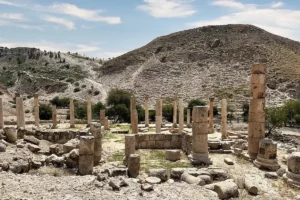
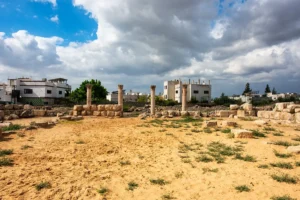
The temple is usually dated to the late 3rd century AD. Two niches flank the temple entrance; recorded inscriptions honour the emperors Diocletian and Maximian, copied by the surveyors Brünnow and von Domaszewski. Early travellers saw more: in 1812 Johann Ludwig Burckhardt noted a wall with several niches, and in 1873 Henry Baker Tristram saw two standing Corinthian columns and two arches. Tristram also recorded two large open water tanks, a main street on the line of the Roman road, and a colonnaded square building.
City of Ares
Its coins show the war god Ares, and Eusebius explained the name Areopolis as his city.
Late Roman Temple
Two niches flank the entrance; inscriptions honour Diocletian and Maximian.
Bishops’ See
Bishops of Areopolis are recorded in the 5th and 6th centuries.
Station on the Road
A town on the north–south Roman road, later a stop on the Damascus–Karak route.
Areopolis: The City of Ares
The city’s name and its coins make Ares its chief god, and coins of Elagabalus spell the name Areopolis in Greek. Whether the surviving temple was dedicated to him is not known. In the Byzantine period Areopolis was a bishopric: bishops are recorded in 449, 518 and 536, and a Greek inscription records a building restored after an earthquake under Bishop John in AD 597/598. Areopolis is still a titular see of the Catholic Church.
Destruction, Rediscovery, and Restoration
Arab geographers called the place Ma’ab. By 1321 it was a village and a station on the road between Damascus and Karak, and the geographer Abu’l-Fida wrote that its ancient remains had largely disappeared. An Ottoman tax register of 1596 lists 16 Muslim and 3 Christian households. Burckhardt and Tristram described the ruins in the 19th century; the site was recorded in the Archaeological Survey of the Kerak Plateau, and an Italian mission led by Calzini Gysens surveyed it from 2002. Ayyubid and Mamluk glazed pottery has been found among the remains.
Visiting Al-Rabba Today
The ruins are unsignposted and free to visit, right beside the King’s Highway — an easy stop between Madaba and Karak. Thirty minutes is enough to see the temple and walk around the ruins.
Further reading: RPC — City coin of Rabbathmoba with Ares; Calzini Gysens, “The First Survey Campaign at Ancient ar-Rabba”, ADAJ 46 (2002).