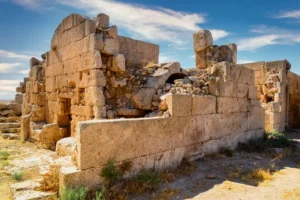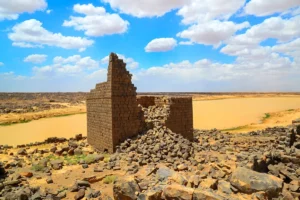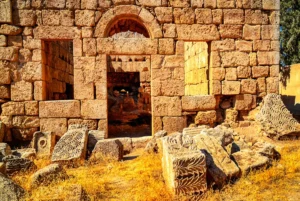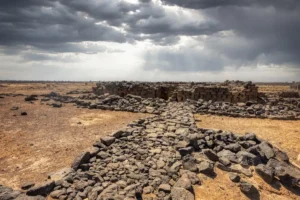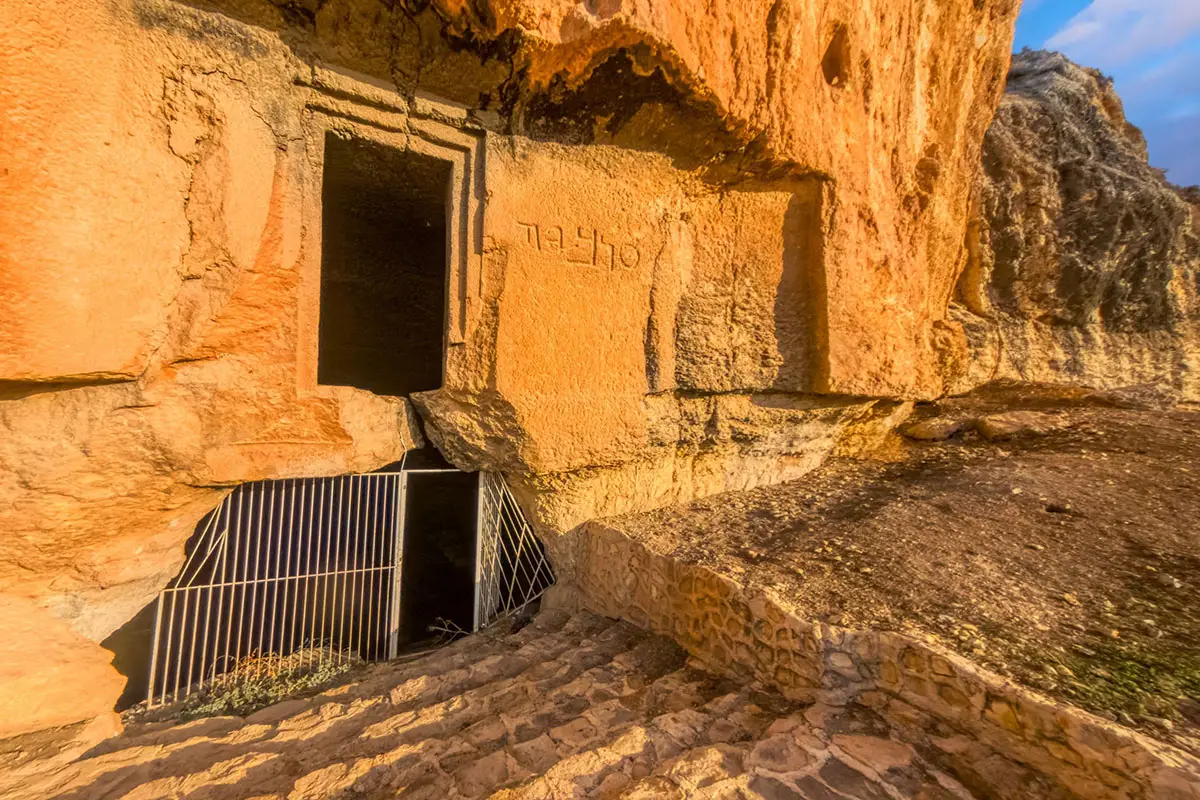


In the cliffs above the village of Iraq al-Amir — “the caves of the prince” — natural caves were enlarged into halls and rooms, in two tiers along the rock face. Beside two of them, the name Tobiah is carved in Aramaic letters: a link to the Tobiads, the powerful family who ruled this valley and built the palace of Qasr al-Abd below.
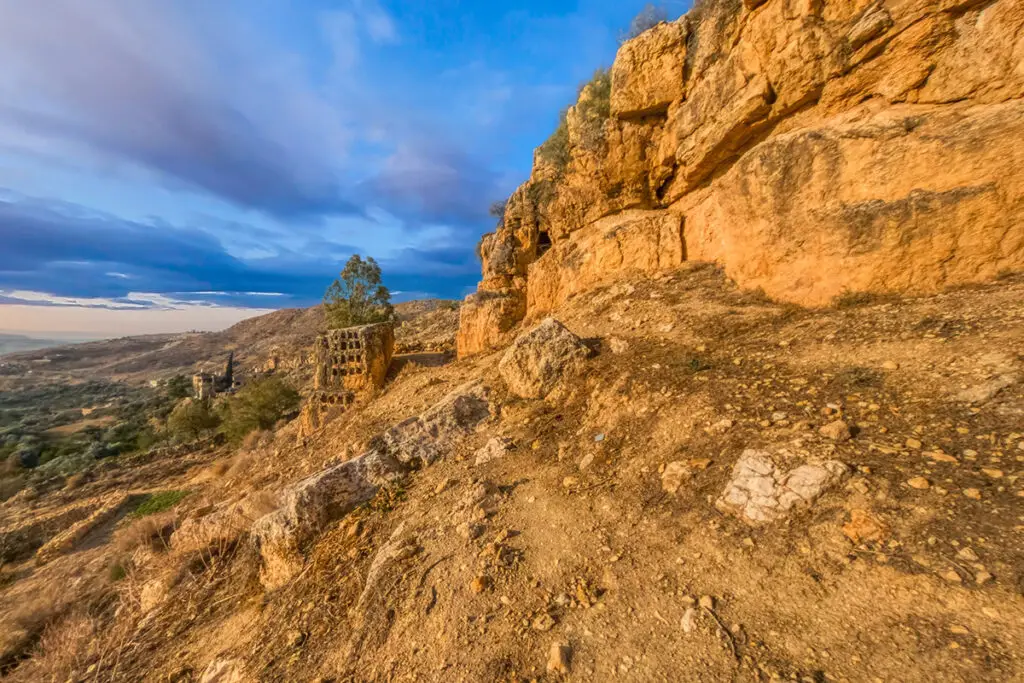
Where Are the Caves of Iraq al-Amir?
The caves lie in the cliffs of Wadi al-Seer, about 200 metres north-west of the ancient village of Iraq al-Amir and about 17 km west of Amman. Qasr al-Abd, the Tobiad palace, stands less than a kilometre to the south. On the way up the valley are the cave church of Al-Bassah and the rock-cut dovecote of Muallaqat al-Dayr.
Historical Context and Origin
The Tobiads were a Jewish family who governed this region east of the Jordan. The historian Josephus tells how Hyrcanus, one of the family, built here in the 2nd century BC a fortress of white stone with carved animals, and cut caves “of many furlongs in length” into the rock, with entrances so narrow that only one person could pass at a time. He named the place Tyre.
The caves are older than Hyrcanus: some have produced pottery of the 7th century BC.
Architectural Design
The cliff holds natural caves that were enlarged and hewn into rectangular halls, arranged in two tiers. The 19th-century explorer Claude Conder counted fifteen — six in the lower tier and nine in the upper. Doorways, steps and small basins are cut into the rock around them.
Two Tiers
Caves in two levels along the cliff — traditionally six below and nine above.
The Tobiah Inscriptions
The name Tobiah carved in Aramaic letters on the façades of two large halls.
Hewn Halls
Natural caves enlarged and squared off, with doorways cut into the rock.
The View
A long view down the green valley towards Qasr al-Abd.
The Tobiah Inscriptions
Two inscriptions in Aramaic script spell the name Tobiah, carved on the façades of two large halls, caves 11 and 13. Their date is one of the great debates of the site: scholars have placed them anywhere from the 6th–5th century BC to the 3rd–2nd century BC. The excavator Paul Lapp linked the name to Hyrcanus himself.
Rediscovery and Research
Nineteenth-century explorers described the caves and their inscriptions. In 1961–1962 the American archaeologist Paul Lapp carried out excavations at Iraq al-Amir, and later the French work of Ernest Will and François Larché focused on Qasr al-Abd and its setting.
Visiting the Caves Today
The caves are reached by road and then on foot by a staircase up to the cliff. Walk along the lower tier, looking for the Tobiah inscriptions beside the doorways. The view down the valley to Qasr al-Abd is best in the late afternoon. Combine the caves with Qasr al-Abd and the other sites of Wadi al-Seer.
Further reading: Josephus, Antiquities 12.4.11.