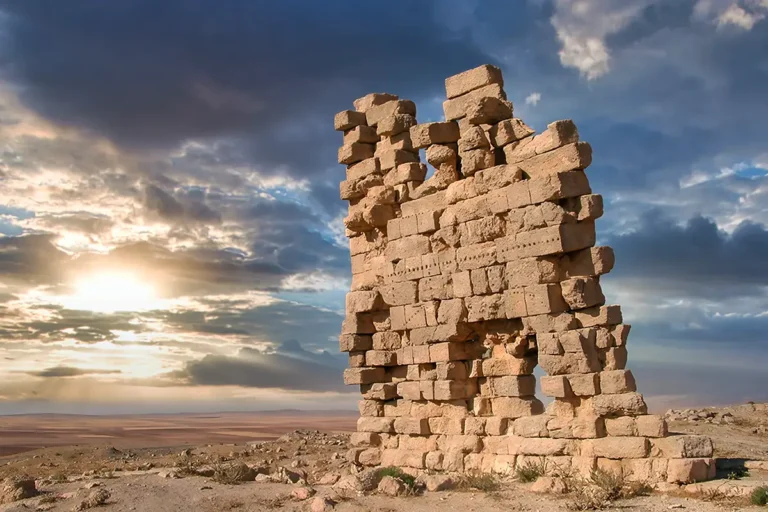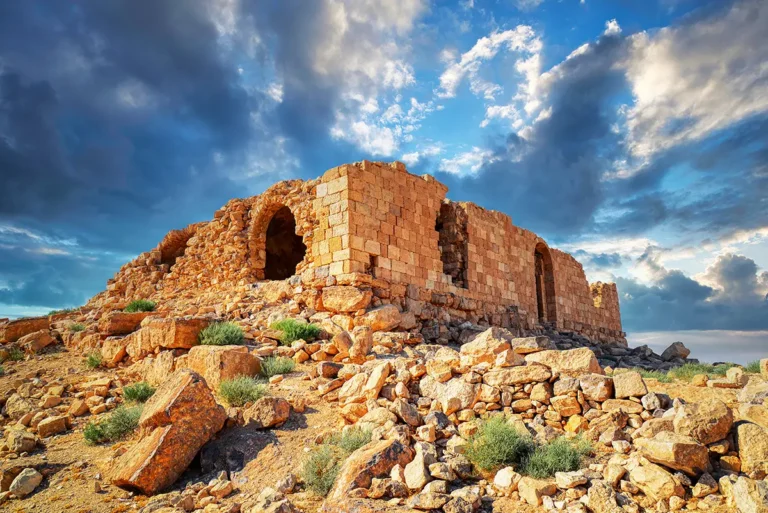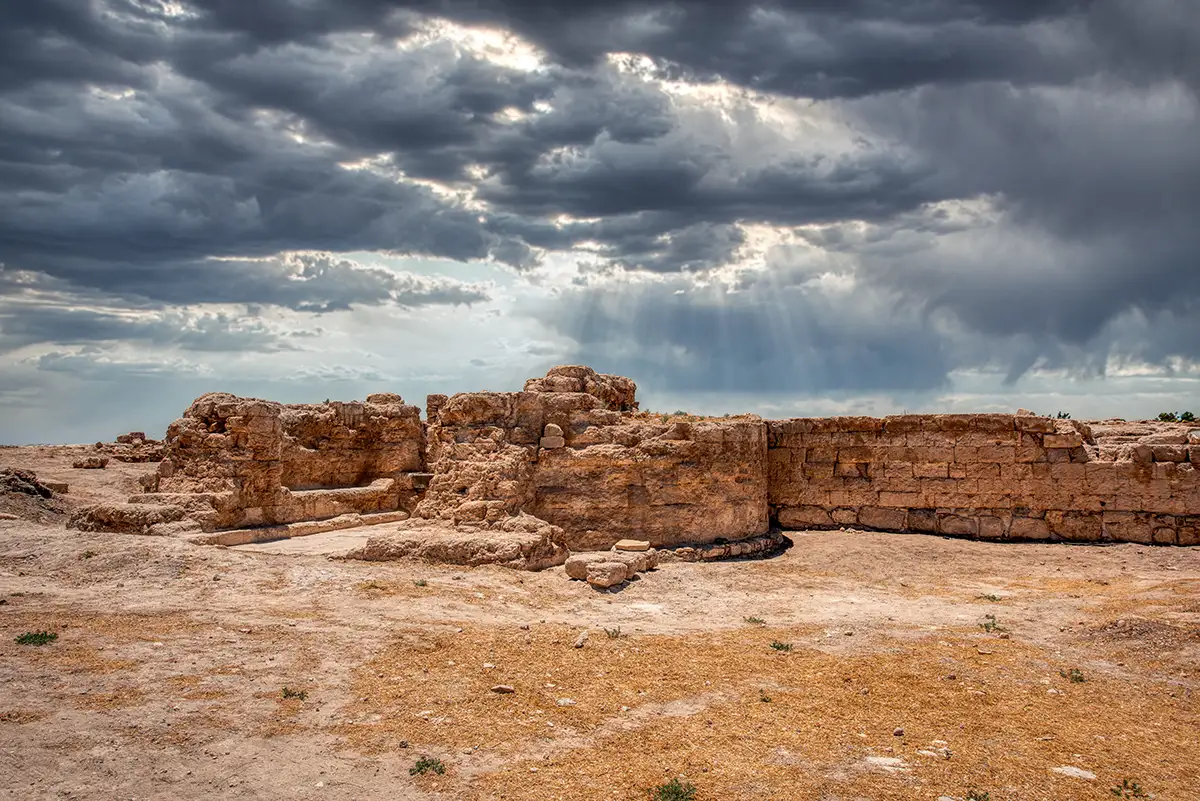

On a spur above Wadi al-Hasa, at the southern edge of the Karak plateau, stand the walls of an Umayyad residence built in the 8th century. Shuqayra al-Gharbiyya — “western Shuqayra” — shows that the Umayyad elite built not only in the desert and the Jordan Valley but also among the farmland of the southern uplands.
Where Is the Umayyad Palace of Shuqayra?
Shuqayra al-Gharbiyya lies in the Dhat Ras area of Karak Governorate, about 4 km from Dhat Ras and some 25 km south-east of Karak. It stands on a spur overlooking Wadi al-Hasa, the deep valley that divides the Karak plateau from the highlands of Tafila.
Historical Context and Origin
The site was first recorded as early Islamic during J. Maxwell Miller’s survey of the Karak plateau in the late 1970s. Excavation has shown that the building was raised in the Umayyad period, in three phases of the 8th century, and remained in use into the Abbasid period of the 9th century. The dating rests on an Umayyad copper coin, on pottery — about four-fifths of it early Islamic — and on a sherd with part of an 8th-century Kufic inscription.
Architectural Design
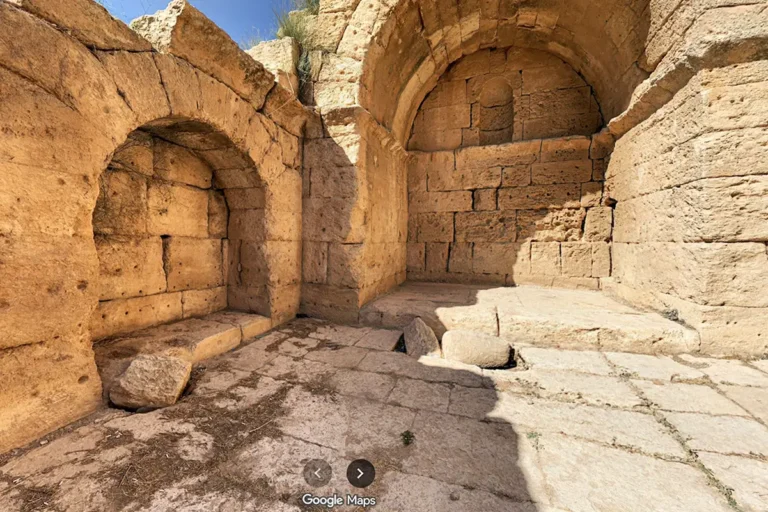
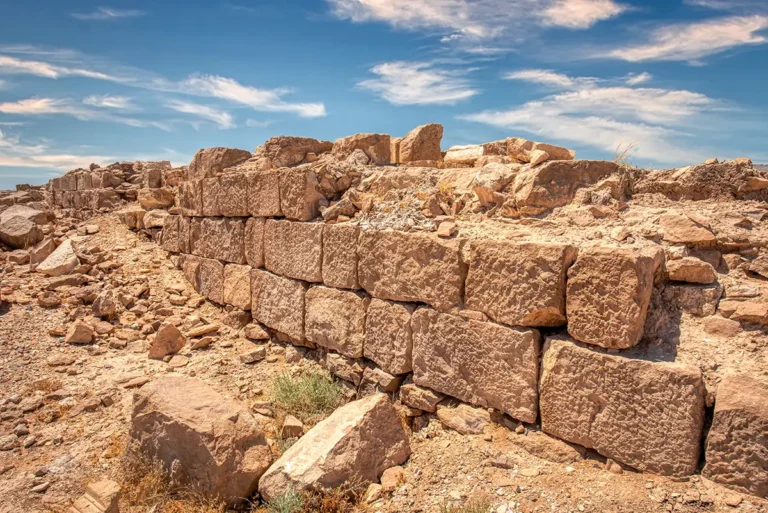
The building is of dressed limestone. Its entrance faces east: a gateway about 3.6 m wide between two solid semicircular towers leads into a square vestibule, about 4.5 m across, lined with benches and niches and probably once covered by a dome. Beyond it a barrel-vaulted hall opens onto a colonnaded courtyard. The largest room found so far is a reception hall of about 22 × 12 m, divided into three aisles by two rows of columns, with marble capitals and column drums.
Towered Entrance
A 3.6 m-wide gate between two solid semicircular towers opens to the east.
Domed Vestibule
A square entrance hall with benches and niches, probably once domed.
Columned Hall
A 22 × 12 m reception hall divided into three aisles by two rows of columns.
Mosaic Floor
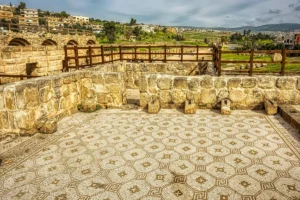
Geometric and plant designs, with a footed vase of dates, grapes and pomelos at the centre.
The Mosaic of Shuqayra
The reception hall has a mosaic floor of geometric and plant designs. At its centre a medallion shows a footed vase holding dates, grapes and pomelos. There are no human or animal figures. It is the first mosaic floor excavated on the Karak plateau. Painted fine pottery and a channel feeding a rainwater cistern were found nearby.
Destruction, Rediscovery, and Restoration
After the Abbasid period the building was reused in the Ayyubid–Mamluk and Ottoman periods, and local families lived in it until the 1970s. Since 2002 Mu’tah University, under Younis Shdaifat and Zakariya Na’imat, has excavated here season after season; nine seasons had been completed by 2019. The American Center of Research helped with conservation in 2012–2013. When we visited in 2026, restoration was under way and the mosaics were covered until the work is complete; the team also showed us the remains of a Byzantine church on the site.
Visiting the Umayyad Palace of Shuqayra Today
The site is not yet open to the public. On our visit the archaeological team kindly let us look inside — see our guide Visiting the Archaeological Sites of Dhat Ras. With conservation and interpretation, Shuqayra could become one of the most rewarding stops on the southern Karak plateau, best combined with the temples of Dhat Ras.
Further reading: Shdaifat & Ben Badhann, “Shuqayra al-Gharbiyya: A New Early Islamic Compound in Central Jordan”, Near Eastern Archaeology 71/3 (2008); The Jordan Times on the Shuqayra mosaic (2019).