

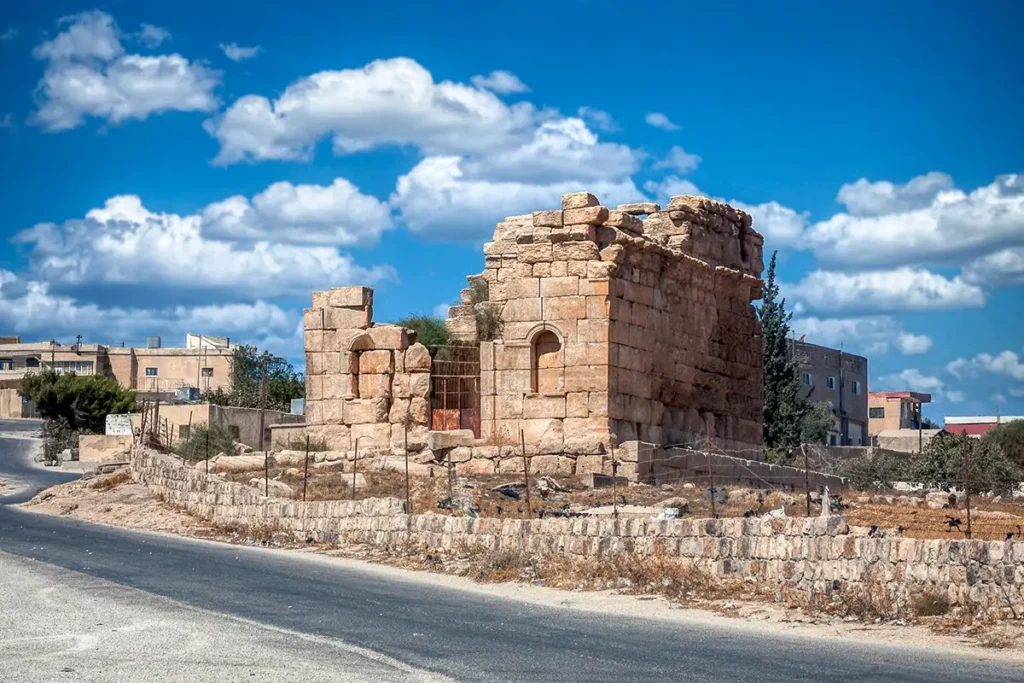
Dhat Ras is a quiet farming village at the southern end of the Karak plateau, but it holds the remains of three ancient temples — and one of them, the “small temple”, still stands almost to its full height in the middle of the village.
Where Is Dhat Ras?
Dhat Ras lies on the north side of Wadi al-Hasa, at about 1,200 m above sea level, in Karak Governorate — some 21 km south-south-east of Karak and about 6 km north-east of the Nabataean sanctuary of Khirbet et-Tannur. It sits along the line of an old Roman road, east of the King’s Highway; from the Desert Highway it is reached via Mhay and Umm Hamaat.
Historical Context and Origin
In the Nabataean and Roman periods Dhat Ras was an important settlement with at least three temples. The best-preserved, the small temple, probably dates to the 1st or early 2nd century AD. Scholars have long debated its character: the 19th-century surveyors Brünnow and Domaszewski called it Nabataean, while G. Lankester Harding described it as a small Roman temple. Its style mixes local Nabataean features with classical forms.
Architectural Design
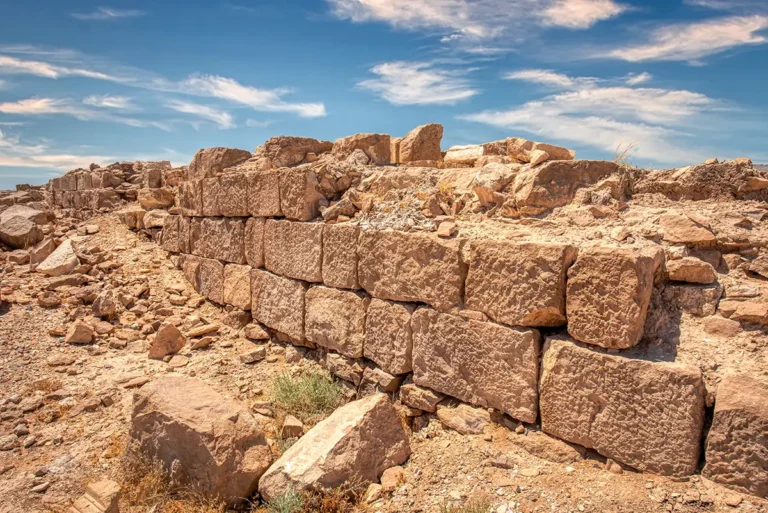
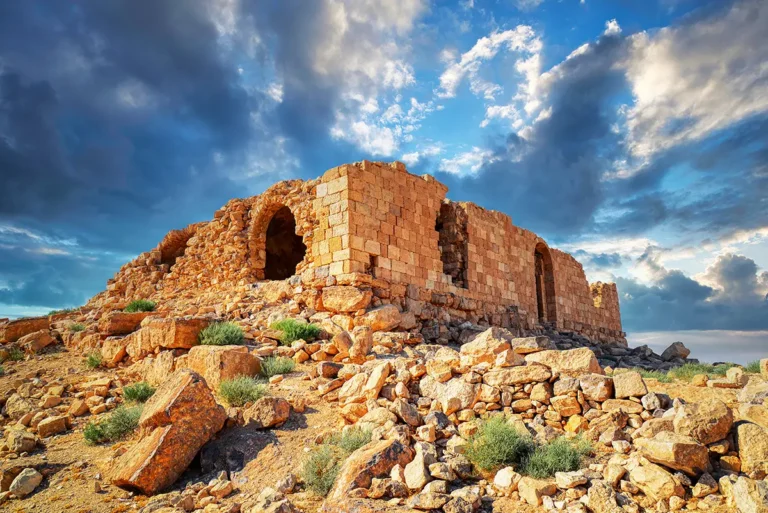
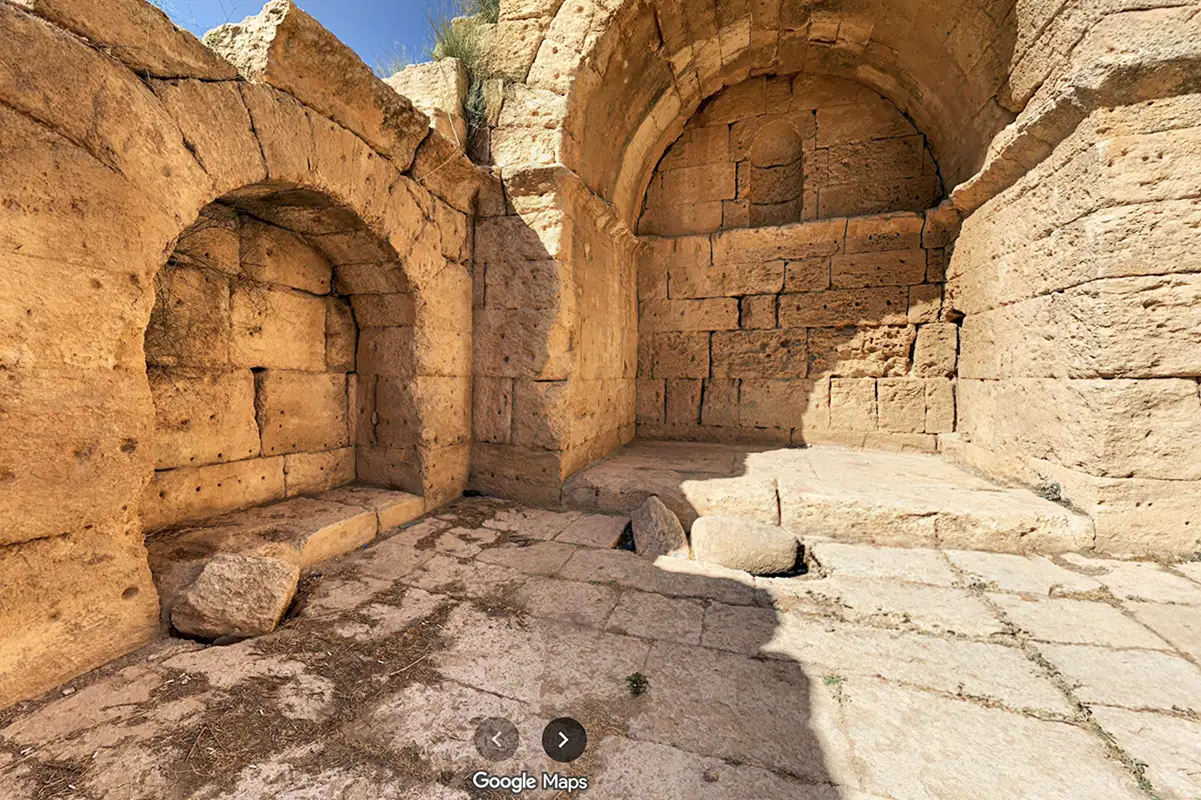
The small temple stands on a podium of about 19.35 × 14.35 m; the building itself measures about 13.90 × 9.90 m, with limestone ashlar walls some 1.80 m thick. It faces south. Its front has a central doorway flanked by two arched niches with pediments, and the corners carry pilasters with modified Corinthian capitals, below a cornice at about 6.7 m. Inside are ground, underground and attic levels. In 2001 it still stood 8.75 m high.
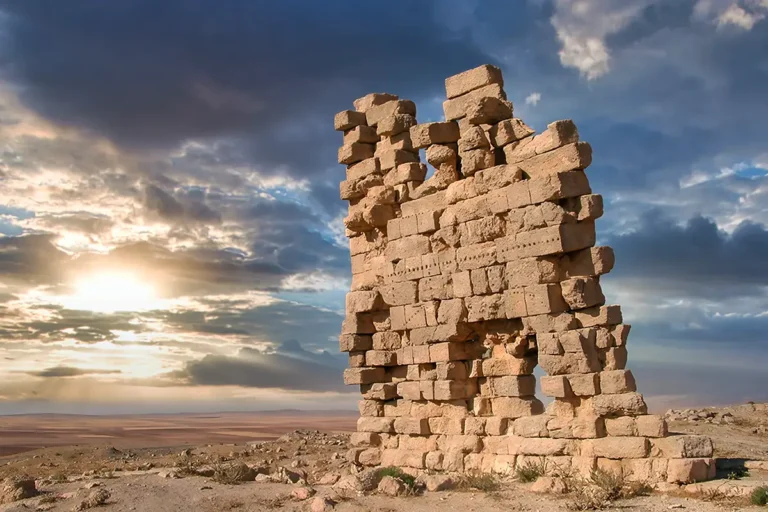
Two larger temples stood on the northern acropolis. The western one, dated to the early 1st century AD, is known for its tall freestanding wall — see Dhat Ras Wall.
Three Temples
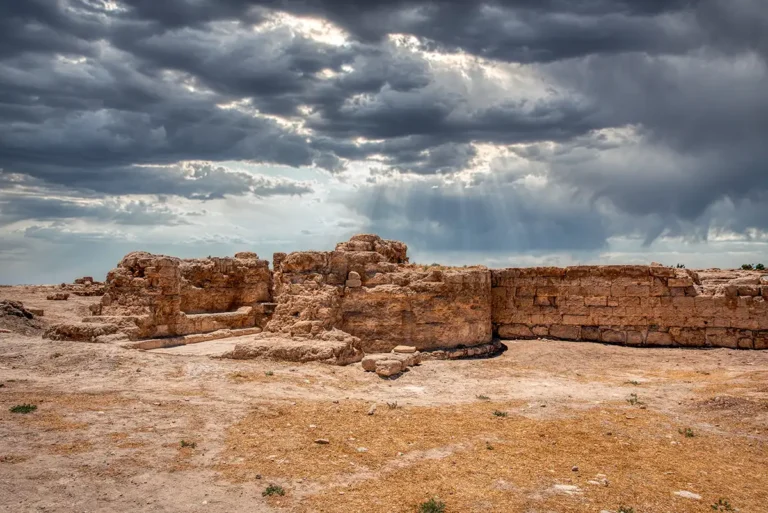
Two larger temples stood on the northern acropolis and a small one on a southern knoll.
The Small Temple
Built on a podium about 19 × 14 m; it still stood 8.75 m high in 2001.
Niches and Pilasters
The south front has a central doorway between two arched, pedimented niches.
Three Levels
Ground, underground and attic levels, with corner pilasters and Corinthian-style capitals.
Three Temples on the Plateau
Three temples in one settlement mark Dhat Ras as more than a farming village: it was a religious centre of the southern Karak plateau, about 6 km from the Nabataean hilltop sanctuary of Khirbet et-Tannur. Two temples crowned the northern acropolis and the small temple stood on a knoll to the south. Which gods were worshipped here is not known: no dedication has been found.
Destruction, Rediscovery, and Restoration
Nelson Glueck recorded and photographed the temples in the 1930s, and the site was included in the Archaeological Survey of the Kerak Plateau, published in 1991. Over the years villagers quarried stone from the two acropolis temples for their houses, and the eastern acropolis temple was bulldozed around 2010. The small temple has survived best; it is now fenced. In 2025 the standing wall of the western acropolis temple was dismantled for rebuilding.
Visiting Dhat Ras Today
The small temple stands beside the main village road and can be seen from outside its fence. On our visit the gate was locked and no one could be found with the key — see our guide Visiting the Archaeological Sites of Dhat Ras. The upper temples are reached by unpaved roads through the village. Combine the visit with the Umayyad Palace of Shuqayra nearby.
Further reading: Karak Resources Project — Dhat Ras temple; Eddinger, “A Nabatean/Roman Temple at Dhat Ras”, Near Eastern Archaeology 67.1 (2004).