












According to the Bible, Moses climbed Mount Nebo, looked out over the Promised Land and died there. Since the 4th century Christians have commemorated him on its summit, Ras Siyagha, where a small church grew into a basilica and monastery covered with some of the finest mosaics in Jordan.
Where Is Mount Nebo?
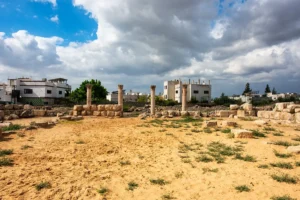
The memorial stands on Ras Siyagha, about 8 km north-west of Madaba and about 30 km from Amman, at about 710 metres above sea level. The higher neighbouring peak, Jebel an-Neba, rises to around 800 metres. From the terrace the view opens across the Jordan Valley and the Dead Sea; on a clear day Jericho and Jerusalem, about 46 km away, can be seen. The Church of St Lot and St Procopius and the Church of St George lie nearby at Khirbet al-Mukhayyat, the ancient town of Nebo.
Historical Context and Origin
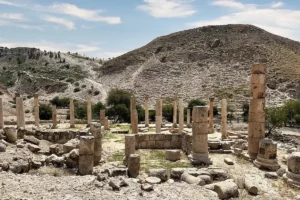
The tradition rests on Deuteronomy 34, where Moses sees the land “from Mount Nebo, to the top of Pisgah” before his death. In the early 380s the pilgrim Egeria found a small church on the summit, where monks told her Moses had been laid to rest. In the 6th century the early chapel became the presbytery of a three-aisled basilica, surrounded by a monastery about 78 by 82 metres. A new baptistery followed in AD 597, and the Theotokos chapel early in the 7th century. Monastic life continued into the early Islamic centuries before the site was abandoned.
Architectural Design
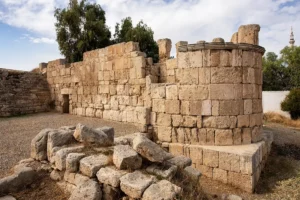
The first church was a small three-apsed building. Its successor, the basilica, kept the old chapel at its east end and added side chapels, baptisteries and the rooms of the monastery around it. The mosaics of the complex cover about 700 square metres, in up to three or four layers laid one over the other.
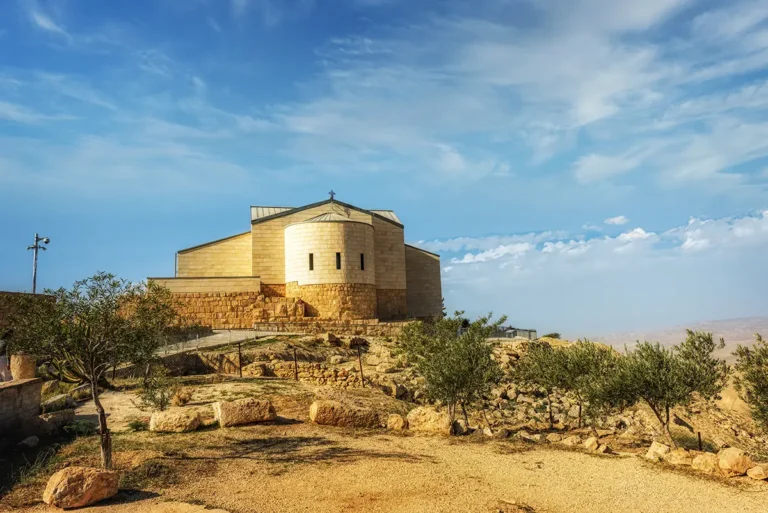
The Memorial of Moses
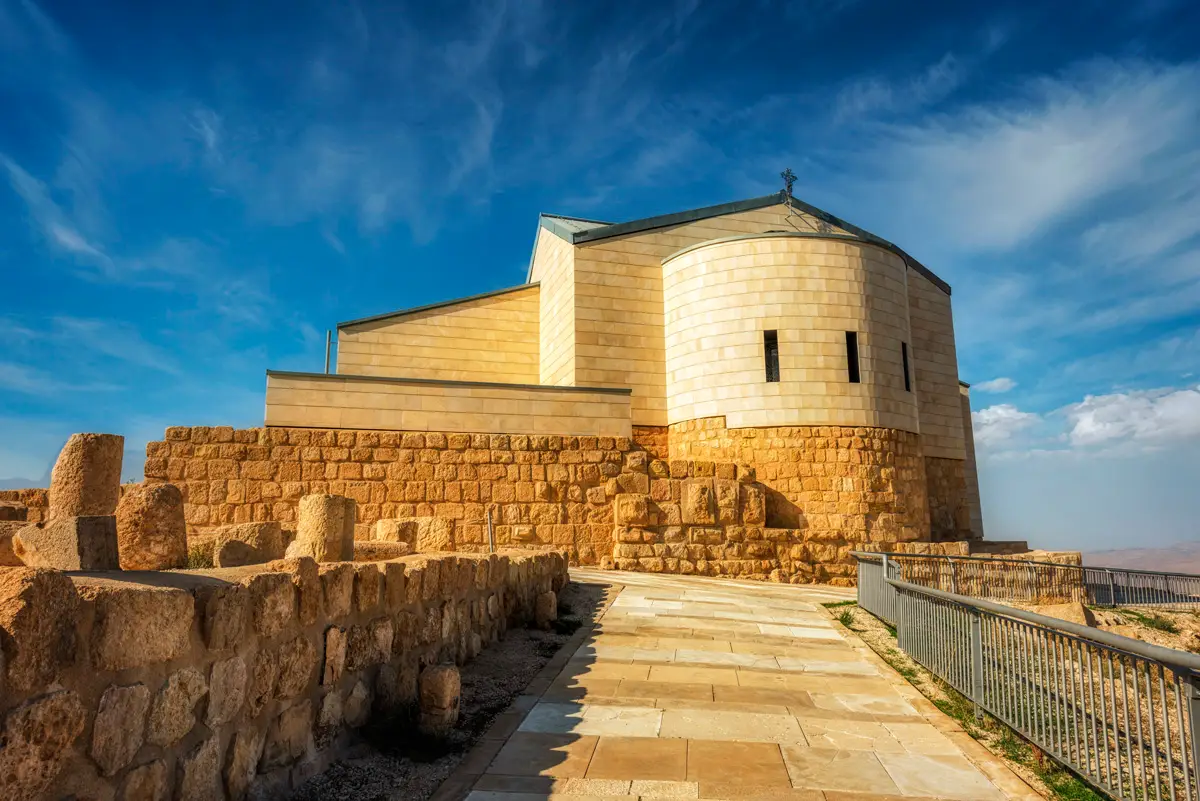
A modern church protects the Byzantine basilica and its mosaics, reopened in 2016.
The Diakonikon Mosaic
A floor of AD 530 with hunting and herding scenes, found in 1976 beneath a later floor.
The Panorama
Views across the Jordan Valley and the Dead Sea; Jerusalem lies about 46 km away.
The Brazen Serpent
A bronze sculpture by Gian Paolo Fantoni (1983–84), recalling the serpent Moses raised in the desert.
The Mosaics
The most famous floor is in the old diakonikon-baptistery: dated AD 530, it shows hunters, herdsmen and animals — a lion, a zebra, an ostrich and a dromedary led by its keeper — framed by vine scrolls. It was found in 1976 beneath a later floor. The Theotokos chapel, paved under Bishop Leontius in the early 7th century, carries a quotation from Psalm 51 around an image of the Temple.
Rediscovery and Restoration
The Franciscans bought Ras Siyagha in 1932, and excavation began in 1933 under Fr Sylvester Saller. Virgilio Corbo began restoration in 1963, and Michele Piccirillo worked on the site from 1976 until his death in 2008. Pope John Paul II visited in 2000 and Pope Benedict XVI in 2009. After a long restoration, the new Memorial Church reopened in October 2016.
Visiting Mount Nebo Today
Walk first to the terrace for the view, then enter the Memorial Church to see the mosaics, and find the Brazen Serpent, a bronze by Gian Paolo Fantoni. The site is run by the Franciscans; morning light usually gives the clearest view across the valley. Allow about an hour.
Further reading: Custody of the Holy Land: Mount Nebo.