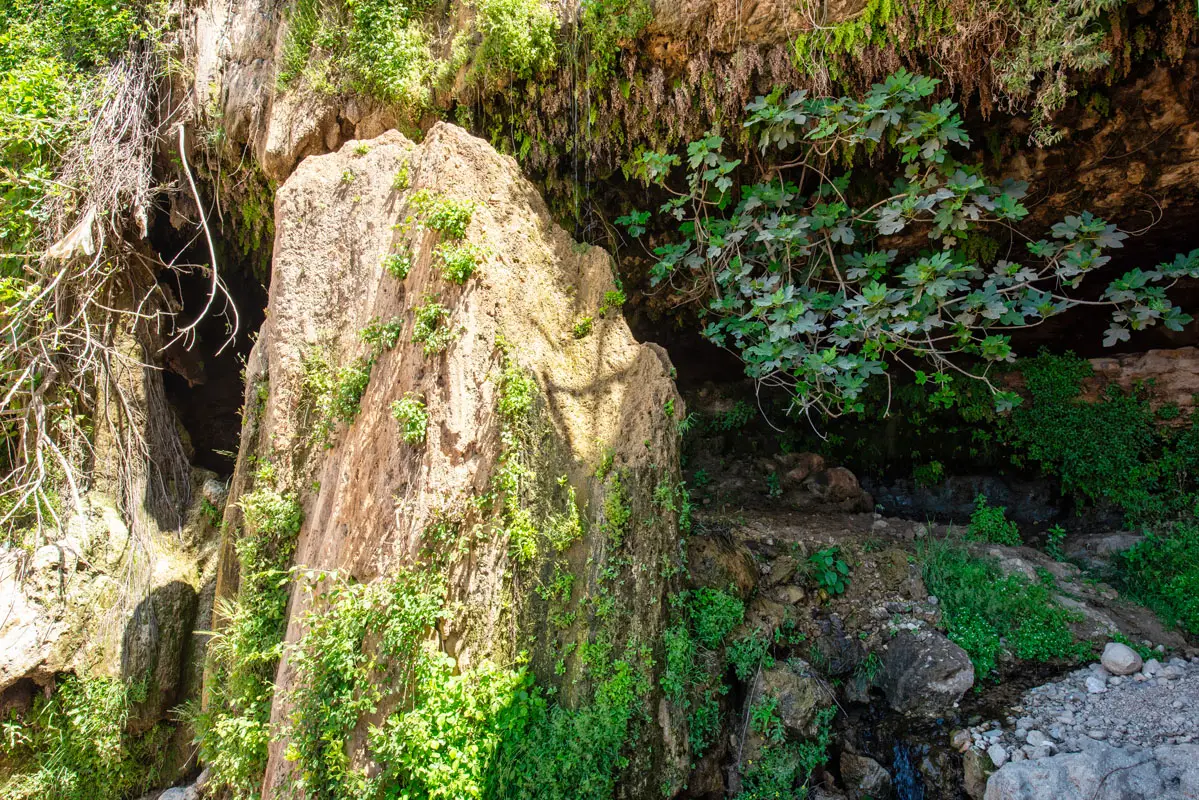


In the valley below Mount Nebo, water still rises from beneath a rock overhang, among ferns and fig trees. Christian tradition linked these springs, known as ‘Ayun Musa, with the water Moses brought from the rock for the Israelites — and in the Byzantine period two churches were built close by.
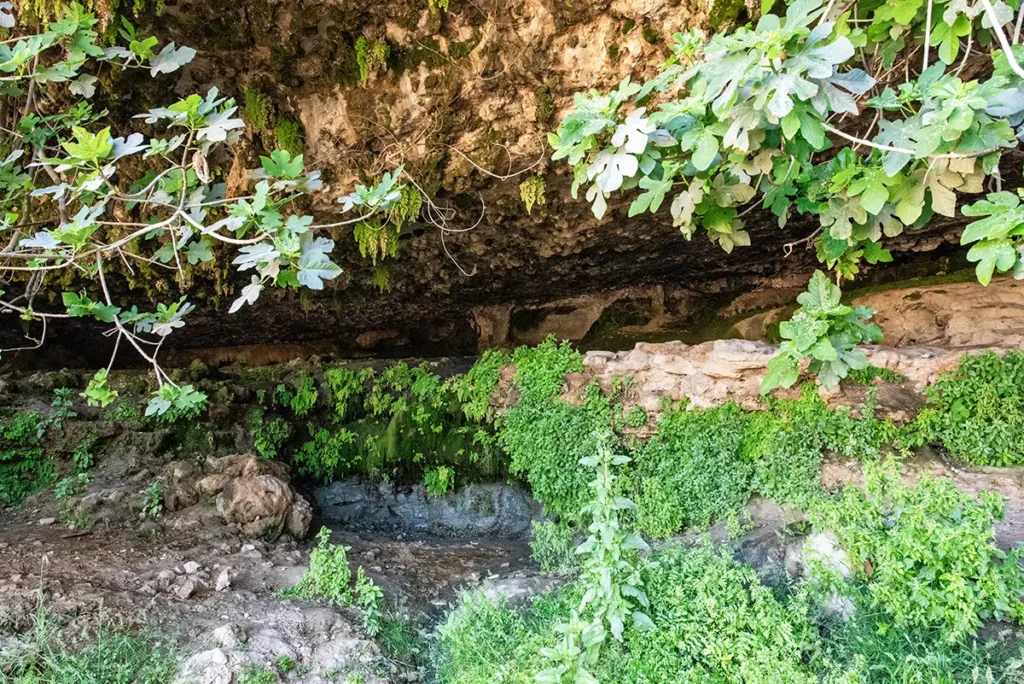
Where Is Moses Spring?
The springs lie in the valley of ‘Ayun Musa, about 3 km north-east of the summit of Mount Nebo (Ras Siyagha). The hill of Khirbet al-Mukhayyat, with the Church of St George, rises to the south.
Historical Context and Origin
The springs were perennial and rich in water, and in antiquity they watered vineyards in the valley. Around AD 381–384 the pilgrim Egeria made a detour to a small church near Nebo, where “a great stream of water” flowed from the rock; the monks told her it was the water Moses gave to the children of Israel. The biblical stories of the rock place the miracle elsewhere, so the link with this valley is a tradition rather than a biblical location.
The Byzantine Churches
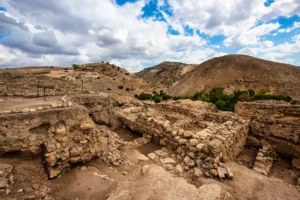
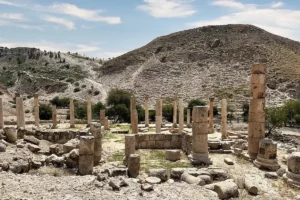
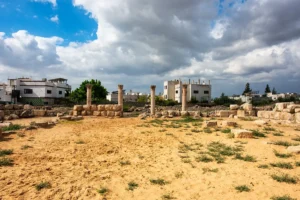
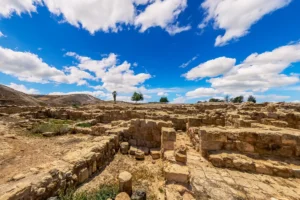
Two churches were excavated near the springs. The Church of Deacon Thomas, excavated in 1986–1987, has mid-6th-century mosaics of vine scrolls, a hunter named Stefanos and a medallion with an eagle naming “Thomas the deacon”; it was abandoned in the Umayyad period. The Church of Kaianus has an upper and a lower church; its lower floor carries an Aramaic-script inscription of the late 5th or early 6th century, the earliest of its kind in Transjordan. Scholars have not been able to say which church, if either, Egeria visited.
The Spring
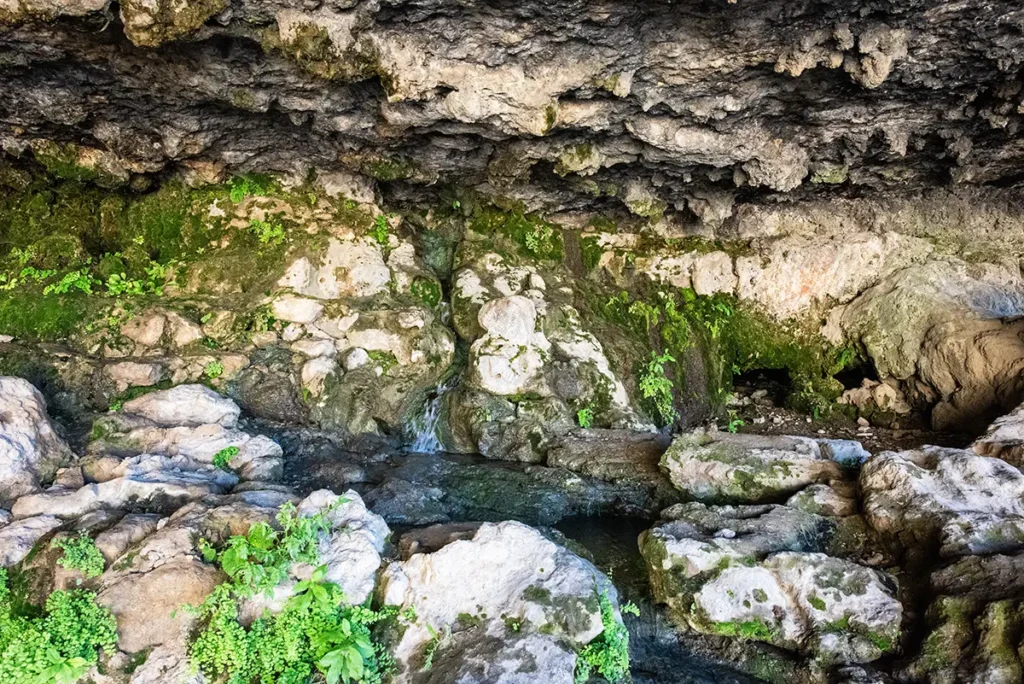
Water rises beneath a rippled rock overhang and runs between boulders in a shaded grotto.
Egeria’s Water
The 4th-century pilgrim Egeria saw “a great stream” flowing from the rock near Nebo.
The Church of Deacon Thomas
A mid-6th-century church with mosaics of vine scrolls, a hunter and an eagle medallion.
The Church of Kaianus
An upper and a lower church, with the earliest Aramaic-script inscription in Transjordan.
Visiting Moses Spring Today
The spring is reached on foot along an established path, though there are no signs, and nothing of the two churches can be seen today. This is a quiet, green place, far from the crowds at the summit. Look for the water pooling under the rock ledge and the stream running between the boulders. It makes a peaceful stop between Mount Nebo and Khirbet al-Mukhayyat.
Further reading: The Pilgrimage of Egeria (McClure & Feltoe).