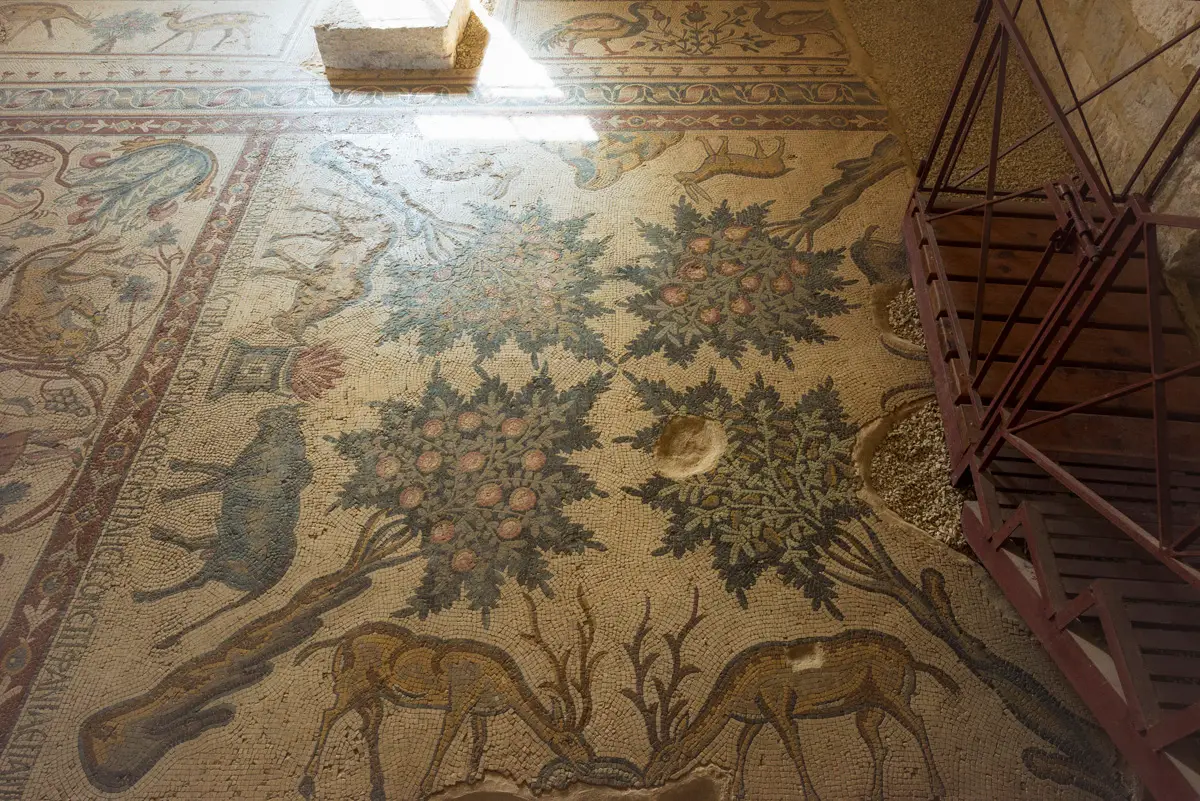
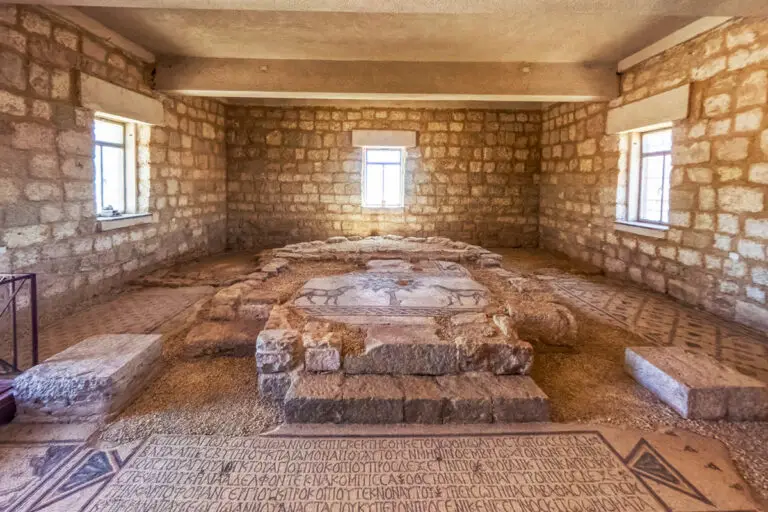

On the hill of Khirbet al-Mukhayyat, the ancient town of Nebo, a small Byzantine church keeps one of the most charming mosaic floors in Jordan. Dedicated to Lot, the Old Testament patriarch, and to the martyr Procopius, it is covered with grape-pickers, wine-pressers, hunters, animals and fishermen — village life in the 6th century, set in stone.
Where Is the Church of St Lot and St Procopius?
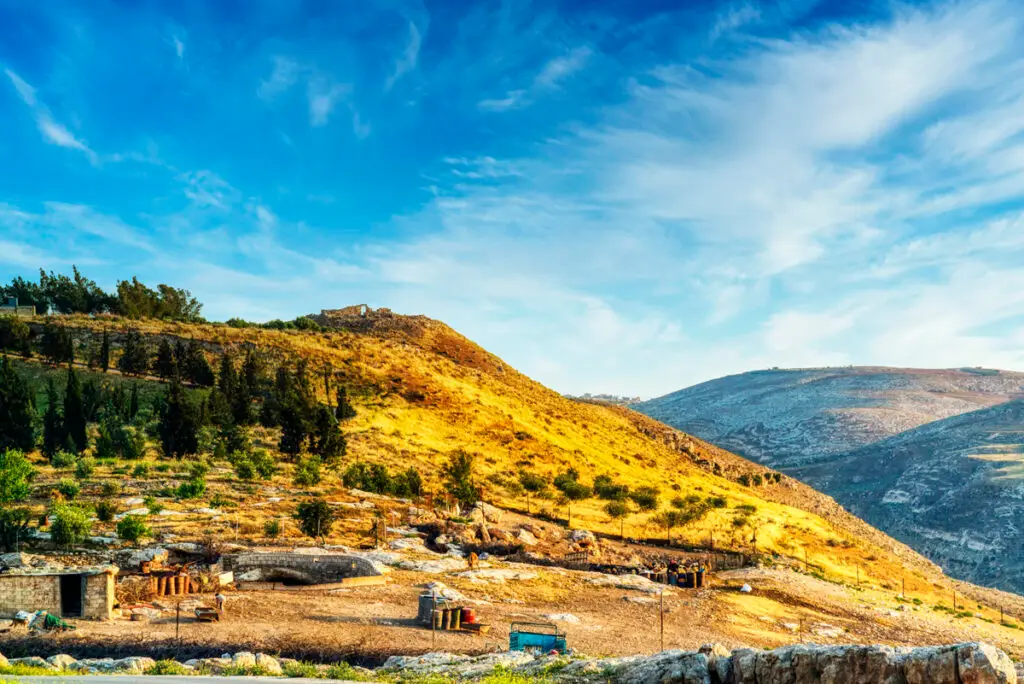
The church stands at Khirbet al-Mukhayyat, about 9 km north-west of Madaba and a few kilometres south-east of Mount Nebo, between Wadi Mukhayyat and Wadi Afrit. The hilltop is usually identified with the town of Nebo named in the 9th-century BC Mesha inscription. The Church of St George stands on the same hill, and Moses Spring lies in the valley below.
Historical Context and Origin
In the 6th century Nebo was a Christian village with several churches. This one was built in the mid-6th century — traditionally in AD 557 — in the time of a Bishop John. Its Greek inscription names the priest and sacristan Barichas, who oversaw the church’s construction, and the donors: Stephanos and Elias, children of Comitissa, and Sergius with his son Procopius. The Church of St George nearby is dated a generation earlier, to AD 536.
Architectural Design
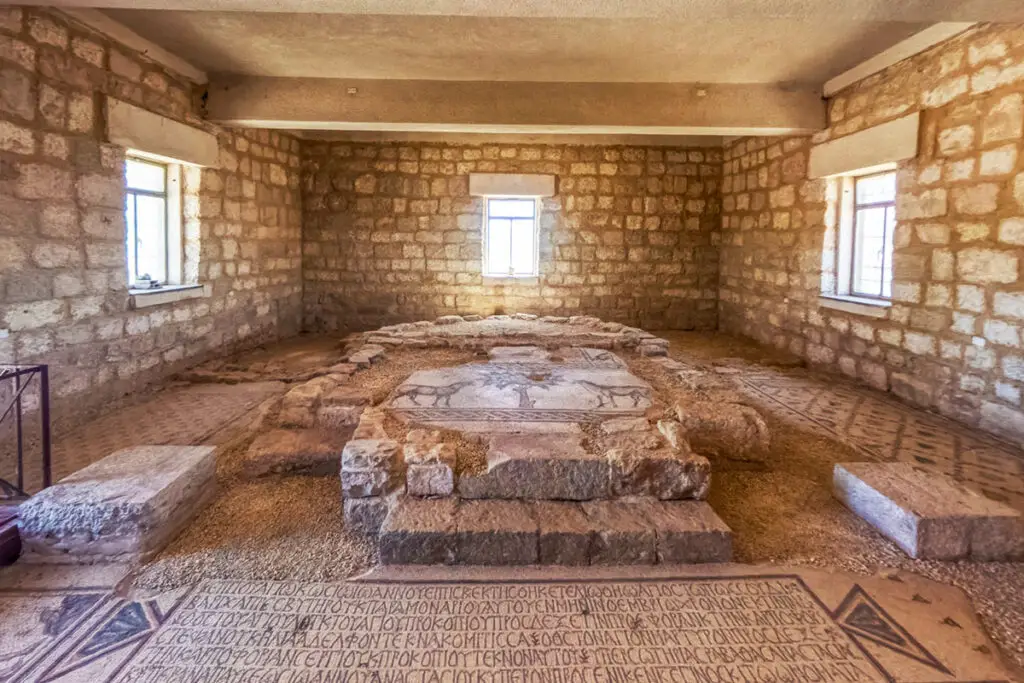
The church is a small basilica inside the old town walls, north of the acropolis, with a nave and two aisles divided by pillars and the sanctuary at the east. Its walls survive only low, but the mosaic floor is almost complete.
The Vine Scroll
Grape-picking, wine-pressing, hunting and herding scenes fill the medallions of a great vine.
The Trees and Animals
A second field shows four trees with pairs of animals between them.
Nile Scenes
Between the columns, boats and fishermen recall the Nile; one panel shows a church between a boatman and a fisherman.
The Dedication
A Greek inscription before the chancel names Bishop John, the priest and sacristan Barichas and the donors.
The Mosaic Floor
The nave is divided into two fields. In the eastern one a great vine forms medallions with scenes of grape-picking and two men treading grapes, alongside hunters and herdsmen. The western field shows four trees with pairs of animals between them. Between the columns are scenes of boats and fishermen, one of them with a church between a boatman and a fisherman. The dedicatory inscription lies in front of the chancel steps.
Rediscovery and Restoration
The first mosaic came to light in 1913, when a house was being built on the hill. The Franciscans acquired the site in 1932 and built a stone shelter over the church in 1935; Sylvester Saller and Bellarmino Bagatti published it in their study of the town of Nebo. A recent conservation lifted the floor, removed old cement and laid it back on a new bed in its original position.
Visiting the Church Today
The mosaic is protected inside a locked stone shelter, opened for visitors by the family living next door. It pairs naturally with the Church of St George on the same hill and with Mount Nebo a short drive away. Allow about 30 minutes.
Further reading: Studies in the History and Archaeology of Jordan 14 (DoA).