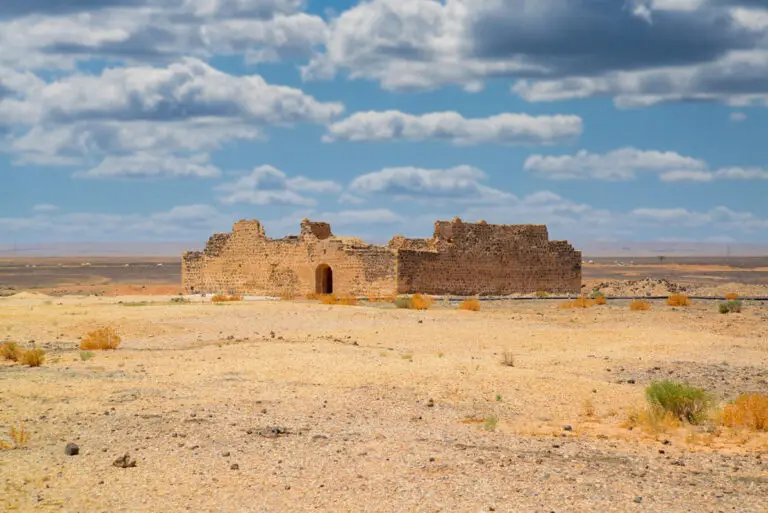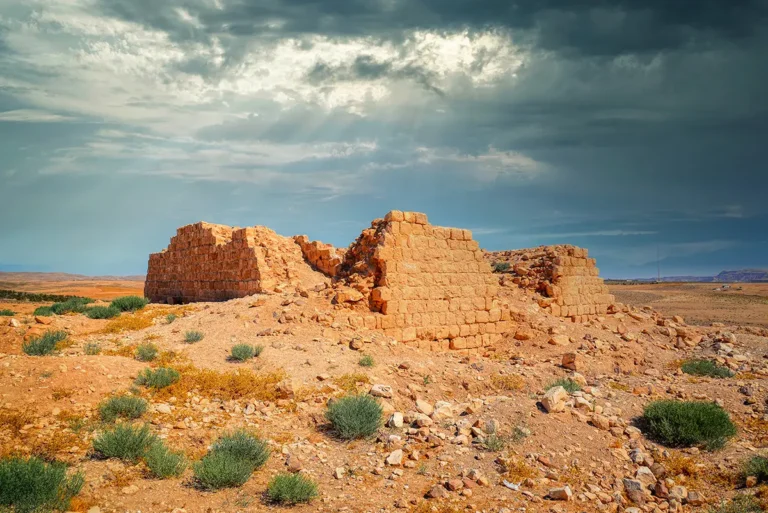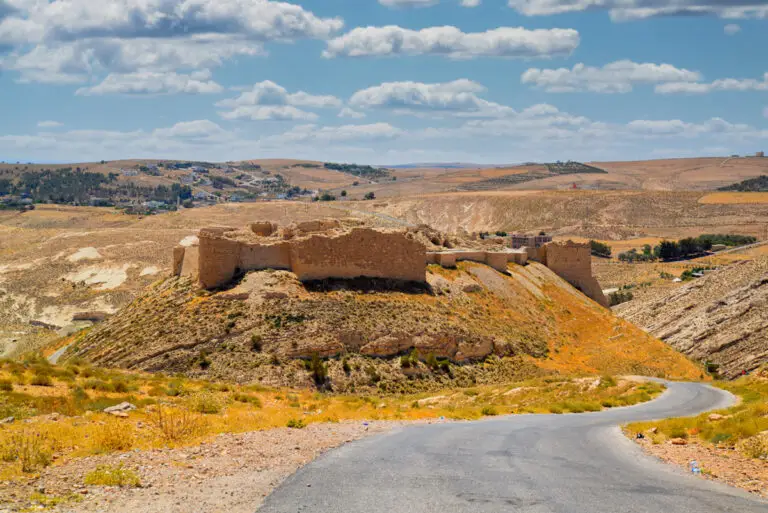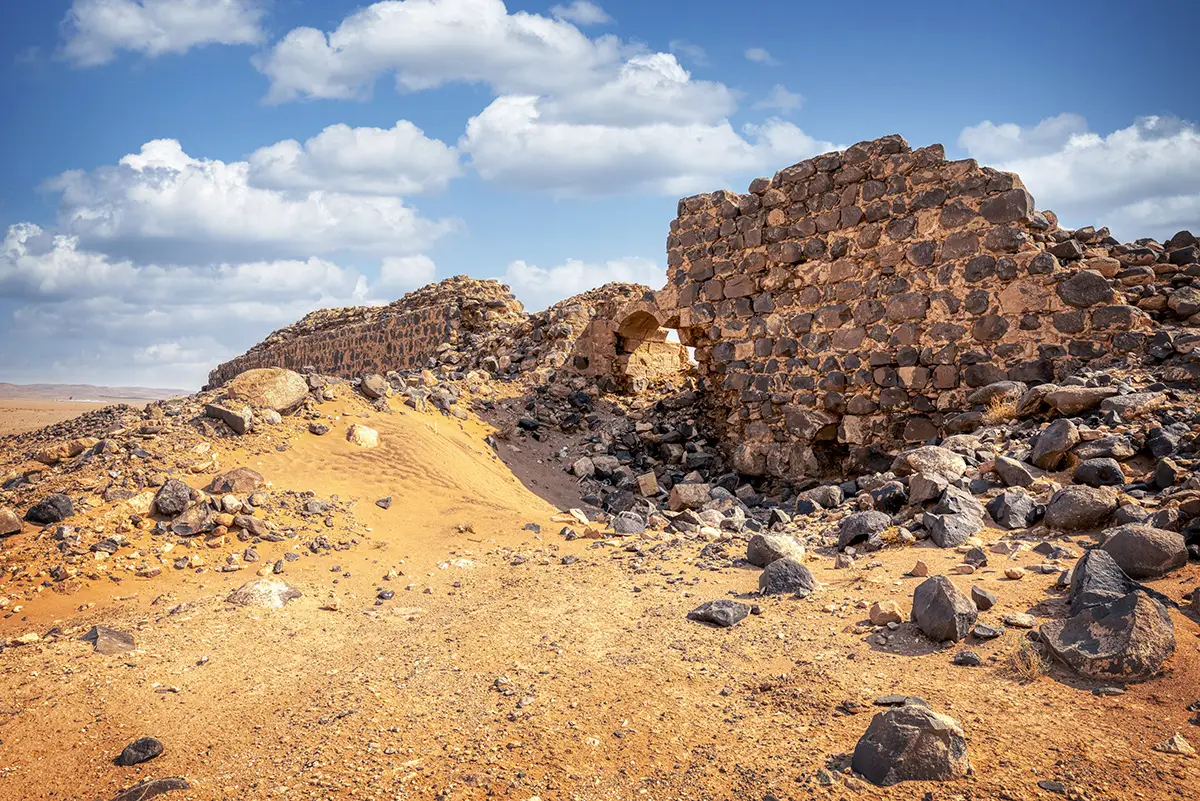

On a quiet plain north of Ma’an, ringed by the dark cones of extinct volcanoes, stands one of the best-preserved Roman forts in southern Jordan. Da’janiya was built around AD 300 to guard the southern stretch of the empire’s desert frontier.
Where Is Dajaniya Fort?
Da’janiya lies about 41 km north of Ma’an and about 40 km north-east of Petra, near the village of al-Husseiniya in Ma’an Governorate. It stands west of the modern Desert Highway, between the highway and the line of the Roman Via Nova Traiana, on the eastern edge of the farmland and south of Wadi al-Hasa. Watchtowers stood on the volcanic cones around it.
Historical Context and Origin
Earlier scholars dated the fort to the 2nd century or the Severan period, but excavation supports a date in the late 3rd or early 4th century, under Diocletian, when the frontier of Arabia was strengthened — the same programme that produced the legionary fortress of El-Lejjun, 78 km to the north. A coin of AD 308–310 was found on the surface. From its barracks and stables, the garrison has been estimated at about 300 men: three centuries of infantry and two troops of cavalry.
Architectural Design
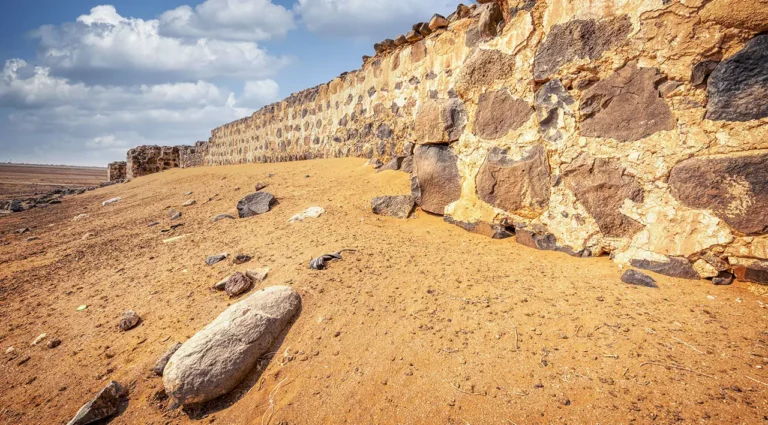
The fort is a near-square of about 102 × 100 m, with walls up to 2.25 m thick and perhaps 5 m high, built of basalt and limestone and once heavily plastered. Fourteen towers projected from the walls: one at each corner, two along each side and two flanking the main gate in the east wall; smaller gates opened in the south and west walls. A central road crossed the interior, and a cistern of about 12.8 × 5.5 m stored water. Parts of the walkway along the top of the walls can still be seen.
A Square Fortress
About 100 × 100 m, with walls up to 2.25 m thick.
Fourteen Towers
Corner towers, two interval towers on each wall and a twin-towered main gate on the east.
Basalt and Limestone
Walls of basalt and limestone, once heavily plastered.
Barracks and Stables
Room for some 300 soldiers, infantry and cavalry.
The Largest Fort Between Lejjun and Udruh
Da’janiya is more than four times the size of a typical Roman castellum and is the largest and best-preserved fort between El-Lejjun and the legionary fortress of Udruh near Petra. Its main occupation lasted through the 4th and 5th centuries, and formal military use ended in the 6th century. The ruins show at least four collapses caused by earthquakes.
Destruction, Rediscovery, and Restoration
After the army left, the fort was used for camping and burials. In 1989 the Limes Arabicus Project, directed by S. Thomas Parker, dug seven soundings here. In 2018 a team from the Jagiellonian University in Kraków documented the fort in 3D, recording seven pits dug by looters, and in 2022 a geophysical survey looked for a civilian settlement around it. The walls are well preserved, the towers less so; a modern reservoir stands beside the ancient one.
Visiting Dajaniya Fort Today
Da’janiya is an unrestored site in open country, open and free to visit. Walk the circuit of the walls, look for the gate towers on the east side, and climb the walls with care. Bring water and sun protection. Our 360° panorama shows the fort.
Further reading: Jagiellonian University — Da’janiya; Karak Resources Project — Castella in Arabia.