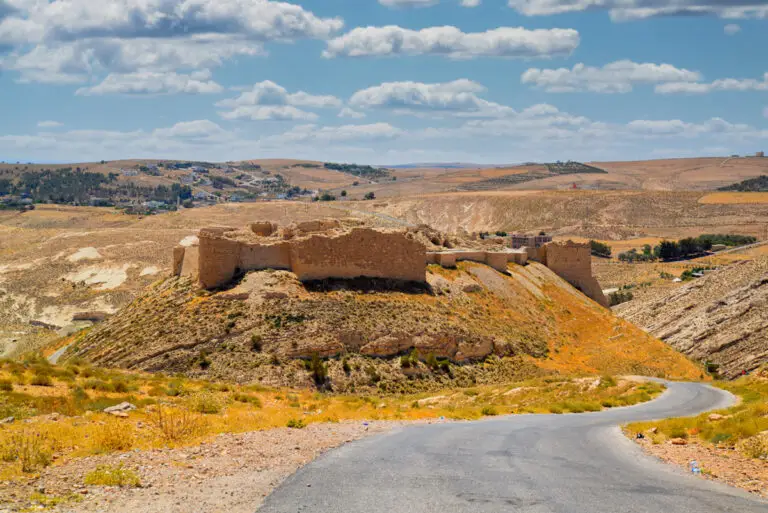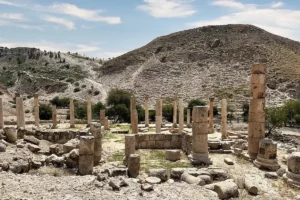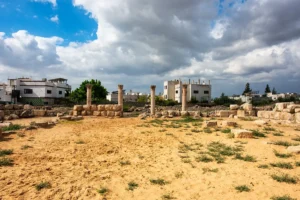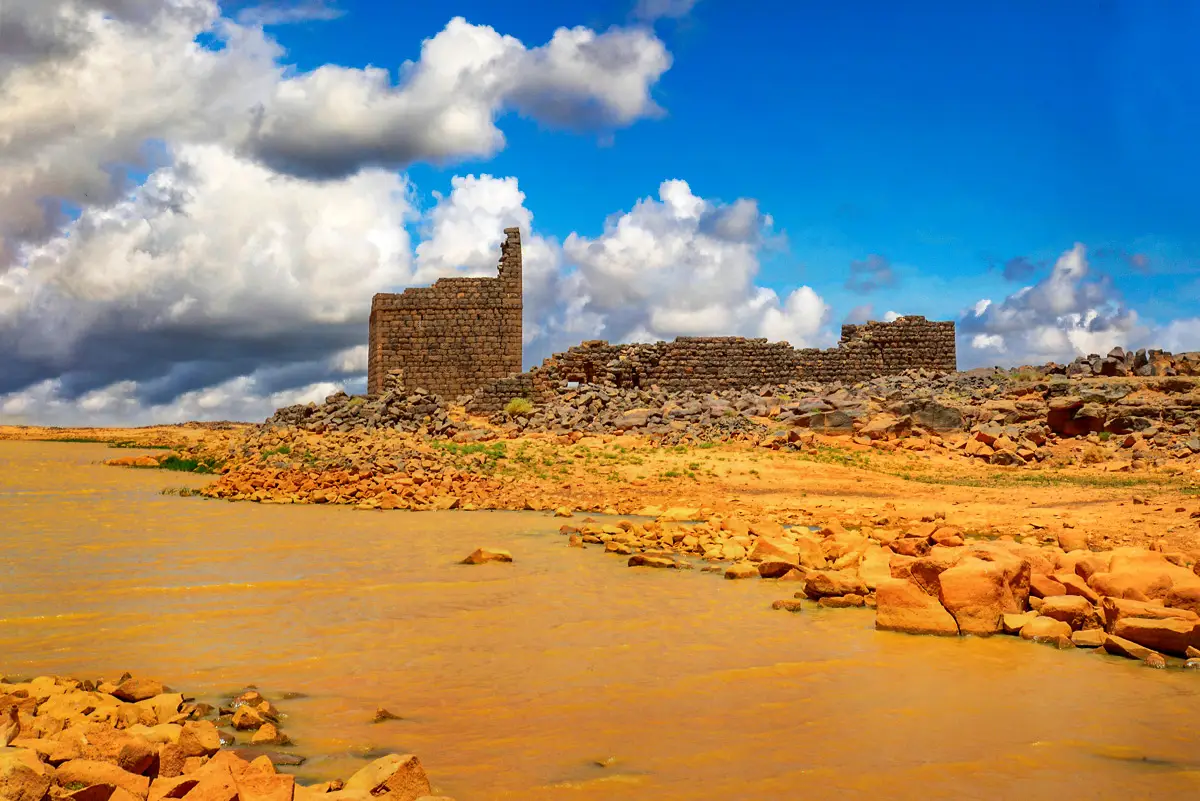














On a hilltop east of Shobak, the broken walls of Dusaq look out over the plain. In 1223 the Ayyubid ruler of Damascus, al-Mu’azzam ‘Isa, built here a residence for comfort and leisure, with a vaulted reception hall, a pool and a heated bathhouse — a rare glimpse of elite life on the road between Syria and the Hejaz.

Where Is Dusaq Palace?
Dusaq — known to archaeologists as Khirbat ad-Dawsaq — stands on a hilltop about 1,270 m above sea level, some 50 m above the surrounding plain, about 5–6 km east of Shobak castle and about 25 km north of Petra. The old Syrian pilgrimage route along the King’s Highway passed at the foot of the hill, at the turn-off to Shobak; the modern Desert Highway runs 15–20 km to the east.
Historical Context and Origin
After Saladin took Shobak from the Crusaders in 1189, the region came under the Ayyubid rulers of Damascus. Fragments of Arabic inscriptions found at Dusaq include a door lintel giving the foundation date: the complex was built and inaugurated in 1223, under al-Malik al-Mu’azzam ‘Isa. Earlier visitors had taken the ruins for a church, a caravanserai, a fort or a mosque; the excavators now see it as a leisure complex of the ruling elite, which may also have served pilgrims on the Hajj route from Damascus.
Architectural Design
Three buildings stand in an L-shape around a central courtyard. Building A is an iwan — a vaulted reception hall open on one side — facing a pool. Building B was probably the living quarters, and one of its rooms forms the base of a tower. Building C holds the bathhouse. A large water basin lies 23 m to the south.
Dated 1223
A foundation inscription dates the complex to the Ayyubid ruler al-Mu’azzam ‘Isa.
Iwan and Pool
A vaulted reception hall opened onto a pool.
Medieval Hammam
A bathhouse with cold, warm and hot rooms and a heated floor.
Courtyard Plan
Three buildings set in an L-shape around a central courtyard.
The Bathhouse of Dusaq
The hammam follows the classic sequence of cold, warm and hot rooms, measuring about 3.5 × 4.8 m, 2.0 × 3.1 m and 2.8 × 4.8 m. The hot room stood on a hypocaust — a raised floor on ten small piers, heated from below by a furnace — with a boiler room and two vaulted brick water tanks alongside.

Destruction, Rediscovery, and Restoration
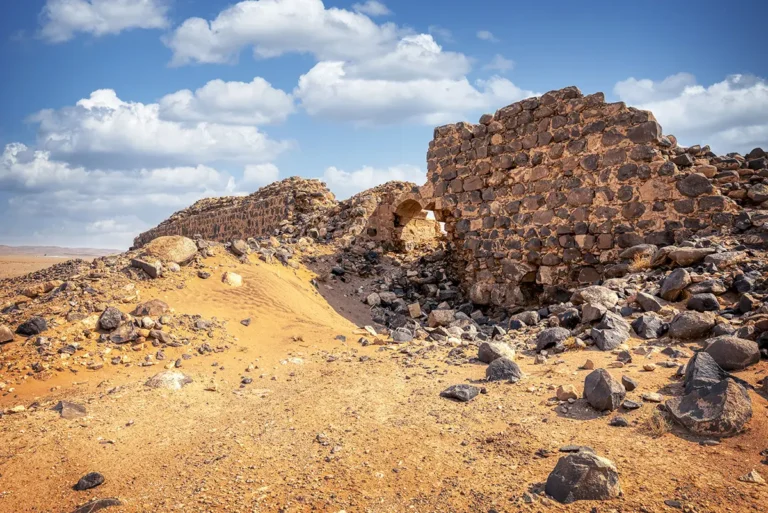
Dusaq remained in use into the Mamluk period. Later, Bedouin buried their dead on the hill, and during the Arab Revolt of 1916–1918 it held a garrison. European travellers described the ruins from 1864 onwards. The French Institute for the Near East (Ifpo) excavated here in 2008–2009 and again from 2014. The site has suffered badly from looting and bulldozing: part of the bath has been destroyed, and the walls survive to about 2.25 m.
Visiting Dusaq Palace Today
Dusaq is an unrestored ruin on an open hilltop, open and free to visit, easily combined with a visit to Shobak castle. Look for the vaulted chambers and the remains of the bathhouse, and take care around the open vaults. See our photo album and 360° panorama.
Further reading: Hofstetter, Vigouroux & Elter, Open Archaeology 8 (2022); Vigouroux & Elter, “The Medieval Ḥammām of Khirbat ad-Dawsaq”, SHAJ 13 (2019).