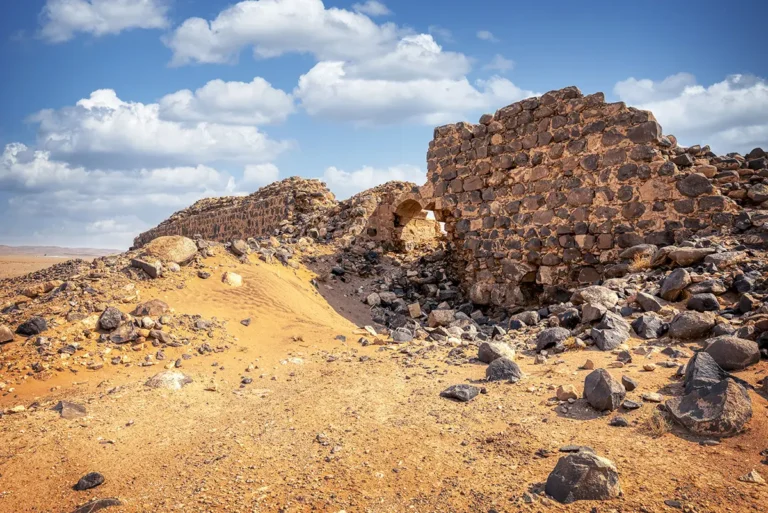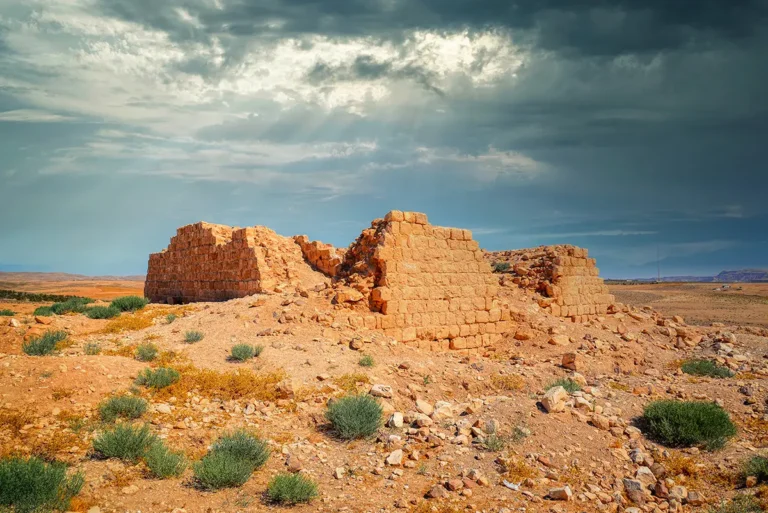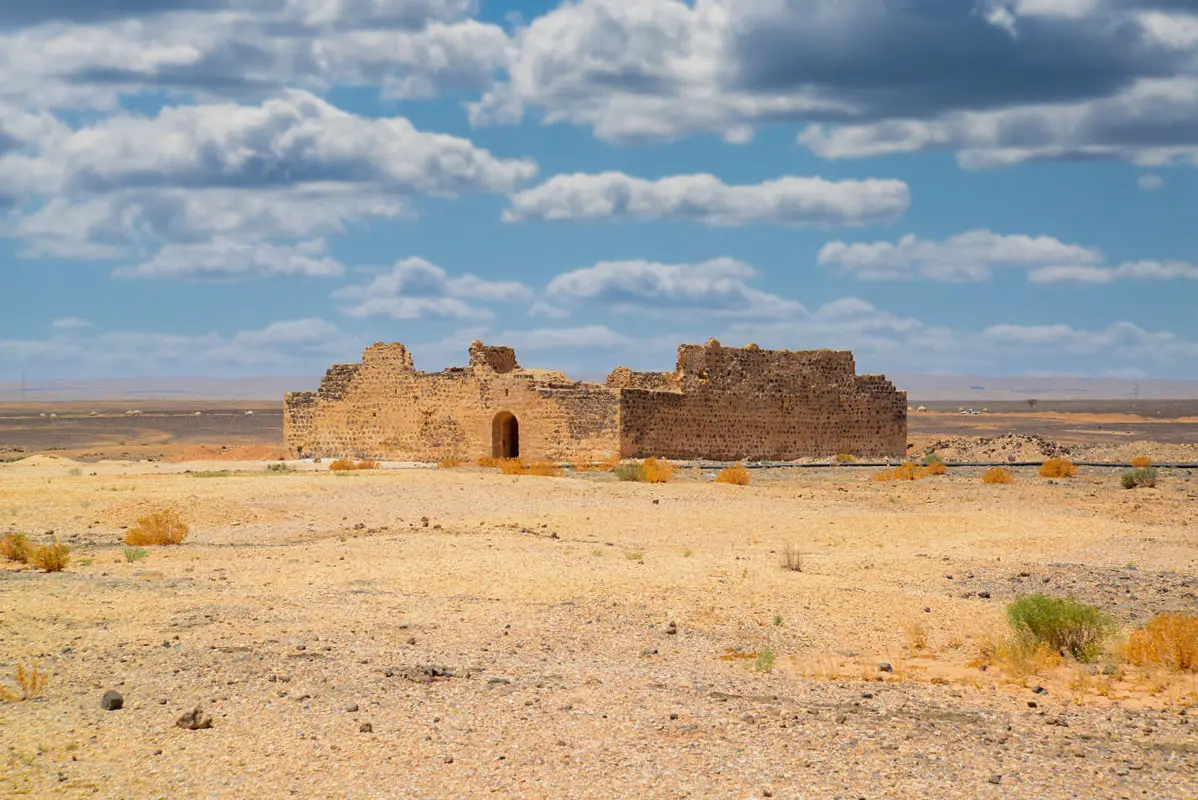
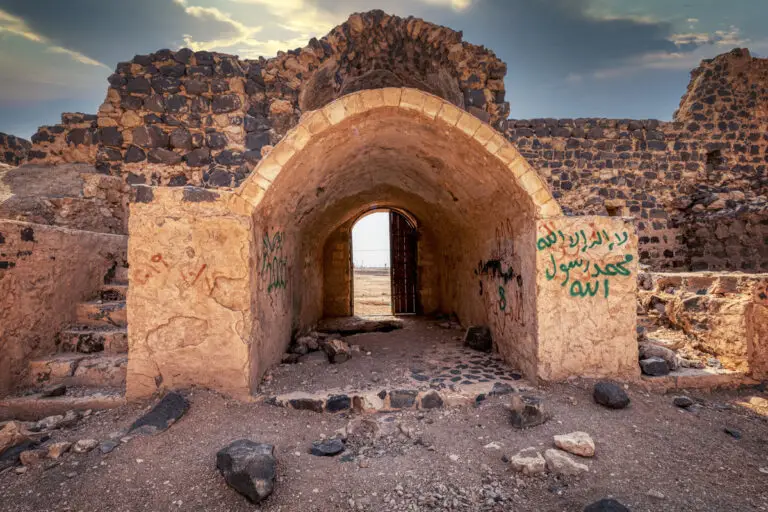


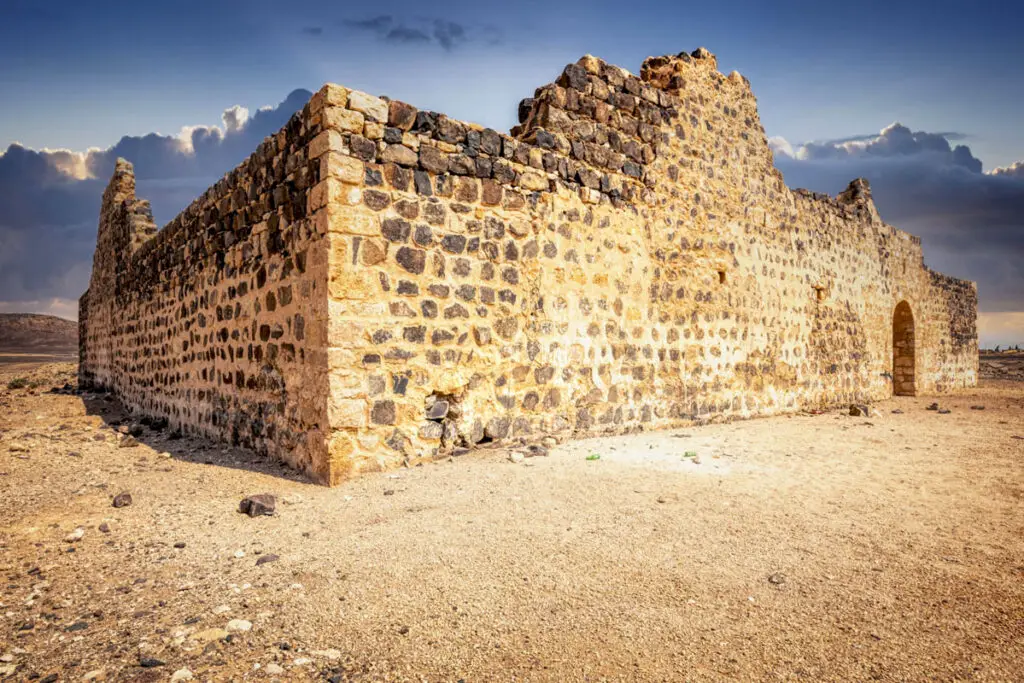
Below the black volcanic hill of Jabal Unaiza, a square fort of dark basalt stands beside the Desert Highway. Built in the later 16th century to protect the pilgrim road, it was garrisoned for centuries, and excavation has shown how its soldiers lived, down to the porcelain cups they drank from.
Where Is Qal’at Unaiza?
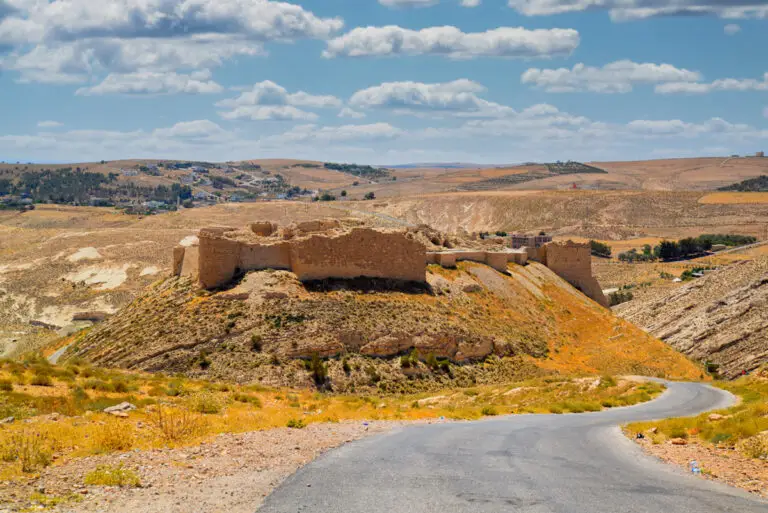
The fort stands beside the Desert Highway about 36 km north of Ma’an, about 180 km south of Amman, and takes its name from Jabal Unaiza, the dark volcanic hill to the west. No 4×4 is needed.
Historical Context and Origin
Unaiza was a station on the Syrian Hajj road between Ma’an and al-Hasa. The fort was built in the later 16th century, probably in the 1570s, as part of the Ottoman programme to secure the road to Mecca with forts and water stations. Next to it stand the remains of an earlier building.
Architectural Design
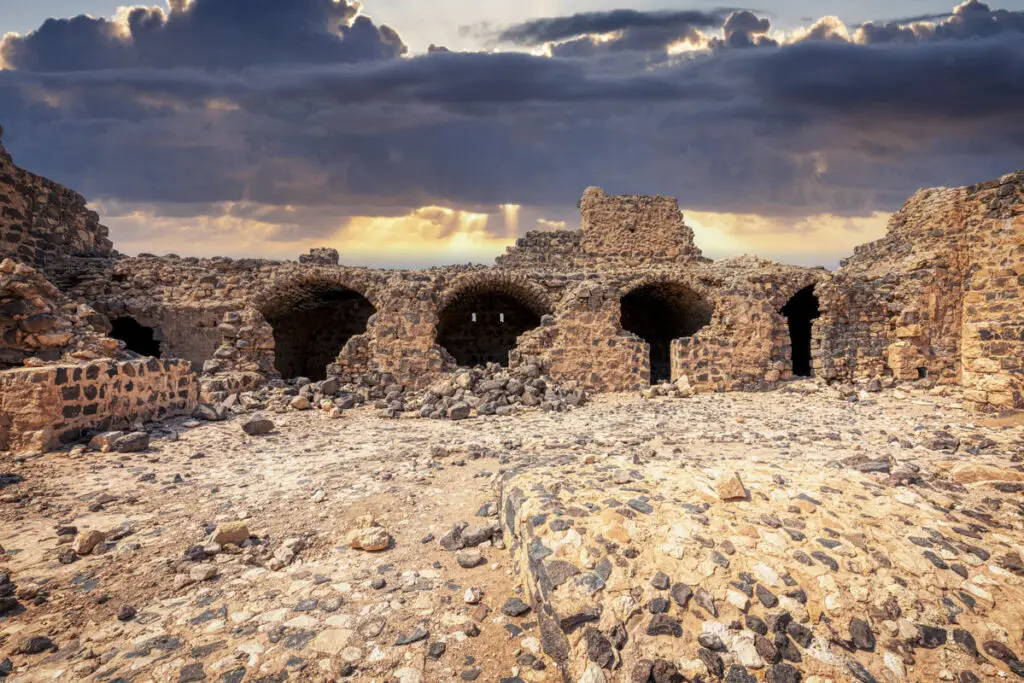
The fort is square, with rooms on two floors around a courtyard. Its walls are of basalt with limestone quoins at the corners. The entrance lies on the east side, where traces of plaster decoration survived in 1986, and a small machicolation projects from the south wall. A cistern lies beneath the cobbled courtyard.
Basalt Walls
A square fort of basalt with limestone corners.
Excavated Finds
Chinese porcelain, tobacco pipes and coins from the garrison.
Courtyard Cistern
A vaulted cistern beneath the cobbled courtyard.
The Railway Station
The Hejaz Railway station of Unaiza still stands nearby.
Excavating the Fort
In May and June 2002 the archaeologist Andrew Petersen dug six trenches at Unaiza. The finds included Chinese porcelain, among them Imari and powder-blue cups with gilding, Batavian ware, tobacco pipes, glass bangles and beads, coins, pieces of military equipment and a gaming piece. They show the fort occupied in the 18th and 19th centuries by a garrison connected to world trade. In the early 20th century the Hejaz Railway built a station nearby, which still stands.
Destruction, Rediscovery, and Restoration
Petersen recorded the fort in 1986 and excavated it in 2002, publishing the results in 2003 and in his study of the Hajj route (2012). The fort belongs to the Department of Antiquities.
Visiting Qal’at Unaiza Today
Entry is free and there are no facilities; bring water and good shoes. Allow about 30 minutes. See our Qal’at Unaiza travel guide for directions.
Further reading: Petersen, The Medieval and Ottoman Hajj Route in Jordan (2012).