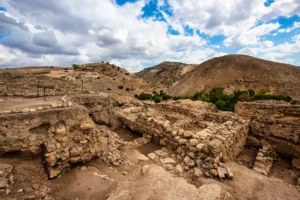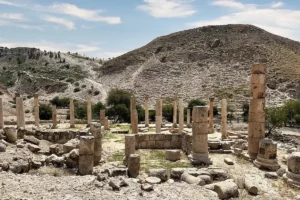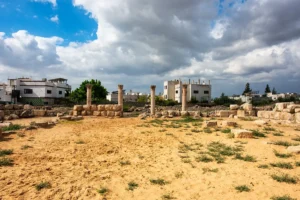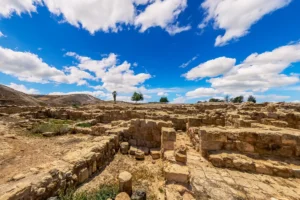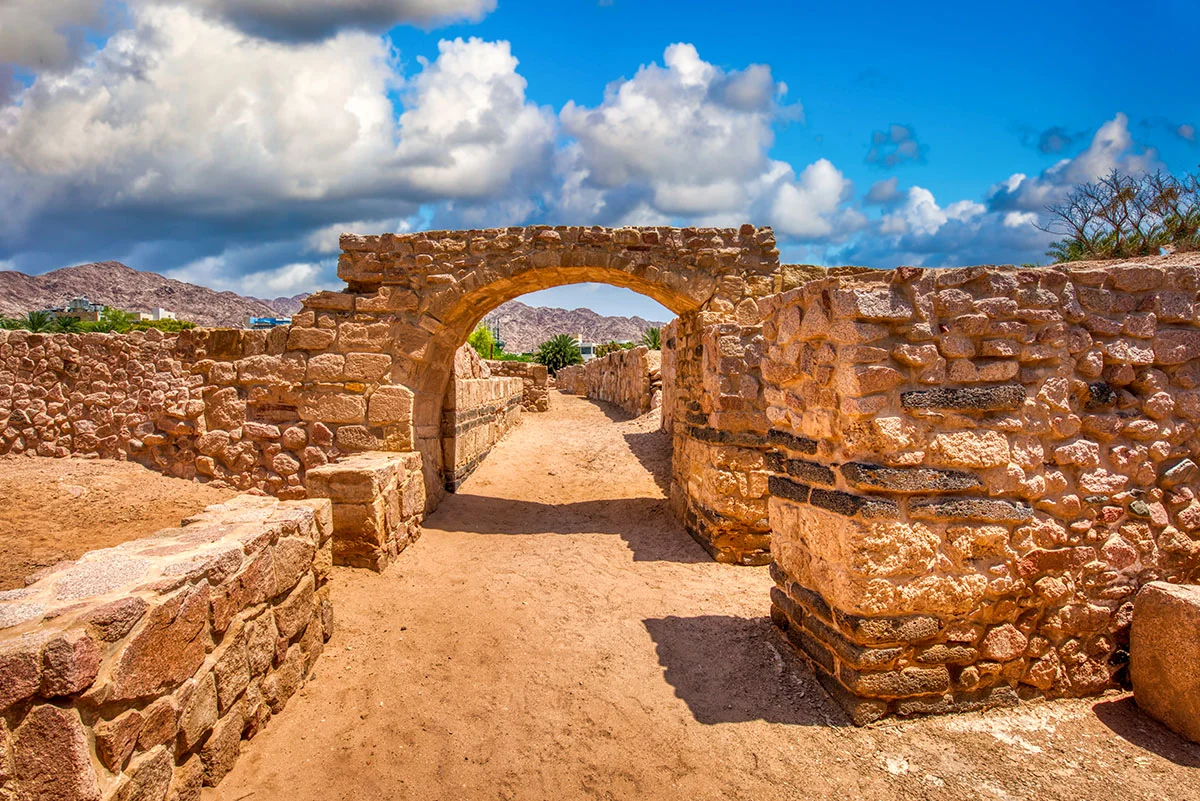


On the seafront of modern Aqaba, the walls and gates of an early Islamic town lie beside the palm trees of the Corniche. Ayla was one of the earliest planned towns of the Islamic world — a walled port where ships from Egypt, Arabia and even China traded.

Where Is Ayla?
Ayla lies on the Aqaba Corniche, between the marina and the Mövenpick hotel, about 1 km north of Aqaba Fort. The best place to begin is the Egyptian Gate and the street that leads from it.
Historical Context and Origin
At Tabuk in AD 630, the ruler of Byzantine Aila submitted to the Prophet Muhammad and agreed to pay tribute. A new walled town was later built beside the Byzantine one, which remained partly inhabited. The excavator Donald Whitcomb proposed that the town was founded around 650 under Caliph Uthman; many scholars prefer a slightly later, Umayyad date, and Whitcomb himself dates the walls to the late 7th century.
Architectural Design
The walls enclose a rectangle of about 170 × 145 m (2.5 ha), with towers along each side and a gate in the middle of each wall, flanked by two towers. The four gates — the Egyptian, Syrian, Hijaz and Sea gates — were linked by two main streets crossing at the centre, where a residence with a four-way arch, an iwan with frescoes and a well stood. A large enclosure of about 50 × 20 m is thought to be the congregational mosque; it was rebuilt in the early Abbasid period after the earthquake of 748.
Four Gates
The Egyptian, Syrian, Hijaz and Sea gates, each flanked by two towers.
Throne Verse
A Kufic inscription of the Ayat al-Kursi once crowned the Egyptian Gate.
Congregational Mosque
A large enclosure, probably the town’s mosque, rebuilt after 748.
Global Trade
Chinese porcelain, ivory and a hoard of 32 gold coins.

A Port on the Red Sea
Ayla linked the Mediterranean world with the Red Sea and the Indian Ocean. Excavations found Chinese porcelain, ivory, amphorae, weights and a hoard of 32 gold coins, mostly from North Africa. Above the Egyptian Gate, the Throne Verse of the Qur’an (Ayat al-Kursi) was set in Kufic letters, later repaired in cursive script.
Destruction, Rediscovery, and Restoration
Ayla was struck by earthquakes in 748 and, most violently, in 1068, and it was sacked by the Bedouin Banu Jarrah in 1024. Crusaders attacked in 1116, and Saladin retook the area in 1170, but the old town did not recover. From 1986 to 1995 the Oriental Institute of the University of Chicago and the Department of Antiquities, led by Donald Whitcomb, excavated the walls, gates, streets and mosque; further work followed from 2008. Nearby, the Roman Aqaba Project found a building of the late 3rd or early 4th century that may be the oldest purpose-built church yet known.
Visiting Ayla Today
The ruins are open to visitors and easy to reach from the Corniche. Walk through the Egyptian Gate, along the main street to the central crossing and the mosque, then out to the Sea Gate. Read our article Exploring the Ancient Islamic City of Ayla and see the 360° panorama.
Further reading: ISAC (Oriental Institute) — Aqaba excavations; AramcoWorld — Digging Out Aqaba’s Islamic Past (2000).