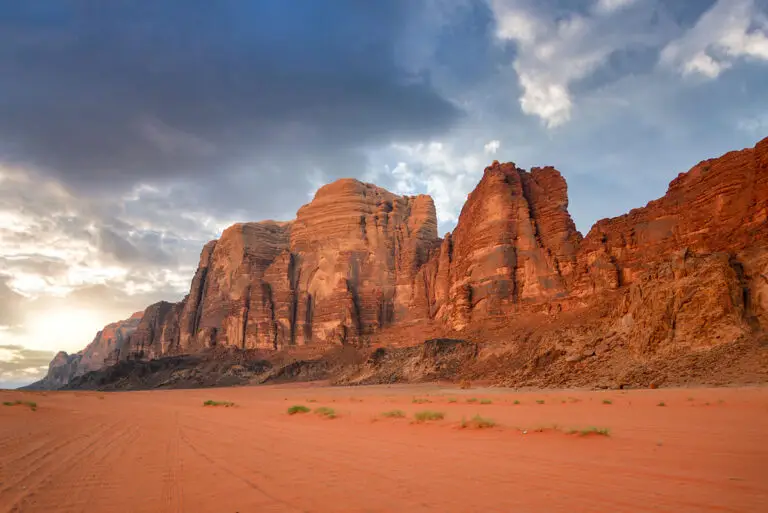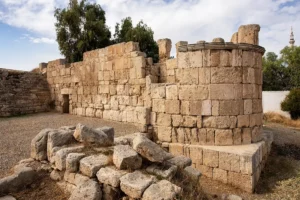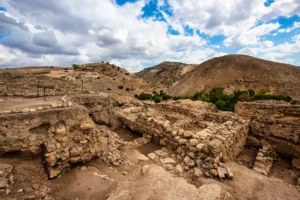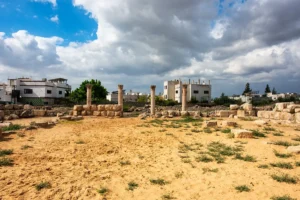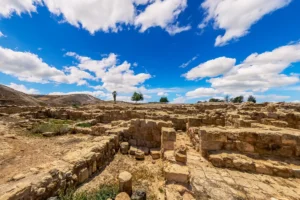












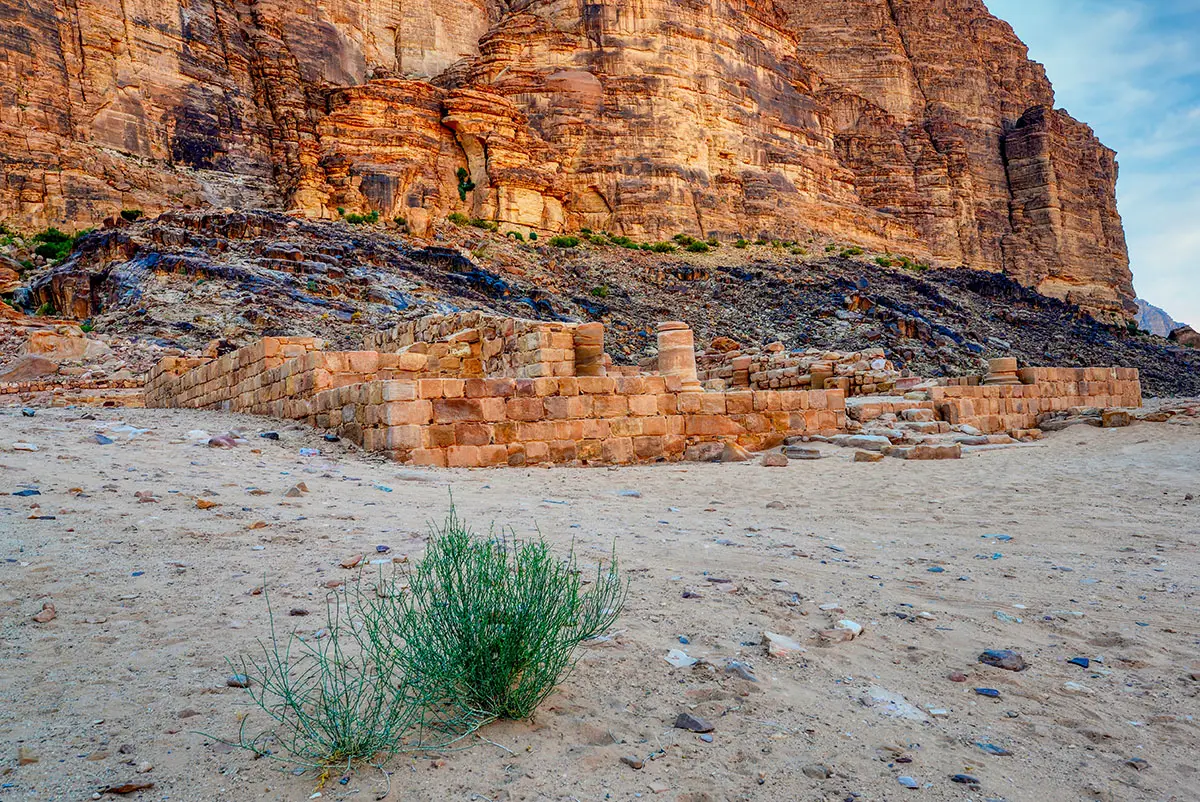
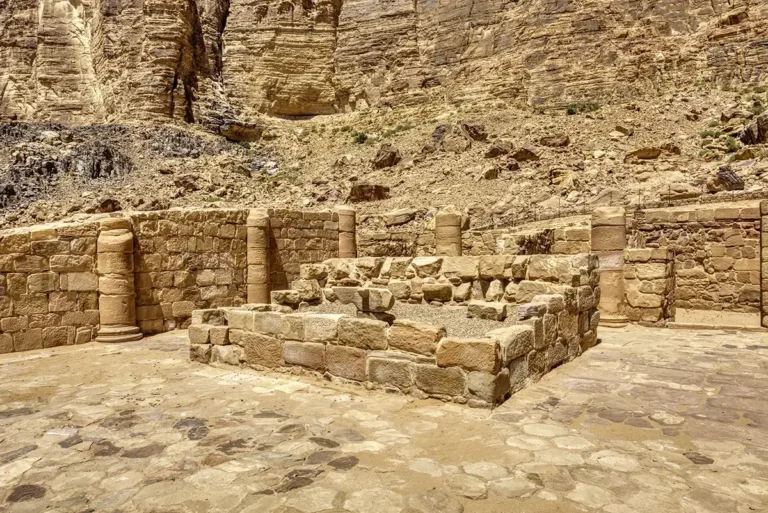


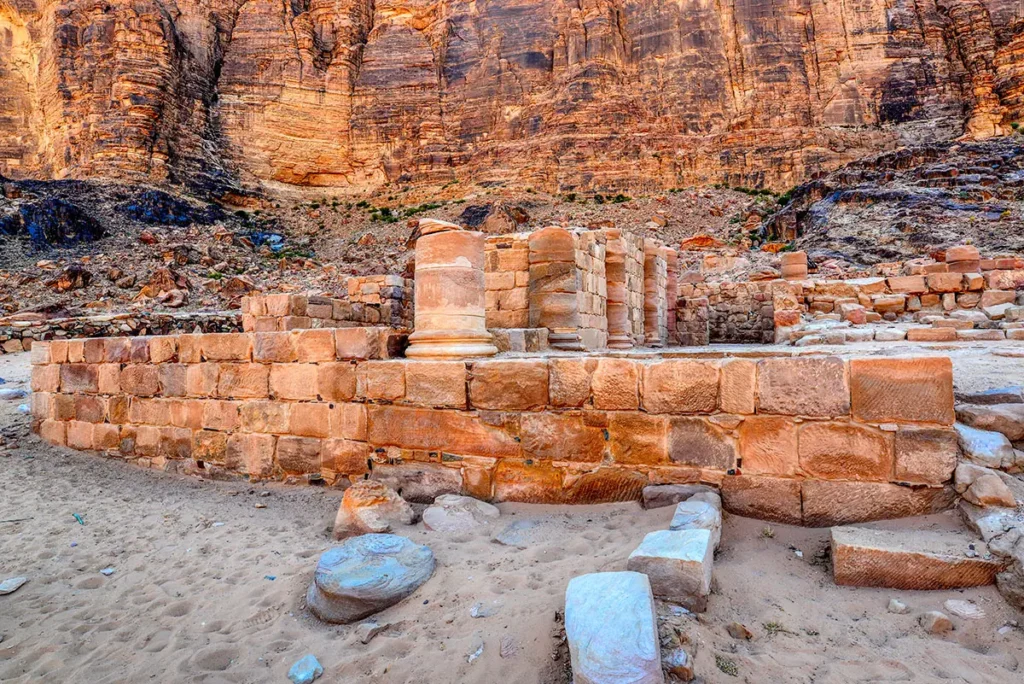
At the foot of the great cliffs of Jebel Rum, beside the springs that made Wadi Rum a stopping place in the desert, the Nabataeans built a temple to Allat, “the great goddess who is in Iram”. Its low walls and column drums are the most important ancient building in Wadi Rum.
Where Is the Temple of Allat?
The temple stands on a small rise near Rum village, about 400 m on foot from the village car park and about 7 km past the Visitor Centre of the Wadi Rum Protected Area. A path leads up to the spring of ‘Ain Shallaleh, where a smaller sanctuary of Allat and Nabataean inscriptions are carved in the rock.
Historical Context and Origin
Inscriptions call the place Iram, the ancient name behind modern Rum, probably a station on the caravan routes of the incense trade. An inscribed block reused in the foundations shows that an earlier shrine of Allat stood here. The temple itself was built in the late 1st century BC or early 1st century AD, during the height of the Nabataean kingdom, and enlarged in the late 1st century AD. It remained in use after the Roman annexation of AD 106, into the 3rd century.
Architectural Design
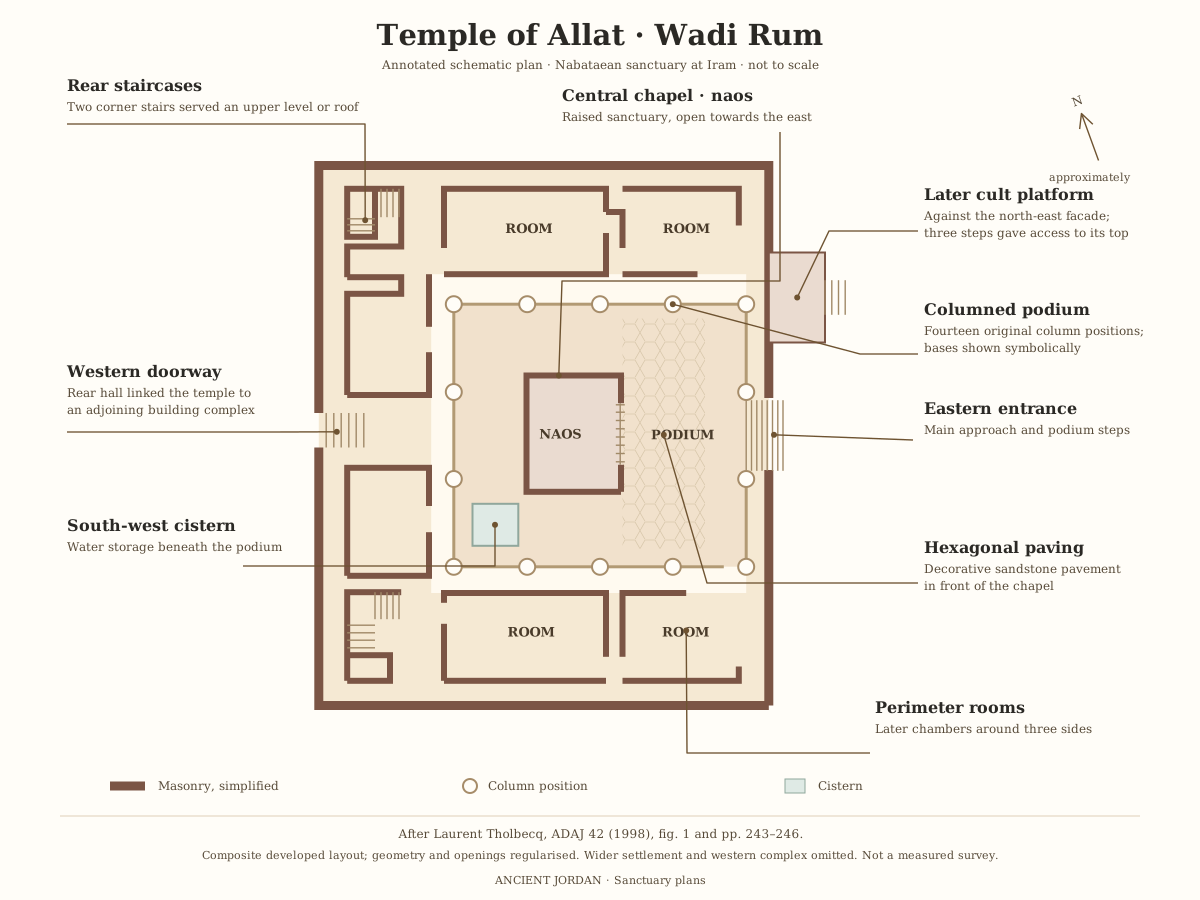
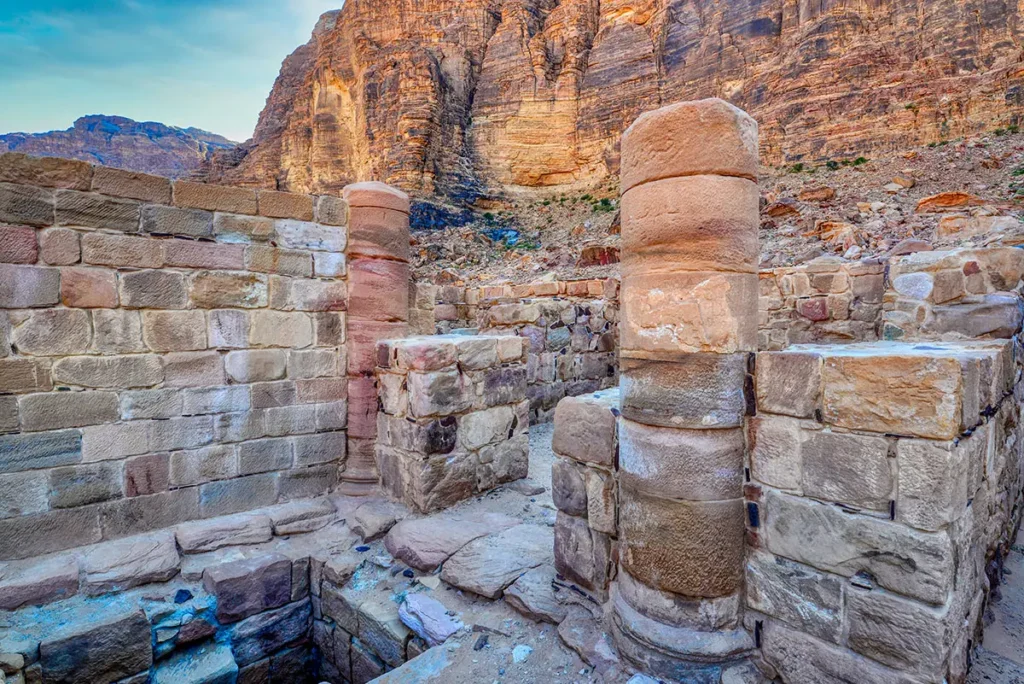
The temple stood on a podium paved with hexagonal sandstone tiles, with a central cella surrounded by columns covered in moulded and painted stucco. Later the spaces between the columns were walled up, the inner walls were plastered and painted with geometric and floral designs, and rooms were added around the podium, with two narrow corner rooms holding stairs to the roof. Nearby, excavators found a house and a bath building of the Nabataean–Roman period.
Podium Temple
A cella on a raised podium, surrounded by columns.
Painted Walls
Plastered walls once painted with geometric and floral designs.
Inscriptions
Nabataean, Greek and Latin texts naming the goddess of Iram.
Spring Sanctuary
A small shrine of Allat at the spring of ‘Ain Shallaleh.
Temple of Allat, Wadi Rum
Schematic plan of the Temple of Allat, after Tholbecq (1998); not to scale
Open drawingHismaic dedication by Ġawṯ of the tribe of ʿĀd
A Hismaic inscription, described in the original publication as “Thamudic E,” records the construction of a sanctuary for Lāt (Allat) by a member of the ʿĀd group. Its sandstone block was reused in the central chapel’s foundations, providing evidence for an earlier sanctuary. Zayadine and Farès-Drappeau, 1998
l ġṯ bn ʾslh bn ṯkm w-bny bt lt ḏ ʾl ʿd
“By Ġawṯ son of Aws-Allāh son of Ṯkm, and he built the temple of Allāt of the tribe of ʿĀd.”
Hismaic script; the text is presented continuously rather than reproducing the stone’s layout. The text and translation are reproduced in Ahmad Al-Jallad’s study, The Epigraphy of the Tribe of ʿĀd, p. 284. Read the study
Ġawṯ, conventionally written Ghawth, is the builder’s name. The inscription gives his father and grandfather. The phrase w-bny bt lt means “and he built the house/temple of Lāt”, where “house” denotes a sanctuary.
The phrase ḏ ʾl ʿd, “of the lineage of ʿĀd,” is grammatically ambiguous. It could identify either the builder’s affiliation or the community associated with the temple. Al-Jallad favours identifying Ġawṯ himself as an ʿĀdite.
The inscription contains no explicit date. Its reuse beneath the chapel indicates an earlier sanctuary, but does not establish its precise construction year. Al-Jallad, pp. 284–285; Tholbecq, 1998, p. 242
Other inscriptions at the temple, in summary: they name the place Iram and its goddess “who is in Iram”. A bilingual Greek and Nabataean text asks Allat to remember the architect Ouaballas. A painted Nabataean text of about AD 147 shows the temple still honoured under Roman rule, and a Latin altar was dedicated by a Roman governor of Arabia in the 3rd century. This is a summary, not a translation. Sources: University of Florence; Reeves & Dudley, ADAJ 61.
The Goddess Allat
Allat was one of the chief deities of the Nabataeans and other Arabs, equated by Greeks and Romans with Athena. Fragments of a seated cult statue and standing stones, the Nabataean symbols of the gods, were found in the temple. A Greek and Nabataean inscription asks Allat to remember the architect, Ouaballas son of Abdomanos, who is also named at the spring sanctuary.
Destruction, Rediscovery, and Restoration
George Horsfield and Raphaël Savignac found the spring sanctuary in 1931–32 and the temple in 1932, and excavated it in 1934. Diana Kirkbride worked here in 1959, and in 1996–97 Laurent Tholbecq re-examined the temple, establishing its phases. The site has not been restored.
Visiting the Temple of Allat Today
There is no paved road to the temple gate, but it is an easy 400 m walk from the village car park; no 4×4 is needed. Most 4×4 tours inside Wadi Rum also include a stop at the temple. The site is fenced, but the gate is open and there is no guard. Visitors can see the surviving low walls, steps and column remains. Allow about 30 minutes. See our Temple of Allat travel guide for directions.
Further reading: University of Florence — Wadi Rum, Nabataean Temple; Reeves & Dudley, Phasing the Eastern Complex at Wadi Ramm (ADAJ 61); Livius — Aramava (Wadi Rum).