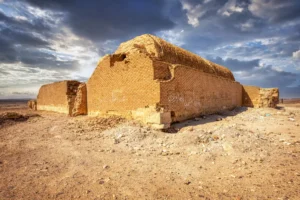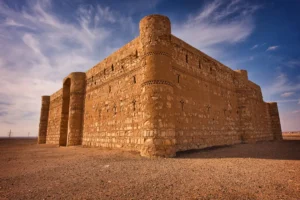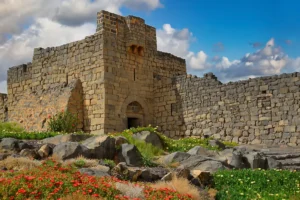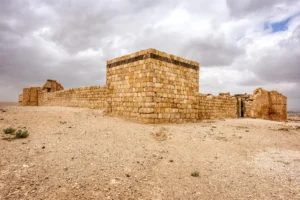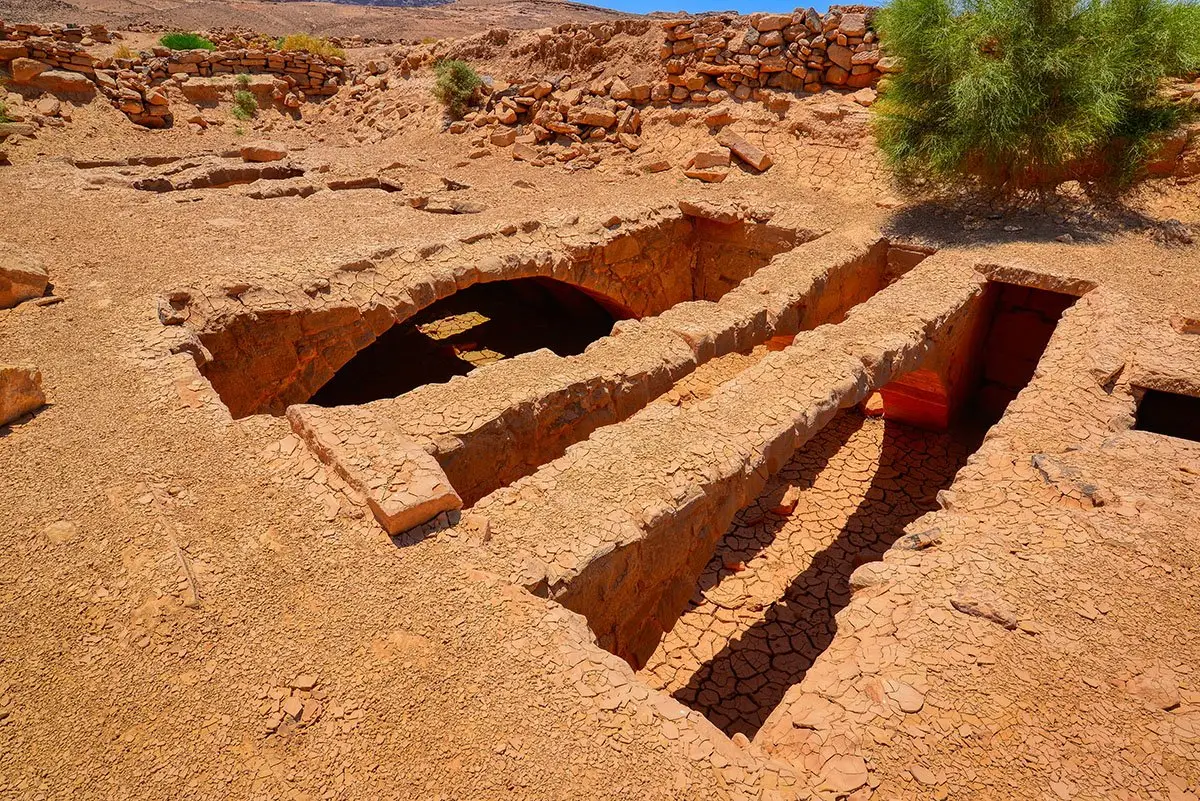
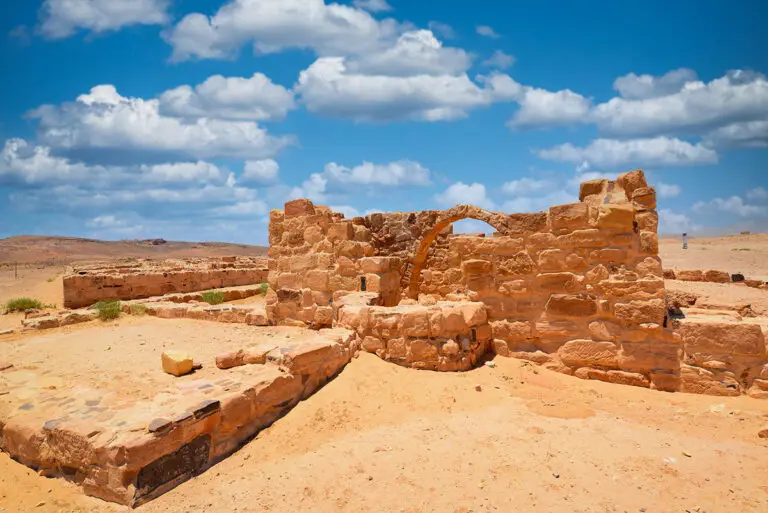

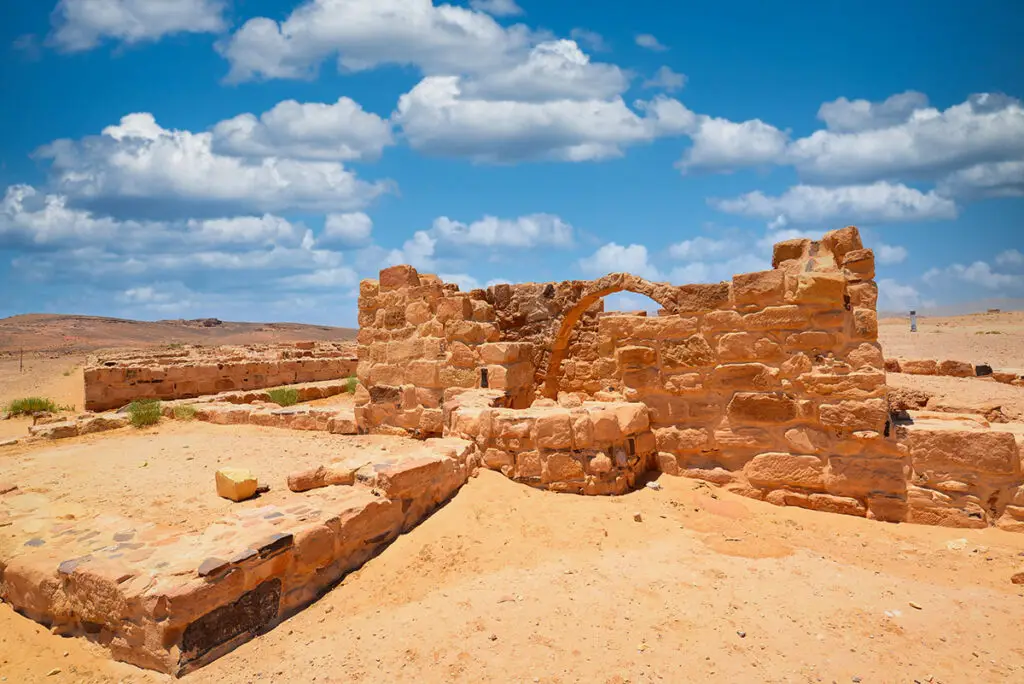
On the open plain of the Hisma desert, between Petra and Aqaba, the low ruins of Humayma tell a long story: a Nabataean town watered by a remarkable aqueduct, a Roman fort, Byzantine churches — and the house where the Abbasid family planned the revolution that made them caliphs.
Where Is Humayma?
Humayma lies in the north-west corner of the Hisma desert in southern Jordan, about 20 minutes’ drive off the Desert Highway. It is about 80 km by road from both Petra and Aqaba — some 41 km from Petra in a straight line.
Historical Context and Origin
Ancient Hawara was founded by a Nabataean king named Aretas. According to the ancient writer Uranius, the king chose the site after an oracle; the name means “white” in Aramaic. Scholars differ on which Aretas: the excavator John Oleson has argued for Aretas III, in the 80s BC, and also for Aretas IV; the archaeological evidence mostly begins towards the end of the 1st century BC. After the Roman annexation of AD 106, a fort was built beside the town. In the Byzantine period at least five churches were built.
Architectural Design
Hawara’s life depended on water. An aqueduct 27 km long brought water from three springs on the al-Shara escarpment to the north, and the town had several reservoirs and more than fifty cisterns — the discharge pool held 633 m³ and the fort’s reservoir 1,275 m³. The Roman fort measures about 148 × 207 m; built soon after AD 106, it is the earliest large Roman fort known in Jordan, and an altar names a detachment of the Third Legion Cyrenaica. It was abandoned in the early 5th century.
27 km Aqueduct
Water ran 27 km from three springs on the al-Shara escarpment.
Reservoirs and Cisterns
Several reservoirs and dozens of cisterns stored water in the desert.
Early Roman Fort
A 148 × 207 m fort built soon after AD 106 — the earliest large Roman fort in Jordan.
Abbasid Home
The family that founded the Abbasid caliphate lived here until 749.
The Abbasids at Humayma
Around 687/688 Ali ibn Abd Allah ibn al-Abbas, a descendant of the Prophet’s uncle al-Abbas, bought the town. His family built a residence (qasr) of about 61 × 50 m and a small mosque nearby, and from Humayma they organised the movement that overthrew the Umayyads. In 749 the family left for Kufa, where the first Abbasid caliph was proclaimed.
Destruction, Rediscovery, and Restoration
From 1986 to 2005 the Humayma Excavation Project, directed by John Oleson with Rebecca Foote, excavated the waterworks, churches and Abbasid qasr; M. Barbara Reeves led further work on the Roman fort from 2008 to 2014. The final reports were published between 2010 and 2024. The ruins have not been restored.
Visiting Humayma Today
The site is signposted and admission is free. The ruins are low and spread out, so allow about an hour and bring water and sun protection. Follow the line of the aqueduct, walk the walls of the Roman fort and find the Abbasid qasr. Our 360° panorama shows the site.
Further reading: Humayma Excavation Project (J. P. Oleson); Queen’s University — Humayma Excavation Project.