











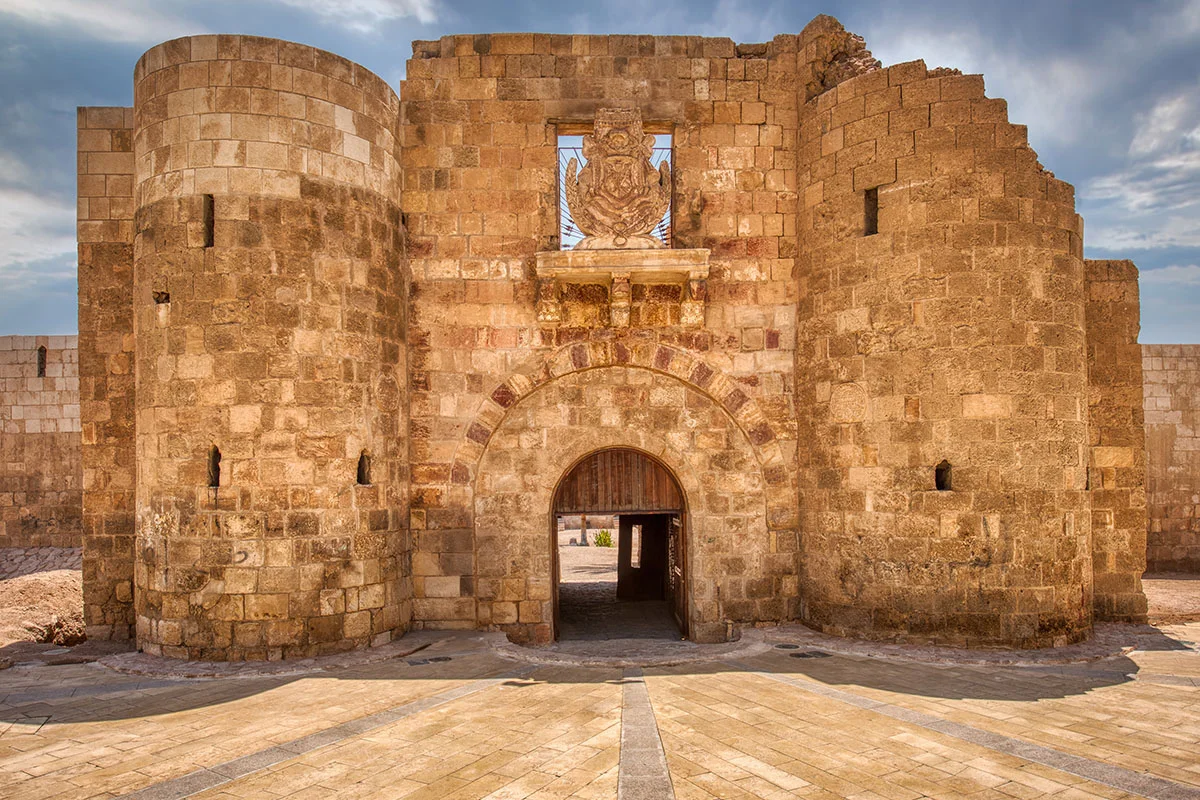


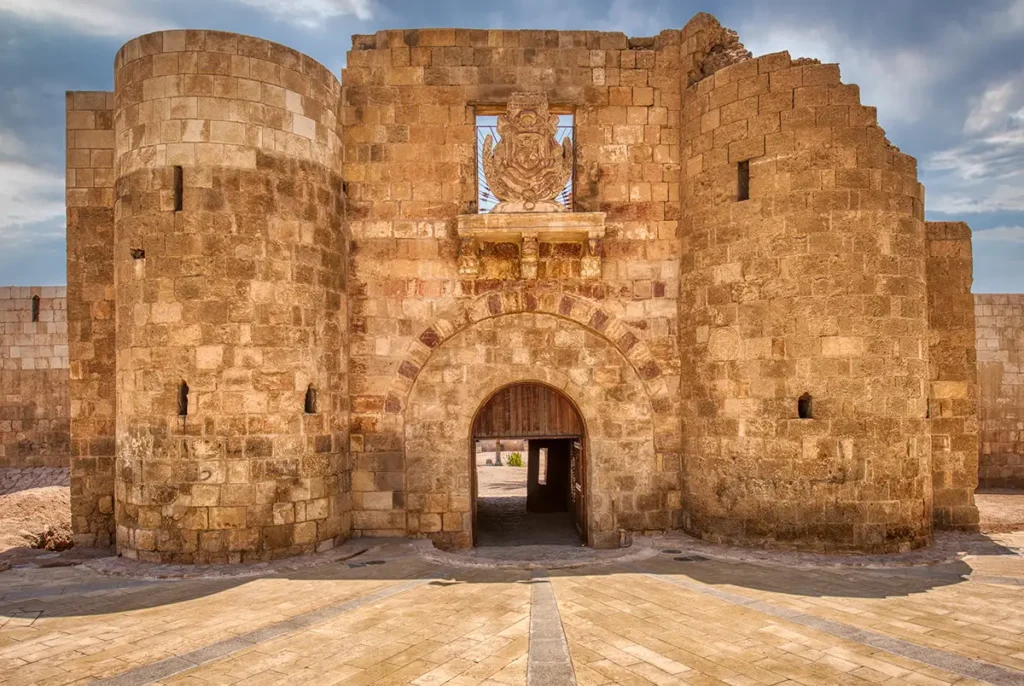
On the seafront of Aqaba, a stone fort with a twin-towered gate guarded the pilgrims of the Egyptian Hajj on their way to Mecca. Its present form goes back to the Mamluk sultan Qansuh al-Ghuri, in the early 16th century.
Where Is Aqaba Fort?
The fort stands on the Aqaba seafront beside the Aqaba Flagpole, about 1 km south of the early Islamic town of Ayla. The Aqaba Archaeological Museum, in the house used by Sharif Hussein bin Ali in 1917, stands next door.
Historical Context and Origin
The fort was built as a khan, a fortified caravanserai, for pilgrims travelling between Egypt and Mecca. Excavations by Ghent University suggest that a first khan stood here in the late 12th or early 13th century and was rebuilt after the earthquake of 1312, around 1320. The present building was raised by Sultan Qansuh al-Ghuri (r. 1501–1516): the excavators date it to 1509, other sources to about 1515. There is no evidence that it began as a Crusader castle.
Architectural Design
The fort is built around a courtyard, with a wing of cells on the west side, corner towers — one of them polygonal — and a mosque. Semicircular towers flank the gate, which leads into a vaulted entrance room. Over time rooms around the courtyard were rebuilt and later removed to enlarge it.
Twin-Towered Gate
Semicircular towers flank the entrance.
Sultan’s Inscription
Inscriptions inside the gate praise the Mamluk sultan Qansuh al-Ghuri.
Hajj Khan
A courtyard caravanserai for pilgrims on the Egyptian Hajj route.
Hashemite Arms
A panel over the gate recalls the Arab Revolt of 1917.
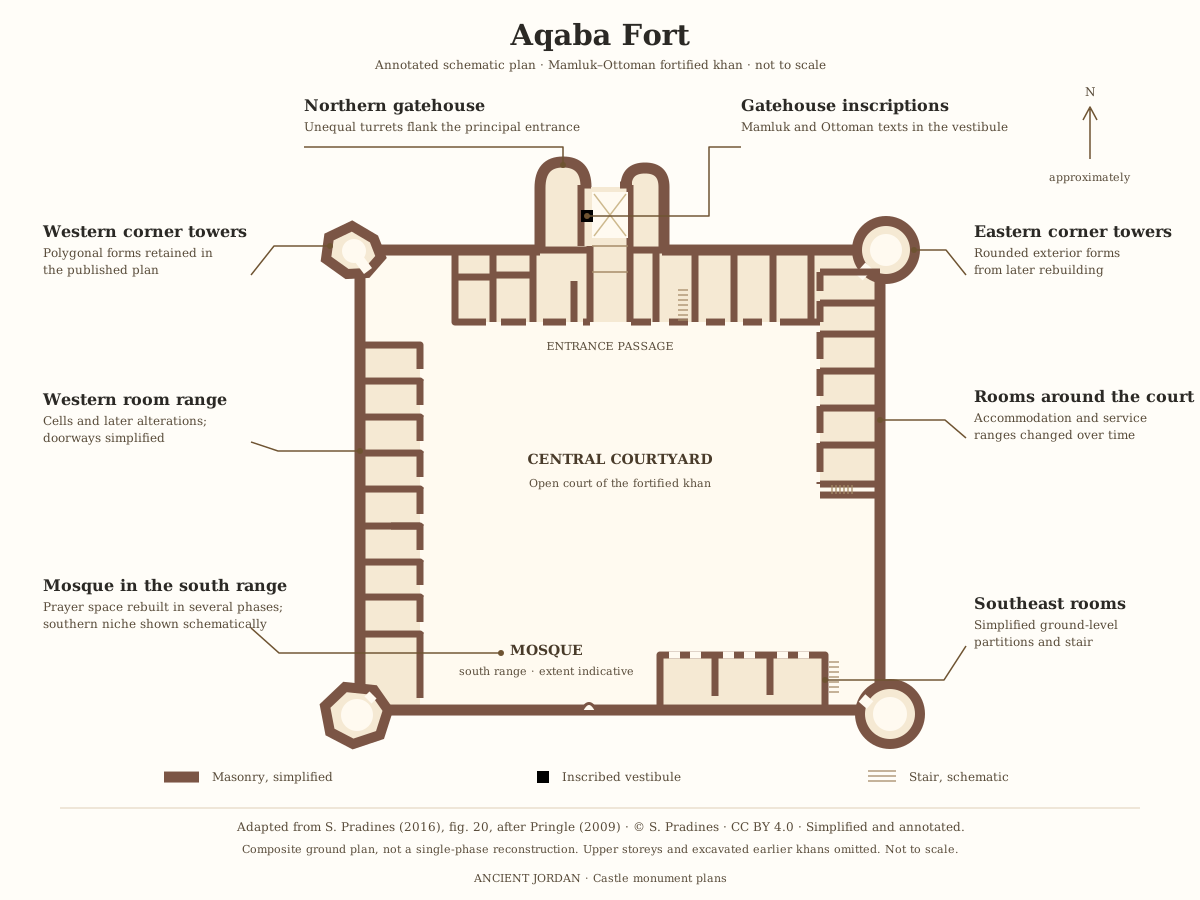
Aqaba Fort
Schematic plan of Aqaba Fort, after Pradines (2016), adapted under CC BY 4.0
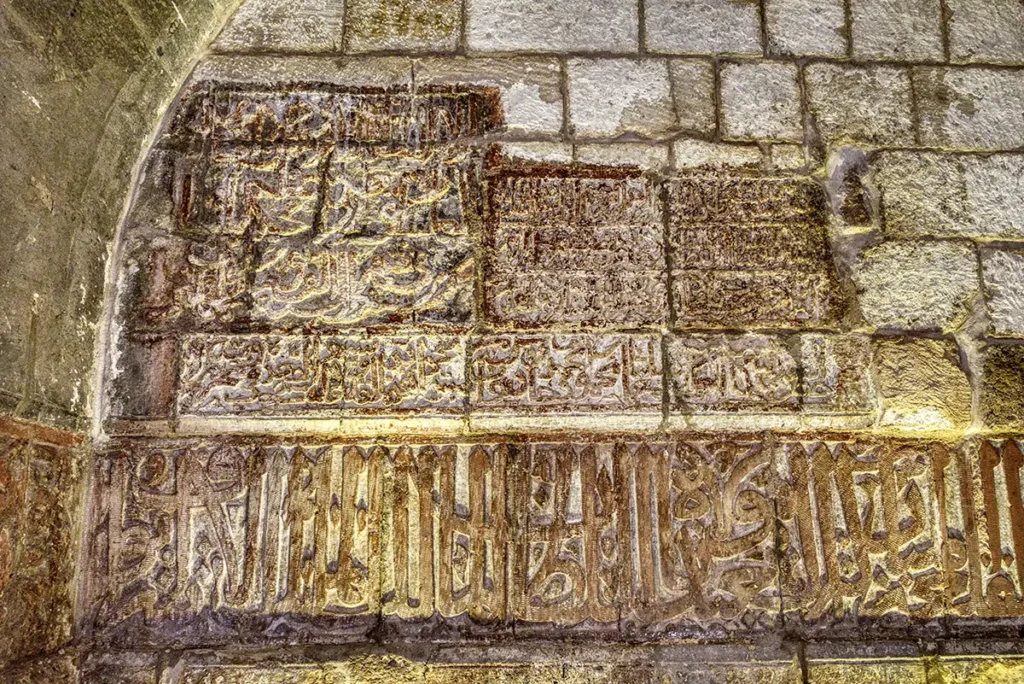
Open drawingThe Mamluk inscription in the entrance vestibule
The long Mamluk inscription inside the entrance vestibule is only partly transcribed in the published sources. The Arabic reading here is a partial one, and … marks missing or omitted wording.
… المباركة السعيدة مولانا السلطان المالك الملك الأشرف أبو النصر قانصوه الغوري سلطان الإسلام والمسلمين قاتل … محي العدل في العالمين الواقف بمشيئة الله في العقبة السلطان المالك الملك الأشرف أبو النصر قانصوه الغوري أعز الله أنصاره بمحمد وآله …
… blessed and auspicious … our lord the sovereign sultan, al-Malik al-Ashraf Abu al-Nasr Qansuh al-Ghuri, Sultan of Islam and the Muslims, slayer of … reviver of justice throughout the world, standing by God’s will at Aqaba; the sovereign sultan, al-Malik al-Ashraf Abu al-Nasr Qansuh al-Ghuri—may God strengthen his victories through Muhammad and his family …
The continuation names Amir Khayr Bak al-ʿAlaʾi, associated with the building work, and includes a damaged date. This is a partial reading, rather than a complete transcription of the entire inscription band. Arabic museum catalogue
Its purpose was to credit Sultan Qansuh al-Ghuri as patron and Khayr Bak as the builder or official responsible for construction. The elaborate titles proclaim royal authority and religious legitimacy. Al-Ashraf means “the most noble”; Abu al-Nasr, literally “father of victory,” forms part of the sultan’s titulature.
The damaged date has been read as AH 910 or 920, approximately AD 1504–1505 or 1514–1515. It should therefore not be presented as an unquestionably preserved date. Catalogue entry for the inscription
Other texts at the gate: a medallion above names the Ottoman sultan Murad III (repairs of 1587/88), and a panel with the Hashemite coat of arms over the gate commemorates the Arab Revolt of 1917.
Sultans, Pashas and the Arab Revolt
The gatehouse carries two inscriptions; the longer, inside the vaulted room, praises Sultan al-Ashraf Qansuh al-Ghuri. A medallion above names the Ottoman sultan Murad III, under whom major repairs were made in 1587/88. In the 17th–18th centuries the cells and mosque were rebuilt, and around 1830 the troops of Muhammad Ali of Egypt used the fort and rebuilt towers in a rounded form. In the First World War, shelling brought down the west wall and the north-west tower. In July 1917 the Ottoman garrison at Aqaba fell to the forces of the Arab Revolt, and the Hashemite coat of arms above the gate marks that victory.
Destruction, Rediscovery, and Restoration
Since 1964 the Ministry of Awqaf and the Department of Antiquities have carried out repairs. In the 2000s Ghent University, with the Department of Antiquities, excavated the fort under Reem Al Shqour and Johnny De Meulemeester, tracing its history from a medieval farm to the Ottoman fort.
Visiting Aqaba Fort Today
The fort is open daily from 8:00 to 17:00; admission for visitors is 3 JOD, which includes the archaeological museum next door, and both are covered by the Jordan Pass. See our photo album and 360° panorama.
Further reading: The Jordan Times — The Islamic waystations of Aqaba (Al Shqour); Al Shqour, Aqaba Castle: Origin, Development and Evolution of Khans in Jordan (2019).