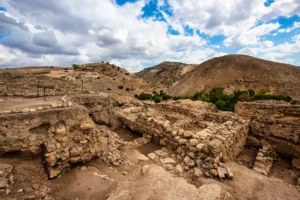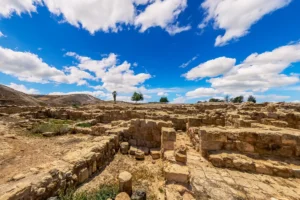














On a spur high above the Dead Sea valley, Karak Castle is one of the great Crusader castles of the Middle East. It was built to control the caravan and pilgrim road between Damascus and Egypt and Arabia, besieged twice by Saladin, and rebuilt by the Ayyubid and Mamluk sultans who held it after him.
Where Is Karak Castle?
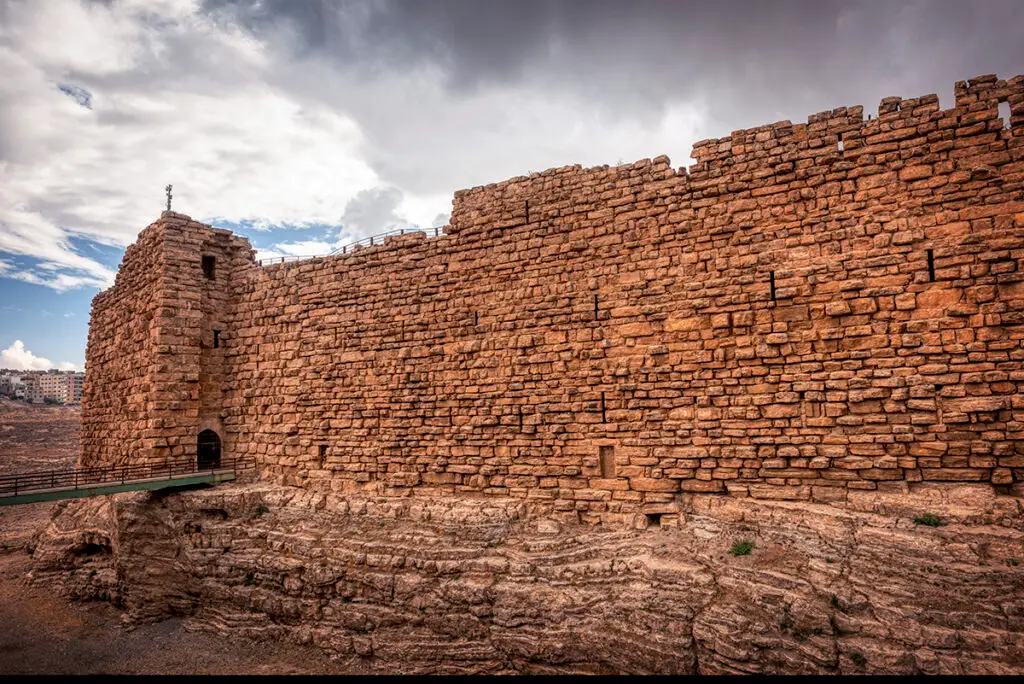
The castle stands at the southern tip of the old walled town of Karak, about 120–125 km south of Amman, at around 900 m above sea level. Steep slopes protect it on three sides, and deep rock-cut ditches cut it off from the town to the north and the hill to the south.
Historical Context and Origin
Karak is usually identified with Kir-hareseth, a capital of biblical Moab, and later with Charachmoba of Roman and Byzantine times. The castle was begun around 1142 by Pagan the Butler, lord of Oultrejordain, who moved his seat here from Shobak. From 1177 it was held by Raynald of Châtillon, whose raids on Muslim caravans provoked Saladin. Saladin besieged Karak in 1183 and 1184 without success; after Raynald’s death at the Battle of Hattin, the castle was starved into surrender in 1188. The Ayyubids strengthened it, and in 1263 the Mamluk sultan Baybars took it and rebuilt its southern and western defences.
Architectural Design
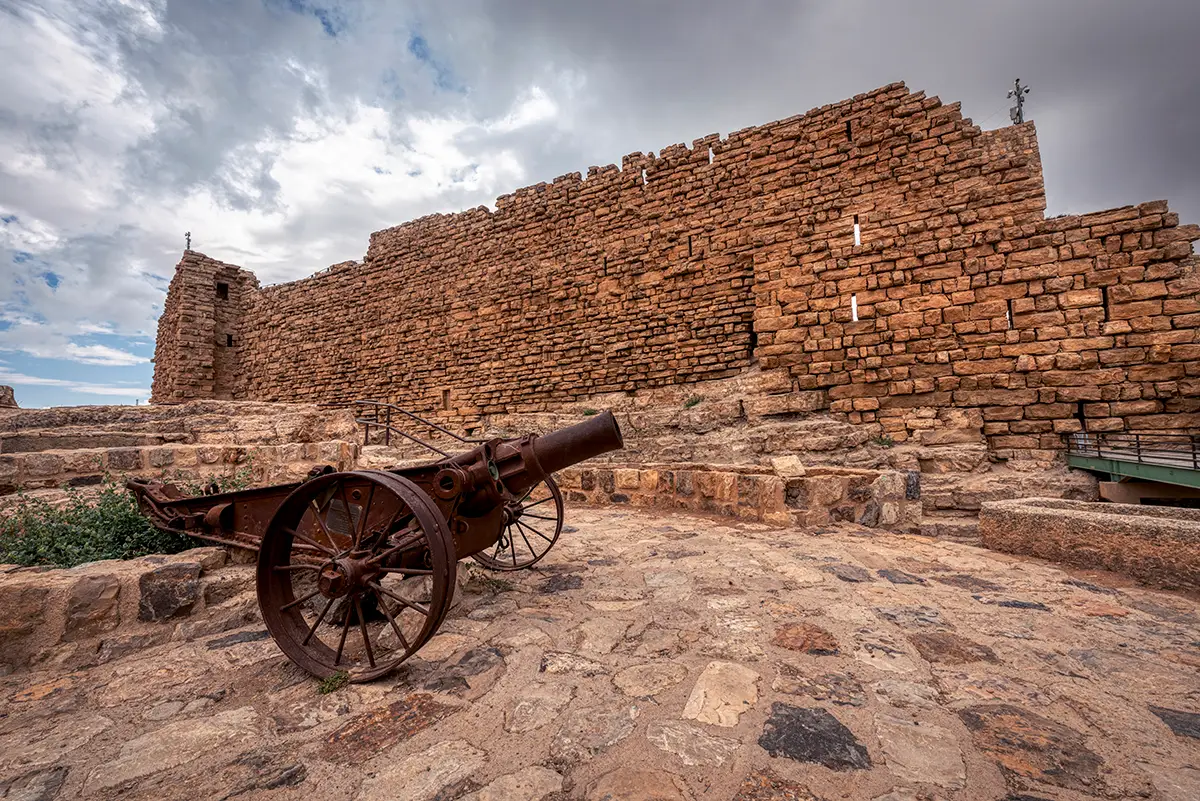
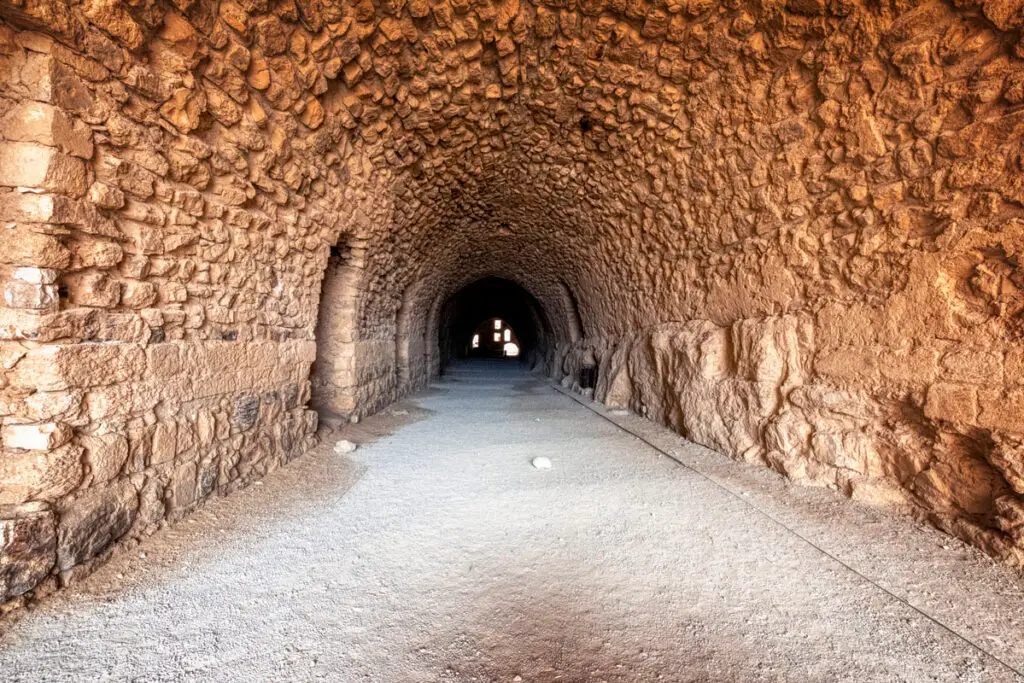
The castle follows the shape of the spur, with its entrance on the north facing the town. Crusader walls of dark, rough stone contrast with the finer limestone of the Ayyubid and Mamluk work. In the upper court, two-storey vaulted halls built into the north wall served as quarters, stables and fighting galleries; the Crusader chapel, vaulted cellars and the Mamluk palace lie further south. At the southern end stands the Mamluk keep, with walls over 6 m thick. Below, the lower court to the west is mostly Mamluk work on Crusader foundations.
Crusader Galleries
Long vaulted halls built into the walls as quarters, stables and fighting galleries.
Mamluk Keep
A massive tower of finely dressed stone at the south end.
The Glacis
Steep stone slopes and deep rock-cut ditches defend the spur.
Dead Sea Views
From the west walls the view reaches across to the Dead Sea.
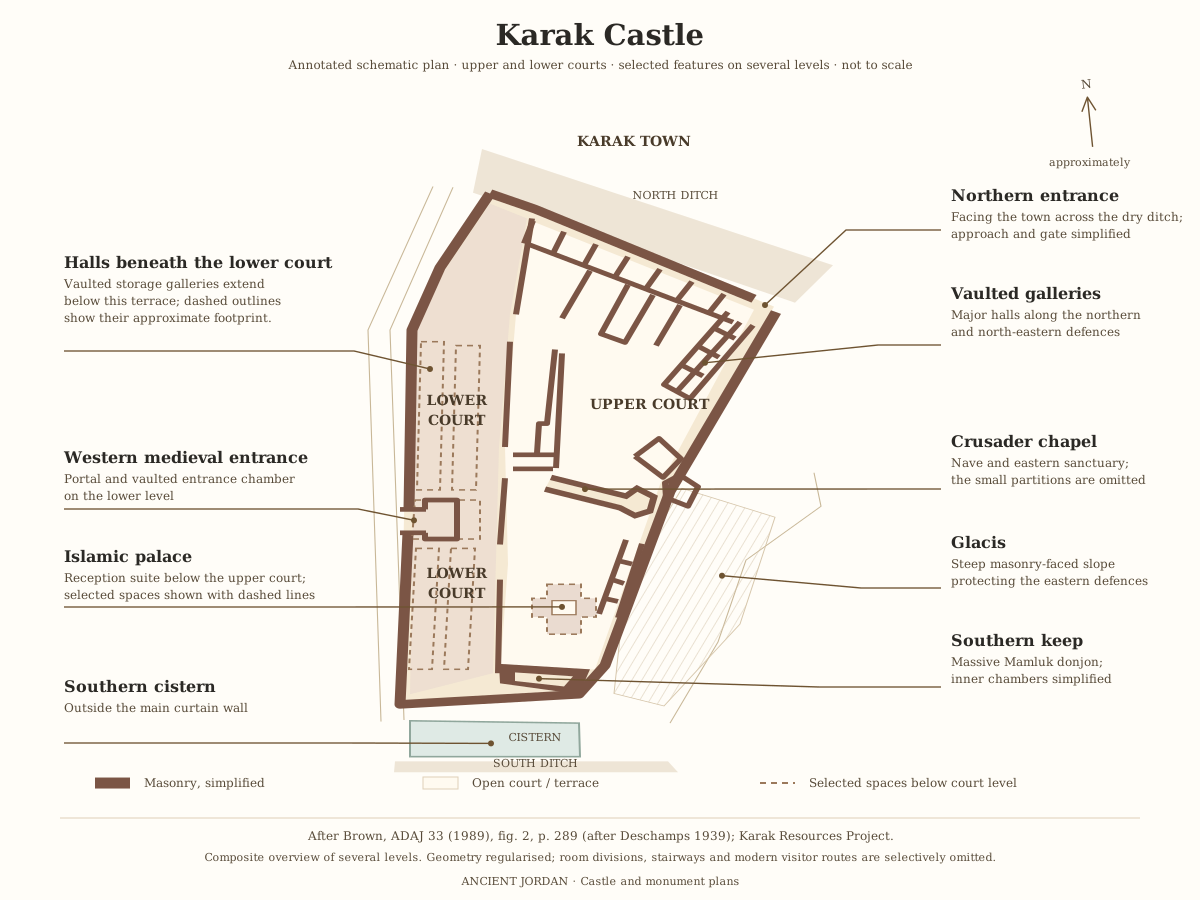
Karak Castle
Schematic plan of Karak Castle, after Brown (1989); not to scale
Open drawingBaybars’s inscription on the southern keep
Karak Castle has a monumental Arabic inscription on the exterior of its southern keep, naming the Mamluk sultan Baybars. Much of the inscription is weathered, but his name remains identifiable. Carved panthers, his personal emblem, frame the dedication. Brown’s archaeological study
بيبرس
الظاهر
الصالحي
Baybars
al-Ẓāhir, “the Victorious,” his royal title
al-Ṣāliḥī, indicating his association with Sultan al-Ṣāliḥ Ayyūb
The inscription is reported as dated AH 673 / AD 1274–1275, linking the keep to Baybars’s rebuilding of the castle. Study of Muslim fortifications
The words shown here are isolated elements, not a reconstruction of their sequence on the stone. The study reports the date but does not reproduce the complete Arabic wording. Study of the southern keep, p. 171
From Crusaders to Mamluks
Under the Ayyubids, al-Adil refortified the castle after 1192, and an-Nasir Dawud made Karak the seat of an almost independent principality. Under the Mamluks it became a palace, treasury, arsenal and prison. The future sultan al-Nasir Muhammad lived here in exile and in 1311 built a palace, a bath and a mosque. Baybars’ inscribed towers, with his lions, still stand in the walls of the town below.
Destruction, Rediscovery, and Restoration
Under the Ottomans, local tribes held real power in Karak. In 1834 Egyptian forces under Ibrahim Pasha besieged the town and blasted its walls, and in 1893 the Ottomans installed a governor and garrison in the castle. The western wing was restored from 2017 to 2022, and in 2025 the Department of Antiquities and the University of Warsaw surveyed the castle for a new conservation plan.
Visiting Karak Castle Today
The castle is open daily from 8:00. Admission is 2 JOD for foreign visitors and 0.25 JOD for residents, including the Karak Archaeological Museum opposite the castle entrance, and is covered by the Jordan Pass. Allow one to two hours. See our Karak Castle travel guide for practical details.
Further reading: Karak Resources Project — Architecture of Karak; Jordan Times — New research on Karak Castle (2025).