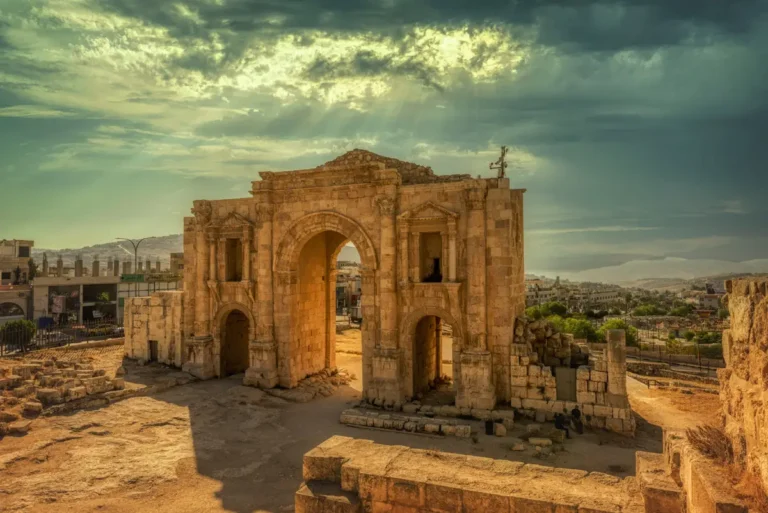
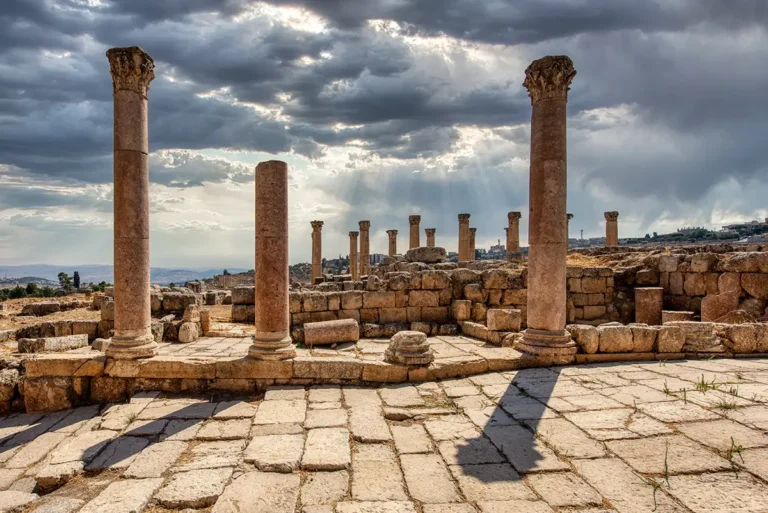
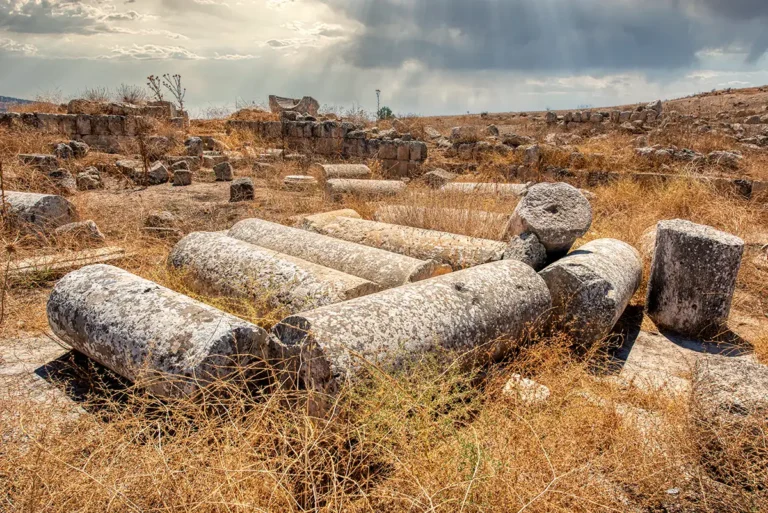
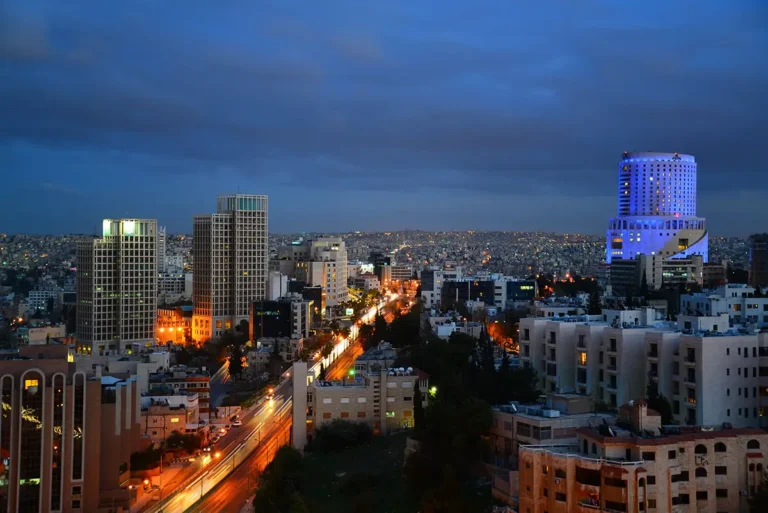
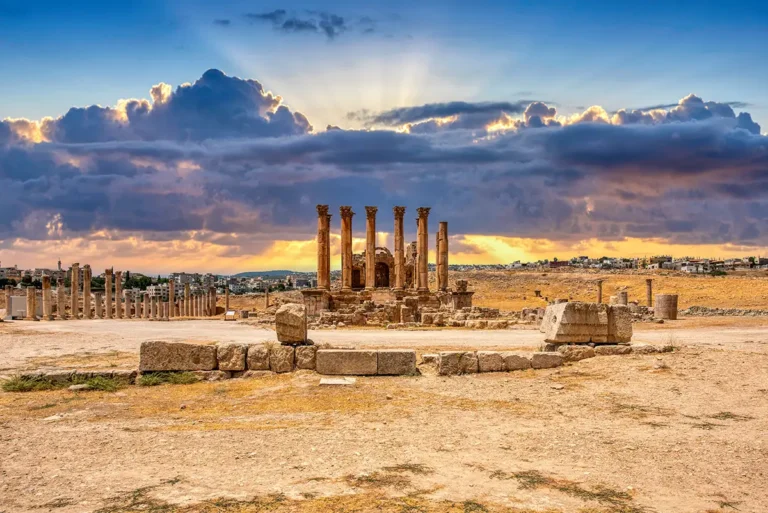
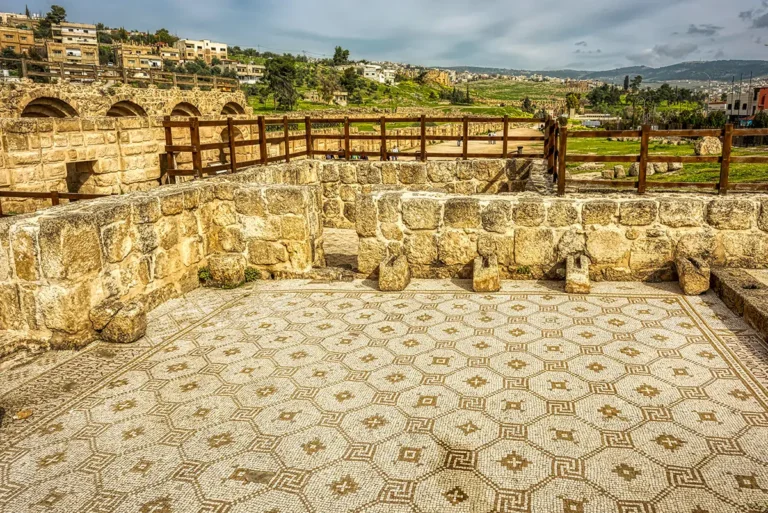
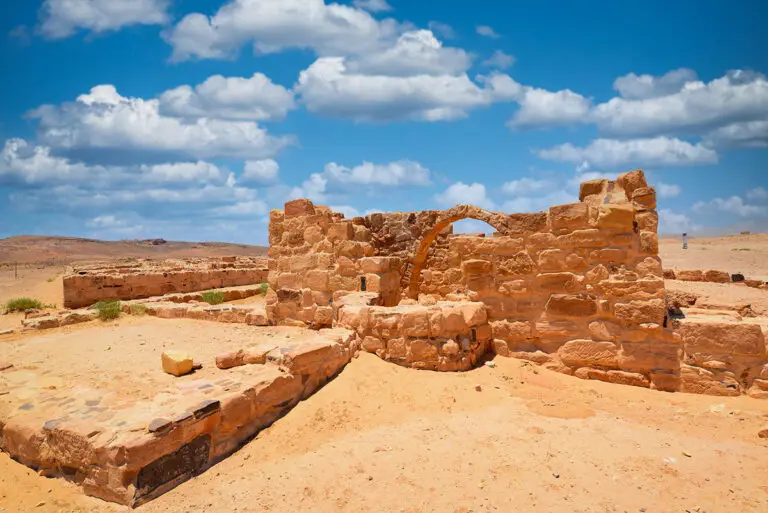
Standing among the Baths of Placcus, the 360-degree panorama reveals a low, intricate landscape of Byzantine walls, chambers and scattered limestone blocks spread across a dry terrace. In the foreground, the bath complex survives as a sequence of sunken rooms, rough stone partitions and fragments of once carefully planned spaces, while taller colonnades rise beyond the ruins and reconnect the site with the monumental Roman city around it. Turning across the view, Jerash’s ancient streets, temples and standing columns appear on the horizon, with the modern town climbing the distant hills. The contrast is striking: this modest 5th-century bathhouse, built by a Christian bishop from reused Roman stone, sits within one of the grandest archaeological landscapes in the Middle East. Under the wide Jordanian sky, the panorama makes its layered history easy to feel—Roman architectural splendour, Byzantine adaptation and centuries of earthquake damage gathered in one quiet, open place.
Trace the stone partitions around the sunken rooms to distinguish the compact spaces within the bathhouse footprint. The shifts in level are especially helpful for reading an interior whose upper structures have largely disappeared. Compare the heavier blocks with the smaller masonry in the dividing walls. Turning towards the standing colonnades places this low complex beside the larger monuments beyond it.