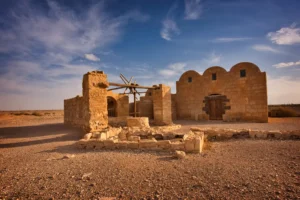
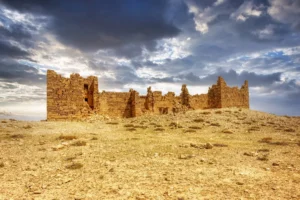
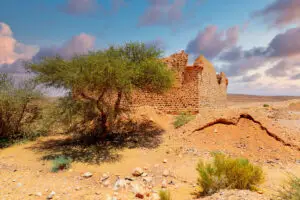
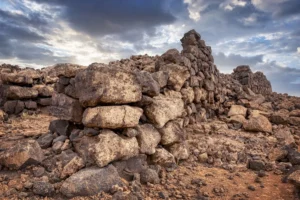
Shuqayra al-Gharbiyya, near Dhat Ras on Jordan’s Karak Plateau, is an important Early Islamic archaeological complex often described as an Umayyad palace. Its discovery broadened the familiar map of Umayyad elite buildings beyond Jordan’s eastern steppe and the Jordan Valley, showing that the fertile uplands of central-southern Jordan also mattered to the dynasty. Rather than a solitary romantic “desert castle,” Shuqayra appears to have been a substantial compound embedded in a productive local landscape, with architectural remains and associated settlement evidence that point to organized residence, administration, and engagement with the surrounding countryside. Archaeological work begun in the early 2000s has made the site especially valuable for understanding how Umayyad authority was expressed outside major cities and along the routes linking Karak, the plateau, and wider Transjordan.
The palace’s significance lies as much in its setting as in its walls. Built in a region with cultivable land, water resources, and long-lived settlement traditions, it suggests an Umayyad landscape in which ruling elites could supervise agricultural production, travel, and local communities while enjoying the prestige of monumental architecture. Its remains evoke the broader Umayyad practice of constructing qusur—palatial or fortified compounds that were not merely military outposts, but places where power, hospitality, estate management, and seasonal residence could overlap. Shuqayra therefore offers a quieter but revealing counterpart to better-known Jordanian monuments such as Qusayr ‘Amra or Qasr al-Mushatta: a site that emphasizes the dynasty’s reach into the Karak Plateau and the close relationship between early Islamic political authority and the cultivated landscape.