













Qasr Abu El-Kharaq
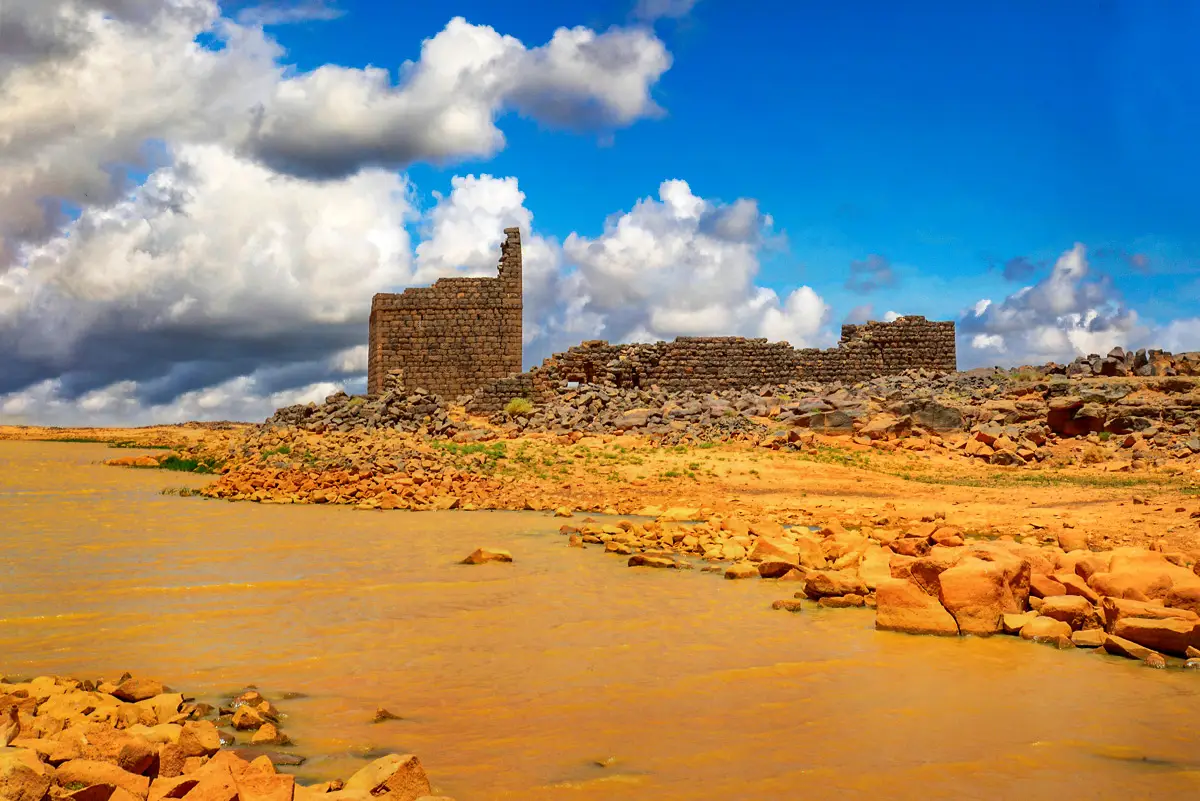
A dry-stone watchtower on a hill, in sight of Qasr Bshir
FoundedIron Age (probably)
TowerAbout 22 × 18 m
Location5 km NW of Qasr Bshir
Access4x4 track
Introduction
Walls that lean inwards, built without mortar.
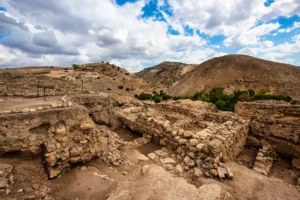
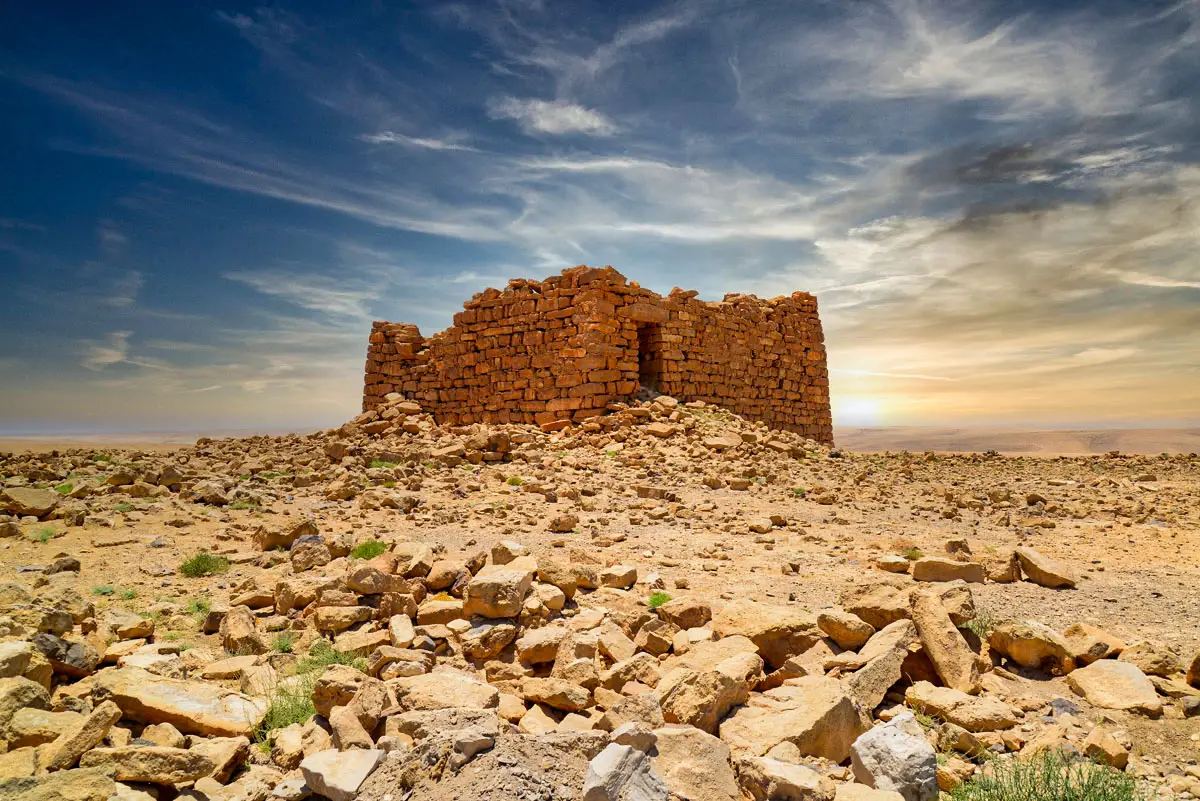
Qasr Abu El-Kharaq is a large stone tower on a hilltop about 5 km north-west of Qasr Bshir. Its dry-stone walls slope inwards, and in 1936 the archaeologist Nelson Glueck counted 22 courses still standing over 8 m high at the best corner.
Most of the pottery found here is Iron Age, with some Nabataean and early Roman pieces, so the tower was probably founded in the Iron Age and used again later. It may have served as an outpost of Qasr Bshir in the late Roman period. It stands against the north wall of an older enclosure of about 60 × 60 m.
Best timeMar–May · Oct–Nov
Time needed20 min
TicketFree
From Amman100 km · 1 hr 50 min
Combine withQasr Bshir · 20 min
Google rating4.8 · Reviews
Highlights · A dry-stone tower
A tower built to last without mortar
Sloping walls, a raised doorway and a view to Qasr Bshir
Abu El-Kharaq is a quick stop from Qasr Bshir, and a good contrast to it: older, rougher and built without mortar.
 01 / 04
01 · Architecture
Sloping walls
The tower
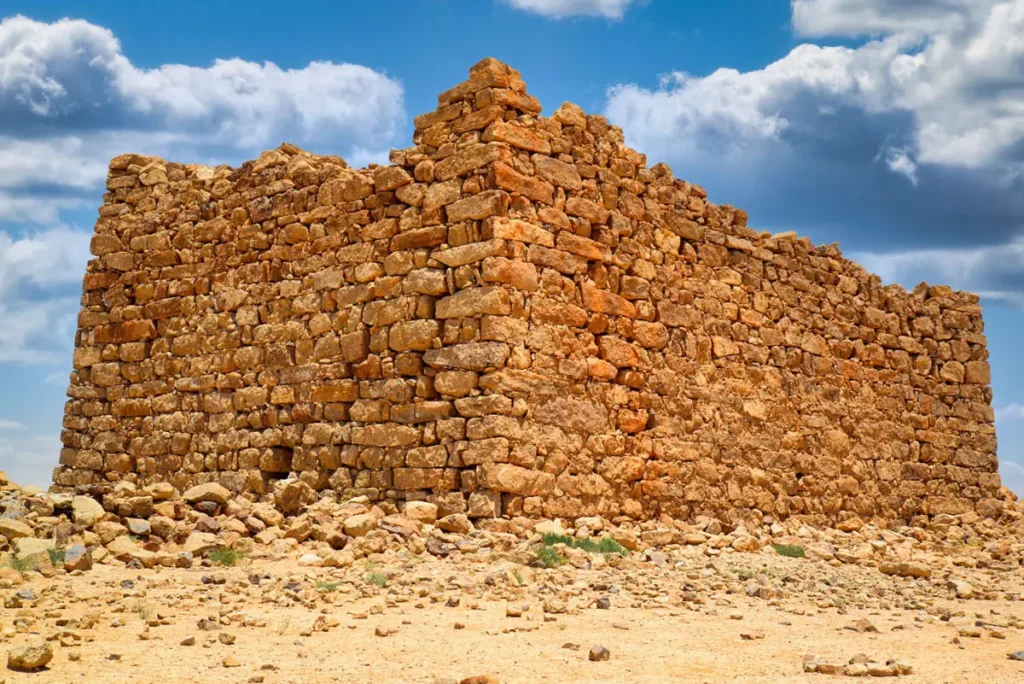
The outer walls lean inwards as they rise, which made the dry-stone tower more stable.
Look closely
The angle of the walls from a corner.
1 of 4
Room by room
What to see
Three stops: the tower, its entrance and masonry, and the view from the hill. Pick a stop to see what to look for.
 1 / 6
01 · From outside
Walk round the tower
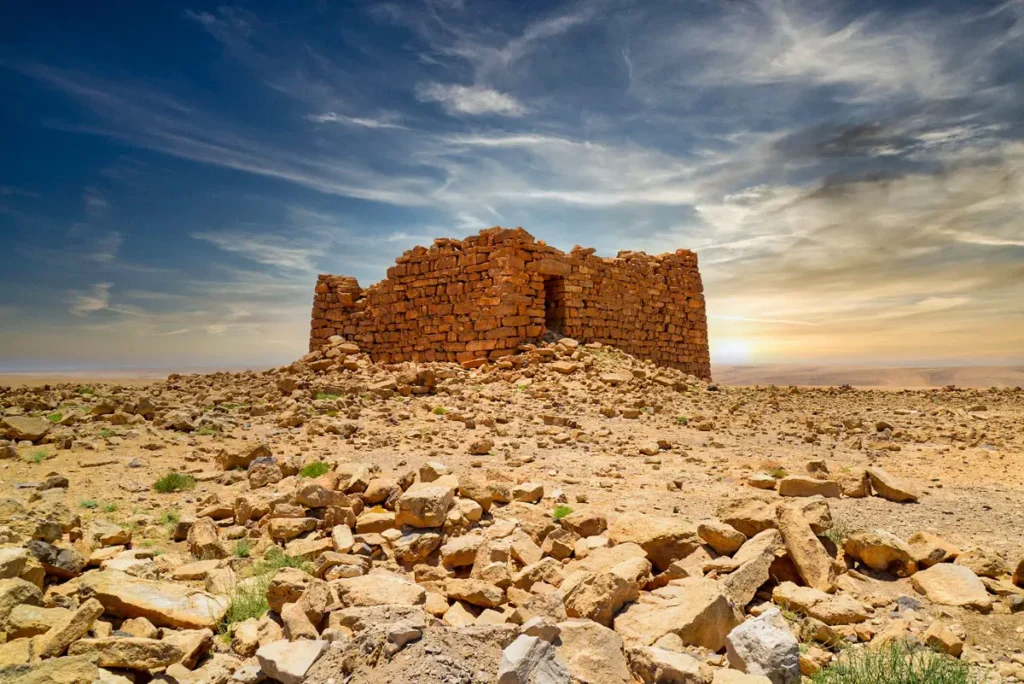
The tower measures about 22 × 18 m. Its walls are built without mortar and slope inwards as they rise. In 1936 Nelson Glueck recorded over 8 m standing at the best corner, with 22 courses, and 23 courses on the west wall. He also saw traces of plaster, mostly on the south side.
Kennedy’s aerial photographs show that it stands against the north wall of an enclosure of about 60 × 60 m, which may be older than the tower.
22 × 18 mDry stoneWalls lean inwardsEnclosure
Look for
- The inward slope of the walls
- The faint line of the enclosure
- Plaster traces on the south side
Dig deeperHow old is it?
There is no inscription, and the site has never been excavated. Glueck found mostly Iron Age pottery and a little Nabataean ware, including one sherd of fine red sigillata. The later Limes Arabicus survey found the same mix.
So the tower was probably founded in the Iron Age, or possibly by the Nabataeans, and used again later. The date of the 4th century AD you may read elsewhere belongs to Qasr Bshir, not to this tower.
 1 / 4
02 · Details
Find the doorway
Early surveys recorded a doorway in the north wall and a low opening into a blocked passage near the southern end of the west wall. In 1936 Glueck described the doorway near the east end of the north wall, a little above ground level, and thought steps or a terrace once led up to it.
The passage was already blocked by fallen debris, and its purpose is unknown.
North doorwayBlocked passageCut corner stones
Look for
- The doorway in the north wall
- Corner stones cut to shape
 1 / 3
03 · From the hill
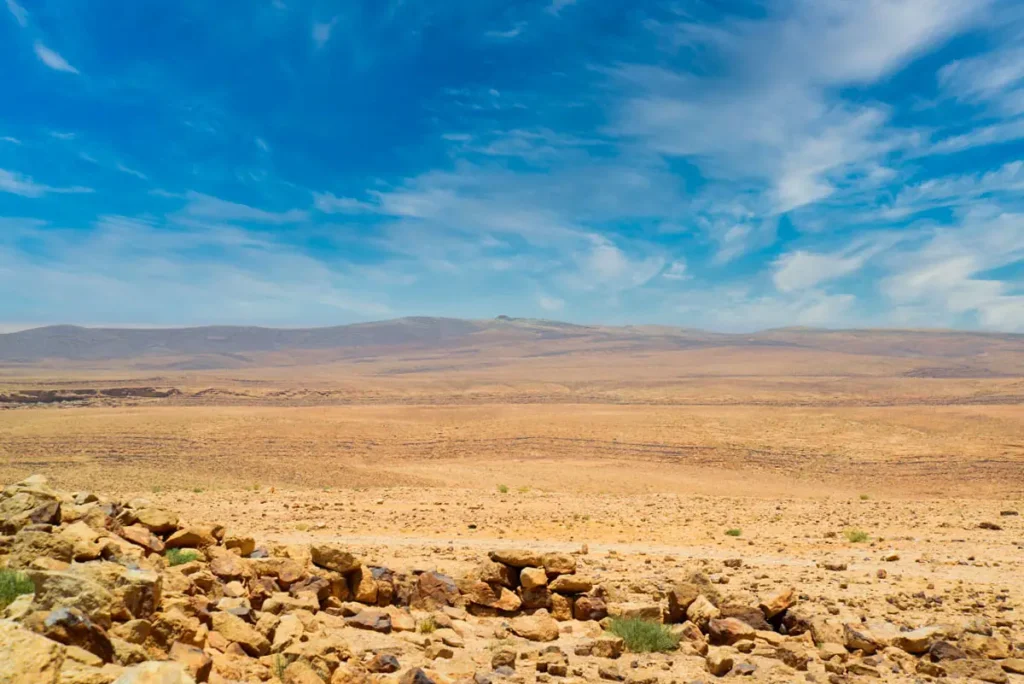
Look across to Qasr Bshir
Abu El-Kharaq stands on a hill with wide views over the steppe. Qasr Bshir is in sight to the south-east and Qasr El-Al to the north-east, and the towers could pass signals between them.
It is a good place to understand the whole group of forts around Qasr Bshir.
HilltopView to Qasr BshirView to El-Al
Look for
- Qasr Bshir on the plain
- Qasr El-Al on its hill
- Shallow wadis draining west
History & significance
An Iron Age tower near a Roman fort
Abu El-Kharaq was probably founded in the Iron Age and used again in Nabataean and early Roman times. It may have served as an outpost of Qasr Bshir in the late Roman period.
- Iron AgeThe tower is probably founded
- 1st c. BC–2nd c. ADNabataean and early Roman use
- 1936Nelson Glueck records the tower
- 1980sLimes Arabicus Project survey
 ProfileQasr Abu El-Kharaq: the full storyHistory, the tower, research and the timeline. About 2 min read.Read the profile →
Plan your visit
Everything you need to know before you go
Qasr Abu El-Kharaq is off the Desert Highway near Qatrana, about 5 km north-west of Qasr Bshir. It is hard to find, with no signs, and can only be reached by 4x4.
Good to know: the site is unstaffed and unsigned, with no facilities and no shade. The walls are dry stone, so don’t climb on them.
Opening hoursOpen accessUnstaffed site · visit in daylight
Entry ticketFreeNo ticket office
Time to visit20 minCombine with Qasr Bshir
From Amman100 kmAbout 1 hr 50 min via the Desert Highway, the last part on a track
LocationNear Qatrana31.3654° N, 35.9418° EGet directions
Opening hours and prices checked October 2026. Spotted a change? Let us know
On site
What you’ll find at Qasr Abu El-Kharaq
- Viewpoint
Not on site: visitor centre, ticket office, toilets, designated parking, museum, guide, food & drinks, market / shop, hotels
Access: 4x4 needed
When to go
Spring and autumn are best. After rain the tracks can be impassable, and in summer there is no shade.
J
F
M
A
M
J
J
A
S
O
N
D
BestGood, cooler or warmVery hot
Tip: visit it straight after Qasr Bshir, and look back from the hill: you will see how the two were linked.
Before you go
Services are limited out in the desert.
- Water and snacksShops in Qatrana
- Sun hat and sunscreenVery little shade outside
- Comfortable shoesUneven, stony ground
- A 4x4 and a guideNo signs, hard to find
- Toilet paperBring your own, just in case
Common questions
Quick answers before you set off.
Do I need a 4x4?
Yes. The site can only be reached by 4x4 on desert tracks, and it is hard to find without a guide.
Is there an entrance fee?
No. The site is unstaffed and free to visit.
Is it Roman?
Probably not originally. Most of the pottery is Iron Age, with some Nabataean and early Roman pieces. It may have been used as an outpost of Qasr Bshir later.
Can I visit it on a tour?
Yes. It is the second stop on our Expedition to Qasr Bshir, Lejjun, Umm ar-Rasas & Karak.
What should I wear?
Comfortable, closed shoes for uneven ground, and light clothing that covers your shoulders and knees, which is respectful in rural Jordan and protects you from the sun.
Combine with
Abu El-Kharaq is one of a group of forts and towers around Qasr Bshir. Drive times are from Qasr Abu El-Kharaq and include the tracks.
1 Qasr BshirRoman fort5 km · ~20 min drive · Tour 12Qasr El-AlIron Age fort4 km · ~20 min drive3Qal’at QatranaOttoman pilgrim fort24 km · ~55 min drive · Tour 1
 Qasr BshirRoman fort5 km · ~20 min drive · Tour 12
 Qasr El-AlIron Age fort4 km · ~20 min drive3
 Qal’at QatranaOttoman pilgrim fort24 km · ~55 min drive · Tour 1
Tour 1 Qasr Bshir, Lejjun, Umm ar-Rasas & Karak. Compare the tours
Private tours
A private day tour that includes Qasr Abu El-Kharaq
The tour is just for you: your own vehicle and driver, hotel pickup in Amman, entry tickets included, and one fixed price for up to three travellers.
Private: only your group
Your own vehicle & driver
Hotel pick-up in Amman
Entry tickets included
from$250per group (1–3) · 178 JOD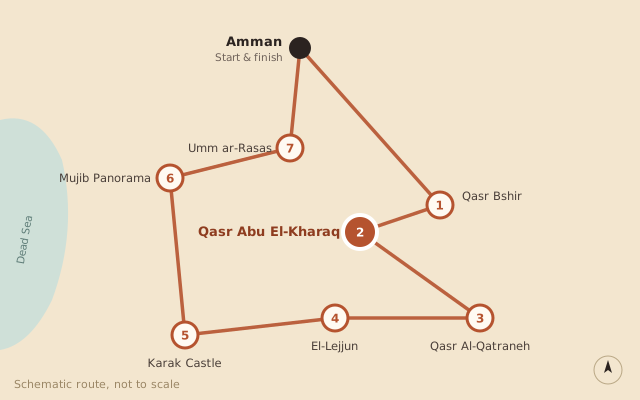
Tour 1 · Full day · Private
Expedition to Qasr Bshir, Lejjun, Umm Ar-Rasas, Karak
Set high at around 800 meters above sea level, deep within a vast and rugged basalt plain, Qasr Bshir (Castra Praetorium Mobene) remains one of Jordan’s most remote and best-preserved Roman frontier forts. Its isolated location makes it difficult to reach for the average traveller—but that’s exactly what makes this journey so rewarding.
HistoryArchitectureRoman fortsCrusader castleUNESCO site7 stops
Duration8–9 hr
Pick-up8 or 9 AM
Group1–3, private
Included
- Private luxury transfer
- Entrance fees
- Bottled water, soft drinks, snacks
- Coffee/tea (on request)
- WiFi, Phone charger
Not included
- Professional on-site (local) guide
- Personal expenses
- Lunch
CancellationFull refund if you cancel at least 24 hours before the start. No refunds or changes within 24 hours.
Pick-upFrom your hotel lobby or home in Amman, 5 minutes before your chosen start time.
BringComfortable shoes, sun hat, sunblock and sunglasses. Tours run in English.
Explore this site
More from Qasr Abu El-Kharaq
Panoramas, walk-throughs, photos and stories about this site.
ProfileQasr Abu El-Kharaq: history & architecture Photo albumQasr Abu El-Kharaq: A Desert Watchtower in Photos
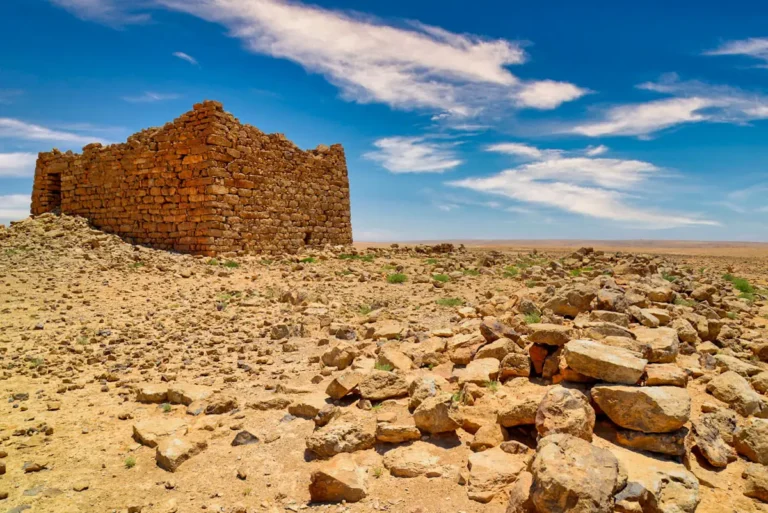 360°360° panoramaQasr Abu El-Kharaq: 360° Panorama
Nearby