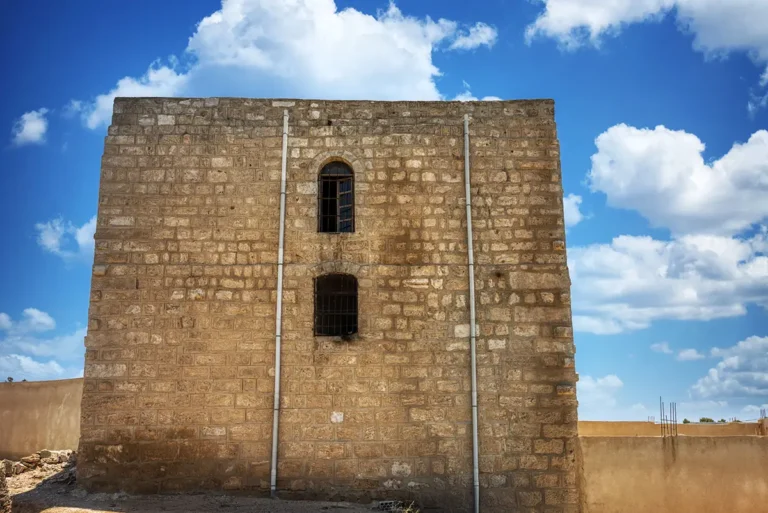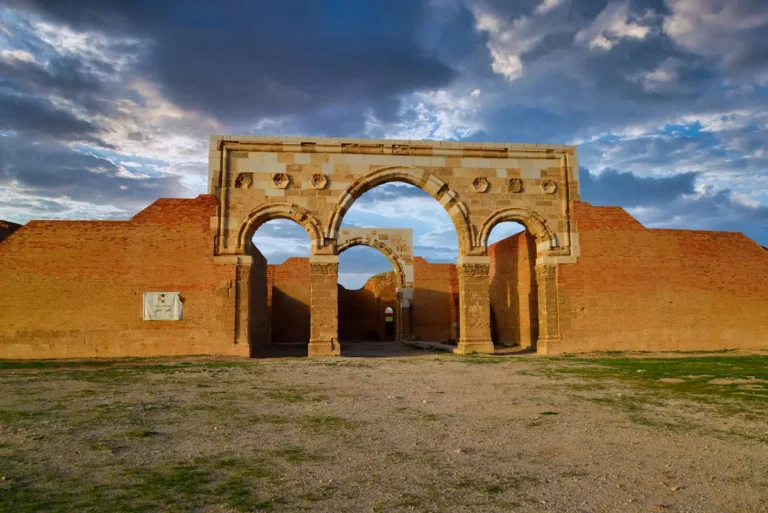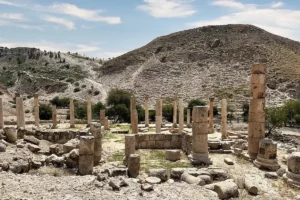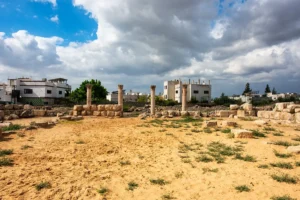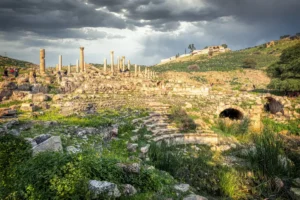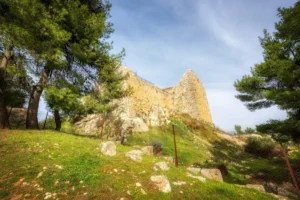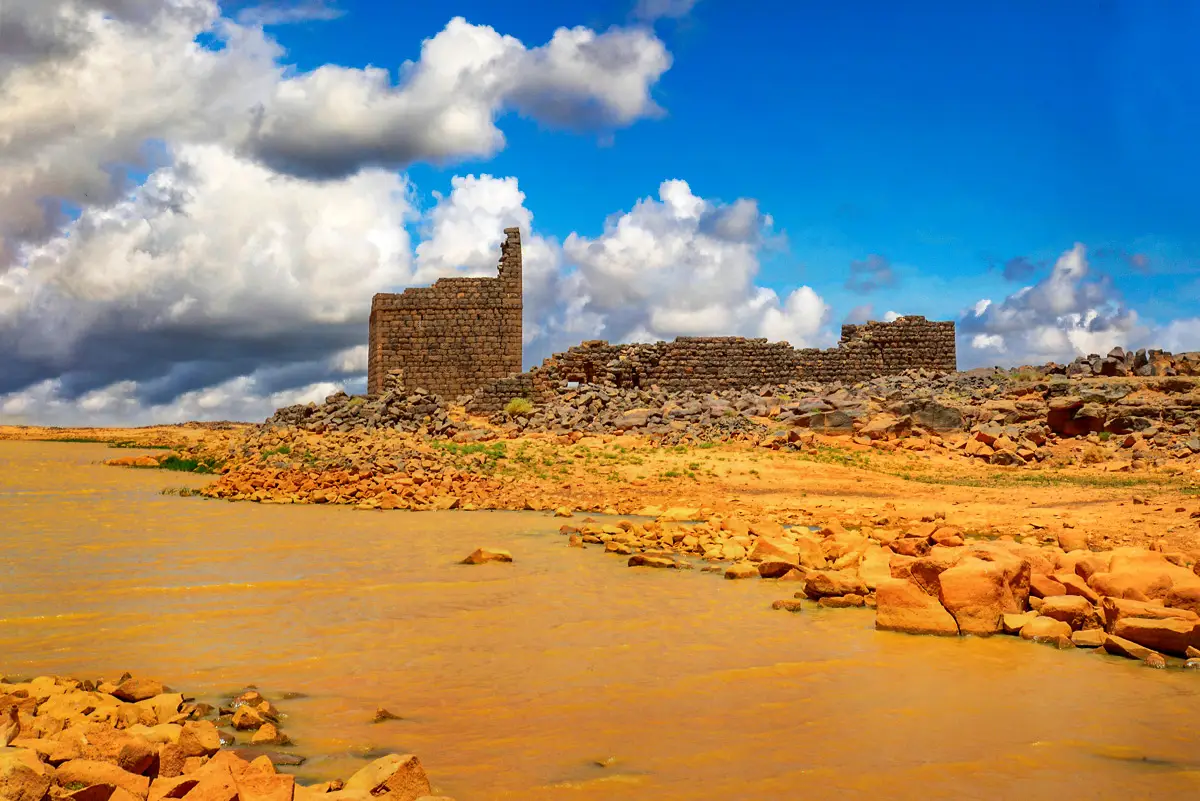












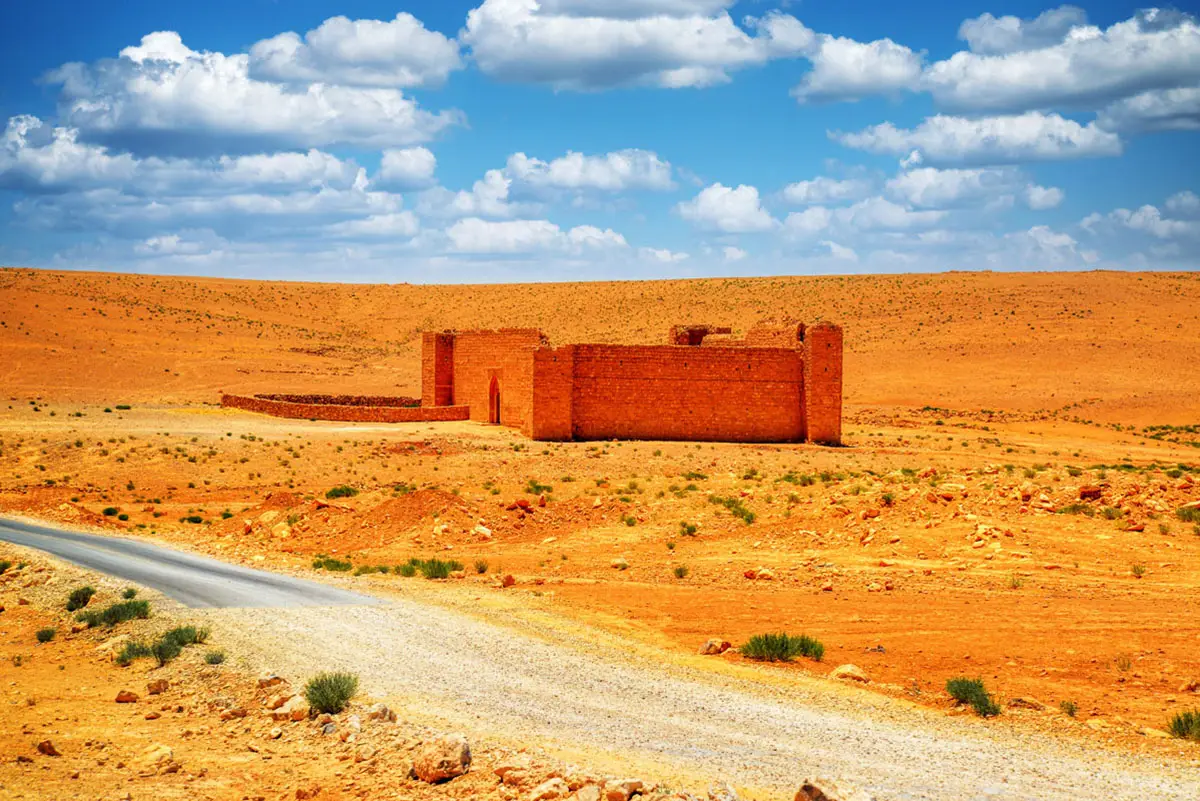


On the open plain south of Amman, a square fort with four corner towers marks a halt on the old pilgrim road from Damascus to Mecca. Qal’at Dab’a guarded a reservoir where the Hajj caravan drew water, and a century and a half later the Hejaz Railway was built beside it.
Where Is Qal’at Dab’a?
The fort lies about 56 km south of Amman. From the Desert Highway, a side road runs about 6.5 km east, the last stretch in poor condition. The Dab’a station of the Hejaz Railway stands about 1 km east of the fort, roughly halfway between Amman and Qal’at Qatrana.
Historical Context and Origin
A halt called Balqa’ already appears on the Ottoman Hajj itineraries of the 16th century, and the reservoir may date from that time. The fort that stands today is an 18th-century building. A recorded Arabic inscription commemorates restoration by ʿUthman Pasha in AH 1180 (AD 1766–67). He was governor of Damascus from 1760 to 1771 and led the pilgrim caravan for about ten years. The inscription’s original position is unknown, perhaps the mosque room, and it has since been lost. The name Dab’a means “hyenas”.
Architectural Design
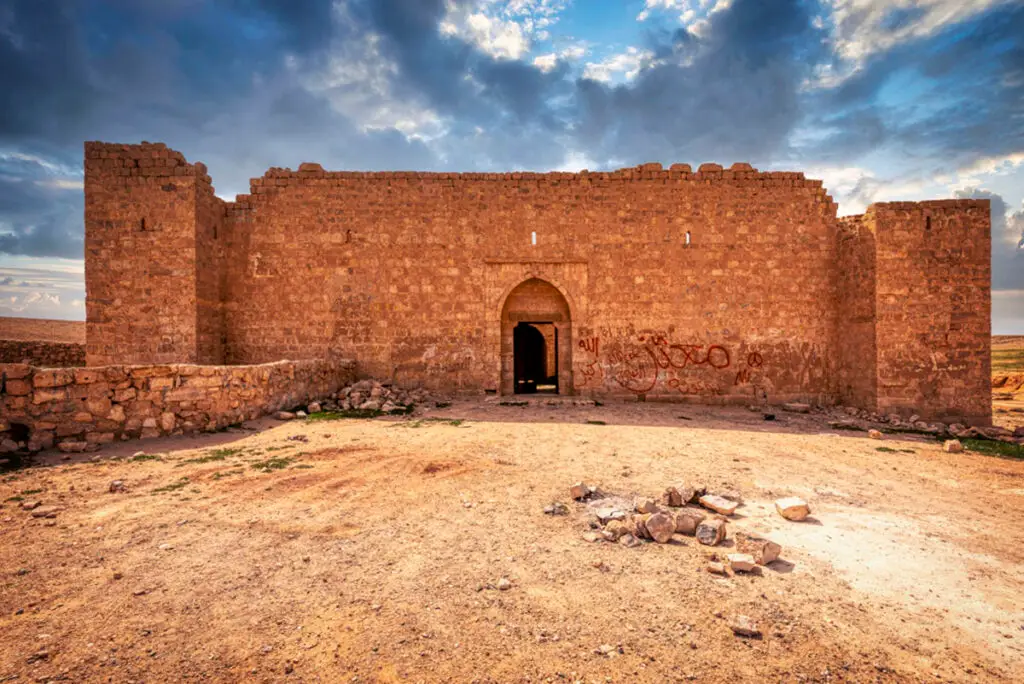
The fort is about 25 m square, with rooms on two floors around a central courtyard and a projecting tower at each corner. Corner towers like these were added to the Hajj forts of the 18th century, when the Bedouin tribes had acquired firearms; they let the small garrison, often 20 men or fewer, cover the walls with musket fire. The forts were placed within musket range of their reservoirs.
Corner Towers
Four projecting towers, typical of the 18th-century Hajj forts.
Two Storeys
Rooms on two floors around a central courtyard.
The Reservoir
A large reservoir beside the fort, possibly older than the fort itself.
The Railway
A Hejaz Railway station and its cemetery lie nearby.
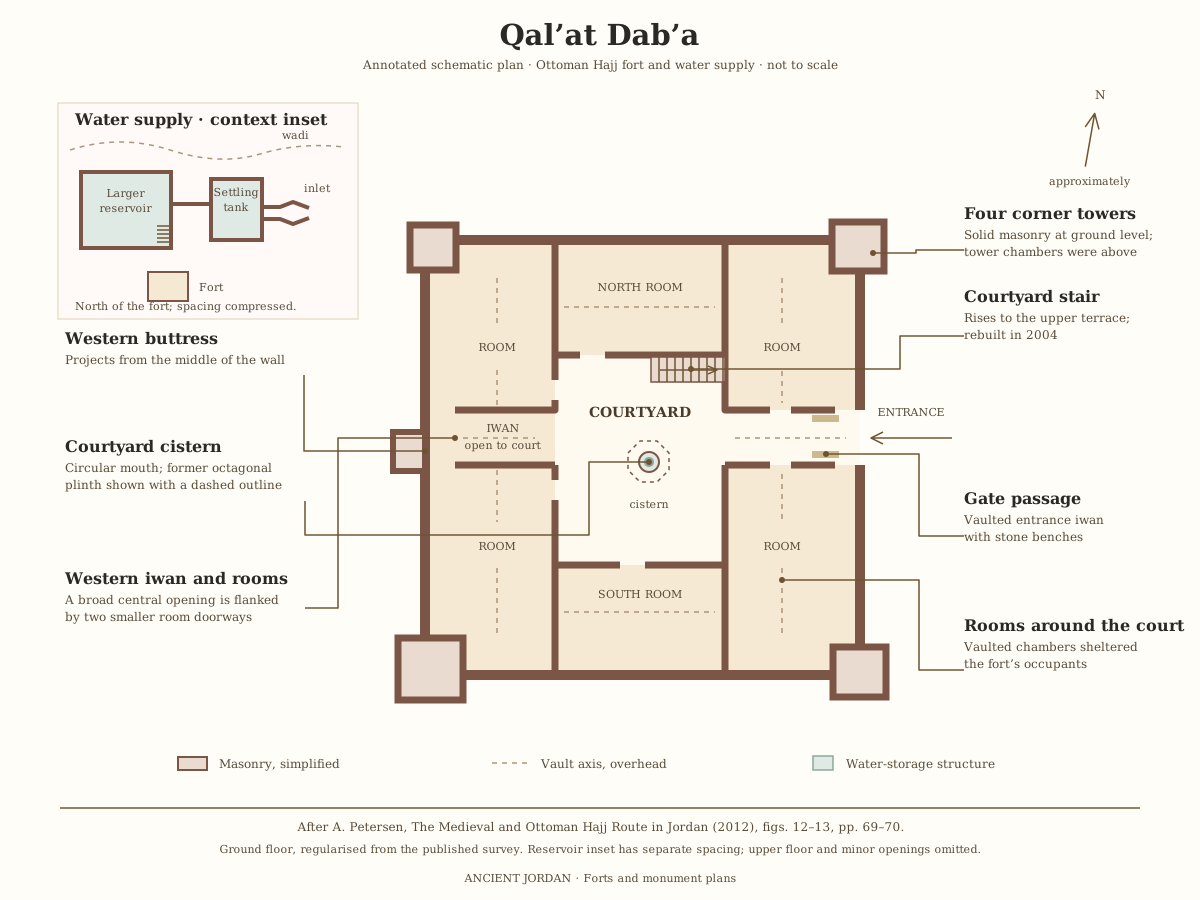
Qal’at Dab’a
Schematic ground-floor plan of Qal'at Dab'a with its reservoir inset, after Petersen (2012)
Open drawingRestoration inscription of ʿUthman Pasha
A four-line Arabic restoration inscription is recorded for Qal’at Dab’a. It begins with Qur’an 9:18, concerning the maintenance of mosques, and names ʿUthman Pasha, the minister and Amir al-Hajj (commander of the pilgrimage caravan), as the person who restored the “blessed place.” It is dated Dhu al-Hijja AH 1180, placing the work in 1767. It commemorates restoration rather than the fort’s original construction. Tütüncü and Petersen, inscription no. 1
إنما يعمر مساجد الله من آمن بالله واليوم الآخر وأقام الصلاة وآتى [الزكاة]
ولم يخش إلا الله فعسى أولئك أن يكونوا من المهتدين
جدد هذا المكان المبارك صاحب الخيرات أمير الحاج الوزير (?)
عثمان باشا [… في ذي؟] الحجة (سنة) ١١٨٠
Only those who believe in God and the Last Day, establish prayer, give [alms], and fear none but God maintain God’s mosques. Such people may hope to be among the rightly guided.
This blessed place was restored by the benefactor, commander of the pilgrimage caravan, the vizier [?], ʿUthman Pasha, [… in Dhu?] al-Hijja, in the year 1180.
The text survives in Max van Berchem’s transcription from a paper impression made by Julius Euting, published in Die Provincia Arabia, vol. II (1905), p. 76. Some words were already uncertain or missing. Original publication
The Arabic is the published reading with modernised spelling and vowel marks omitted. Square brackets indicate restored or missing text; a question mark indicates an uncertain reading. The word سنة, “year,” appears in parentheses in the edition as an explanatory addition. Arabic transcription
The first two lines quote Qur’an 9:18, connecting the restoration with the care of a place of worship. The verb جدد (jaddada), “renewed” or “restored,” explicitly describes work on an existing building.
The final date corresponds approximately to May 1767. The month’s introductory wording is partly restored, while 1180 is recorded clearly. The inscription’s original position is unknown; its religious wording suggests a prayer room, but does not establish that location. Original edition, Tütüncü and Petersen, inscription no. 1
Water and the Railway
Beside the fort lie a large reservoir, now roofed, and further cisterns near the wadis, which collected winter rain for the caravans. In the early 20th century the Hejaz Railway was built past Dab’a. Its station was a small desert halt, and a large cemetery beside it holds the graves of railway workers who died in epidemics.

Destruction, Rediscovery, and Restoration
Brünnow and Domaszewski recorded the fort in 1898, and Henry Field visited it in 1928. Andrew Petersen surveyed it in the 1980s for his study of the Hajj forts. The stair, destroyed after 1986, was rebuilt in 2004, but the fort has seen little other conservation, and parts of it are at risk of collapse.
Visiting Qal’at Dab’a Today
The fort is open at any time and free, with no facilities. Allow about 30 minutes, and combine it with the railway station nearby. See our Qal’at Dab’a travel guide for directions.
Further reading: Petersen, The Medieval and Ottoman Hajj Route in Jordan (2012); Tütüncü & Petersen — Ottoman inscriptions of the Hajj forts (2017); AramcoWorld — Guardians of the Pilgrim Wells (2004).