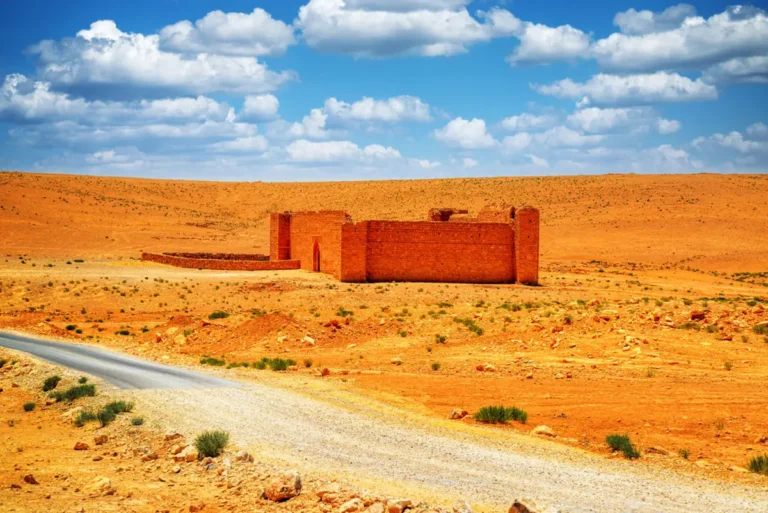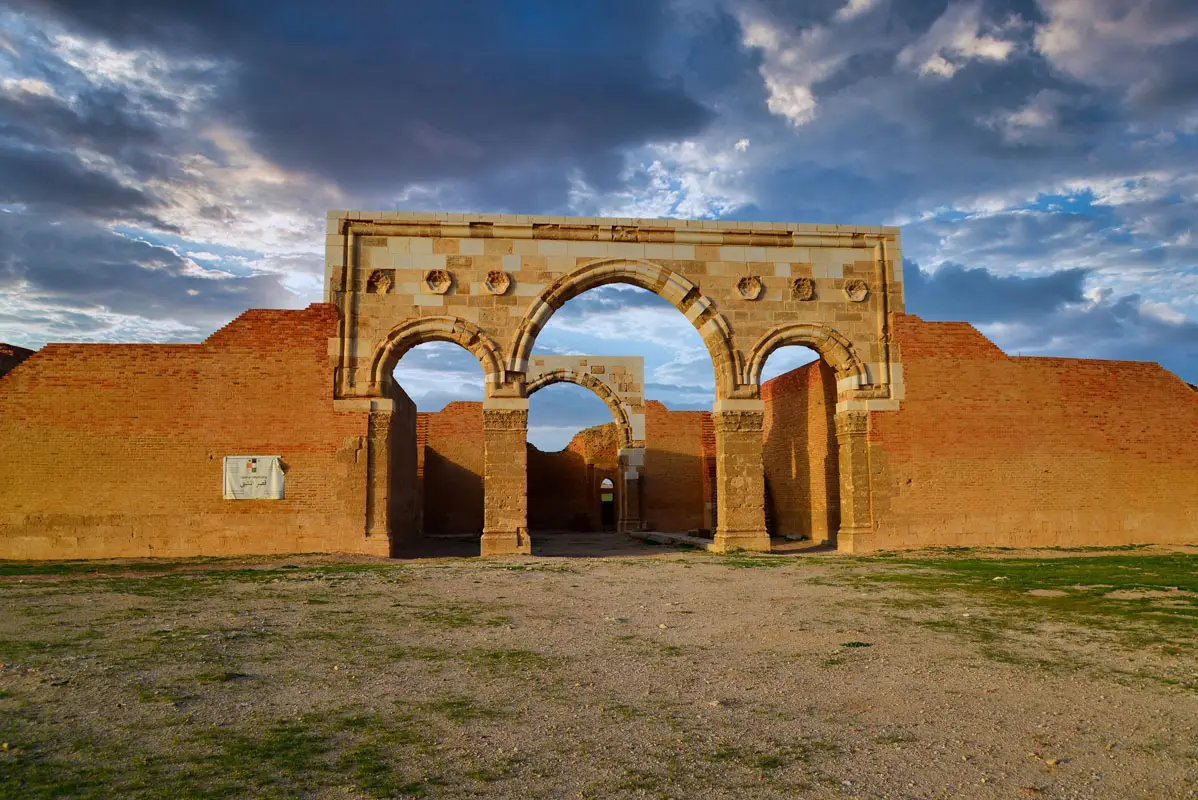

Qasr Al-Mushatta was meant to be the grandest of the Umayyad palaces in Jordan: a square enclosure 144 m across with 25 towers and a throne room behind a richly carved façade. It was never finished, and in 1903 most of the façade was taken to Berlin. What remains is a vast, quiet ruin of orange brick on the edge of the airport.
Where Is Qasr Al-Mushatta?
Mushatta lies about 30 km south of Amman, immediately north of the runways of Queen Alia International Airport. It is reached by the airport perimeter road, about 11 km, through security checkpoints where you must show your passport.
Historical Context and Origin
No inscription names the builder, but the palace is usually attributed to the Umayyad caliph al-Walid II and dated to his short reign, AD 743–744. Work stopped when he was assassinated in 744, and the palace was never completed. It was probably badly damaged in the earthquake of 749. Recent research has found traces of a later occupation lasting about half a century.
Architectural Design
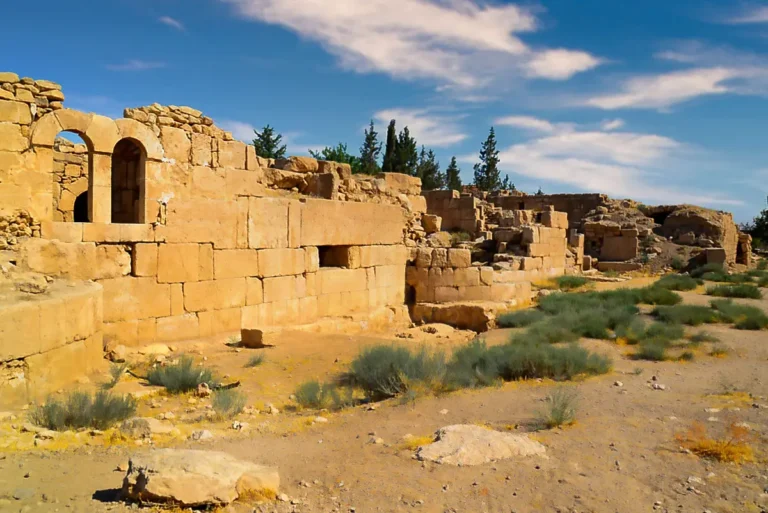
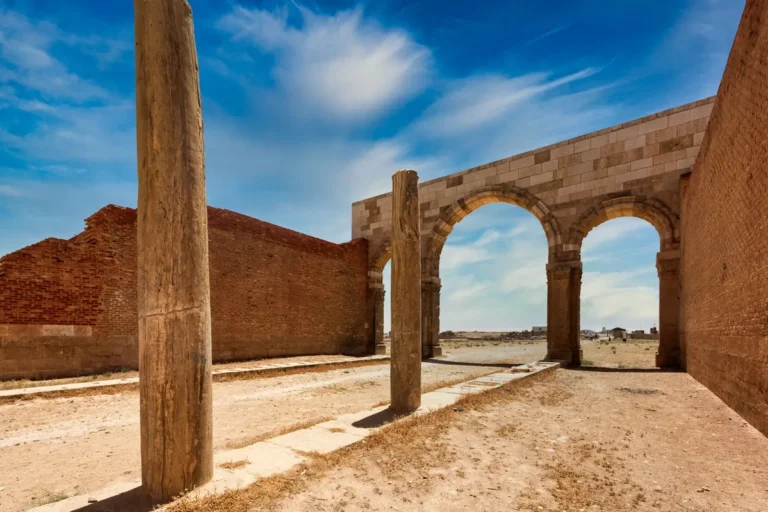
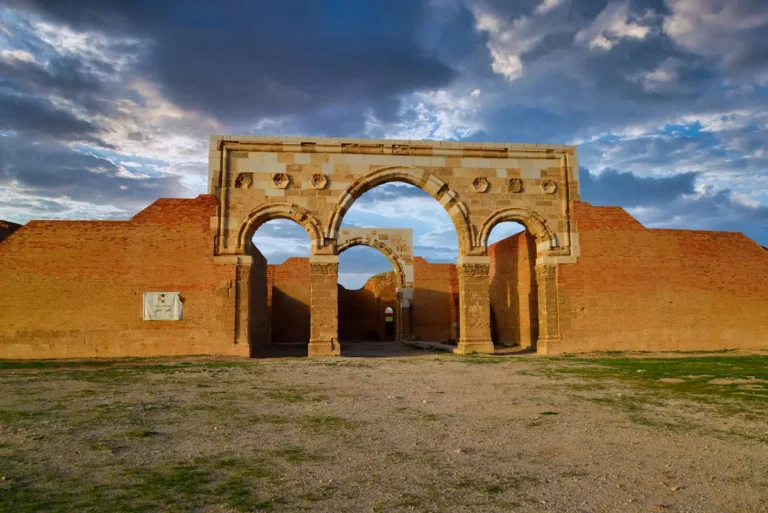
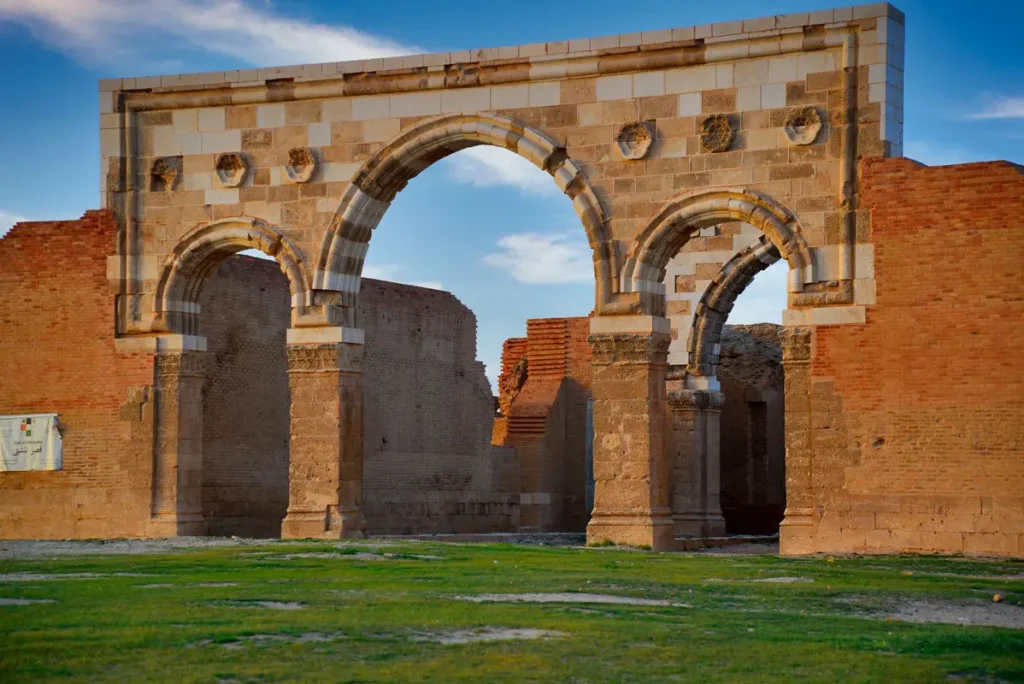
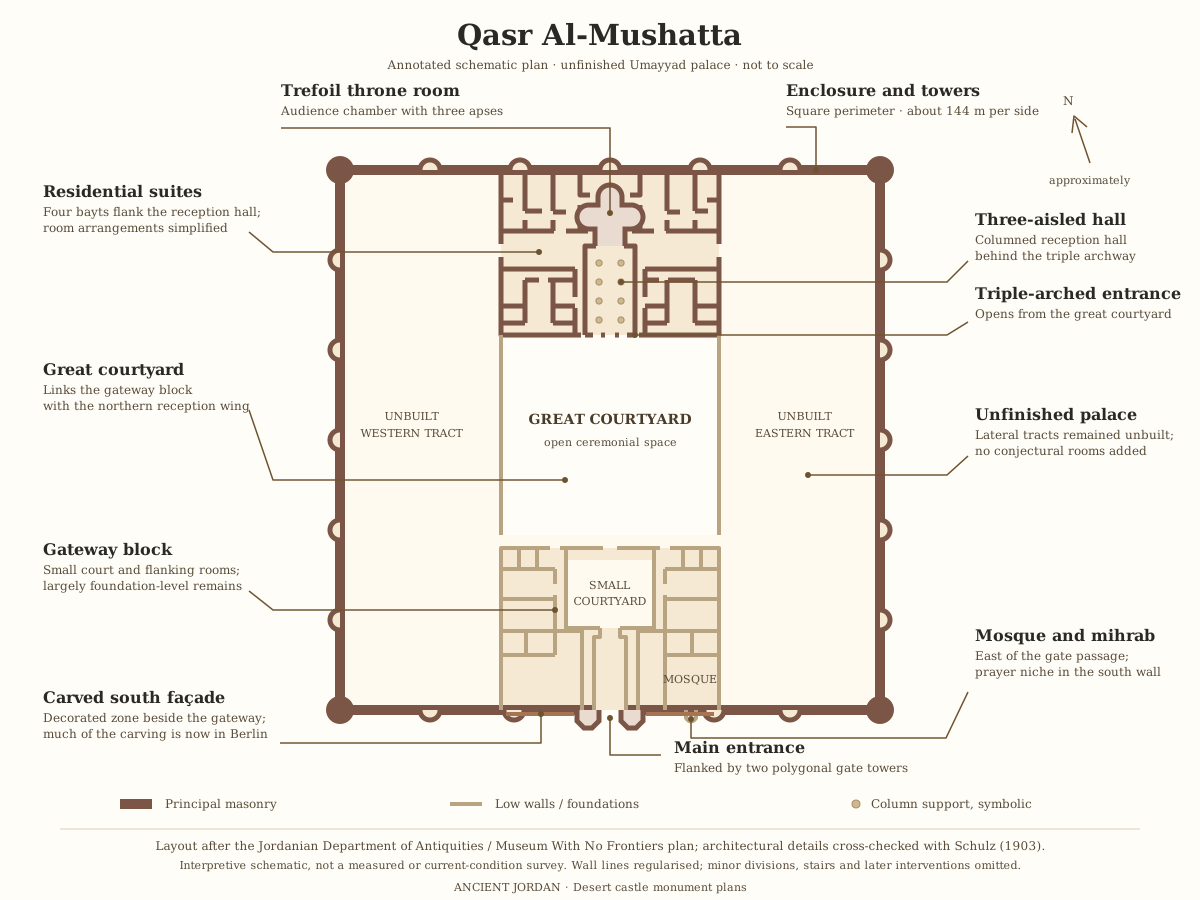
The enclosure is 144 m square, with walls 1.7 m thick and 25 towers: round ones at the corners, two semi-octagonal towers flanking the single gate in the south wall and half-round towers between. The walls rise in stone for the lowest courses and in orange fired brick above. The interior was planned in three strips, but only the central one was partly built: a gateway block with a small mosque, a large courtyard and, to the north, the main building. There a triple-arched entrance opens into a columned, three-aisled hall leading to a throne room with three apses, flanked by vaulted living suites.
The Carved Façade
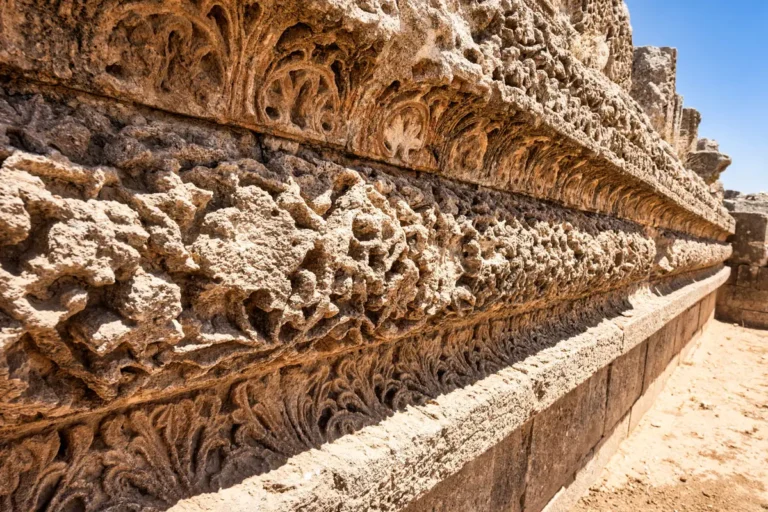
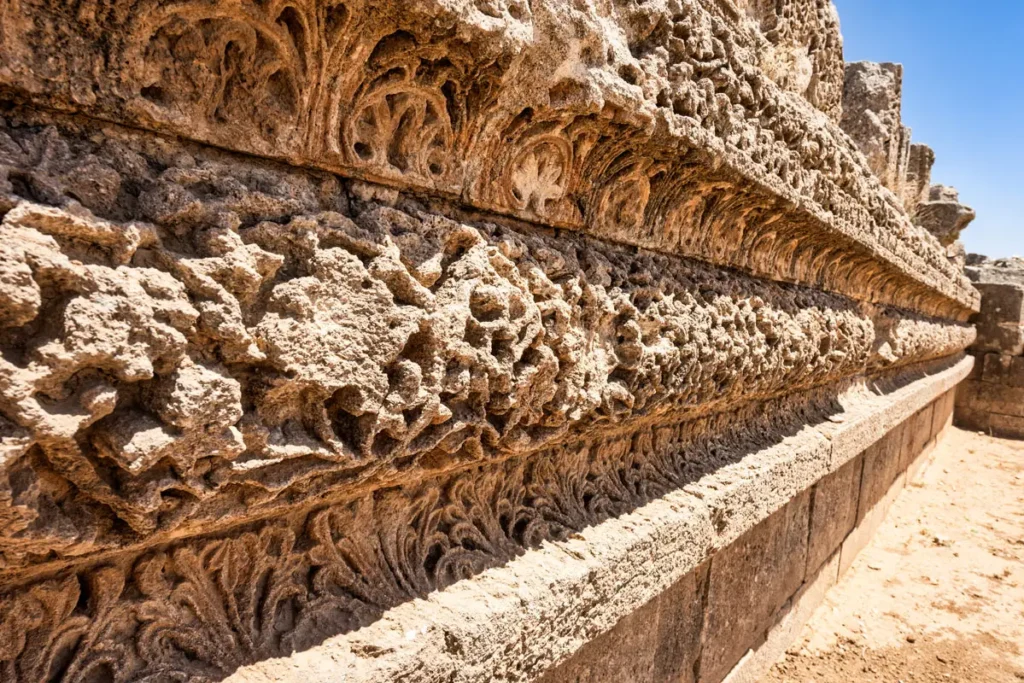
Triangles with large rosettes in a field of vine scrolls, birds and animals.
Fired Brick
Orange fired brick above stone footings — rare in stone-built Jordan.
The Throne Room
A columned hall leads to a triple-apsed throne room.
Never Finished
Only the central strip of the vast enclosure was ever built.
The brick letter fragment
Fragmentary Arabic inscription on a baked brick, found during clearance work at Al-Mushatta in June 1964. Written in five lines of early Kufic script, it contains the opening of a letter from Sulaymān ibn Kaysān to a recipient whose name is damaged. It begins with the basmala (“In the name of God, the Compassionate, the Merciful”), followed by the sender’s name and a greeting invoking peace, God’s mercy and blessings. It was published by Ghazi Bisheh as “Qasr al-Mshatta in the Light of a Recently Found Inscription” and bears the museum inventory number J.9883. Bisheh’s study, 1987, pp. 193–197
١. بسم الله الرحمن [الرحيم]
٢. من سليمن بن كيسان الى [خيلا…؟]
٣. ابن […] سلم عليك ورحمت [الله]
٤. وبركاته أما بعد فاني أحمد [اليك الله]
٥. […] المسلمون
1. In the name of God, the Compassionate, the Merciful.
2. From Sulaymān ibn Kaysān to [Khayla…?],
3. son of […]. Peace be upon you, and God’s mercy
4. and His blessings. To proceed: I praise God to you […]
5. […] the Muslims.
Its significance is chronological: the proposed identification of Sulaymān ibn Kaysān with an official known from late Umayyad sources supports an eighth-century date. However, this is not a foundation inscription naming the palace’s builder or giving its construction date. Al-Walid II’s patronage remains an attribution. Museum discussion
Square brackets mark supplied or uncertain text; dots indicate missing or unreadable passages. Early spellings are retained.
The recipient’s name in line 2 is tentative. The sender’s name is normally written سليمان بن كيسان, Sulaymān ibn Kaysān in modern Arabic.
The Mshatta Façade in Berlin
Either side of the gate, the south façade carried a band of carved limestone: a zigzag forming triangles, each with a large rosette, set in a dense field of vine and acanthus scrolls with lions, birds and other animals. Its motifs draw on late-antique, Coptic and Sasanian art. In 1903 the Ottoman sultan Abdülhamid II gave about three quarters of it to the German emperor Wilhelm II. It went on show in Berlin in 1904 and has stood in the Pergamonmuseum since 1932; damaged by a bomb in the Second World War, it was restored in the 1950s. The museum is closed for refurbishment and the façade is due back on view on 4 June 2027.
Destruction, Rediscovery, and Restoration
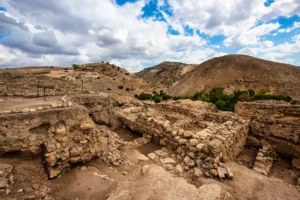
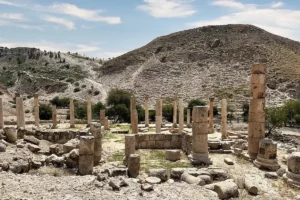
European travellers described Mushatta in the late 19th century, and Brünnow and Domaszewski documented it in 1897–98. From 2009 to 2014 a German–Jordanian project of the Department of Antiquities, TU Berlin and the Museum für Islamische Kunst documented the site, re-erected the arches of the main building from original stones, repaired 150 m of the west wall and installed a lapidarium. The site was handed over to the Department of Antiquities on 18 May 2014. It has been on Jordan’s UNESCO Tentative List since 2001.
Visiting Qasr Al-Mushatta Today
Entry is free. Allow about 40 minutes to walk from the gate to the throne room. See our Qasr Al-Mushatta travel guide for directions and practical tips.
Further reading: UNESCO Tentative List — Qasr al-Mushatta; Museum für Islamische Kunst — Qasr al-Mschatta research; Archnet — Mshatta.