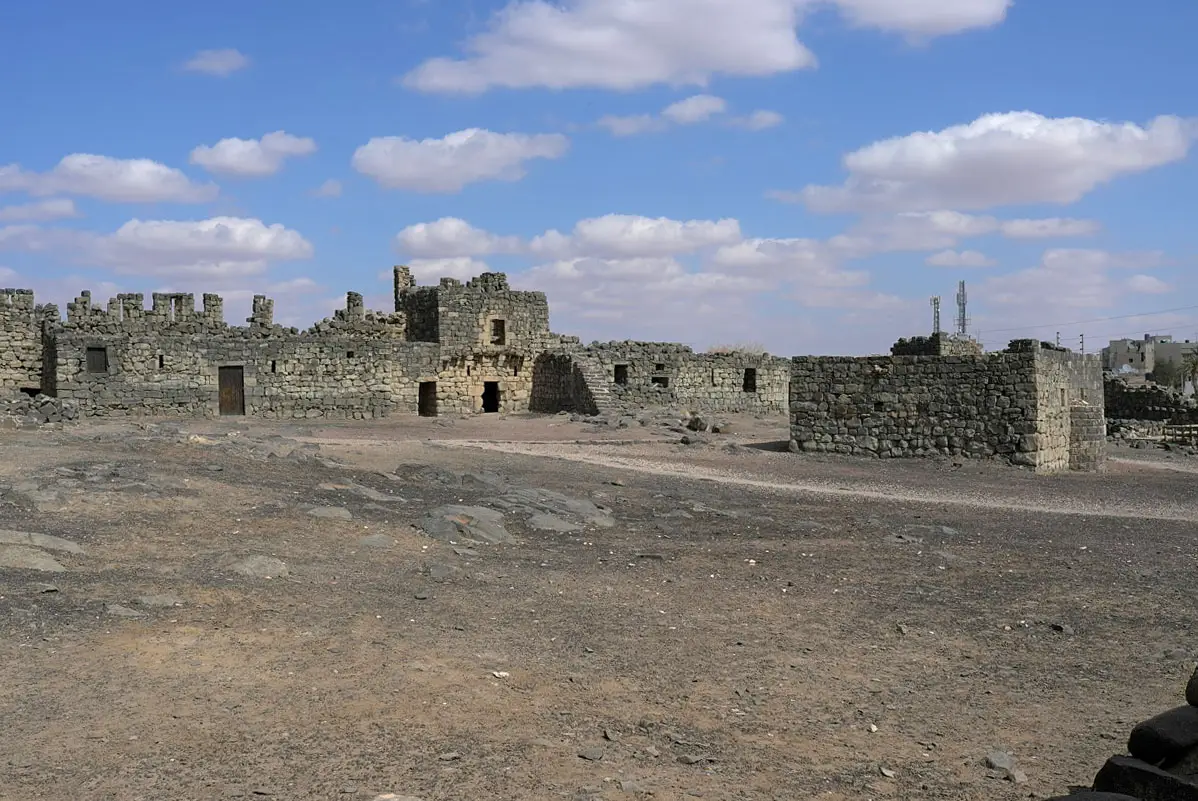
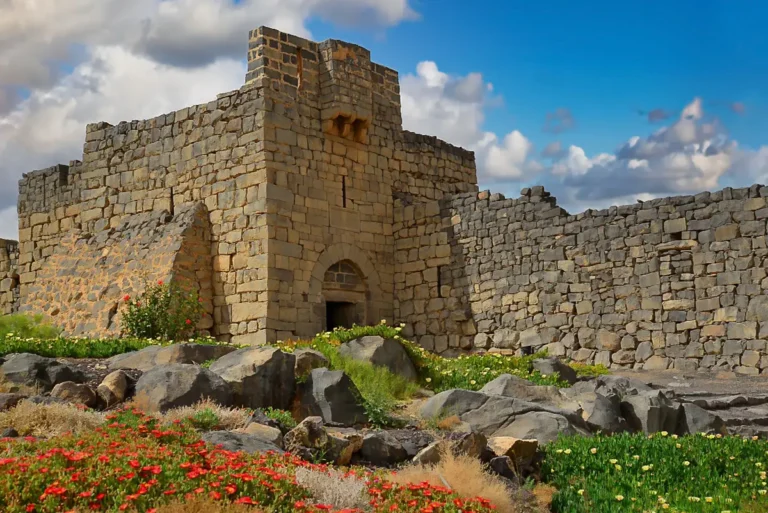


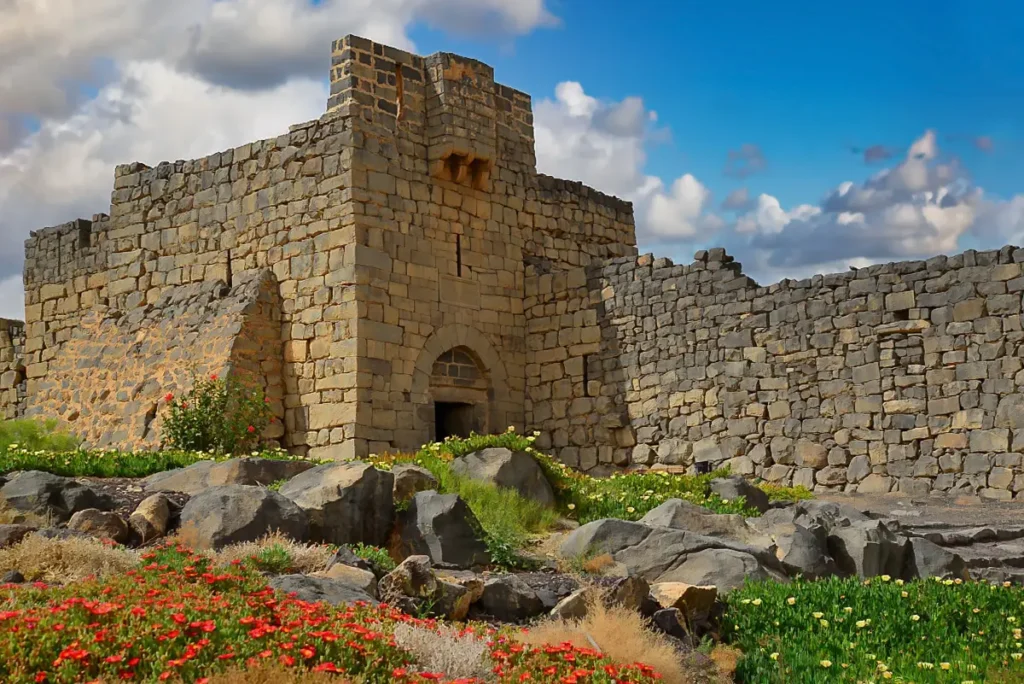
At the edge of the Azraq oasis stands a fortress built entirely of black basalt. Roman soldiers garrisoned it, an Ayyubid emir rebuilt it, Ottoman troops guarded the pilgrim road from it, and in 1917 it became the desert base of the Arab Revolt, where T. E. Lawrence stayed in the room above the gate.
Where Is Qasr Azraq?
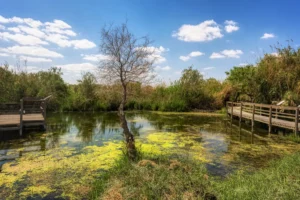
Qasr Azraq stands in Azraq North (Azraq al-Shamali), about 100 km east of Amman by road. The Azraq oasis was the most important source of permanent water in this part of the desert, at the head of Wadi al-Sirhan, the natural corridor towards Arabia. That water is why soldiers, travellers and rulers kept coming back here.
Historical Context and Origin
Roman troops were at the oasis by about AD 200, and an altar dedicated to the emperors Diocletian and Maximian (AD 287–305) dates the fort itself. Inscriptions of Constantine and his sons show work here around AD 326–333. In the 8th century the Umayyad prince al-Walid ibn Yazid, later Caliph al-Walid II, came here to hunt. The fortress you see today is largely the work of the Ayyubid emir ʿIzz al-Din Aybak: an Arabic inscription over the south gate records his rebuilding in AH 634 (AD 1236–37). In the 16th century the Ottomans kept a garrison here to protect the road to Mecca.
Architectural Design
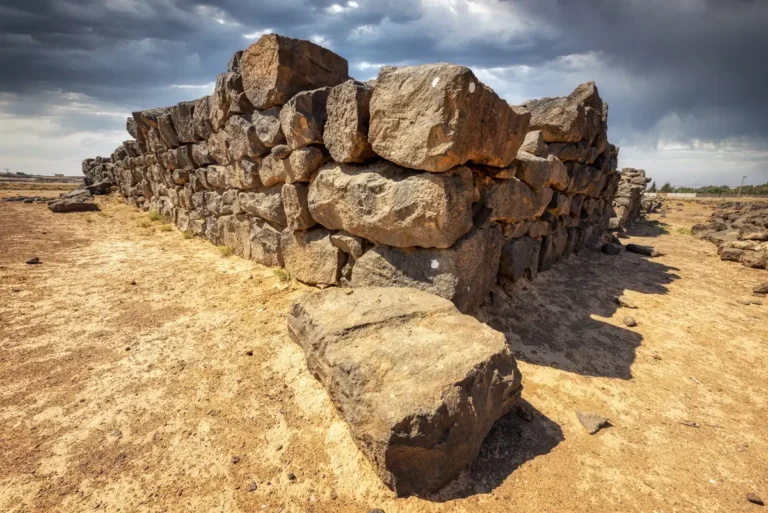
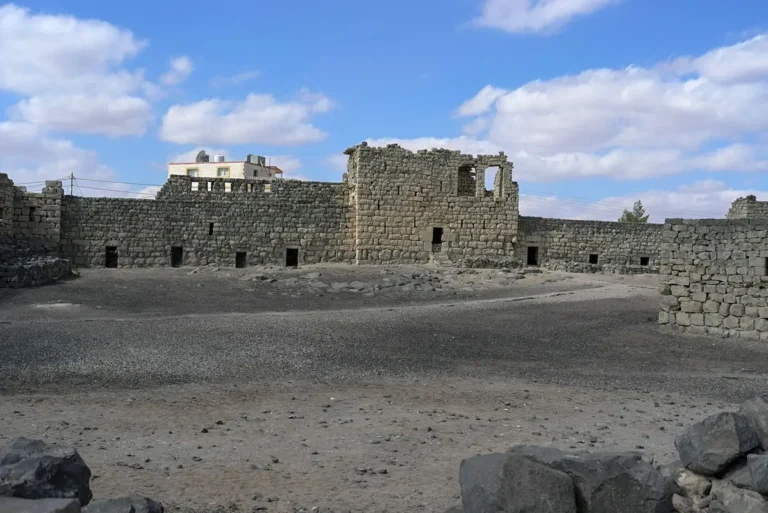
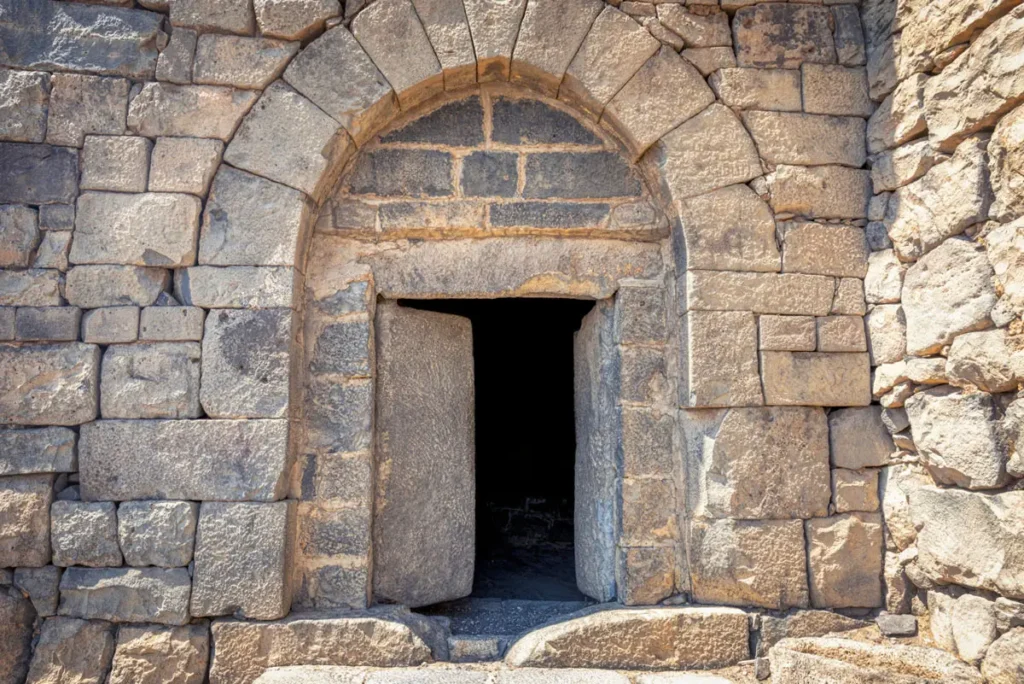
The fort measures about 79 × 72 m and is built of local basalt, with square corner towers and smaller towers along the walls. Rooms line the walls around a large courtyard, and a headquarters building projects from the north-west side. Arches carry basalt slabs as roof beams, a technique of this stone-rich region. The main gate still holds its two door leaves, each cut from a single slab of basalt, and gaming boards are carved into the paving of the entrance. A small mosque stands at an angle in the courtyard; it may go back to al-Walid II or to the Ayyubid rebuilding.
Basalt Doors
Huge doors made of single slabs of black basalt still turn in the gateways.
Ayyubid Inscription
An Arabic inscription over the south gate dates the rebuilding to AH 634 (AD 1236–37).
Lawrence’s Room
The room above the south gate is where T. E. Lawrence stayed in November 1917.
Courtyard Mosque
A small mosque stands at an angle in the courtyard, turned towards Mecca.
Lawrence of Arabia at Azraq
In November 1917 Sharif Ali ibn al-Hussein and T. E. Lawrence made Azraq a base for the Arab Revolt. Ali took the south-east tower and Lawrence the room above the south gate; their men roofed the ruined rooms with brushwood, palm branches and clay. Lawrence left for Aqaba later that month, and Ali held the fort through the winter. Lawrence remembered the place in Seven Pillars of Wisdom as “the blue fort on its rock above the rustling palms”.
Destruction, Rediscovery, and Restoration
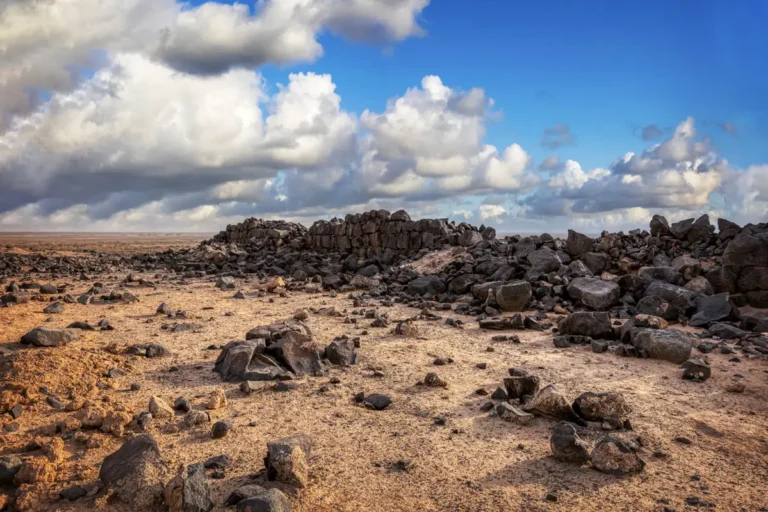
Unlike many desert monuments, Azraq never fell out of use. In the 1920s Druze families fleeing the revolt in Syria lived inside its walls, and after Jordan’s founding it served the border guards. Earthquakes and collapse took their toll, and parts of the fort were rebuilt in modern times. The Department of Antiquities has restored it since the 1970s, including a project in 2006–08 that rebuilt the south-west section.
Visiting Qasr Azraq Today
Admission is 3 JOD for foreign visitors and 0.25 JOD for residents, and is included in the Jordan Pass. Allow 20–30 minutes for the gate, the courtyard, the mosque and Lawrence’s room. See our Qasr Azraq travel guide for hours and practical tips.
Further reading: Archnet — Qasr al-Azraq; Livius — Basienis (Qasr el-Azraq); Jordan Times — Qasr Azraq.