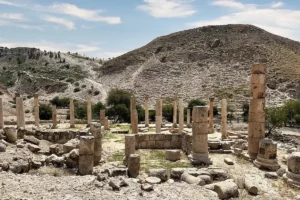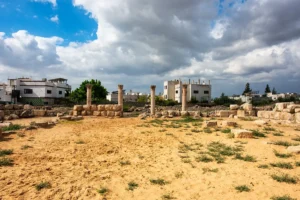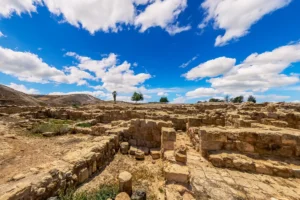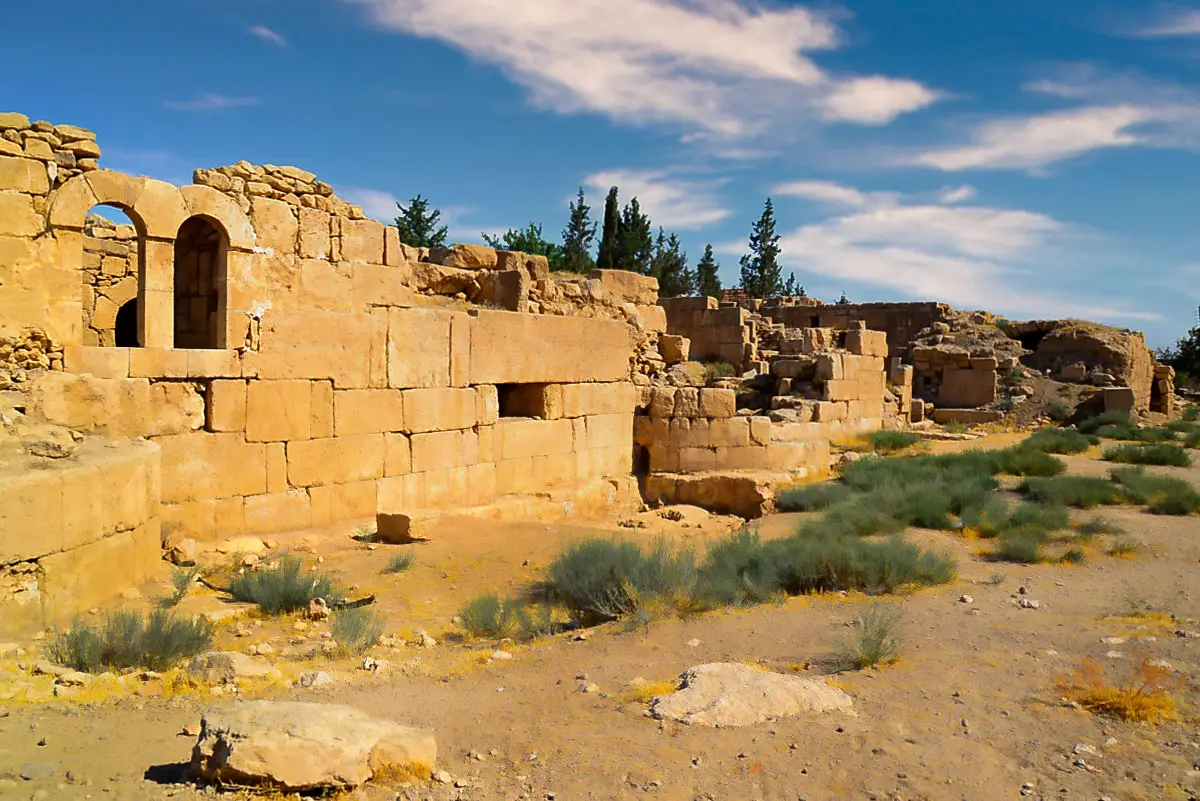


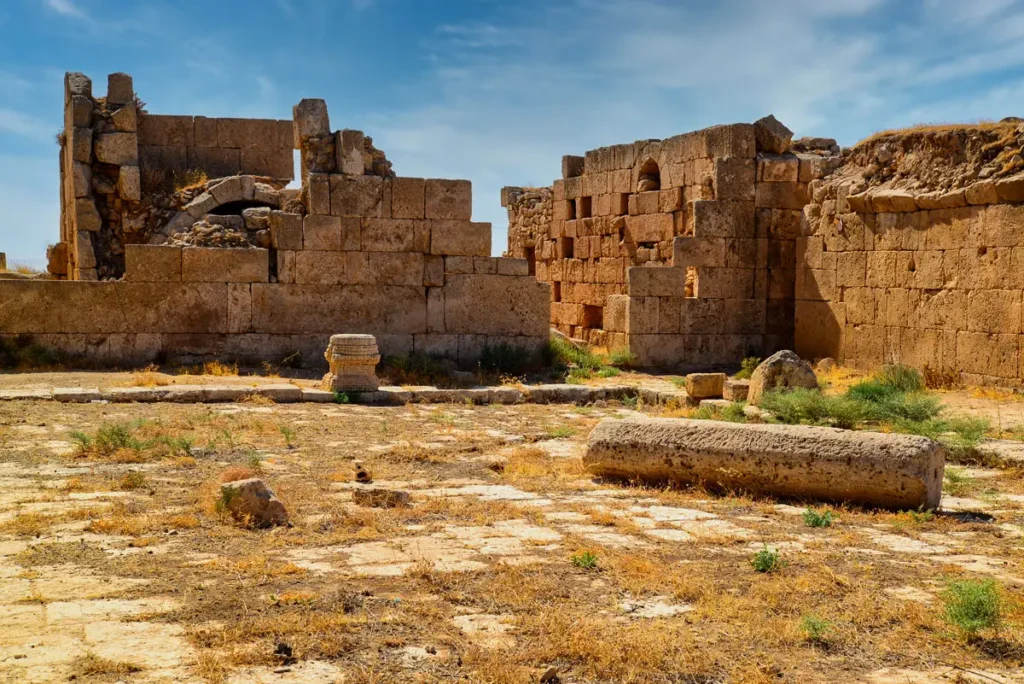
At the edge of Queen Alia Airport lies one of the earliest and most complete Umayyad settlements in the Near East. Qasr Al-Qastal had a palace, a mosque with a round minaret, baths, a cemetery and a whole system of dams and cisterns, and unlike nearby Mushatta it was finished and lived in.
Where Is Qasr Al-Qastal?
The site lies in the village of al-Qastal, about 25 km south of Amman and about 100 m west of the Airport Highway, just north of Queen Alia International Airport. Qasr Al-Mushatta is about 5 km to the east.
Historical Context and Origin
Long taken for a Roman fort because of its name (from Latin castellum), Qastal was identified as Umayyad in the 20th century. The palace is thought to have been built in the late 7th or early 8th century, probably begun under Caliph ʿAbd al-Malik (685–705); the mosque and minaret may date from Yazid II (720–724). In 723 the poet Kuthayyir ʿAzza called it “Qastal al-Balqa’”, and al-Walid II probably stayed here while Mushatta was being built. Tombstones show use into the Abbasid period, and the palace was reoccupied in the Ayyubid–Mamluk period.
Architectural Design
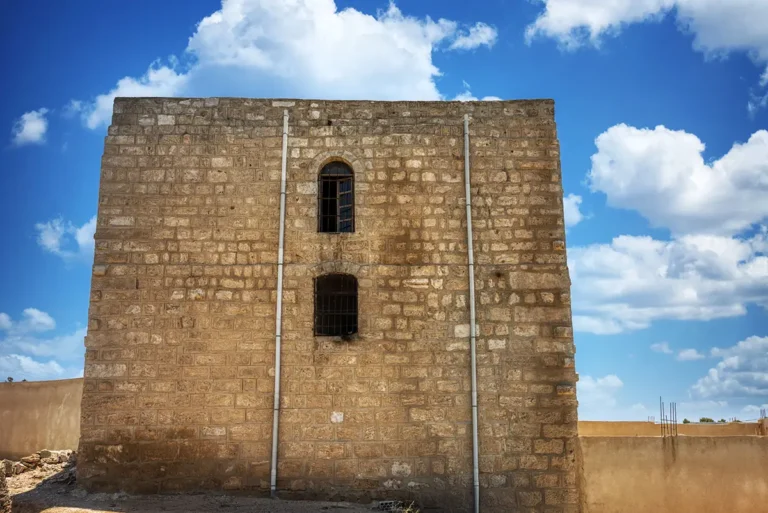
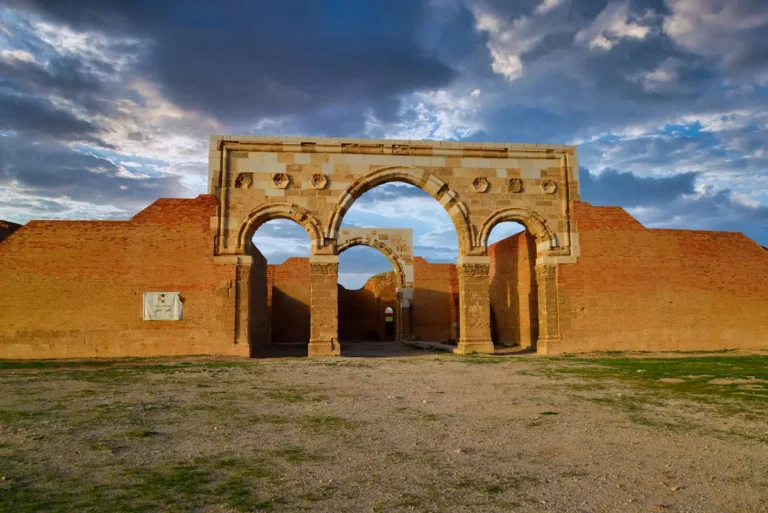
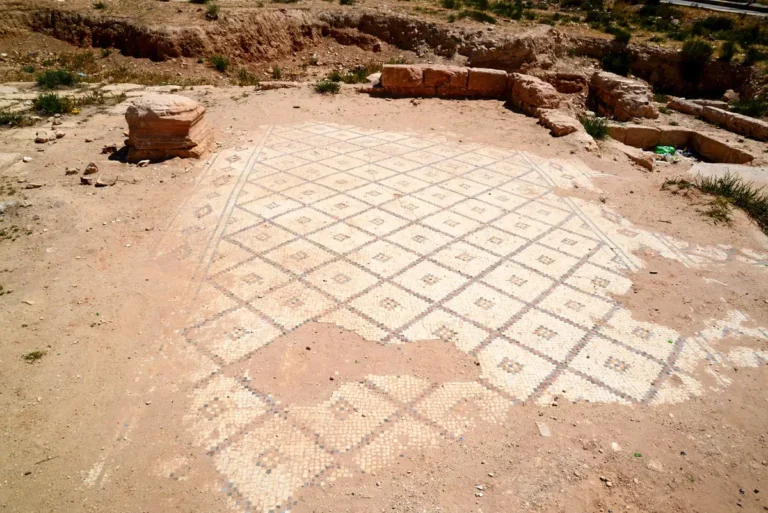
The palace is almost 68 m square, with four round corner towers and twelve half-round towers, and an entrance hall with carved stonework in the east wall. Around a courtyard over a large cistern were six suites on each of two floors, with a triple-apsed audience hall upstairs. Floors, even in the latrines, were paved with mosaics. North of the palace stands a rectangular mosque with a round minaret and an internal spiral stair, which may be the oldest surviving minaret built as such.
The Minaret
A round minaret with a spiral stair, claimed as the oldest surviving purpose-built minaret.
The Palace
A 68 m square palace with 16 towers and mosaic floors.
Early Islamic Cemetery
The only known early Islamic cemetery in Jordan.
Water Works
A 400 m dam, a reservoir and some 70 cisterns.
Water, Fields and a Cemetery
Just over 1 km east, across today’s highway, a dam 400 m long held winter floods for irrigation. A reservoir about 30 × 22 m and 6.5 m deep was cut into the quarry that supplied the building stone, and about 70 cisterns are scattered over some 2 km². South-west of the palace lies the only known early Islamic cemetery in Jordan; some of its tombs face Jerusalem, and inscribed tombstones of the 8th–11th centuries are in the Madaba Archaeological Museum.

Destruction, Rediscovery, and Restoration
Heinz Gaube surveyed the site, and a French team led by Patricia Carlier and Frédéric Morin excavated the palace and cemetery in 1983 and 1985. Since the 1970s nearly a third of the palace has been destroyed by modern building. A conservation project in 1998–2001 cleared cisterns and conserved mosaics, and in 2000 mosaics of big cats attacking prey were found west of the palace. The minaret was restored in 2004, and the mosque, restored in 2017, is again used for daily prayers. Qastal has been on Jordan’s UNESCO Tentative List since 2001.
Visiting Qasr Al-Qastal Today
The site is open and entry is free; there are no signs or facilities. Allow about 30 minutes, and respect prayer times at the mosque. See our Qasr Al-Qastal travel guide for directions.
Further reading: UNESCO Tentative List — Al Qastal; AramcoWorld — Qastal (1990); Jordan Times — Qastal mosque (2018).