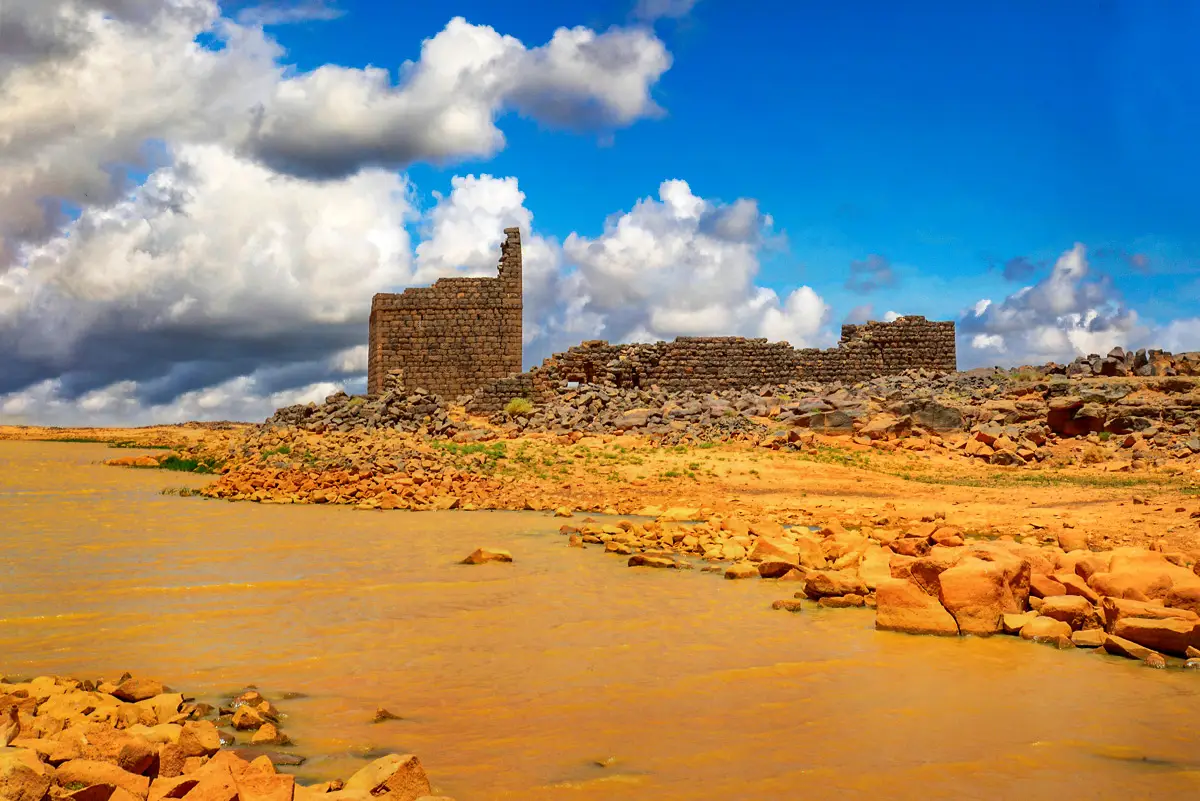












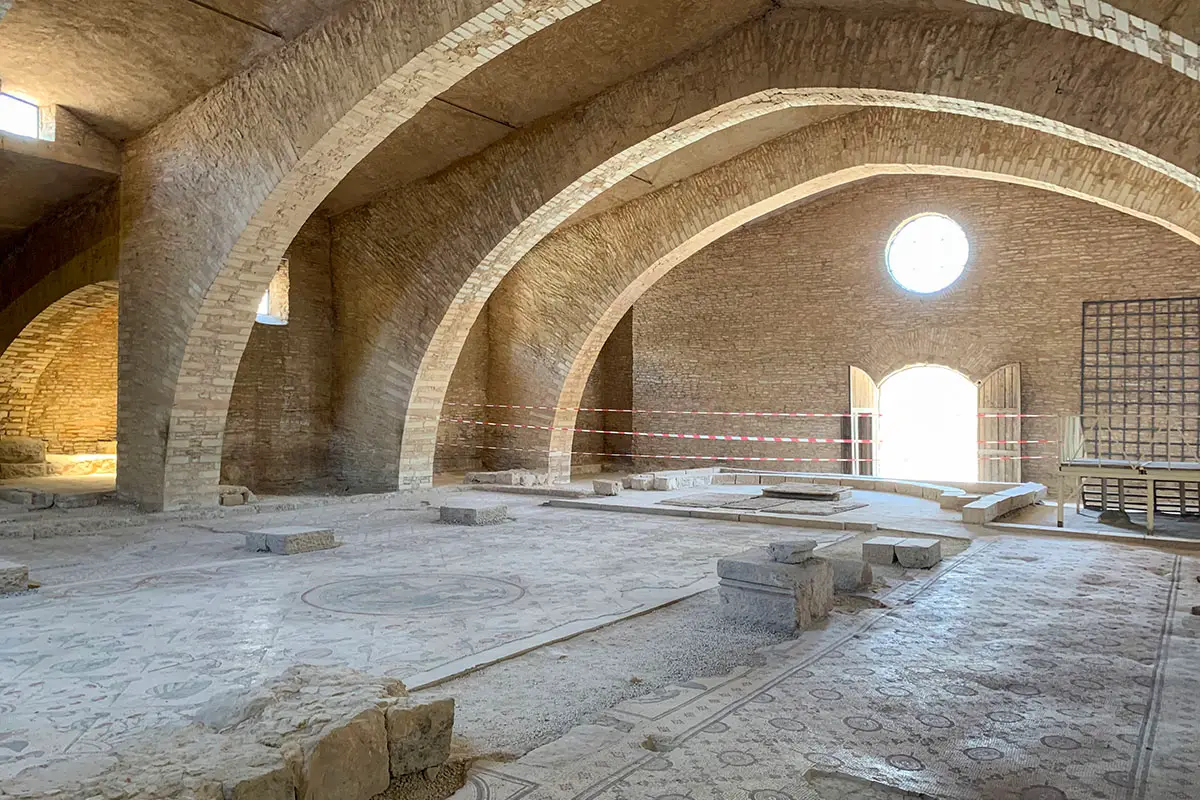

On the edge of Madaba’s old town, under a modern roof, lies the floor of the Church of the Apostles. Its most famous image is Thalassa — the Sea, shown as a woman rising from the waves among fish and sea creatures — set in a medallion that also carries the name of the mosaicist, Salaman. The church was built in AD 578, one of the many churches of Byzantine Madaba.
Where Is the Church of the Apostles?
The church stands south-east of Madaba’s ancient acropolis, a few metres from the King’s Highway and about 500 metres south of the Madaba Archaeological Park. Madaba itself is about 30 km south-west of Amman, and Mount Nebo is a short drive away.
Historical Context and Origin
In the 6th century Madaba was a flourishing Christian town, famous for its mosaic workshops. An inscription found in 1902 gave the church’s name and its date, AD 578 (some read 578/579). A dedication in one of the north chapels speaks of “the temple of the Holy Apostles”, and other inscriptions list the donors who paid for the floors.
Architectural Design
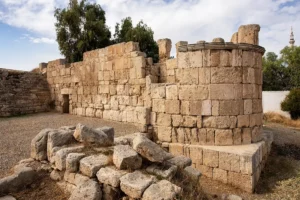
The church was a basilica with a nave and two aisles. Two doors in the north wall led to two side chapels, and three rooms at the east end — where the dating inscription was found — have since been destroyed. Today the floors are covered by a modern building whose arches span 16 metres, designed by the architect Ammar Khammash.
Thalassa
A medallion in the nave shows the Sea as a woman rising from the waves, among fish and sea creatures.
Salaman’s Signature
The inscription around Thalassa names the mosaicist Salaman.
Youths and Animals
Acanthus scrolls in the nave frame young men and animals — left undamaged by iconoclasts.
The North Chapels
Stags, sheep and gazelles face fruit trees; another floor has birds and fruit in a flower grid.
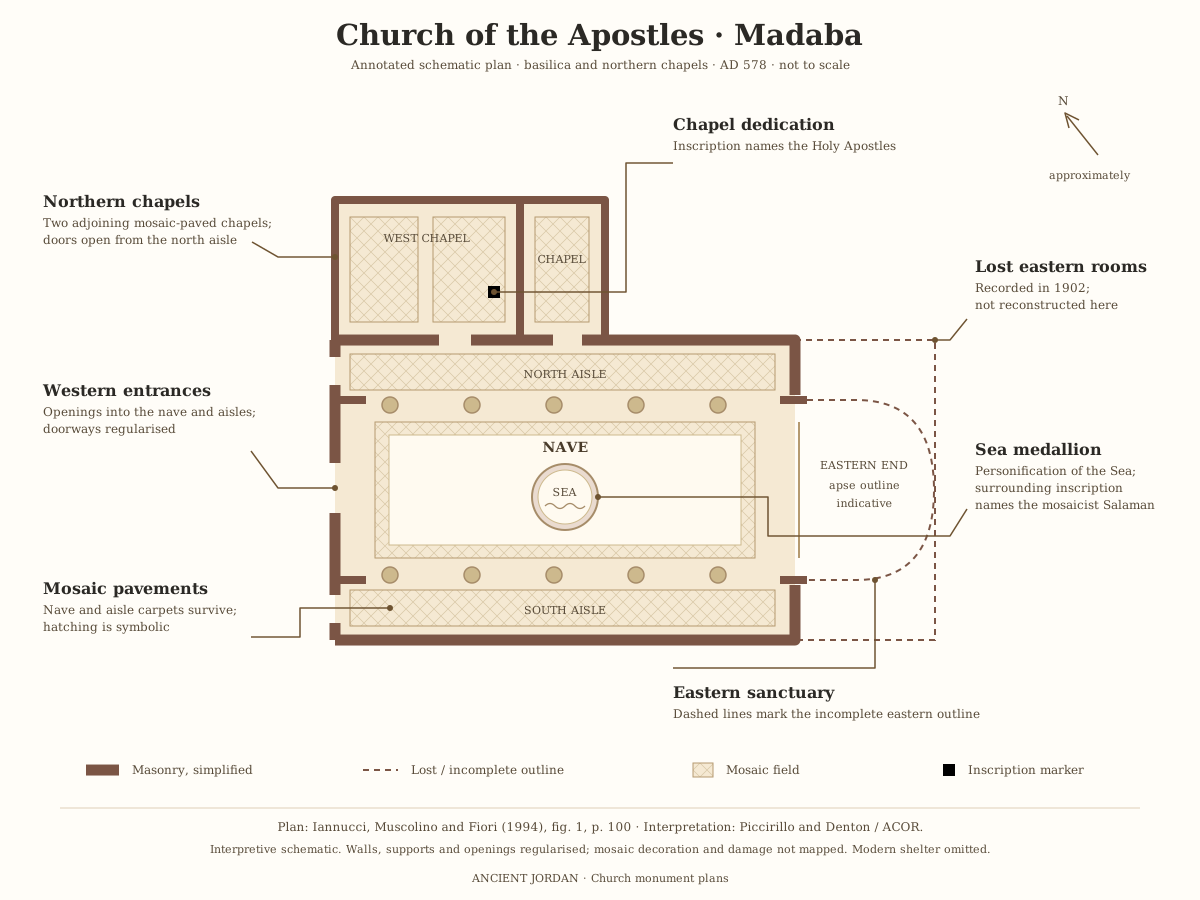
Apostles Church
Schematic plan of the Church of the Apostles, Madaba, after Iannucci, Muscolino and Fiori (1994)
Open drawingThe memorial and offering inscription
This is a memorial and offering inscription, not simply a dedication. It commemorates the priest John and names the deacon Anastasios. It is published as inscription 143 in Pierre-Louis Gatier, Inscriptions de la Jordanie, volume 2, pp. 139–140. Scholarly edition
Κύριε πρόσδεξε τὴν προσφορὰν
τῶν καρποφορησάντων καὶ καρποφορούντων
τῷ ναῷ τῶν Ἁγίων Ἀποστόλων
εἰς μνήμην Ἰωά[ννου] πρεσβυτέρου
σπουδῇ Ἀναστ[ασίου δι]ακόνου.
Lord, accept the offering of those who have made—and those who make—offerings to the church of the Holy Apostles, in memory of John the priest, through the devoted efforts of Anastasios the deacon.
The Greek uses modern accents and expanded abbreviations. Square brackets mark letters restored by the editor; line breaks are for readability rather than reproducing the mosaic’s six lines.
English translation by Ancient Jordan, after the Greek published by Gatier. Text and commentary, pp. 139–140
“The Holy Apostles” identifies the church’s dedication. John is explicitly called a priest; he is not being identified as John the Apostle.
“Those who have made … offerings” translates language literally associated with bearing fruit. Here it refers to contributions to the church, without specifying whether these were money, goods or other support.
“In memory of John” commemorates a deceased priest. Gatier cautions that this does not establish that John was buried there: the excavations found no burial.
“Through the devoted efforts of Anastasios” credits the deacon’s involvement in the undertaking. It does not identify him as the mosaicist.
The inscription contains no date. The church’s conventional AD 578/579 date comes from a separate inscription, so it should not automatically be assigned to this chapel text. Gatier’s edition and commentary, ACOR’s account of the dated inscription
The Thalassa Mosaic
At the centre of the nave, a medallion shows Thalassa, the personified Sea, emerging from the water with fish and sea creatures around her. The inscription around her is a prayer for three people — Anastasius, Thomas and Theodora — and names the work of Salaman the mosaicist. Around the medallion, acanthus scrolls frame young men and animals. Unlike many floors in Jordan, these figures were never damaged by iconoclasts.
Rediscovery and Restoration
Fr Giuseppe Manfredi found the church in 1902, and the German Evangelical Institute excavated it systematically in 1967. In the early 1990s it was roofed as part of the Madaba Archaeological Park project, begun in 1991 by the Ministry of Tourism and Antiquities with ACOR and USAID, and the Madaba Mosaic School restored the floors in 1996–1998.
Visiting the Church of the Apostles Today
The church is covered by the combined Madaba ticket, together with the Archaeological Park, the Archaeological Museum and the Burnt Palace. Walk around the raised walkways to see the Thalassa medallion and the chapels on the north side, then continue to the Archaeological Park and St George’s Church with the Madaba Map.
Further reading: ACOR: Madaba — Church of the Apostles.